
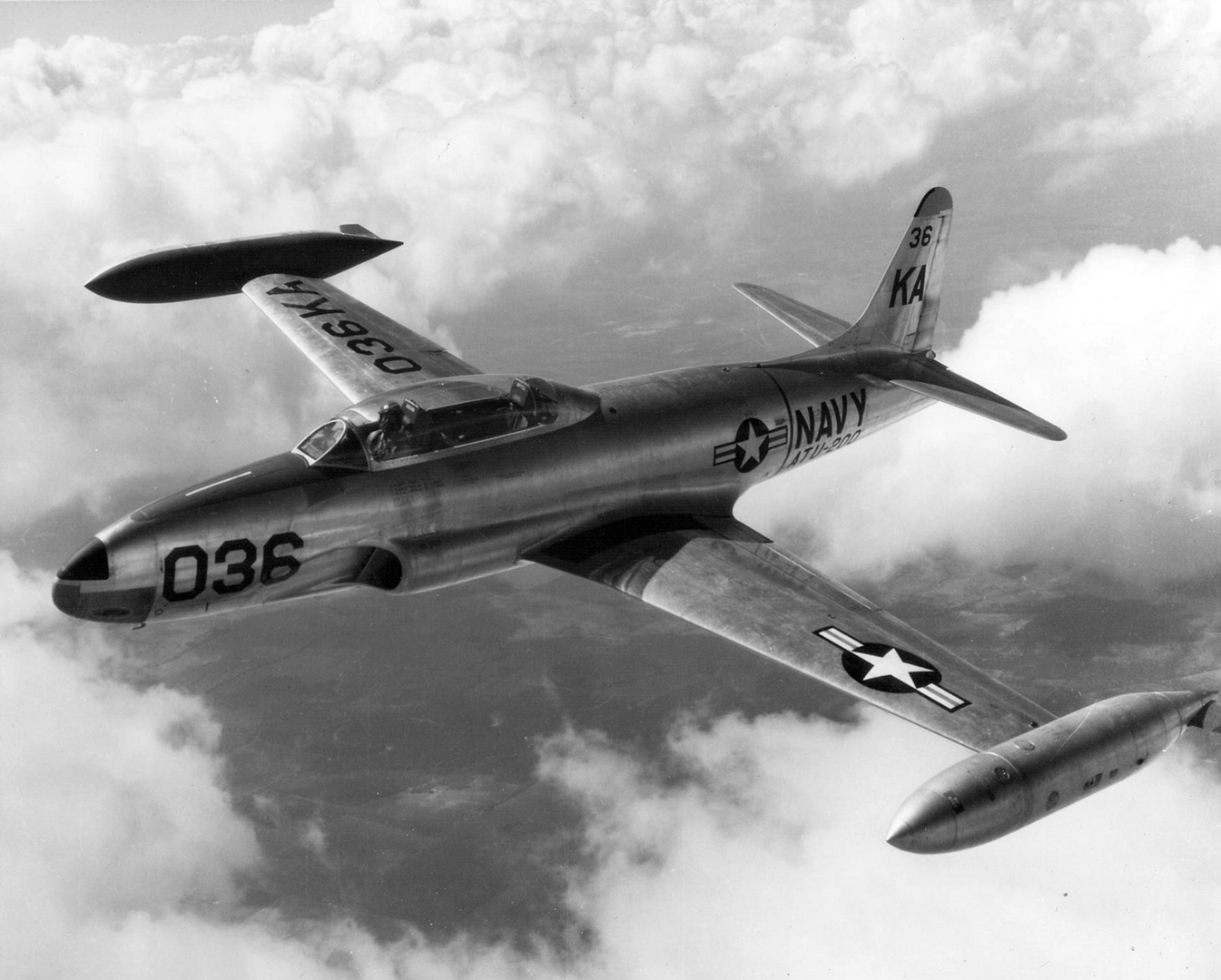
Lockheed T-33 Shooting Star
“T-Bird”
The two-seat jet that taught the Western world to fly jets — a stretched, tandem-cockpit development of America’s first operational jet fighter, the P-80/F-80 Shooting Star. More than 6,500 were built, over thirty air forces flew it, and it remains one of the very few genuine 1950s military jets a civilian can still fly today.
The jet that taught the free world to fly jets
The T-33 began life not as a trainer but as a fighter. In the closing years of World War II, Lockheed’s Kelly Johnson and the Skunk Works designed the P-80 Shooting Star — redesignated F-80 in 1948 — America’s first operational jet fighter. As the jet age arrived, the U.S. needed a way to convert propeller-trained pilots onto jets, so Lockheed stretched the F-80 fuselage by about three feet to add a second, tandem cockpit for an instructor. The result first flew in 1948 as the TF-80C, soon redesignated T-33A.
It was an instant success: docile, rugged and cheap to operate. For a generation of Western military aviators, the road to any fighter cockpit ran through the T-33. From the late 1940s onward it became the near-universal jet trainer of the United States and its allies — a straightforward, forgiving aeroplane that turned prop pilots into jet pilots by the tens of thousands.
Production ran into the late 1950s: Lockheed built 5,691, Canadair built 656 as the CT-133 Silver Star under licence, and Kawasaki built 210 in Japan — about 6,557 in all. Some air forces flew the T-Bird for half a century, long after the fighters it once fed had gone to museums. Today it has a third act as a beloved warbird — and one of the very few Cold War jets a civilian can actually fly, including through MiGFlug.
01The T-33 Shooting Star’s origins: how a fighter became the world’s jet schoolmaster
The single-seat P-80 first flew in January 1944 and reached squadron service before the war’s end, though it saw no WWII air combat in theatre. Built around a British-derived centrifugal-flow turbojet, it was straightforward and stable — exactly the wrong recipe for a cutting-edge dogfighter, but exactly the right one for a trainer.
By stretching that airframe and adding an instructor’s cockpit, Lockheed turned a middling fighter into a legendary teacher. The T-33 proved so honest and so cheap that it spread to more than thirty air forces and soldiered on into the 2010s, the last military examples retiring around 2017 — nearly seventy years after the first flight.
O que torna o T-33 especial?
Straight wing, centrifugal engine
The T-33 kept the F-80’s clean, unswept laminar-flow wing and a single centrifugal-flow Allison J33 turbojet fed by wing-root intakes. Simple, reliable and easy to maintain, it was perfectly suited to high-tempo training and to export operators with limited infrastructure alike.
Docile, forgiving handling
The T-33 was deliberately benign: predictable stalls, honest controls and no swept-wing surprises let student pilots build confidence, while the tandem dual-control layout let an instructor take command instantly. That gentleness is exactly why it lasted as a primary jet trainer for decades.
Longevity and ruggedness
Wingtip fuel tanks extended range and endurance without complicating the airframe, and the structure proved remarkably durable — many airframes accumulated thousands of hours over 40–50-year careers. That toughness underpins its survival today as a flyable warbird.
02The T-33’s handling: why a gentle jet made the best teacher
A trainer needs the opposite virtues of a front-line fighter. Where a combat aircraft is tuned for agility at the edge of control, the T-33 was tuned for predictability: it did what the student asked and forgave what the student got wrong. Pilot reports praise its honest stall and stable approach. Those qualities let mass-conscript and allied air forces safely turn raw pilots into jet aviators — and kept the type in schoolhouses long after faster designs arrived.
03The T-33’s F-80 fighter bloodline: from Shooting Star to T-Bird
The T-33 shares its wing, tail and basic fuselage with the P-80/F-80 fighter; the visible difference is the roughly three-foot fuselage plug that made room for a second cockpit. That shared ancestry gave the trainer a genuine fighter’s feel — enough that armed versions could carry nose machine guns, and in a handful of air forces the type flew light-attack and reconnaissance sorties as well as training.
Full T-33A specifications
Airframe & Performance
- Equipe
- 2 (tandem, dual controls)
- Comprimento
- ~11.5 m (37 ft 8 in)
- Envergadura
- ~11.85 m over tip tanks
- Altura
- ~3.55 m (11 ft 7 in)
- Max speed
- ~965 km/h (600 mph), subsonic
- Teto de serviço
- ~14,600 m (~48,000 ft)
- Faixa
- ~2,050 km (~1,275 mi)
- Number built
- ~6,557 (all builders)
Propulsion & Systems
- Motor
- 1 × Allison J33-A-35 turbojet
- Thrust
- ~24 kN (5,400 lbf)
- Armamento
- Optional 2 × 0.50-cal guns (armed variants)
- First flight
- 1948 (as TF-80C)
- Builders
- Lockheed 5,691 · Canadair 656 · Kawasaki 210
- Unit cost
- ~$100,000–130,000 (1950s, est.)
- Cost per flight hour
- No reliable public figure
- Origin
- United States · Lockheed
04The T-33’s numbers: max speed, ceiling and cost, and why sources disagree
Published figures for the T-33 vary by source and variant. Museum fact-sheets often quote a typical cruising figure around 525 mph, while the commonly cited maximum is about 965 km/h (600 mph) — in all cases firmly subsonic. Service-ceiling figures range from roughly 45,000 to 49,200 ft. Period unit-cost estimates cluster around US$100,000–130,000 in 1950s dollars, but treat these as approximate; as a simple single-turbojet trainer it was cheap to run, though no authoritative cost-per-hour figure exists in open sources. The values above are hedged toward the most commonly quoted numbers.
Seven decades of the Shooting Star
XP-80 first flight
Lockheed’s Skunk Works flies the prototype Shooting Star, the fighter from which the T-33 would descend.
P-80 enters service
The Shooting Star becomes America’s first operational jet fighter, though it sees no WWII air combat in theatre.
Two-seat T-33 flies
The TF-80C / T-33A first flight: the F-80 fuselage is stretched about three feet for a second, tandem cockpit.
First jet-vs-jet kill
An F-80 is credited with the first jet-versus-jet aerial victory over Korea — a claim later disputed by historians.
Canadair licence
Canadair begins CT-133 Silver Star production, re-engined with the Orenda-built Rolls-Royce Nene.
Kawasaki and export
Kawasaki builds T-33s under licence in Japan, and the type spreads to more than thirty air forces worldwide.
Bay of Pigs
Cuban gun-armed T-33s help defeat the CIA-backed invasion, shooting down B-26 bombers over the beachhead.
Canada retires the Silver Star
The RCAF flies the last CT-133 Silver Stars after more than fifty years of service.
The last military T-33s
Bolivia retires its T-33s, ending front-line military service — but the warbird era continues.
From the flight line: twelve T-33 stories
The fighter that became a schoolmaster
A three-foot stretch turned a frontline fighter into a legend.
Read the full story
Taught the free world to fly jets
Tens of thousands of pilots earned their jet wings in a T-Bird.
Read the full story
First jet-vs-jet kill (the F-80 in Korea)
Its ancestor opened the jet-combat age.
Read the full story
Canada’s Silver Star
A Rolls-Royce heart in a Lockheed airframe.
Read the full story
Bay of Pigs, 1961
Three old trainers helped topple an invasion.
Read the full story
The half-century jet
Built in the 1940s, still flying in the 2010s.
Read the full story
Survivors in the air
One of the most accessible Cold War jets flying today.
Read the full story
Fly the T-Bird with MiGFlug
Take the controls of a real Cold War jet trainer.
Read the full story
The thirty-nation jet
A world map painted in Shooting Stars.
Read the full story
Simplicity by design
One straight wing, one honest engine.
Read the full story
Kawasaki’s licence-built T-Bird
The Shooting Star, built in Japan.
Read the full story
The trainer that made the fighters
Behind every Cold War ace, a T-Bird.
Read the full story
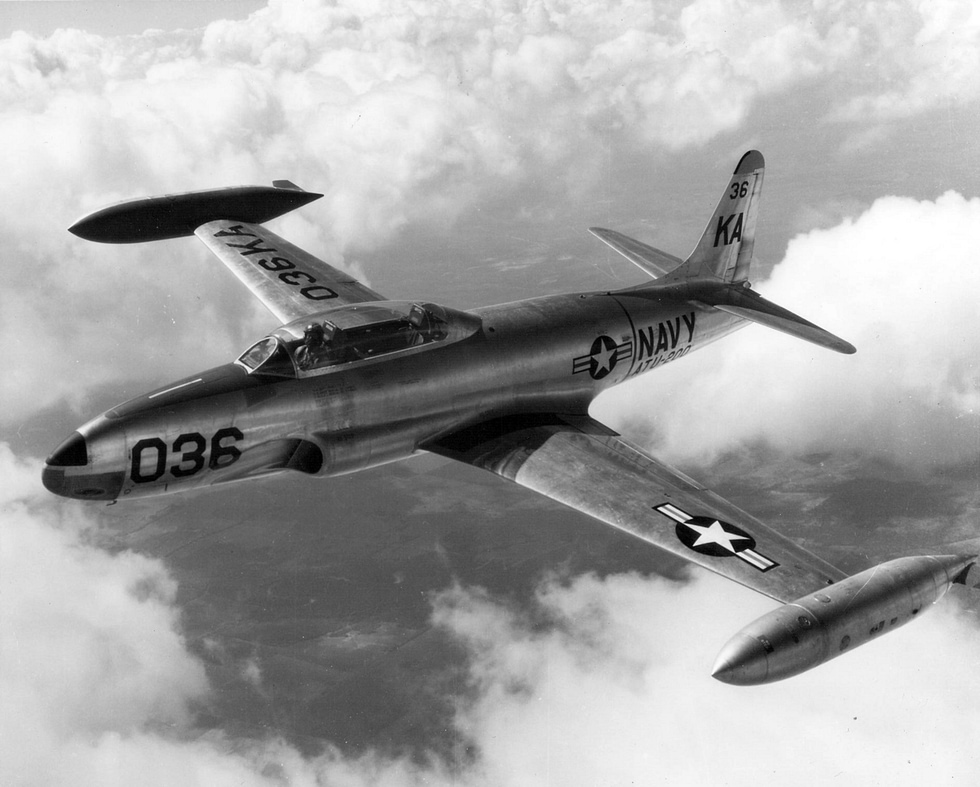
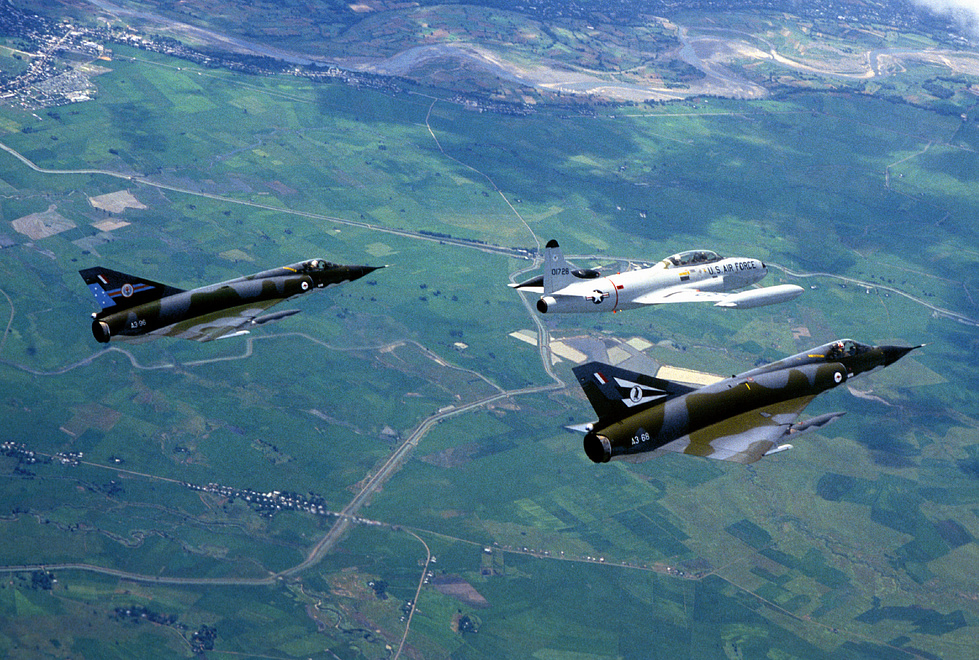
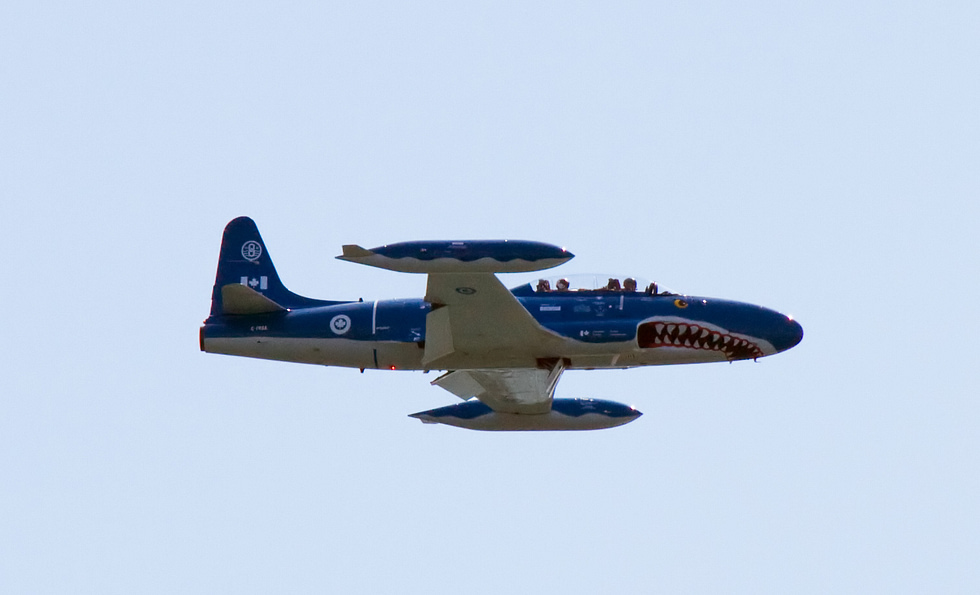
The T-33 in pictures
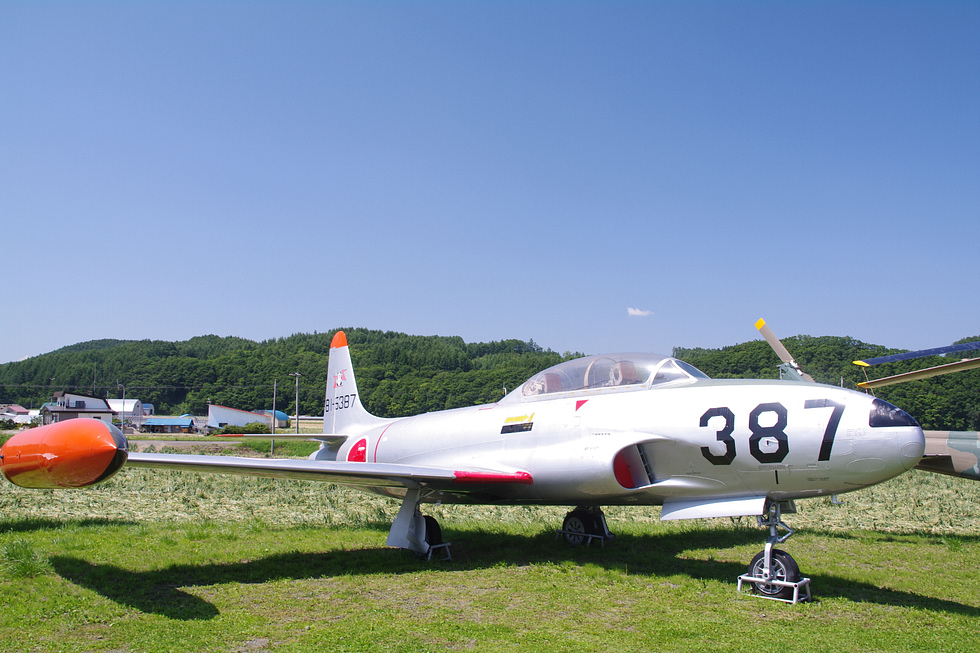
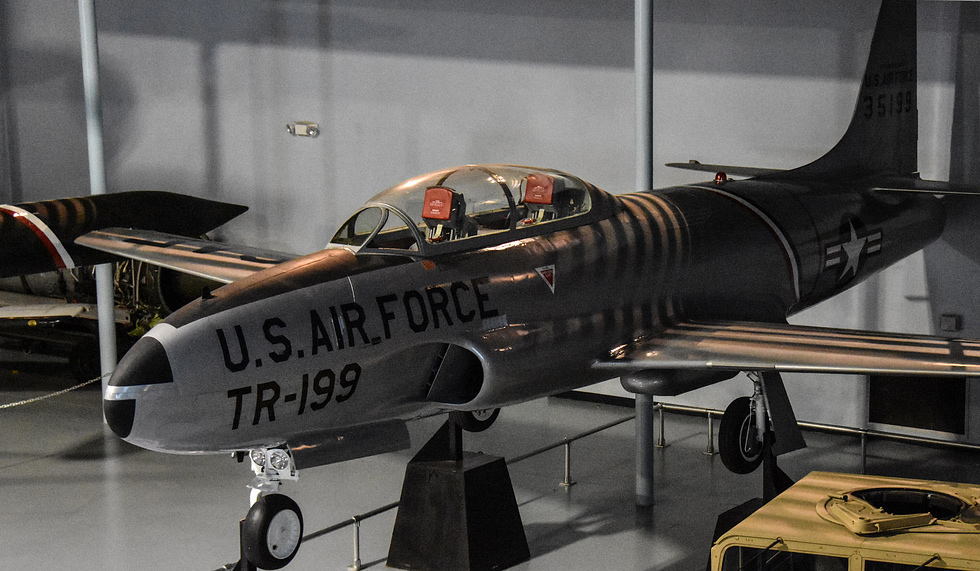
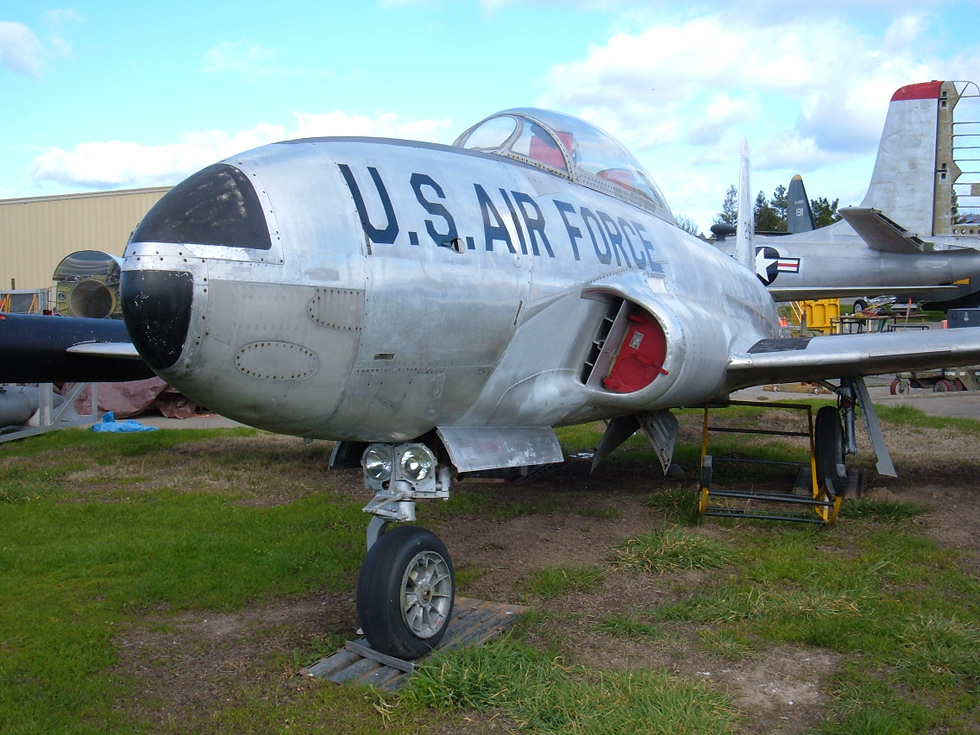
The T-33 in motion
The T-Bird remains a familiar sight at airshows across North America and Europe, where preserved Shooting Stars and Canadair Silver Stars still fly in period colours — slim silhouette, wingtip tanks and that unmistakable 1950s jet whistle.
The T-33 Shooting Star in motion
AirshowStuffVideos — one of the most-watched T-33 Shooting Star films on YouTube.
Where the Shooting Star flew
A trainer that occasionally went to war
The T-33 was overwhelmingly a trainer and utility aircraft, but armed variants saw action in several minor conflicts. The most famous is the Bay of Pigs in April 1961, when Cuba’s gun-armed T-33s helped shoot down invading B-26 bombers and dominated the air over the beachhead. Elsewhere, armed T-33s and Canadair Silver Stars flew light-attack, counter-insurgency and reconnaissance sorties with various air forces.
Its fighter ancestor the F-80 scored what the USAF long credited as the first jet-versus-jet aerial victory — 1st Lt Russell J. Brown claiming a MiG-15 over Korea on 8 November 1950. That claim is genuinely disputed: Soviet records do not confirm the loss, and some historians credit a US Navy F9F Panther with the first jet kill. Treat it as a contested claim, not settled history.
Compare the combat record of every military aircraft. Figures as of July 2026.
Everything people ask about the T-33 Shooting Star
Can I fly in a T-33 Shooting Star?
Is the T-33 easy to fly?
Is the T-33 fast? Is it supersonic?
How is the T-33 related to the P-80/F-80?
How many T-33s were built?
Is the T-33 still flyable today?
Você can actually fly the T-33.
Pick your cockpit.
Some legends only live in museums — others are fuelled and waiting. MiGFlug has put civilians in real military jet cockpits since 2004.
 Fly the L-39 AlbatrosThe world’s most-flown jet trainer — aerobatics included
 Fly the F-104 Starfighter“The missile with a man in it”
 Fly the MiG-21The Cold War’s most-produced jet
 Pilote o T-33 Shooting StarAmerica’s first jet trainer
 Fly the DH VampireA piece of early jet history
 Fly the S.211Agile Italian jet trainer
 Fly the MB-326The classic Aermacchi jet
 Fly the MiG-15The Soviet legend of the Korean War
Continue the tour
Every fact, checked
- MiGFlug — Lockheed T-33 Jet Flight ExperienceBooking details for the flyable T-33 experience from Toronto, Canada.
- National Museum of the U.S. Air Force — T-33A fact sheetOfficial specifications and service history for the T-33A.
- National Air Force Museum of Canada — CT-133 Silver StarThe Canadair-built Silver Star and its long RCAF career.
- Air & Space Forces Magazine — Airpower at the Bay of PigsHow Cuba’s armed T-33s helped defeat the 1961 invasion.
- Smithsonian National Air and Space Museum — Lockheed T-33ACollection notes on the type and its development from the F-80.
- This Day in Aviation — 8 November 1950The disputed first jet-versus-jet victory by an F-80 over Korea.
- AOPA — Taming the T-BirdPilot report on flying the T-33 and its forgiving handling.