
Fighter Aircraft Combat Statistics / Lavochkin La-5/7
Combat record
Lavochkin La-5/7 — Combat Record
WWII · USSR · First flight 1942 · Retired · Combat-proven: air-to-air
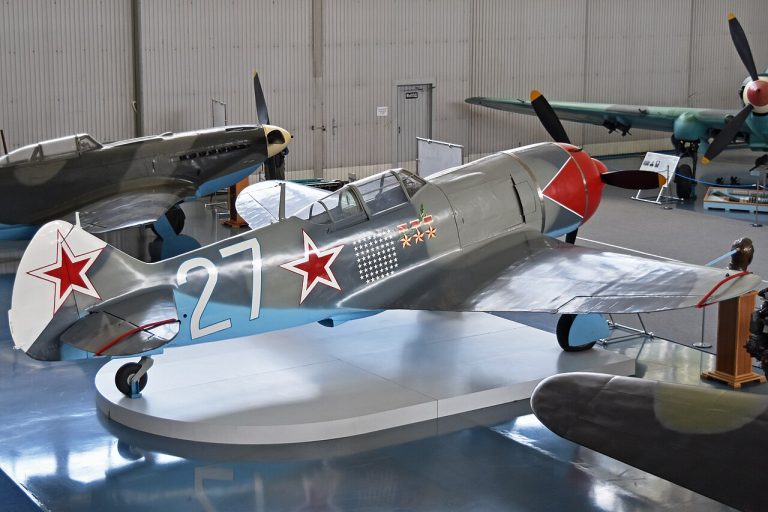
Photo: Alan Wilson from Stilton, Peterborough, Cambs, UK / Wikimedia Commons (CC BY-SA 2.0)
2,500–6,000Credited aerial victories
1,200–2,000Air-to-air losses
≈2.7 : 1Kill ratio (midpoint)
1942First flight
The story behind the numbers
The Lavochkin was the Soviet counterpunch: a wooden fighter reborn with a big radial engine, at its best exactly where the Eastern Front war lived — on the deck. The La-5FN and its refined successor the La-7 could out-accelerate and out-climb the Fw 190 low down, and German pilots learned to respect the blunt-nosed silhouette.
It was the mount of the Soviet Union’s greatest aces: Ivan Kozhedub scored all 62 of his victories — the highest Allied total of the war — on La-5s and La-7s, including the only Soviet kill of an Me 262. Roughly 2,500 to 6,000 victories are credited to the family, the range a measure of how chaotic Eastern Front accounting remains.
Kozhedub’s mount — 62 kills, every one in a Lavochkin, the highest Allied score of the war.
Campaign by campaign
| Years | Campaign | Operator | Victories | A2A losses | What happened |
|---|---|---|---|---|---|
| 1942–45 | Eastern Front (La-5) | USSR | ~3,000 claims | 2,591 combat | Born at Stalingrad, vindicated at Kursk. |
| 1944–45 | Eastern Front (La-7) | USSR | ~1,000 claims | 115 in air combat | Kozhedub’s La-7 even downed an Me 262 jet. |
| 1945 | Eastern Front | Czechoslovakia | few | few | Czech La-5FNs finished the war over their own country. |
How we count. Victories are credits recognised by the operating air force, cross-checked against opposing loss records where they exist. Where wartime credits and postwar research genuinely disagree we show the range, not a single number. Friendly-fire and accident losses are not counted as air-to-air losses. Full methodology on the statistics hub.
Go deeper