
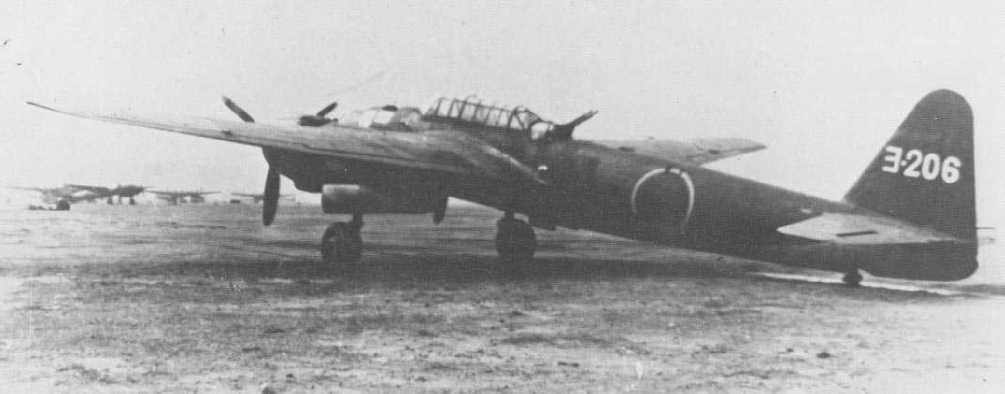
Yokosuka P1Y Ginga
“Frances”
Japan’s sleekest bomber of the war — a fast, twin-engine land-based raider designed to be too quick to catch, undone by temperamental engines, and remembered for a desperate one-way kamikaze flight to Ulithi.
The Yokosuka P1Y Ginga: Japan’s bomber that was too advanced for its own war
In 1940 the Imperial Japanese Navy issued an ambitious requirement, the 15-Shi specification, for a single land-based bomber that could do everything at once: level-bomb, dive-bomb and drop a torpedo, all while flying fast enough and low enough that Allied fighters would struggle to catch it. The design bureau at the Yokosuka Naval Air Technical Arsenal (the Kugisho) answered with one of the cleanest, most modern-looking aircraft Japan built in the entire war — the P1Y Ginga, its name meaning “Milky Way” or “Galaxy.”
On paper it was superb. The prototype first flew in 1943, and with two powerful Nakajima Homare radial engines and a slim, drag-minimised fuselage the Ginga could reach roughly 547 km/h (about 340 mph) and outrun many of the interceptors sent after it at low altitude. Test crews praised its handling. To Allied intelligence it earned the reporting name “Frances,” and it looked a clear generation ahead of the older G4M “Betty.”
Then reality intervened. The same Homare engines that made the Ginga fast made it fragile: they were complex, hard to maintain, and demanded skilled ground crews and quality fuel that Japan increasingly did not have. Serviceability was dismal, and many airframes sat unflyable while the type was formally accepted only in October 1944 and saw meaningful combat only in the spring of 1945. A brilliant airframe had been bolted to an engine its own industry could not keep running.
By the time it reached the front in numbers, the war was already lost. The Ginga fought over the Philippines, the Marianas and Okinawa as a conventional and torpedo bomber, and some were rebuilt as radar-equipped night fighters with obliquely upward-firing cannon. But its most remembered mission was an act of desperation: on 11 March 1945 the Azusa Special Attack Unit sent two dozen Ginga on a near ten-hour, one-way kamikaze flight against the US fleet anchorage at Ulithi. Designed to be uncatchable, the Ginga ended the war as a guided bomb — and today a single survivor waits, unrestored, in a Smithsonian storage building.
01The Yokosuka P1Y Ginga’s design brief: one bomber meant to do everything
The 15-Shi requirement that produced the Ginga asked for a genuinely multi-role machine — a fast twin able to level-bomb from altitude, dive-bomb accurately, and carry a torpedo for anti-ship strikes, all in one airframe. Chief designers Tadanao Mitsuzi and Masao Yamana chased that goal with an aerodynamically clean design that drew inevitable comparisons to fast Western twins like the de Havilland Mosquito and the B-25.
The trouble with a jack-of-all-trades is that it stretches the design thin. The Ginga could perform each of its missions adequately, but the sophistication needed to do so — and above all the high-strung Homare engines chosen to give it speed — made it complex and maintenance-hungry at exactly the moment Japan was running short of fuel, spare parts and trained mechanics. It is a textbook case of an advanced design outrunning the industry meant to support it.
What makes the P1Y Ginga special
A clean airframe built for speed
The Ginga’s slim, tapering fuselage and low-drag wing gave it a top speed near 547 km/h — fast enough to outrun many Allied interceptors at low level. Test crews praised its handling, and it looked a generation more modern than the G4M “Betty” it was meant to supplement. Aerodynamically it was arguably the finest bomber Japan fielded.
Two Homare engines — its gift and its curse
Power came from two Nakajima Homare 18-cylinder radials of roughly 1,820 hp each at take-off. They made the Ginga quick, but they were notoriously temperamental, hard to keep tuned and demanding of fuel and skilled maintenance. Poor serviceability, not enemy action, grounded much of the fleet.
Night fighter with ‘Schräge Musik’ cannon
Some airframes became night fighters — the P1Y1-S Byakko and P1Y2-S Kyokko — carrying cannon angled to fire obliquely upward, the same idea as Germany’s “Schräge Musik.” The plan was to slide beneath a bomber and rake its belly. Against high-flying B-29s the converted Ginga simply couldn’t climb well enough, and most reverted to bombing or kamikaze duty.
02The Yokosuka P1Y Ginga’s engines: why the Homare grounded a galaxy
The Nakajima Homare (NK9) was an 18-cylinder, twin-row air-cooled radial that promised big power in a compact package — roughly 1,820 hp at take-off on the P1Y1. In theory it was exactly what a fast bomber needed. In practice it was one of the most troublesome Japanese engines of the war, sensitive to fuel quality and maintenance standards that a collapsing 1944–45 supply system could rarely meet.
The result was chronically low serviceability: many Ginga sat on the ground waiting for parts or attention while relatively few were flyable at any moment. The later Kawanishi-built P1Y2 series switched to the more dependable Mitsubishi Kasei radial specifically to escape the Homare’s supply and reliability problems — an implicit admission of how much the engine had hobbled an otherwise excellent aircraft.
03The Yokosuka P1Y Ginga as night fighter: Japan’s answer to Schräge Musik
As American night raids intensified, the Navy converted Ginga airframes into radar-carrying night fighters, generally listed as the P1Y1-S Byakko (“White Light”) and the Kawanishi P1Y2-S Kyokko (“Aurora”). Sources genuinely disagree on which designation applied to which conversion, so the naming should be read with caution. Both mounted 20 mm cannon angled to fire obliquely upward — the same tactical idea as the German “Schräge Musik” installations, letting a fighter attack a bomber’s vulnerable underside from below.
The concept was sound but the airframe was wrong for the job: laden with radar and cannon, the Ginga lacked the high-altitude climb and performance to reliably reach and hold a firing position under a B-29. The night-fighter experiment was largely a failure, and many of the converted machines were sent back to bombing units or, in the end, to special-attack (kamikaze) duty.
Yokosuka P1Y1 Ginga full specifications
Airframe & Performance
- צוות
- 3 (pilot, navigator/bombardier, radio-operator/gunner)
- מֶשֶׁך
- ~15.0 m
- מוּטַת כְּנָפַים
- ~20.0 m
- גוֹבַה
- ~4.3 m
- Max takeoff weight
- ~10,500 kg
- Max speed
- ~547 km/h (~340 mph) at ~5,900 m
- תקרת השירות
- ~9,400 m
- לָנוּעַ
- ~1,900 km combat · up to ~5,370 km ferry
- First flight
- 1943 (prototype)
- Built
- ~1,100 (1943–1945)
Propulsion, Armament & Cost
- Engines
- 2 × Nakajima Homare 18-cyl radial
- Power (each)
- ~1,820 hp at take-off
- Defensive guns
- 1 × 20 mm nose · 1 × 20 mm (or 13 mm) rear
- Offensive load
- 1 torpedo (~800 kg) or ~1,000 kg bombs
- Manufacturer
- Design: Yokosuka · built by Nakajima (P1Y2 by Kawanishi)
- Allied name
- “Frances”
- Unit cost
- No reliable public figure exists
- Cost per flight hour
- No reliable public figure exists
04The Yokosuka P1Y Ginga’s cost: why no reliable price exists
There is no credible unit cost or cost-per-flight-hour figure for the P1Y Ginga in the public record. It was a wartime product of the Imperial Japanese Navy, procured through the Navy’s own arsenal-and-contractor system rather than sold on any open market; contemporary yen pricing was not published, and much wartime industrial documentation was destroyed in 1945.
Any specific dollar or yen figure attached to a Ginga online should be treated as unverified. What is well established is the scale of the effort: roughly 1,100 aircraft were built, the great majority by Nakajima, with a smaller batch of the Kasei-engined P1Y2 series by Kawanishi — a substantial investment for an aircraft that spent much of its short life grounded for maintenance.
The P1Y Ginga: from great expectations to special attack
The 15-Shi requirement
The Imperial Japanese Navy asks Yokosuka for a fast land-based bomber able to level-bomb, dive-bomb and torpedo-attack in one airframe.
First flight
The prototype flies (commonly dated to the summer of 1943), revealing one of the cleanest, most modern airframes Japan built.
Production
Nakajima builds the great majority of roughly 1,100 aircraft; Kawanishi later builds the Kasei-engined P1Y2 series.
Accepted into service
Formally accepted as the Navy Bomber Ginga, though engine unreliability and shortages delay meaningful combat use.
Into combat
Ginga units begin operations over the Philippines and against US task forces as the Pacific war reaches Japan’s inner defences.
The Ulithi raid
The Azusa Special Attack Unit launches 24 Ginga on a near ten-hour, one-way kamikaze flight to Ulithi; one strikes the carrier USS Randolph.
Okinawa & the end
Ginga fly conventional and special-attack missions around Okinawa and the fleet until Japan’s surrender in August 1945.
Captured & preserved
A captured example is flight-tested by the US at Olmsted Field, then transferred to the Smithsonian in 1948 — the sole survivor.
From the record: twelve P1Y Ginga stories
Named after the galaxy
The Navy called it “Ginga” — the Milky Way — and it nearly lived up to the reach the name promised.
Read the full story
Fast enough to embarrass fighters
At low altitude the Ginga could outrun many of the interceptors sent to catch it.
Read the full story
The engine that grounded a galaxy
The twin Homare radials that made the Ginga fast also made it fragile.
Read the full story
Too advanced for its own war
What was cutting-edge in 1943 became a liability by 1945.
Read the full story
Japan’s Schräge Musik
Some Ginga were rebuilt with cannon angled to fire obliquely upward, to rake a bomber’s belly.
Read the full story
The ten-hour one-way flight
On 11 March 1945, 24 Ginga set out from Kyushu for the US fleet at Ulithi — almost ten hours away.
Read the full story
The carrier caught at anchor
USS Randolph was riding quietly at anchor in Ulithi lagoon when the Ginga struck aft.
Read the full story
From precision bomber to guided bomb
Designed for torpedo runs and dive attacks, the Ginga ended the war as a suicide weapon.
Read the full story
The last Ginga on Earth
The world’s only surviving P1Y sits, unrestored, in Smithsonian storage.
Read the full story
“Frances,” FE-1702
When US intelligence catalogued the captured bomber, it became Foreign Equipment number 1702.
Read the full story
A bomber that wanted to be a Mosquito
The brief asked for level bombing, dive bombing and torpedo work in one airframe.
Read the full story
The Ginga meant to carry a suicide rocket
A proposed variant was to serve as a mother-ship for the Ohka rocket bomb.
Read the full story
The P1Y Ginga in pictures
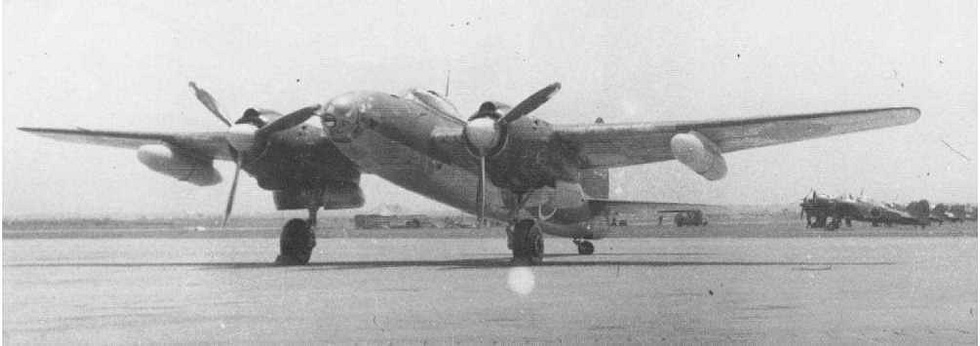
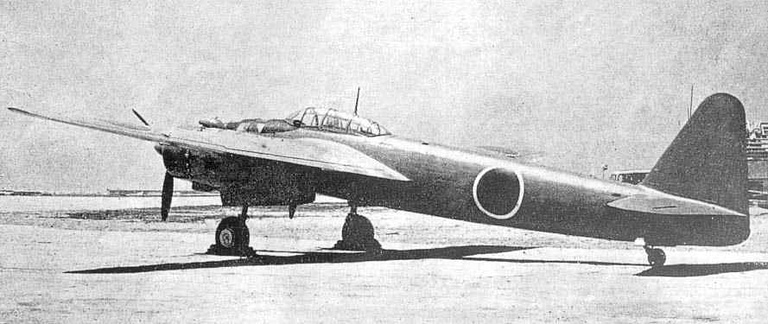
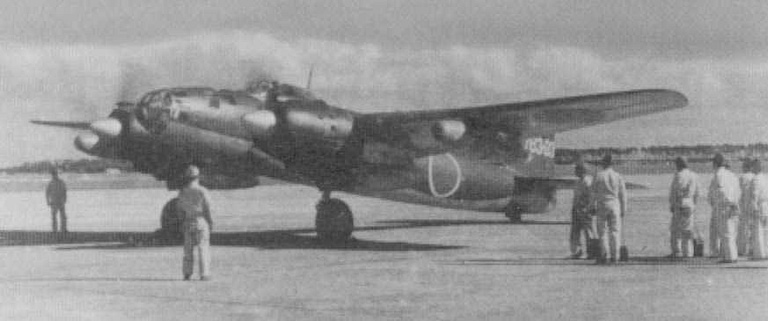
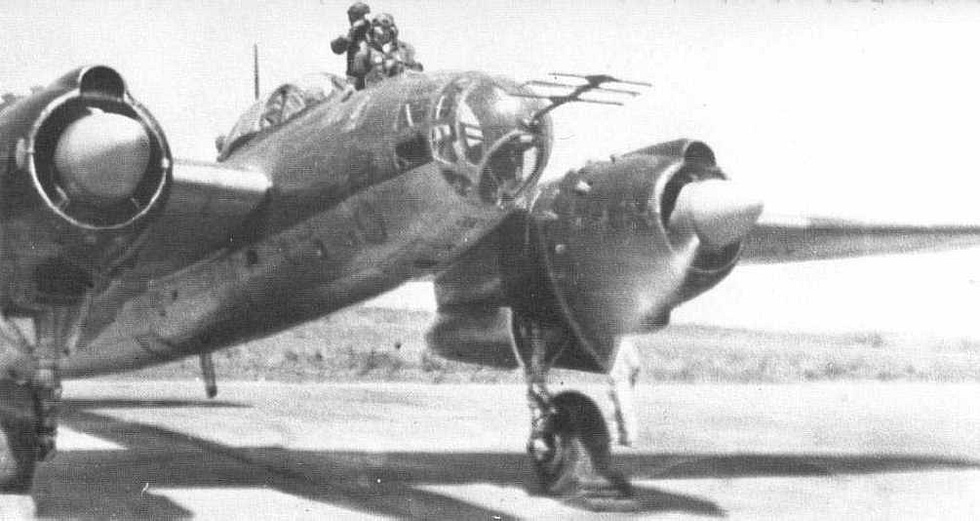
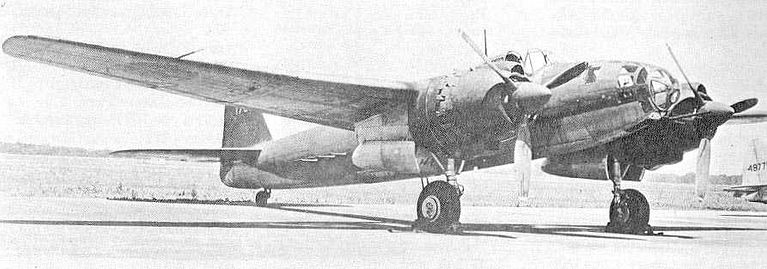
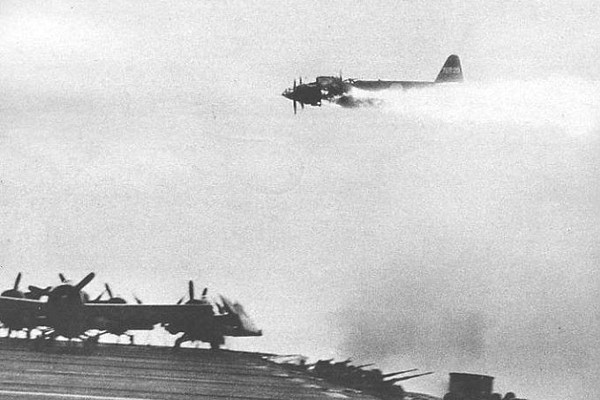
The P1Y Ginga in motion
Yokosuka P1Y Ginga: Japan’s “Galaxy” Bomber — a dedicated profile of the type, its design, its troublesome Homare engines and its late-war service. A useful visual introduction to an aircraft that is otherwise rarely filmed.
Where the P1Y Ginga flew and survives
The P1Y Ginga’s combat record: speed, torpedoes and one desperate raid
The Ginga arrived too late and in too few serviceable numbers to change the course of the Pacific war. Its record is one of fast conventional and torpedo strikes, a failed night-fighter experiment, and a growing slide into special-attack (kamikaze) missions as 1945 wore on. Its single most famous result was the long-range strike on the US fleet at Ulithi.
Compare the combat record of every military aircraft. Figures are best-available estimates and are hedged where sources disagree.
Everything people ask about the Yokosuka P1Y Ginga
Can I fly in a Yokosuka P1Y Ginga?
What does “Ginga” mean, and why “Frances”?
How fast was the P1Y Ginga?
Why is the Ginga remembered as unreliable?
Was the P1Y used as a kamikaze aircraft?
Was there a P1Y night fighter?
How many were built, and who built them?
Does any P1Y Ginga survive today?
You can’t fly the P1Y Ginga.
These, you can.
Some legends only live in museums — others are fuelled and waiting. MiGFlug has put civilians in real military jet cockpits since 2004.
 Fly the L-39 AlbatrosThe world’s most-flown jet trainer — aerobatics included
 Fly the F-104 Starfighter“The missile with a man in it”
 Fly the MiG-21The Cold War’s most-produced jet
 טסו על ה-T-33 Shooting StarAmerica’s first jet trainer
 Fly the DH VampireA piece of early jet history
 Fly the S.211Agile Italian jet trainer
 Fly the MB-326The classic Aermacchi jet
 Fly the MiG-15The Soviet legend of the Korean War
Continue the tour
Every fact, checked
- Smithsonian National Air and Space Museum — Kugisho P1Y1 Ginga (“Frances”)Museum record for the sole surviving airframe: capture, evaluation and storage status.
- Pacific War Online Encyclopedia — P1Y “Frances”Technical specifications, production breakdown, engines and variant detail.
- HistoryOfWar.org — Yokosuka P1Y Ginga “Frances”Design origin, dates and the family of bomber and night-fighter variants.
- CombinedFleet.com — Operation Tan No. 2Detailed account of the Azusa unit’s 11 March 1945 kamikaze raid on Ulithi.
- US Navy History & Heritage CommandUS primary-source records and photographs of the USS Randolph kamikaze strike.
- MilitaryFactory — P1Y2-S Kyokko night fighterKasei engines, oblique-cannon armament and the reversion to bomber/kamikaze roles.
- SilverHawkAuthor — Warplanes of Japan: Yokosuka P1Y GingaAviation-history overview and discussion of the P1Y variant family.
- René J. Francillon, Japanese Aircraft of the Pacific War (Putnam)The standard printed reference from which most P1Y specifications and production figures derive.