
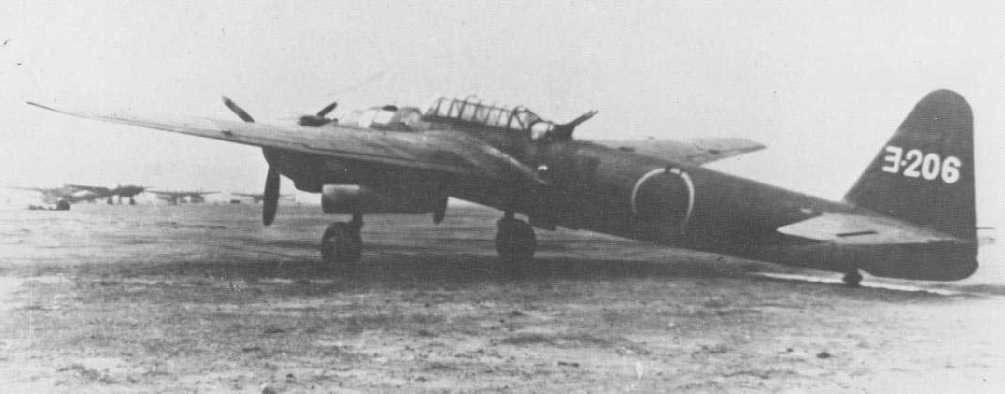
Yokosuka P1Y Ginga
“Frances”
Japan’s sleekest bomber of the war — a fast, twin-engine land-based raider designed to be too quick to catch, undone by temperamental engines, and remembered for a desperate one-way kamikaze flight to Ulithi.
The Yokosuka P1Y Ginga: Japan’s bomber that was too advanced for its own war
In 1940 the Imperial Japanese Navy issued an ambitious requirement, the 15-Shi specification, for a single land-based bomber that could do everything at once: level-bomb, dive-bomb and drop a torpedo, all while flying fast enough and low enough that Allied fighters would struggle to catch it. The design bureau at the Yokosuka Naval Air Technical Arsenal (the Kugisho) answered with one of the cleanest, most modern-looking aircraft Japan built in the entire war — the P1Y Ginga, its name meaning “Milky Way” or “Galaxy.”
On paper it was superb. The prototype first flew in 1943, and with two powerful Nakajima Homare radial engines and a slim, drag-minimised fuselage the Ginga could reach roughly 547 km/h (about 340 mph) and outrun many of the interceptors sent after it at low altitude. Test crews praised its handling. To Allied intelligence it earned the reporting name “Frances,” and it looked a clear generation ahead of the older G4M “Betty.”
Then reality intervened. The same Homare engines that made the Ginga fast made it fragile: they were complex, hard to maintain, and demanded skilled ground crews and quality fuel that Japan increasingly did not have. Serviceability was dismal, and many airframes sat unflyable while the type was formally accepted only in October 1944 and saw meaningful combat only in the spring of 1945. A brilliant airframe had been bolted to an engine its own industry could not keep running.
By the time it reached the front in numbers, the war was already lost. The Ginga fought over the Philippines, the Marianas and Okinawa as a conventional and torpedo bomber, and some were rebuilt as radar-equipped night fighters with obliquely upward-firing cannon. But its most remembered mission was an act of desperation: on 11 March 1945 the Azusa Special Attack Unit sent two dozen Ginga on a near ten-hour, one-way kamikaze flight against the US fleet anchorage at Ulithi. Designed to be uncatchable, the Ginga ended the war as a guided bomb — and today a single survivor waits, unrestored, in a Smithsonian storage building.
01The Yokosuka P1Y Ginga’s design brief: one bomber meant to do everything
The 15-Shi requirement that produced the Ginga asked for a genuinely multi-role machine — a fast twin able to level-bomb from altitude, dive-bomb accurately, and carry a torpedo for anti-ship strikes, all in one airframe. Chief designers Tadanao Mitsuzi and Masao Yamana chased that goal with an aerodynamically clean design that drew inevitable comparisons to fast Western twins like the de Havilland Mosquito and the B-25.
The trouble with a jack-of-all-trades is that it stretches the design thin. The Ginga could perform each of its missions adequately, but the sophistication needed to do so — and above all the high-strung Homare engines chosen to give it speed — made it complex and maintenance-hungry at exactly the moment Japan was running short of fuel, spare parts and trained mechanics. It is a textbook case of an advanced design outrunning the industry meant to support it.
What makes the P1Y Ginga special
A clean airframe built for speed
The Ginga’s slim, tapering fuselage and low-drag wing gave it a top speed near 547 km/h — fast enough to outrun many Allied interceptors at low level. Test crews praised its handling, and it looked a generation more modern than the G4M “Betty” it was meant to supplement. Aerodynamically it was arguably the finest bomber Japan fielded.
Two Homare engines — its gift and its curse
Power came from two Nakajima Homare 18-cylinder radials of roughly 1,820 hp each at take-off. They made the Ginga quick, but they were notoriously temperamental, hard to keep tuned and demanding of fuel and skilled maintenance. Poor serviceability, not enemy action, grounded much of the fleet.
Night fighter with ‘Schräge Musik’ cannon
Some airframes became night fighters — the P1Y1-S Byakko and P1Y2-S Kyokko — carrying cannon angled to fire obliquely upward, the same idea as Germany’s “Schräge Musik.” The plan was to slide beneath a bomber and rake its belly. Against high-flying B-29s the converted Ginga simply couldn’t climb well enough, and most reverted to bombing or kamikaze duty.
02The Yokosuka P1Y Ginga’s engines: why the Homare grounded a galaxy
The Nakajima Homare (NK9) was an 18-cylinder, twin-row air-cooled radial that promised big power in a compact package — roughly 1,820 hp at take-off on the P1Y1. In theory it was exactly what a fast bomber needed. In practice it was one of the most troublesome Japanese engines of the war, sensitive to fuel quality and maintenance standards that a collapsing 1944–45 supply system could rarely meet.
The result was chronically low serviceability: many Ginga sat on the ground waiting for parts or attention while relatively few were flyable at any moment. The later Kawanishi-built P1Y2 series switched to the more dependable Mitsubishi Kasei radial specifically to escape the Homare’s supply and reliability problems — an implicit admission of how much the engine had hobbled an otherwise excellent aircraft.
03The Yokosuka P1Y Ginga as night fighter: Japan’s answer to Schräge Musik
As American night raids intensified, the Navy converted Ginga airframes into radar-carrying night fighters, generally listed as the P1Y1-S Byakko (“White Light”) and the Kawanishi P1Y2-S Kyokko (“Aurora”). Sources genuinely disagree on which designation applied to which conversion, so the naming should be read with caution. Both mounted 20 mm cannon angled to fire obliquely upward — the same tactical idea as the German “Schräge Musik” installations, letting a fighter attack a bomber’s vulnerable underside from below.
The concept was sound but the airframe was wrong for the job: laden with radar and cannon, the Ginga lacked the high-altitude climb and performance to reliably reach and hold a firing position under a B-29. The night-fighter experiment was largely a failure, and many of the converted machines were sent back to bombing units or, in the end, to special-attack (kamikaze) duty.
Yokosuka P1Y1 Ginga full specifications
Baseline note: the figures below describe the P1Y1 Ginga Model 11, the Nakajima-built Homare-engined bomber that made up the overwhelming majority of production and flew every one of the type’s famous operations. Deltas for the Kasei-engined P1Y2-S Kyokko night fighter, the P1Y2 Model 16 bombers reconverted from it, and the enlarged P1Y3 Model 33 project are given in grey. Metric figures follow the Naval Air Technical Arsenal and Nakajima data tables reprinted in the Japanese literature; where Western compilations after Rene Francillon round differently, or disagree outright, both readings are named rather than one being quietly preferred.
Dimensions & weights
- Crew
- 3 — pilot, observer/bomb-aimer and radio operator/gunner cut down from the seven of the G4M it was meant to replace, which is the single decision that made the aeroplane as small and as fast as it was. The P1Y2-S night fighter flew with 2
- Length
- 15.00 m (49 ft 3 in); P1Y3 Model 33 project 19.00 m (62 ft 4 in)
- Wingspan
- 20.00 m (65 ft 7 in); P1Y3 project 22.00 m (72 ft 2 in)
- Height
- 4.30 m (14 ft 1 in) is the figure in the German and English reference literature; the Japanese-language infobox tradition and the Russian tables give 5.30 m (17 ft 5 in). The discrepancy is almost certainly a transcription error propagated for decades, but it is not resolved and both numbers remain in print
- Wing area
- 55.00 m² (592 sq ft) — about 30 per cent less wing than the roughly comparable Army Ki-67 Hiryu, and the root of both the speed and the landing accidents
- Aspect ratio
- 7.28 high for a 1940 bomber, and chosen for cruise efficiency at the 15-Shi range figure
- Aerofoil thickness
- 17 per cent at the root, 8 per cent at the tip — a thick, deep root spar box that carried the fuel and let the wing stay thin and fast outboard
- Fuselage cross-section
- 1.20 m wide × 2.134 m deep (3 ft 11 in × 7 ft 0 in). The Ki-67 was 2.00 m wide and the G4M deeper still; the Ginga’s crew worked in a tube barely wider than a man’s shoulders
- Bomb bay
- over 5.00 m long (16 ft 5 in) — sized around the Type 91 aerial torpedo, which is why a 15 m aeroplane has a bay a third of its own length
- Empty weight
- 7,265 kg (16,017 lb); P1Y2 with Kasei engines 7,138 kg (15,737 lb), lighter despite the larger engine because the Kasei installation was simpler
- Normal loaded weight
- 10,500 kg (23,149 lb), the same for the P1Y1 and the P1Y2
- Maximum overload weight
- 13,500 kg (29,762 lb) in the Japanese tables; 13,300 kg (29,321 lb) in the Russian compilation. This is the ferry and long-range special-attack condition, not a routine one
- Wing loading
- 191 kg/m² (39.1 lb/sq ft) at normal weight, rising to 245 kg/m² (50.2 lb/sq ft) at overload — heavier at normal load than the Ki-67 was when overloaded, and unprecedented for a Japanese bomber
Performance
- Maximum speed
- 546.3 km/h (339 mph, 295 kn) at 5,900 m (19,360 ft) — English-language sources usually round this to 547 km/h
- Prototype trials figure
- 566.7 km/h (352 mph, 306 kn) at 5,500 m (18,050 ft) on the Yokosho prototypes, comfortably past the requirement. Service aeroplanes with worn Homares, field patches and full equipment did not see it
- P1Y2 Kyokko and Model 16
- 522.3 km/h (325 mph, 282 kn) at 5,400 m (17,720 ft) — the Kasei was reliable and slower, which was the whole bargain
- Cruising speed
- 370 km/h (230 mph, 200 kn) at 4,000 m (13,120 ft)
- Rate of climb
- 615 m/min (2,020 ft/min, 10.3 m/s); P1Y2 531 m/min (1,742 ft/min). Japanese trial reports recorded climb as time to altitude rather than a rate, and the two conventions do not convert cleanly
- Service ceiling
- 9,400 m (30,840 ft); P1Y2 9,560 m (31,360 ft) — and neither figure was enough to reach a B-29 at its cruising height in time, which is why the night-fighter conversions failed
- Range, normal
- 1,920 km (1,193 miles) with an offensive load; P1Y2 1,815 km (1,128 miles)
- Range, maximum
- 5,370 km (3,337 miles) in overload with bay tanks. The 15-Shi specification had asked for about 5,556 km (3,452 miles), matching the G4M, and the Ginga came close enough for the Navy to accept it
- Dive limiting speed
- 648.2 km/h (403 mph) was the requirement; trials took the airframe to a terminal 703.8 km/h (437 mph). A twin-engined bomber cleared for a genuine bombing dive was a rare thing anywhere in 1943
- Take-off and landing distance
- 600 m (1,970 ft) was the 15-Shi limit and the design met it, but only with the elaborate flap system working. On a rough forward strip with one flap circuit unserviceable it was a dangerous aeroplane
- Speed requirement
- 511.2 km/h (318 mph) — the 15-Shi asked for a bomber as fast as the A6M Zero fighter, and it got one
Propulsion & systems
- Engines
- 2 × Nakajima NK9C Homare 12, 18-cylinder twin-row air-cooled radial, 1,825 hp (1,361 kW) for take-off
- Prototypes
- Nakajima NK9B Homare 11, 1,820 hp (1,357 kW). The Homare was adopted at a stage when it was barely proven; the prototype programme logged more than twenty engine malfunctions
- P1Y2 family
- 2 × Mitsubishi MK4T Kasei 25, 14-cylinder radial, 1,850 hp (1,379 kW) — adopted purely because Kasei engines could actually be had and could actually be maintained
- Homare internals
- 35.8 litres (2,185 cu in), bore and stroke 130 mm × 150 mm (5.12 in × 5.91 in), compression 8.0:1, 810 kg (1,786 lb) dry, 1,180 mm (46.5 in) diameter. An enormous amount of power packed into a small frontal area, and the tightness of the design is exactly why production quality could not be held
- Fuel and boost
- 92-octane petrol with water-methanol injection, two-speed single-stage centrifugal supercharger — on the fuel actually available in 1944 the Homare delivered nearer 1,300 hp at altitude against a design intent of about 1,800 hp
- Propellers
- Three-blade constant-speed, reduction ratio 0.5 chosen to keep tip speed near 95 per cent of Mach and buy static thrust for the 600 m take-off
- Nacelles
- 1.30 m (51 in) maximum diameter around a 1.18 m engine, and even so the nacelles accounted for roughly 30 per cent of the whole aeroplane’s drag. The cowling, intake and cooling ducting were refined obsessively for about 200 m of extra full-throttle height — and that refinement is precisely what made an engine change a nightmare in a revetment
- Fuel system
- Seven tanks in each wing: four forward of the main spar, three of them semi-integral with the lower skin and emptied first on the outbound leg, then purged with carbon dioxide; three self-sealing tanks aft of the spar reserved for the fight and the flight home; one methanol tank inboard. Two 600-litre drop tanks (132 imp gal, 159 US gal each) could be carried underwing, and bay tanks replaced the bomb load for ferry and special-attack sorties
- Hydraulics
- Undercarriage, flaps and bomb-bay doors were oil-hydraulic, deliberately, after the electrical actuation on the D4Y Suisei had proved unreliable. A hand pump gave manual back-up and a 150-atmosphere compressed-air blow-down system dropped the gear if the hydraulics failed — three routes to the same job, three things to rig, three things to leak
- Dive brake
- A single under-wing panel ahead of the flaps, opening to 80° and retracting automatically when flaps were selected — the symmetrical upper-and-lower arrangement first tried shook the tailplane, and even the one-sided panel put enough download on the stabiliser to force local strengthening and rigged elevator tabs to cancel the pitch change
- Protection and equipment
- Folding armour plate behind the pilot, self-sealing rear tank group and carbon-dioxide fire suppression for the semi-integral tanks; H-6 air-to-surface search radar on maritime and night-attack aeroplanes, FD-2 airborne interception radar on some night fighters — radar fits varied by unit and month and are poorly documented
04The Yokosuka P1Y Ginga’s cost: why no reliable price exists
There is no credible unit cost or cost-per-flight-hour figure for the P1Y Ginga in the public record. It was a wartime product of the Imperial Japanese Navy, procured through the Navy’s own arsenal-and-contractor system rather than sold on any open market; contemporary yen pricing was not published, and much wartime industrial documentation was destroyed in 1945.
Any specific dollar or yen figure attached to a Ginga online should be treated as unverified. What is well established is the scale of the effort: roughly 1,100 aircraft were built, the great majority by Nakajima, with a smaller batch of the Kasei-engined P1Y2 series by Kawanishi — a substantial investment for an aircraft that spent much of its short life grounded for maintenance.
Armament & payload
The Ginga was built around one torpedo bay and defended by almost nothing
The 15-Shi specification asked for an aeroplane that could dive-bomb, level-bomb and drop a torpedo, and the Ginga is one of the very few twin-engined machines of the war that genuinely did all three. Everything in the design points at the bay: a fuselage barely 1.2 m wide wrapped around a hole more than five metres long, a hydraulically worked door system, an under-wing dive brake cleared to 80°, and external guide rods to swing ordnance clear of the propeller arc in a bombing dive. What the Navy did not buy was survivability. The defensive fit was one flexible gun forward and one aft, worked by a crew of three who also had to navigate, bomb-aim and operate the radio, and against the Hellcat and the Corsair it was a gesture.
In service the type therefore fought at night and at low level, where its speed mattered and its guns did not. The T Attack Force torpedo squadrons that struck Task Force 38 off Formosa in October 1944 flew in the dark, low over the water, and put a torpedo into the cruiser USS Canberra. By 1945 the same qualities — long legs, high cruising speed, a big bay — were being spent on one-way missions instead. Gun fits differ between the Model 11, 11A, 11B and 11C and between Japanese and Western sources, and unit-level modifications were common enough that photographs regularly contradict the published tables.
Gun
- Model 11 as designed: one 20 mm Type 99 Model 1 cannon on a flexible mounting in the nose, one 20 mm Type 99 on a flexible mounting in the rear cockpit
- Model 11A (P1Y1a): the rear position rearmed with a 13 mm Type 2 machine gun on an improved mounting — less punch, far more rounds and a much better field of fire
- Model 11B (P1Y1b): twin 13 mm Type 2 in the rear position, the heaviest defensive fit the type ever carried in production
- Model 11C (P1Y1c): 13 mm Type 2 substituted in the nose station instead
- Three guns, worked by two of the three crew, on an aeroplane with no turret and no beam positions. The Ginga’s defence was its speed and the darkness, and when either failed it burned
Air-to-air
- No guided air-to-air weapon existed in Japanese service. This card belongs to the night-fighter conversions, which fought B-29s with oblique cannon in the German Schräge Musik manner
- P1Y1-S Byakko: Homare-engined conversion with 20 mm Type 99 cannon firing obliquely upward and forward from the fuselage. Only a small number were done, and the aeroplane could not climb to a B-29 in time
- P1Y2-S Kyokko: two 20 mm Type 99 obliquely mounted, plus forward-firing cannon and airborne interception radar, on Kasei engines. The 302nd Kokutai went further on its own account, fitting 20 mm and in some cases 30 mm oblique guns to standard airframes
- Type 3 No. 6 air-to-air bombs were dropped into B-29 formations by 302nd Kokutai machines — a phosphorus scatter weapon, and the closest thing the type had to an anti-bomber missile
- The 302nd claimed B-29s with these conversions. They are the only air-to-air successes credited to the Ginga, and they came from a unit improvising at squadron level, not from the official night-fighter programme
Air-to-surface guided
- None ever carried operationally. The Ginga dropped no guided weapon of any kind
- The card matters because of what was planned: the enlarged P1Y3 Model 33 was to be the mother ship for the Yokosuka MXY7 Ohka Model 22, the thermojet-powered piloted flying bomb with a shortened wing and a reduced 600 kg (1,323 lb) warhead sized specifically so a Ginga could lift it
- The Ohka Model 11, the only mark used in action, was too heavy for the Ginga and was carried by the G4M2e Betty instead — with results that destroyed whole squadrons of mother ships
- Neither the P1Y3 nor the Ohka Model 22 reached operational units. Around fifty Model 22 airframes were built and the combination was never flown against a ship
- What the Navy fielded instead was the crew: from 1945 the Ginga itself was flown into targets, which is a guidance system with a man in it and no way of aborting
Bombs
- One Type 91 aerial torpedo, about 848 kg (1,870 lb), carried semi-internally; the rear bay doors were removed for torpedo sorties because the weapon was longer than the bay could close over
- One 800 kg (1,764 lb) bomb, or two of 250 kg (551 lb) or 500 kg (1,102 lb), to a normal maximum around 1,000 kg (2,205 lb). The 15-Shi requirement had been 907 kg (2,000 lb) and the aeroplane bettered it
- Dive attack used external guide rods rather than a swinging crutch to throw the bomb clear of the propeller disc, with the under-wing brake open to 80° and elevator tabs rigged to cancel the resulting pitch change
- Ginga crews of the 762nd Kokutai put 250 kg bombs into USS Franklin in March 1945, one of the most destructive single air attacks ever survived by an American carrier
- The projected P1Y3 Model 33 was to carry up to 3,000 kg (6,614 lb) with a fourth crewman. It never flew
Rockets
- None. The Ginga carried no air-to-ground rocket armament in service and no rocket-assisted take-off gear was standardised on it, unlike the D4Y4 Suisei whose Type 4 boosters were designed in from the start
- The card is kept rather than padded away because the absence is informative: where German and American twins of 1944 were acquiring rocket projectiles for anti-shipping and ground attack, Japanese industry in the Ginga’s production years was struggling to deliver serviceable engines, let alone new stores
- The one rocket-powered weapon associated with the type — the Ohka Model 22 with its Tsu-11 thermojet — belongs to a mother-ship variant that never entered service
- Late-war Japanese practice put the same effort into oblique cannon and air-to-air bombs instead, which is where the 302nd Kokutai’s Ginga conversions went
Pods & other stores
- Two 600-litre (132 imp gal, 159 US gal) drop tanks underwing, and ferry tanks in the bomb bay in place of ordnance — the fit that made Operation Tan No. 2 physically possible
- H-6 air-to-surface search radar on maritime patrol and night torpedo aeroplanes; FD-2 airborne interception radar on part of the night-fighter force
- Ground-attack rebuild: up to twenty 20 mm Type 99 cannon installed in the bomb bay to fire downward, intended for strikes on B-29 bases in the Marianas. About thirty airframes were rebuilt
- A separate and better-documented conversion by the 765th Kokutai’s Attack Squadron 401, done at the 61st Naval Air Arsenal at Takao, fitted three aeroplanes with ten to twelve downward-firing 20 mm cannon. They flew from Tainan against Lingayen on 22 March 1945; the only confirmed result was three fires started at Dagupan airfield, and the idea was dropped
- The MXY10 was a non-flying full-scale Ginga replica built as a ground decoy — an admission that airframes were easier to fake than to keep serviceable
Three typical loadouts
- Night torpedo strike, T Attack Force, October 1944
- One Type 91 torpedo with the rear bay doors removed, two 600-litre drop tanks, H-6 search radar, nose and rear guns loaded. Ten Ginga found Task Group 38.1 low over the water at 18:23 on 14 October 1944 and one of them torpedoed the heavy cruiser USS Canberra, flooding both engine rooms and killing twenty-three men.
- Dive and low-level bombing, Kyushu, March 1945
- Two 250 kg bombs, internal fuel only, dive brake armed, guide rods fitted. This is the configuration in which 762nd Kokutai aeroplanes struck USS Franklin off Kyushu on 19 March 1945 — the Ginga doing exactly the job it had been specified for, once, and doing it superbly.
- Special attack, Azusa Unit, 11 March 1945
- One 800 kg bomb, bay and drop tanks filled to the limit, guns and much equipment stripped, no return leg planned. Twenty-four aeroplanes left Kanoya for Ulithi, roughly 3,000 km away; six turned back with mechanical failures, others force-landed at Yap or ditched, and two reached the anchorage after dark. One struck USS Randolph below the flight deck, killing twenty-six and wounding one hundred and five; the other flew into an access road on Sorlen island, mistaking a signal tower for a ship.
Sourcing caveat: Japanese and Western tables disagree on which gun sat in which station on which sub-type, and unit conversions were frequent and largely undocumented. Ordnance figures follow the Naval Air Technical Arsenal load tables; the twenty-cannon bomb-bay battery rests on a single well-repeated line in the reference literature and the number of airframes so rebuilt should be treated as approximate.
Variants
Nakajima built the Ginga and Kawanishi built the night fighter nobody needed
Production totals are unusually clean for a late-war Japanese type. Nakajima delivered 1,002 bombers from its Koizumi works between August 1943 and August 1945 — 90 in 1943, 620 in 1944 and 434 in the eight months of 1945 — and Kawanishi delivered 96 or 97 P1Y2-S Kyokko night fighters and Model 16 conversions, for a combined 1,098 or 1,099 airframes. That is a large programme by Japanese standards, and it produced an aeroplane the Navy could rarely fly.
The reasons are worth stating plainly rather than softening. The Homare 12 was a superb engine on a test bench and an unreliable one in a revetment on Kyushu in 1945, delivering perhaps 1,300 hp at altitude on the fuel available against a design figure near 1,800 hp. The airframe compounded it: three separate actuation paths for the undercarriage, a flap and dive-brake system tuned to the degree, nacelles refined to the point where getting at the engine meant dismantling the cowling geometry that made the aeroplane fast. Serviceability collapsed, and the aircrew coined a bitter parody of Du Fu to describe it — kuni horobite Ginga ari, "the nation is destroyed, but the Ginga remains". The most honest single measure of the problem is Operation Tan No. 2: twenty-four aeroplanes launched by a service that badly needed all of them, and two arrived.
The night-fighter line is the second half of the contradiction. Ordered from Kawanishi in May 1943 and flying in prototype form in May 1944, the Kyokko swapped the scarce Homare for the plentiful and dependable Mitsubishi Kasei 25, which was the right call and cost about 25 km/h and most of the point. It could not climb to a B-29 in time and could not catch one when it got there, and by April 1945 Kawanishi was converting the line back into Model 16 bombers. Meanwhile the 302nd Kokutai, improvising its own oblique-cannon conversions at Atsugi from standard bombers, actually shot B-29s down.
- P1Y1 prototypes (1943, about 12 built as Y-20)
- Yokosho-built machines on Homare 11 engines; first flight August 1943, and more than twenty engine malfunctions logged during the trials programme.
- P1Y1 Ginga Model 11 (Nakajima, 1943–45, 1,002 of all Model 11 sub-types)
- The production bomber on Homare 12 engines, formally adopted only in October 1944 although mass production had begun in November 1943. Nose and rear 20 mm Type 99 cannon, torpedo or bomb bay, dive brake.
- P1Y1a / P1Y1b / P1Y1c Model 11A, 11B, 11C (within the 1,002 total)
- Defensive-armament sub-types: 13 mm Type 2 in the rear position, twin 13 mm in the rear position, and 13 mm in the nose respectively. No change to the airframe or engines.
- P1Y1-S Byakko (1944, small number converted)
- Homare-engined night fighter with obliquely mounted 20 mm cannon. A stopgap that showed the type had neither the ceiling nor the climb for the role, and led directly to the Kasei-engined Kyokko.
- P1Y2-S Kyokko (Kawanishi, prototype May 1944; 96–97 including Model 16 conversions)
- Mitsubishi Kasei 25 engines, two-man crew, airborne interception radar, forward and oblique 20 mm cannon. Reliable, and too slow and too low-flying to be a B-29 interceptor.
- P1Y2 Model 16 and Model 16A/B/C (1945, converted from Kyokko and P1Y1 airframes)
- Kyokko airframes reconverted to bombers from April 1945 with the bay restored, plus Kasei-engined conversions of the Model 11A, 11B and 11C. The Kasei made these the most dependable Ginga of all, at a cost in speed and ceiling.
- Ginga ground-attack rebuild (1944–45, about 30 rebuilt)
- Up to twenty downward-firing 20 mm Type 99 cannon in the bomb bay for strafing the B-29 bases in the Marianas. A separate and better-attested 765th Kokutai conversion of three aeroplanes with ten to twelve guns flew one mission, against Lingayen on 22 March 1945.
- P1Y3 Model 33 (project, not flown)
- Enlarged to 22.00 m span and 19.00 m length on Homare 21 engines, four crew and up to 3,000 kg of bombs; intended as the mother ship for the Ohka Model 22.
- P1Y4, P1Y5, P1Y6 (projects, 1944–45)
- Model 12 on Homare 23, Model 14 on Mitsubishi Ha-43, Model 17 on Kasei 25 Hei. None was completed. A jet development, Tenga, around the Ishikawajima Ne-30 was abandoned in 1945.
- MXY10 (1945, quantity unrecorded)
- Full-scale non-flying Ginga replica built as an airfield decoy.
Survivors: essentially one, and it is not on public display. A single incomplete P1Y1 — one of three brought to the United States for evaluation after the surrender — is held by the Smithsonian National Air and Space Museum in storage at the Paul E. Garber Facility at Suitland, Maryland. The fuselage has been photographed repeatedly over the years and the wings and engines are confirmed to be in the collection; the aeroplane is unrestored and has never been exhibited. Nothing original survives in Japan and no reproduction of the type has been built. Everything else on this page rests on documents and photographs, because there is no second airframe to check them against.
The P1Y Ginga: from great expectations to special attack
The 15-Shi requirement
The Imperial Japanese Navy asks Yokosuka for a fast land-based bomber able to level-bomb, dive-bomb and torpedo-attack in one airframe.
First flight
The prototype flies (commonly dated to the summer of 1943), revealing one of the cleanest, most modern airframes Japan built.
Production
Nakajima builds the great majority of roughly 1,100 aircraft; Kawanishi later builds the Kasei-engined P1Y2 series.
Accepted into service
Formally accepted as the Navy Bomber Ginga, though engine unreliability and shortages delay meaningful combat use.
Into combat
Ginga units begin operations over the Philippines and against US task forces as the Pacific war reaches Japan’s inner defences.
The Ulithi raid
The Azusa Special Attack Unit launches 24 Ginga on a near ten-hour, one-way kamikaze flight to Ulithi; one strikes the carrier USS Randolph.
Okinawa & the end
Ginga fly conventional and special-attack missions around Okinawa and the fleet until Japan’s surrender in August 1945.
Captured & preserved
A captured example is flight-tested by the US at Olmsted Field, then transferred to the Smithsonian in 1948 — the sole survivor.
From the record: twelve P1Y Ginga stories
Named after the galaxy
The Navy called it “Ginga” — the Milky Way — and it nearly lived up to the reach the name promised.
Read the full story
Fast enough to embarrass fighters
At low altitude the Ginga could outrun many of the interceptors sent to catch it.
Read the full story
The engine that grounded a galaxy
The twin Homare radials that made the Ginga fast also made it fragile.
Read the full story
Too advanced for its own war
What was cutting-edge in 1943 became a liability by 1945.
Read the full story
Japan’s Schräge Musik
Some Ginga were rebuilt with cannon angled to fire obliquely upward, to rake a bomber’s belly.
Read the full story
The ten-hour one-way flight
On 11 March 1945, 24 Ginga set out from Kyushu for the US fleet at Ulithi — almost ten hours away.
Read the full story
The carrier caught at anchor
USS Randolph was riding quietly at anchor in Ulithi lagoon when the Ginga struck aft.
Read the full story
From precision bomber to guided bomb
Designed for torpedo runs and dive attacks, the Ginga ended the war as a suicide weapon.
Read the full story
The last Ginga on Earth
The world’s only surviving P1Y sits, unrestored, in Smithsonian storage.
Read the full story
“Frances,” FE-1702
When US intelligence catalogued the captured bomber, it became Foreign Equipment number 1702.
Read the full story
A bomber that wanted to be a Mosquito
The brief asked for level bombing, dive bombing and torpedo work in one airframe.
Read the full story
The Ginga meant to carry a suicide rocket
A proposed variant was to serve as a mother-ship for the Ohka rocket bomb.
Read the full story
The P1Y Ginga in pictures
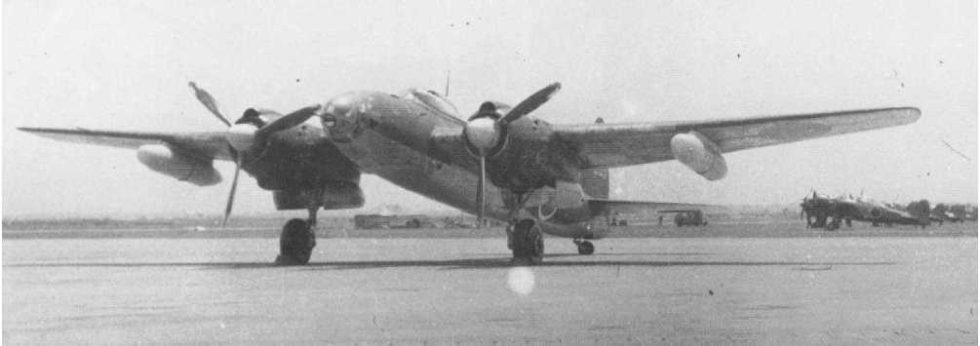
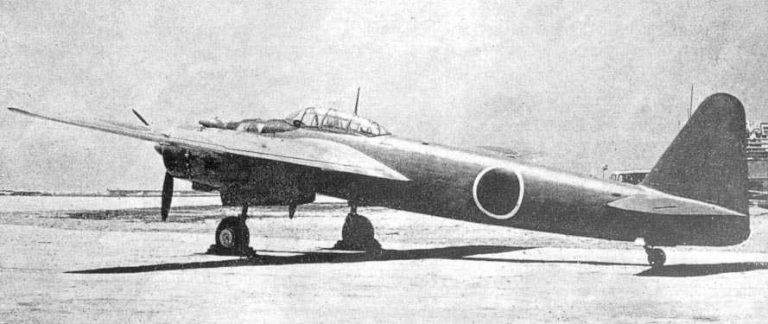
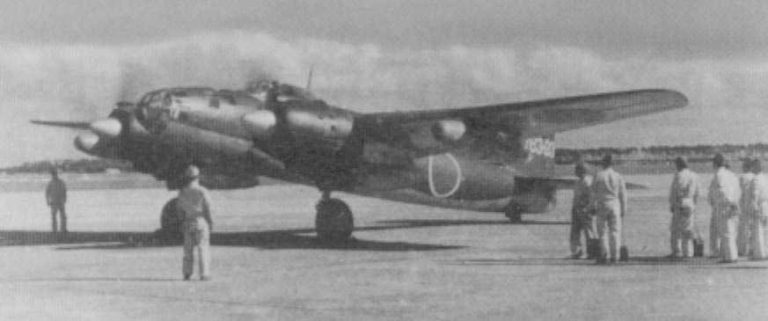
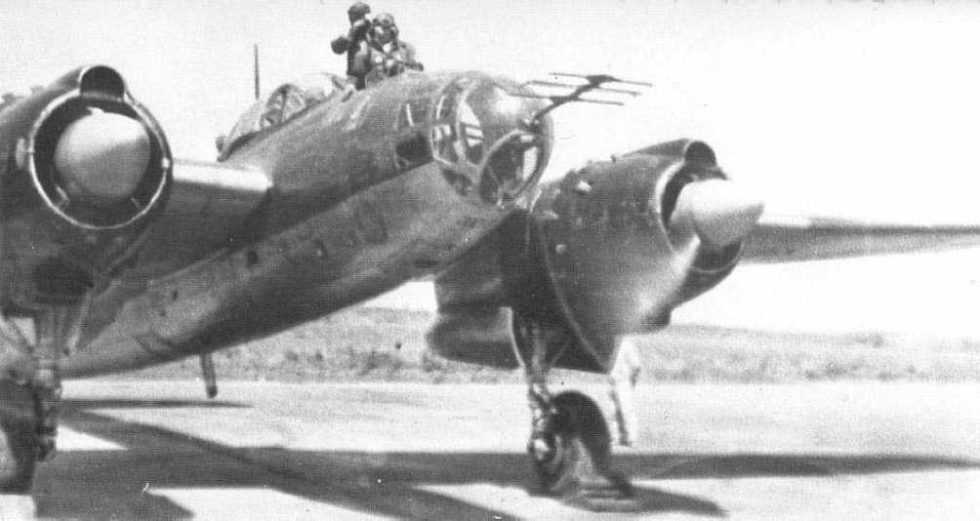
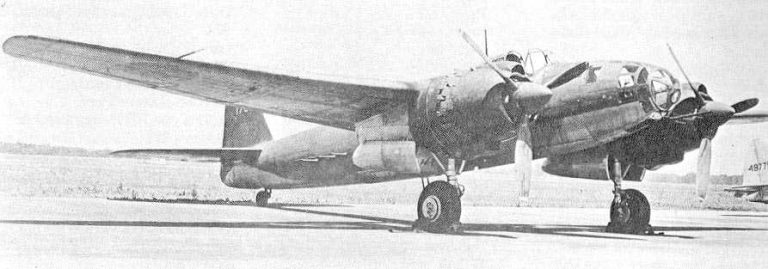
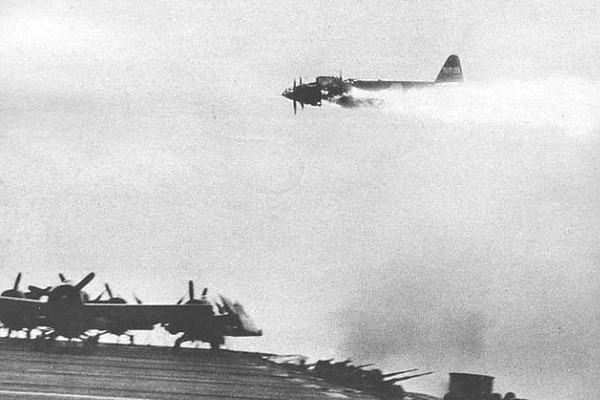
The P1Y Ginga in motion
Yokosuka P1Y Ginga: Japan’s “Galaxy” Bomber — a dedicated profile of the type, its design, its troublesome Homare engines and its late-war service. A useful visual introduction to an aircraft that is otherwise rarely filmed.
Where the P1Y Ginga flew and survives
The P1Y Ginga’s combat record: speed, torpedoes and one desperate raid
The Ginga arrived too late and in too few serviceable numbers to change the course of the Pacific war. Its record is one of fast conventional and torpedo strikes, a failed night-fighter experiment, and a growing slide into special-attack (kamikaze) missions as 1945 wore on. Its single most famous result was the long-range strike on the US fleet at Ulithi.
Compare the combat record of every military aircraft. Figures are best-available estimates and are hedged where sources disagree.
Everything people ask about the Yokosuka P1Y Ginga
Can I fly in a Yokosuka P1Y Ginga?
What does “Ginga” mean, and why “Frances”?
How fast was the P1Y Ginga?
Why is the Ginga remembered as unreliable?
Was the P1Y used as a kamikaze aircraft?
Was there a P1Y night fighter?
How many were built, and who built them?
Does any P1Y Ginga survive today?
You can’t fly the P1Y Ginga.
These, you can.
Some legends only live in museums — others are fuelled and waiting. MiGFlug has put civilians in real military jet cockpits since 2004.
 Fly the L-39 AlbatrosThe world’s most-flown jet trainer — aerobatics included
 Fly the F-104 Starfighter“The missile with a man in it”
 Fly the MiG-21The Cold War’s most-produced jet
 Fly the T-33 Shooting StarAmerica’s first jet trainer
 Fly the DH VampireA piece of early jet history
 Fly the S.211Agile Italian jet trainer
 Fly the MB-326The classic Aermacchi jet
 Fly the MiG-15The Soviet legend of the Korean War
Continue the tour
Every fact, checked
- Smithsonian National Air and Space Museum — Kugisho P1Y1 Ginga (“Frances”)Museum record for the sole surviving airframe: capture, evaluation and storage status.
- Pacific War Online Encyclopedia — P1Y “Frances”Technical specifications, production breakdown, engines and variant detail.
- HistoryOfWar.org — Yokosuka P1Y Ginga “Frances”Design origin, dates and the family of bomber and night-fighter variants.
- CombinedFleet.com — Operation Tan No. 2Detailed account of the Azusa unit’s 11 March 1945 kamikaze raid on Ulithi.
- US Navy History & Heritage CommandUS primary-source records and photographs of the USS Randolph kamikaze strike.
- MilitaryFactory — P1Y2-S Kyokko night fighterKasei engines, oblique-cannon armament and the reversion to bomber/kamikaze roles.
- SilverHawkAuthor — Warplanes of Japan: Yokosuka P1Y GingaAviation-history overview and discussion of the P1Y variant family.
- René J. Francillon, Japanese Aircraft of the Pacific War (Putnam)The standard printed reference from which most P1Y specifications and production figures derive.