
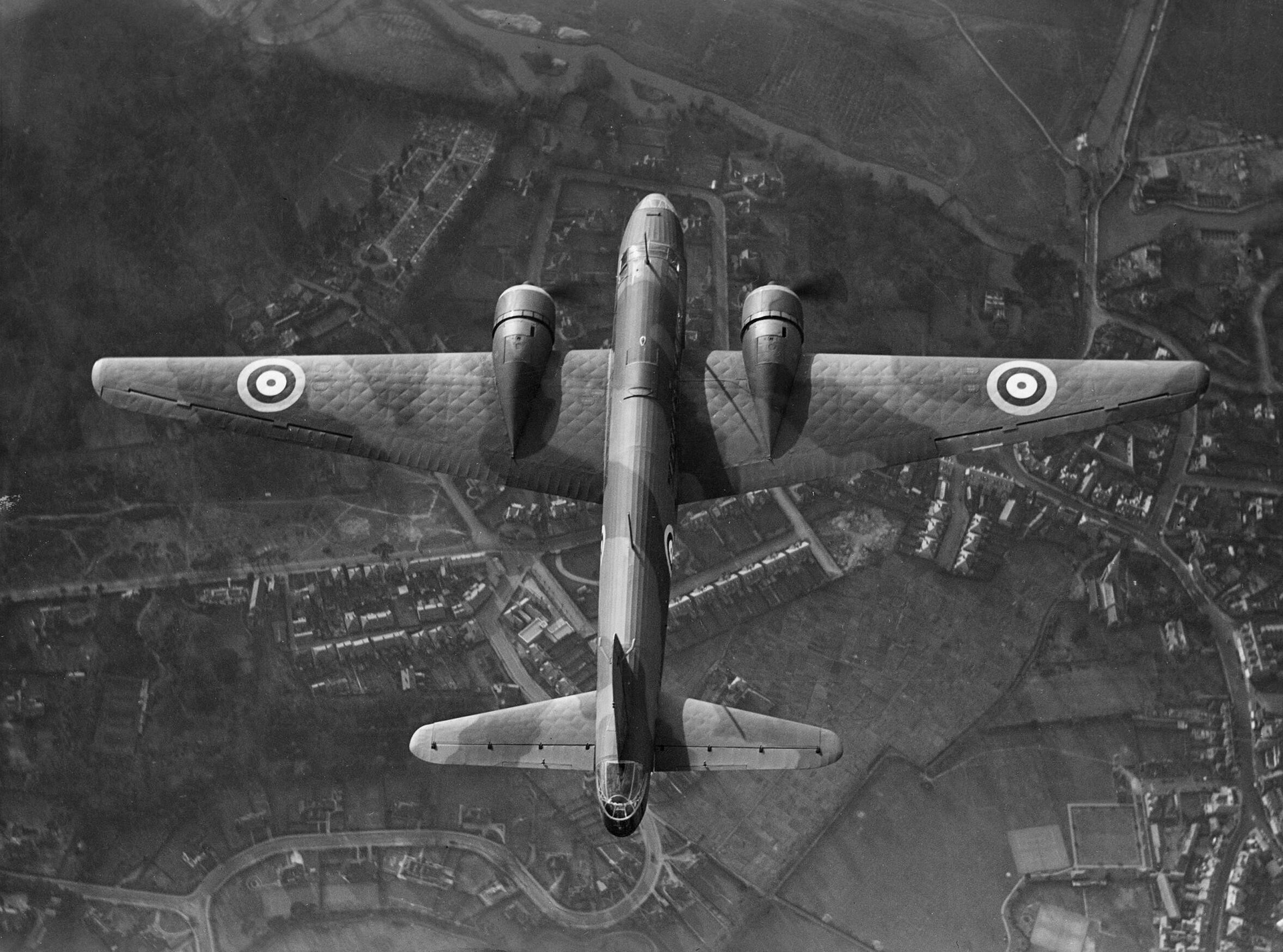
Vickers Wellington
“Wimpy”
The geodetic bomber that carried RAF Bomber Command through the first years of the war. Barnes Wallis’s basket-weave airframe could soak up battle damage that would have torn a conventional bomber apart — and, as the most-produced British multi-engine aircraft of the war, the “Wimpy” bombed Germany by night, hunted U-boats over the Atlantic and trained a generation of aircrew.
The Vickers Wellington: the geodetic bomber that carried Britain’s early war
ה Vickers Wellington was the aircraft that carried RAF Bomber Command into the Second World War. Designed to Air Ministry Specification B.9/32 by a Vickers team under Rex Pierson, with structural engineer Barnes Wallis, it first flew as a prototype on 15 June 1936 and entered squadron service in 1938. What made it extraordinary was hidden beneath its fabric skin: a geodetic airframe of interlocking metal lattice — a basket-weave structure Wallis had first used on airships. The geodetic frame spread loads so effectively that a Wellington could lose whole panels, or come home with great holes torn in fuselage and wing, and still fly.
For its crew of six that meant a machine that was famously hard to kill. Gunners and pilots returned from raids in Wellingtons whose fabric had burned away to bare the metal lattice, the airframe still holding its shape. That reputation for absorbing punishment — together with docile handling and an airframe that could be built quickly in dispersed factories — is why the Wellington stayed in front-line and second-line service long after newer designs arrived.
By the outbreak of war in September 1939 the Wellington was Bomber Command’s most capable heavy bomber, and it flew some of the RAF’s first raids of the war against German warships. Early daylight operations over the Heligoland Bight proved catastrophically costly against fighters, and the lesson — that unescorted bombers could not survive by day — pushed the Wellington, and Bomber Command, into the night campaign that would define the air war over Europe. Through 1940 and 1941 the “Wimpy” was the backbone of that night offensive, and in May 1942 Wellingtons made up the largest part of the first 1,000-bomber raid, against Cologne.
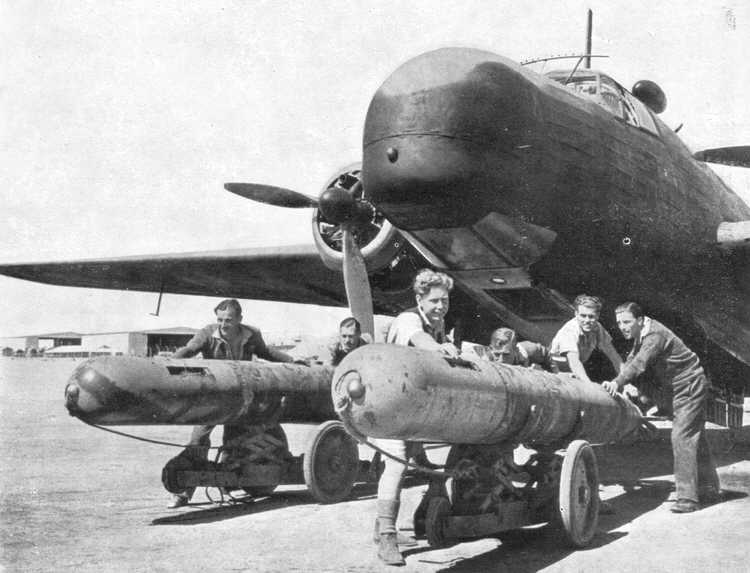
As the four-engine “heavies” — the Lancaster, Halifax and Stirling — came into service from 1942, the Wellington was steadily withdrawn from the main bomber force over Germany. But it was far from finished. It found a vital second career with Coastal Command, hunting U-boats over the Atlantic and the Bay of Biscay; specially equipped aircraft carried the Leigh Light searchlight to catch surfaced submarines at night, and the DWI variant flew with a huge magnetic ring beneath it to detonate German magnetic mines from the air. Torpedo-armed Wellingtons struck Axis shipping in the Mediterranean, and the type served across North Africa, the Middle East and the Far East.
Built at Weybridge (Brooklands), Chester and Blackpool, the Wellington became the most-produced British multi-engine aircraft of the war — around 11,461 of all marks by the time production ended in 1945. It served on after the war as a navigation and aircrew trainer until the RAF retired the last examples in 1953. Its nickname, “Wimpy”, came not from any official source but from J. Wellington Wimpy, the hamburger-loving character in the Popeye cartoons — an affectionate name for an aircraft crews trusted to bring them home.
01Why the Vickers Wellington could survive so much damage: Barnes Wallis and geodetic construction
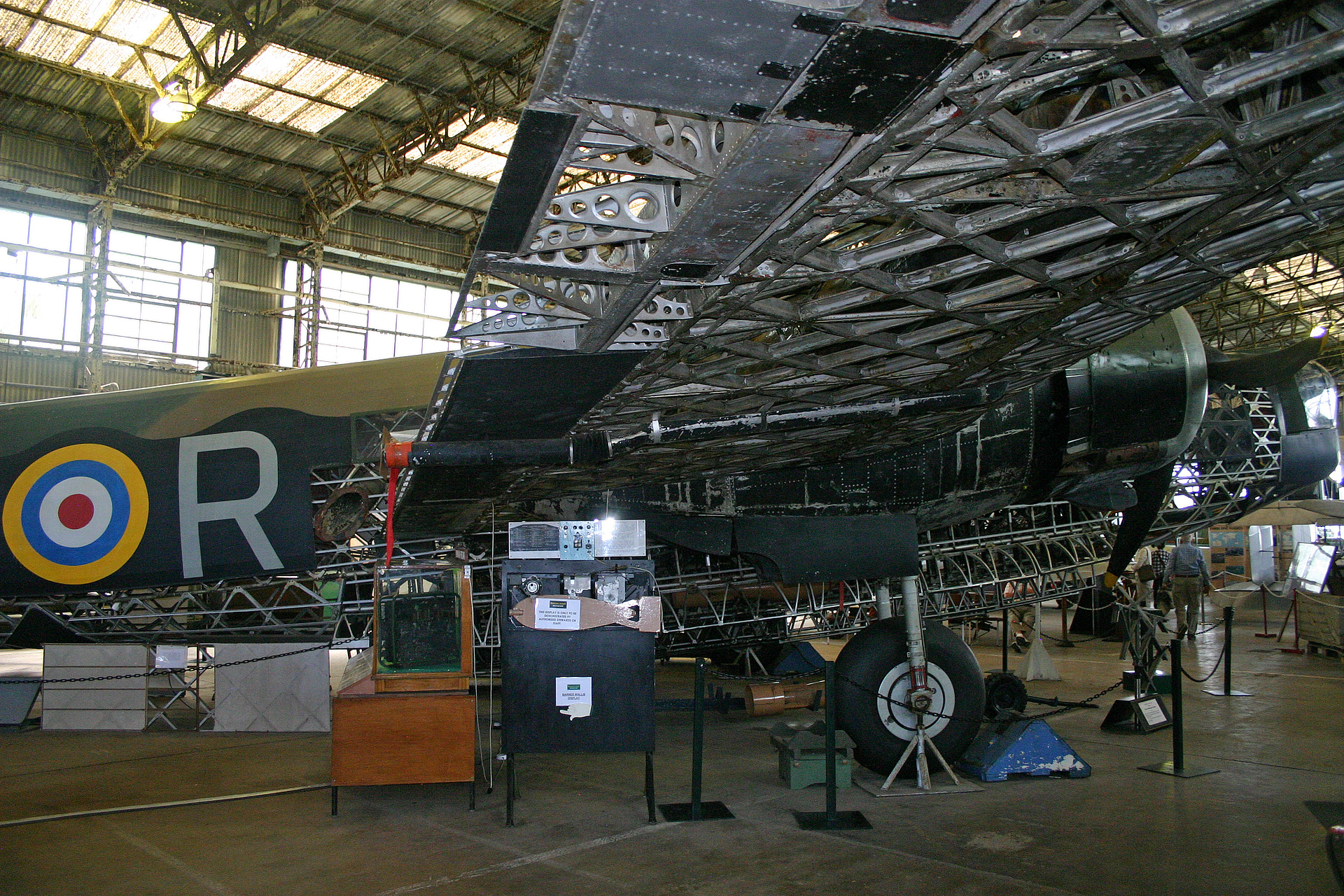
Barnes Wallis designed the Wellington’s airframe as a geodetic lattice — light metal members woven in a criss-cross basket weave, a technique he had refined on the R100 airship. Loads travelled around the whole structure rather than through a few heavy frames, so the removal or destruction of any one part did not collapse the rest.
The practical result was exceptional damage tolerance. Wellingtons repeatedly returned from operations with large areas of skin and structure shot away, the exposed geodetic framework still carrying the aircraft. The trade-off was a structure that was labour-intensive to build and awkward to pressurise or cut large openings into, but for a wartime bomber the survivability was worth it.
02The Vickers Wellington’s nickname: how the bomber became the “Wimpy”
Crews named the Wellington the “Wimpy” after J. Wellington Wimpy, the round, hamburger-eating character from the Popeye comics and cartoons. The link was simply the shared name “Wellington”. It was never official, but it was used everywhere — in logbooks, letters and squadron slang — and it captured the affection crews felt for a plain, reliable aircraft.
How the Vickers Wellington works: geodetic structure, fabric skin and radial engines
A geodetic lattice airframe
The Wellington’s fuselage and wings are built as a geodetic basket-weave of light alloy members, designed by Barnes Wallis. Loads are spread around the whole structure, so the airframe is light for its strength and remarkably damage-tolerant — the single feature for which the Wellington is best remembered.
A doped-fabric skin
Over the metal lattice the Wellington was covered in doped fabric rather than stressed metal. It kept weight down and was easy to repair, and because the fabric carried no structural load, holes in it did little to weaken the aircraft — part of why battle-damaged Wellingtons kept flying.
Two radial engines
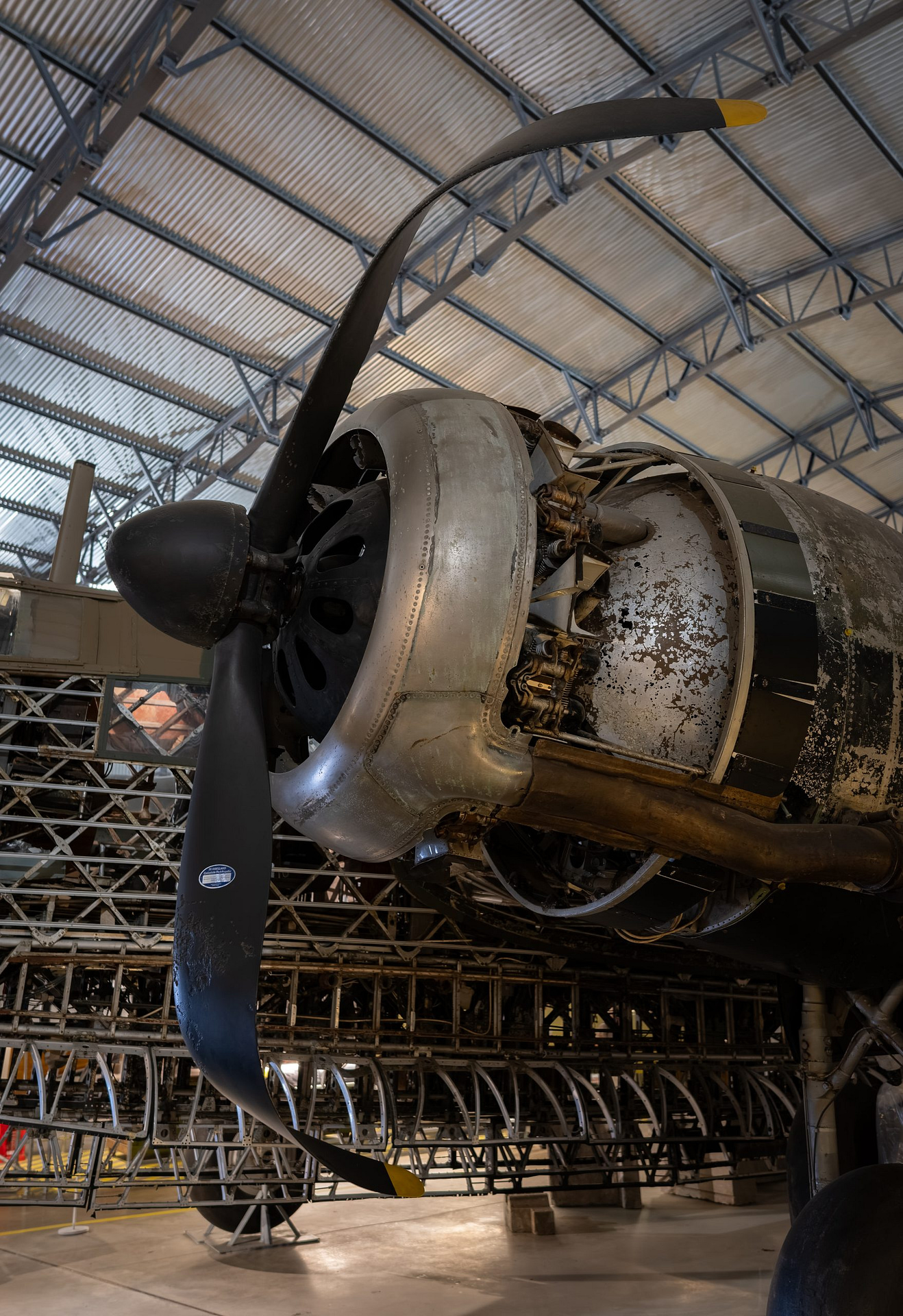
The classic bomber marks are powered by two Bristol Pegasus radial engines of about 1,000 hp each (Mk IC). Other marks used Rolls-Royce Merlin V12s or the more powerful Bristol Hercules radials, giving the family a wide spread of performance across the war.
03The Vickers Wellington’s engines: Pegasus, Merlin, Hercules and Twin Wasp across the marks
The early bomber Wellingtons (Mk I, IA, IC) used two Bristol Pegasus radials of roughly 1,000 hp. The Mk II switched to Rolls-Royce Merlin V12s; the Mk IV used American Pratt & Whitney Twin Wasp radials; and the major later marks — the Mk III, the much-produced Mk X and the Coastal Command versions — used the more powerful Bristol Hercules sleeve-valve radials.
This flexibility — a sound airframe that could take whatever engines were available — helped keep the Wellington in production and in service throughout the war.
04Vickers Wellington variants: from night bomber to Leigh Light, DWI and torpedo aircraft
The Wellington was produced in many marks. Bomber versions ran from the Mk I through the Hercules-powered Mk III and the mass-produced Mk X. Coastal Command flew GR (general reconnaissance) versions for anti-submarine and torpedo work, some fitted with the Leigh Light searchlight and air-to-surface radar. The extraordinary DWI aircraft carried a large magnetic ring to detonate magnetic mines. Later, dedicated T (trainer) marks such as the T.10 served for years after the war.
05Who built the Vickers Wellington: Vickers-Armstrongs and dispersed wartime production
The Wellington was designed and built by Vickers-Armstrongs. Production was spread across factories at Weybridge (Brooklands) in Surrey, Chester (Broughton) and Blackpool to guard against bombing and to reach the enormous output required. Between 1936 and 1945 the plants together delivered around 11,461 aircraft — more than any other British multi-engine type.
Vickers Wellington specifications: dimensions, performance and cost
Airframe & weights
- סוּג
- Twin-engine medium/heavy bomber (later maritime patrol, torpedo & trainer)
- צוות
- 6 (pilot, co-pilot, navigator/bomb-aimer, radio operator, front & rear gunners)
- מוּטַת כְּנָפַים
- 26.26 m (86 ft 2 in)
- מֶשֶׁך
- 19.68 m (64 ft 7 in)
- גוֹבַה
- ~5.31 m (17 ft 5 in)
- Structure
- Geodetic light-alloy lattice with doped-fabric skin (designed by Barnes Wallis)
- משקל ריק
- ~8,400 kg (18,500 lb) — Mk IC
- Max takeoff weight
- ~12,900 kg (28,500 lb) — Mk IC
- הְתחַמְשׁוּת
- 6–8 × 0.303 in Browning machine guns (nose & tail turrets, beam)
Powerplant, performance & cost
- Powerplant
- 2 × Bristol Pegasus XVIII radial, ~1,000 hp each (Mk IC); Merlin or Hercules on other marks
- Max speed
- ~378 km/h (235 mph) at altitude — Mk IC
- מהירות שיוט
- ~290–300 km/h (180–185 mph)
- לָנוּעַ
- ~2,550 mi (4,100 km) with reduced load; much less with a full bomb load (estimate, varies by mark)
- תקרת השירות
- ~5,500 m (18,000 ft)
- Bomb load
- ~2,000 lb typical; up to ~4,500 lb (2,041 kg) maximum
- First flight
- Prototype: 15 June 1936; RAF service from 1938
- Number built
- ~11,461 (all marks, 1936–1945; estimates vary)
- Unit cost
- not reliably recorded in a single authoritative modern source; a wartime medium bomber of this class (historic)
- Cost per flight hour
- not officially published; as a non-airworthy preserved type it has no current operating cost (any figure would be an estimate)
06Vickers Wellington numbers: how many were built, and how many survive
Around 11,461 Wellingtons of all marks were built between 1936 and 1945, the most of any British multi-engine aircraft of the war. Sources differ by a few dozen and the total should be treated as the commonly cited estimate.
Only two substantially complete aircraft survive: N2980 at Brooklands Museum ו MF628 at the Royal Air Force Museum. Both are static. Various relics, wrecks and recovered fragments exist elsewhere, but none is airworthy.
07The Vickers Wellington’s cost: what a wartime bomber was worth, then and now
There is no reliable single modern figure for the Wellington’s unit cost, and wartime accounting for aircraft prices was inconsistent; any specific number should be treated as an estimate. As a mass-produced medium bomber it was, by design, far cheaper and quicker to build than the four-engine heavies that followed.
Because no Wellington is airworthy today, there is likewise no current cost per flight hour. The real modern cost is conservation — the specialised work of preserving irreplaceable survivors such as N2980 and MF628 — rather than operation. Treat any operating-cost figure you see as an unverified estimate.
The Vickers Wellington: a timeline from B.9/32 to the last trainers
A specification for a new bomber
The Air Ministry issues Specification B.9/32 for a twin-engine medium bomber; Vickers responds with a geodetic design led by Rex Pierson and Barnes Wallis.
The prototype flies
The prototype Type 271 makes its first flight at Brooklands (Weybridge) in the hands of Vickers chief test pilot “Mutt” Summers.
Into RAF service
The Wellington enters squadron service, first with No. 9 Squadron, as Bomber Command’s most capable heavy bomber.
War and the first raids
Wellingtons fly among the RAF’s first bombing operations of the war; costly daylight raids over the Heligoland Bight push the type towards night operations.
The night offensive
The Wellington becomes the backbone of Bomber Command’s night bombing of Germany and Italy.
The first 1,000-bomber raid
Wellingtons form the largest part of the force in Operation Millennium, the first 1,000-bomber raid, against Cologne.
Coastal Command and new roles
As four-engine heavies take over the German night war, Wellingtons move to Coastal Command for anti-submarine work, carrying the Leigh Light and the DWI magnetic-mine ring.
Every front
Torpedo, transport and bomber Wellingtons serve across the Mediterranean, the Middle East and the Far East.
Production ends
Wellington production finishes after around 11,461 aircraft — the most of any British multi-engine type.
Retirement
The RAF withdraws its last Wellingtons, by then serving as aircrew trainers such as the T.10.
The Vickers Wellington in service: night bomber, U-boat hunter and survivor
Barnes Wallis and the geodetic idea
How an airship engineer built a bomber that would not fall apart.
Read the full account
Why crews called it “Wimpy”
A hamburger-loving cartoon character gave the bomber its nickname.
Read the full account
1939: the RAF’s first raids
The Wellington went to war on the first day and paid a hard price.
Read the full account
Backbone of Bomber Command
For the first years of the war, the night sky belonged to the Wimpy.
Read the full account
The first 1,000-bomber raid
In May 1942, Wellingtons made up the bulk of a record force.
Read the full account
Making way for the heavies
The four-engine bombers took over the German night war.
Read the full account
Hunting U-boats over the Atlantic
A second career against the submarine menace.
Read the full account
The flying mine-sweeper
A giant magnetic hoop that blew up mines from the air.
Read the full account
Wellingtons against Axis shipping
In the Mediterranean, the Wimpy carried torpedoes.
Read the full account
The Wimpy in the desert and the jungle
The Wellington served on every major front.
Read the full account
Teaching a generation of aircrew
After the front line, the Wellington trained those who followed.
Read the full account
N2980 and the Loch Ness Wellington
Two aircraft survive — and one came back from the deep.
Read the full account
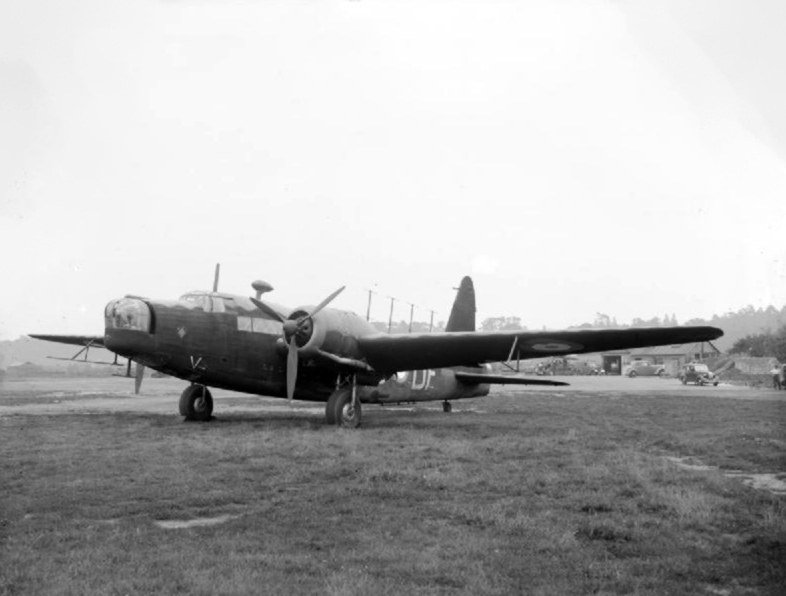
Vickers Wellington photos: bomber, Coastal Command and preserved survivors
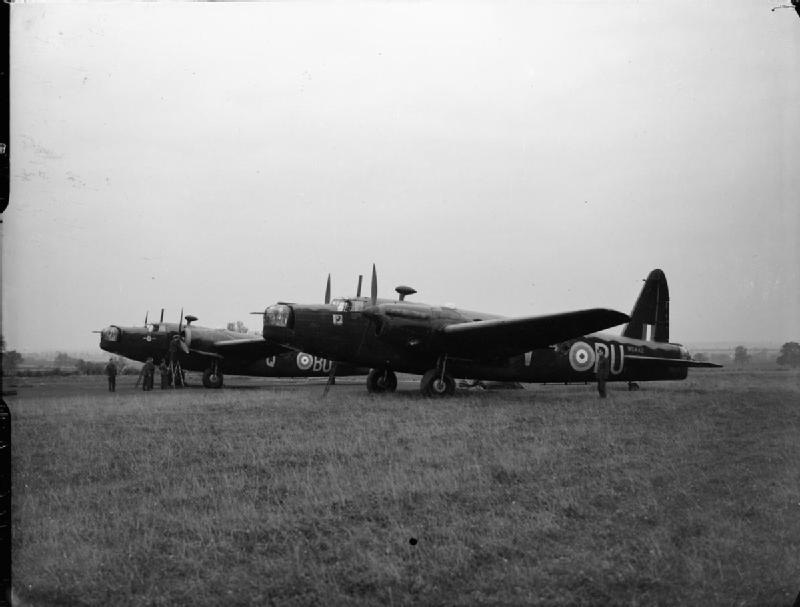
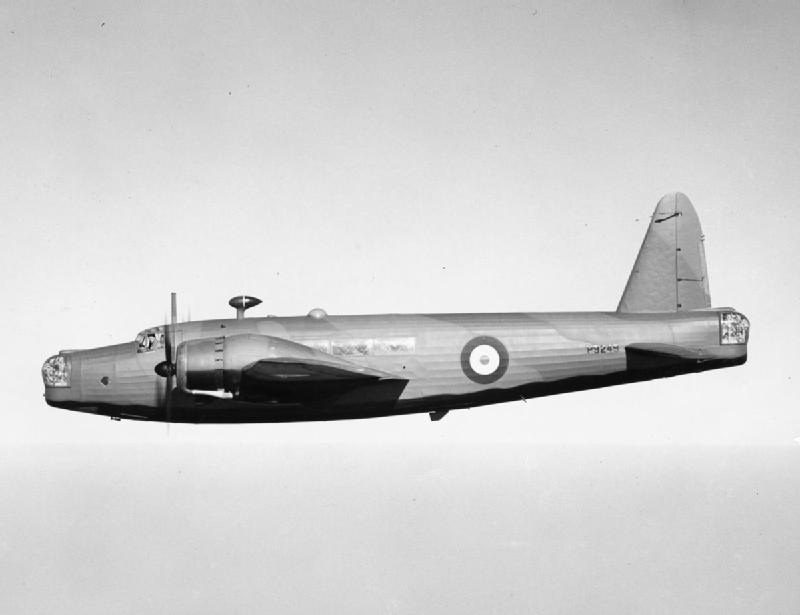
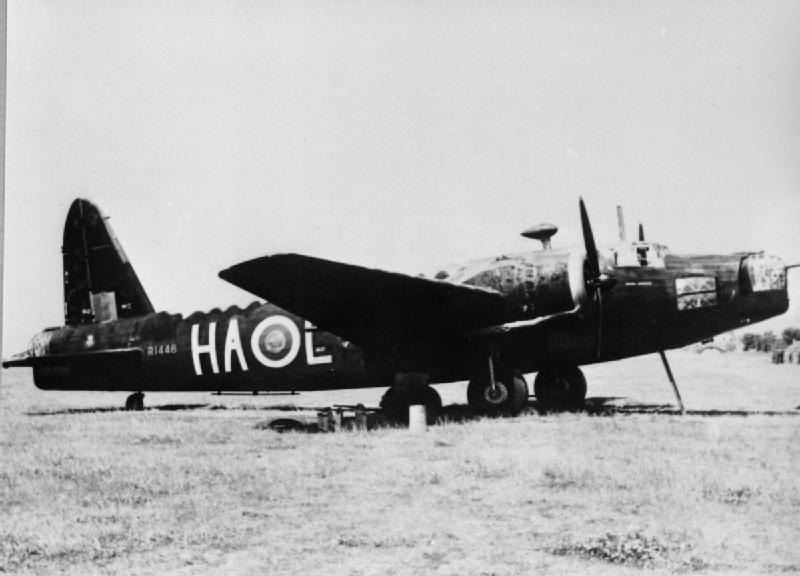
The Vickers Wellington on screen: Britain’s most-produced bomber
“Britain’s Most Mass-Produced Bomber | Vickers Wellington” by the aviation-history channel Rex’s Hangar (~764,000 views) — a detailed, well-sourced account of the Wellington’s design and wartime career.
Where the Vickers Wellington flew: RAF, Allied operators and combat theatres
The Vickers Wellington at war: first raids, the night offensive and the U-boat war
The Wellington flew from the first days of the war to the last, first as Bomber Command’s principal night bomber over Germany and Italy, then as a Coastal Command submarine-hunter and torpedo aircraft. It bombed by night, mined enemy waters, sank U-boats with the Leigh Light, swept magnetic mines with the DWI ring and trained the crews who came after. Loss and sortie figures vary between sources and should be treated as estimates.
Explore the combat record of every military aircraft. Data as of August 2026.
Vickers Wellington: frequently asked questions
Can I fly in a Vickers Wellington?
What is the Vickers Wellington?
Why is the Wellington nicknamed “Wimpy”?
What is a geodetic airframe, and who designed the Wellington?
What engines did the Vickers Wellington use?
How many Vickers Wellingtons were built?
What did the Wellington do in the Second World War?
What was the Wellington’s DWI magnetic-mine ring?
Are any Vickers Wellingtons still flying?
Where can I see a Vickers Wellington?
You can’t fly the Vickers Wellington.
These, you can.
Some legends only live in museums — others are fuelled and waiting. MiGFlug has put civilians in real military jet cockpits since 2004.
 Fly the L-39 AlbatrosThe world’s most-flown jet trainer — aerobatics included
 Fly the F-104 Starfighter“The missile with a man in it”
 Fly the MiG-21The Cold War’s most-produced jet
 טסו על ה-T-33 Shooting StarAmerica’s first jet trainer
 Fly the DH VampireA piece of early jet history
 Fly the S.211Agile Italian jet trainer
 Fly the MB-326The classic Aermacchi jet
 Fly the MiG-15The Soviet legend of the Korean War
More from the Military Aircraft Encyclopedia
Vickers Wellington: sources & further reading
- Royal Air Force MuseumRoyal Air Force Museum — Vickers Wellington history and the preserved MF628.
- Imperial War MuseumsImperial War Museums — the Wellington in Bomber Command and Coastal Command service.
- Brooklands MuseumBrooklands Museum — home of Wellington N2980, the “Loch Ness Wellington”, on the site where Wellingtons were built.
- Smithsonian National Air and Space MuseumSmithsonian National Air and Space Museum — reference on the Wellington and geodetic construction.
- RAF Museum MidlandsRAF Museum Midlands (Cosford) — RAF bomber and aircrew history.
- Royal Air Forces Association / RAF Benevolent FundBackground on RAF Bomber Command crews and the early-war air offensive.
- flugzeuginfo.netflugzeuginfo.net — Vickers Wellington technical data and variants.
- מיגפלוגMiGFlug — genuine historic and military aircraft flights available to book today.
Hero and gallery photography: Imperial War Museums / RAF (public domain) and credited Wikimedia Commons contributors. Figures for production, performance and cost vary between sources and are given as commonly cited estimates. Spotted an error? Every page in the Aircraft Museum is fact-checked before publication — write to us and we’ll correct it.