

A hypersonic missile usually costs about as much as a small mansion — tens of millions of dollars per shot, hand-built, hoarded like crown jewels. The U.S. Navy just placed an order for a hypersonic missile it hopes to buy for the price of a modest house: somewhere south of $300,000 each.
On 16 June the Navy handed the startup Castelion a $23.4 million firm-fixed-price order for the first 50 Blackbeard missiles — early-production rounds, plus 50 shipping-and-storage containers to go with them. It is small money by Pentagon standards. It is also the first time the U.S. has ordered low-cost hypersonic strike weapons in any quantity at all.
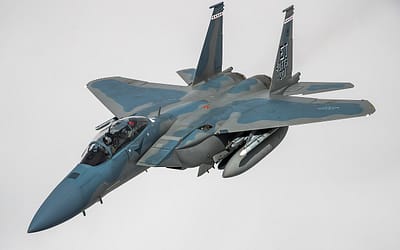
And the first jet that will carry them is the workhorse of the carrier deck: the F/A-18 Super Hornet.
QUICK FACTS
| What | Navy’s first delivery order for the Blackbeard hypersonic missile |
| Order | 50 pre-production rounds + 50 containers — $23.4M firm-fixed-price |
| Announced | 16 June 2026 |
| Target cost | Reportedly under $300,000 per round |
| Speed | In excess of Mach 5 |
| First platform | F/A-18E/F Super Hornet (live firing planned 2027) |
| Maker | Castelion — Torrance, CA; factory in Rio Rancho, NM |
The Navy buys its first 50
These 50 rounds are what Castelion calls “early operational capability” prototypes — not museum pieces, but real weapons the Navy can handle, certify, test-fire and learn from. The work runs primarily out of Project Ranger, the company’s 1,000-acre factory campus in Rio Rancho, New Mexico, and is due to wrap in 2027.
It is the third Navy cheque in five months. In February, Castelion took roughly $50 million to push Blackbeard from prototype toward operational use. In April, the Navy added $105 million specifically to integrate the missile onto the F/A-18 and run the brutal carrier-suitability testing that naval aviation demands. June’s order is the first time the Navy has paid for finished rounds.

Castelion is not a legacy defence prime. It was founded by former SpaceX engineers who looked at the missile business and asked why a weapon couldn’t be built like a rocket — fast, cheap, and improved on every flight. The company says it has flown more than two dozen flight tests in under three years, including a test at Dugway Proving Ground late in 2025.
Why cheap is the whole point
For decades, hypersonics were treated as exquisite, scarce, almost ceremonial weapons. The problem with exquisite is that you run out. A war against a peer adversary burns through missiles faster than any boutique production line can replace them — a lesson the Pentagon keeps relearning.
Blackbeard is the opposite bet: a missile fast enough to matter — comfortably past Mach 5, with a reported reach of several hundred miles — but cheap and simple enough to build by the thousand. If the target price holds, the Navy can afford magazine depth instead of a handful of silver bullets.
That is why a $23.4 million order is a bigger deal than the number suggests. It is the first proof that the “affordable hypersonic” pitch can survive contact with a real purchase order.
From a jet today, a drone boat tomorrow
The Super Hornet gets Blackbeard first, with a live firing planned for 2027. But the missile is not meant to stay bolted under a fighter’s wing. Castelion has teamed with the uncrewed-boat maker Saronic to demonstrate launching Blackbeard from a robotic surface vessel, and in May the company signed a framework agreement with the Department of War aimed at multi-year production of around 500 weapons a year.
If the testing holds up, the plan is to buy them by the thousand. For naval aviation, that turns a single ageing fighter into something it has never really been before: a launch platform for cheap, fast, long-range firepower. The Hornet, it turns out, has at least one big trick left.
Sources: Castelion press releases; U.S. Navy; The Defense Post; Army Recognition; Interesting Engineering; Axios.
Related Questions
What is the Blackbeard missile?
Blackbeard is a low-cost hypersonic strike missile built by the startup Castelion. The U.S. Navy ordered its first 50 rounds in June 2026 for $23.4 million — reportedly under $300,000 each, a fraction of typical hypersonic costs. It will first be carried by the F/A-18 Super Hornet.
Why is a $300,000 hypersonic missile a big deal?
Hypersonic missiles normally cost tens of millions of dollars each and are hand-built in tiny numbers. Castelion aims to mass-produce Blackbeard for under $300,000 a round, making it the first time the U.S. has ordered low-cost hypersonic weapons in any real quantity.
How fast is a hypersonic missile?
Hypersonic weapons travel faster than Mach 5 — five times the speed of sound. Blackbeard is designed to exceed that speed while staying cheap enough to buy in bulk. Several startups, including Mach 5 ventures like Hermeus, are chasing similar speeds.
What aircraft will carry the Blackbeard missile?
The F/A-18E/F Super Hornet, the workhorse of the U.S. carrier deck, with live firing planned for 2027. Integrating a new weapon onto a carrier jet requires the demanding carrier-suitability testing that defines naval aviation.
Who makes the Blackbeard missile?
Castelion, a startup based in Torrance, California, with a 1,000-acre factory campus called Project Ranger in Rio Rancho, New Mexico. The June 2026 order was the Navy’s third payment to Castelion in five months, following deals in February and April.
How much did the U.S. Navy order?
The Navy placed a $23.4 million firm-fixed-price order for the first 50 “early operational capability” Blackbeard rounds plus 50 shipping-and-storage containers. Earlier in 2026 it had paid about $50 million and then $105 million to develop and integrate the missile.

0 Comments