
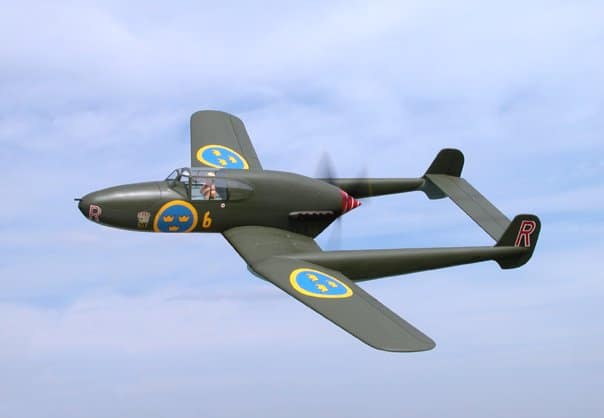
Most fighters carry the engine in the nose and the propeller out front. The Swedish Saab 21 did the opposite: it put the engine behind the pilot and the propeller at the very back, spinning between two slender tail booms. It was an elegant answer to an old problem — a clear nose for a heavy battery of guns and a superb forward view — but it created a lethal new one. How does a pilot bail out without being cut to pieces by the propeller turning directly behind him?
Saab’s solution was an ejection seat, making the J21 one of the first operational aircraft in the world to carry one. And then, in a feat almost no other design ever managed, the entire aircraft was rebuilt as a jet.
Quick Facts
| Type | Swedish single-seat fighter (twin-boom) |
| Piston version (J21A) | Daimler-Benz DB 605B driving a pusher propeller; first flight 30 July 1943; in service December 1945 |
| Safety first | A Bofors ejection seat — one of the first on any operational aircraft, needed because of the rear propeller |
| Jet version (Saab 21R) | de Havilland Goblin turbojet; first flew 10 March 1947; Saab’s first jet |
| Rare distinction | With the Soviet Yak-15, one of only two fighters successfully converted from piston to jet power |
Engine at the back, guns at the front
The pusher layout was deliberate. With a licence-built Daimler-Benz DB 605B and its propeller mounted at the rear of the fuselage nacelle, the nose was free to carry a dense concentration of cannon and machine guns, and the pilot enjoyed an unobstructed view forward. The Saab 21 first flew on 30 July 1943 and entered service in December 1945. The catch was obvious to everyone who looked at it: the propeller arc sat exactly where a pilot would tumble if he tried to jump.
One of the first ejection seats in the world
Saab’s engineers studied several escape methods, including blowing off the propeller or the whole engine with explosive charges before the pilot bailed out. In the end they adopted an ejection seat developed by the defence firm Bofors, fired by a cartridge to throw the pilot up and clear of the blades. It made the J21 one of the first operational aircraft anywhere to be fitted with an ejection seat — a technology that would go on to save thousands of lives.
From propeller to jet
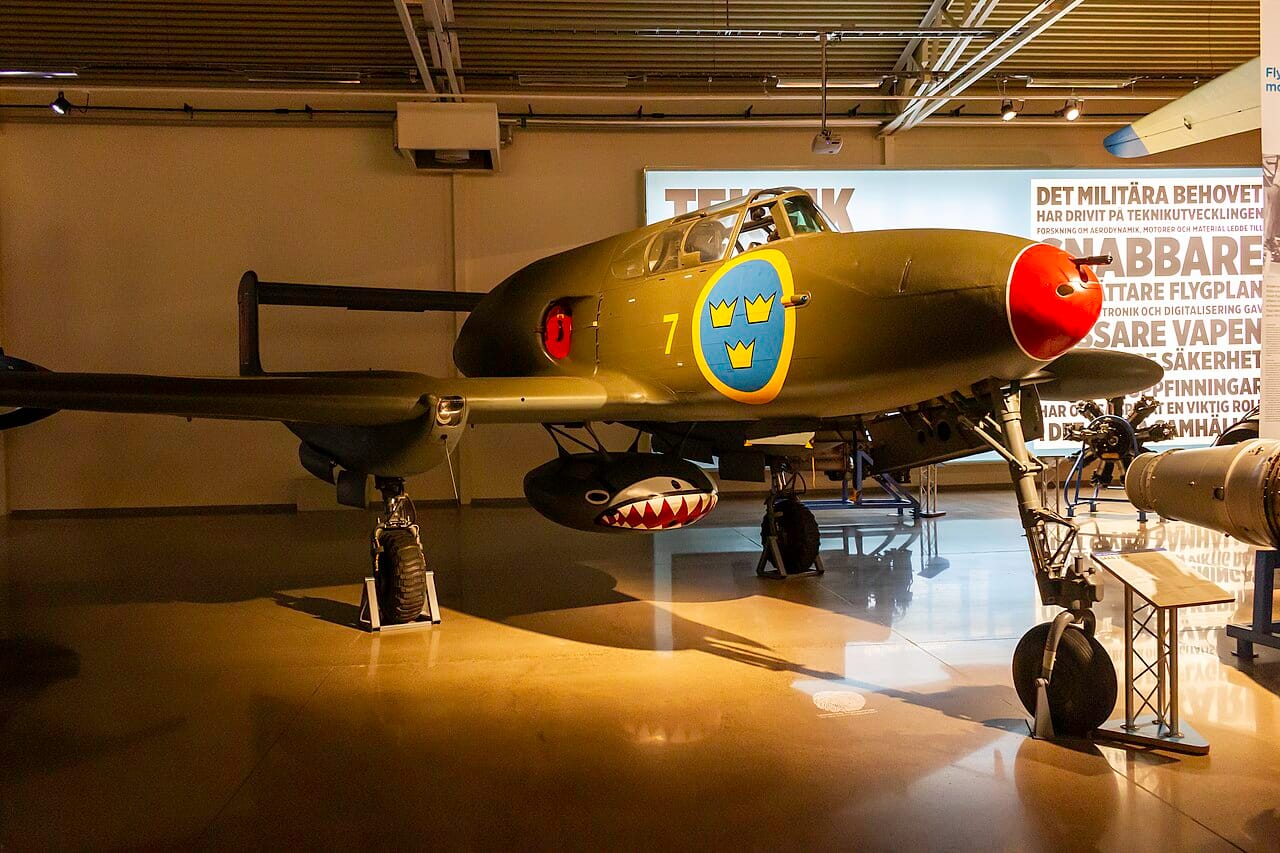
In 1947 Saab did something almost no one else achieved: it turned its piston fighter into a jet. The DB 605 and its propeller were removed and a British de Havilland Goblin turbojet installed in their place, breathing through an intake beneath the nose and exhausting between the booms. More than half of the airframe had to be changed. The first 21R flew on 10 March 1947 in the hands of test pilot Åke Sundén, and it became Saab’s first jet aircraft.
Only one other fighter in history made the same leap successfully — the Soviet Yakovlev Yak-15. The Saab 21 is, almost uniquely, an aircraft that carried its country into the jet age using the body it had already flown as a propeller fighter. Put the propeller where nobody else would, solve the resulting danger with one of the world’s first ejection seats, then keep the airframe and change the engine for a jet: pragmatic, contrarian, and unmistakably Swedish engineering.
Sources: Wikipedia; Plane-Encyclopedia.
Related Questions
What was the Saab 21?
The Saab 21 was a Swedish single-seat fighter of the 1940s with an unusual twin-boom layout and a pusher propeller mounted behind the pilot. It first flew in 1943 and was later rebuilt as a jet, the Saab 21R.
Why did the Saab 21 have a pusher propeller?
Mounting the engine and propeller at the rear left the nose free for a heavy concentration of guns and gave the pilot excellent forward visibility. The trade-off was the danger the rear propeller posed to a pilot trying to bail out.
Did the Saab 21 have an ejection seat?
Yes. Because the propeller sat directly behind the pilot, Saab fitted a Bofors-developed ejection seat so the pilot could escape without striking the blades. It was one of the first operational aircraft in the world with an ejection seat.
What was the Saab 21R?
The Saab 21R was the jet-powered version of the piston-engined Saab 21. A de Havilland Goblin turbojet replaced the engine and propeller, and it became the first jet aircraft built by Saab, first flying on 10 March 1947.
Is the Saab 21 the only aircraft that was both prop and jet?
It is one of only two fighters successfully converted from piston power to jet power. The other was the Soviet Yakovlev Yak-15. This makes the Saab 21 a very rare example of an airframe that served in both forms.
When did the Saab 21 first fly?
The piston-engined Saab 21 first flew on 30 July 1943 and entered service in December 1945. The jet-powered 21R first flew on 10 March 1947.
Related Posts
0 Comentarios