
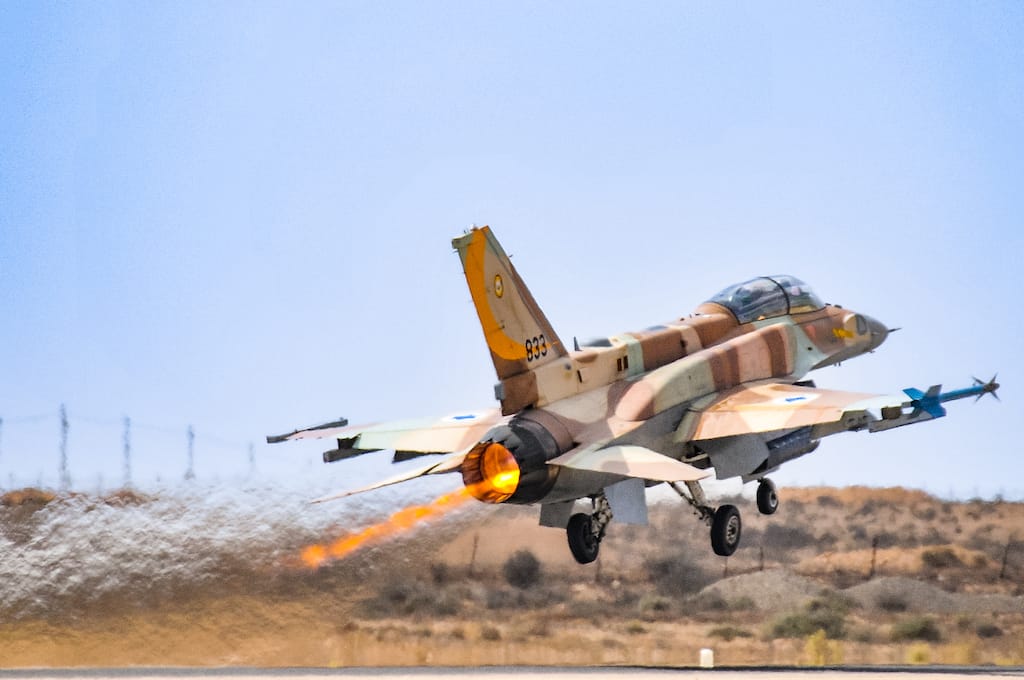
A nighttime photograph released by the Israeli Air Force on March 29 shows a pair of F-16I Sufas taxiing for another strike mission against Iran. The jets are loaded heavy. But the weapons hanging under their wings aren't the precision-guided JDAMs or Rampage standoff missiles usually seen on Israeli jets. They're something far more unusual — and far more controversial.
The munitions have blunt noses with prominent fuzes protruding from the center, largely straight bodies, and flat tail ends. Aviation analysts immediately recognized the profile: Tactical Munitions Dispensers. Cluster bombs. Israel appears to be seeding Iranian missile infrastructure with air-dropped mines.
The likely payload is the CBU-89 Gator system, which carries 72 BLU-91/B anti-tank mines and 22 BLU-92/B anti-personnel mines in a single canister. When released, the dispenser splits open and scatters its submunitions across a wide area. Anything that rolls over them — a transporter-erector-launcher, a fuel truck, a missile reload vehicle — is destroyed.
Sealing the Missile Cities
Iran's ballistic missile program relies on a network of underground facilities — what Western intelligence calls "missile cities." Deep inside mountains, connected by tunnels, these bases shelter Iran's most dangerous weapons. The missiles themselves are survivable. But the roads leading in and out are not.
That's where cluster munitions change the equation. By mining the access roads and staging areas around these underground complexes, Israel can deny Iran the ability to move missiles from storage to launch positions. Even if the bombs and bunker-busters can't reach the missiles underground, the mines can keep them trapped there. No road, no launch.
"This is textbook area denial," said Justin Bronk, a senior research fellow for airpower at the Royal United Services Institute. "You don't need to destroy the missile — you just need to prevent it from reaching the surface."

Over 7,600 Strikes and Counting
The cluster munition sightings come as Operation Roaring Lion — Israel's codename for its part of the campaign — reaches staggering scale. The Israeli Air Force has conducted over 7,600 individual strikes inside Iran. Of those, 4,700 targeted Iran's missile program directly: production facilities, storage bunkers, launch bases, and now the roads connecting them.
In the opening salvo alone, the IAF flew approximately 200 fighter jets and dropped over 1,200 bombs in 24 hours — the largest combat sortie in Israeli Air Force history. Four key ballistic missile production facilities and 29 launch bases have been struck since the campaign began on February 28.
The apparent shift to area-denial weapons like cluster munitions suggests Israel is moving beyond the initial destruction phase. The first wave smashed what it could reach. Now the mines are locking the door on what it couldn't.
A Weapon Both Sides Are Using
The cluster munition revelation carries a sharp irony. Iran has been firing cluster warheads at Israeli cities — a fact documented by Human Rights Watch, which reported on March 30 that Iranian ballistic missiles carrying cluster submunitions have struck civilian areas in central Israel. The weapons scatter hundreds of small bomblets across residential neighborhoods, where they can maim and kill long after the initial strike.
"Every gun that is made, every warship launched, every rocket fired signifies, in the final sense, a theft from those who hunger and are not fed."
— Dwight D. Eisenhower
Neither Israel nor Iran has signed the Convention on Cluster Munitions, the 2008 treaty that bans their use. Nor has the United States, which supplied the Gator system to Israel decades ago. The legal framework is murky. The tactical logic, for both sides, is clear.
But there's a difference between scattering bomblets across a city and mining a military road in a mountain pass. Israel's apparent use targets infrastructure, not population centers. Whether that distinction holds up under scrutiny — legal, moral, or political — is a question this war will eventually have to answer.
For now, the F-16I Sufas keep flying. And somewhere in the Iranian mountains, roads that once led to missile launchers are becoming no-go zones.
Sources: The War Zone; Human Rights Watch; Foundation for Defense of Democracies; IDF
Related Questions
What is the CBU-89 Gator cluster munition?
The CBU-89 Gator is a US air-dropped cluster munition that scatters mines over a wide area. A single canister carries 72 BLU-91/B anti-tank mines and 22 BLU-92/B anti-personnel mines. When released, the dispenser splits open in mid-air and seeds the mines across roads and staging areas to deny enemy movement.
What are cluster munitions?
Cluster munitions are weapons that release many smaller submunitions, or bomblets, over a broad area instead of detonating as a single warhead. Dropped from aircraft or fired by artillery, they blanket a target zone. Because unexploded bomblets can remain dangerous for years, the 2008 Convention on Cluster Munitions bans their use among signatories.
What is a Tactical Munitions Dispenser?
A Tactical Munitions Dispenser (TMD) is the canister-shaped casing that carries and releases cluster submunitions from an aircraft. It has a blunt nose, a largely straight body and a flat tail. After release the dispenser opens and spreads its payload — such as mines or bomblets — across the target area below.
What does area denial mean in military terms?
Area denial means preventing an enemy from using or moving through a space, rather than destroying a specific target. Mining the access roads around underground missile bases, for instance, can trap weapons inside even if the bunkers survive. It is a way to shut down movement near heavily defended sites, such as those protected by Iran's layered air defences.
Has the United States signed the Convention on Cluster Munitions?
No. The United States has not signed the 2008 Convention on Cluster Munitions, the treaty banning their use, production and stockpiling. Neither Israel nor Iran has signed it either. The treaty has been ratified by many nations, but major military powers including the US, Russia and China remain outside it.
What is the F-16I Sufa?
The F-16I Sufa ("Storm") is an Israeli two-seat variant of the F-16 Fighting Falcon, heavily modified for long-range strike. It carries conformal fuel tanks for extended range plus Israeli-made avionics and weapons, and has been a workhorse of Israeli Air Force strike operations, part of a fleet Israel is expanding with new stealth jets.
What is a transporter-erector-launcher (TEL)?
A transporter-erector-launcher (TEL) is a mobile vehicle that carries, raises and fires a ballistic or cruise missile. TELs let forces move missiles between hidden storage and launch sites, making them hard to target. Denying roads with mines is one way to keep these vehicles from reaching firing positions.

0 commentaire