
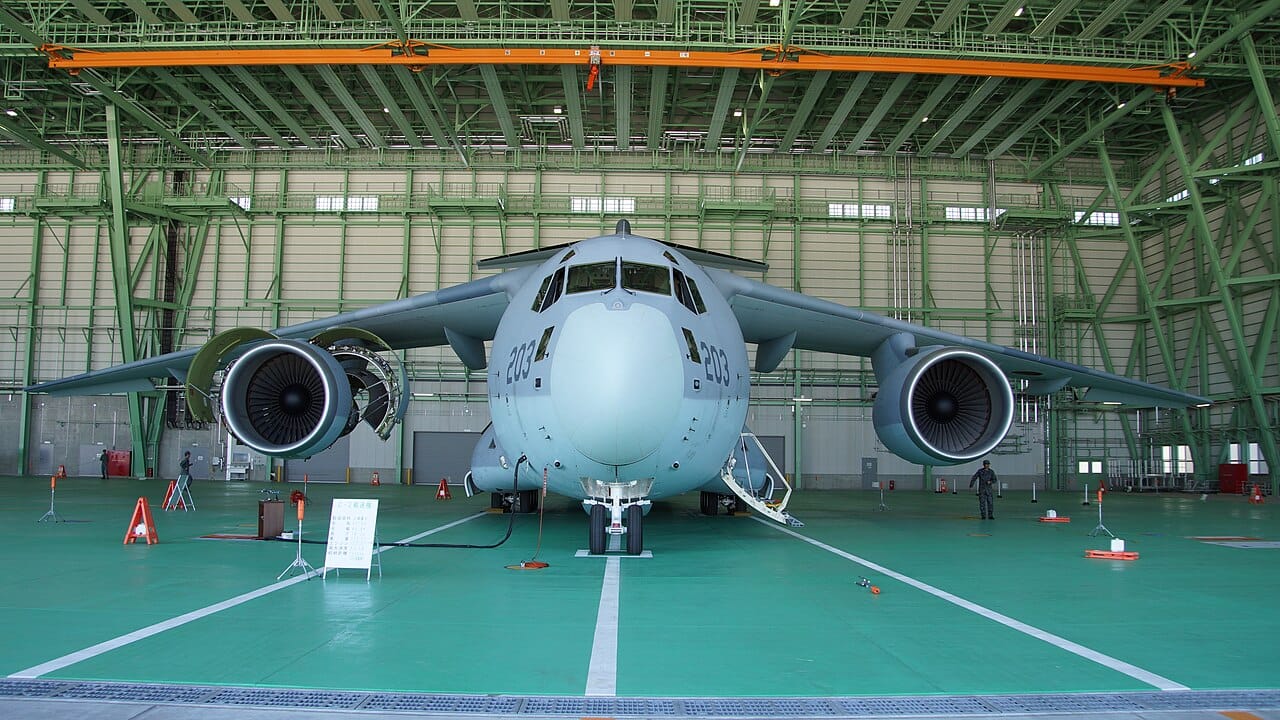
On 28 May 2017, a photographer at Miho Air Base in western Japan took a picture of a Kawasaki C-2 transport, tail number 68-1203. It was an unremarkable aeroplane doing an unremarkable thing: a high-winged, T-tailed freighter on a ramp, clean-lined and entirely conventional.
That same airframe took off from Gifu Air Base on 15 July 2026 with a bulbous grey growth on its nose, two dome-shaped blisters along its spine, and further bulges on the rear fuselage. Japanese spotters call it the kamonohashi, the platypus. The Japan Air Self-Defense Force calls it the XEC-2, and it has just begun the flight-test campaign that will decide whether it enters service.
It is one of the least attractive aircraft flying anywhere in the world. It is also one of the more consequential.
Informations clés
Taper: Kawasaki XEC-2 Stand-Off Jammer (EW-SOJ), converted from a C-2 transport
Cellule : tail number 68-1203
Premier vol : 17 March 2026, from Gifu Air Base
Operational testing began: 15 July 2026, with the JASDF Air Development and Test Wing at Gifu
Baseline airframe: Kawasaki C-2, 43.9 m long, 44.4 m span, two General Electric CF6-80C2 turbofans
Inherited equipment: J/ALQ-5 electronic countermeasures system, from the EC-1
Remplace : the single Kawasaki EC-1, in service since 1986
Planned fleet: four aircraft
Development completion: targeted end of FY2026, service entry FY2027
Future operator: Electronic Warfare Operations Group, Iruma Air Base
What changed on 15 July
The distinction matters and is easy to blur. The XEC-2 has been flying since March. What began on 15 July is something different: the handover from Kawasaki's contractor-led airworthiness programme to the JASDF's own Air Development and Test Wing, which now has to establish flight restrictions, centre-of-gravity limits and whether the aircraft is actually suitable for the job.
Aircraft manufacturers prove that an aeroplane can fly safely. Test wings prove that it can fight. The gap between those two statements is where programmes are quietly killed.
Spotters noted several details on the day. The aircraft now carries the tail flash of the Air Development and Experiment Command, which it did not wear in March. It flew with a JASDF F-2B as chase aircraft. And it used the callsign BOXER, which at Gifu has long belonged to the elderly C-1 transports of the test unit, a small piece of institutional continuity that appears to have amused the Japanese spotting community considerably.

Why the aeroplane looks like that
Nothing about the XEC-2's shape is styling. Every protrusion is an antenna installation, and antenna installations are governed by physics rather than taste.
A stand-off jammer has to radiate very large amounts of electromagnetic energy in specific directions over long distances, which requires large apertures. It has to receive faint signals at the same time without deafening itself, which requires those apertures to be physically separated. The nose sensor, the two dorsal domes and the rear-fuselage bulges are the geometric consequence of those requirements applied to a fuselage that was originally designed to carry pallets.
The C-2 is a reasonable donor airframe for this. It is fast for a transport at Mach 0.82, it has substantial internal volume, and critically it has the electrical generation and cooling capacity to feed high-power transmitters. Inside, cargo space has been given over to receivers, transmitters, processors, operator consoles, power conditioning and cooling plant.
The aircraft it replaces
Japan has operated exactly one dedicated electronic warfare aircraft since 1986: a single Kawasaki EC-1, itself a converted C-1 transport with its own bulbous nose. One aircraft is not a capability. It is a training aid and a technology demonstrator that happened to wear an operational designation.

Four EC-2s is a different proposition. Four airframes can sustain one aircraft on task with maintenance rotation and attrition margin. That is the difference between owning a capability and demonstrating one, and it is the real content of this programme.
Where it fits
The EC-2 is the second specialised variant of the C-2 airframe, following the RC-2 signals intelligence aircraft that first flew in 2018 using the second prototype, 18-1202. Both will eventually be operated by the Electronic Warfare Operations Group at Iruma. The pairing is deliberate: the RC-2 listens and characterises, the EC-2 jams. One builds the picture, the other acts on it.
Japan is not alone in reaching this conclusion. The XEC-2 belongs to the same generation of programmes as the Turkish Hava SOJ, the Australian MC-55A Peregrine, the US Air Force EA-37B Compass Call and the French Archange. Every serious air force has worked out that contested airspace is now defined by the electromagnetic spectrum as much as by radar coverage, and that the aircraft which controls the spectrum decides what everything else is able to do.
Japan chose to build its own rather than buy one, on the reasoning that spectrum warfare is too sensitive to depend on anybody else for. That decision is now sitting on a ramp at Gifu, wearing a nose that no aerodynamicist would have chosen, waiting to find out whether it works.
Sources: The Aviationist, Japan Ministry of Defense, Army Recognition, FlightGlobal, Defense News.

0 commentaire