
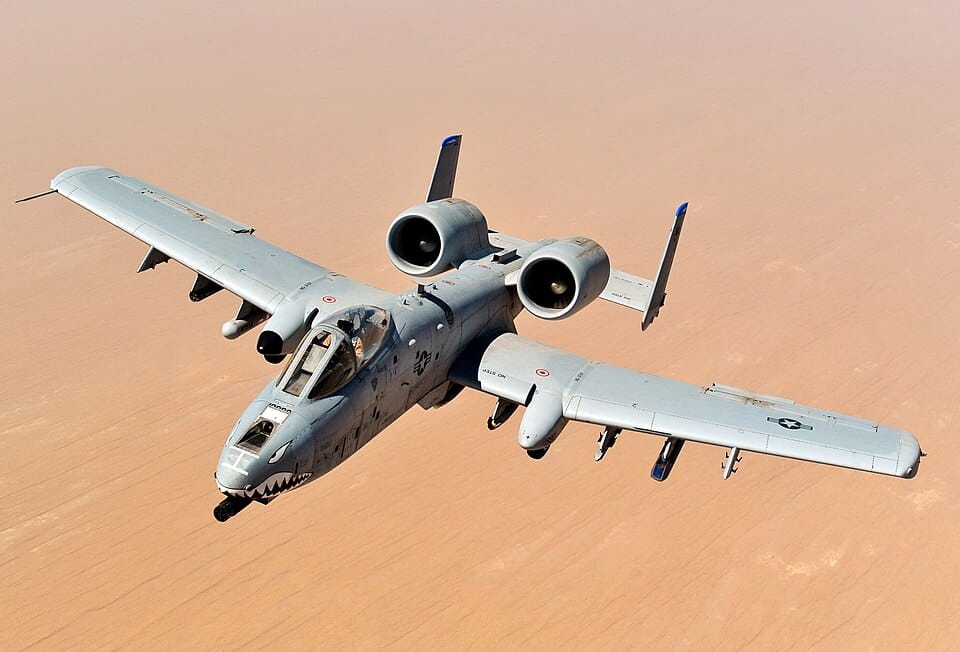
Il est rentré à Portsmouth le 11 octobre 2025, sous l'indicatif TABOR61, son nez orné de deux petites silhouettes de drones de type Shahed et de la figure d'Arès. Garde nationale aérienne de l'Idaho A-10C Elle venait de terminer une mission de six mois dans la zone de responsabilité du CENTCOM. Elle avait traqué des drones — et elle les avait trouvés.
Le A-10 Thunderbolt II, conçu dans les années 1970 pour détruire les chars soviétiques dans les plaines d'Europe centrale, est devenu un redoutable chasseur de drones au Moyen-Orient. Personne ne l'avait prévu ainsi. C'est tout simplement efficace.
L'arme qui change la donne
La méthode standard pour abattre un drone Shahed iranien consiste à tirer un missile : un intercepteur Patriot, un AIM-9 ou un missile NASAMS. Le problème réside dans le coût. La construction d'un Shahed coûte à l'Iran environ 1 400 000 milliards de roupies iraniennes. Les missiles utilisés pour les intercepter coûtent entre 500 000 et plus de 3 400 000 milliards de roupies iraniennes. L'Iran exploite délibérément ce rapport de force, en lançant des essaims de drones bon marché pour épuiser les coûteux stocks de systèmes de défense aérienne occidentaux.
Voici l'A-10, équipé de roquettes à guidage laser AGM-20F FALCO – des munitions du système d'arme de précision avancé (APKWS) dont le coût est bien inférieur à celui d'un missile air-air classique. Un système APKWS coûte environ $28 000. C'est toujours plus cher qu'un drone, mais c'est un rapport de prix acceptable pour l'Occident. L'A-10 offre aux commandants une plateforme mobile et réutilisable pour traquer et détruire les drones sans épuiser leurs stocks d'intercepteurs haut de gamme.

Un avion que l'armée de l'air voulait retirer du service
L'ironie est frappante. L'US Air Force tente de retirer le A-10 du service depuis des années, arguant qu'il est trop lent, trop vulnérable et trop spécialisé pour survivre sur le champ de bataille moderne. Le Congrès a bloqué à plusieurs reprises ces efforts, invoquant souvent les capacités d'appui aérien rapproché de l'appareil. Or, le Warthog accomplit aujourd'hui un exploit inattendu : il démontre qu'à l'ère des drones de combat, une plateforme lente, peu coûteuse et lourdement armée, capable de patrouiller et de traquer les cibles, est précisément ce dont le champ de bataille a besoin.
Deux victoires aériennes sur un seul appareil lors d'un déploiement peuvent paraître modestes. Multipliez ce chiffre par l'échelle d'une flotte et d'une campagne prolongée, et le nouveau rôle du A-10 prend tout son sens stratégique. Le survivant le plus décrié de la Guerre froide pourrait bien avoir obtenu un nouveau sursis.
Sources : The Aviationist ; The War Zone ; Army Recognition ; United 24 Media
Questions connexes
Pourquoi utilise-t-on le A-10 pour abattre des drones ?
L'A-10 est devenu un redoutable chasseur de drones grâce à son rapport coût-efficacité avantageux. Un drone Shahed iranien coûte environ 20 000 TP4T, tandis que les missiles intercepteurs comme le Patriot, l'AIM-9 ou le NASAMS coûtent entre 500 000 et plus de 3 millions de TP4T chacun. Équipé de roquettes APKWS à guidage laser bon marché, l'A-10 traque les drones sans épuiser les stocks de missiles haut de gamme.
Quel est le prix des roquettes APKWS par rapport aux drones ?
Un missile APKWS (le missile à guidage laser AGM-20F FALCO utilisé par le A-10) coûte environ $28 000. C’est toujours plus cher qu’un drone Shahed, qui coûte environ $20 000, mais c’est un ratio que l’Occident peut supporter, contrairement au tir d’intercepteurs à plusieurs millions de dollars. Ce même calcul du coût des drones bon marché permet d’élargir le champ de bataille. drone contre drone concours.
À quoi était destiné le A-10 à l'origine ?
L'A-10 Thunderbolt II a été conçu dans les années 1970 pour détruire les chars soviétiques dans les plaines d'Europe centrale grâce à son canon de 30 mm. Des décennies plus tard, il a trouvé un nouveau rôle imprévu : la chasse aux drones au Moyen-Orient. Cette reconversion a contribué à justifier le maintien de l'appareil en service, comme détaillé dans… Comment l'Iran a sauvé le phacochère.
Un A-10 a-t-il déjà abattu des drones ?
Oui. Un A-10C de la Garde nationale aérienne de l'Idaho est rentré à Portsmouth le 11 octobre 2025, sous l'indicatif TABOR61, arborant deux silhouettes de drones de type Shahed peintes sur son nez après un déploiement de six mois au CENTCOM. Ces marques de victoires ont officialisé la chose : le chasseur de chars de la Guerre froide était devenu un redoutable chasseur de drones.
Pourquoi l'armée de l'air a-t-elle conservé le A-10 malgré sa tentative de retrait du service ?
L'armée de l'air américaine cherche depuis longtemps à retirer du service le A-10, le jugeant trop lent, vulnérable et spécialisé pour le champ de bataille moderne, mais le Congrès a bloqué à plusieurs reprises ces efforts – et le nouveau rôle de l'appareil dans la lutte contre les drones a donné raison à cette décision. Son retrait du service et ses derniers déploiements sont relatés dans [référence manquante]. La dernière guerre du phacochère.
0 commentaire