
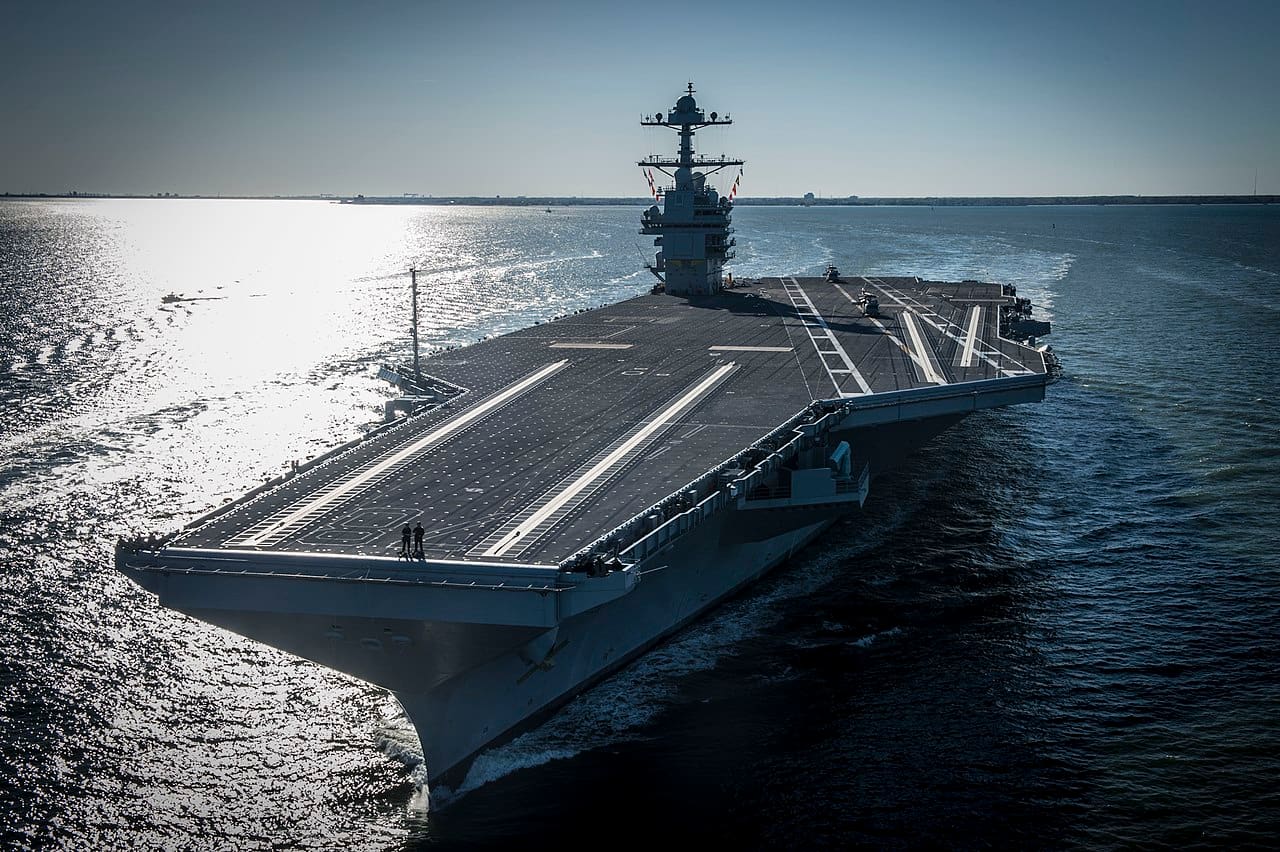
The video below argues that US aircraft carriers are virtually impossible to sink. What do you think? Share your thoughts in the comments.
First of all, attacking a US aircraft carrier is a very bad idea. The United States has a long history of avenging its sunken ships, meaning any attacker would face the full wrath of the American military. Consider Operation Praying Mantis: a U.S. attack within Iranian territorial waters launched in retaliation for the Iranian mining of the Persian Gulf during the Iran–Iraq War, which had damaged the guided-missile frigate USS Samuel B. Roberts. The operation took place on 18 April 1988 and became the largest U.S. naval surface engagement since the Second World War. By its end, U.S. air and surface units had sunk or severely damaged half of Iran’s operational fleet. It is assumed that this decisive response helped pressure Iran into agreeing to a ceasefire with Iraq a few months later, ending the eight-year conflict between the Persian Gulf neighbours.
Want to learn more about aircraft carriers? We put together a mini-series starting with the History of Aircraft Carriers. The second part covers the Exterior of Aircraft Carriers, and the third explores the Interior of Aircraft Carriers. There is also a dedicated article about the USS Gerald R. Ford Class Aircraft Carrier.
Related Questions
Are US aircraft carriers hard to sink?
US aircraft carriers are widely considered extremely difficult to sink, protected by a strike group of escorts, aircraft, and submarines. Beyond their defences, attacking one risks the full retaliation of the US military, which has a long history of avenging losses at sea.
What was Operation Praying Mantis?
Operation Praying Mantis was a US naval attack on April 18, 1988, inside Iranian territorial waters, launched in retaliation after Iran mined the Persian Gulf and damaged the frigate USS Samuel B. Roberts. It became the largest US naval surface engagement since World War II.
What happened during Operation Praying Mantis?
On April 18, 1988, US air and surface units sank or severely damaged about half of Iran's operational fleet in a single day. The decisive action is believed to have helped pressure Iran toward a ceasefire with Iraq months later, ending their eight-year war.
What is a US carrier strike group?
A carrier strike group surrounds the carrier with guided-missile cruisers and destroyers, attack submarines, and embarked aircraft, layering defences against air, surface, and underwater threats. This combination is a major reason carriers are so hard to attack successfully.
How do aircraft carriers launch jets?
Carriers use catapults to accelerate aircraft from a standstill to flying speed in seconds along a short deck. The latest US supercarriers use electromagnetic launch systems in place of older steam catapults — here is how carriers launch jets.
What is the newest US aircraft carrier?
The USS Gerald R. Ford is the lead ship of America's newest class of supercarriers, introducing technologies such as electromagnetic catapults and advanced arresting gear to launch and recover aircraft more efficiently than previous classes.

China has a non nuclear ICBM,that was specificlly made to sink an aircraft carrier.Also cruise missles would be deadly to any surface ship if they were launched in volume.
American navy it’s the baddest in the world and the most powerful . . Iam just lucky Iam in the winning side .
Most of China’s military might as well be crippled beyond repair. I mean does anyone seriously believe their propaganda? They can’t even manufacture toy’s properly, so why in the hell do you simpletons believe they’re a threat.
Come on seriously the first time they embarked on developing a biological weapon they fucking “accidentally” released it….accident my ass, the world shouldn’t be so cowardly. Put china in it’s place Russia before the world does it for you.
The US navy has not only unequal experice with carrier based warfare, it has more Carriers than the rest of the world together. In operation dessert storm 2 carriers demonstrated there durability and fighter strength. As I recall one missil aimed on a carrier was shot down by a SAM,
The US Navy also practice relentlessly. In the pacific they gaurd a surface area of 1/3 of the globe. The only thing they fear is high tech Russian subs. And I think thats why they have never put in service in the eastersea of the nordics.
Carriers could be severely damaged or sunk by large hyper velocity air to surface missiles and torpedoes.
Metal is heavier than water, breach the hull enough, it will sink!