
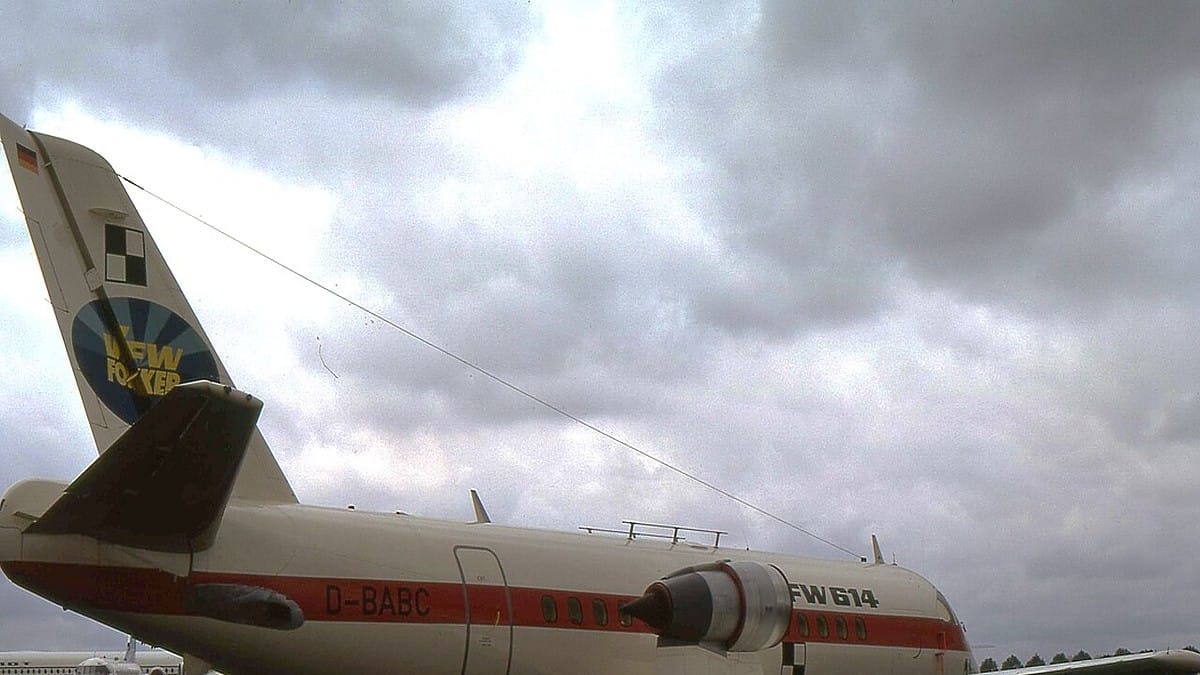
Look at almost any jet airliner and the engines are in one of two places: slung under the wings, or bolted to the tail. Now look at the VFW-614. Its two engines sit on pylons on top of the wings — a layout almost no other airliner in history has ever used.
It was West Germany’s first jet airliner, and one of the most quietly radical designs of the 1970s. It was also a commercial disaster. Both facts are worth remembering.
| Aircraft | VFW-Fokker 614 |
| Distinction | First jet airliner built in West Germany |
| Engines | Two Rolls-Royce/SNECMA M45H, mounted above the wings |
| First flight | 14 July 1971 |
| Built | Just 19 aircraft |
Why put the engines on top?
It was not a gimmick. The VFW-614 was conceived as a small, tough regional jet to do the job the ageing Douglas DC-3 still did in the 1960s: fly short hops into small, sometimes rough, airfields. Mounting the two turbofans above the wings served that mission with cold German logic.
Up there, the engines were kept well clear of stones and debris thrown up from unpaved runways — a real hazard for low-slung underwing engines. The layout also avoided the structural weight penalty of hanging engines off the rear fuselage, and it let the cabin sit low to the ground so passengers and freight could be loaded without tall airstairs or special equipment. Every strange choice had a reason.
A rough start
The first of three prototypes flew on 14 July 1971 — and, unusually, that flight was also the very first time the M45H engine had ever been airborne, having skipped the usual flying test-bed stage. Then came disaster. On 1 February 1972 the first prototype, D-BABA, was lost to elevator flutter; two of the three crew survived, but the airframe was destroyed and confidence in the programme took a heavy blow.
Deliveries eventually followed. Denmark’s Cimber Air put the type into service in 1975; France’s Touraine Air Transport became the largest operator with eight; the West German Luftwaffe flew three as VIP transports until 1999. But the numbers never grew.
Beaten by the market, saved by science
Only nineteen VFW-614s were ever built. The aircraft arrived into the teeth of the 1970s oil crisis and fierce competition, Lufthansa showed little interest, the economics never worked, and production was halted in 1977. When VFW itself was wound up in 1981, the type lost its support and quietly faded from airline fleets.
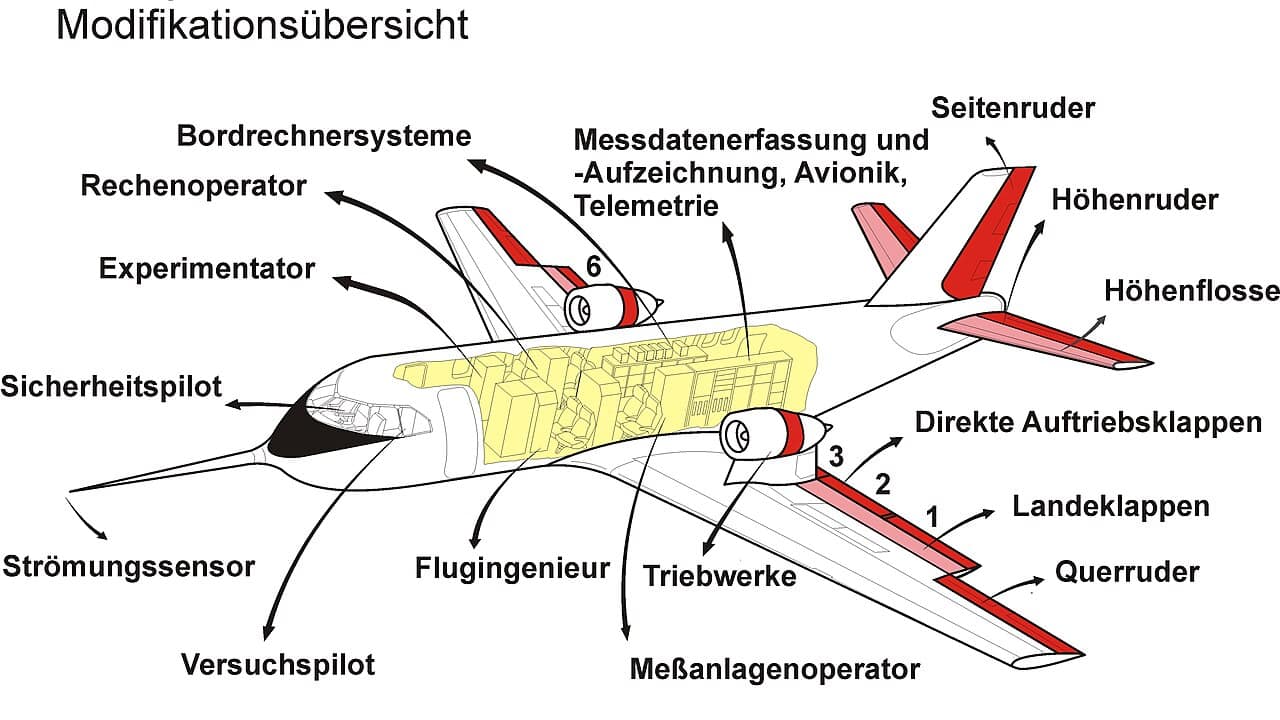
Yet the story has a graceful epilogue. The German aerospace research agency DLR took one VFW-614 and rebuilt it as “ATTAS,” a flying laboratory used to test fly-by-wire controls and flight-research systems for decades, into the 2010s. The over-wing engine never caught on for airliners — though decades later the HondaJet business aircraft would revive the idea — but the VFW-614 remains a small monument to doing the unconventional thing for entirely sensible reasons.
Sources: Deutsches Museum; DLR; Wikipedia.
Related Questions
What was the VFW-614 airliner?
The VFW-Fokker 614 was West Germany's first jet airliner, a small regional jet of the 1970s notable for mounting its two engines on pylons above the wings, a layout almost no other airliner has ever used. First flying on 14 July 1971, it was a quietly radical design and a commercial disaster, with just 19 aircraft built.
Why were the VFW-614's engines mounted on top of the wings?
It was not a gimmick. The VFW-614 was designed as a tough regional jet for short hops into small, sometimes rough airfields, replacing aircraft like the ageing Douglas DC-3. Mounting the two Rolls-Royce/SNECMA M45H turbofans above the wings kept them clear of stones and debris kicked up from rough runways, and kept the cabin floor low for easy loading.
How many VFW-614s were built?
Only nineteen VFW-614s were ever built. The aircraft arrived into the teeth of the 1970s oil crisis and fierce competition; Lufthansa showed little interest and the economics never worked. Operators included Denmark's Cimber Air, France's Touraine Air Transport and the West German Luftwaffe, which flew three as VIP transports until 1999. Production halted in 1977.
Why did the VFW-614 fail commercially?
The VFW-614 was beaten by the market rather than the concept. It entered service amid the 1970s oil crisis and intense competition, a 1972 prototype crash from elevator flutter dented confidence, and Lufthansa's lack of interest hurt sales. When manufacturer VFW was wound up in 1981, the type lost support and faded from airline fleets after just 19 examples, unlike enduring designs such as the Boeing 747.
What was unusual about West German aviation projects of this era?
Post-war West Germany produced several bold, unconventional aircraft as it rebuilt its aerospace industry, from the over-wing-engined VFW-614 airliner to the vertical-takeoff VFW VAK-191B strike fighter. These designs often chose the unconventional path for entirely sensible engineering reasons, even when the market or the physics ultimately worked against them.
0 Comments