
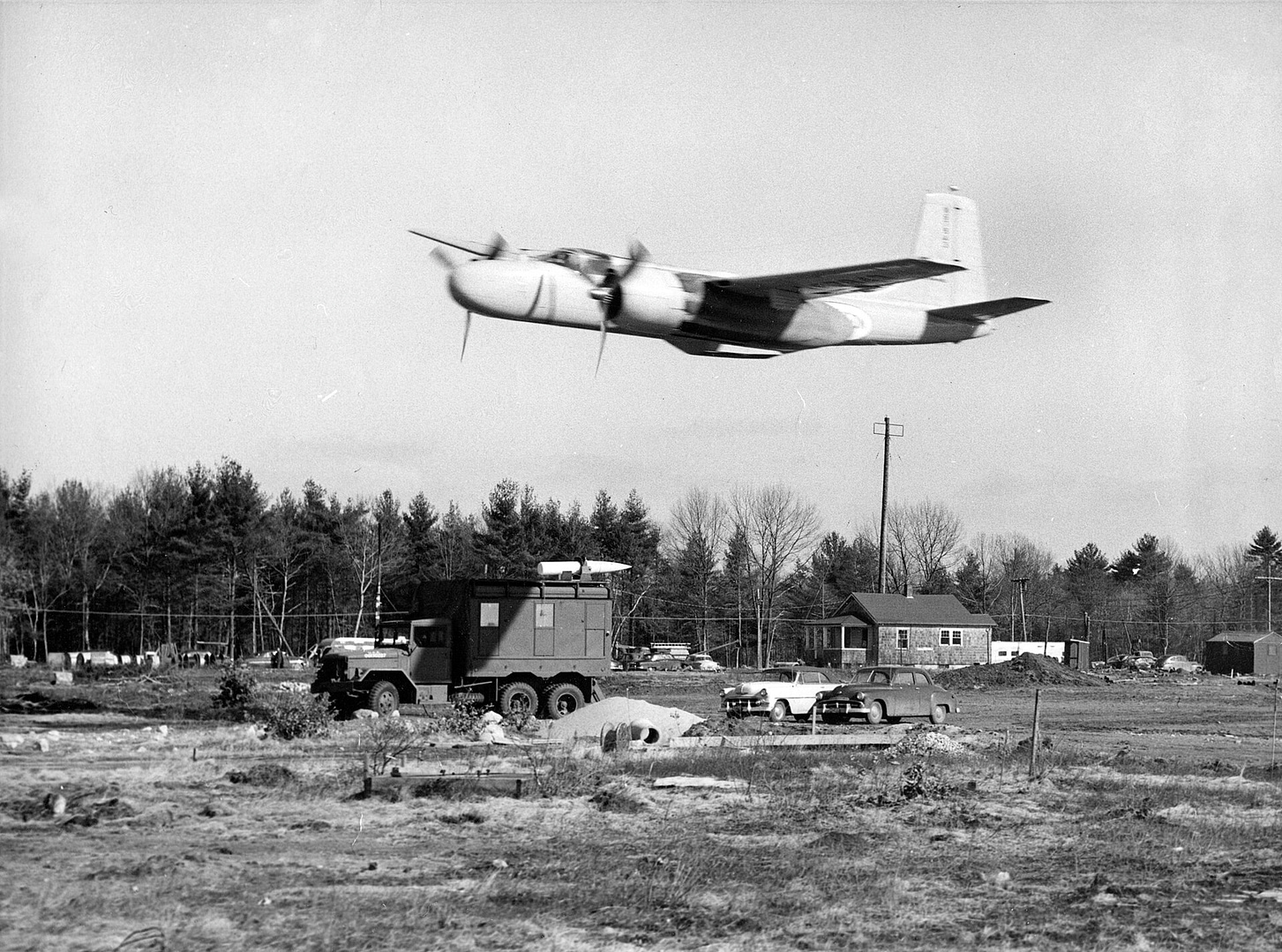
Douglas A-26 / B-26
“Invader”
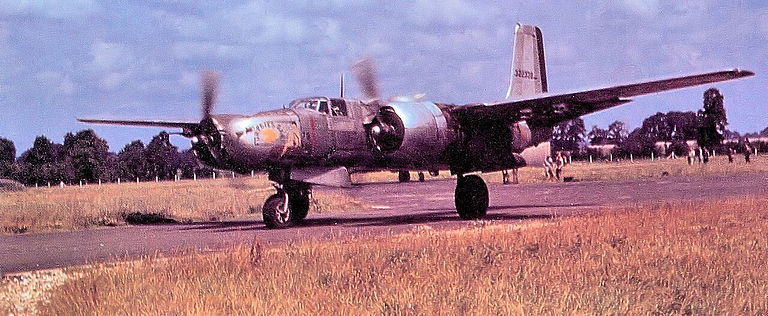
The fast twin-engine attack bomber that fought in three American wars — World War II, Korea and Vietnam — and confused everyone by wearing two different names along the way.
One airframe, two names, three wars
When the Douglas team under Ed Heinemann laid out the A-26 in 1941, the brief was simple: build a twin-engine attack bomber faster, tougher and harder-hitting than the A-20 Havoc it was meant to replace. The prototype XA-26 first flew on 10 July 1942, and it delivered — a clean, fast machine wrapped around two Pratt & Whitney R-2800 Double Wasp radials, able to touch roughly 570 km/h and carry a heavy bomb load with, in its gun-nose form, a punishing battery of forward-firing .50-calibre machine guns.
The Invader reached combat late — the first missions over Europe came in 1944 — but it arrived in two very different guises. The “glass-nose” A-26C carried a bombardier for level bombing; the “gun-nose” A-26B traded him for six or eight fixed .50-calibre guns and went in low as a strafer. It served with the Ninth Air Force over Germany and in the Pacific, and by VJ-Day it was regarded as one of the best light bombers of the war.
Then came the confusion that has dogged the type ever since. In 1948, after the Martin B-26 Marauder was retired, the USAF reused the designation and the A-26 became the B-26 — so the same aircraft that fought WWII as the A-26 flew the Korean War as the B-26. There it found its signature mission: night interdiction, prowling alone in the dark over North Korean roads and rail lines, hunting trucks and trains until an armistice in 1953.
Officially retired in 1958, the Invader refused to die. When the United States needed a rugged piston-engine attack aircraft for the counter-insurgency war in Southeast Asia, it came back — first as tired WWII airframes flown covertly under Project Farm Gate, then, after wing-fatigue groundings, as the extensively rebuilt On Mark B-26K “Counter-Invader.” Flying from Thailand under the call-sign “Nimrod,” the B-26K became a feared truck-killer over the Ho Chi Minh Trail until 1969. Along the way the type also flew for the CIA at the Bay of Pigs in 1961 and for Frankrijk in Indochina and Algeria — making the Invader one of very few aircraft types to see combat in all three of the mid-century American wars.
Its final career was civilian: surplus Invaders became fast fire-bombers and executive conversions in the 1960s and 70s, until a run of wing-spar fatigue failures grounded many and thinned the survivors. Even so, a handful still fly today as lovingly kept warbirds.
01The Douglas A-26 Invader’s three wars: how one design outlived its own era
Very few combat aircraft fought in World War II, Korea En Vietnam. The Invader did all three — not as a museum curiosity dragged out of storage, but as a front-line weapon each time. In 1944–45 it was a fast Ninth Air Force attack bomber over Europe. Renamed B-26 in 1948, it flew the Korean War’s lonely night-interdiction campaign, and USAF crews flew the war’s last bombing sortie in an Invader minutes before the 1953 armistice. A decade later, rebuilt as the B-26K, it was killing trucks on the Ho Chi Minh Trail. That longevity came from a simple truth: for hunting soft targets at low level, day or night, a rugged, heavily armed piston twin with long endurance was hard to beat — and nothing in the jet age quite replaced it until the dedicated gunships and the A-1 Skyraider took over the role.
What makes it special
A fast twin with a shotgun for a nose
The A-26 paired two 2,000-hp R-2800 Double Wasp radials with a clean, laminar-flow wing, giving it roughly 570 km/h — fast for a WWII attack bomber. The gun-nose A-26B then bolted on six or eight fixed .50-calibre guns firing straight ahead; with optional under-wing and turret guns, some configurations mounted up to ten to fourteen .50-cals, on top of a 1,800 kg internal bomb load. It could strafe, skip-bomb and level-bomb from the same airframe.
Three wars — and a total rebuild as the B-26K
By the 1960s the surviving WWII airframes were dangerously fatigued. On Mark Engineering answered with the B-26K Counter-Invader: rebuilt fuselage and tail, strengthened wing, uprated 2,500-hp engines, reversible propellers, wingtip tanks and eight wing pylons roughly doubling the ordnance load. It was effectively a new aircraft inside an old shape, and it let a 1943 design fight credibly in 1968.
The night-interdiction and COIN specialist
The Invader’s enduring niche was hunting alone in the dark. Over Korea, gloss-black B-26s flew solo night-intruder sorties against truck convoys and trains. Over Laos, B-26K “Nimrods” did the same on the Ho Chi Minh Trail. Long endurance, a heavy and varied weapons fit, and a crew to work the targets made it one of the best counter-insurgency (COIN) attack aircraft of its day.
02The A-26 vs B-26 designation: why the Invader has two names
There were two completely different American “B-26s.” The first was the Martin B-26 Marauder, a WWII medium bomber. The second was the Douglas Invader — built as the A-26 under the old “A” (attack) category. When the USAF dropped the separate attack category and the Martin Marauder was withdrawn, the Invader was redesignated B-26 in 1948, inheriting the very number its predecessor had just vacated. So a “B-26” in 1944 is a Martin Marauder; a “B-26” in 1951 is a Douglas Invader. Douglas re-adopted the “A-26” label again in Vietnam for political reasons — the B-26K was briefly re-styled A-26A so it could be based in Thailand, where “bombers” were not welcome. Few aircraft have generated as much honest confusion.
03The On Mark B-26K Counter-Invader: rebuilding a WWII bomber for Vietnam
The first Invaders sent to Vietnam were worn-out war-surplus machines, and in 1964 a series of in-flight wing failures forced their withdrawal. Rather than abandon a proven weapon, the USAF had On Mark Engineering remanufacture the type. The resulting B-26K (first YB-26K in 1963) had strengthened wings with a redesigned spar, more powerful water-injected R-2800 engines, reversible propellers for short fields, permanent wingtip fuel tanks, and eight underwing pylons. Ordnance capacity rose from around 6,000 to roughly 12,000 lb. Redesignated A-26A to sidestep basing politics in Thailand, these aircraft flew night interdiction over Laos until November 1969.
Full specifications
Airframe & Performance (A-26B)
- Bemanning
- 3 (pilot, navigator/bombardier, gunner)
- Lengte
- ~15.6 m (51 ft)
- Spanwijdte
- ~21.3 m (70 ft)
- Hoogte
- ~5.6 m (18 ft 6 in)
- Max takeoff weight
- ~15,900 kg (35,000 lb)
- Max speed
- ~570 km/h (~355 mph)
- Serviceplafond
- ~6,700 m (~22,000 ft)
- Bereik
- ~2,300 km (~1,400 mi)
- First flight
- 10 July 1942 (XA-26)
- Built
- ~2,503 (1943–1945)
Propulsion, Armament & Cost
- Engines
- 2 × Pratt & Whitney R-2800 Double Wasp
- Power (each)
- ~2,000 hp (~2,500 hp on the B-26K)
- Guns
- Up to ~10 × .50-cal M2 (6–8 in gun nose)
- Bomb load
- ~1,800 kg (4,000 lb) internal; more external on B-26K
- Later variant
- On Mark B-26K “Counter-Invader” (A-26A)
- Unit cost
- ~$192,000–$250,000 (1944, estimate)
- Cost per flight hour
- No reliable public figure
- Redesignated
- B-26 in 1948
04The A-26 Invader’s cost: what a wartime attack bomber was worth
As a mass-produced 1940s military aircraft, the Invader never had an open-market price, and figures vary by source and year. A wartime flyaway cost is commonly cited in the region of $192,000 to $250,000 — roughly comparable to other twin-engine attack bombers of the period — but that should be read as an order-of-magnitude estimate rather than a precise ledger figure. No credible modern cost-per-flight-hour number exists for the type; today the meaningful costs are those of keeping a handful of warbird Invaders airworthy, which run into the many hundreds of dollars per hour in fuel alone for two thirsty R-2800 radials. Any exact dollar figure attached to an A-26 is, in practice, an estimate.
From wartime attack bomber to Cold-War COIN veteran
First flight
The Douglas XA-26 prototype, designed under Ed Heinemann, flies for the first time on 10 July as a successor to the A-20 Havoc.
Combat debut
The A-26 enters combat over Europe with the Ninth Air Force, and later in the Pacific, in both glass-nose and gun-nose forms.
A-26 becomes B-26
With the Martin B-26 Marauder retired, the USAF redesignates the Invader as the B-26 — the source of decades of confusion.
Korean night intruder
Gloss-black B-26s fly the lonely night-interdiction war against North Korean supply lines; an Invader flies the war’s last bombing sortie.
Bay of Pigs
CIA-supplied B-26s attack Cuban airfields in support of the failed Bay of Pigs invasion.
French service
France flies Invaders in the First Indochina War — including over Dien Bien Phu — and later in the Algerian War.
B-26K over the Trail
The rebuilt On Mark B-26K “Nimrod” flies night interdiction against the Ho Chi Minh Trail from Thailand until withdrawal in 1969.
Fire-bombers and warbirds
Surplus Invaders serve as civil fire-bombers until wing-fatigue failures ground many; a handful still fly as preserved warbirds today.
Twelve stories from three wars
Heinemann’s answer to the Havoc
Douglas built the A-26 to be faster and harder-hitting than the A-20 it replaced.
Read the full story
Gun nose or glass nose
The Invader came in a strafer version and a level-bomber version of the same aircraft.
Read the full story
With the Ninth over Germany
The Ninth Air Force embraced the Invader in the last year of the war in Europe.
Read the full story
How the A-26 became the B-26
A quirk of USAF paperwork gave the Invader the number of a different bomber.
Read the full story
The lonely night war
Black-painted B-26s hunted trucks and trains alone in the Korean dark.
Read the full story
The Bay of Pigs
Unmarked B-26s flew the air campaign for the failed Cuban invasion.
Read the full story
Invaders at Dien Bien Phu
France flew the B-26 in its own losing war in Indochina.
Read the full story
Farm Gate
Old Invaders returned to war under a covert training programme.
Read the full story
A new aircraft in an old shape
On Mark Engineering rebuilt the tired Invader into the B-26K.
Read the full story
Nimrod on the Trail
B-26K crews became feared truck-killers over the Ho Chi Minh Trail.
Read the full story
An Invader diaspora
Surplus Invaders ended up in air forces around the world.
Read the full story
Fire-bombers and fatigue
As a civil tanker the Invader met its limit in cracked wing spars.
Read the full story
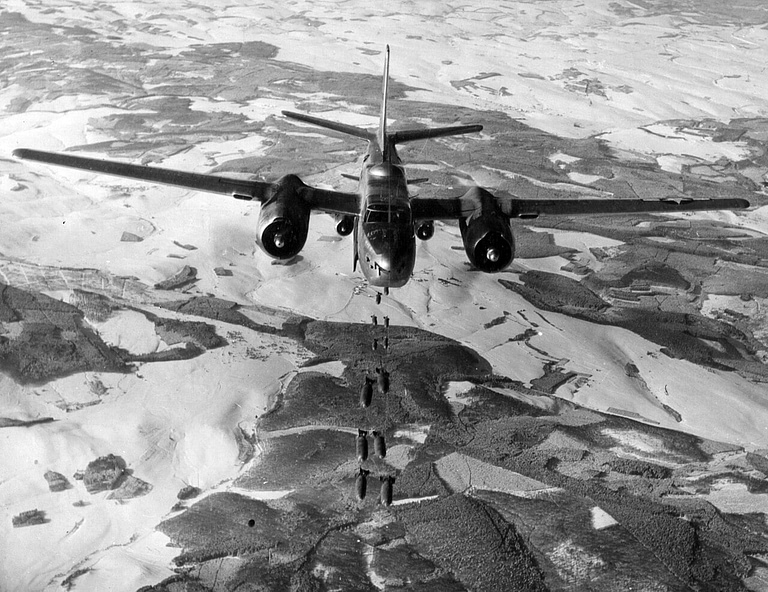
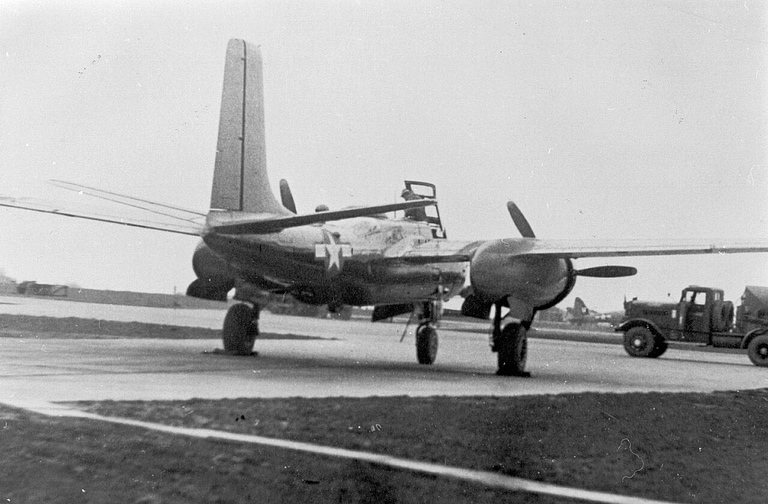
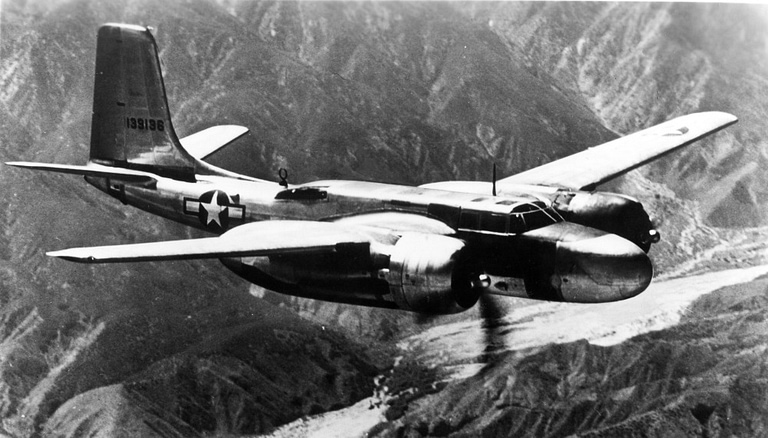
The Invader in pictures


The Invader in motion
Video coming soon. We are curating a high-quality documentary clip on the Douglas A-26 Invader — its three-war career and the B-26K Counter-Invader rebuild — and will add it here.
Where the Invader flew
The record that defines it
The Invader’s combat story is not measured in air-to-air kills — it was an attack aircraft, not a fighter. Its record is one of endurance and reach: a single design that struck ground targets in World War II, Korea and Vietnam, plus covert and colonial wars in between. Its most famous work was done alone, at night, low over enemy supply lines.
Compare the combat record of every military aircraft. Figures as of August 2026.
Everything people ask about the A-26 Invader
Can I fly in an A-26 Invader?
Why is the A-26 also called the B-26?
What made the A-26 Invader special?
Did the A-26 fight in Vietnam?
Was the A-26 used at the Bay of Pigs?
How many A-26 Invaders were built, and are any still flying?
You can’t fly the Invader.
These, you can.
Some legends only live in museums — others are fuelled and waiting. MiGFlug has put civilians in real military jet cockpits since 2004.
 Fly the L-39 AlbatrosThe world’s most-flown jet trainer — aerobatics included
 Fly the F-104 Starfighter“The missile with a man in it”
 Fly the MiG-21The Cold War’s most-produced jet
 Vlieg met de T-33 Shooting StarAmerica’s first jet trainer
 Fly the DH VampireA piece of early jet history
 Fly the S.211Agile Italian jet trainer
 Fly the MB-326The classic Aermacchi jet
 Fly the MiG-15The Soviet legend of the Korean War
Continue the tour
Every fact, checked
- National Museum of the U.S. Air Force — Douglas B-26K (A-26) Counter InvaderPrimary reference for the B-26K rebuild, Southeast Asia service and specifications.
- Vintage Aviation News — First flight of the A-26 InvaderFirst-flight date, gun-nose/glass-nose variants and production totals.
- Military Matters — The B-26K Counter InvaderBay of Pigs, Operation Millpond, Farm Gate and the On Mark rebuild.
- Military Factory — Douglas A-26 / B-26 InvaderAirframe dimensions, weights, powerplant and armament data.
- Pima Air & Space Museum — Douglas B-26KMuseum reference for the Counter-Invader and its Nimrod operations.
- Warbirds Resource Group — A-26 Invader operationsOperational history across WWII, Korea and Vietnam.
- Aeropedia — Douglas A-26 InvaderVariant history, foreign operators and the designation change.
- Vintage Flying Museum — Douglas A-26KReference for a preserved Counter-Invader airframe.