
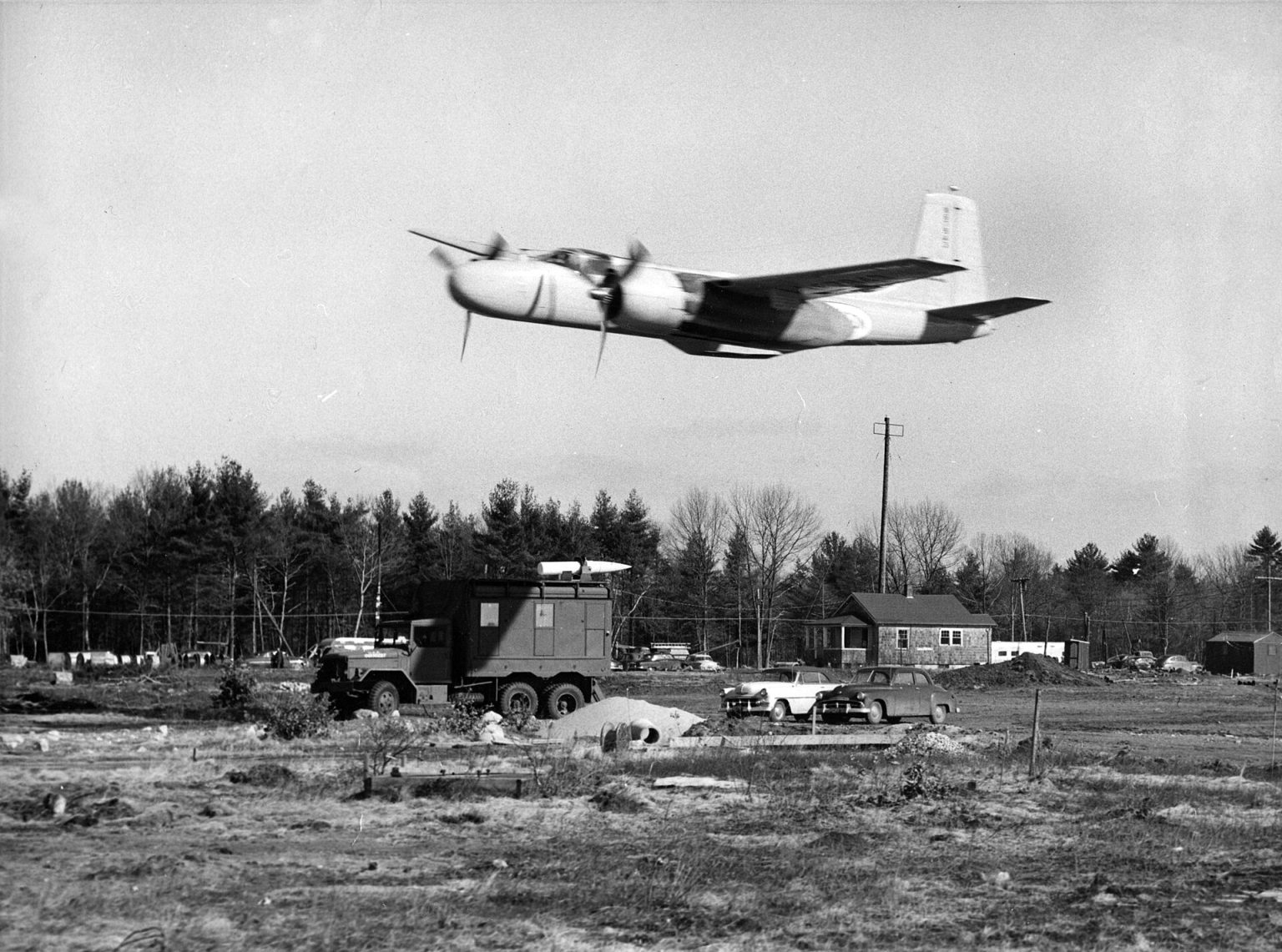
Douglas A-26 / B-26
“Invader”
The fast twin-engine attack bomber that fought in three American wars — World War II, Korea and Vietnam — and confused everyone by wearing two different names along the way.
One airframe, two names, three wars
When the Douglas team under Ed Heinemann laid out the A-26 in 1941, the brief was simple: build a twin-engine attack bomber faster, tougher and harder-hitting than the A-20 Havoc it was meant to replace. The prototype XA-26 first flew on 10 July 1942, and it delivered — a clean, fast machine wrapped around two Pratt & Whitney R-2800 Double Wasp radials, able to touch roughly 570 km/h and carry a heavy bomb load with, in its gun-nose form, a punishing battery of forward-firing .50-calibre machine guns.
The Invader reached combat late — the first missions over Europe came in 1944 — but it arrived in two very different guises. The “glass-nose” A-26C carried a bombardier for level bombing; the “gun-nose” A-26B traded him for six or eight fixed .50-calibre guns and went in low as a strafer. It served with the Ninth Air Force over Germany and in the Pacific, and by VJ-Day it was regarded as one of the best light bombers of the war.
Then came the confusion that has dogged the type ever since. In 1948, after the Martin B-26 Marauder was retired, the USAF reused the designation and the A-26 became the B-26 — so the same aircraft that fought WWII as the A-26 flew the Korean War as the B-26. There it found its signature mission: night interdiction, prowling alone in the dark over North Korean roads and rail lines, hunting trucks and trains until an armistice in 1953.
Officially retired in 1958, the Invader refused to die. When the United States needed a rugged piston-engine attack aircraft for the counter-insurgency war in Southeast Asia, it came back — first as tired WWII airframes flown covertly under Project Farm Gate, then, after wing-fatigue groundings, as the extensively rebuilt On Mark B-26K “Counter-Invader.” Flying from Thailand under the call-sign “Nimrod,” the B-26K became a feared truck-killer over the Ho Chi Minh Trail until 1969. Along the way the type also flew for the CIA at the Bay of Pigs in 1961 and for France in Indochina and Algeria — making the Invader one of very few aircraft types to see combat in all three of the mid-century American wars.
Its final career was civilian: surplus Invaders became fast fire-bombers and executive conversions in the 1960s and 70s, until a run of wing-spar fatigue failures grounded many and thinned the survivors. Even so, a handful still fly today as lovingly kept warbirds.
01The Douglas A-26 Invader’s three wars: how one design outlived its own era
Very few combat aircraft fought in World War II, Korea and Vietnam. The Invader did all three — not as a museum curiosity dragged out of storage, but as a front-line weapon each time. In 1944–45 it was a fast Ninth Air Force attack bomber over Europe. Renamed B-26 in 1948, it flew the Korean War’s lonely night-interdiction campaign, and USAF crews flew the war’s last bombing sortie in an Invader minutes before the 1953 armistice. A decade later, rebuilt as the B-26K, it was killing trucks on the Ho Chi Minh Trail. That longevity came from a simple truth: for hunting soft targets at low level, day or night, a rugged, heavily armed piston twin with long endurance was hard to beat — and nothing in the jet age quite replaced it until the dedicated gunships and the A-1 Skyraider took over the role.
What makes it special
A fast twin with a shotgun for a nose
The A-26 paired two 2,000-hp R-2800 Double Wasp radials with a clean, laminar-flow wing, giving it roughly 570 km/h — fast for a WWII attack bomber. The gun-nose A-26B then bolted on six or eight fixed .50-calibre guns firing straight ahead; with optional under-wing and turret guns, some configurations mounted up to ten to fourteen .50-cals, on top of a 1,800 kg internal bomb load. It could strafe, skip-bomb and level-bomb from the same airframe.
Three wars — and a total rebuild as the B-26K
By the 1960s the surviving WWII airframes were dangerously fatigued. On Mark Engineering answered with the B-26K Counter-Invader: rebuilt fuselage and tail, strengthened wing, uprated 2,500-hp engines, reversible propellers, wingtip tanks and eight wing pylons roughly doubling the ordnance load. It was effectively a new aircraft inside an old shape, and it let a 1943 design fight credibly in 1968.
The night-interdiction and COIN specialist
The Invader’s enduring niche was hunting alone in the dark. Over Korea, gloss-black B-26s flew solo night-intruder sorties against truck convoys and trains. Over Laos, B-26K “Nimrods” did the same on the Ho Chi Minh Trail. Long endurance, a heavy and varied weapons fit, and a crew to work the targets made it one of the best counter-insurgency (COIN) attack aircraft of its day.
02The A-26 vs B-26 designation: why the Invader has two names
There were two completely different American “B-26s.” The first was the Martin B-26 Marauder, a WWII medium bomber. The second was the Douglas Invader — built as the A-26 under the old “A” (attack) category. When the USAF dropped the separate attack category and the Martin Marauder was withdrawn, the Invader was redesignated B-26 in 1948, inheriting the very number its predecessor had just vacated. So a “B-26” in 1944 is a Martin Marauder; a “B-26” in 1951 is a Douglas Invader. Douglas re-adopted the “A-26” label again in Vietnam for political reasons — the B-26K was briefly re-styled A-26A so it could be based in Thailand, where “bombers” were not welcome. Few aircraft have generated as much honest confusion.
03The On Mark B-26K Counter-Invader: rebuilding a WWII bomber for Vietnam
The first Invaders sent to Vietnam were worn-out war-surplus machines, and in 1964 a series of in-flight wing failures forced their withdrawal. Rather than abandon a proven weapon, the USAF had On Mark Engineering remanufacture the type. The resulting B-26K (first YB-26K in 1963) had strengthened wings with a redesigned spar, more powerful water-injected R-2800 engines, reversible propellers for short fields, permanent wingtip fuel tanks, and eight underwing pylons. Ordnance capacity rose from around 6,000 to roughly 12,000 lb. Redesignated A-26A to sidestep basing politics in Thailand, these aircraft flew night interdiction over Laos until November 1969.
Full specifications
Baseline note: the figures below describe the Douglas A-26B Invader of 1944–45 — the solid-nosed attack version built at Long Beach and Tulsa with two Pratt & Whitney R-2800 Double Wasps, eight fixed 12.7 mm guns in the nose and two remotely sighted turrets. This is the aeroplane that reached the Ninth Air Force in the autumn of 1944 and that flew, under a different letter, over Korea six years later. Deltas for the glass-nosed A-26C, for the On Mark B-26K/A-26A Counter Invader of 1964 and for the civil conversions are given in grey. Published Invader figures scatter more than most, because the airframe changed inside production blocks, because the same aircraft was measured as an A-26, a B-26, an A-26 again and then as a civil aeroplane on a restricted certificate, and because noses were physically swapped between marks in a morning.
Dimensions & weights
- Crew
- 3 — pilot; a second man beside him who was gun-loader and navigator in the A-26B and bombardier in the A-26C, crawling forward through the lower right instrument panel to reach the Norden; and a gunner in a separate rear compartment reachable only through an empty bomb bay. The Counter Invader normally flew with two, pilot and navigator, side by side under dual controls
- Length
- 15.24 m (50 ft 0 in); the B-26K grew to 15.72 m (51 ft 7 in) with its rebuilt tail
- Wingspan
- 21.34 m (70 ft 0 in); 21.79 m (71 ft 6 in) on the B-26K with permanent wingtip tanks
- Height
- 5.64 m (18 ft 6 in) on the tricycle undercarriage; 5.79 m (19 ft 0 in) for the B-26K
- Wing area
- 50.2 m² (540 sq ft)
- Aerofoil
- NACA 65-215 laminar-flow section, the work of A. M. O. Smith — the first laminar-flow wing on an American twin-engined bomber, and the single reason the Invader was faster than the A-20 it replaced on the same nominal power
- Empty weight
- 10,147 kg (22,370 lb)
- Gross weight
- 12,519 kg (27,600 lb)
- Maximum take-off weight
- 15,876 kg (35,000 lb) in the standard tables; Baugher gives 18,960 kg (41,800 lb) for the late A-26B-60-DL block, and the B-26K was certified at 17,379 kg (38,314 lb). The spread is real, not sloppy: the same wing was cleared to progressively higher weights over twenty years, which is the beginning of the fatigue story told below
- Wing loading
- 249 kg/m² (51.1 lb/sq ft) at gross weight
- Internal fuel
- ~3,501 L (925 US gal) in wing cells, plus an optional 2,555 L (675 US gal) ferry tank in the bomb bay; oil 227 L (60 US gal) in two nacelle tanks. Pacific-block A-26Bs traded the ventral turret for a 473 L (125 US gal) auxiliary tank, because over New Guinea range mattered and rear defence did not
- Bomb bay
- 1,814 kg (4,000 lb) internal — twice the A-20’s, and the number that made the Invader a bomber rather than merely a strafer
- Undercarriage
- Retractable tricycle with a steerable nosewheel; the prototype’s nose leg proved structurally inadequate in testing and was strengthened before production
Performance
- Maximum speed
- 578 km/h (359 mph, 312 kn) at 5,090 m (16,700 ft) at normal rated power, per Francillon and the 1947 Jane’s
- Maximum speed, competing authority
- 571 km/h (355 mph) at 4,570 m (15,000 ft) is Baugher’s figure for the A-26B-15-DL. Both are defensible and neither is wrong; they describe different blocks at different ratings. What is not in dispute is that the Invader was the fastest American bomber of the Second World War, quicker than most of the fighters it met in 1944
- Cruising speed
- 428 km/h (266 mph, 231 kn) at 1,525 m (5,000 ft) at 62.5 per cent rated power
- Time to 3,050 m
- 8 min 6 s to 10,000 ft at gross weight
- Service ceiling
- 8,687 m (28,500 ft)
- Single-engine ceiling
- 4,389 m (14,400 ft) — a genuinely useful number for an aeroplane that spent two decades being shot at from below
- Combat range
- ~1,130 km (700 miles) with a war load
- Range, clean
- 2,575 km (1,600 miles) without the ferry tank at 332 km/h (206 mph) at 1,525 m
- Ferry range
- ~4,828 km (3,000 miles) with the bomb-bay ferry tank at 338 km/h (210 mph)
- Power-to-weight
- 0.238 kW/kg (0.145 hp/lb) at gross weight
- B-26K Counter Invader
- 520 km/h (323 mph) maximum, 9,145 m (30,000 ft) service ceiling and 4,345 km (2,700 miles) range on 2,500 hp engines. Slower flat out than the wartime aeroplane despite more power, because it flew heavier, dirtier and with tip tanks — and none of that mattered for the job, which was to loiter over a road in Laos at low speed for four hours
Propulsion & systems
- Engines
- 2 × Pratt & Whitney R-2800-27, -71 or -79 Double Wasp, 18-cylinder air-cooled two-row radials, 1,491 kW (2,000 hp) each for take-off
- War emergency power
- 1,752 kW (2,350 hp) from the Ford-built R-2800-79 with water injection, fitted from the A-26B-45-DL block. Earlier blocks had the -27; mid-production aircraft took Ford-built -71s with revised ignition
- Counter Invader engines
- 2 × R-2800-52W, 1,864 kW (2,500 hp), with reversible-pitch propellers and anti-skid brakes — fitted so a fully loaded aeroplane could be stopped on a short Thai strip at night
- Propellers
- Hamilton Standard Hydromatic, three-blade, constant-speed, fully feathering, 3.84 m (12 ft 7 in) diameter. Spinners were fitted to the prototypes, caused cooling trouble along with the original cowlings, and were deleted on production aircraft
- Wing structure
- Single-piece laminar-flow centre section carrying the engines, undercarriage and fuel — light, clean, efficient, and designed in 1941 against a bomber’s load spectrum. It was the finest thing about the aeroplane and it was also what eventually killed it
- Turret system
- Two remotely controlled General Electric turrets, dorsal and ventral, aimed by a single gunner through a dual-ended periscope sight on a vertical column, the mirror flipping automatically from upper to lower sight as the bead crossed the centreline. It computed for parallax, it was genuinely clever, it delayed production, and in the field it was very difficult to keep working
- Bombing and navigation
- Norden bombsight in the A-26C’s glazed nose; AN/APQ-13 bombing radar in a radome in the forward bomb bay of pathfinder aircraft; SHORAN beacon-ranging equipment for blind bombing on Korean night interdiction sorties
- Canopy
- The original flat-topped canopy, hinged upward on the right, was replaced from the A-26B-30-DL block — about 820 aircraft into the run, in late 1944 — by a raised clamshell of two frameless panels hinged at the fuselage sides. It let the pilot see over the nacelles and check his undercarriage, and it is the quickest way to date an Invader photograph
- Nose modularity
- An A-26C nose section could be unbolted and an A-26B nose fitted in a few hours, formally and officially changing both the aircraft’s designation and its role. Squadrons did this routinely; museum survivor lists are consequently littered with entries reading A-26B marked as A-26C
- Counter Invader systems
- Remanufactured wing with new spar caps, enlarged rudder, dual controls, permanent tip tanks, eight underwing pylons, updated avionics and a new electrical system. Two aircraft received forward-looking infrared under project Lonesome Tiger, part of Operation Shed Light
- Unit cost
- ~US$192,457 in 1944, falling to ~US$175,892 in 1945 in the standard USAAF cost tables — against ~US$212,932 for a 1944 Martin B-26 Marauder and ~US$100,800 for a 1945 A-20 Havoc. The Invader was not cheap; it was simply worth it
04The A-26 Invader’s cost: what a wartime attack bomber was worth
As a mass-produced 1940s military aircraft, the Invader never had an open-market price, and figures vary by source and year. A wartime flyaway cost is commonly cited in the region of $192,000 to $250,000 — roughly comparable to other twin-engine attack bombers of the period — but that should be read as an order-of-magnitude estimate rather than a precise ledger figure. No credible modern cost-per-flight-hour number exists for the type; today the meaningful costs are those of keeping a handful of warbird Invaders airworthy, which run into the many hundreds of dollars per hour in fuel alone for two thirsty R-2800 radials. Any exact dollar figure attached to an A-26 is, in practice, an estimate.
Armament & payload
The Invader’s nose was a bolt-on argument: fourteen forward-firing half-inch guns, or a Norden bombsight and a man to look through it
The A-26 carried 1,814 kg (4,000 lb) of bombs internally and 907 kg (2,000 lb) more under the wings, which by 1944 was ordinary; what was not ordinary was how much gun it could carry at the same time. A late A-26B put eight 12.7 mm Brownings in a solid nose and three more in each outer wing panel, fourteen fixed guns firing forward, with two remotely sighted turrets covering the rear — and it did that while still carrying a full bomb load and still outrunning most of what came up to meet it. The glass-nosed A-26C gave up the nose battery for a Norden sight and a bombardier, and squadrons flew the two together, one C leading a box of Bs onto the aiming point. Because the two noses were interchangeable in a morning, an aircraft’s armament was a decision the group armament officer could revisit at will. Gun fits varied inside production blocks as well as between marks, field modification was constant in every air force that flew the type, and CIA-sanitised aircraft were rebuilt to no manual at all, so squadron photographs routinely contradict the published fits.
Gun
- Six 12.7 mm (0.50 in) M2 Browning in the solid "all-purpose" nose of the standard A-26B with 400 rounds per gun; eight from the A-26B-50-DL block onward. The pilot fired them, which is why the second man was called a gun-loader
- Three 12.7 mm M2 in each outer wing panel from roughly the 1,570th airframe, giving as many as fourteen fixed forward-firing guns. Being internal, they left the wing pylons free for bombs and rockets — the point of the change
- Two 12.7 mm M2 in a remotely controlled dorsal turret and two more in a ventral turret, both worked by one gunner through the periscope sight. Ninth Air Force Invaders were credited with seven confirmed air-to-air kills, a modest number that says more about the Luftwaffe of 1945 than about the guns
- The A-26C’s glazed nose carried two fixed M2s beside the bombardier; these were later deleted because they were of little use and the underwing gun packs did the job better, particularly in cold weather
- Early A-26B-1 and -5 blocks carried a 75 mm M5 cannon in the nose with two 12.7 mm guns, and the all-purpose nose was trialled with 37 mm cannon in several combinations. All of it was abandoned at the end of 1944 in favour of machine guns that fired every time. The B-26K reverted to the eight-gun nose and deleted the wing guns entirely
Air-to-air
- No guided air-to-air weapon was ever carried. The Invader’s air-to-air record was made with 12.7 mm turret guns and, in Korea, with the nose battery against slow night intruders
- The XA-26A of 1943 was a two-seat radar night fighter with a nose radar and a ventral gun pack. It was a good aeroplane and it lost the competition to the purpose-built Northrop P-61 Black Widow; nothing came of it
- The French Armée de l’Air built its own night fighter anyway: the unofficial B-26N of the Algerian war, a B-26C with AI Mk X radar salvaged from retired Meteor NF 11s, two twin 12.7 mm underwing gun packs and SNEB rocket pods, hunting aircraft running weapons across the frontier
- The type’s most famous air-to-air moment was as the target. On 18 May 1958 a blacked-out CIA-operated B-26 flown by the American contract pilot Allen Pope was hit by naval anti-aircraft fire over Ambon and finished off by an Indonesian P-51 Mustang flown by Captain Ignatius Dewanto — the only air-to-air kill in the history of the Indonesian Air Force. Pope was captured, tried, and the operation collapsed with him
- In Korea the Invader destroyed seven enemy aircraft on the ground and none in the air. It was there to kill lorries, and it did
Air-to-surface guided
- None. No Invader of any mark is recorded operationally employing a guided air-to-surface weapon, and the card is kept because what filled the gap explains the aeroplane
- Precision came instead from getting close in the dark. Korean night interdiction used flares, a searchlight and a low pass; the Laotian Nimrods used a navigator’s eyes, ground beacons and, on two aircraft, an experimental forward-looking infrared set under project Lonesome Tiger
- Operation Shed Light, the USAF’s late-1960s night-attack sensor programme, treated the A-26A as a testbed rather than a customer. The sensors matured; the airframe ran out of fatigue life first
- The Counter Invader’s eight wing pylons were perfectly capable of carrying laser-guided bombs, and the first Paveways reached Southeast Asia in 1968. The Nimrods went home in 1969 without ever using one
- The type’s successors in the same role — the A-1 Skyraider, then the AC-130 gunship — inherited the sensors the Invader had helped prove
Bombs
- Up to 2,722 kg (6,000 lb): 1,814 kg (4,000 lb) in the bomb bay plus 907 kg (2,000 lb) on underwing hardpoints. The B-26K raised the external figure to 3,629 kg (8,000 lb) on eight pylons while keeping the internal 4,000 lb
- 500 lb and 1,000 lb general-purpose bombs were the Ninth Air Force staple against bridges, marshalling yards and road junctions from medium altitude, dropped on the signal of a glass-nosed leader
- Napalm and 500 lb GP bombs in mixed loads were the Korean night-interdiction standard, with M-26 parachute flares to light the road first — the flare, the pass, the fire, and then the long dark run home over the Yellow Sea
- Over the Ho Chi Minh Trail the Nimrods carried cluster dispensers and finned napalm against soft-skinned lorries in truck parks, mixed with Mk 24 flares. Ordnance varied nightly with the target and with what Nakhon Phanom had on the pad
- Bay of Pigs FAL aircraft flew with 500 lb bombs, napalm and rocket racks against airfields; two of the eight aircraft that attacked on 15 April 1961 did not come back, and nine FAL Invaders were lost in four days
Rockets
- Up to ten 5 in (12.7 cm) HVAR high-velocity aircraft rockets on zero-length launchers, five under each outer wing panel — the standard American anti-vehicle and anti-structure rocket of 1945 and of Korea
- Zero-length launchers were fitted from late-war A-26C blocks onward and are visible in most Korean-era photographs; they cost almost nothing in drag and gave the pilot a heavy first pass before he committed his guns
- The French B-26N in Algeria carried SNEB 68 mm rocket pods alongside its gun packs, the standard European counter-insurgency fit of the period
- B-26K/A-26A aircraft in Laos carried 2.75 in FFAR rockets in LAU-3 pods on the outboard pylons, usually with flares and cluster munitions inboard
- Rockets suited the Invader because they let it strike from outside light flak range and then close only if the target was worth it — the tactical logic that kept the aeroplane alive over Korea and, for a while, over Laos
Pods & other stores
- Four underwing packs of two 12.7 mm M2 each, eight guns in total, available from the A-26B-15 block. They were an alternative to internal wing guns rather than an addition, and they cost pylon space
- A 2,555 L (675 US gal) ferry tank in the bomb bay, and on the B-26K permanent wingtip tanks — the tip tanks being the fastest way to identify a Counter Invader at a distance
- A high-intensity searchlight under the wing on Korean night-attack aircraft. On 14 September 1951 Captain John S. Walmsley Jr. of the 8th Bomb Squadron, his guns all jammed, held his searchlight on a supply train so his wingmen could destroy it, and was shot down doing it; he received the Medal of Honor posthumously
- Cameras and photoflash cartridges in the RB-26C, and specialised low-light night-photography fits in the two RB-26Ls of Projects Black Watch and Sweet Sue. WB-26 weather aircraft flew Korean reconnaissance and two later served NOAA hurricane research from 1960 to 1975
- What the Invader never carried: an ejection seat, effective armour for the rear gunner, or any way for the three crew stations to reach one another in flight except through an empty bomb bay. The gunner’s compartment was a separate world, and in an emergency it was a bad one to be in
Three typical loadouts
- Ninth Air Force interdiction, France and Germany, spring 1945
- A-26B: 1,814 kg (4,000 lb) of 500 lb general-purpose bombs in the bay, eight-gun nose plus six wing guns loaded, both turrets manned, no external stores. A box of six to twelve aircraft led by a single glass-nosed A-26C, bombing on the leader from 3,000–3,700 m, then descending to strafe road transport on the way out.
- 3rd Bomb Wing night interdiction, Kunsan, Korea, 1952
- B-26B: a mixed bay of 500 lb GP bombs and napalm, M-26 parachute flares, five HVAR rockets a side, searchlight fitted, SHORAN for the run-in. One aircraft, alone, working a designated stretch of road between last light and first light at 300–600 m. The 3rd flew the western half of North Korea, the reserve 452nd Bomb Wing the eastern.
- Nimrod truck hunt over the Ho Chi Minh Trail, Laos, 1968
- A-26A of the 609th Special Operations Squadron out of Nakhon Phanom: eight-gun nose, cluster-bomb dispensers and finned napalm inboard, LAU-3 rocket pods outboard, Mk 24 flares, tip tanks full for a four-hour loiter. Two crew, no turrets, and a forward air controller or a road-watch team on the radio.
Sourcing caveat: the wartime fits are firm and come from Francillon, the 1947 Jane’s and the USAAF block records. The Korean and Southeast Asian loads are reconstructed from unit histories and are necessarily typical rather than authoritative — Nimrod ordnance changed nightly with the weather, the target and the state of the bomb dump. CIA-operated aircraft were assembled and armed outside any published standard, and no complete manifest of what the Bay of Pigs Invaders carried has ever been released.
Variants
Douglas built two Invaders, On Mark built a third, and the designation system lied about all of them
Two versions account for almost the whole production run of 2,452 aircraft: 1,355 solid-nosed A-26Bs and 1,091 glass-nosed A-26Cs, delivered from Long Beach and Tulsa between September 1943 and the end of 1945, with roughly seventy-seven more airframes completed but never taken on charge. Get the letters the right way round, because published accounts frequently do not: A-26B is the gun nose, solid metal with six or eight 12.7 mm Brownings and no bombardier; A-26C is the glazed nose, with a Norden sight and a man lying behind Perspex to use it. Since the two noses were interchangeable in a few hours, a great many surviving aircraft are one mark wearing the other’s face.
Then the designations went wrong. In June 1948 the newly independent USAF abolished the "A for attack" category and folded its attack types into the bomber series; the A-26B became the B-26B and the A-26C the B-26C. The number was technically free, because the Martin B-26 Marauder had been retired, but the collision has confused readers ever since — every account of the Korean War has to specify which B-26 it means, and a great deal of popular writing gets it wrong, crediting the Invader’s Korean night interdiction to a Marauder that had not flown in USAF service for years. Then it went wrong a second time in the opposite direction: in May 1966 the On Mark B-26K was redesignated A-26A because Thailand would not host American bombers on its soil but would host attack aircraft. That is a designation changed by diplomacy, not by engineering, and it is the only case of its kind in the American inventory.
What follows is the load-bearing list. The Invader was never licence-built abroad and had no export designation of its own; its foreign identities were all conversions, and the most important of them were done by civilian firms in California rather than by Douglas.
- XA-26, XA-26A, XA-26B (1942–43 / 3 built)
- Prototypes. 41-19504 first flew at Mines Field on 10 July 1942 with Benny Howard flying and dummy armament fitted; 41-19505 was a two-seat radar night fighter that lost to the P-61; 41-19588 was the solid-nose attack prototype with a 75 mm cannon.
- A-26B / B-26B (1943–45 / 1,355 delivered)
- The solid-nosed attack aircraft: six then eight 12.7 mm nose guns, three more per outer wing panel from about the 1,570th airframe, R-2800-27 then Ford-built -71 and water-injected -79 engines. Redesignated B-26B in 1948.
- A-26C / B-26C (1944–45 / 1,091 delivered)
- The glazed bombardier nose with a Norden sight and, initially, two fixed guns beside it. Built almost entirely at Tulsa. Late aircraft carried AN/APQ-13 radar in the forward bomb bay as pathfinders. Redesignated B-26C in 1948.
- XA-26D, XA-26E, A-26Z/G/H (1945 / 2 prototypes, no production)
- Chevrolet-built R-2800-83 engines with the late fourteen-gun armament, solid nose on the D and glazed on the E. Orders for 750 A-26Ds and 2,150 A-26Es died with the Japanese surrender. The proposed A-26Z with a raised canopy and tip tanks — A-26G solid, A-26H glazed — was cancelled in October 1945 because the USAAF already had enough Invaders.
- XA-26F (1946 / 1 converted)
- 44-34586 with 2,100 hp R-2800-83s, four-blade propellers and a 1,600 lbf General Electric J31 turbojet in the rear fuselage. It reached 700 km/h (435 mph) and was judged not worth the complication — the correct answer, and the end of the piston Invader’s development.
- JD-1, JD-1D, UB-26J, DB-26J (1945–62 / ~150 transferred)
- US Navy utility aircraft for land-based VU squadrons: target tugs, then drone directors. Redesignated UB-26J and DB-26J in the 1962 Tri-Service reshuffle, and replaced in the drone-control role by the DC-130A.
- RB-26C, RB-26L, WB-26, TB-26, VB-26 (1948–60s / conversions)
- Photo-reconnaissance with cameras and night photoflash; two RB-26Ls (44-34718 and 44-35782) rebuilt for night photography under Projects Black Watch and Sweet Sue; weather reconnaissance WB-26s first used in Korea, two of which flew for NOAA hurricane research until 1975; unarmed TB-26 trainers and VB-26 staff transports.
- B-26K / A-26A Counter Invader (1963–66 / 40 remanufactured by On Mark)
- The best Invader ever built, and the reason the type survived the spar crisis. On Mark Engineering of Van Nuys took mostly B-26Bs and TB-26Bs down to bare metal: remanufactured wing, enlarged tail, 2,500 hp R-2800-52W engines with reversible propellers, anti-skid brakes, dual controls, tip tanks, eight underwing pylons, new avionics. First flight 30 May 1964; redesignated A-26A in May 1966 for Thai political reasons.
- B-26N (1959–60s / small number, unofficial)
- French night-fighter conversions used in Algeria: B-26Cs fitted with AI Mk X radar taken out of retired Gloster Meteor NF 11s, two twin 12.7 mm underwing gun packs and SNEB rocket pods. Never an official designation, and one of the odder second lives of a 1942 attack bomber.
- On Mark Executive, Marketeer, Marksman; Rock Island Monarch 26; L.B. Smith, Wold, LeTourneau, Rhodes-Berry and Lockheed conversions (1955–60s / scores converted)
- The civil career. Bomb-bay doors sealed, airstair fitted, six to eight seats in the fuselage. Grand Central Aircraft did the early work and its drawings and people passed to On Mark from about 1955; by the 1960s On Mark held an exclusive Douglas licence for Invader parts. The Executive (1956) and Marketeer (1957) were unpressurised; the Marksman (1961) was pressurised and was, briefly, the fastest business aeroplane money could buy.
- Conair 322 and other fire-bomber conversions (1950s–80s / dozens converted)
- Retardant tanks in and under the bomb bay, gate systems, and a working life of low-level drops. Briefly loaded with borate, hence the inaccurate nickname "borate bombers"; borate was dropped for ecological reasons in favour of water, clay, fertiliser and red dye. American USDA contracts ended in the major regions by about 1973, after which most airworthy tankers went north to Canadian operators.
Closing note on the spar, and on what is left. The Invader’s laminar-flow wing was designed in 1941 for a bomber’s load spectrum and was then flown for twenty years at rising weights in the one regime it was never sized for: repeated high-g pull-outs at low level. It caught up with the type twice. A B-26 lost a wing in combat in Southeast Asia in August 1963, and on 11 February 1964 another shed a wing pulling out of a strafing demonstration on Range 52 at Eglin AFB, killing both 1st Air Commando Wing pilots; USAF Invaders in Vietnam were grounded on 8 April 1964 and the South Vietnamese Air Force followed. On Mark’s answer was to remanufacture the wing outright, which is why the forty B-26Ks flew safely until 1969, when they were retired on reaching their allotted fatigue life. The same mechanism ended the civil career: retardant dropping is the worst spectrum imaginable for that wing — maximum weight, hot and low, several pull-ups per sortie — and the American fire-bomber Invaders were progressively squeezed out by spar inspections, life limits and contract cancellations rather than by any single grounding order, with USDA work finished by about 1973 and Canadian operators flying the survivors into the 1980s. Beware accounts that cite one dated civil grounding notice; the documentary trail shows attrition, not an edict, and authorities differ on the dates. Of survivors: the standard list runs to 100 complete airframes worldwide, all of them original Douglas aeroplanes — no Invader reproduction has ever been built, and the type is too large and too recent for one to be worth attempting. Roughly two-thirds are in the United States; the remainder are in France (4), Canada, Chile, Brazil and Indonesia (3 each), Colombia, Peru, Cuba and Australia (2 each), with single examples in Belgium, Germany, Switzerland, Poland, Saudi Arabia, Pakistan, Guatemala, Taiwan and South Korea. Fifty-seven are static display aircraft, six are under restoration and eight are in storage; twenty-five carry an airworthy code, of which seventeen are listed as flying outright and the rest are display, stored or restoration aircraft nominally kept in flying condition. The number genuinely airborne in any given season is closer to a dozen, and spar inspection is the reason. Among them are the Commemorative Air Force machines at Enid and Meacham Field, three in Europe — N167B in Germany, N500MR in Switzerland and NL4313 in Poland — and one Counter Invader, A-26A 64-17679, flying from Fort Worth: the only airworthy example of the forty aircraft that fought over the Ho Chi Minh Trail.
From wartime attack bomber to Cold-War COIN veteran
First flight
The Douglas XA-26 prototype, designed under Ed Heinemann, flies for the first time on 10 July as a successor to the A-20 Havoc.
Combat debut
The A-26 enters combat over Europe with the Ninth Air Force, and later in the Pacific, in both glass-nose and gun-nose forms.
A-26 becomes B-26
With the Martin B-26 Marauder retired, the USAF redesignates the Invader as the B-26 — the source of decades of confusion.
Korean night intruder
Gloss-black B-26s fly the lonely night-interdiction war against North Korean supply lines; an Invader flies the war’s last bombing sortie.
Bay of Pigs
CIA-supplied B-26s attack Cuban airfields in support of the failed Bay of Pigs invasion.
French service
France flies Invaders in the First Indochina War — including over Dien Bien Phu — and later in the Algerian War.
B-26K over the Trail
The rebuilt On Mark B-26K “Nimrod” flies night interdiction against the Ho Chi Minh Trail from Thailand until withdrawal in 1969.
Fire-bombers and warbirds
Surplus Invaders serve as civil fire-bombers until wing-fatigue failures ground many; a handful still fly as preserved warbirds today.
Twelve stories from three wars
Heinemann’s answer to the Havoc
Douglas built the A-26 to be faster and harder-hitting than the A-20 it replaced.
Read the full story
Gun nose or glass nose
The Invader came in a strafer version and a level-bomber version of the same aircraft.
Read the full story
With the Ninth over Germany
The Ninth Air Force embraced the Invader in the last year of the war in Europe.
Read the full story
How the A-26 became the B-26
A quirk of USAF paperwork gave the Invader the number of a different bomber.
Read the full story
The lonely night war
Black-painted B-26s hunted trucks and trains alone in the Korean dark.
Read the full story
The Bay of Pigs
Unmarked B-26s flew the air campaign for the failed Cuban invasion.
Read the full story
Invaders at Dien Bien Phu
France flew the B-26 in its own losing war in Indochina.
Read the full story
Farm Gate
Old Invaders returned to war under a covert training programme.
Read the full story
A new aircraft in an old shape
On Mark Engineering rebuilt the tired Invader into the B-26K.
Read the full story
Nimrod on the Trail
B-26K crews became feared truck-killers over the Ho Chi Minh Trail.
Read the full story
An Invader diaspora
Surplus Invaders ended up in air forces around the world.
Read the full story
Fire-bombers and fatigue
As a civil tanker the Invader met its limit in cracked wing spars.
Read the full story
The Invader in pictures
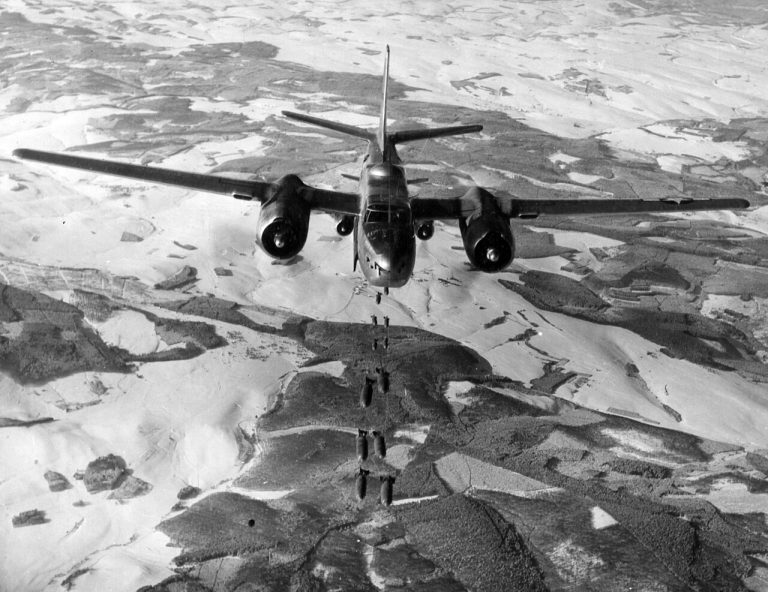
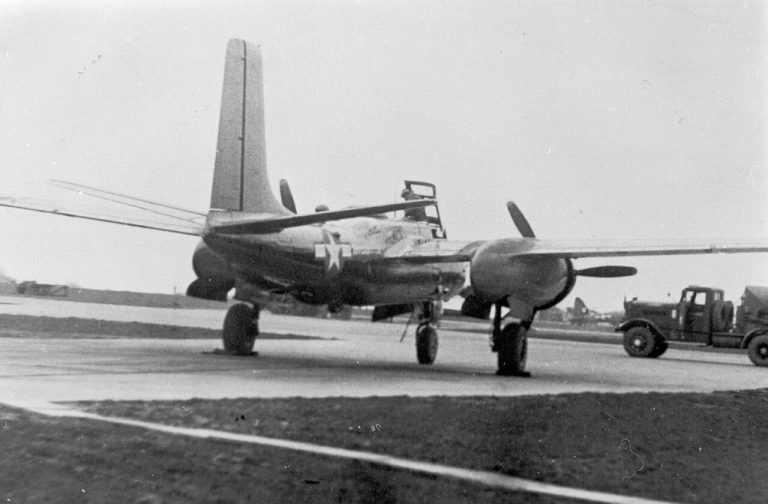
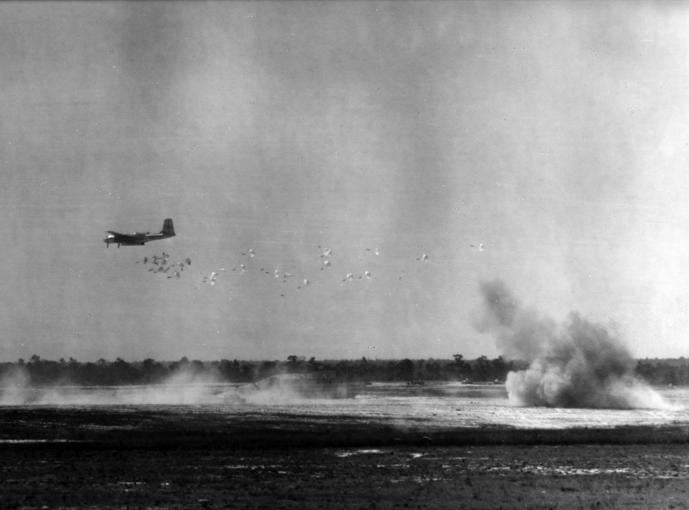
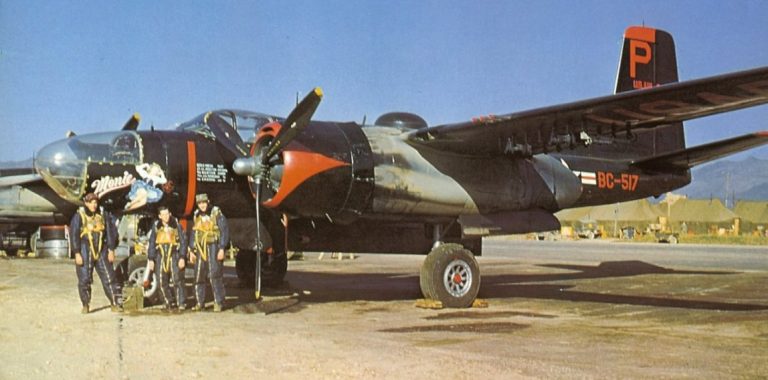
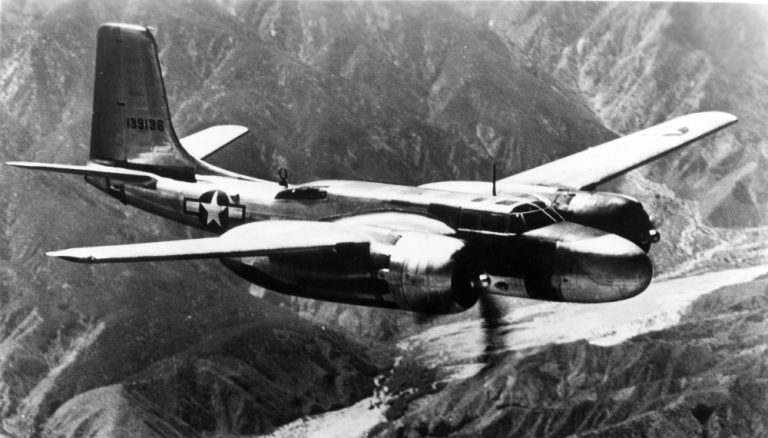
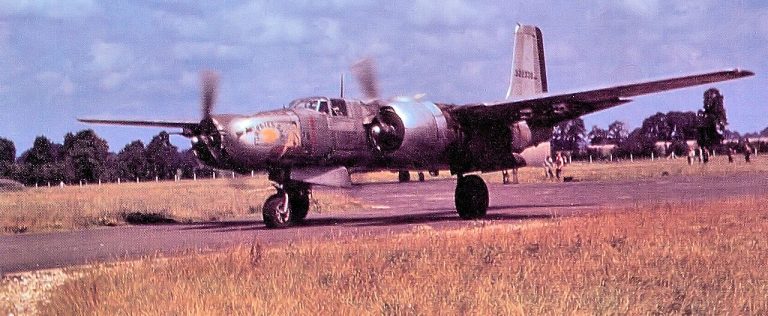
The Invader in motion
Video coming soon. We are curating a high-quality documentary clip on the Douglas A-26 Invader — its three-war career and the B-26K Counter-Invader rebuild — and will add it here.
Where the Invader flew
The record that defines it
The Invader’s combat story is not measured in air-to-air kills — it was an attack aircraft, not a fighter. Its record is one of endurance and reach: a single design that struck ground targets in World War II, Korea and Vietnam, plus covert and colonial wars in between. Its most famous work was done alone, at night, low over enemy supply lines.
Compare the combat record of every military aircraft. Figures as of August 2026.
Everything people ask about the A-26 Invader
Can I fly in an A-26 Invader?
Why is the A-26 also called the B-26?
What made the A-26 Invader special?
Did the A-26 fight in Vietnam?
Was the A-26 used at the Bay of Pigs?
How many A-26 Invaders were built, and are any still flying?
You can’t fly the Invader.
These, you can.
Some legends only live in museums — others are fuelled and waiting. MiGFlug has put civilians in real military jet cockpits since 2004.
 Fly the L-39 AlbatrosThe world’s most-flown jet trainer — aerobatics included
 Fly the F-104 Starfighter“The missile with a man in it”
 Fly the MiG-21The Cold War’s most-produced jet
 Fly the T-33 Shooting StarAmerica’s first jet trainer
 Fly the DH VampireA piece of early jet history
 Fly the S.211Agile Italian jet trainer
 Fly the MB-326The classic Aermacchi jet
 Fly the MiG-15The Soviet legend of the Korean War
Continue the tour
Every fact, checked
- National Museum of the U.S. Air Force — Douglas B-26K (A-26) Counter InvaderPrimary reference for the B-26K rebuild, Southeast Asia service and specifications.
- Vintage Aviation News — First flight of the A-26 InvaderFirst-flight date, gun-nose/glass-nose variants and production totals.
- Military Matters — The B-26K Counter InvaderBay of Pigs, Operation Millpond, Farm Gate and the On Mark rebuild.
- Military Factory — Douglas A-26 / B-26 InvaderAirframe dimensions, weights, powerplant and armament data.
- Pima Air & Space Museum — Douglas B-26KMuseum reference for the Counter-Invader and its Nimrod operations.
- Warbirds Resource Group — A-26 Invader operationsOperational history across WWII, Korea and Vietnam.
- Aeropedia — Douglas A-26 InvaderVariant history, foreign operators and the designation change.
- Vintage Flying Museum — Douglas A-26KReference for a preserved Counter-Invader airframe.