
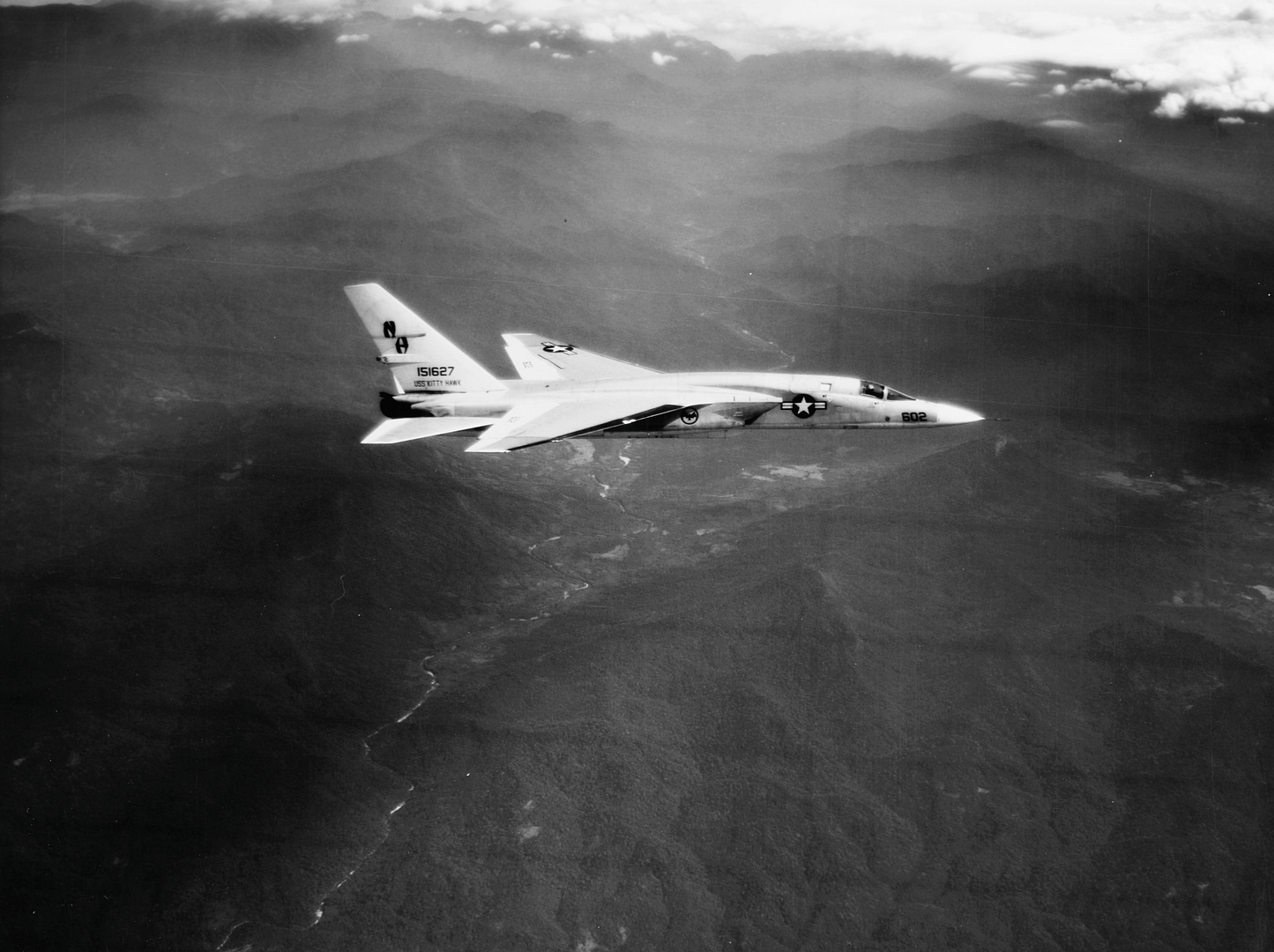
North American A-5
“Vigilante”
The US Navy’s big, beautiful Mach-2 carrier nuclear bomber — undone by a bomb bay that fired its weapon backwards out of the tail, then reborn as the fastest, most dangerous reconnaissance jet of the Vietnam War.
The most beautiful bomber that never bombed
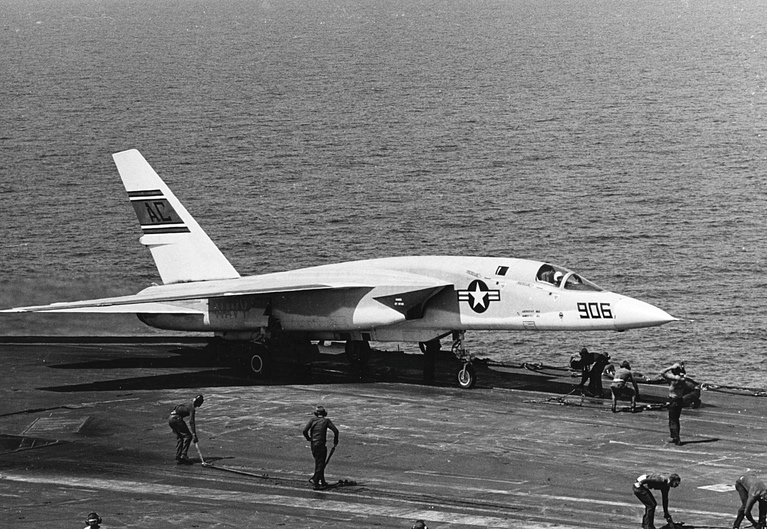
In the late 1950s the US Navy wanted something audacious: a carrier aircraft that could sprint at Mach 2, climb near the edge of space and deliver a nuclear bomb deep into enemy territory — all while launching from and recovering on a pitching flight deck. North American Aviation, fresh from building the F-86 Sabre and the X-15 rocket plane, answered with the A3J Vigilante. It was, and remains, one of the largest and fastest aircraft ever operated from an aircraft carrier — a sleek, twin-engined machine bristling with technology a decade ahead of its time.
The Vigilante first flew in 1958 and entered service in 1961, packed with firsts: an early head-up display, a digital nav-attack computer, fly-by-wire-assisted controls, variable-geometry engine inlets and an all-moving tail. But its signature feature was also its fatal flaw. The nuclear weapon lived in a “linear bomb bay” — a tunnel running between the two engines — and was meant to be ejected rearward out of the tail, stacked behind two disposable fuel cans, so it would decelerate and fall behind the speeding aircraft. In practice the system worked poorly. As one naval aviator put it, it “didn’t work very well at all, to the point of being hazardous to the crew.” Weapons could tumble; the bomber never delivered a weapon in anger.
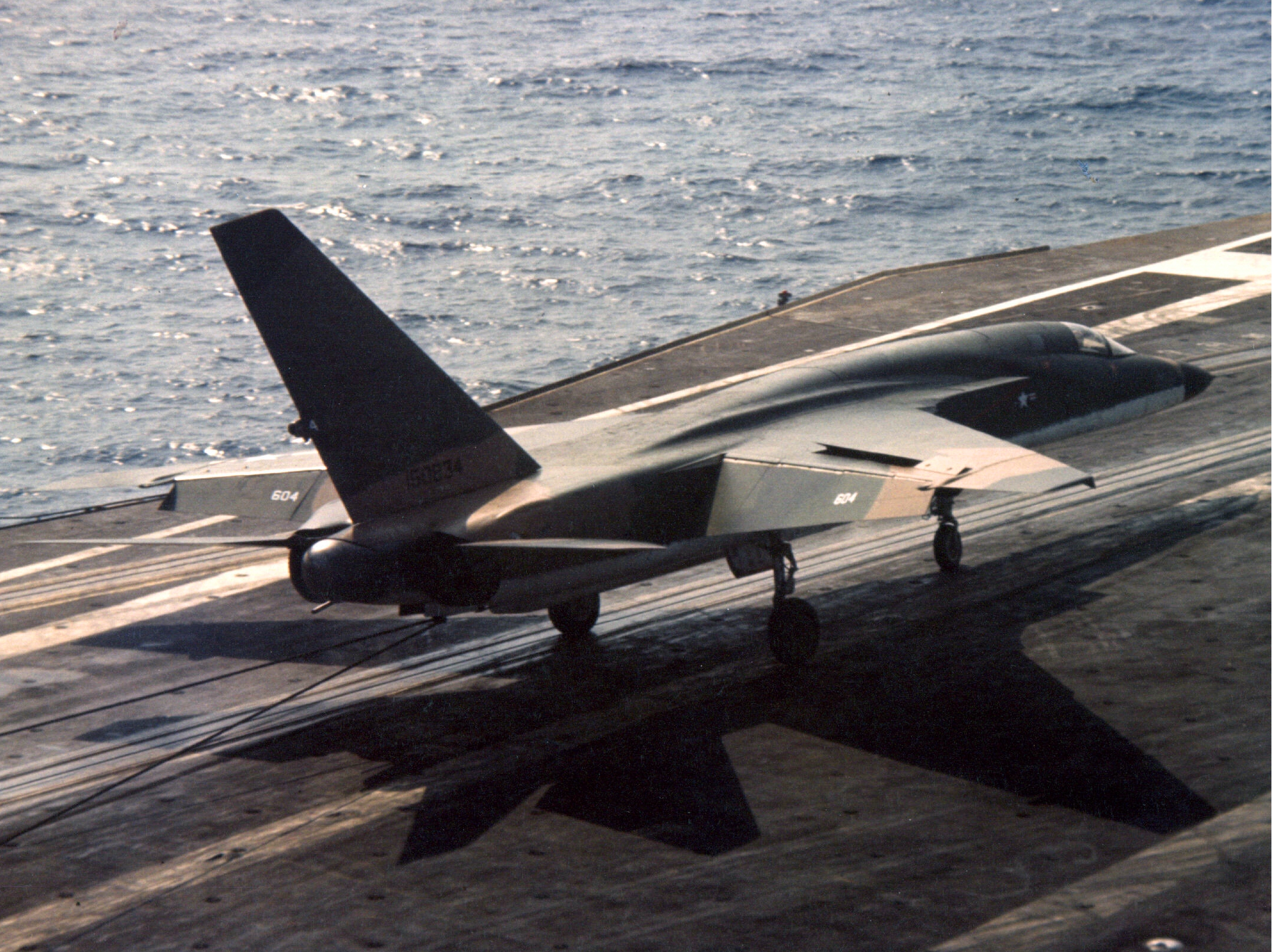
Rather than scrap a superb airframe, the Navy did something clever: it filled that troublesome tunnel with fuel and sensors and turned the Vigilante into the RA-5C, a Mach-2 reconnaissance platform carrying cameras, side-looking radar and electronic intelligence gear in a long belly canoe. In that role it excelled — and paid for it. Streaking low and fast over the most heavily defended airspace on earth in the skies of Vietnam, the RA-5C flew the lonely, predictable, straight-line photo runs that made it a magnet for flak and missiles. It is commonly cited as having suffered the highest loss rate of any US aircraft type in the war. Around 26 were lost in Southeast Asia. The Vigilante retired in 1979, remembered as a magnificent aircraft the Navy never quite used the way it intended.
01The North American A-5 Vigilante’s origins: the Navy’s bid for a supersonic carrier nuclear bomber
By the mid-1950s the US Navy feared being locked out of the nuclear-strike mission that the Air Force’s big bombers dominated. Its answer was to put a strategic nuclear weapon on a carrier deck and make it fast enough to survive. North American won the contract in 1956 for what was then called the A3J, and the prototype flew on 31 August 1958. Redesignated the A-5 in the 1962 tri-service system, it entered fleet service in 1961 with heavy-attack squadron VAH-3.
To show what it could do, an A3J-1 set a world altitude record on 13 December 1960, lifting a 1,000-kilogram payload to 91,451 feet (27,874 m) — a stunning demonstration of raw performance. Yet the strategic-bomber mission it was built for was already slipping away: the Navy’s nuclear-deterrent role was passing to the Polaris ballistic-missile submarines, and the Vigilante’s troubled weapon-delivery system did the rest. The bomber that broke records never dropped a weapon in combat.
What makes it special
A Mach-2 giant off a carrier deck
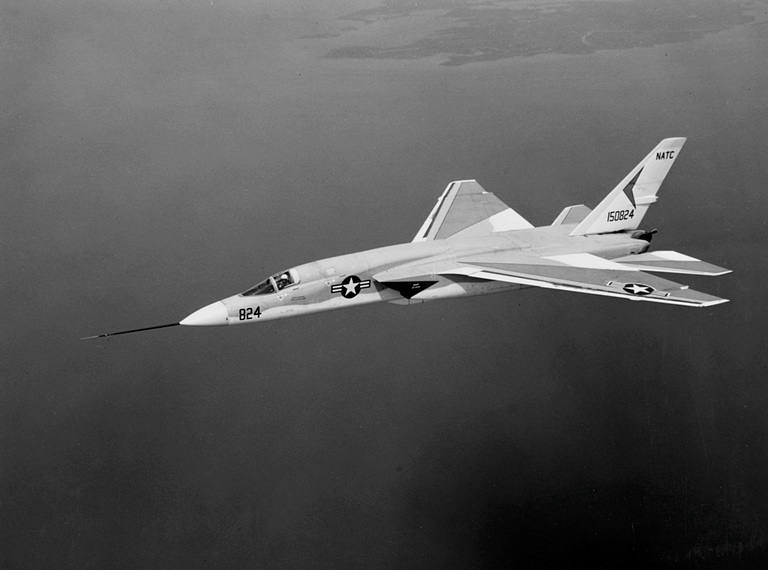
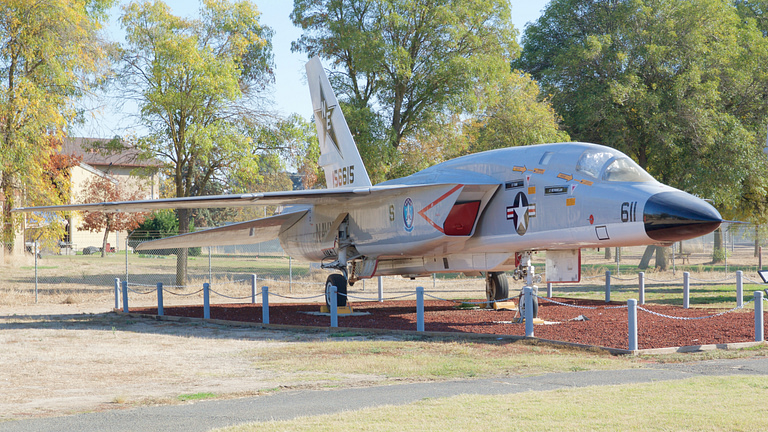
The Vigilante was huge and fast for a carrier aircraft — roughly 23 m long with a ~16 m wingspan and a max weight commonly cited near 36 tonnes, yet capable of Mach 2. Two afterburning General Electric J79 turbojets, variable-geometry inlets, an all-moving tail (it had no conventional ailerons) and a single-piece wraparound windscreen made it one of the largest and fastest machines ever flown from a flight deck.
The linear bomb bay: a bomb fired out of the tail
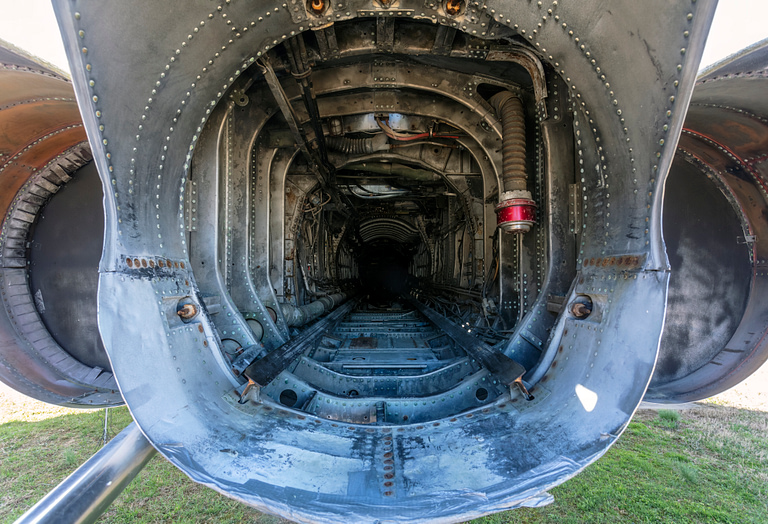
Its defining idea was a “linear bomb bay” — a tunnel between the engines holding a nuclear store behind two disposable fuel cans, all capped by the tail cone. On release the cone blew off and the weapon was ejected rearward, meant to fall behind the jet. In practice it was unreliable and, by pilots’ accounts, hazardous. The Vigilante never delivered a weapon operationally.
A cockpit a decade ahead of its time
The Vigilante pioneered technology that became standard only years later: one of the first operational head-up displays, a digital nav-attack computer (the AN/ASB-12 system), an early fly-by-wire-assisted flight-control channel and inertial navigation. As the RA-5C, it added side-looking airborne radar, cameras and ELINT to become a true multi-sensor reconnaissance platform.
02The A-5 Vigilante’s linear bomb bay: why the backwards-firing nuclear bomb never worked
The linear bomb bay was an elegant solution to a hard problem. A Mach-2 aircraft cannot simply open a conventional bay and drop a bomb — airflow at that speed would fling it dangerously. So North American ran a tunnel down the aircraft’s spine, between the two J79 engines, and stored the nuclear weapon there with two cylindrical fuel tanks stacked behind it. The idea was that the fuel would be burned on the way to the target, then the tail cone and the empty cans, followed by the weapon, would be ejected straight out the back. Freed at high speed, the bomb would decelerate and arc down onto the target while the Vigilante escaped.
Reality was messier. The rearward ejection was unreliable, and crews reported the whole arrangement was, in the words of one aviator, hazardous to the aircraft itself. Combined with the shift of the Navy’s nuclear deterrent to Polaris submarines, the weapon-delivery problems ended the Vigilante’s bombing career almost before it began. The airframe, however, was far too good to waste.
03The RA-5C Vigilante: how a failed bomber became the Navy’s finest reconnaissance jet
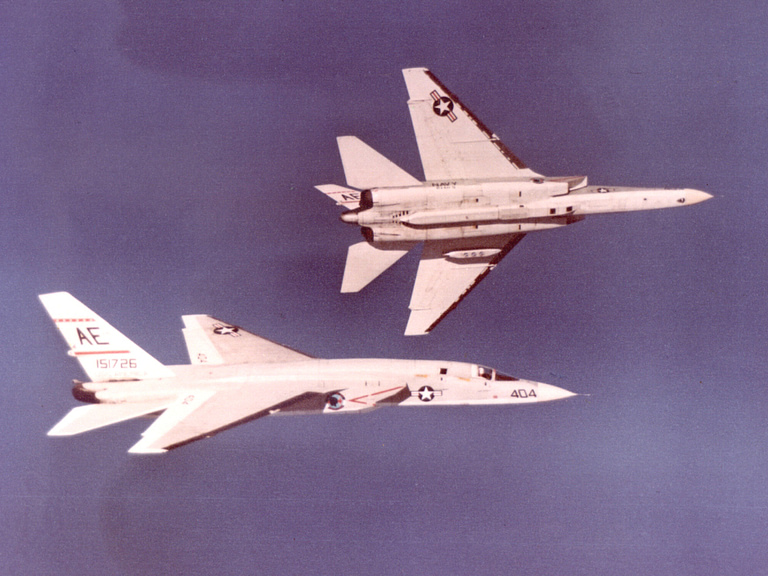
The reconnaissance conversion turned the Vigilante’s weakness into strength. Engineers filled the linear bomb-bay tunnel with fuel and hung a long “canoe” sensor pod under the belly, packing in optical and panoramic cameras, side-looking airborne radar (SLAR), infrared line-scan and electronic-intelligence receivers. The wing was reworked and the fuel load increased. The result, the RA-5C, could photograph a battlefield at Mach 2 and feed its imagery into the carrier’s Integrated Operational Intelligence Center — an early, ambitious attempt at near-real-time fleet intelligence.
Ten Reconnaissance Attack Squadrons (RVAH) flew the type, and eight of them deployed to Vietnam. The RA-5C gathered pre- and post-strike imagery no other Navy platform could match — but its high-speed runs were fast, straight and predictable, and North Vietnamese gunners and SAM crews learned to wait for them. Its reconnaissance record is one of genuine achievement bought at a heavy price.
Full specifications
Figures are for the RA-5C reconnaissance variant; the earlier A-5A / A-5B bomber versions differed in equipment and weight. Contested values are hedged.
Airframe & Performance
- Bemanning
- 2 (pilot & reconnaissance/attack navigator)
- Lengte
- ~23.3 m (76 ft 6 in)
- Spanwijdte
- ~16.2 m (53 ft)
- Hoogte
- ~5.9 m (19 ft 5 in)
- Vleugelgebied
- ~70 m² (~754 ft²)
- Leeggewicht
- ~17,000 kg (~37,500 lb)
- Max takeoff weight
- ~36,300 kg (~80,000 lb, commonly cited)
- Max speed
- ~Mach 2.0 (~2,124 km/h at altitude)
- Serviceplafond
- ~15,900 m (~52,100 ft)
- Gevechtsradius
- ~1,600 km (recon profile, estimate)
Propulsion, Sensors & Cost
- Engines
- 2 × General Electric J79-GE-10 (A-5A used J79-GE-8)
- Thrust
- ~80 kN (~17,900 lbf) each with afterburner
- Sensors (RA-5C)
- Cameras, side-looking radar, IR line-scan, ELINT
- Nav-attack
- AN/ASB-12 digital bombing-navigation system, HUD
- Armament (A-5A)
- Nuclear store in linear bomb bay (rarely, if ever, operational)
- First flight
- 31 August 1958 (as A3J-1)
- Built
- ~156 of all variants (1958–1970)
- Unit cost
- No single reliable public figure (estimate)
- Cost per flight hour
- No reliable public figure
04The A-5 Vigilante’s operating costs: why the numbers are hard to pin down
The Vigilante was an expensive, technologically ambitious aircraft — small production runs of a complex, cutting-edge airframe rarely come cheap. But no single, reliable open-source flyaway unit price or cost-per-flight-hour figure exists for the type in a form that can be quoted with confidence, and 1960s dollar figures are difficult to translate meaningfully. What is clear is that its sophistication, low production numbers (about 156 aircraft of all variants) and demanding maintenance made it a costly machine to buy and operate. Any precise dollar figure attached to the A-5 should be read as an estimate rather than an audited number.
From record-setting bomber to Vietnam spy plane
Contract awarded
North American wins the Navy contract for the A3J, a Mach-2 carrier-based nuclear strike bomber.
First flight
The A3J-1 prototype flies on 31 August 1958, revealing a sleek twin-engined machine years ahead of its time.
World altitude record
On 13 December an A3J-1 lifts a 1,000 kg payload to 91,451 ft (27,874 m) — a world record.
Enters service
The Vigilante joins heavy-attack squadron VAH-3 as a carrier-based nuclear bomber.
Redesignated A-5
Under the new tri-service system the A3J becomes the A-5; the linear bomb bay proves troublesome.
Becomes a spy plane
The RA-5C reconnaissance version enters service and makes its first Vietnam deployment aboard USS Ranger.
Flint River 603
On 28 December a MiG-21 downs an RA-5C near Hanoi — the only Vigilante lost to a fighter, and the last US aircraft downed by a MiG in the war.
Retirement
The last Vigilantes fly their final carrier deployment aboard USS Ranger; the type passes into history.
Twelve Vigilante stories
The Navy’s supersonic nuclear bomber
The A3J was built to put a nuclear weapon on a carrier deck and fly it at Mach 2.
Read the full story
91,451 feet, with a tonne aboard
On 13 December 1960 an A3J-1 set a world altitude record carrying a 1,000 kg payload.
Read the full story
A bomb fired out of the back
The Vigilante’s nuclear weapon was meant to eject rearward through the tail — and it did not work.
Read the full story
The bomber that never bombed
For all its power, the A-5 never delivered a weapon in anger.
Read the full story
From bomber to spy plane
The Navy filled the useless bomb bay with fuel and sensors and created the RA-5C.
Read the full story
Fast, lonely photo runs
RA-5Cs streaked over North Vietnam gathering the imagery the fleet depended on.
Read the full story
The highest loss rate of the war
Predictable high-speed runs over the world’s densest air defenses made the RA-5C a target.
Read the full story
The SAM that missed by 104 feet
An RA-5C once photographed an SA-2 missile passing just feet from its belly.
Read the full story
The only Vigilante downed by a MiG
On 28 December 1972 a MiG-21 shot down an RA-5C near Hanoi — the last US aircraft lost to a MiG in the war.
Read the full story
Flipped inverted by a thunderstorm
An RA-5C and its escort dived into a storm to escape flak — and popped out upside down.
Read the full story
Among the biggest and fastest ever off a carrier
The Vigilante set a benchmark for size and speed on the flight deck that has rarely been matched.
Read the full story
The end, and what came after
The Vigilante retired in 1979, its reconnaissance mission passing to the F-14 and its TARPS pod.
Read the full story
The Vigilante in pictures
The Vigilante in motion
A curated video feature for the North American A-5 Vigilante is coming soon. In the meantime, explore the photo gallery above and the operations map below.
Where the Vigilante flew
The record that defines it
The Vigilante’s combat story is not one of kills but of images — and of extraordinary risk. As a bomber it never delivered a weapon in anger; as the RA-5C it flew the most dangerous reconnaissance missions of the Vietnam War, streaking fast and straight over the world’s densest air defenses to bring back the photographs the fleet depended on. That work came at a steep cost: the type is commonly cited as having the highest loss rate of any US aircraft in the war.
Compare the combat record of every military aircraft. Figures as of July 2026.
Everything people ask about the A-5 Vigilante
Can I fly in an A-5 Vigilante?
Why is the A-5 called “the bomber that never bombed”?
What was the linear bomb bay?
What was the RA-5C?
How many Vigilantes were lost in Vietnam?
Was the Vigilante really one of the biggest aircraft flown from a carrier?
Are any A-5 Vigilantes still flying?
You can’t fly the Vigilante.
These, you can.
Some legends only live in museums — others are fuelled and waiting. MiGFlug has put civilians in real military jet cockpits since 2004.
 Fly the L-39 AlbatrosThe world’s most-flown jet trainer — aerobatics included
 Fly the F-104 Starfighter“The missile with a man in it”
 Fly the MiG-21The Cold War’s most-produced jet
 Vlieg met de T-33 Shooting StarAmerica’s first jet trainer
 Fly the DH VampireA piece of early jet history
 Fly the S.211Agile Italian jet trainer
 Fly the MB-326The classic Aermacchi jet
 Fly the MiG-15The Soviet legend of the Korean War
Continue the tour
Every fact, checked
- Naval History and Heritage Command — RA-5C VigilanteOfficial US Navy history of the type, its development and service.
- The National Interest — the Navy’s forgotten A-planeThe bomber-to-recon story and its Vietnam service.
- The Aviation Geek Club — Flint River 603The only Vigilante downed by a MiG, December 1972.
- This Day in Aviation — 13 December 1960The A3J-1 world altitude record with a 1,000 kg payload.
- GlobalSecurity — A3J (A-5) VigilanteDevelopment timeline, bomber role and reconnaissance conversion.
- MiGFlug Afterburner — the beautiful bomber that never workedThe linear bomb bay and the aircraft’s central paradox.
- U.S. Naval Institute — The Tale of the VigiNaval History magazine account of flying and operating the type.
- Vietnam Aviation Resource Center — RA-5C operationsSquadron deployments and combat-loss breakdown in Southeast Asia.