
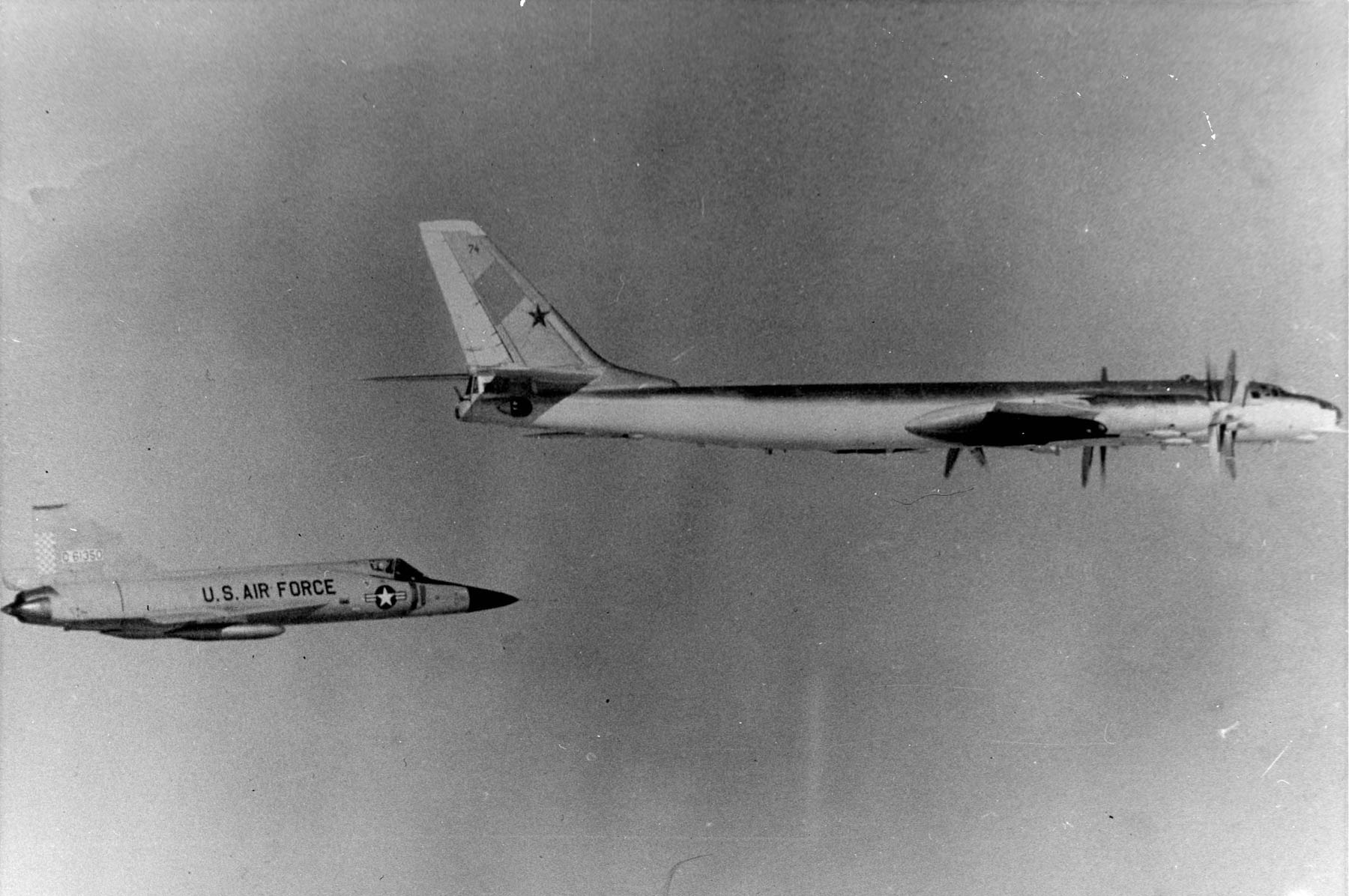
Convair F-102 Delta Dagger
“The Deuce”
The USAF’s first operational delta-wing interceptor and first all-weather supersonic interceptor — a jet that could not break the sound barrier until a wasp-waisted “area-rule” fuselage rescued it, then stood Cold War alert from the Arctic to Vietnam.
The jet that could not go supersonic — until it could
In the early 1950s the United States was building a continental shield against Soviet bombers, and the Convair F-102 Delta Dagger was meant to be one of its sharpest points: the Air Force’s first operational delta-wing interceptor and its first all-weather supersonic interceptor. Its tailless triangle wing traced back to the experimental Convair XF-92, itself rooted in the wartime delta research of German aerodynamicist Alexander Lippisch. The Deuce was designed from the outset to plug into SAGE — the Semi-Automatic Ground Environment — a continent-spanning web of radars and computers that could detect an intruder and steer an interceptor toward it by data link.
There was just one problem: when the YF-102 prototype first flew on 24 October 1953, it could not exceed Mach 1 in level flight. Transonic drag walled it below the very speed it existed to reach — a potential national embarrassment. The rescue came from NACA engineer Richard Whitcomb’s “area rule,” which showed that transonic drag depends on how smoothly an aircraft’s total cross-section changes along its length. Convair pinched the fuselage into the now-famous “coke-bottle” wasp-waist shape, and the redesigned YF-102A went supersonic on an early flight in December 1953. It is the textbook real-world proof of the area rule.
Saved by aerodynamics, the Deuce entered service with Air Defense Command in 1956. It carried no gun; instead its Hughes MG-3/MG-10 fire-control system and an internal weapons bay held six Falcon air-to-air missiles and two dozen folding-fin rockets, ready to be flown to the kill half-automatically by SAGE. Nearly a thousand were built, they stood alert from Iceland to Germany to Vietnam, and the type led directly to the faster F-106 Delta Dart — which began life as the “F-102B.”
01The F-102 Delta Dagger’s area-rule crisis: the “coke-bottle” fix that saved the programme
The YF-102 was designed to be supersonic, yet wind-tunnel data and its first flights in late 1953 revealed it slamming into a wall of transonic drag that held it below Mach 1 in level flight. The interceptor was, on its own terms, a failure. The answer had just been formalised by NACA Langley engineer Richard T. Whitcomb: the area rule, which holds that near the speed of sound what matters is the smooth distribution of an aircraft’s total cross-sectional area — wing plus fuselage — along its length. Convair reshaped the fuselage with a pinched, wasp-waisted “coke-bottle” middle and lengthened, refined nose and tail. The revised YF-102A first flew on 20 December 1953 and promptly punched through Mach 1, reaching roughly Mach 1.2. The story is one of the canonical demonstrations that the area rule works, and it is credited with rescuing a programme that had come perilously close to cancellation.
What makes it special
The area-rule fuselage — the pinch that unlocked supersonic flight
The F-102’s defining feature is invisible at a glance: a fuselage narrowed at the waist to obey Whitcomb’s area rule. Paired with the tailless delta wing from the XF-92, the reshaped body let a single Pratt & Whitney J57 turbojet of roughly 16,000–17,000 lbf in afterburner push the Deuce past Mach 1.25 to a ceiling around 54,000–55,000 ft. Without the coke-bottle fix, the same airframe could not go supersonic at all.
A delta wing and an all-internal weapons bay — no gun at all
To stay clean and supersonic, the F-102 carried no cannon and hid everything inside. A three-part ventral bay held six Hughes Falcon air-to-air missiles — a mix of radar and infrared homing — and, ingeniously, twenty-four 2.75-inch folding-fin rockets tucked into tubes built into the weapons-bay doors themselves. Some aircraft could even carry the nuclear-tipped AIM-26 Falcon to be sure of a kill.
SAGE and the MG-10 — an interceptor steered by computer
The Deuce was built to be a node in a machine larger than itself. Plugged into the SAGE network, its Hughes MG-3 (later MG-10) fire-control system could receive an interception by data link and be steered toward the firing point almost hands-off, the radar and Falcons cued automatically. For the mid-1950s it was a strikingly futuristic idea: air defence partly flown from the ground.
02The F-102 Delta Dagger’s weapons bay: six Falcons and rockets hidden in the doors
The F-102 was a pure missileer with no gun. Its internal ventral bay was split into three compartments, each holding a pair of Hughes Falcon missiles on extending trapeze launchers — six in all, typically a mix of semi-active radar-homing (AIM-4A/E) and infrared (AIM-4C/F) rounds so the pilot could salvo both guidance types at a target. Packed into tubes inside the forward weapons-bay doors were twenty-four 2.75-inch “Mighty Mouse” folding-fin rockets (earlier aircraft carried smaller 2-inch rockets). Because the early Falcons were unreliable in a real intercept, the centre bay could instead carry the nuclear AIM-26 (GAR-11) Falcon, with a sub-kiloton warhead meant to destroy a bomber even with a near miss — a stark expression of Cold War air-defence logic.
03The F-102 Delta Dagger and SAGE: automated interception in the vacuum-tube age
SAGE was one of the largest computer projects of the early Cold War — a chain of blockhouses full of room-sized vacuum-tube computers that fused radar tracks into a single air picture and could hand an interception straight to a fighter. Aboard the F-102, the MG-3 and later MG-10 fire-control systems flew that interception: ground controllers could uplink steering commands, and the aircraft could be guided toward the firing solution with the pilot largely monitoring the radar scope. It was genuinely futuristic for the mid-1950s. Read the automation claims of the era with some caution — the system worked, but never quite as seamlessly as the brochures suggested, and it was refined for years after the jet entered service.
Full specifications
Airframe & Performance
- Bemanning
- 1 (two-seat TF-102A trainer seats 2, side-by-side)
- Lengte
- ~20.8 m (68 ft 4 in)
- Spanwijdte
- ~11.6 m (38 ft 1 in)
- Hoogte
- ~6.5 m (21 ft 2 in)
- Max takeoff weight
- ~14,300 kg (~31,500 lb)
- Max speed
- ~Mach 1.25 · ~1,300 km/h (~810 mph)
- Serviceplafond
- ~16,800 m (~55,000 ft)
- Bereik
- ~1,600–2,170 km (~1,000–1,350 mi)
- Gevechtsradius
- much shorter on internal fuel
Propulsion & Systems
- Motor
- 1 × Pratt & Whitney J57-P-25 turbojet
- Thrust
- ~16,000–17,200 lbf with afterburner (~71–76 kN)
- Fire control
- Hughes MG-3 / MG-10 (SAGE data link)
- Bewapening
- 6 × AIM-4 Falcon + 24 × 2.75 in FFAR; optional nuclear AIM-26; no gun
- First flight
- YF-102 24 Oct 1953 · area-ruled YF-102A 20 Dec 1953
- In service
- 1956 (retired mid-1970s; drones to 1980s)
- Built
- ~1,000 (889 F-102A + 111 TF-102A)
- Unit cost
- ~$1.2 million (1950s estimate)
- Cost per flight hour
- No reliable public figure
04The F-102 Delta Dagger’s operating costs: what the numbers really tell us
Firm cost figures for the F-102 are scarce and inconsistent, as is usual for a 1950s military aircraft. Contemporary sources place the flyaway unit cost very roughly around $1.2–1.4 million in 1950s dollars, but this should be read as an order-of-magnitude estimate rather than a precise, audited price. No reliable public cost-per-flight-hour figure exists for the type. What is better documented is scale: nearly 1,000 airframes were built and the type equipped more than 25 Air Defense Command squadrons at its peak before being handed down to the Air National Guard. Treat any exact dollar figure attached to the Deuce with healthy scepticism.
From area-rule crisis to Cold War sentinel
The delta ancestor
The experimental Convair XF-92A — the first American delta-wing aircraft, derived from Lippisch’s work — flies and proves the tailless triangle planform.
First flight & the drag wall
The YF-102 flies on 24 October but cannot pass Mach 1. Within weeks the area-ruled YF-102A (20 December) goes supersonic — the fix that saves the programme.
Enters service
The F-102A joins Air Defense Command as the USAF’s first operational delta-wing and first all-weather supersonic interceptor.
The SAGE shield
More than 25 ADC squadrons stand alert across the US, Iceland, Greenland, Alaska and Europe, plugged into the SAGE air-defence network.
To Vietnam
F-102s deploy to Southeast Asia for air-defence alert, MiG combat air patrol and B-52 escort — and occasional ground attack with rockets.
The only air-to-air loss
On 3 February a 509th FIS F-102 is shot down by a North Vietnamese MiG-21 near Sam Neua — the type’s sole air-combat loss.
Guard duty & export
Retired from active USAF service, the Deuce soldiers on with the Air National Guard and is passed to NATO allies Greece and Turkey.
A second life as a drone
Under Project Pave Deuce, more than 200 retired airframes become PQM-102 target drones; the last is expended in 1985.
Twelve stories of the Deuce
From a refugee’s delta to the first US delta fighter
The F-102’s triangle wing traces back to Alexander Lippisch.
Read the full story
The “coke-bottle” fix that saved the Deuce
A jet built to be supersonic — that could not break the sound barrier.
Read the full story
The interceptor a computer could fly to the kill
The Deuce was the trigger finger of an automated Cold War shield.
Read the full story
Missiles and rockets, hidden behind the doors
Six Falcons inside — and 24 rockets tucked into the bay doors.
Read the full story
The Deuce’s half-kiloton air-to-air Falcon
To be certain of a kill, the F-102 could carry a nuclear missile.
Read the full story
The Deuce that grew a second seat — sideways
Most trainers seat pupils in tandem; the TF-102A sat them shoulder to shoulder.
Read the full story
An interceptor sent to a war it was not built for
The Deuce guarded Vietnam’s skies — and sometimes rocketed the jungle.
Read the full story
The only Deuce a MiG ever killed
February 1968: an ambush over Laos ends with three Falcons missing.
Read the full story
Deuce versus Deuce: the contested Aegean of 1974
Both Greece and Turkey flew the F-102 — and one may have downed the other.
Read the full story
The president who flew the Deuce
George W. Bush strapped into a supersonic interceptor in the Texas Guard.
Read the full story
Reborn as a target: the Deuce’s unmanned second life
Hundreds of retired F-102s came back to be shot down on purpose.
Read the full story
The Deuce’s bigger brother started as an F-102
The F-106 Delta Dart was literally born as the “F-102B.”
Read the full story
The Delta Dagger in pictures
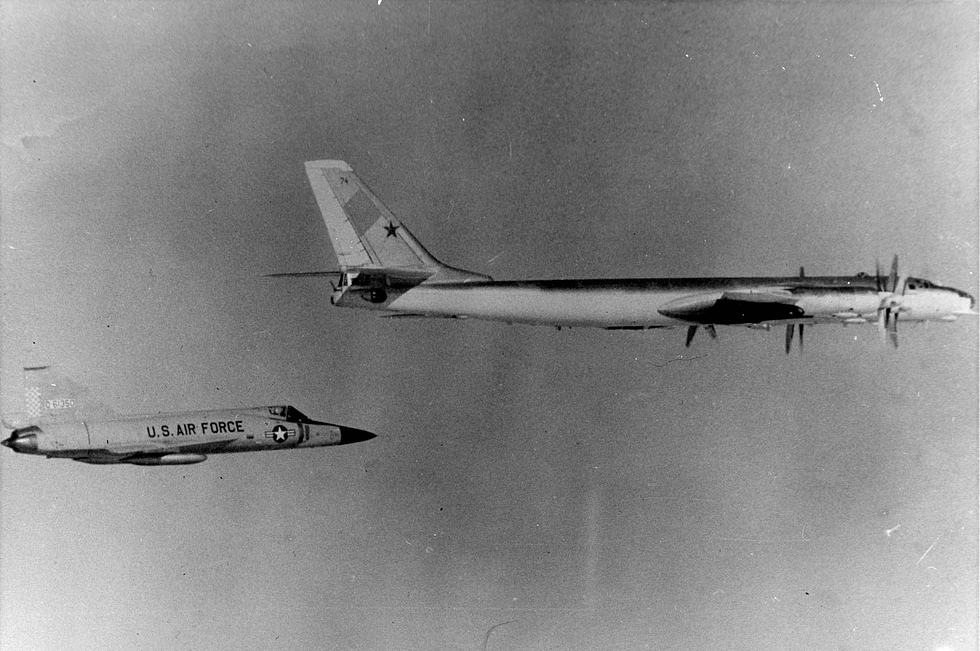
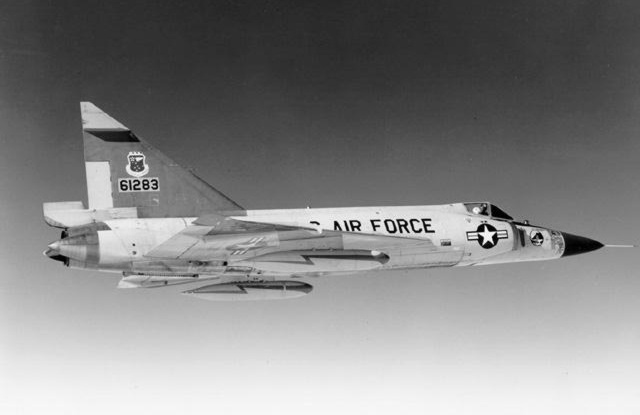
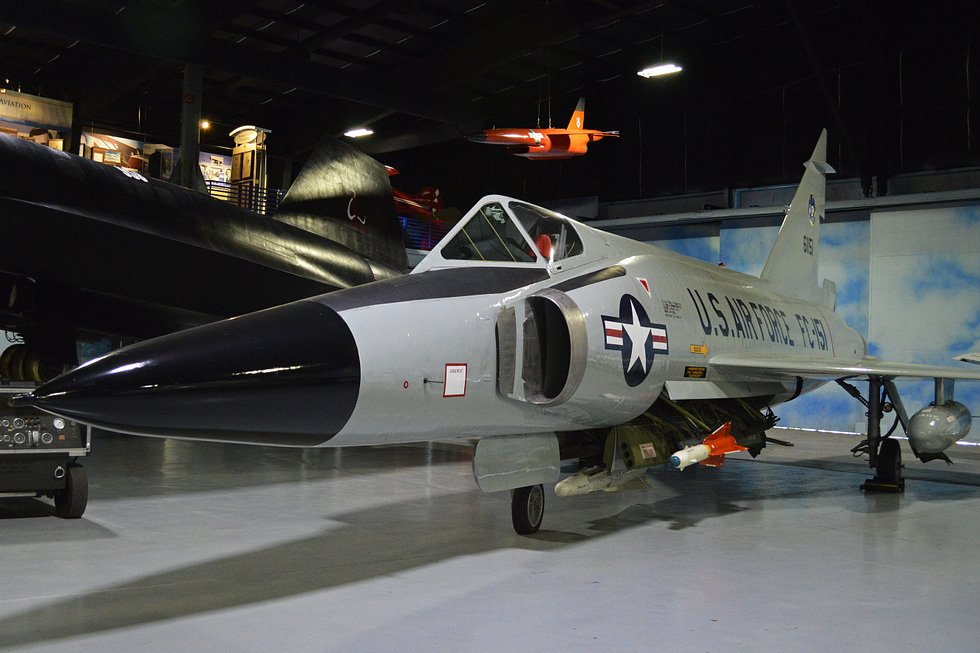
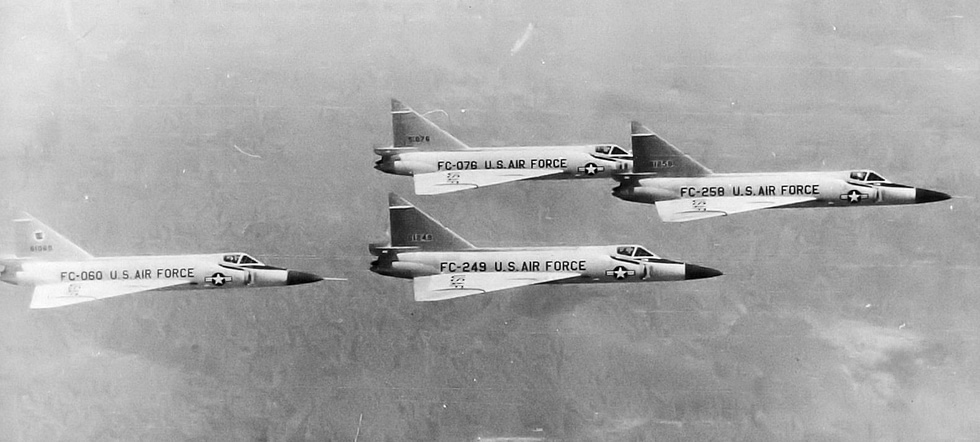
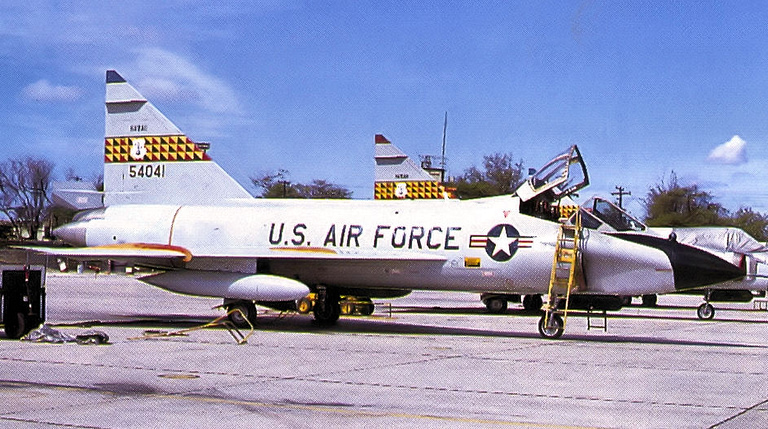
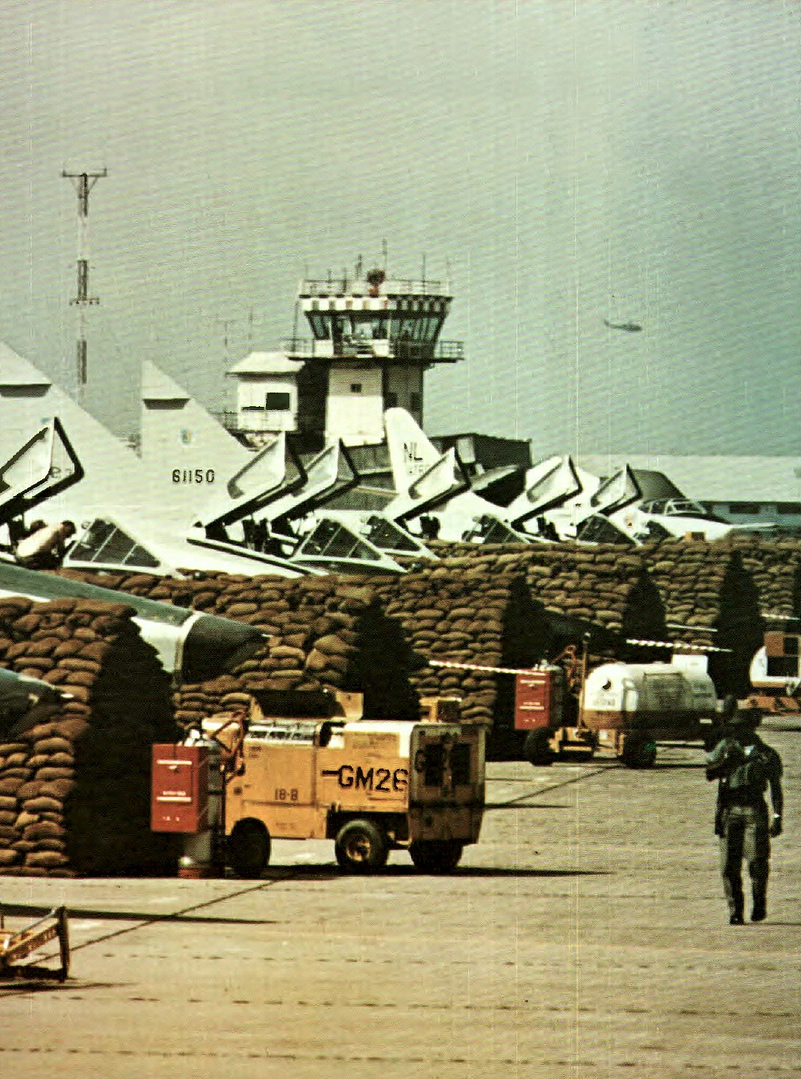
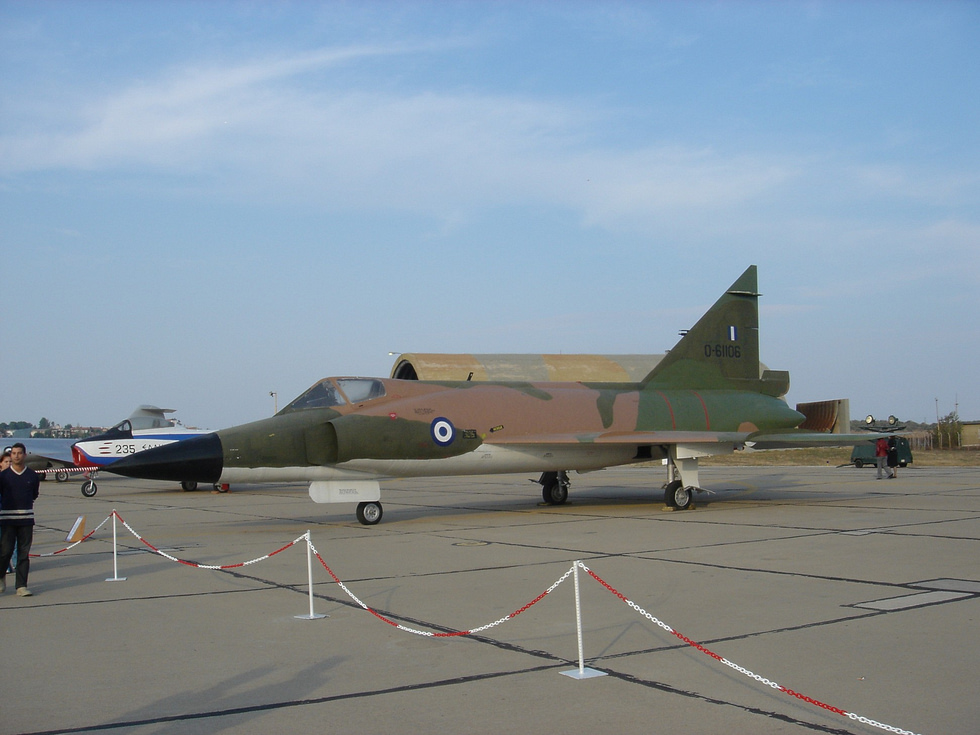
The Delta Dagger in motion
A verified, high-authority video feature for the F-102 is still being selected — video coming soon. In the meantime, the photo gallery above and the stories carousel cover the aircraft in depth.
Where the Delta Dagger flew
The record that defines it
The F-102 was built to intercept Soviet bombers, not to dogfight, and it never fired a shot on continental alert. Its one real war was Vietnam, where it flew air-defence alert, MiG combat air patrol and B-52 escort from 1962. With few enemy aircraft to meet, some crews used their rockets against ground targets. About 15 Deuces were lost in Southeast Asia — most to accidents, ground fire and base attacks, and one, famously, to a MiG-21.
Compare the combat record of every military aircraft. Figures as of July 2026.
Everything people ask about the F-102
Can I fly in an F-102?
Why couldn’t the original F-102 go supersonic?
What does the nickname “Deuce” mean?
Did the F-102 have a gun?
Did F-102s fight in Vietnam?
What is the difference between the F-102 and the F-106?
Which countries flew the F-102?
Did George W. Bush really fly the F-102?
You can’t fly the F-102.
These, you can.
Some legends only live in museums — others are fuelled and waiting. MiGFlug has put civilians in real military jet cockpits since 2004.
 Fly the L-39 AlbatrosThe world’s most-flown jet trainer — aerobatics included
 Fly the F-104 Starfighter“The missile with a man in it”
 Fly the MiG-21The Cold War’s most-produced jet
 Vlieg met de T-33 Shooting StarAmerica’s first jet trainer
 Fly the DH VampireA piece of early jet history
 Fly the S.211Agile Italian jet trainer
 Fly the MB-326The classic Aermacchi jet
 Fly the MiG-15The Soviet legend of the Korean War
Continue the tour
Every fact, checked
- National Museum of the U.S. Air Force — F-102A Delta DaggerOfficial specifications, production totals (889 F-102A + 111 TF-102A) and Iceland service.
- GlobalSecurity.org — F-102 Delta DaggerDevelopment, the area-rule redesign, MG-3/MG-10 fire control and ADC/ANG history.
- The War Zone — The F-102’s weapons baysThe six-Falcon-plus-24-rocket internal bay and the nuclear AIM-26 option.
- The Aviation Geek Club — the only F-102 shot down by a MiG-21Full detail of the 3 February 1968 loss of 1st Lt Wallace Wiggins.
- Aerospaceweb.org — F-102 in VietnamDeployment dates, roles and the loss breakdown of about 15 aircraft.
- Designation-Systems.net — Sperry PQM-102The QF-102/PQM-102 target-drone conversions under Project Pave Deuce.
- Hellenic Air Force — F-102 Delta DaggerGreek acquisition: 24 aircraft with 342 Squadron, 1970–1977.
- HistoryNet — Convair F-102 Delta DaggerDevelopment, the XF-92 delta lineage and the F-102-to-F-106 story.