
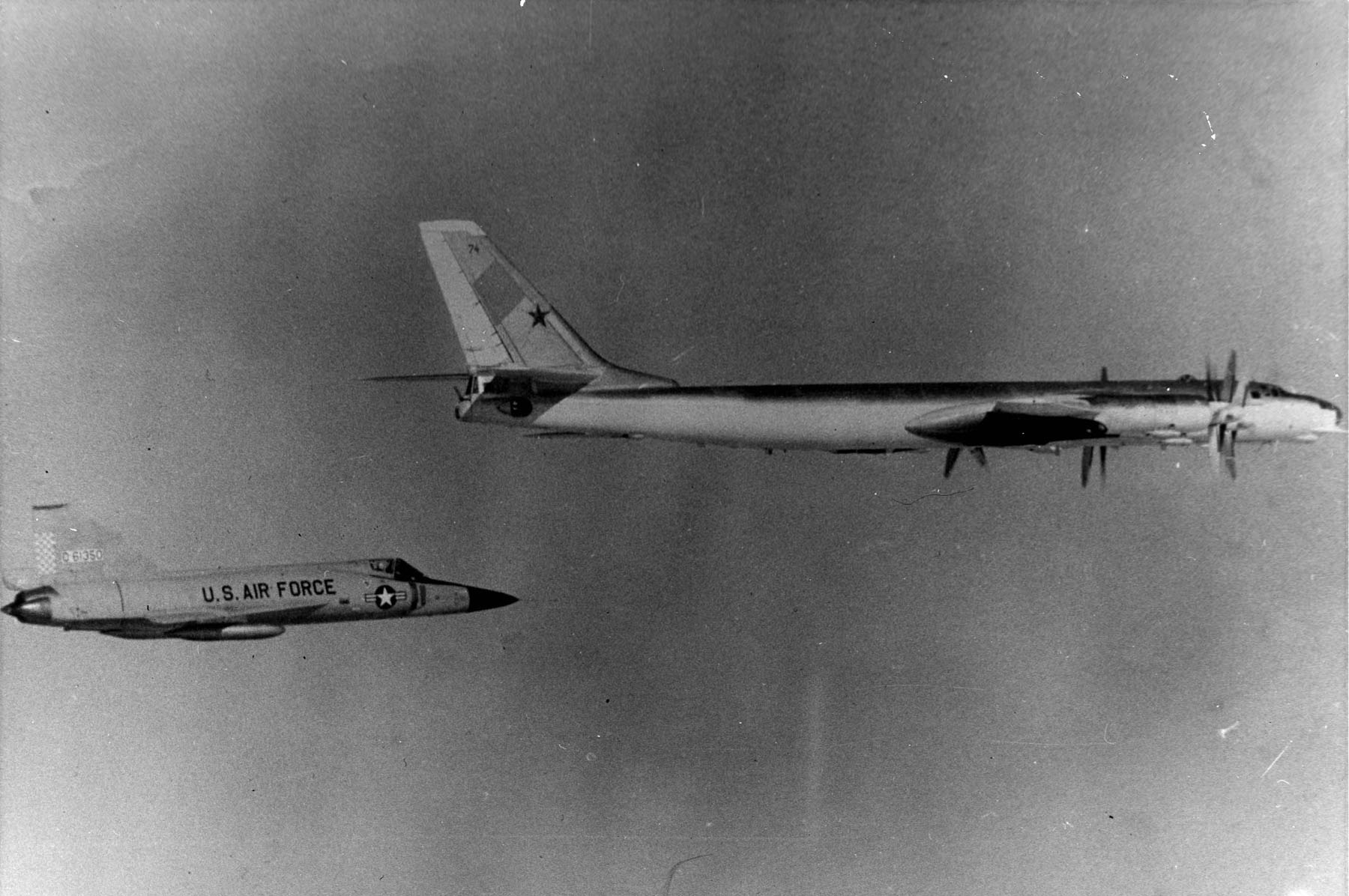
Convair F-102 Delta Dagger
“The Deuce”
The USAF’s first operational delta-wing interceptor and first all-weather supersonic interceptor — a jet that could not break the sound barrier until a wasp-waisted “area-rule” fuselage rescued it, then stood Cold War alert from the Arctic to Vietnam.
The jet that could not go supersonic — until it could
In the early 1950s the United States was building a continental shield against Soviet bombers, and the Convair F-102 Delta Dagger was meant to be one of its sharpest points: the Air Force’s first operational delta-wing interceptor and its first all-weather supersonic interceptor. Its tailless triangle wing traced back to the experimental Convair XF-92, itself rooted in the wartime delta research of German aerodynamicist Alexander Lippisch. The Deuce was designed from the outset to plug into SAGE — the Semi-Automatic Ground Environment — a continent-spanning web of radars and computers that could detect an intruder and steer an interceptor toward it by data link.
There was just one problem: when the YF-102 prototype first flew on 24 October 1953, it could not exceed Mach 1 in level flight. Transonic drag walled it below the very speed it existed to reach — a potential national embarrassment. The rescue came from NACA engineer Richard Whitcomb’s “area rule,” which showed that transonic drag depends on how smoothly an aircraft’s total cross-section changes along its length. Convair pinched the fuselage into the now-famous “coke-bottle” wasp-waist shape, and the redesigned YF-102A went supersonic on an early flight in December 1953. It is the textbook real-world proof of the area rule.
Saved by aerodynamics, the Deuce entered service with Air Defense Command in 1956. It carried no gun; instead its Hughes MG-3/MG-10 fire-control system and an internal weapons bay held six Falcon air-to-air missiles and two dozen folding-fin rockets, ready to be flown to the kill half-automatically by SAGE. Nearly a thousand were built, they stood alert from Iceland to Germany to Vietnam, and the type led directly to the faster F-106 Delta Dart — which began life as the “F-102B.”
01The F-102 Delta Dagger’s area-rule crisis: the “coke-bottle” fix that saved the programme
The YF-102 was designed to be supersonic, yet wind-tunnel data and its first flights in late 1953 revealed it slamming into a wall of transonic drag that held it below Mach 1 in level flight. The interceptor was, on its own terms, a failure. The answer had just been formalised by NACA Langley engineer Richard T. Whitcomb: the area rule, which holds that near the speed of sound what matters is the smooth distribution of an aircraft’s total cross-sectional area — wing plus fuselage — along its length. Convair reshaped the fuselage with a pinched, wasp-waisted “coke-bottle” middle and lengthened, refined nose and tail. The revised YF-102A first flew on 20 December 1953 and promptly punched through Mach 1, reaching roughly Mach 1.2. The story is one of the canonical demonstrations that the area rule works, and it is credited with rescuing a programme that had come perilously close to cancellation.
What makes it special
The area-rule fuselage — the pinch that unlocked supersonic flight
The F-102’s defining feature is invisible at a glance: a fuselage narrowed at the waist to obey Whitcomb’s area rule. Paired with the tailless delta wing from the XF-92, the reshaped body let a single Pratt & Whitney J57 turbojet of roughly 16,000–17,000 lbf in afterburner push the Deuce past Mach 1.25 to a ceiling around 54,000–55,000 ft. Without the coke-bottle fix, the same airframe could not go supersonic at all.
A delta wing and an all-internal weapons bay — no gun at all
To stay clean and supersonic, the F-102 carried no cannon and hid everything inside. A three-part ventral bay held six Hughes Falcon air-to-air missiles — a mix of radar and infrared homing — and, ingeniously, twenty-four 2.75-inch folding-fin rockets tucked into tubes built into the weapons-bay doors themselves. Some aircraft could even carry the nuclear-tipped AIM-26 Falcon to be sure of a kill.
SAGE and the MG-10 — an interceptor steered by computer
The Deuce was built to be a node in a machine larger than itself. Plugged into the SAGE network, its Hughes MG-3 (later MG-10) fire-control system could receive an interception by data link and be steered toward the firing point almost hands-off, the radar and Falcons cued automatically. For the mid-1950s it was a strikingly futuristic idea: air defence partly flown from the ground.
02The F-102 Delta Dagger’s weapons bay: six Falcons and rockets hidden in the doors
The F-102 was a pure missileer with no gun. Its internal ventral bay was split into three compartments, each holding a pair of Hughes Falcon missiles on extending trapeze launchers — six in all, typically a mix of semi-active radar-homing (AIM-4A/E) and infrared (AIM-4C/F) rounds so the pilot could salvo both guidance types at a target. Packed into tubes inside the forward weapons-bay doors were twenty-four 2.75-inch “Mighty Mouse” folding-fin rockets (earlier aircraft carried smaller 2-inch rockets). Because the early Falcons were unreliable in a real intercept, the centre bay could instead carry the nuclear AIM-26 (GAR-11) Falcon, with a sub-kiloton warhead meant to destroy a bomber even with a near miss — a stark expression of Cold War air-defence logic.
03The F-102 Delta Dagger and SAGE: automated interception in the vacuum-tube age
SAGE was one of the largest computer projects of the early Cold War — a chain of blockhouses full of room-sized vacuum-tube computers that fused radar tracks into a single air picture and could hand an interception straight to a fighter. Aboard the F-102, the MG-3 and later MG-10 fire-control systems flew that interception: ground controllers could uplink steering commands, and the aircraft could be guided toward the firing solution with the pilot largely monitoring the radar scope. It was genuinely futuristic for the mid-1950s. Read the automation claims of the era with some caution — the system worked, but never quite as seamlessly as the brochures suggested, and it was refined for years after the jet entered service.
Full specifications
Baseline note: the figures below describe the single-seat F-102A in its mature Air Defense Command form — area-ruled fuselage, one Pratt & Whitney J57-P-25, Hughes MG-10 fire control, Falcon missiles carried inside a three-segment ventral bay and no gun of any kind. That is the right baseline because it is what the overwhelming majority of Delta Daggers actually were: 889 of the 1,000 aircraft built were F-102As, and the remaining 111 were trainers derived from them. Deltas for the non-area-ruled YF-102 of 1953, for the rebuilt YF-102A of 1954, for the side-by-side TF-102A and for the PQM-102 drone conversions of the 1970s are in grey. Seven warnings before any number below is read. First, and most important, the F-102 and the F-106 Delta Dart are not the same aeroplane and their figures are routinely mixed up. The F-106 began as the F-102B, and that shared ancestry is the whole problem: it has a different fuselage, a J75 in place of the J57, the MA-1 fire-control system instead of the MG-10, a variable-geometry intake and a top speed above Mach 2. Nothing on this page describes the F-106. Any source that gives a Delta Dagger a speed of Mach 2 has quoted the wrong aircraft. Second, production totals wobble by authority. The best-attested figure is 889 F-102As accepted, production ending in September 1958; 875 and 887 also appear, the differences being contract accounting against acceptance accounting. Add 111 TF-102As and the round total of 1,000 aircraft that everyone quotes is exact rather than approximate. Third, maximum speed is given as Mach 1.25 or 825 mph at 40,000 ft, and as Mach 1.23 to 1.24 or about 817 mph at 35,000 ft. Both describe a clean aeroplane. An alert aircraft normally sat on the pad with two drop tanks fitted, and in that state the Deuce was subsonic. Fourth, ceilings spread from 53,400 ft to 57,000 ft. 53,400 ft is the standard service ceiling, about 55,000 to 56,000 ft is the combat ceiling once the later conically cambered wing was fitted, and 57,000 ft was an early prediction the aircraft never met. Nor did it meet the 1954 Interceptor requirement of 50,000 ft in four minutes: the production machine needed about 6.4 minutes. Fifth, combat radius is quoted both as 326 nautical miles, which is the operational planning figure, and as 430 nautical miles, which is a best-case number. The gap is large enough that neither should be quoted alone. Sixth, the TF-102A’s length is genuinely disputed: 63 ft 4.5 in appears in the detailed monograph literature, 68 ft 4 in in general references that appear simply to have copied the F-102A figure across. The trainer had no MG-10 and no radar dish, so a shorter nose is entirely plausible, but the point is unsettled. Seventh, the YF-102’s first flight is dated both 23 and 24 October 1953. The aircraft was destroyed on 2 November 1953, and the accounts that call that crash the ninth day after first flight point to 24 October.
Dimensions & weights
- Crew
- 1 — one man flew the aeroplane, worked the radar and fired the missiles, which was the single most demanding thing about the type and the reason a purpose-built trainer had to be bought. The TF-102A seated two side by side, instructor and pupil sharing the same instrument panel; the PQM-102 drones flew with nobody aboard at all
- Length
- 20.84 m (68 ft 4.5 in) — the area-rule redesign added about 3.4 m (11 ft) to the YF-102, so the original prototype was roughly 17.4 m (57 ft) long. TF-102A quoted at 19.31 m (63 ft 4.5 in) in the monograph literature and at the F-102A figure elsewhere
- Wingspan
- 11.62 m (38 ft 1.5 in) — unchanged between the F-102A and the TF-102A
- Height
- 6.46 m (21 ft 2.5 in) — tall for its length, because the fin of a tailless delta has to do all the directional work on its own
- Wing area
- 64.58 m² (695.1 sq ft) on the production wing; 61.46 m² (661.5 sq ft) on the YF-102. The redesign made the wing both thinner and larger, which is the part of the area-rule story that usually gets left out
- Wing sweep
- 60° 6′ at the leading edge — a true tailless delta with elevons, no tailplane and no flaps. The USAF’s first operational delta wing, descended by way of the Convair XF-92A from Alexander Lippisch’s wartime German work
- Aerofoil
- NACA 0004-65 (modified) — four per cent thickness/chord, extremely thin for 1953. Later production wings added conical camber to the leading edge, which enlarged the elevons, reduced take-off speed and raised the ceiling
- Fuselage
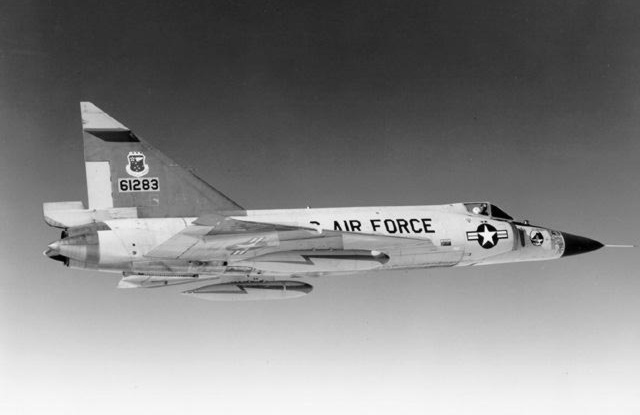
- Area-ruled, waisted at the wing — the "Coke bottle" pinch, plus two large fairings flanking the jet pipe to fill the cross-sectional area lost aft of the wing. These bulges are the quickest way to identify an F-102A in a photograph
- Empty weight
- 8,777 kg (19,350 lb); 8,747 kg (19,283 lb) also appears in the flight-test literature
- Combat weight
- 11,110 kg (24,494 lb) — a clean interceptor with a full missile bay and internal fuel
- Maximum take-off weight
- 12,678 kg (27,950 lb); the maximum permitted in-flight weight was 14,315 kg (31,559 lb), and 31,500 lb is the figure most tables round it to
- Internal fuel
- About 1,085 US gal (about 4,105 litres, about 903 imp gal) — modest, and the reason a Delta Dagger on a long patrol almost always carried tanks
- External fuel
- 2 × 215 US gal (2 × 814 litres) on underwing pylons — the only external stores the type routinely carried, and they cost it supersonic flight
- Wing loading
- 170 kg/m² (35 lb/sq ft) at combat weight — very low, which gave the delta its famous turn rate at height and its equally famous appetite for energy in the turn
Performance
- Maximum speed
- 1,328 km/h (825 mph, 717 kt) at 12,190 m (40,000 ft), Mach 1.25 — the standard clean-configuration figure
- Maximum speed at 10,670 m
- 1,315 km/h (817 mph, 710 kt) at 35,000 ft, Mach 1.23 to 1.24 — the flight-test figure, and the more honest one for an operational aircraft
- Maximum speed with drop tanks
- Mach 0.95 — subsonic. An interceptor sitting alert with tanks on was a subsonic aeroplane until it jettisoned them, which matters far more to the type’s real capability than the clean figure does
- Rate of climb, sea level
- 66 m/s (13,000 ft/min)
- Time to 15,240 m
- 6.4 min to 50,000 ft from a standing start — against a 1954 Interceptor requirement of four minutes. The Deuce missed the requirement that had defined it, which is precisely why the F-106 was ordered
- Service ceiling
- 16,300 m (53,400 ft); 16,915 m (55,500 ft) appears in flight-test data for a light aircraft
- Combat ceiling
- About 16,760 m (about 55,000 ft), rising to about 17,070 m (56,000 ft) with the later conically cambered wing. An early programme prediction of 57,000 ft was never achieved
- Combat radius
- About 604 km (about 326 nmi, 375 miles) as an operational planning figure; about 796 km (430 nmi, 495 miles) is quoted from flight test. Take the smaller number seriously
- Ferry range
- 2,170 km (1,350 miles, 1,170 nmi) with external tanks; 2,111 km (1,312 miles, 1,140 nmi) also quoted
- Thrust-to-weight
- 0.70 at combat weight with afterburner — unremarkable even in 1956, and the reason the type accelerated poorly through the transonic region despite the area rule
- PQM-102B drone
- Mach 1.2, ceiling about 17,000 m (about 55,800 ft), controllable down to about 60 m (200 ft) above the ground — the drone conversions flew a wider altitude envelope than the manned interceptor ever had, because nobody had to survive the sortie
Propulsion & systems
- Engine
- 1 × Pratt & Whitney J57-P-25 — two-spool axial-flow turbojet with afterburner, sixteen-stage compressor and three-stage turbine. The J57 was the defining American engine of the 1950s: it also powered the B-52, the F-100, the F-101 and the U-2
- Military (dry) thrust
- 52.0 kN (11,700 lbf) — the J57-P-23 fitted to earlier aircraft was rated at 45.4 kN (10,200 lbf) for thirty minutes
- Afterburning thrust
- 76.5 kN (17,200 lbf), commonly rounded to 17,000 lbf; the J57-P-23 gave 71.2 kN (16,000 lbf), and the J57-P-11 of the original YF-102 gave 44.5 kN (10,000 lbf) dry and 71.2 kN (16,000 lbf) in reheat. Reheat was cleared for five minutes at a time
- Engine size and weight
- 6.22 m long, 1.01 m diameter, 2,288 kg (20 ft 5 in, 3 ft 4 in, 5,045 lb) — a big, heavy engine for a small aircraft, and a large part of why the fuselage had the volume the area rule then had to be applied to
- Air intakes
- Fixed side intakes at the wing root — enlarged and reprofiled during the area-rule redesign. The TF-102A’s intakes sat lower and further forward to clear the widened side-by-side cockpit. Fixed geometry capped the type at low supersonic speed; the F-106 got variable ramps and Mach 2
- Fire control
- Hughes MG-3, replaced in service by the Hughes MG-10 — search and track radar, analogue computer, autopilot coupling and missile launch computation in one integrated set. The intended system, the Hughes MX-1179 that became the MA-1, was not ready; the F-102 got the interim set and the F-106 inherited the one the requirement had actually asked for
- Infrared search and track
- Nose-mounted IR sensor, retrofitted to most airframes — a passive detector sitting in a small ball ahead of the windscreen, added from the early 1960s. In Vietnam crews used it to hunt lorry engines and camp fires along the Ho Chi Minh Trail, a use nobody had imagined for an air-defence sensor
- Interception method
- Ground-controlled, later SAGE-directed — the Deuce was one node of a continental air-defence system, vectored to a computed lead-collision course by a ground controller and then handed the target by its own radar. It was never intended to hunt on its own and was poor at it
- Weapons bay
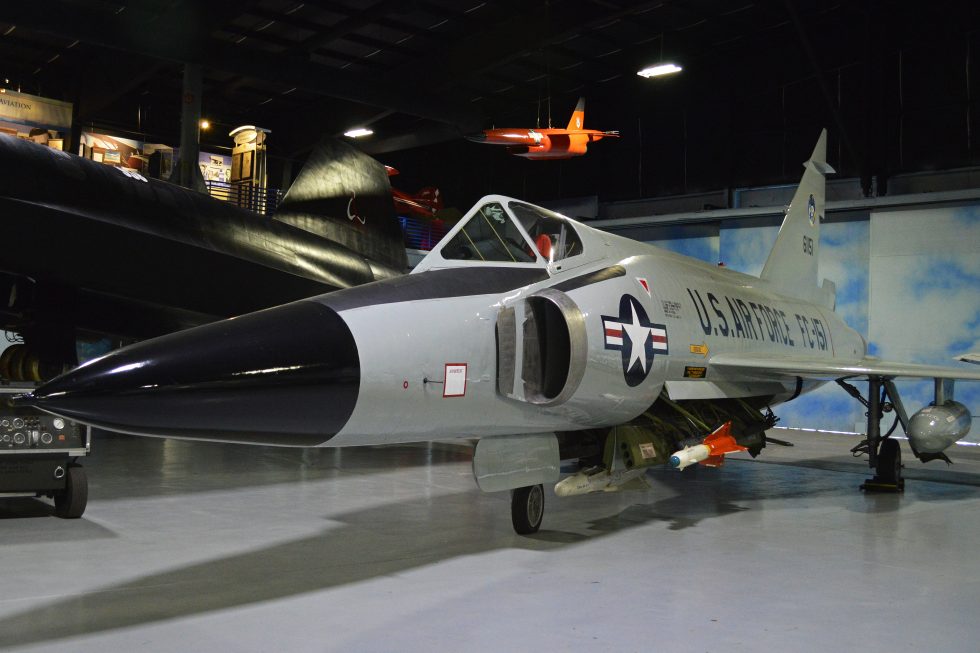
- Three-segment internal ventral bay — left, centre and right compartments, each holding two Falcons in tandem on trapeze launchers that swung the missile clear of the fuselage before firing. Rocket tubes were built into the bay doors. No external weapon pylons of any kind were fitted
- Flight controls
- Elevons, single fin and rudder, no tailplane, no flaps — a pure tailless delta. Approach speeds were high and the nose attitude on finals steep, hence the braking parachute and the trainer
- Wing development
- Case X and Case XX cambered wings — successive conical-camber leading edges trialled from 1955 and retrofitted in service. The Case XX wing enlarged the elevons, cut take-off speed, improved supersonic lift/drag and lifted the ceiling to about 56,000 ft. It is the second-largest aerodynamic fix in the programme after the area rule itself
04The F-102 Delta Dagger’s operating costs: what the numbers really tell us
Firm cost figures for the F-102 are scarce and inconsistent, as is usual for a 1950s military aircraft. Contemporary sources place the flyaway unit cost very roughly around $1.2–1.4 million in 1950s dollars, but this should be read as an order-of-magnitude estimate rather than a precise, audited price. No reliable public cost-per-flight-hour figure exists for the type. What is better documented is scale: nearly 1,000 airframes were built and the type equipped more than 25 Air Defense Command squadrons at its peak before being handed down to the Air National Guard. Treat any exact dollar figure attached to the Deuce with healthy scepticism.
Armament & payload
The F-102 was the first American fighter designed with no gun at all, and it carried everything inside
The Delta Dagger was built around a proposition that looked obvious in 1951 and turned out to be half right: that the interceptor of the missile age would kill bombers with guided weapons directed by an integrated fire-control system, and that a gun was dead weight. No production F-102A ever carried a gun, no provision for one existed, and none was ever seriously proposed. That made it the USAF’s first operational all-weather interceptor armed only with missiles, and the first American fighter of any kind conceived without a gun.
Everything the aircraft carried lived inside a three-segment ventral bay. Each of the three compartments held two Hughes Falcons in tandem on trapeze launchers that extended the missile into the airstream before ignition, so the full fit was six missiles. The doors of the bay were themselves weapons: they carried tubes for twenty-four 2.75 in Mighty Mouse folding-fin aerial rockets, fired in salvoes of six, twelve or the lot. An interceptor whose bomb-bay doors were a rocket battery is a genuinely unusual piece of engineering, and it existed for one reason: an internal load kept the fuselage clean, and a clean fuselage was the whole point of an aeroplane that had already lost one fight with transonic drag.
The weapons themselves aged badly. The early Falcon needed a long, stable tail-cone approach and had no proximity fuse: it had to hit the target to detonate, against a large, slow, non-manoeuvring bomber. Against anything that jinked it was close to useless, and the unguided rockets were worse. The nuclear-tipped AIM-26 Falcon of 1961 was the honest admission of this — if you cannot guarantee a hit, carry a warhead that does not need one. Fits varied sharply by year and by operator: the rocket load was cut from twenty-four to twelve from about 1957 and many later aircraft carried none, the nuclear AIM-26A had left service by 1971, and Greek and Turkish aircraft were supplied with conventional Falcons only.
Gun
- None. No gun, no cannon, no provision, no ammunition bay, on any F-102A, TF-102A or drone conversion. This is not an omission in the record; it is the defining feature of the aircraft.
- The decision followed directly from the mission. A gun pass on a Soviet bomber meant closing to a few hundred metres inside its defensive fire; a Falcon fired from several miles out on a computed collision course did not. Against the target the type was designed to kill, the reasoning was sound.
- It was also the standard American answer of the period rather than a Convair eccentricity: the F-89H, the F-101B and the F-106A were all gunless missile carriers, and the F-4 Phantom II followed them.
- The reckoning came in Vietnam, where gunless fighters met manoeuvring targets at close range and the missiles of the day failed repeatedly. The F-102 was never the aircraft that had to answer for that — it flew almost no air-to-air engagements — but it was the design that started the argument.
- The one proposal that would have added guns, the F-102C tactical strike version, was rejected by the Air Force in April 1957 before any gun installation was built.
Air-to-air
- 6 × Hughes Falcon in three internal bays, two per bay in tandem on extending trapeze rails. The normal mixed fit was three semi-active radar-homing and three infrared rounds, so the pilot could shoot whichever the geometry and the weather favoured.
- GAR-1 / GAR-1D Falcon (redesignated AIM-4 / AIM-4A) — semi-active radar homing, about 54 kg (119 lb), a 3.4 kg (7.6 lb) high-explosive warhead and a reach of some 9.7 km (6 miles). Operational on the F-102A from 1956. No proximity fuse: a direct hit was required.
- GAR-2 / GAR-2A Falcon (AIM-4B / AIM-4C) — infrared homing, about 61 kg (135 lb), rear-aspect only, which meant a stern chase against a target that could not be allowed to notice.
- GAR-11 / AIM-26A Falcon — the nuclear round, operational on the F-102 from 1961, carrying a W54 fission warhead of about 0.25 kt. Larger than the standard Falcon at 2.14 m and 92 kg, it needed a modified centre bay, which took two of them in place of two conventional rounds. Out of service by 1971.
- AIM-26B — the conventionally armed development of the same missile, produced because a nuclear air-to-air weapon could not be used over friendly territory. Exported widely and licence-built in Sweden as the Rb 27.
Air-to-surface guided
- None was ever carried or cleared. The F-102 had no air-to-ground guided weapon, no laser designator, no television-guided store and no capability to deliver one.
- The card is kept because the aircraft nonetheless flew ground-attack sorties in Vietnam. It did so with air-to-air weapons pointed downwards, which is a different thing entirely.
- Crews on night interdiction along the Ho Chi Minh Trail used the nose infrared sensor to find hot lorry engines and cooking fires, then fired infrared Falcons at them. The missiles were homing on a heat source, so in the loosest possible sense this was guided attack; it was also an improvisation that no manual described.
- Accuracy and effect were poor, and the results were never good enough to justify the practice on its own terms. It happened because the aircraft was in theatre, had a sensor nothing else had, and had nothing better to do.
- The F-102C would have added a proper strike fit with an uprated J57-P-47 and a modified fire-control system. Two aircraft became YF-102C test airframes and the Air Force declined the variant in April 1957.
Bombs
- None. No F-102 of any mark was cleared to carry a bomb, conventional or nuclear. There were no external weapon pylons, and the internal bay was sized and shaped for Falcons on trapezes.
- The two underwing hardpoints existed solely for 215 US gal (814 litre) drop tanks. They were plumbed for fuel and nothing else.
- This is one of the sharpest distinctions between the Deuce and its contemporaries. The F-100 and the F-101 both became strike aircraft; the F-102 remained an interceptor to the day it was retired.
- The rejected F-102C was the only attempt to change that, and it died at the two-prototype stage in 1957.
- The one nuclear weapon the type ever carried, the AIM-26A Falcon, was an air-to-air missile fired at aircraft, not a bomb. Conflating the two is a common error.
Rockets
- 24 × 2.75 in (70 mm) FFAR — the Mighty Mouse folding-fin aerial rocket, carried in tubes built into the weapons-bay doors themselves rather than in a pod or a tray. Three tubes in each of the four inner doors, each tube holding a pair of rockets roughly 1.2 m (4 ft) long.
- Firing was by salvo, and the pilot could select six, twelve or all twenty-four. The fire-control system computed the release point on a lead-collision intercept; the pilot pressed and the system decided when.
- A YF-102A demonstrated the full armament on 8 July 1955, firing six Falcons and twenty-four rockets in under ten seconds. As a piece of showmanship it was superb. As a tactic it was a product of a brief American conviction that unguided rocket salvoes could destroy bombers, which live-fire trials across several types comprehensively disproved.
- From about 1957 the tubes were deleted from the inner doors and the standard load halved to 12 rockets, which remained the fit until retirement. Many late aircraft carried none at all.
- In Vietnam the rockets found their only real use, fired at ground targets in the Trail interdiction role. Contemporary assessments describe them as relatively ineffective there too.
Pods & other stores
- 2 × 215 US gal (814 litre) drop tanks on underwing pylons — the only external stores in the type’s repertoire. They roughly doubled the useful radius and made the aircraft subsonic, capping it at about Mach 0.95.
- Infrared search and track ball ahead of the windscreen, retrofitted to most airframes from the early 1960s. Not a store, but the only sensor the type gained after entering service, and the one that gave it a night role it had not been designed for.
- Braking parachute in the tail — standard equipment on a tailless delta with no flaps and a long landing roll.
- No gun pod, no reconnaissance pod, no electronic-warfare pod, no buddy refuelling store. The Deuce carried tanks or it carried nothing.
- Pave Deuce drone kit — from 1973 Sperry installed radio command guidance, telemetry, an autoland system and scoring cameras in surplus airframes. The fit turned the interceptor into a target, and in that role it flew with no weapons and no pilot.
Three typical loadouts
- Continental alert, 1958
- Three GAR-1D radar-homing and three GAR-2A infrared Falcons in the three bays, 24 × 2.75 in FFAR in the bay doors, full internal fuel, no external tanks. Five-minute readiness under a SAGE sector, scrambled against an unidentified track over the Arctic approaches. The configuration the aircraft was designed for and the one it spent most of its life sitting in.
- Nuclear-armed area defence, 1963
- Two AIM-26A nuclear Falcons in the modified centre bay, two conventional radar-homing and two infrared Falcons in the outer bays, rocket tubes deleted, two 215 US gal drop tanks for a long standing patrol. The weapon of last resort against a bomber stream, carried by an aircraft whose conventional missiles nobody quite trusted to hit.
- Night interdiction, Southeast Asia, 1966
- Infrared Falcons in the bays, 12 × 2.75 in FFAR in the doors, two drop tanks, nose infrared sensor as the primary search device. Launched at dusk to work the Ho Chi Minh Trail, hunting truck engines by their heat. An air-defence interceptor doing close air support with air-to-air missiles, and the strangest thing the type ever did.
Sourcing caveat: Falcon designations changed wholesale in the 1962 tri-service redesignation, so the same missile appears as GAR-1D in 1958 documents and AIM-4A in 1965 ones; sources that mix the two systems in a single sentence are common and confusing. The rocket count is particularly unreliable in secondary sources, which almost universally quote 24 without noting that the standard fit was halved in 1957 and often deleted later. Yields for the AIM-26A W54 warhead are given as 0.25 kt in the open literature, with some programme accounts suggesting higher; the figure remains contested.
Variants
The Delta Dagger has only two real marks, and its most famous relative is a different aeroplane
For a type built in four figures, the F-102 has a remarkably short variant list. There is the aircraft that could not go supersonic, the aircraft that could, a trainer, and several hundred drones. Everything else is either a prototype block, a proposal that died, or the F-106.
The central event is the area rule, and it is one of the cleanest illustrations in aviation history of theory rescuing a programme. The YF-102 flew in October 1953 and could not exceed Mach 1 in level flight, which for an aircraft specified to reach Mach 1.2 was a programme-ending failure. Richard Whitcomb at NACA Langley had found the reason in his 8 ft high-speed tunnel: transonic drag depends on how the total cross-sectional area of the whole aeroplane, wing and fuselage together, varies along its length. Smooth that distribution and the drag rise falls away. Convair pinched the fuselage in at the wing, stretched it 11 ft, added fairings beside the jet pipe and fitted a thinner, larger wing. The first YF-102A flew 117 days after the redesign began, on 20 December 1954, and went through Mach 1 the next day — on its second flight — eventually reaching Mach 1.2 in level flight.
The cost was brutal and is usually understated. Convair had been building the F-102 under the Cook-Craigie plan, which committed production tooling before flight testing to speed the aircraft into service. When the fuselage changed shape, about two-thirds of some 30,000 tools had to be scrapped or reworked. The area rule saved the aeroplane; the Cook-Craigie plan is what made saving it so expensive, and the two lessons are usually taught separately when they belong together.
The service pattern that followed was the standard one for American interceptors of the period, run at unusual scale. At its peak in the late 1950s the F-102A equipped more than 25 Air Defense Command squadrons, and 43 Air Force squadrons flew the type in all; deployments reached Thule, Iceland, Alaska, Europe and the Pacific. From the mid-1960s aircraft were handed down to the Air National Guard, which became the principal operator and flew the type until October 1976, by which time the active-duty fleet had been gone for three years. Among the Guard pilots was George W. Bush, who flew F-102s with the 147th Fighter Interceptor Group of the Texas Air National Guard at Ellington AFB, Houston, between 1968 and 1972; the assignment is a matter of record and is noted here for the same reason any notable operator is.
- YF-102 (1953, 2 built)
- The original prototype: J57-P-11, no area ruling, 661.5 sq ft wing. First flight 24 October 1953 at Edwards with Richard L. Johnson (some sources give 23 October); destroyed on 2 November 1953 after an engine flameout, Johnson badly injured. The second aircraft confirmed the verdict — limited to about Mach 0.98 in level flight, with severe transonic buffet. A complete failure against the specification, and the most useful failure in the programme.
- YF-102A (1954–1955, 4 converted)
- The area-ruled rebuild: fuselage waisted and lengthened by 11 ft, aerodynamic fairings beside the jet pipe, thinner and larger wing, revised intakes, new canopy, lightened structure, J57-P-23. Rolled out 117 days after redesign began; first flight 20 December 1954; supersonic on its second flight the following day. This aircraft is why the F-102 exists.
- F-102A (1955–1958, 889 accepted)
- The production interceptor and the baseline for this page. First flight 24 June 1955, operational with the 327th Fighter-Interceptor Squadron at George AFB from spring 1956. Hughes MG-3 fire control replaced in service by MG-10, J57-P-25, six Falcons and 24 rockets internally. Later blocks and retrofits brought the Case X and Case XX cambered wings and the nose infrared sensor. The first 40 airframes were used for research and development rather than issued to squadrons.
- TF-102A (1955–1958, 111 built)
- The side-by-side trainer, known to crews as the Tub. Widened forward fuselage, intakes moved down and forward, vortex generators on the canopy framing and an enlarged fin to cure serious high-speed buffet. First flight 8 November 1955 (31 October is also given), Richard L. Johnson again at the controls. Combat-capable and fully armed but subsonic, topping out around Mach 0.97. Two normally served with each F-102A squadron; in Vietnam some flew forward air control sorties.
- F-102B (never built as such)
- The designation under which the F-106A Delta Dart was ordered, redesignated in 1956 once the changes had grown too large to call it a variant. J75 engine, MA-1 fire control, variable intake ramps, Mach 2. It is a different aircraft and its figures do not belong on this page — the confusion between the two is the single most common error in F-102 writing.
- F-102C / YF-102C (1957, 2 converted, cancelled)
- A proposed tactical strike version with the uprated J57-P-47, strengthened structure and a modified fire-control system. Two F-102As (53-1797 and 53-1806) were converted as test airframes; the Air Force rejected the variant in April 1957. The only serious attempt to make the Deuce anything other than an interceptor.
- QF-102A (1973, 6 converted)
- The first Pave Deuce conversions, produced by Sperry, which retained a cockpit and could be flown by a safety pilot as well as by radio command. Used to prove the drone system before unmanned production began.
- PQM-102A (1974 onwards, about 65 converted)
- The first full-drone standard: no pilot provision, radio command guidance, telemetry, scoring cameras. First flight August 1974, operational from October 1974. Flown as a full-scale supersonic target simulating a MiG-21 for Sparrow, Sidewinder, Hawk and Patriot development.
- PQM-102B (late 1970s, about 146 converted)
- Improved drone with restored pilot controls for ferry flights and a low-altitude capability down to about 60 m (200 ft), which the PQM-102A lacked. The most numerous drone standard, and the one most often photographed being destroyed.
- Greek and Turkish aircraft (1968–1979, about 75 transferred)
- No separate designation, but a distinct operational chapter. Turkey received roughly 50 F-102As and TF-102As from 1968 for the 191st, 142nd and 182nd Filo, retiring them in mid-1979; Turkish aircraft flew during the 1974 Cyprus intervention. Greece took 24 in 1969 for 342 All-Weather Squadron at Tanagra, retired between 1975 and 1977 depending on the source. These were the only export operators.
Closing note on survivors: no F-102 has flown since the last drone was expended, and none is airworthy. Sources give the end of the drone programme as 1985 or 1986; conversions had ceased by 1982. Roughly 25 to 50 original airframes survive as static exhibits, a spread that reflects genuine uncertainty rather than sloppiness — the lower figure counts accessible museum aircraft, the higher one includes gate guardians at Air National Guard bases, technical-school hulks and aircraft in poor condition. Every survivor is an original Convair airframe; there are no reproductions of this type, and given the complexity of an area-ruled fuselage there never will be. Notable examples include the National Museum of the United States Air Force at Wright-Patterson (56-1416), the Pima Air and Space Museum at Tucson and the Hill Aerospace Museum in Utah (57-0833), with further aircraft preserved in Greece and Turkey. The drone programme is the reason so few remain: several hundred airframes that would otherwise have gone to museums or scrapyards were instead shot down over ranges.
From area-rule crisis to Cold War sentinel
The delta ancestor
The experimental Convair XF-92A — the first American delta-wing aircraft, derived from Lippisch’s work — flies and proves the tailless triangle planform.
First flight & the drag wall
The YF-102 flies on 24 October but cannot pass Mach 1. Within weeks the area-ruled YF-102A (20 December) goes supersonic — the fix that saves the programme.
Enters service
The F-102A joins Air Defense Command as the USAF’s first operational delta-wing and first all-weather supersonic interceptor.
The SAGE shield
More than 25 ADC squadrons stand alert across the US, Iceland, Greenland, Alaska and Europe, plugged into the SAGE air-defence network.
To Vietnam
F-102s deploy to Southeast Asia for air-defence alert, MiG combat air patrol and B-52 escort — and occasional ground attack with rockets.
The only air-to-air loss
On 3 February a 509th FIS F-102 is shot down by a North Vietnamese MiG-21 near Sam Neua — the type’s sole air-combat loss.
Guard duty & export
Retired from active USAF service, the Deuce soldiers on with the Air National Guard and is passed to NATO allies Greece and Turkey.
A second life as a drone
Under Project Pave Deuce, more than 200 retired airframes become PQM-102 target drones; the last is expended in 1985.
Twelve stories of the Deuce
From a refugee’s delta to the first US delta fighter
The F-102’s triangle wing traces back to Alexander Lippisch.
Read the full story
The “coke-bottle” fix that saved the Deuce
A jet built to be supersonic — that could not break the sound barrier.
Read the full story
The interceptor a computer could fly to the kill
The Deuce was the trigger finger of an automated Cold War shield.
Read the full story
Missiles and rockets, hidden behind the doors
Six Falcons inside — and 24 rockets tucked into the bay doors.
Read the full story
The Deuce’s half-kiloton air-to-air Falcon
To be certain of a kill, the F-102 could carry a nuclear missile.
Read the full story
The Deuce that grew a second seat — sideways
Most trainers seat pupils in tandem; the TF-102A sat them shoulder to shoulder.
Read the full story
An interceptor sent to a war it was not built for
The Deuce guarded Vietnam’s skies — and sometimes rocketed the jungle.
Read the full story
The only Deuce a MiG ever killed
February 1968: an ambush over Laos ends with three Falcons missing.
Read the full story
Deuce versus Deuce: the contested Aegean of 1974
Both Greece and Turkey flew the F-102 — and one may have downed the other.
Read the full story
The president who flew the Deuce
George W. Bush strapped into a supersonic interceptor in the Texas Guard.
Read the full story
Reborn as a target: the Deuce’s unmanned second life
Hundreds of retired F-102s came back to be shot down on purpose.
Read the full story
The Deuce’s bigger brother started as an F-102
The F-106 Delta Dart was literally born as the “F-102B.”
Read the full story
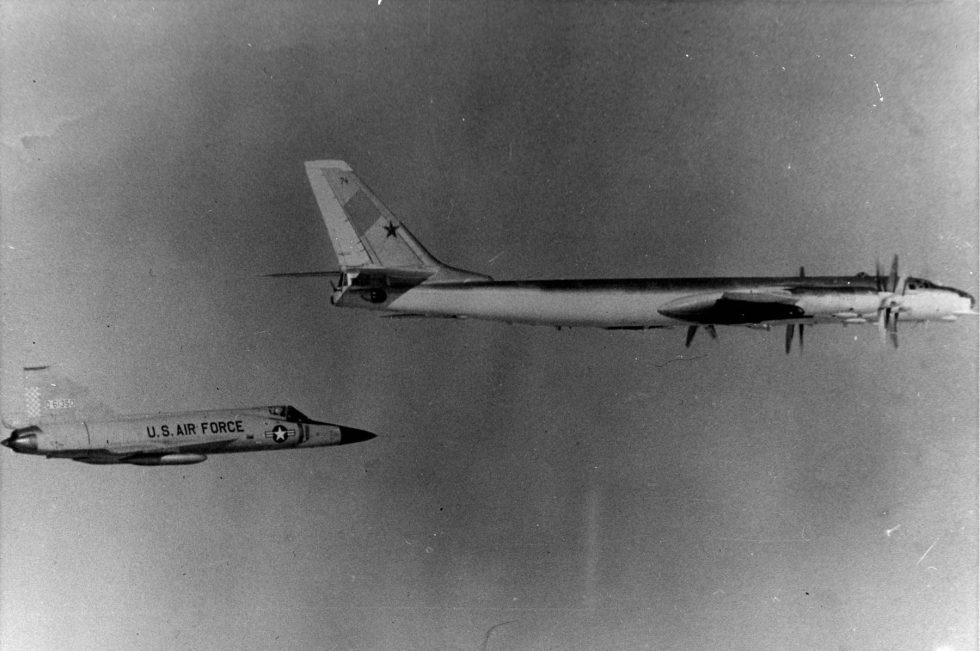
The Delta Dagger in pictures
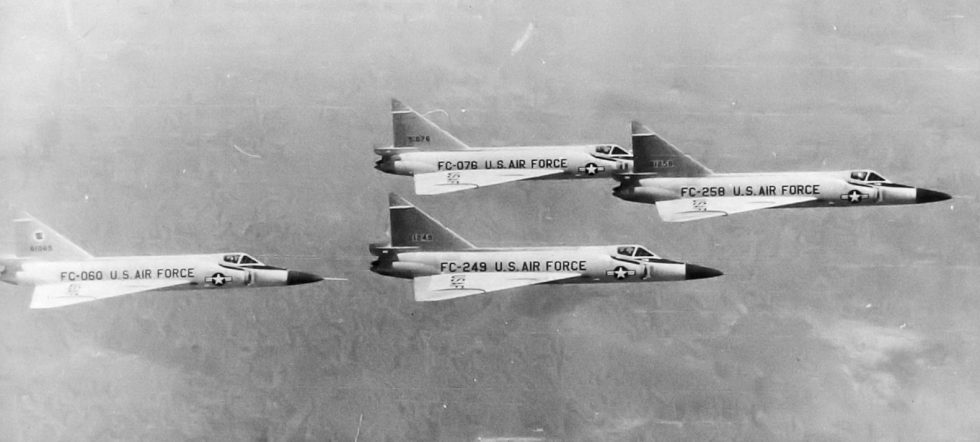
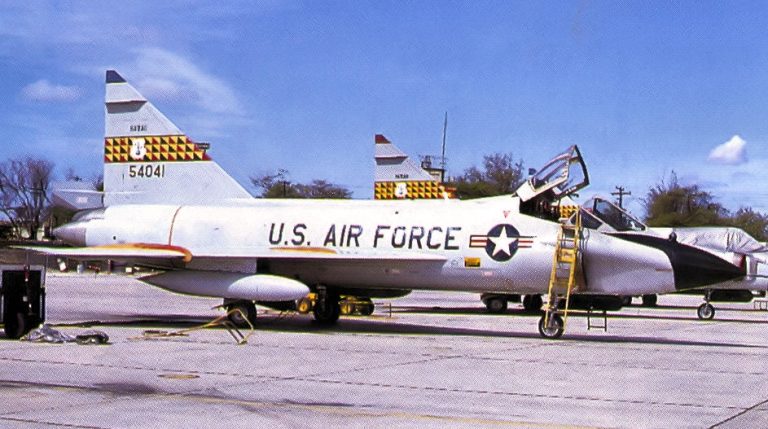
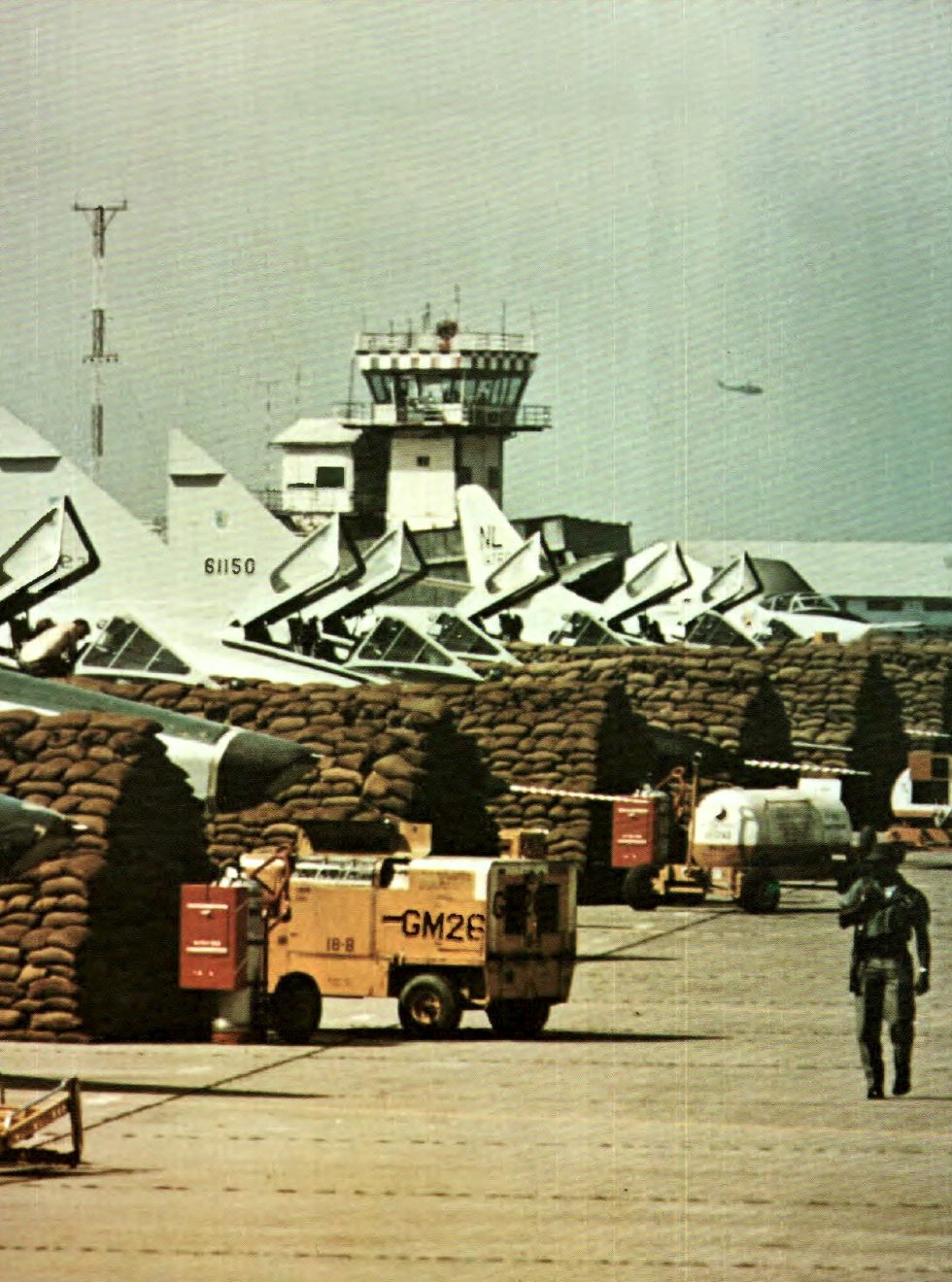
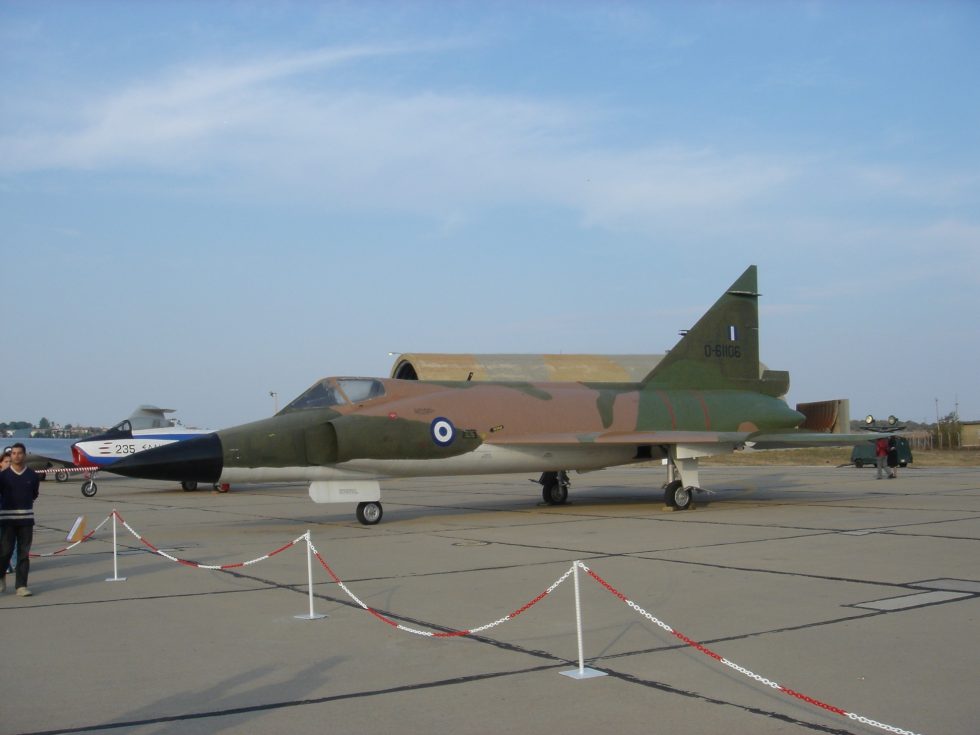
The Delta Dagger in motion
A verified, high-authority video feature for the F-102 is still being selected — video coming soon. In the meantime, the photo gallery above and the stories carousel cover the aircraft in depth.
Where the Delta Dagger flew
The record that defines it
The F-102 was built to intercept Soviet bombers, not to dogfight, and it never fired a shot on continental alert. Its one real war was Vietnam, where it flew air-defence alert, MiG combat air patrol and B-52 escort from 1962. With few enemy aircraft to meet, some crews used their rockets against ground targets. About 15 Deuces were lost in Southeast Asia — most to accidents, ground fire and base attacks, and one, famously, to a MiG-21.
Compare the combat record of every military aircraft. Figures as of July 2026.
Everything people ask about the F-102
Can I fly in an F-102?
Why couldn’t the original F-102 go supersonic?
What does the nickname “Deuce” mean?
Did the F-102 have a gun?
Did F-102s fight in Vietnam?
What is the difference between the F-102 and the F-106?
Which countries flew the F-102?
Did George W. Bush really fly the F-102?
You can’t fly the F-102.
These, you can.
Some legends only live in museums — others are fuelled and waiting. MiGFlug has put civilians in real military jet cockpits since 2004.
 Fly the L-39 AlbatrosThe world’s most-flown jet trainer — aerobatics included
 Fly the F-104 Starfighter“The missile with a man in it”
 Fly the MiG-21The Cold War’s most-produced jet
 Fly the T-33 Shooting StarAmerica’s first jet trainer
 Fly the DH VampireA piece of early jet history
 Fly the S.211Agile Italian jet trainer
 Fly the MB-326The classic Aermacchi jet
 Fly the MiG-15The Soviet legend of the Korean War
Continue the tour
Every fact, checked
- National Museum of the U.S. Air Force — F-102A Delta DaggerOfficial specifications, production totals (889 F-102A + 111 TF-102A) and Iceland service.
- GlobalSecurity.org — F-102 Delta DaggerDevelopment, the area-rule redesign, MG-3/MG-10 fire control and ADC/ANG history.
- The War Zone — The F-102’s weapons baysThe six-Falcon-plus-24-rocket internal bay and the nuclear AIM-26 option.
- The Aviation Geek Club — the only F-102 shot down by a MiG-21Full detail of the 3 February 1968 loss of 1st Lt Wallace Wiggins.
- Aerospaceweb.org — F-102 in VietnamDeployment dates, roles and the loss breakdown of about 15 aircraft.
- Designation-Systems.net — Sperry PQM-102The QF-102/PQM-102 target-drone conversions under Project Pave Deuce.
- Hellenic Air Force — F-102 Delta DaggerGreek acquisition: 24 aircraft with 342 Squadron, 1970–1977.
- HistoryNet — Convair F-102 Delta DaggerDevelopment, the XF-92 delta lineage and the F-102-to-F-106 story.