
Grumman F-11
“Tiger”
A slender, area-ruled carrier fighter that punched the US Navy through the sound barrier — remembered for a short front-line career, a long life with the Blue Angels, and the day one shot itself down.
The Grumman F-11 Tiger: the Navy’s first supersonic carrier fighter
In the early 1950s Grumman — the “Ironworks” that had built the Navy’s rugged wartime fighters — set out to give its straight-and-swept-wing F9F Cougar a genuine supersonic successor. What began in 1952 as a modest redesign quickly became an all-new aircraft. The engineers wrapped a thin, low wing and a single afterburning turbojet inside a fuselage shaped by the newest aerodynamic idea of the decade: the area rule, whose pinched, “coke-bottle” waist cut transonic drag. The result was the F11F-1 Tiger — sleek, small and, for Grumman, genuinely fast.
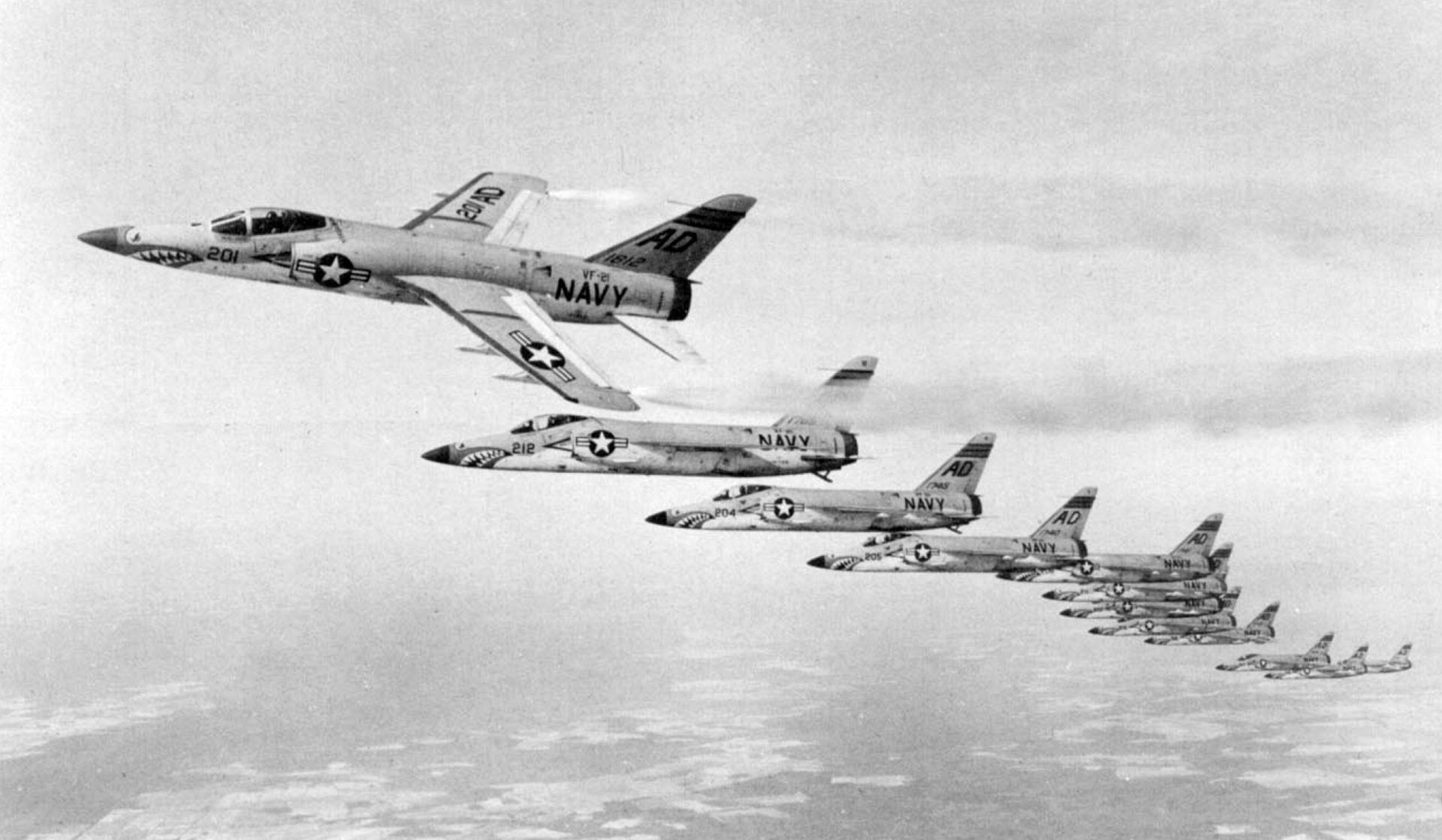
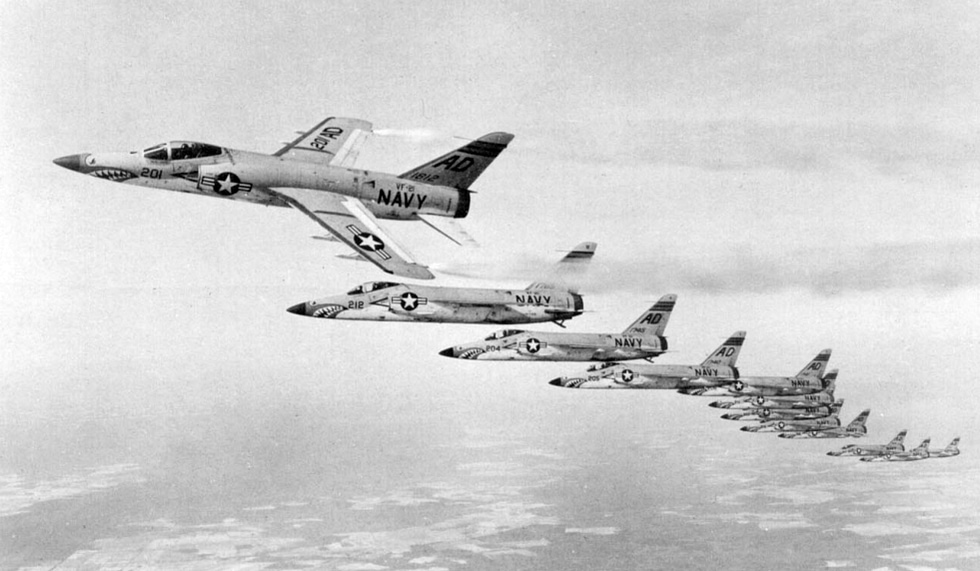
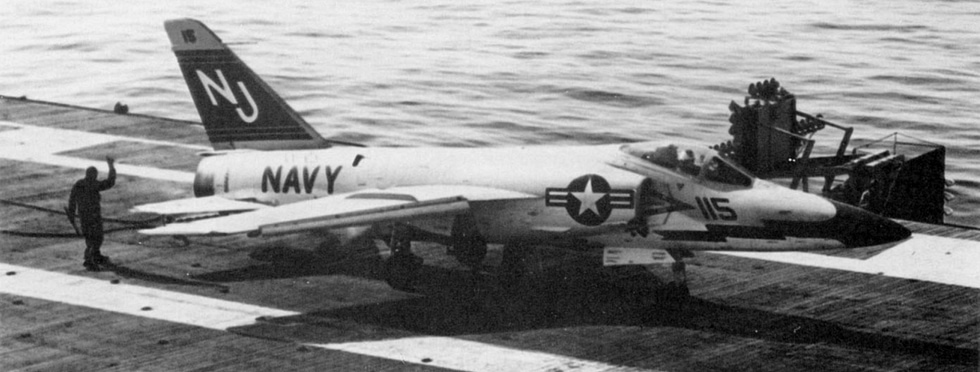
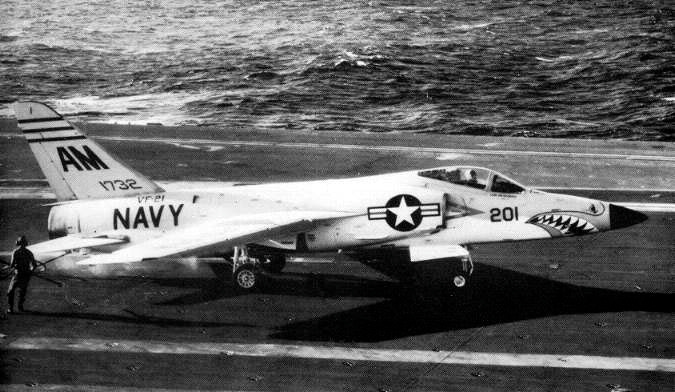
The prototype first flew on 30 July 1954, and slipped past Mach 1 in a shallow dive soon after — a first for a Grumman fighter. The Tiger reached the fleet in 1956–57 as one of the US Navy’s first supersonic carrier-based day fighters, armed with four 20 mm cannon and, later, Sidewinder missiles. On paper it was everything a mid-1950s carrier air wing wanted: light, agile, transonic, and small enough to fold onto a crowded deck.
The reality was less kind. The Tiger was powered by the Wright J65 — a licence-built British Armstrong Siddeley Sapphire — and the engine was both underpowered and troublesome. Top speed was only a little over Mach 1, range was short, and the airframe arrived just as a faster, longer-legged rival did. The Vought F-8 Crusader, capable of nearly Mach 2, simply outclassed it. The Tiger’s front-line career was correspondingly brief: it equipped only a handful of squadrons and was withdrawn from carrier fighter service by 1961, barely five years after entering it.
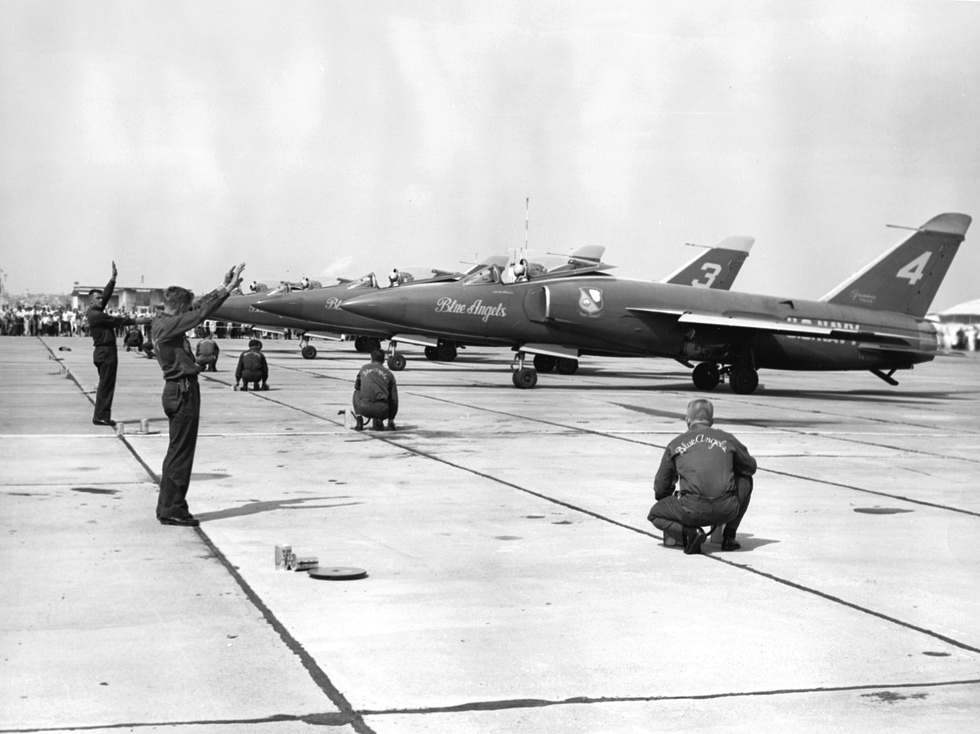
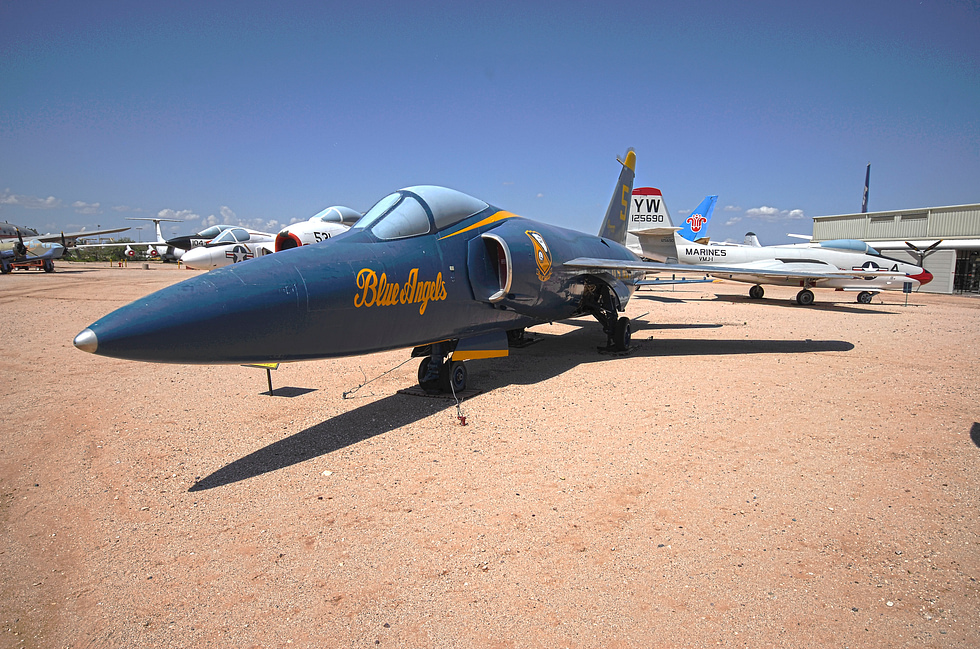
Yet the Tiger’s story did not end there — and neither of the two things it is best remembered for is really about combat. In September 1956 a Grumman test pilot, diving and firing his cannon, managed to catch up with and fly into his own bullets, becoming the first pilot in history to shoot down his own aircraft. And in 1957 the Navy’s flight-demonstration team, the Blue Angels, adopted the Tiger — and flew it for twelve seasons, until 1969, longer than any other aircraft the team had used to that point. Retired from the fleet as a near-failure, the Tiger became one of the most-watched aircraft in America.
Around 200 were built, all for the US Navy; the type was never exported and never fought in a war. Its most extreme form, the re-engined Super Tiger, flew at over Mach 2 and set an altitude record — but was never bought. The Tiger’s legacy is that of a beautiful, flawed transitional machine: a jet that mattered less for what it did in the fleet than for what it showed the crowds, and for one very strange afternoon over Long Island.
01The F-11 Tiger’s origins: from the F9F Cougar to an area-ruled supersonic fighter
The Tiger began life in 1952 as Grumman’s Design 98, an in-house study for a “super Cougar” — a refined version of the swept-wing F9F-6 Cougar then in service. But as the engineers chased supersonic performance the project diverged completely from its parent: a new thin wing, a new slim fuselage, and a single afterburning engine in place of the Cougar’s layout. Little more than the name lineage survived, and the Navy ordered it as a new type.
The decisive design move was the adoption of the area rule — NACA engineer Richard Whitcomb’s discovery that transonic drag is governed by the smooth distribution of a body’s cross-sectional area from nose to tail. Waisting the fuselage where the wings joined it gave the Tiger its distinctive pinched profile and let a relatively modest engine push it through the sound barrier. It was among the first US Navy fighters designed around the principle from the outset.
What makes the F-11 Tiger special
An area-ruled ‘coke-bottle’ fuselage
The Tiger was one of the first US Navy fighters shaped from the start by the area rule. Its fuselage is visibly waisted where the thin, low wing meets it — a pinch that smooths the aircraft’s cross-sectional area and cuts the drag spike at the speed of sound. That single idea is what let a modest engine carry a small fighter past Mach 1.
One Wright J65 — the Tiger’s weak heart
Power came from a single Wright J65 afterburning turbojet, a licence-built version of Britain’s Armstrong Siddeley Sapphire producing about 47 kN (10,500 lbf) in afterburner. It was reliable enough on paper but under-powered for a supersonic fighter and troubled in service — the single greatest limit on the Tiger’s speed, range and front-line usefulness.
Thin wing, spoilers and a folding tip
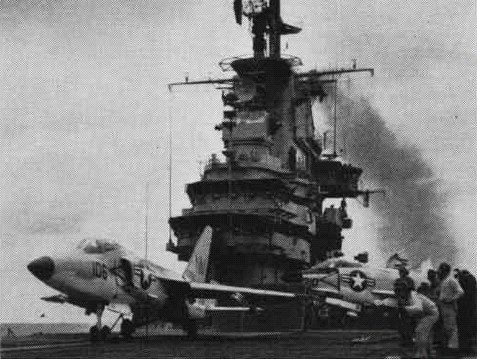
The Tiger used a very thin swept wing with spoilers instead of conventional ailerons for roll control, and an all-moving tailplane — features chosen for high-speed handling. To fit a packed carrier deck the outer wings folded downward, an unusual arrangement that kept the aircraft compact aboard ship.
02The Grumman F11F-1F Super Tiger: the Mach-2 Tiger the Navy never bought
Grumman knew the J65 was holding the Tiger back, so it built a re-engined version around the far more powerful General Electric J79 — the same engine that powered the F-104 and the F-4 Phantom II. The result, the F11F-1F Super Tiger, was a transformed aircraft: it exceeded Mach 2 and, in 1958, zoom-climbed to a world altitude record commonly cited at around 76,800 ft (about 23,400 m).
It was fast, impressive and, in the end, unwanted. The US Navy had already committed to the Vought F-8 Crusader and, soon after, the Phantom II. Grumman pitched the Super Tiger hard for export — Japan and West Germany both evaluated it — but neither bought, and only two prototypes were ever built. The Super Tiger remains one of the great “what-ifs” of 1950s naval aviation.
03Why the F-11 Tiger’s front-line career was so short
The Tiger reached the fleet in 1956–57 and was gone from carrier fighter squadrons by about 1961 — an unusually short run for a new fighter. Three problems compounded each other. The Wright J65 engine was underpowered and unreliable. The aircraft’s range and endurance were short, a serious drawback for ocean operations. And crucially, a superior aircraft arrived at almost the same moment: the Vought F-8 Crusader, nearly twice as fast and far longer-legged, gave the Navy a better single-seat fighter for the same job.
The Tiger was not scrapped, though. Withdrawn from front-line squadrons, surviving aircraft served for years as advanced trainers at Naval Air Training Command until the late 1960s — and, most famously, as the mount of the Blue Angels from 1957 to 1969.
Full F11F-1 Tiger specifications
Airframe & Performance
- Bemanning
- 1
- Lengte
- ~14.3 m (46 ft 11 in)
- Spanwijdte
- ~9.64 m (31 ft 7 in)
- Hoogte
- ~4.0 m (13 ft 2 in)
- Leeggewicht
- ~6,265 kg (13,810 lb)
- Max takeoff weight
- ~10,700 kg (~23,500 lb)
- Max speed
- ~Mach 1.1 · ~1,210 km/h at altitude
- Serviceplafond
- ~14,900 m (49,000 ft)
- Bereik
- ~2,040 km (1,270 mi)
Propulsion & Systems
- Motor
- 1 × Wright J65-W-18 turbojet
- Thrust
- ~47 kN (10,500 lbf) with afterburner
- Armament (guns)
- 4 × 20 mm Colt Mk 12 cannon
- Armament (missiles)
- Up to 4 × AIM-9 Sidewinder
- First flight
- 30 July 1954
- Introduced
- 1956–57 (US Navy)
- Built
- ~200 (production ended 1959)
- Unit cost
- No reliable public figure
- Cost per flight hour
- No reliable public figure
04The F-11 Tiger’s operating costs: why no reliable figure exists
The Tiger was a mid-1950s US Navy programme of only about 200 aircraft, and no dependable public flyaway unit price or cost-per-flight-hour figure survives for it in open sources. Any precise dollar amount attached to the type online should be treated as an estimate rather than a documented figure. What can be said with confidence is that its short front-line life — barely five years before the fleet moved to the F-8 Crusader — made it a poor return on investment as a fighter, even though individual airframes then earned their keep for another decade as trainers and Blue Angels demonstrators.
From ‘super Cougar’ to Blue Angel
Design begins
Grumman starts Design 98, first conceived as an improved F9F Cougar; it soon becomes an all-new area-ruled supersonic fighter.
First flight
The prototype flies on 30 July and goes supersonic in a shallow dive shortly after — a first for a Grumman fighter.
Fleet service & the self-shootdown
The F11F-1 enters US Navy squadron service. On 21 September, test pilot Tom Attridge flies into his own cannon fire — the first aircraft to shoot itself down.
The Blue Angels adopt the Tiger
The Navy’s flight-demonstration team re-equips with the F11F-1, beginning a twelve-year association with the type.
Super Tiger sets a record
The J79-powered F11F-1F Super Tiger exceeds Mach 2 and zoom-climbs to a world altitude record of roughly 76,800 ft — but is never bought.
Out of the front line
Outclassed by the Mach-2 F-8 Crusader and limited by its engine and range, the Tiger is withdrawn from carrier fighter squadrons.
End of training service
The last Tigers are retired from Naval Air Training Command, where they had served for years as advanced trainers.
The Blue Angels move on
After twelve seasons, the Blue Angels replace the Tiger with the F-4J Phantom II — ending the type’s active career.
Twelve Tiger stories
The fighter that started as a Cougar
The Tiger began as a tweak to the F9F Cougar — and ended up an all-new supersonic jet.
Read the full story
The coke-bottle waist
The Tiger’s pinched fuselage came straight from the newest aerodynamic idea of the 1950s.
Read the full story
The jet that shot itself down
Diving and firing his cannon, Tom Attridge flew straight into his own bullets over Long Island.
Read the full story
How a jet catches its own bullets
Bullets slow down; a diving, afterburning jet speeds up. Their paths can cross.
Read the full story
A mile short of the runway
His engine wrecked, Attridge nursed the Tiger toward home — and crashed just short, but survived.
Read the full story
Twelve years in blue and gold
Rejected by the fleet, the Tiger found its true fame with the Navy’s demonstration team.
Read the full story
Beaten by the Crusader
The Tiger arrived just as a faster, longer-legged fighter did — and lost.
Read the full story
The Mach-2 Tiger nobody bought
Re-engined with a J79, the Tiger became a world-beater — and was still turned down.
Read the full story
The trouble with the J65
A licence-built British engine, underpowered and unreliable, capped the Tiger’s potential.
Read the full story
Wings that folded downward
To fit a crowded carrier deck, the Tiger’s wingtips folded down rather than up.
Read the full story
Seven squadrons, five years
The Tiger equipped only a handful of fighter squadrons before the fleet moved on.
Read the full story
A beautiful transitional jet
The Tiger mattered less as a fighter than as a bridge — and a showpiece.
Read the full story
The Tiger in pictures
Where the Tiger flew
A fighter that never fired in anger
The F-11 Tiger scored no air-to-air victories and saw no combat — it entered service after Korea and was gone from the fleet before Vietnam. Its record is one of peacetime carrier operations, a decade of training flights, and twelve seasons of precision aerobatics with the Blue Angels. The single most famous shot ever fired by a Tiger was the one it fired into itself.
See the wider combat record of every military aircraft. The self-shootdown is described in full in the stories and Q&A above and below.
Everything people ask about the F-11 Tiger
Can I fly in an F-11 Tiger?
Did a Tiger really shoot itself down?
How is it possible for a jet to hit its own bullets?
Why did the Blue Angels fly the F-11 Tiger?
How fast was the F-11 Tiger?
Why did the Tiger have such a short front-line career?
Is the F-11 Tiger still in service?
You can’t fly the Tiger.
These, you can.
Some legends only live in museums — others are fuelled and waiting. MiGFlug has put civilians in real military jet cockpits since 2004.
 Fly the L-39 AlbatrosThe world’s most-flown jet trainer — aerobatics included
 Fly the F-104 Starfighter“The missile with a man in it”
 Fly the MiG-21The Cold War’s most-produced jet
 Vlieg met de T-33 Shooting StarAmerica’s first jet trainer
 Fly the DH VampireA piece of early jet history
 Fly the S.211Agile Italian jet trainer
 Fly the MB-326The classic Aermacchi jet
 Fly the MiG-15The Soviet legend of the Korean War
Continue the tour
Every fact, checked
- Naval History and Heritage Command — F11F TigerOfficial US Navy specifications, service dates and Blue Angels history.
- Vintage Aviation News — Boneyard Files: F-11 TigerDevelopment, the short front-line career, the F-8 Crusader rivalry and the Super Tiger.
- The Aviation Geek Club — The Tiger that shot itself downDetailed account of Tom Attridge’s 21 September 1956 self-shootdown.
- Task & Purpose — The Navy jet that shot itself downThe sequence of the dive, the impacts and Attridge’s survival, with the physics.
- Military.com — The test pilot who shot down his own jetRetrospective on Attridge and the first aircraft to shoot itself down.
- Cradle of Aviation Museum — Grumman F-11A TigerGrumman’s own Long Island museum on the Tiger’s design and place in the “Ironworks” line.
- MAPS Air Museum — Grumman F-11F TigerAirframe history, variants and the area-rule design.
- U.S. Navy Blue Angels — Team historyOfficial record of the aircraft the Blue Angels have flown, including the F11F-1 Tiger (1957–1969).