
Grumman F-11
“Tiger”
A slender, area-ruled carrier fighter that punched the US Navy through the sound barrier — remembered for a short front-line career, a long life with the Blue Angels, and the day one shot itself down.
The Grumman F-11 Tiger: the Navy’s first supersonic carrier fighter
In the early 1950s Grumman — the “Ironworks” that had built the Navy’s rugged wartime fighters — set out to give its straight-and-swept-wing F9F Cougar a genuine supersonic successor. What began in 1952 as a modest redesign quickly became an all-new aircraft. The engineers wrapped a thin, low wing and a single afterburning turbojet inside a fuselage shaped by the newest aerodynamic idea of the decade: the area rule, whose pinched, “coke-bottle” waist cut transonic drag. The result was the F11F-1 Tiger — sleek, small and, for Grumman, genuinely fast.
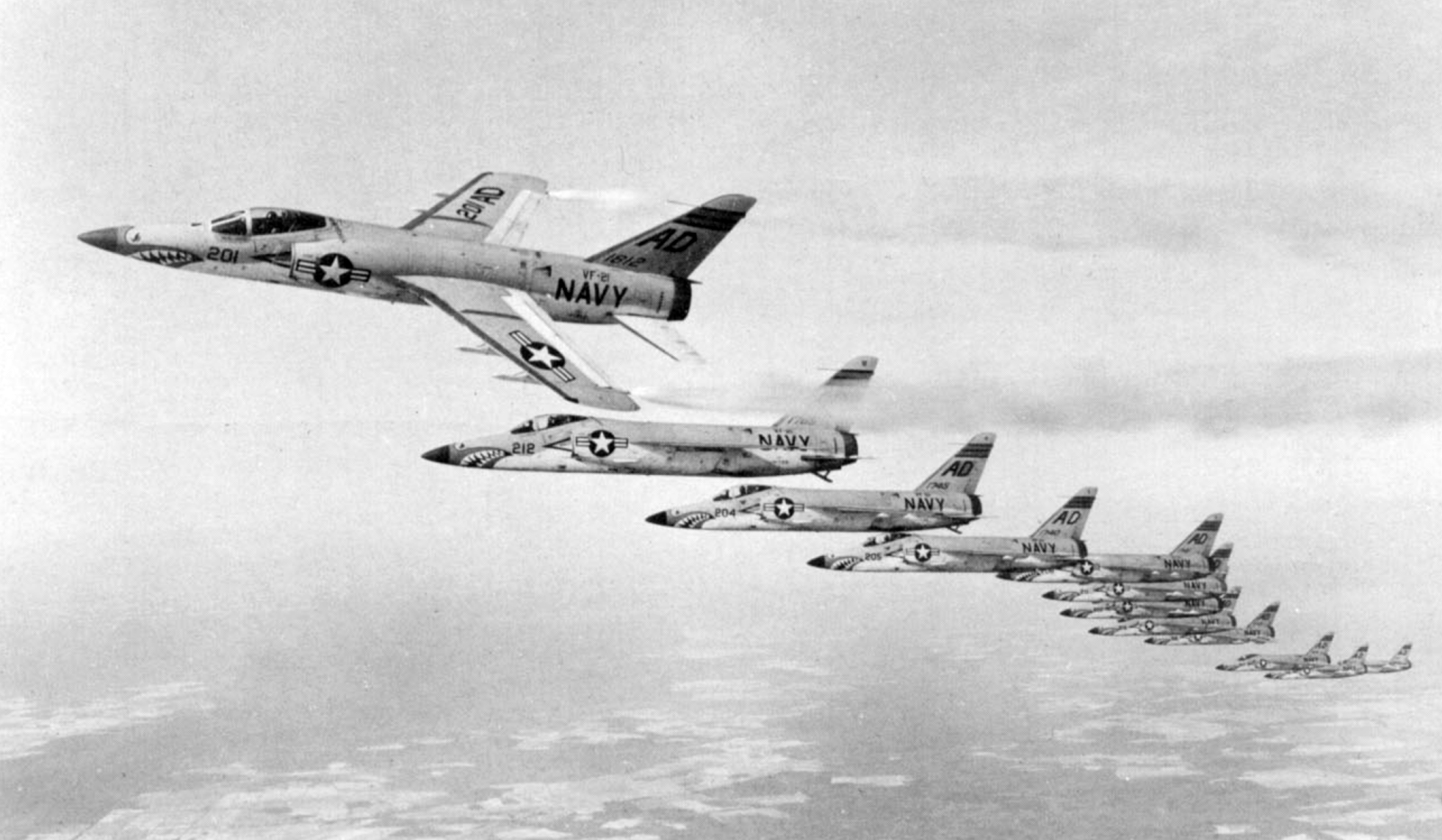
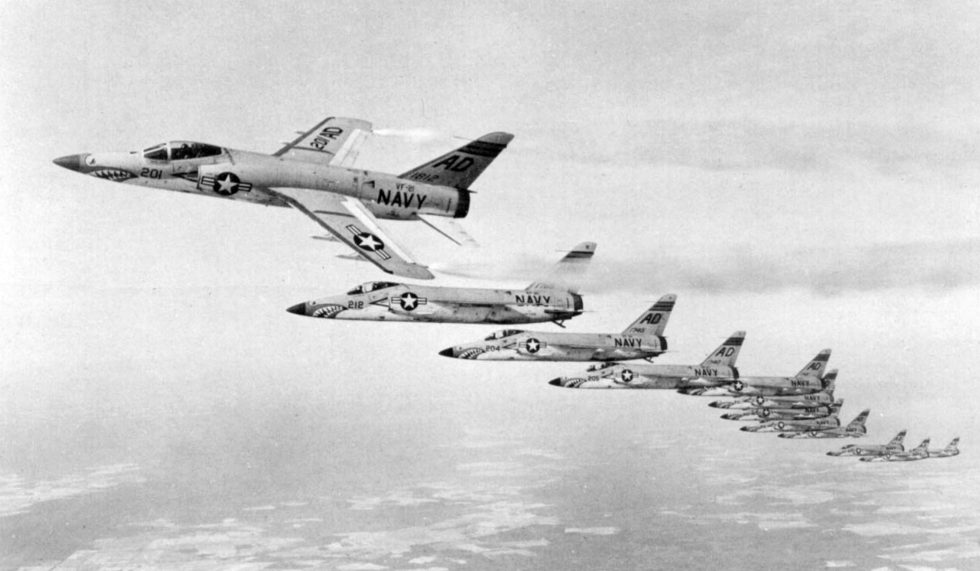
The prototype first flew on 30 July 1954, and slipped past Mach 1 in a shallow dive soon after — a first for a Grumman fighter. The Tiger reached the fleet in 1956–57 as one of the US Navy’s first supersonic carrier-based day fighters, armed with four 20 mm cannon and, later, Sidewinder missiles. On paper it was everything a mid-1950s carrier air wing wanted: light, agile, transonic, and small enough to fold onto a crowded deck.
The reality was less kind. The Tiger was powered by the Wright J65 — a licence-built British Armstrong Siddeley Sapphire — and the engine was both underpowered and troublesome. Top speed was only a little over Mach 1, range was short, and the airframe arrived just as a faster, longer-legged rival did. The Vought F-8 Crusader, capable of nearly Mach 2, simply outclassed it. The Tiger’s front-line career was correspondingly brief: it equipped only a handful of squadrons and was withdrawn from carrier fighter service by 1961, barely five years after entering it.
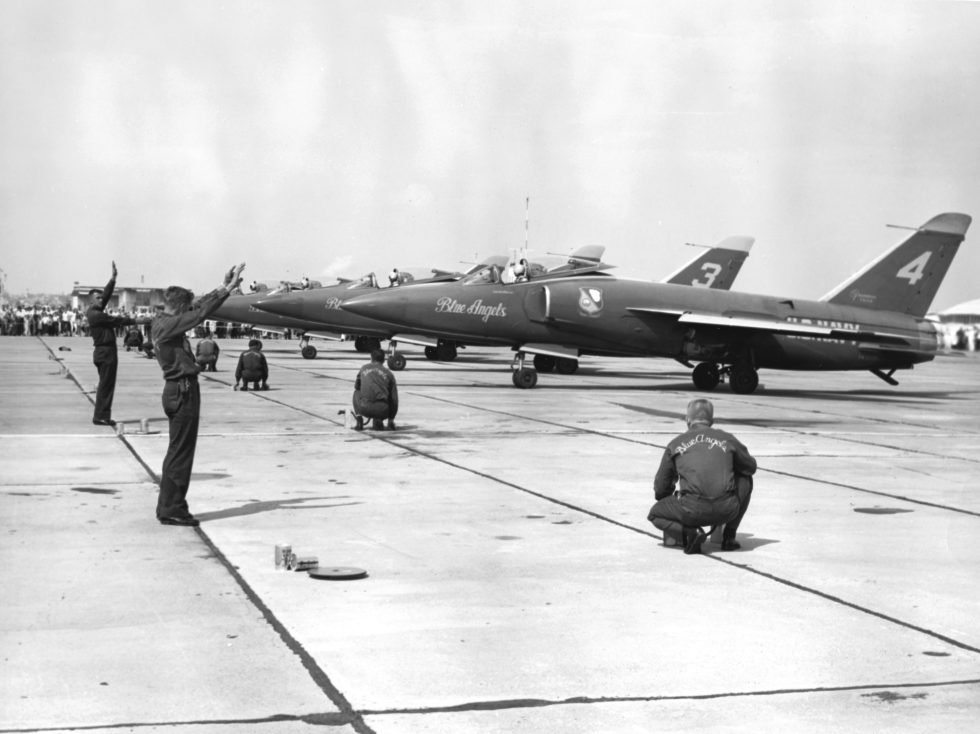
Yet the Tiger’s story did not end there — and neither of the two things it is best remembered for is really about combat. In September 1956 a Grumman test pilot, diving and firing his cannon, managed to catch up with and fly into his own bullets, becoming the first pilot in history to shoot down his own aircraft. And in 1957 the Navy’s flight-demonstration team, the Blue Angels, adopted the Tiger — and flew it for twelve seasons, until 1969, longer than any other aircraft the team had used to that point. Retired from the fleet as a near-failure, the Tiger became one of the most-watched aircraft in America.
Around 200 were built, all for the US Navy; the type was never exported and never fought in a war. Its most extreme form, the re-engined Super Tiger, flew at over Mach 2 and set an altitude record — but was never bought. The Tiger’s legacy is that of a beautiful, flawed transitional machine: a jet that mattered less for what it did in the fleet than for what it showed the crowds, and for one very strange afternoon over Long Island.
01The F-11 Tiger’s origins: from the F9F Cougar to an area-ruled supersonic fighter
The Tiger began life in 1952 as Grumman’s Design 98, an in-house study for a “super Cougar” — a refined version of the swept-wing F9F-6 Cougar then in service. But as the engineers chased supersonic performance the project diverged completely from its parent: a new thin wing, a new slim fuselage, and a single afterburning engine in place of the Cougar’s layout. Little more than the name lineage survived, and the Navy ordered it as a new type.
The decisive design move was the adoption of the area rule — NACA engineer Richard Whitcomb’s discovery that transonic drag is governed by the smooth distribution of a body’s cross-sectional area from nose to tail. Waisting the fuselage where the wings joined it gave the Tiger its distinctive pinched profile and let a relatively modest engine push it through the sound barrier. It was among the first US Navy fighters designed around the principle from the outset.
What makes the F-11 Tiger special
An area-ruled ‘coke-bottle’ fuselage
The Tiger was one of the first US Navy fighters shaped from the start by the area rule. Its fuselage is visibly waisted where the thin, low wing meets it — a pinch that smooths the aircraft’s cross-sectional area and cuts the drag spike at the speed of sound. That single idea is what let a modest engine carry a small fighter past Mach 1.
One Wright J65 — the Tiger’s weak heart
Power came from a single Wright J65 afterburning turbojet, a licence-built version of Britain’s Armstrong Siddeley Sapphire producing about 47 kN (10,500 lbf) in afterburner. It was reliable enough on paper but under-powered for a supersonic fighter and troubled in service — the single greatest limit on the Tiger’s speed, range and front-line usefulness.
Thin wing, spoilers and a folding tip
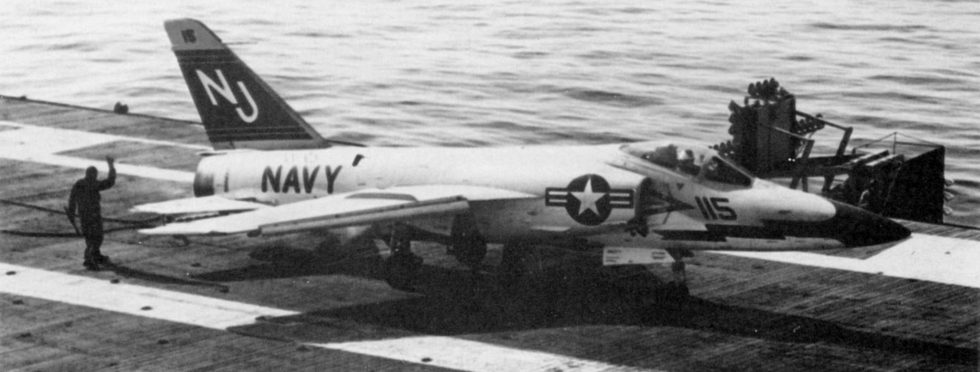
The Tiger used a very thin swept wing with spoilers instead of conventional ailerons for roll control, and an all-moving tailplane — features chosen for high-speed handling. To fit a packed carrier deck the outer wings folded downward, an unusual arrangement that kept the aircraft compact aboard ship.
02The Grumman F11F-1F Super Tiger: the Mach-2 Tiger the Navy never bought
Grumman knew the J65 was holding the Tiger back, so it built a re-engined version around the far more powerful General Electric J79 — the same engine that powered the F-104 and the F-4 Phantom II. The result, the F11F-1F Super Tiger, was a transformed aircraft: it exceeded Mach 2 and, in 1958, zoom-climbed to a world altitude record commonly cited at around 76,800 ft (about 23,400 m).
It was fast, impressive and, in the end, unwanted. The US Navy had already committed to the Vought F-8 Crusader and, soon after, the Phantom II. Grumman pitched the Super Tiger hard for export — Japan and West Germany both evaluated it — but neither bought, and only two prototypes were ever built. The Super Tiger remains one of the great “what-ifs” of 1950s naval aviation.
03Why the F-11 Tiger’s front-line career was so short
The Tiger reached the fleet in 1956–57 and was gone from carrier fighter squadrons by about 1961 — an unusually short run for a new fighter. Three problems compounded each other. The Wright J65 engine was underpowered and unreliable. The aircraft’s range and endurance were short, a serious drawback for ocean operations. And crucially, a superior aircraft arrived at almost the same moment: the Vought F-8 Crusader, nearly twice as fast and far longer-legged, gave the Navy a better single-seat fighter for the same job.
The Tiger was not scrapped, though. Withdrawn from front-line squadrons, surviving aircraft served for years as advanced trainers at Naval Air Training Command until the late 1960s — and, most famously, as the mount of the Blue Angels from 1957 to 1969.
Full F11F-1 Tiger specifications
Baseline note: the figures below describe the F11F-1 (F-11A) Tiger as the US Navy actually bought it — the production single-seat day fighter with the Wright J65-W-18 — and are drawn in the main from the Navy’s own Standard Aircraft Characteristics sheet NAVAIR 00-110AF11-1 of 1 July 1967, the best-attested single source for the type, checked against Bowers, United States Navy Aircraft since 1911. Deltas for the two F11F-1F Super Tigers — the J79-engined pair that went to Mach 2 and was never ordered — are in grey. Five things to settle before the numbers. First, there are two Tigers. The 42 airframes of the BuNo 138604–138645 block have the original short nose; the 157 of 141728–141884 have a nose roughly two feet longer, provided so that an AN/APS-67 search radar could be fitted from the 45th aircraft onward, which the SAC lists only as an alternate to the standard AN/APG-30A ranging set. The SAC quotes 44 ft 10.75 in overall; references describing the long-nose machines generally give about 14.3 m (46 ft 11 in); and the 45 ft 10.5 in (13.98 m) copied across the internet from a widely reproduced specification table matches neither. State which nose you mean. Second, what "supersonic" means here. Clean, guns only, at combat weight, the SAC gives 632 knots at 35,000 ft — Mach 1.10 — and that is the whole of it. Add two Sidewinders and their pylons and it is 591 knots; add two 150-gallon tanks and the aeroplane is subsonic, 542 knots at 26,000 ft. The contract had asked for Mach 1.2, and the Tiger never held supersonic speed in an operational fit. Third, a correction to the usual claim. The Tiger was Grumman’s first supersonic fighter and the second US Navy aeroplane to exceed Mach 1 in flight test, after the Douglas F4D Skyray — but it was not the Navy’s first supersonic fighter in service. The Skyray beat it into squadrons by about a year, in April 1956, and the Vought F8U-1 Crusader, which really could hold supersonic speed in level flight, reached the fleet at the same moment in the spring of 1957 and made the Tiger redundant on arrival. Fourth, weights. The SAC separates empty (13,307 lb) from basic (13,810 lb); the 13,810 lb reproduced everywhere as the Tiger’s "empty weight" is the basic weight, and the difference is oil, trapped fluids and installed equipment, not a disagreement between sources. Fifth, the altitude record. It belongs to the Super Tiger, not to the F11F-1: 23,449 m (76,932 ft), flown by Lieutenant Commander George C. Watkins USN at Edwards on 18 April 1958 and homologated by the FAI as record file 8596. The 76,939 ft that circulates is a rounding of the same flight, not a second record.
Dimensions & weights
- Crew
- 1 — a single-seater in every version built. The tandem two-seat F11F-1T trainer was proposed and never made, so the Navy’s advanced training units later put students into a supersonic aeroplane they had never flown dual in
- Length
- 13.68 m (44 ft 10.75 in) — the SAC figure, including the fixed refuelling boom in the nose. Long-nose aircraft are usually given as about 14.3 m (46 ft 11 in)
- Wingspan
- 9.65 m (31 ft 8 in) — tiny. Grumman set out to make the aeroplane as small as the mission allowed, and the Tiger has a smaller span than a Spitfire
- Width, wings folded
- 8.33 m (27 ft 4 in) — the wingtips fold downwards rather than upwards, and by hand rather than hydraulically. It saves hangar height and weight; it costs deck crew time in a wind
- Height
- 4.03 m (13 ft 2.75 in)
- Wing area
- 23.2 m² (250 sq ft) — thin, milled from solid aluminium plate, and small enough that the fighter’s wing loading at take-off weight is 84 lb/sq ft (411 kg/m²)
- Wing sweep and aspect ratio
- 35° at quarter chord, aspect ratio 4.0 — mean aerodynamic chord 2.49 m (8 ft 2 in). Full-span leading-edge slats and no ailerons at all
- Undercarriage track
- 2.16 m (7 ft 1 in) — narrow, which is one reason the type was disliked in a crosswind at the training fields
- Empty weight
- 6,036 kg (13,307 lb) — the SAC’s empty weight, as distinct from its basic weight below
- Basic weight
- 6,264 kg (13,810 lb) — the figure almost every published table mislabels as the empty weight
- Combat weight
- 8,335 kg (18,375 lb) — clean, half fuel, guns loaded. This is the weight at which the performance figures for a fighting Tiger are quoted, and the design load factor at it is 6.5 g
- Take-off weight, day fighter
- 9,541 kg (21,035 lb) — guns and full internal fuel, no external stores; the SAC’s loading condition 1
- Maximum take-off weight
- 10,641 kg (23,459 lb) — the same figure for a field take-off and for a catapult shot, which is unusual and speaks to how lightly stressed the aeroplane was for its size
- Maximum landing weight
- 9,344 kg (20,600 lb) ashore, but only 7,128 kg (15,715 lb) into the wires — a Tiger that had to come back aboard heavy had to dump fuel first, which did nothing for an aeroplane already short of it
- Super Tiger delta
- A 13.5 in fuselage plug, 60° wing-root fillets and enlarged intakes take the F11F-1F to 14.85 m (48 ft 9 in) long and 11,833 kg (26,086 lb) maximum take-off on the same 250 sq ft wing
Performance
- Maximum speed, clean
- 1,170 km/h (632 kn, 727 mph) at 35,000 ft — Mach 1.10 at combat weight with guns only. That is the Tiger at its absolute best, and it is 100 knots slower than an F8U-1 Crusader doing the same job on the same day
- Maximum speed at sea level
- 1,211 km/h (654 kn, 753 mph) — about Mach 0.99, so the aeroplane is fastest in absolute terms on the deck and still cannot go through Mach 1 there
- Maximum speed with drop tanks
- 1,004 km/h (542 kn) at 26,000 ft — subsonic. Fit the tanks the aeroplane needed to reach anywhere and the supersonic fighter stops being one
- Cruising speed
- 930 km/h (502 kn) at 38,000–41,800 ft — the average cruise used for the SAC’s range calculations
- Stall speed
- 231 km/h (124.5 kn) power-off at take-off weight; 191 km/h (103.3 kn) with approach power at landing weight — the slats and slotted flaps earned their keep, and the type had a good reputation in the circuit
- Rate of climb at sea level
- 83 m/s (16,300 ft/min) clean at combat weight; 26 m/s (5,130 ft/min) at full-fuel take-off weight on military thrust. The gap between those two numbers is the whole story of the aeroplane
- Time to altitude
- 4.7 min to 20,000 ft, 8.1 min to 30,000 ft — at 21,035 lb on military rated thrust. With two Sidewinders and two tanks it is 7.2 and 13.7 min
- Combat ceiling
- 14,935 m (49,000 ft) clean at combat weight; service ceiling 12,770 m (41,900 ft) at take-off weight, and only 10,670 m (35,000 ft) with tanks and missiles
- Combat range
- 2,052 km (1,108 nm, 1,275 miles) on internal fuel; 2,122 km (1,146 nm) with two 150-gallon tanks, which buys almost nothing because the tanks cost as much in drag as they add in fuel
- Combat radius
- 574 km (310 nm) in 1.57 hr on internal fuel; 778 km (420 nm) in 2.11 hr with two tanks; 463 km (250 nm) with four Sidewinders. One top-up from an A3D-2 tanker 455 nm out stretches it to 1,278 km (690 nm). These are the numbers that killed the Tiger’s fleet career
- Combat air patrol
- 0.62 hr on station at 9,296 m (30,500 ft) at a radius of 150 nm, for a total mission of 1.56 hr on internal fuel — thirty-seven minutes of loiter is not a fighter screen, it is a gesture
- Take-off run
- 1,300 m (4,260 ft) in calm air at 21,035 lb; 945 m (3,100 ft) into a 25-knot wind; 1,707 m (5,600 ft) to clear 50 ft
- Super Tiger delta
- Mach 2.04 (about 2,253 km/h, 1,400 mph) at 40,000 ft and a nominal ceiling of 17,980 m (59,000 ft), from the same airframe with a J79 in it — the first naval aeroplane in the world past Mach 2, two years before the F4H, F8U-3 and A3J
Propulsion & systems
- Engine
- One Wright J65-W-18 axial-flow turbojet with afterburner — the Armstrong Siddeley Sapphire built under licence by Curtiss-Wright, and the single worst decision in the programme. Its unreliability is named in every account of why the Tiger left the carriers so quickly. Early production aircraft flew behind earlier J65 marks before the W-18 became standard; sources disagree on the exact sequence
- Rated thrust
- 46.7 kN (10,500 lbf) maximum with afterburner at sea level; 33.1 kN (7,450 lbf) military and 28.8 kN (6,470 lbf) normal, per engine specification N-927-B
- Engine installation
- 4.67 m long, 1.04 m diameter (184 in by 41 in) — the whole rear fuselage comes off to change or service it, a Grumman habit that made engine changes quick and structural repair back aft slow
- Thrust-to-weight
- 0.50 at take-off weight — 0.57 at combat weight. Respectable for 1956, hopeless against the Crusader’s J57 by 1957
- Internal fuel
- 3,872 l (1,023 US gal, about 6,650 lb of JP-4) — 722 gal in two fuselage tanks, 59 gal in four cheek tanks, 192 gal in the wings and 50 gal inside the fin. None of it self-sealing, which the Navy accepted in a day fighter and would not have accepted in a strike aeroplane
- External fuel
- Two 568 l drop tanks (150 US gal each) on the two wing pylons at wing station 109.7 — the same two stations that carry the Sidewinders, so tanks and a full missile load compete for space
- In-flight refuelling
- Fixed nose boom — a short probe standing out of the nose, ahead of the windscreen. From an A3D-2 tanker the SAC assumes a transfer of 4,800 lb at 455 nm outbound, which adds 270 nm to the radius. Probe-and-drogue refuelling was built into the Tiger from the start rather than added later as a kit, which was still novel in the mid-1950s
- Flight controls
- Irreversible hydraulic, two independent systems — tandem cylinders on every surface, spoilers instead of ailerons for roll, an all-moving stabiliser with flaps up, augmented by a geared elevator with flaps down, and a conventional rudder. Pilots rated the roll and the control harmony at high g the best of any aeroplane the Blue Angels flew, which is why the team kept it from 1957 to 1969, a longer run than any Blue Angels type before it
- High lift and airbrakes
- Full-span leading-edge slats, slotted flaps, belly speed brakes — the wing folds outboard of the slat, manually, and there is no boundary-layer control or blown flap of the kind the Crusader and Phantom used
- Radar and fire control
- AN/APG-30A ranging radar and a Mk 16 Mod 2 fire-control system — a gunsight ranging set, not a search radar, with an AN/APA-89 video coder. The AN/APS-67 search radar was a listed alternate from the 45th aircraft and is the reason the later nose is longer; it is not what the fleet flew with. The Tiger was a clear-weather aeroplane and the Navy never pretended otherwise
- Radio and navigation
- AN/ARC-27A UHF, AN/ARA-25 UHF direction finder, AN/ARR-40, AN/ARN-14E VOR, AN/APX-6B IFF — provision for AN/ARN-21 TACAN as an alternate. No ECM, no radar warning, no countermeasures dispensers of any kind
- Protection and carrier fit
- Bullet-resistant windscreen, armour plate supplied in kits — that is, armour was a field option rather than part of the aeroplane. Catapult hook and holdback, arrester hook, manually folded wingtips; the SAC notes that 80 Tigers could be spotted on a CVA-19 class angled-deck carrier, 45 on the flight deck and 35 in the hangar
- Super Tiger delta
- One General Electric J79-GE-3A of 55.8 kN (12,533 lbf) dry and 75.6 kN (17,000 lbf) with afterburner, fed by enlarged intakes — a 62 per cent increase in reheated thrust in an airframe whose maximum weight had grown by about a tenth. Grumman also offered a Rolls-Royce Avon-engined version to West Germany in 1958
04The F-11 Tiger’s operating costs: why no reliable figure exists
The Tiger was a mid-1950s US Navy programme of only about 200 aircraft, and no dependable public flyaway unit price or cost-per-flight-hour figure survives for it in open sources. Any precise dollar amount attached to the type online should be treated as an estimate rather than a documented figure. What can be said with confidence is that its short front-line life — barely five years before the fleet moved to the F-8 Crusader — made it a poor return on investment as a fighter, even though individual airframes then earned their keep for another decade as trainers and Blue Angels demonstrators.
Armament & payload
The Tiger was a gun fighter with four Sidewinders bolted on, and the only aeroplane it ever shot down was itself
The F11F-1’s armament fits on one line of the Standard Aircraft Characteristics sheet: four 20 mm Colt Mk 12 cannon with 500 rounds between them, provision for the Sidewinder, two rocket packages and a pair of drop tanks. That is the complete list of external stores the Navy ever approved for the type, and it is worth dwelling on what is missing — no bombs, no guided air-to-surface weapon, no gun pod, no reconnaissance fit once the F11F-1P was cancelled. The SAC states the mission in six words: "the destruction of enemy aircraft", in daylight, in clear weather, at short range, and the aeroplane was built to do that and nothing else at a moment when the US Navy was already moving towards fighters that could do more. The Tiger never fired a shot in anger — not in the Lebanon crisis of 1958, not anywhere — so its entire combat record consists of the few seconds on 21 September 1956 in which one of them shot itself down. Ordnance provisions varied a little across the production run and a good deal between the SAC and the popular reference books; where a secondary source credits the Tiger with bombs or a heavier load, it is not supported by the Navy’s own document.
Gun
- Four 20 mm Colt Mk 12 Mod 0 cannon low in the forward fuselage, under and ahead of the cockpit floor, 125 rounds per gun and 500 rounds in total — the standard US Navy gun of the decade, shared with the F4D Skyray, the F8U Crusader and the A4D Skyhawk
- Aimed through an AN/APG-30A ranging radar feeding a Mk 16 Mod 2 fire-control system. Muzzle velocity of the Mk 12 is about 3,000 ft/sec, and firing the low-mounted battery pitches the nose down — a detail that mattered a great deal on one particular afternoon
- On Friday 21 September 1956, Grumman test pilot Thomas W. Attridge Jr took F11F-1 BuNo 138620 out over the Atlantic gunnery range about 20 miles off Long Island, entered a 20-degree dive from 20,000 ft in afterburner, fired a four-second burst at 13,000 ft, steepened the dive and fired the rest of the belts at 7,000 ft. About eleven seconds after firing, three of his own rounds struck the aeroplane: the windscreen, the outboard lip of the right intake, and the nose cone
- A battered 20 mm projectile was recovered from the first compressor stage after passing through the inlet guide vanes. Attridge nursed the aeroplane back towards Grumman’s Peconic River field at Calverton on the 78 per cent power the engine would take without running rough, ran out of power half a mile short, retracted the gear and put it into the trees. He broke a leg and three vertebrae, was lifted out by a Grumman S-58, and was back on flight status inside six months; he later ran the LM-3 lunar module programme that flew as Spider on Apollo 9
- The legend says he outran his own bullets. He did not. The rounds left the muzzles at about 4,300 ft/sec — muzzle velocity plus aircraft speed — then decayed fast against air resistance while their trajectory curved downwards; the Tiger, at around 880 mph on a roughly half-g descending path, flew down into that curve and overtook shells that had by then lost most of their speed. Had he held his original flight path he would have passed clear. The Navy’s response was to tell fast-jet pilots to turn or pull up after firing; Attridge’s own view was that at 1956 speeds it "could be duplicated any time"
Air-to-air
- Up to four Sidewinders — XAAM-N-7 on the original drawings, AAM-N-7 in service, redesignated AIM-9B in 1962. The Tiger was one of the first fighters in the world designed from the start to carry the missile, and the SAC treats a four-round fit as a normal loading condition rather than an experiment
- The two wing pylons at wing station 109.7 take either a Sidewinder or a 150-gallon tank; the four-missile fit uses lighter dedicated launcher pylons weighing about 65 lb each. Carrying four costs about 40 knots of top speed and 60 nautical miles of radius against the clean aeroplane
- Guidance was the first-generation infrared seeker: rear-hemisphere only, clear weather, no manoeuvring target worth the name, and a launch envelope so narrow that guns remained the primary weapon throughout the type’s service
- No radar-guided missile was ever carried or proposed for the F11F-1. With a ranging-only radar there was nothing to guide one with, and this is precisely the gap the Navy filled with the Sparrow-armed F4H Phantom II instead
- No Tiger ever fired a missile in anger, and no Tiger was ever shot at. The type’s four years on carrier decks were entirely peacetime years
Air-to-surface guided
- None, ever, in any variant. The card is kept because the emptiness is the point: this was a pure day interceptor and the Navy bought it as one
- The F11F-1 has no bombing computer, no toss-bombing gear, no low-altitude delivery system and no nuclear capability — all things its stablemate the A4D Skyhawk had by 1956
- Practical Western air-to-surface guided weapons in carrier service were still most of a decade away; the Navy’s first, Bullpup, went to attack squadrons, and by the time Walleye and the laser-guided bombs arrived the Tiger had been out of the fleet for years
- Grumman’s marketing to Switzerland, West Germany, Japan and Canada offered the Super Tiger as a multi-role aeroplane with a ground-attack capability, but no such fit was ever built or tested
Bombs
- None. The Navy’s Standard Aircraft Characteristics sheet lists exactly four external store provisions for the F-11A — Sidewinder, 150-gallon drop tank, Aero 7A rocket package, Aero 6A rocket package — and no bomb of any kind appears among them
- Reference books and web compilations that credit the Tiger with a bomb load are extrapolating from the four hardpoints rather than reporting a cleared store. Treat any such figure as unsupported unless it cites a Navy loading chart
- This is a deliberate choice, not an oversight. Grumman sold the aeroplane to the Bureau of Aeronautics as a small, cheap, quickly available supersonic day fighter to fill the gap before the Crusader and the Phantom; adding strike capability would have added the weight the design could least afford
- The contrast with the rest of Grumman’s naval line is stark: the F9F Panther and Cougar it grew out of both became competent bombers, and the Cougar outlived the Tiger in service partly because it could do more than one job
Rockets
- Aero 6A and Aero 7A "rocket packages" are listed in the SAC as approved external stores for the wing pylons — packages of 2.75 in (70 mm) folding-fin aircraft rockets, the "Mighty Mouse" of the period, intended against bomber formations rather than ground targets. The SAC names the packages but not their contents
- Unguided rockets were the mainstream American interceptor weapon of the mid-1950s — the same thinking gave the F-89 Scorpion and F-86D their rocket trays — and the Tiger inherited the provision from a doctrine that the Sidewinder made obsolete within a few years
- There is no evidence the packages were used operationally by fleet squadrons, and no performance figures for a rocket-armed Tiger appear in the SAC’s loading tables, which cover only guns, Sidewinders and tanks
- Training squadrons at NAS Chase Field and NAS Kingsville flew the type unarmed; by then the Tiger’s purpose was to give students their first taste of Mach 1, not weapons work
Pods & other stores
- Two 150 US gal (568 l) contractor-furnished drop tanks, one on each wing pylon — the only non-weapon store the type carried, and the one that turned a supersonic fighter into a subsonic one
- No camera pod and no reconnaissance nose: the dedicated F11F-1P photo-reconnaissance version was cancelled before any of the 85 ordered were built, which is why no Tiger ever flew a reconnaissance sortie
- No electronic countermeasures pods, no chaff or flare dispensers, no targeting or navigation pods. The aeroplane went to sea with a UHF radio, an IFF set and a gunsight radar
- Armour plate was supplied in kits rather than built in, so the level of protection on a given airframe depended on what the squadron had fitted
- The one genuinely unusual fit came late: in 1973–75 BuNo 141853 carried a Rohr Industries in-flight thrust reverser for Grumman and the Naval Air Test Center, with 141824 as chase — the last two Tigers to fly
Three typical loadouts
- Day fighter, internal fuel
- Four 20 mm Mk 12 with 500 rounds, no external stores. Take-off weight 21,035 lb, combat radius 310 nm in 1 hr 34 min, or a combat air patrol of 37 minutes on station at 30,500 ft at a radius of 150 nm. This is the Tiger as designed and the configuration in which every quoted supersonic figure was achieved.
- Fighter with tanks
- Guns, two Sidewinders and two 150-gallon drop tanks. Take-off weight 23,899 lb, radius 420 nm in 2 hr 7 min, maximum speed 542 kn at 26,000 ft — subsonic, ceiling down to 35,000 ft, and 13.7 minutes to reach 30,000 ft. With one top-up from an A3D-2 tanker 455 nm out, the radius goes to 690 nm.
- Four-missile interceptor
- Guns and four Sidewinders on internal fuel. Take-off weight 21,915 lb, radius only 250 nm in 1 hr 25 min, maximum speed 551 kn at 25,000 ft, combat ceiling 47,500 ft. The heaviest air-to-air load the type could carry, and the one that most clearly shows how little fuel there was to trade.
Sourcing caveat: the store list, the loading conditions and every performance number above come from NAVAIR 00-110AF11-1 (Standard Aircraft Characteristics, F-11A, 1 July 1967), which supersedes the popular tables where the two disagree. The Attridge accident is reconstructed from the Check-Six.com and Aerofiles accounts, which agree on sequence and damage but differ in detail — Aerofiles has the windscreen struck but not penetrated where Check-Six has an inert practice round through it, Aerofiles gives the recovery speed as 230 mph where Check-Six gives 200 knots, and the German-language account has Attridge climbing back to 4,000 m, which the American sources do not support. Aerofiles also prints the aircraft’s bureau number as 138260, a transposition; 138620 falls correctly inside the 138604–138645 short-nose block and is the number given elsewhere.
Variants
Two hundred airframes, one bad engine, and a Mach 2 development the Navy declined to buy
The Tiger began in 1952 as Grumman design G-98, a private study to improve the F9F-6 Cougar, and ended as something else entirely: an area-ruled, spoiler-controlled, slat-winged little fighter that shared almost nothing with its ancestor but the manufacturer. The Bureau of Aeronautics ordered two prototypes in 1953 under the fiction that they were Cougar derivatives — XF9F-8, then XF9F-9 when the real XF9F-8 turned out to be a different aeroplane — and Grumman flew the first on 30 July 1954, less than fifteen months after the letter of intent and without the afterburning engine, which was not ready. It nearly reached Mach 1 anyway.
What followed was a case study in being second-best at the wrong moment. The second prototype was lost in October 1954 when its engine flamed out on a Navy pilot’s first flight; the first afterburner flight in January 1955 ended with an explosion that damaged the fuselage; and the production aeroplane made Mach 1.05 to 1.1 rather than the Mach 1.2 the contract specified. The Navy’s order climbed from 42 aircraft towards 388 and was then cut back hard, the 85 F11F-1P reconnaissance aircraft were cancelled outright, and 199 fighters were delivered between 1954 and 23 January 1959 against a peak requirement several times that size.
The J79-engined Super Tiger is the ghost at this feast. Two airframes, a 62 per cent increase in reheated thrust, Mach 2.04 in 1957 — the first naval aeroplane in the world past Mach 2, two years ahead of the Phantom, the Crusader III and the Vigilante — and no orders at all, from the US Navy or from any of the four foreign air forces that looked hard at it. Switzerland’s assessors rated it ahead of the Draken, the Starfighter, the Mirage III and the G.91 on technical performance and bought the Mirage anyway, on price and support. Germany, Japan and Canada all chose the F-104 in selection processes later touched by the Lockheed bribery scandals. Grumman would not build another carrier fighter until the F-14 in 1968.
- XF9F-8, then XF9F-9 (1953–54 / 2)
- Two prototypes ordered under a Cougar designation for budgetary tidiness and redesignated before flight. First flight 30 July 1954 on a non-afterburning J65; the second aircraft, with reheat, became the second US Navy aeroplane to exceed Mach 1 and was lost in October 1954.
- F11F-1, short nose (1954–57 / 42, BuNo 138604–138645)
- The first production block, redesignated F-11A in 1962. Original short radome, AN/APG-30A ranging radar, J65 turbojet. First carrier landing and catapult launch from USS Forrestal on 4 April 1956; these are the aircraft the Blue Angels took on in 1957.
- F11F-1, long nose (1957–59 / 157, BuNo 141728–141884)
- Nose lengthened by roughly two feet to accept an AN/APS-67 search radar, listed in the SAC as an alternate fit from the 45th aircraft onward. Everything else is common with the short-nose machines; the fleet squadrons other than VA-156 flew these, as did the Blue Angels from 1959.
- F11F-1P (cancelled / 85 ordered, 0 built)
- Photo-reconnaissance version with a camera nose. Cancelled with the rest of the Tiger order once the Crusader’s superiority was obvious; the reconnaissance role went to the F8U-1P instead, which held it for the next twenty years.
- F11F-1T (proposed / 0)
- Tandem two-seat trainer, offered in the 1958–59 Jane’s and never built. Its absence is why the Naval Air Training Command later put students into a single-seat supersonic fighter with no dual conversion at all.
- F11F-1F Super Tiger, company G-98J (1956–58 / 2, BuNo 138646–138647)
- Two airframes rebuilt around the General Electric J79-GE-3A with enlarged intakes, 60-degree wing-root fillets and a 13.5 in fuselage plug. First flight 25 May 1956, Mach 1.44 initially, Mach 2.04 after modification — a speed that astonished Grumman, which had expected Mach 1.4.
- F11F-2 and F-11B (designations only / 0)
- The pre-1962 and post-1962 designations reserved for production Super Tigers. Neither was ever applied to an aircraft, because none was ordered; the aeroplane was judged too heavy for the carriers it would have flown from.
- Avon-engined proposal (1958 / 0)
- With a West German order in prospect, Grumman offered a Super Tiger with the Rolls-Royce Avon of 10,500 lbf in place of the J79 — a proven European engine to ease licence production. Germany chose the Starfighter.
- Grumman G-118, loosely called XF12F (1955 / 0)
- Where the family would have gone: a two-seat, twin-J79, rocket-augmented all-weather interceptor with a T-tail, encapsulated downward ejection seats and semi-recessed Sparrows. Conceived as an uprated Tiger, it grew into a different aeroplane; two prototypes were ordered in 1955 and cancelled the same year in favour of the F4H Phantom II.
- F-11A thrust-reverser testbeds (1973–75 / 2 conversions)
- Two ex-Blue Angels aircraft pulled out of storage at Davis-Monthan: 141853 fitted with a Rohr Industries in-flight thrust reverser, 141824 kept standard as chase. Flown from Calverton from March 1974 and at NATC Patuxent River to 1975, then returned to the desert. The last Tigers to fly.
Closing note on survivors. No Tiger is airworthy and none has been for fifty years; equally, no reproduction exists, so every surviving aeroplane is an original Grumman airframe with a bureau number. Twenty F11F-1/F-11A are currently listed as extant, of which three come from the short-nose block — 138608 at the California Science Center in Los Angeles, 138619 at Wilmington, North Carolina, and 138645 at NAF El Centro — and the rest are long-nose machines: 141735 at Yanks Air Museum, Chino; 141783 at MAPS Air Museum, Canton; 141790 at Grissom Air Museum, Peru, Indiana; 141802 at Lawson Creek Park, New Bern; 141803 at Reserve, Louisiana; 141811 at the Combat Air Museum, Topeka; 141824 at Pima Air & Space Museum, Tucson; 141828 at the National Naval Aviation Museum, Pensacola; 141832 at the Cradle of Aviation Museum, Garden City, New York, a few miles from where the type was designed; 141851 at NAES Lakehurst; 141853 at the Pueblo Weisbrod Aircraft Museum; 141859 at Tishomingo, Oklahoma; 141864 at the NAS Oceana Aviation Historical Park; 141868 at Planes of Fame, Valle, Arizona; 141869 at Discovery Park of America, Union City, Tennessee; 141872 at the Air Zoo, Kalamazoo; and 141882 at the Valiant Air Command Warbird Museum, Titusville. Several of these entries carry no citation in the standard lists and a few aircraft on outdoor poles have moved or deteriorated, so treat the tally as approximate at the margins. On the Blue Angels question, be careful: many surviving Tigers wear blue and gold, and paint is not provenance. Airframes with a documented team history include 141824 and 141853, the pair taken from storage for the 1973 thrust-reverser trials, and 141828 at Pensacola, which flew with the team in its final Tiger seasons and is displayed instead in the fleet markings of VF-33. Of the two Super Tigers, 138646 was expended in fire-fighting practice in the 1980s; 138647, the aircraft that set the world altitude record, was retired on 10 January 1961, served as a ground instructional airframe and stands outdoors today at the China Lake Museum in Ridgecrest, California, on loan from Naval Air Weapons Station China Lake.
From ‘super Cougar’ to Blue Angel
Design begins
Grumman starts Design 98, first conceived as an improved F9F Cougar; it soon becomes an all-new area-ruled supersonic fighter.
First flight
The prototype flies on 30 July and goes supersonic in a shallow dive shortly after — a first for a Grumman fighter.
Fleet service & the self-shootdown
The F11F-1 enters US Navy squadron service. On 21 September, test pilot Tom Attridge flies into his own cannon fire — the first aircraft to shoot itself down.
The Blue Angels adopt the Tiger
The Navy’s flight-demonstration team re-equips with the F11F-1, beginning a twelve-year association with the type.
Super Tiger sets a record
The J79-powered F11F-1F Super Tiger exceeds Mach 2 and zoom-climbs to a world altitude record of roughly 76,800 ft — but is never bought.
Out of the front line
Outclassed by the Mach-2 F-8 Crusader and limited by its engine and range, the Tiger is withdrawn from carrier fighter squadrons.
End of training service
The last Tigers are retired from Naval Air Training Command, where they had served for years as advanced trainers.
The Blue Angels move on
After twelve seasons, the Blue Angels replace the Tiger with the F-4J Phantom II — ending the type’s active career.
Twelve Tiger stories
The fighter that started as a Cougar
The Tiger began as a tweak to the F9F Cougar — and ended up an all-new supersonic jet.
Read the full story
The coke-bottle waist
The Tiger’s pinched fuselage came straight from the newest aerodynamic idea of the 1950s.
Read the full story
The jet that shot itself down
Diving and firing his cannon, Tom Attridge flew straight into his own bullets over Long Island.
Read the full story
How a jet catches its own bullets
Bullets slow down; a diving, afterburning jet speeds up. Their paths can cross.
Read the full story
A mile short of the runway
His engine wrecked, Attridge nursed the Tiger toward home — and crashed just short, but survived.
Read the full story
Twelve years in blue and gold
Rejected by the fleet, the Tiger found its true fame with the Navy’s demonstration team.
Read the full story
Beaten by the Crusader
The Tiger arrived just as a faster, longer-legged fighter did — and lost.
Read the full story
The Mach-2 Tiger nobody bought
Re-engined with a J79, the Tiger became a world-beater — and was still turned down.
Read the full story
The trouble with the J65
A licence-built British engine, underpowered and unreliable, capped the Tiger’s potential.
Read the full story
Wings that folded downward
To fit a crowded carrier deck, the Tiger’s wingtips folded down rather than up.
Read the full story
Seven squadrons, five years
The Tiger equipped only a handful of fighter squadrons before the fleet moved on.
Read the full story
A beautiful transitional jet
The Tiger mattered less as a fighter than as a bridge — and a showpiece.
Read the full story
The Tiger in pictures
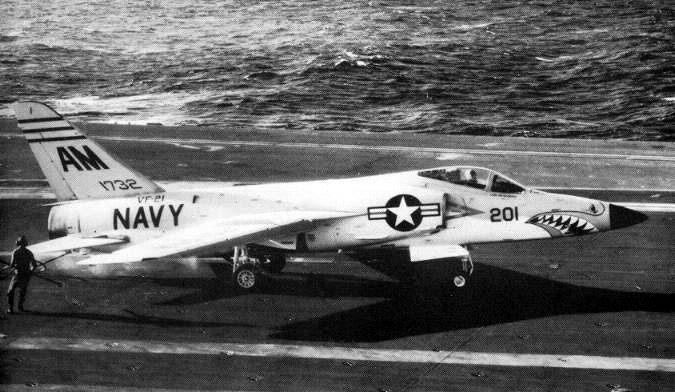
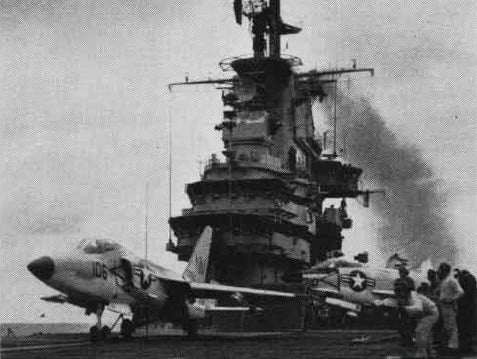
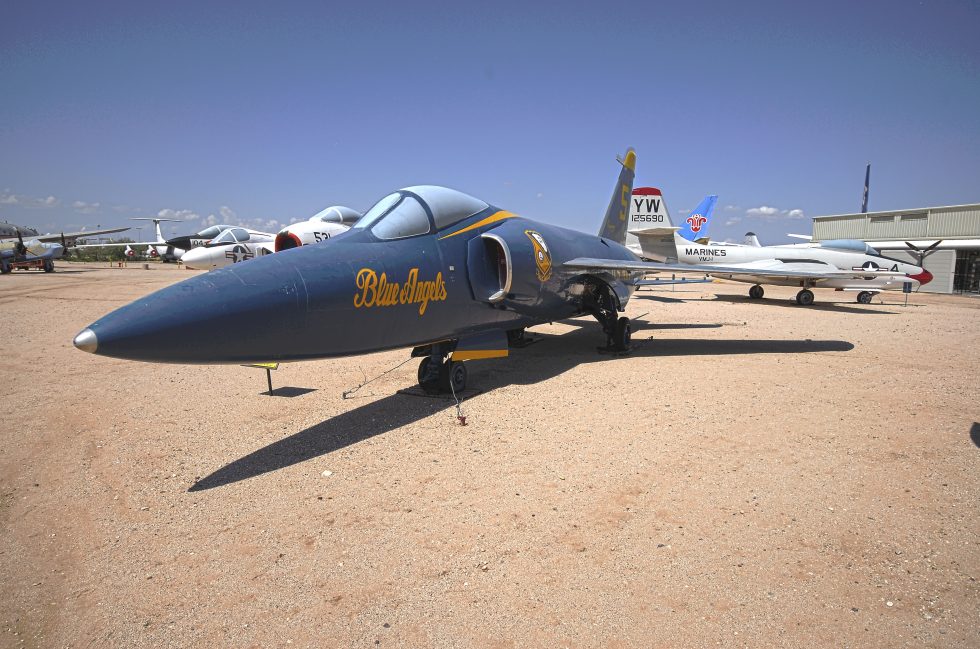
Where the Tiger flew
A fighter that never fired in anger
The F-11 Tiger scored no air-to-air victories and saw no combat — it entered service after Korea and was gone from the fleet before Vietnam. Its record is one of peacetime carrier operations, a decade of training flights, and twelve seasons of precision aerobatics with the Blue Angels. The single most famous shot ever fired by a Tiger was the one it fired into itself.
See the wider combat record of every military aircraft. The self-shootdown is described in full in the stories and Q&A above and below.
Everything people ask about the F-11 Tiger
Can I fly in an F-11 Tiger?
Did a Tiger really shoot itself down?
How is it possible for a jet to hit its own bullets?
Why did the Blue Angels fly the F-11 Tiger?
How fast was the F-11 Tiger?
Why did the Tiger have such a short front-line career?
Is the F-11 Tiger still in service?
You can’t fly the Tiger.
These, you can.
Some legends only live in museums — others are fuelled and waiting. MiGFlug has put civilians in real military jet cockpits since 2004.
 Fly the L-39 AlbatrosThe world’s most-flown jet trainer — aerobatics included
 Fly the F-104 Starfighter“The missile with a man in it”
 Fly the MiG-21The Cold War’s most-produced jet
 Fly the T-33 Shooting StarAmerica’s first jet trainer
 Fly the DH VampireA piece of early jet history
 Fly the S.211Agile Italian jet trainer
 Fly the MB-326The classic Aermacchi jet
 Fly the MiG-15The Soviet legend of the Korean War
Continue the tour
Every fact, checked
- Naval History and Heritage Command — F11F TigerOfficial US Navy specifications, service dates and Blue Angels history.
- Vintage Aviation News — Boneyard Files: F-11 TigerDevelopment, the short front-line career, the F-8 Crusader rivalry and the Super Tiger.
- The Aviation Geek Club — The Tiger that shot itself downDetailed account of Tom Attridge’s 21 September 1956 self-shootdown.
- Task & Purpose — The Navy jet that shot itself downThe sequence of the dive, the impacts and Attridge’s survival, with the physics.
- Military.com — The test pilot who shot down his own jetRetrospective on Attridge and the first aircraft to shoot itself down.
- Cradle of Aviation Museum — Grumman F-11A TigerGrumman’s own Long Island museum on the Tiger’s design and place in the “Ironworks” line.
- MAPS Air Museum — Grumman F-11F TigerAirframe history, variants and the area-rule design.
- U.S. Navy Blue Angels — Team historyOfficial record of the aircraft the Blue Angels have flown, including the F11F-1 Tiger (1957–1969).