
Germany’s parasol-wing monoplane of 1918 — clean, fast-climbing and widely thought to be one of the best fighters of the war, yet nearly destroyed by the wing that made it beautiful.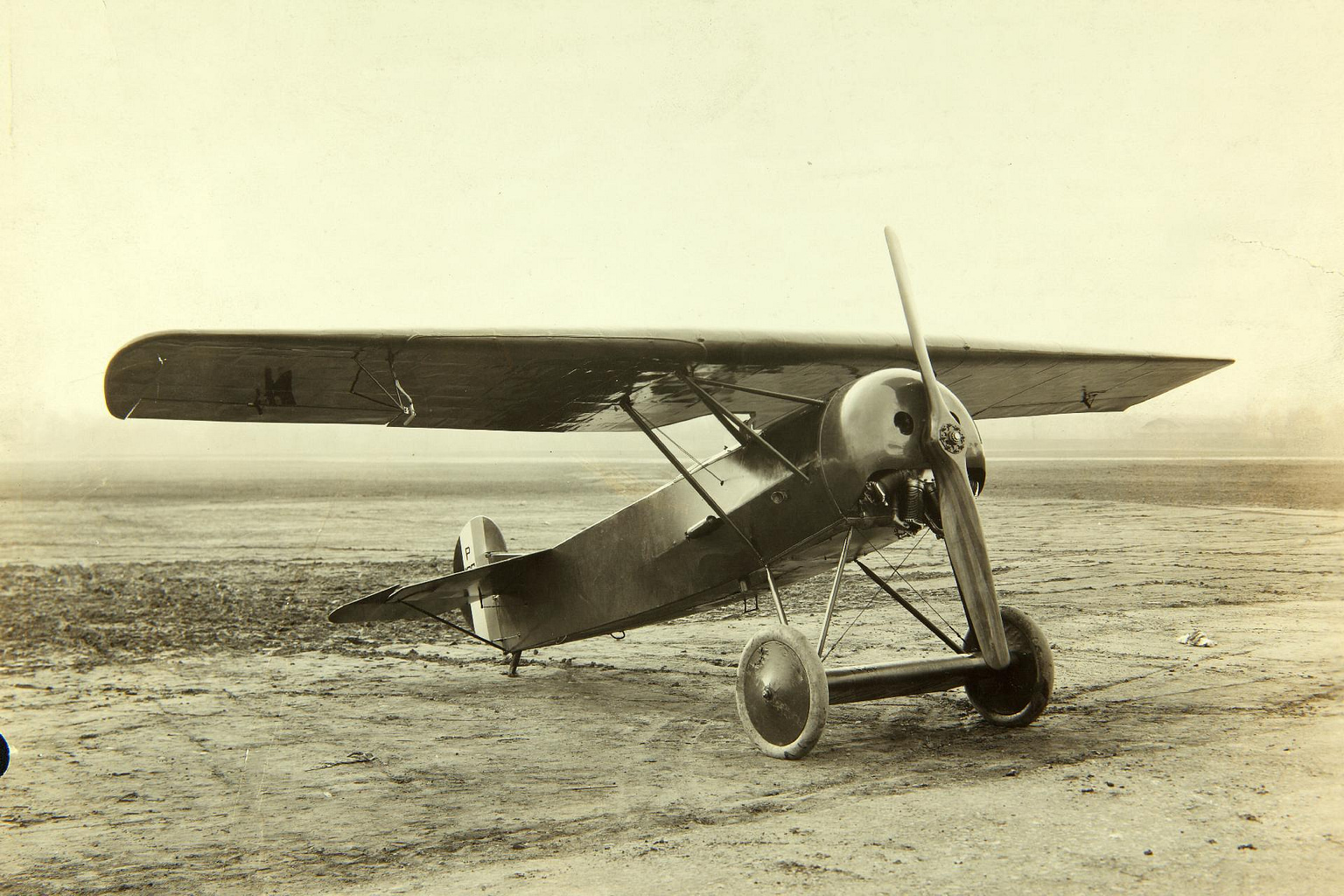
Fokker D.VIII
“The Flying Razor”
The Fokker D.VIII: the promising fighter that its own wings almost killed
In the last summer of the First World War the German air service was running out of time and out of good aircraft. The Fokker Dr.I triplane that had carried Manfred von Richthofen to fame was slow and dated; the Fokker D.VII was excellent but could not be built fast enough; and the Allied SPADs, SE5as and Camels kept coming. At the second Adlershof fighter competition of 1918 the Fokker firm entered a strikingly modern-looking machine designed by Reinhold Platz, Anthony Fokker’s self-taught chief designer — a single-seat parasol-wing monoplane whose one broad wing sat above the fuselage on a cage of struts.
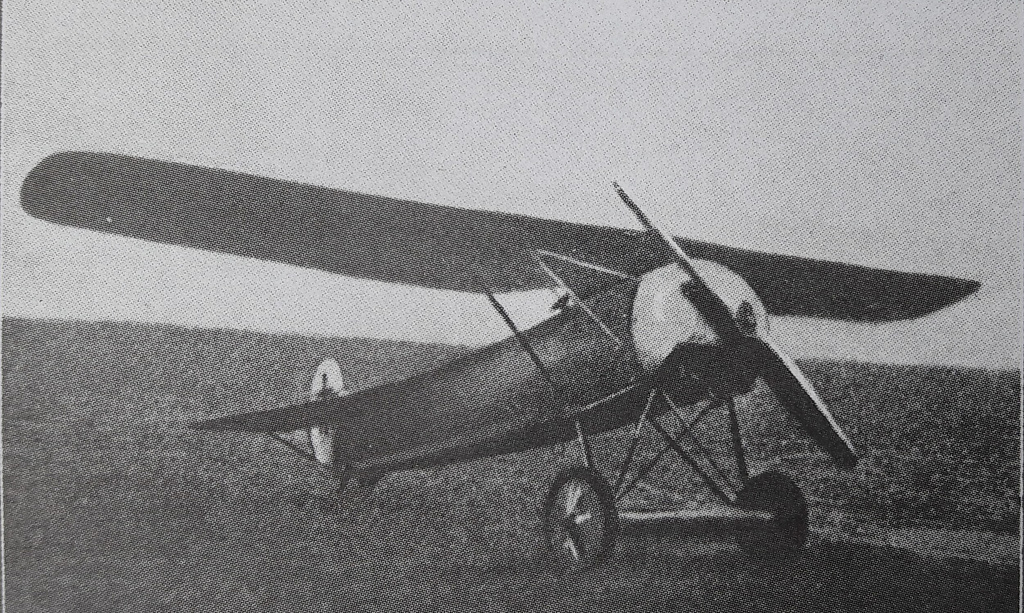
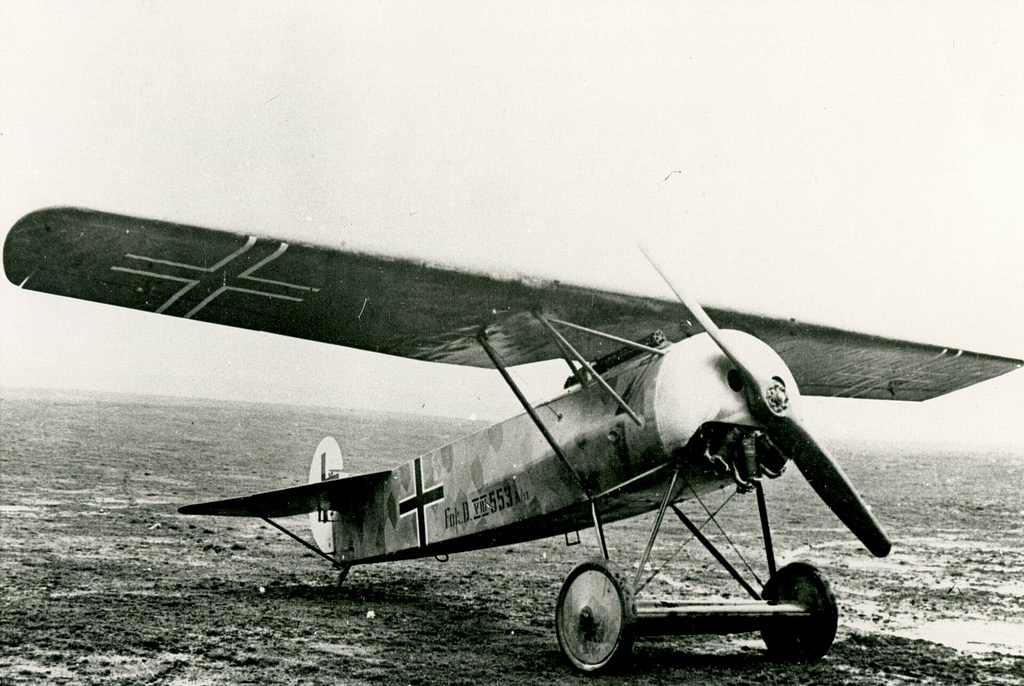
It was unlike almost anything else at the front. Where its rivals braced thin wings with a web of wires, Platz used a thick, internally-braced cantilever wooden wing that carried its own loads with almost no external rigging. The result was clean, light and nimble, with a superb view upward and forward past that single high wing. Allied pilots who met it are said to have nicknamed it the “Flying Razor” for its knife-thin planform. Powered by a ~110 hp Oberursel or Goebel rotary and armed with two 7.92 mm Spandau guns, it climbed hard and handled sweetly, and more than a few observers rated it, on paper, as potentially the best fighter of the war.
Then it began to kill its own pilots. Rushed into service in August 1918 as the Fokker E.V, the type had barely reached the Jagdstaffeln when several suffered catastrophic in-flight wing failures — the cantilever wing simply folded in the air. After a run of fatal crashes the E.V was grounded within weeks of its debut. An urgent investigation followed, and its findings are still argued over: some blamed poor wartime workmanship at Fokker’s factory — damp, warped or under-strength spars — while others pointed at Idflieg-mandated changes to the wing structure that may have shifted loads onto a weaker rear spar. The truth was probably a mixture of both, and a century later the blame is still not cleanly settled.
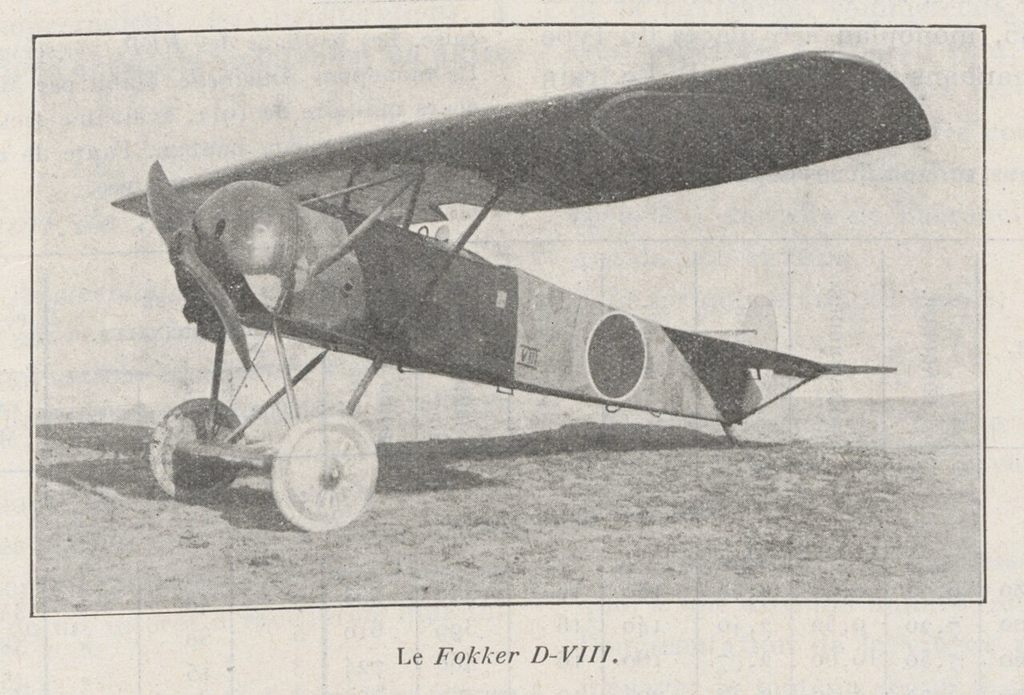
The wing was rebuilt to a stronger standard, and the cleared aircraft returned to the front in October 1918 under a new name: the Fokker D.VIII. By then only weeks of war remained. Relatively few reached front-line units before the Armistice of 11 November 1918, so the type never had the chance to prove itself on the scale its design promised. In its brief career it performed well — a D.VIII is sometimes credited with one of the last aerial victories of the war — but the “Flying Razor” arrived just too late to matter.
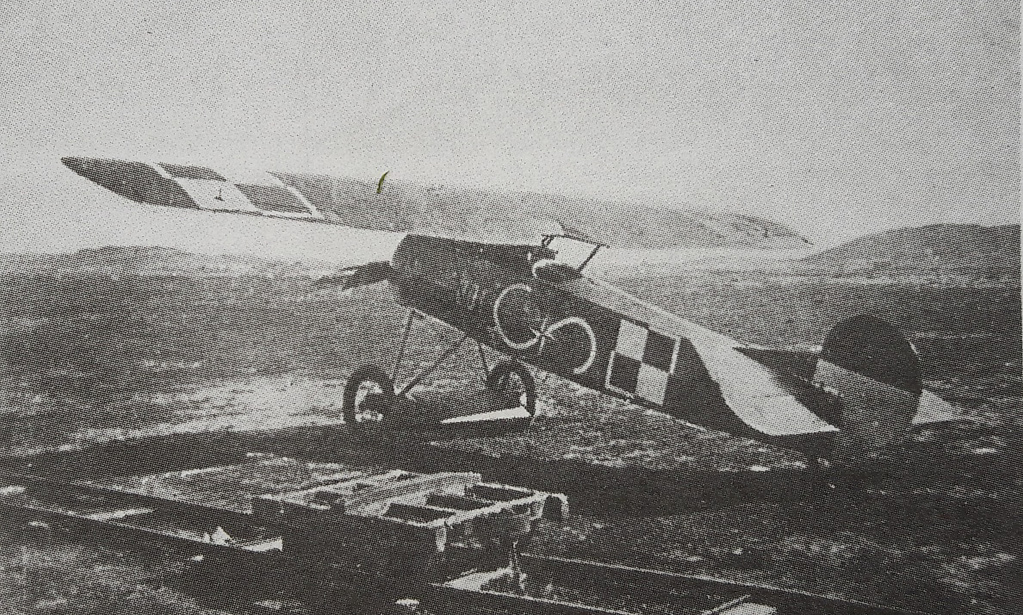
Its afterlife was longer than its war. In the chaos that followed 1918 the design outlived the empire that ordered it: Poland flew captured and assembled examples in the Polish–Soviet War, the Netherlands — Anthony Fokker’s post-war home — operated a handful, and the United States and others evaluated captured airframes, one American example flying on into 1927 as the last rotary-engined aircraft on the US Army’s books. Today no genuine original still flies, but museum survivors and beautifully built airworthy reproductions keep the Flying Razor in the air.
The D.VIII’s deeper significance is not what it did in 1918 but what it pointed towards. At a moment when every other front-line fighter was still a wire-braced biplane, Platz and Fokker had flown a clean, cantilever-winged monoplane that was faster-climbing and easier to see out of than most of them — and had done it with cheap wood and a small rotary. The idea was sound; only the execution, under wartime pressure, let it down. Within fifteen years the world’s air forces would abandon the biplane entirely for exactly the kind of high-winged, cantilever monoplane the little Fokker had sketched out in miniature. Judged that way, the “Flying Razor” was less a failure than a prophecy delivered a generation early — which is why it remains one of the most quietly influential fighters of the First World War.
01Why the D.VIII was called the “Flying Razor”
The nickname is usually attributed to Allied airmen, who saw a fighter reduced to essentials: a slim fuselage and a single, thin, high-set wing with no forest of struts and wires. From the side and from below the wing presented a clean, blade-like edge — hence “razor.” Hedge: like many wartime nicknames it is hard to source to a single first use, and it is repeated more often than it is documented, so treat it as a colourful tradition rather than an official name.
02The parasol layout and Reinhold Platz’s cantilever wing
The D.VIII is a parasol monoplane: its one wing is mounted above the fuselage on cabane and outer struts, clear of the pilot’s eyeline. What made it special was internal, not external — Platz’s deep, box-spar plywood-and-timber wing was strong enough to need almost no bracing wires, an idea he had already proven on the Fokker D.VII. The payoff was excellent lift, a gentle stall and outstanding upward visibility. The cost, as events showed, was that the wing’s strength depended entirely on the quality of its internal structure — with no external wires to catch a failure.
03Reinhold Platz: the welder who designed a fighter
The man behind the wing is one of aviation’s great outsiders. Reinhold Platz began as a gas- and arc-welder and had no formal engineering training when Anthony Fokker made him chief designer. He worked by intuition, test and refinement rather than by textbook stress calculation — which is exactly how he arrived at the thick, self-supporting cantilever wing years before it became orthodox. It is a genuine historical irony that the E.V’s wing failures were later blamed partly on the very kind of paperwork-driven structural change that Platz’s hands-on method usually avoided. Hedge: accounts of exactly who decided what inside the Fokker works are second-hand and coloured by Anthony Fokker’s own later memoirs, so treat the personalities with some caution.
How the Fokker D.VIII was built: one clean wing, one rotary, two guns
A thick cantilever wing, almost no wires
Platz’s single parasol wing used a deep internal box structure to carry its loads, so it needed only minimal bracing. That gave the D.VIII light, responsive handling, a strong climb and a clean look — but it also meant the wing’s safety lived or died on the quality of its internal spars.
A light airframe on a modest rotary
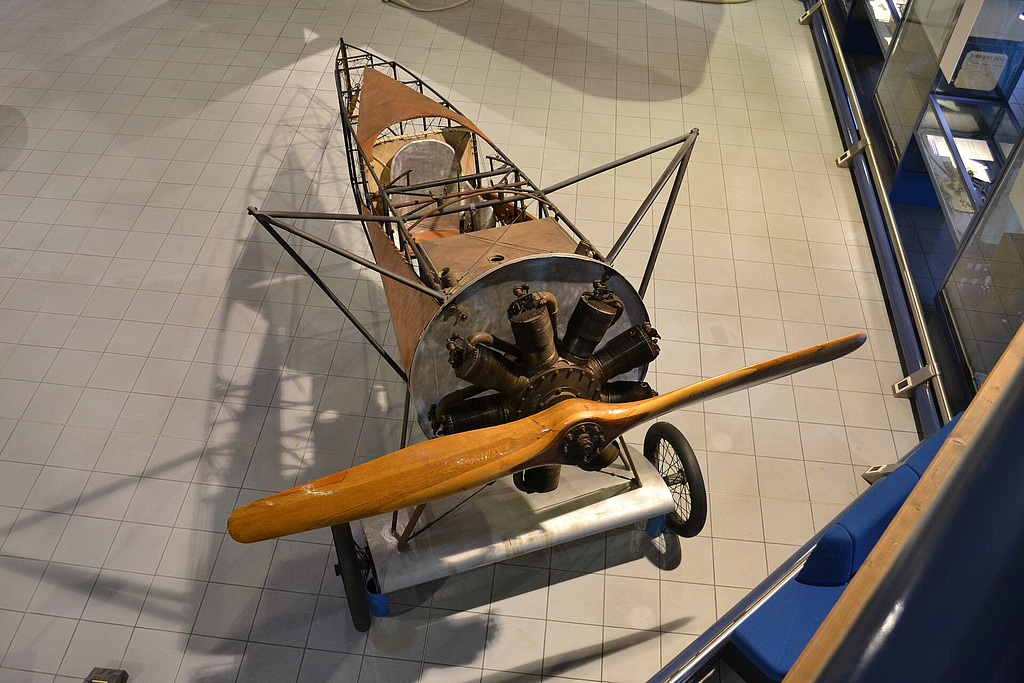
With a ~110 hp Oberursel UR.II or Goebel Goe.III rotary turning a two-blade propeller, the little fighter weighed only around 405 kg empty. Low weight and plenty of wing made it a fast climber and a nimble dogfighter rather than a fast diver — exactly the qualities 1918 air combat rewarded.
Two Spandau guns and a commanding view
Standard armament was two synchronised 7.92 mm LMG 08/15 “Spandau” machine guns firing through the propeller. Sitting under a high wing with an uncluttered nose, the pilot enjoyed one of the best fields of view of any WWI fighter — a real advantage in the hunt.
04The wing failures of 1918 — and the disputed blame
Between roughly 5 and 19 August 1918 the newly issued E.V suffered a series of fatal in-flight wing collapses. The type was grounded almost immediately. The subsequent inquiry pointed at a combination of causes: substandard wartime construction — rushed work, poor-quality or damp timber, and inner-wing rot — and, per some accounts, structural changes demanded by Idflieg that added weight to the rear of the wing. Fokker blamed the authorities; the authorities blamed Fokker’s workmanship. Hedge: primary evidence is incomplete and the apportionment of blame remains genuinely contested among historians.
05From E.V to D.VIII: the rebuild and the return
Once the wings were rebuilt to a stronger specification and re-tested, the cleared fighter returned to service in October 1918 under the designation D.VIII (the letter “D” marking a single-seat biplane/monoplane fighter class). The redesignation was as much a fresh start for the type’s reputation as an administrative act. The rebuilt wing appears to have solved the problem, but so little time was left in the war that the D.VIII never operated in large numbers at the front.
06How many were built — and how few reached the front
Figures vary widely between sources. A commonly cited breakdown is roughly 139 E.V delivered from August 1918 and around 289 aircraft built in total, though other estimates range from well under a hundred to several hundred ordered. Hedge: treat any single number with caution. What is clear is that only a modest number saw genuine front-line service before the Armistice.
Fokker D.VIII specifications: dimensions, performance and cost
Airframe & powerplant
- Bemanning
- 1 (pilot)
- Lengte
- 5.92 m (19 ft 5 in)
- Spanwijdte
- 8.35 m (27 ft 5 in)
- Hoogte
- 2.6 m (8 ft 6 in)
- Leeggewicht
- ≈ 405 kg (893 lb)
- Loaded weight
- ≈ 605 kg (1,334 lb)
- Motor
- Oberursel UR.II 9-cyl rotary, ≈110 hp (also Goebel Goe.III)
- Wing
- Thick cantilever parasol monoplane wing
- Configuration
- Single-seat parasol-wing monoplane
Performance, armament & cost
- Max speed
- ≈ 204 km/h (127 mph) at sea level
- Speed at 4,500 m
- ≈ 173 km/h (107 mph)
- Serviceplafond
- ≈ 6,000 m (19,700 ft)
- Climb
- ≈ 5 min 8 s to 2,000 m
- Endurance
- ≈ 1 hr 30 min
- Bewapening
- 2 × 7.92 mm LMG 08/15 “Spandau” machine guns
- Number built
- ≈ 289 total (figures vary widely)
- Unit cost
- Not reliably recorded (WWI)
- Cost per flight hour
- Not reliably recorded (WWI)
07Variants: E.V, D.VIII and the engine question
The airframe was issued first as the E.V (monoplane) and, after the wing rebuild, as the D.VIII — the same basic aircraft under two names. The main real variation was the engine: the standard Oberursel UR.II rotary of about 110 hp was in chronically short supply, so some machines used the Goebel Goe.III, and higher-power rotaries were trialled. Performance figures therefore differ from source to source depending on which engine and loadout is quoted.
08What a Fokker D.VIII “cost” — and why we can’t give a number
There is no reliable, comparable unit price or cost-per-flight-hour for a 1918 German fighter of this class. Wartime accounting, hyperinflation, and the collapse of the German state in 1918–19 mean any figure would be misleading, so we record it honestly as not reliably recorded. What can be said is that the D.VIII was designed to be cheap and quick to build — a simple wooden wing and a light fuselage — which was much of its appeal to a hard-pressed air service.
Fokker D.VIII timeline: from competition winner to Armistice
Adlershof competition
Fokker enters a parasol-wing monoplane by Reinhold Platz at the second D-type fighter competition; the design impresses.
Ordered into production
Idflieg orders the monoplane as the Fokker E.V, intended as a light, cheap, fast-climbing interceptor.
Front-line debut as the E.V
The E.V reaches Jagdstaffeln on the Western Front; a first victory is recorded on 17 August 1918.
Fatal wing failures & grounding
After several in-flight wing collapses kill their pilots, the E.V is grounded within weeks of entering service.
Investigation & rebuild
Inquiries blame a mix of poor wartime workmanship and mandated structural changes; the wing is rebuilt to a stronger standard.
Return as the D.VIII
The cleared fighter re-enters service, redesignated D.VIII — with only weeks of the war left to run.
Armistice
The war ends before the D.VIII can be deployed in numbers; it is sometimes credited with one of the last aerial victories.
Post-war service
Poland flies E.V/D.VIIIs in the Polish–Soviet War; the Netherlands and others operate or evaluate the type.
Last of the rotaries
A US-evaluated D.VIII (P-165) survives at McCook Field as the last rotary-engined aircraft on the US Army’s inventory.
The Fokker D.VIII in its own words: stories from 1918 and after
A promising arrival
Pilots who first flew the E.V praised its light controls, strong climb and superb visibility — many thought Fokker had produced a war-winner.
Read the story
The wings that folded
Within days of reaching the front, E.Vs began shedding their wings in the air, killing experienced pilots for no reason anyone could see.
Read the story
Whose fault was the wing?
The investigation split the blame between Fokker’s factory and the authorities’ own specification changes — and it has never been cleanly resolved.
Read the story
Made strong again
New, heavier-built wings were fitted and tested, and the cleared aircraft returned as the D.VIII — the same airframe, a second chance.
Read the story
From E.V to D.VIII
The switch from “E” (monoplane) to “D” (single-seat fighter) marked both a bureaucratic reclassification and a fresh start for a tainted reputation.
Read the story
Weeks from the end
By the time enough D.VIIIs were cleared for the front, the war had almost run out; relatively few saw combat before 11 November.
Read the story
A claim at the finish
A Fokker D.VIII is sometimes credited with scoring one of the very last aerial victories of the First World War.
Read the story
A second war
After 1918 Poland assembled and flew captured E.V/D.VIII airframes against Soviet forces in the Polish–Soviet War of 1919–21.
Read the story
Fokker comes home
Anthony Fokker returned to the Netherlands after the war, and a small number of D.VIIIs served there — close to where the marque would build its post-war future.
Read the story
Evaluated and flown on
Captured examples were shipped to the United States for evaluation; one flew at McCook Field into 1927 as the Army’s last rotary-engined aircraft.
Read the story
Originals behind glass
No genuine D.VIII still flies, but original airframes and relics survive in museums in Poland, Italy and elsewhere.
Read the story
The Razor flies again
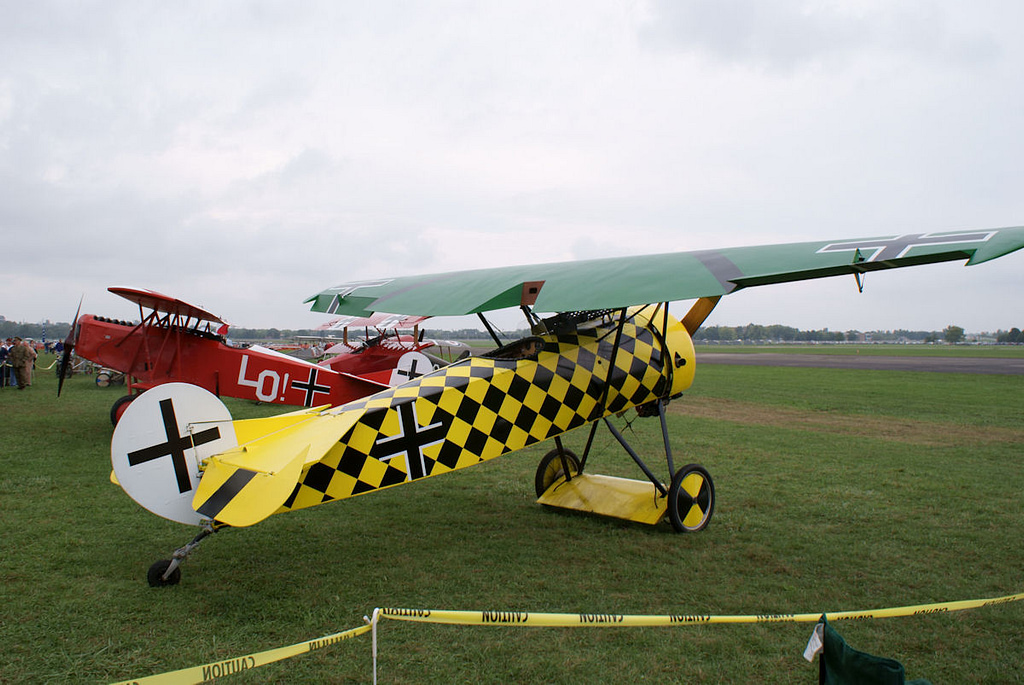
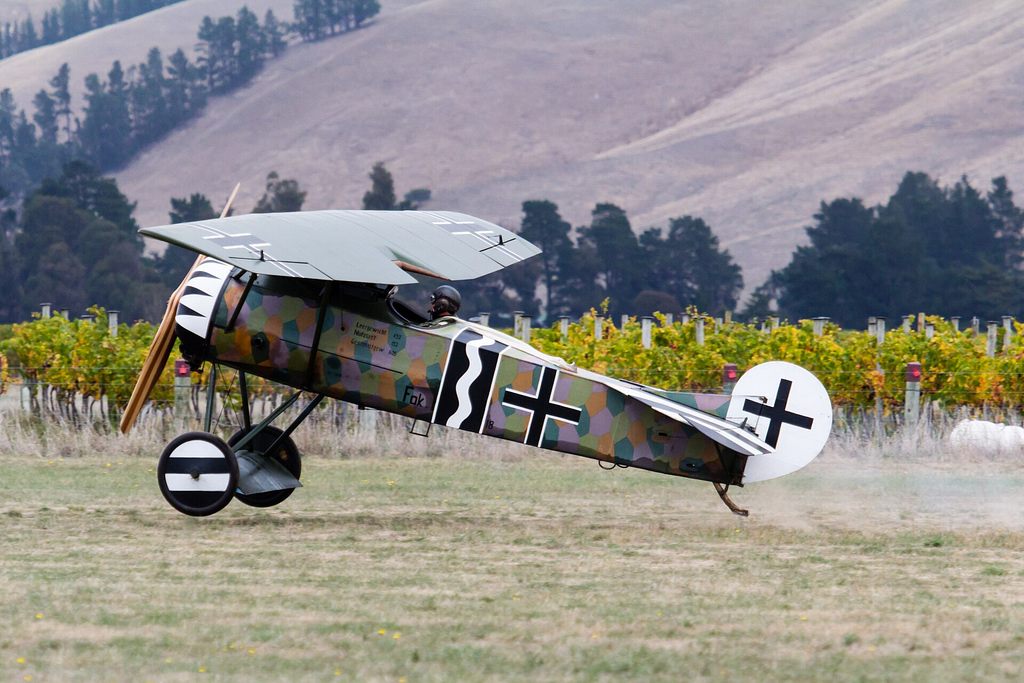
Beautifully built airworthy reproductions — at Old Rhinebeck and elsewhere — let modern audiences watch the Flying Razor in its element.
Read the story
Fokker D.VIII in photographs: 1918 service, museums and reproductions
Fly along in a Fokker D.VIII: the Smithsonian’s cockpit film
“Strap into the cockpit of a WWI airplane — fly along in a Fokker D.VIII (D8), 360° video.” Filmed in an airworthy reproduction by the Smithsonian National Air and Space Museum (≈ 40,700 views). Drag inside the frame to look around the cockpit and out past that famous parasol wing.
Where the Fokker D.VIII flew: origin, front-line service and survivors
One country designed and flew it in anger; a few others gave it a second life. Toggle the categories to see its German origin, its brief Western-Front service in the autumn of 1918, the post-war operators who flew or evaluated it, and where original airframes and replicas survive today. Hover or tap a country for detail.
The Fokker D.VIII’s war record: brief, promising and cut short
The E.V/D.VIII reached the front for only a few weeks of active combat before the Armistice, and spent part of even that time grounded. Its record is therefore thin by an accident of history rather than any fault of the aircraft. The numbers below are best understood as a measure of how little time the type was given, not of how good it was — most assessments, then and now, rate its raw fighting potential very highly.
A first victory is recorded on 17 August 1918, and historians suspect two or three more; a D.VIII is sometimes credited with one of the very last aerial victories of the war. Hedge: late-1918 records are incomplete, so exact totals are uncertain.
Fokker D.VIII: frequently asked questions
Can I fly in a Fokker D.VIII?
Why was the Fokker D.VIII called the “Flying Razor”?
Was the Fokker D.VIII a good fighter?
What was the Fokker E.V, and how is it related to the D.VIII?
Why did the Fokker E.V’s wings fail?
How many Fokker D.VIIIs were built?
Are there any surviving Fokker D.VIIIs?
What engine and armament did the Fokker D.VIII have?
Was the Fokker D.VIII a monoplane or a biplane?
You can’t fly the Fokker D.VIII.
These, you can.
Some legends only live in museums — others are fuelled and waiting. MiGFlug has put civilians in real military jet cockpits since 2004.
 Fly the L-39 AlbatrosThe world’s most-flown jet trainer — aerobatics included
 Fly the F-104 Starfighter“The missile with a man in it”
 Fly the MiG-21The Cold War’s most-produced jet
 Vlieg met de T-33 Shooting StarAmerica’s first jet trainer
 Fly the DH VampireA piece of early jet history
 Fly the S.211Agile Italian jet trainer
 Fly the MB-326The classic Aermacchi jet
 Fly the MiG-15The Soviet legend of the Korean War
More from the Fokker stable
Sources & further reading on the Fokker D.VIII
- Military Aviation MuseumType history, production numbers, the August 1918 groundings and post-war Polish service.
- Smithsonian National Air and Space MuseumInstitutional collection and the 360° cockpit film of an airworthy D.VIII reproduction.
- Aeropedia — D. C. EyreDetailed specifications: engine, speed, ceiling, weights and dimensions.
- The Museum of FlightNotes on the parasol layout and a museum reproduction of the D.VIII.
- Old Rhinebeck AerodromeHome of an airworthy flying Fokker D.VIII reproduction and pilot commentary.
- The Armory LifeAccessible feature on the D.VIII, the “Flying Razor” nickname and its troubled debut.
- Fighter Factory / Military Aviation MuseumWWI-era collection context for the E.V/D.VIII and its contemporaries.
Photographs via Wikimedia Commons under the licences credited beside each image; historical figures for production, performance and victories vary between sources and are hedged in the text. Encyclopedia entry compiled by MiGFlug. This page is editorial — MiGFlug does not operate Fokker D.VIII flights.