
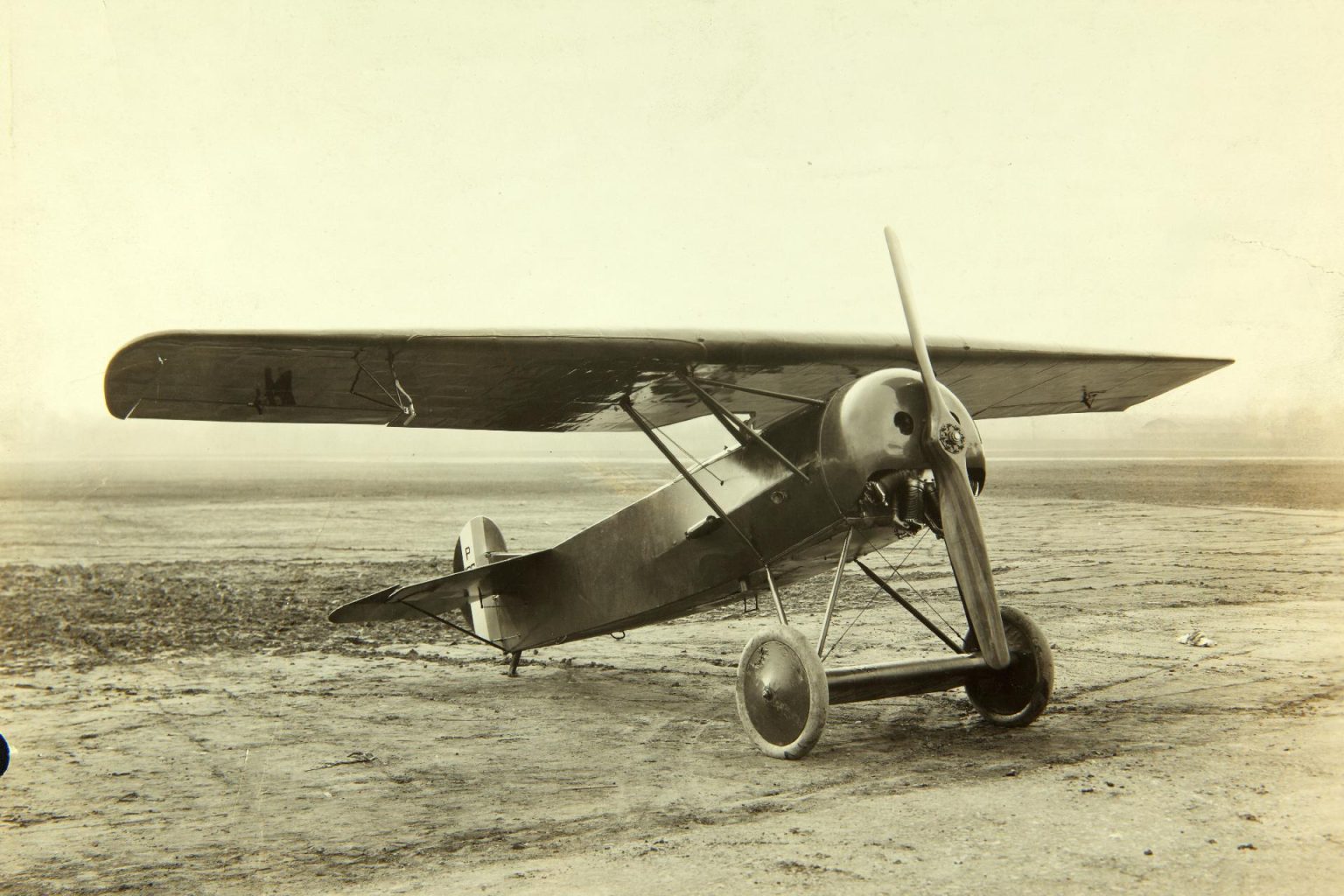
Fokker D.VIII
“The Flying Razor”
Germany’s parasol-wing monoplane of 1918 — clean, fast-climbing and widely thought to be one of the best fighters of the war, yet nearly destroyed by the wing that made it beautiful.
The Fokker D.VIII: the promising fighter that its own wings almost killed
In the last summer of the First World War the German air service was running out of time and out of good aircraft. The Fokker Dr.I triplane that had carried Manfred von Richthofen to fame was slow and dated; the Fokker D.VII was excellent but could not be built fast enough; and the Allied SPADs, SE5as and Camels kept coming. At the second Adlershof fighter competition of 1918 the Fokker firm entered a strikingly modern-looking machine designed by Reinhold Platz, Anthony Fokker’s self-taught chief designer — a single-seat parasol-wing monoplane whose one broad wing sat above the fuselage on a cage of struts.
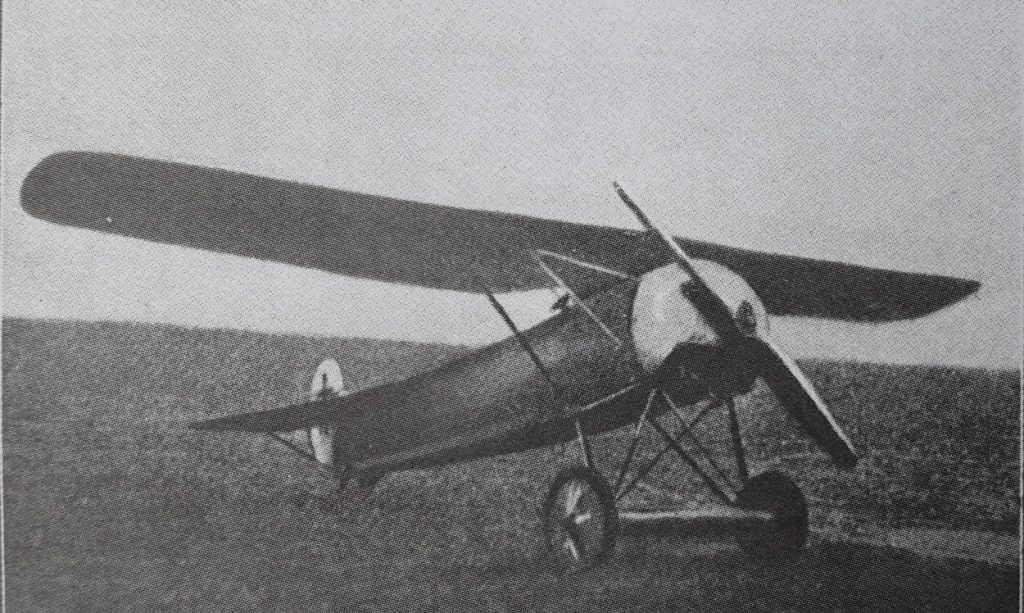
It was unlike almost anything else at the front. Where its rivals braced thin wings with a web of wires, Platz used a thick, internally-braced cantilever wooden wing that carried its own loads with almost no external rigging. The result was clean, light and nimble, with a superb view upward and forward past that single high wing. Allied pilots who met it are said to have nicknamed it the “Flying Razor” for its knife-thin planform. Powered by a ~110 hp Oberursel or Goebel rotary and armed with two 7.92 mm Spandau guns, it climbed hard and handled sweetly, and more than a few observers rated it, on paper, as potentially the best fighter of the war.
Then it began to kill its own pilots. Rushed into service in August 1918 as the Fokker E.V, the type had barely reached the Jagdstaffeln when several suffered catastrophic in-flight wing failures — the cantilever wing simply folded in the air. After a run of fatal crashes the E.V was grounded within weeks of its debut. An urgent investigation followed, and its findings are still argued over: some blamed poor wartime workmanship at Fokker’s factory — damp, warped or under-strength spars — while others pointed at Idflieg-mandated changes to the wing structure that may have shifted loads onto a weaker rear spar. The truth was probably a mixture of both, and a century later the blame is still not cleanly settled.
The wing was rebuilt to a stronger standard, and the cleared aircraft returned to the front in October 1918 under a new name: the Fokker D.VIII. By then only weeks of war remained. Relatively few reached front-line units before the Armistice of 11 November 1918, so the type never had the chance to prove itself on the scale its design promised. In its brief career it performed well — a D.VIII is sometimes credited with one of the last aerial victories of the war — but the "Flying Razor" arrived just too late to matter.
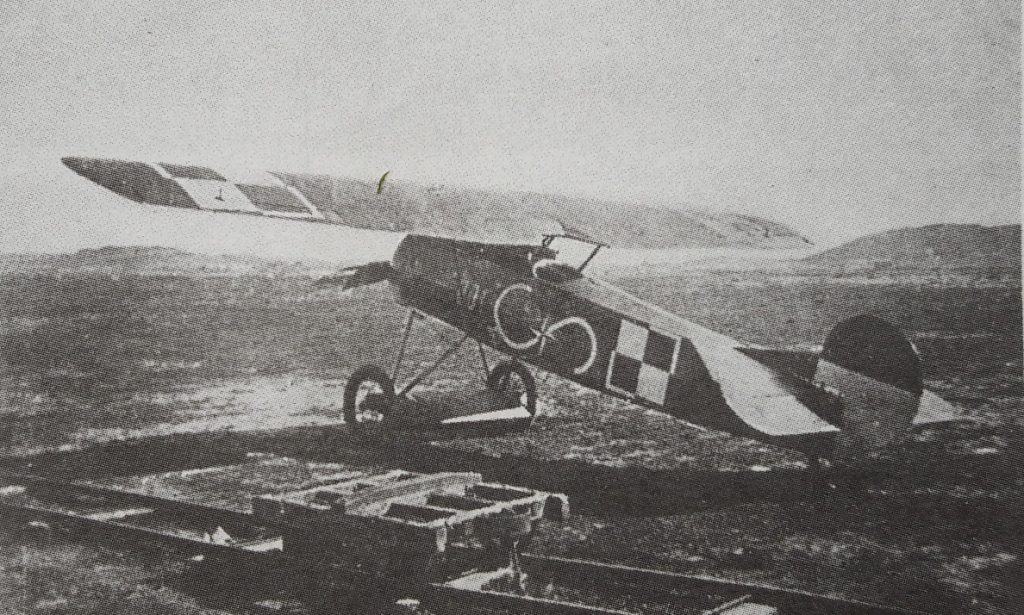
Its afterlife was longer than its war. In the chaos that followed 1918 the design outlived the empire that ordered it: Poland flew captured and assembled examples in the Polish–Soviet War, the Netherlands — Anthony Fokker’s post-war home — operated a handful, and the United States and others evaluated captured airframes, one American example flying on into 1927 as the last rotary-engined aircraft on the US Army’s books. Today no genuine original still flies, but museum survivors and beautifully built airworthy reproductions keep the Flying Razor in the air.
The D.VIII’s deeper significance is not what it did in 1918 but what it pointed towards. At a moment when every other front-line fighter was still a wire-braced biplane, Platz and Fokker had flown a clean, cantilever-winged monoplane that was faster-climbing and easier to see out of than most of them — and had done it with cheap wood and a small rotary. The idea was sound; only the execution, under wartime pressure, let it down. Within fifteen years the world’s air forces would abandon the biplane entirely for exactly the kind of high-winged, cantilever monoplane the little Fokker had sketched out in miniature. Judged that way, the "Flying Razor" was less a failure than a prophecy delivered a generation early — which is why it remains one of the most quietly influential fighters of the First World War.
01Why the D.VIII was called the “Flying Razor”
The nickname is usually attributed to Allied airmen, who saw a fighter reduced to essentials: a slim fuselage and a single, thin, high-set wing with no forest of struts and wires. From the side and from below the wing presented a clean, blade-like edge — hence "razor." Hedge: like many wartime nicknames it is hard to source to a single first use, and it is repeated more often than it is documented, so treat it as a colourful tradition rather than an official name.
02The parasol layout and Reinhold Platz’s cantilever wing
The D.VIII is a parasol monoplane: its one wing is mounted above the fuselage on cabane and outer struts, clear of the pilot’s eyeline. What made it special was internal, not external — Platz’s deep, box-spar plywood-and-timber wing was strong enough to need almost no bracing wires, an idea he had already proven on the Fokker D.VII. The payoff was excellent lift, a gentle stall and outstanding upward visibility. The cost, as events showed, was that the wing’s strength depended entirely on the quality of its internal structure — with no external wires to catch a failure.
03Reinhold Platz: the welder who designed a fighter
The man behind the wing is one of aviation’s great outsiders. Reinhold Platz began as a gas- and arc-welder and had no formal engineering training when Anthony Fokker made him chief designer. He worked by intuition, test and refinement rather than by textbook stress calculation — which is exactly how he arrived at the thick, self-supporting cantilever wing years before it became orthodox. It is a genuine historical irony that the E.V’s wing failures were later blamed partly on the very kind of paperwork-driven structural change that Platz’s hands-on method usually avoided. Hedge: accounts of exactly who decided what inside the Fokker works are second-hand and coloured by Anthony Fokker’s own later memoirs, so treat the personalities with some caution.
How the Fokker D.VIII was built: one clean wing, one rotary, two guns
A thick cantilever wing, almost no wires
Platz’s single parasol wing used a deep internal box structure to carry its loads, so it needed only minimal bracing. That gave the D.VIII light, responsive handling, a strong climb and a clean look — but it also meant the wing’s safety lived or died on the quality of its internal spars.
A light airframe on a modest rotary
With a ~110 hp Oberursel UR.II or Goebel Goe.III rotary turning a two-blade propeller, the little fighter weighed only around 405 kg empty. Low weight and plenty of wing made it a fast climber and a nimble dogfighter rather than a fast diver — exactly the qualities 1918 air combat rewarded.
Two Spandau guns and a commanding view
Standard armament was two synchronised 7.92 mm LMG 08/15 "Spandau" machine guns firing through the propeller. Sitting under a high wing with an uncluttered nose, the pilot enjoyed one of the best fields of view of any WWI fighter — a real advantage in the hunt.
04The wing failures of 1918 — and the disputed blame
Between roughly 5 and 19 August 1918 the newly issued E.V suffered a series of fatal in-flight wing collapses. The type was grounded almost immediately. The subsequent inquiry pointed at a combination of causes: substandard wartime construction — rushed work, poor-quality or damp timber, and inner-wing rot — and, per some accounts, structural changes demanded by Idflieg that added weight to the rear of the wing. Fokker blamed the authorities; the authorities blamed Fokker’s workmanship. Hedge: primary evidence is incomplete and the apportionment of blame remains genuinely contested among historians.
05From E.V to D.VIII: the rebuild and the return
Once the wings were rebuilt to a stronger specification and re-tested, the cleared fighter returned to service in October 1918 under the designation D.VIII (the letter "D" marking a single-seat biplane/monoplane fighter class). The redesignation was as much a fresh start for the type’s reputation as an administrative act. The rebuilt wing appears to have solved the problem, but so little time was left in the war that the D.VIII never operated in large numbers at the front.
06How many were built — and how few reached the front
Figures vary widely between sources. A commonly cited breakdown is roughly 139 E.V delivered from August 1918 and around 289 aircraft built in total, though other estimates range from well under a hundred to several hundred ordered. Hedge: treat any single number with caution. What is clear is that only a modest number saw genuine front-line service before the Armistice.
Fokker D.VIII specifications: dimensions, performance and cost
Baseline note: the figures describe the production Fokker parasol fighter with the 110 hp Oberursel Ur.II — the same aeroplane throughout, delivered as the E.V from late July 1918, grounded in August after fatal wing failures, and redelivered from October 1918 as the D.VIII. The change of designation was not a change of aircraft; it was a deliberate act of reassurance after the groundings, made easier by a wider German renaming that dropped the E for monoplane fighter and folded them into the D series. Deltas for the V.26 and V.28 prototypes and for the small batch ordered with the 145 hp Oberursel Ur.III are in grey. Climb is given as time to a stated height and endurance in place of range, as period practice requires. German speed figures of 1918 are almost never published with an altitude attached; where that is so, this page says so rather than inventing one.
Dimensions & weights
- Crew
- 1
- Wingspan
- 8.34 m (27 ft 4 in) per Herris and Leckscheid; Kondratyev gives 8.30 m
- Length
- 5.865 m (19 ft 3 in); 5.86 m and 5.90 m both circulate
- Height
- 2.82 m (9 ft 3 in) per Herris and Leckscheid; 2.60 m (8 ft 6 in) is widely published and is the one figure on this aircraft where the authorities are more than trivially apart
- Wing area
- 10.7 m² (115 sq ft) — a very small wing, which is the whole reason the aircraft performed as it did on an obsolete engine
- Wing configuration
- One-piece cantilever parasol, carried on a splayed steel-tube cabane above the fuselage. No landing wires, no flying wires, no interplane struts, nothing external bracing the wing at all. In 1918, when the standard fighter was a wire-braced biplane, this was genuinely advanced.
- Wing structure
- Two internal box spars with plywood webs and laminated pine flanges — the flanges glued up from 10 mm planks with the splices staggered — the whole covered in 1.5 mm plywood skin pinned and glued to ribs and spars, then filled, polished and lacquered. Reinhold Platz set great store by a perfectly smooth wing surface, and the thick section owes an obvious debt to Hugo Junkers.
- Fuselage and tail
- Welded steel-tube fuselage with fabric covering, and Platz's usual comma-shaped balanced rudder with no fixed fin. The undercarriage legs were steel tube with a faired aerofoil-section axle that contributed a small amount of lift.
- Empty weight
- 405 kg (893 lb)
- Loaded weight
- 605 kg (1,334 lb); 606 kg in Kondratyev. Around 200 kg of that is pilot, fuel, oil, guns and ammunition — a third of the aircraft.
- Wing loading at loaded weight
- 56.5 kg/m² (11.6 lb/sq ft) — high for 1918 and much higher than the Fokker D.VII's. A small wing worked here because the aircraft was so light.
- Power loading
- 5.5 kg/hp (12.1 lb/hp) on 110 hp. That is a poor number, and the aircraft was fast anyway, which is the measure of how clean it was.
- Production
- 381 aircraft is the figure in general circulation. Herris and Leckscheid's contract-by-contract tally is lower and more precise: 10 delivered of 10 ordered, 129 of 200, 62 of 65, and 26 of 60 ordered with the Ur.III — 227 delivered against 335 ordered, or 289 completed including undelivered airframes. About 85 reached front-line units before the Armistice. Whichever total is used, this is an aircraft that barely existed.
- Service dates
- V.26 and V.28 submitted to the second Adlershof fighter competition, May to June 1918; V.26 selected and 400 ordered; first E.V deliveries to Jagdstaffel 6 in late July 1918; first victory 17 August; grounded after fatal wing failures in mid- to late August; production authorised again after quality-control changes; deliveries resumed October as the D.VIII; operations from 24 October 1918 with Jasta 11; war over eighteen days later.
Performance
- Maximum speed
- 200 km/h (124 mph), Herris and Leckscheid; 204 km/h (127 mph) and 199 km/h are also published. No altitude is stated in any of these sources, and that omission should be read as a warning — on 110 hp this is almost certainly a low-level figure.
- Time to 1,000 m
- 2 minutes (to 3,280 ft)
- Time to 2,000 m
- 4 minutes 30 seconds (to 6,560 ft); Kondratyev gives 5 minutes 6 seconds
- Time to 3,000 m
- 7 minutes 30 seconds (to 9,840 ft)
- Time to 4,000 m
- 10 minutes 48 seconds (to 13,120 ft); 10 minutes 45 seconds is the more commonly quoted rounding
- Time to 5,000 m
- 15 minutes (to 16,400 ft)
- Time to 6,000 m
- 19 minutes 30 seconds (to 19,685 ft) — a full time-to-height ladder, which is rare for a German type of 1918 and is the best evidence this page has that the aircraft climbed genuinely well
- Initial rate of climb
- 8 m/s (1,575 ft/min)
- Service ceiling
- 6,000 m (19,685 ft); Kondratyev gives 6,300 m (20,670 ft)
- Endurance
- 1 hour 30 minutes. Short even by 1918 standards, and adequate for the defensive interception work German fighters were reduced to by the autumn of that year.
- Handling
- Agile, light on the controls and easy to fly, with an exceptional view upward and forward past the thin parasol wing. Pilots liked it. The recorded reservation is that speed fell away at height, which is what an unsupercharged 110 hp rotary of 1915 design guarantees.
- Combat record
- One confirmed victory before the grounding, by Leutnant Emil Rolff on 17 August 1918. Operations from 24 October with Jasta 11 and a handful of other units. The type is credited with the last aerial victory of the war, a claim repeated everywhere and corroborated nowhere in detail. Total combat time for the whole class of aircraft is measured in weeks.
Propulsion & systems
- Engine
- One Oberursel Ur.II, a nine-cylinder air-cooled rotary of 110 hp (82 kW), driving a two-blade fixed-pitch wooden propeller inside a horseshoe cowling open at the bottom.
- Engine origin
- A licence copy of the French Le Rhône 9J. Anthony Fokker bought Motorenfabrik Oberursel outright in 1916 to guarantee his own supply of it — a vertical integration that looks shrewd until you notice he thereby tied his 1918 fighters to a 1915 engine.
- Why the engine was the problem
- By 1918 the Ur.II was frankly obsolete, and its condition in service was worse than its design. Germany had no castor oil, and the mineral substitute Voltol severely reduced rotary engine life and reliability. A German rotary of late 1918 did not deliver what the same engine had delivered in 1916.
- What made it fast anyway
- Very low drag and very low weight. A cantilever wing has no bracing wires and no interplane struts to drag through the air; a 405 kg empty weight needs little power to accelerate. This is the whole argument of the aircraft, and it is a sound one.
- Alternative engines
- The V.28 was flown with the 145 hp Oberursel Ur.III and with the 200 hp Goebel Goe.III, and 60 aircraft were ordered with the Ur.III of which 26 were delivered. Neither engine was ever fit for operations; the Ur.III was never used operationally at all. Had either worked, the D.VIII would have been a genuinely dangerous aeroplane.
- Fuel and oil
- Fuel and castor-oil tanks behind the engine bulkhead, sized for the aircraft's hour and a half. A rotary throws its lubricant overboard by design, which is why the oil supply mattered so much and why the Voltol substitute was so damaging.
- Gun synchronisation gear
- Fokker Zentralsteuerung, the German standard from an official order signed 24 July 1917 and fitted to every German fighter from the Dr.I onwards. It moved the firing cam off the engine and onto the gun itself, connecting the two by a flexible drive shaft engaged through a clutch, so each gun generated its own impulses.
- Why that gear mattered
- Because each gun had its own components running through a junction box, a stoppage on one weapon left the other firing, and each gun could be timed separately — essential when two guns firing at slightly different moments must both put their rounds through the same point of the propeller disc.
- Cockpit and equipment
- Open cockpit under the wing centre-section, no headrest of consequence, no radio, no oxygen, no armour, no parachute in most German fighter units at this date although German aircrew did receive them earlier than the British. Instrumentation was a tachometer, an altimeter, a compass and fuel and oil controls.
- Structure and the failures
- The type-test wing was strong: it met every specified load factor and the starboard wing sheared at the cabane only at 140 per cent of the required Case C load. Production wings from the subcontractor failed at 74 and 77 per cent of specified load. A properly built replacement wing later took 191 per cent of the specified sand load, an ultimate load factor of 9.5. The design was never the problem.
- Ground handling
- Steel-tube undercarriage with a lifting aerofoil axle fairing, a tailskid, and a nose-heavy stance typical of a rotary aircraft. Pilots found it straightforward on the ground, which is not something that can be said of the Camel.
07Variants: E.V, D.VIII and the engine question
The airframe was issued first as the E.V (monoplane) and, after the wing rebuild, as the D.VIII — the same basic aircraft under two names. The main real variation was the engine: the standard Oberursel UR.II rotary of about 110 hp was in chronically short supply, so some machines used the Goebel Goe.III, and higher-power rotaries were trialled. Performance figures therefore differ from source to source depending on which engine and loadout is quoted.
08What a Fokker D.VIII “cost” — and why we can’t give a number
There is no reliable, comparable unit price or cost-per-flight-hour for a 1918 German fighter of this class. Wartime accounting, hyperinflation, and the collapse of the German state in 1918–19 mean any figure would be misleading, so we record it honestly as not reliably recorded. What can be said is that the D.VIII was designed to be cheap and quick to build — a simple wooden wing and a light fuselage — which was much of its appeal to a hard-pressed air service.
Armament & payload
The Fokker D.VIII carried two Spandaus and nothing else, which is exactly what a 1918 interceptor needed
Two synchronised 7.92 mm LMG 08/15 machine guns on the forward decking, firing through the propeller by the Fokker Zentralsteuerung gear, is the complete armament of a Fokker D.VIII. There is no bomb rack, no camera, no radio and no alternative fit. This is not an omission to be excused: on an aircraft of 605 kg loaded weight with 110 hp, two guns and their ammunition already account for a meaningful fraction of the useful load, and the Luftstreitkräfte of late 1918 wanted a defensive interceptor and nothing else.
Where the D.VIII's armament is genuinely interesting is in the geometry rather than the hardware. A parasol monoplane puts nothing between the pilot and the sky above and ahead. Compared with a biplane, the pilot could follow a target through a climbing turn without losing it behind a top wing, and could see his own tracer converge on it. That is worth more in a dogfight than a third gun would have been. Fits did not vary: with so few aircraft built and so short a service life, there was no time for the field modification and squadron preference that characterise longer-lived types, and the small Ur.III batch differed in engine only.
Fixed forward guns
- Two 7.92 mm LMG 08/15 machine guns — the aircraft version of the Maxim, universally called the Spandau after the arsenal that made it — mounted side by side on the forward decking ahead of the cockpit and firing through the propeller arc.
- Cyclic rate around 450 rounds per minute each before the synchronisation gear cuts it, and lower still at the top of the propeller's speed range.
- The breeches sat inside the cockpit within the pilot's reach, so a stoppage could be cleared in flight — the same practical advantage the British got from a fuselage-mounted Vickers and one the Germans had enjoyed since 1915.
- The gun bay is the one part of the D.VIII that is completely conventional. Fokker put the proven installation from the D.VII onto a radically new airframe, which was sensible.
Ammunition, feed and sights
- Belt feed, with commonly quoted capacities of around 500 rounds per gun. Belts and spent links were collected internally rather than dumped overboard.
- Standard German 7.92 mm belting mixed ball with tracer, with incendiary loaded for balloon work — a German synchronised gun could fire incendiary rounds, unlike a British one, because the ammunition and the gear were designed together.
- Ring-and-bead sights, one set per gun. German fighters of 1918 rarely carried a telescopic sight; the Aldis tube was largely a British and French habit.
- Guns were left uncovered on the decking rather than faired in, on the same reasoning as the D.VII: access beats a fraction of a mile per hour.
- No gun heating. At the top of the D.VIII's useful band the guns were as cold as the pilot, and freezing was a routine cause of a lost engagement.
Fokker Zentralsteuerung gear
- Designed in late 1916, standardised for all German aircraft by an official order of 24 July 1917, and fitted to every German fighter from the Dr.I onward including this one.
- Its innovation was to abolish the push rod. The cam that generates the firing impulses moved from the engine to the gun, and a flexible drive shaft from the engine camshaft turned a trigger motor at each gun, engaged by a clutch. The gun made its own impulses.
- Because timing was adjusted at the gun, each weapon could be set independently — necessary because two guns fire at different instants to place their rounds at the same point in the propeller disc.
- Each gun ran its own components through a junction box, so a failure in one did not silence the other. British mechanical gears of 1916 could not claim that.
- Rotary engines change speed abruptly and the Ur.II ran on a blip switch rather than a throttle for much of its range; a gear tolerant of that behaviour was not a luxury.
The wing, the view and the shot
- A parasol monoplane has one wing, above the pilot and thin in section, with nothing bracing it. Forward, downward and sideways vision are better than in any contemporary biplane, and the pilot can hold a target through a climbing turn instead of losing it behind a top wing.
- Because both guns sit on the centreline directly ahead of the pilot at eye level, aiming is a matter of pointing the aeroplane. There is no convergence problem and no offset to allow for, unlike a wing-gunned fighter.
- The high wing loading gave a firm gun platform in the sense that mattered: the aircraft did not wallow when the guns fired.
- Against that, the wing directly overhead does obstruct the vertical view at the moment a pilot most wants it, and this is the one place where a Camel or a D.VII pilot had the advantage.
- Allied pilots named it the Flying Razor, sometimes rendered Fokker's Razor — a nickname earned by the silhouette rather than by anything it did to them, since almost none of them ever met one.
Bombs, rockets and external stores
- None. No bomb racks, no external stores of any kind, and no provision to fit any. This is a card that would be padding on many aircraft and is a real statement on this one.
- The D.VIII was ordered as a defensive interceptor at a moment when Germany had lost the initiative in the air and was rationing fuel, engines and pilots. Ground attack was the Schlachtstaffeln's work, flown in armoured two-seaters like the Halberstadt CL.IV and the Junkers J.I.
- With 110 hp and 200 kg of useful load there was nothing left to give. Adding fifty kilogrammes of bombs to this aircraft would have removed the performance that was its only advantage.
- Polish D.VIIIs and E.Vs after the war were used for reconnaissance and occasionally for strafing in the Polish-Soviet War, with the guns and nothing else.
What was not carried, and the wing that carried it all
- No radio, no camera, no oxygen, no armour and no self-sealing tanks. A pure gun-carrying airframe with nothing else aboard.
- No armament change was ever made in service, because the type's entire operational life ran from late July to mid-August 1918 and then from 24 October to 11 November.
- The structural failures of August 1918 were failures of the wing, not of the armament or its mounting, and they killed pilots who never had a chance to use either. Emil Rolff scored the first E.V victory on 17 August and was dead two days later when his wing collapsed in flight.
- The wing that finally went to war in October was the same design with the manufacture put right, and it was demonstrably strong: a properly built example took 191 per cent of the specified sand load.
- What this aircraft actually needed was not more guns. It needed the 145 hp Ur.III to work, and it needed to exist in 1917.
Three typical loadouts
- Jasta 11 front-line patrol, late October 1918
- Two LMG 08/15 with full belts, full fuel for an hour and a half, nothing else. Short defensive sorties over German-held ground against Allied formations that by then outnumbered the Jastas heavily. This is the only genuinely operational D.VIII loadout, and fewer than a hundred aircraft ever flew it.
- E.V as first issued, Jagdstaffel 6, late July 1918
- Identical fit, delivered to Jastas 1, 6, 8, 19, 24 and 36 and to naval units. Flown for roughly three weeks before the groundings. One victory was scored in it, and at least two pilots were killed by their own wings.
- Polish Air Force sortie, Polish-Soviet War, 1919–1920
- Guns and fuel, flown on reconnaissance and occasional strafing by an air force operating captured German equipment. Lieutenant Stefan Stec took the Polish Air Force's first aerial victory in one on 29 April 1919. This is where the type saw most of what combat it ever saw, which says more about its war than any specification does.
Sourcing caveat: the D.VIII is a well-documented aircraft with a poorly documented service record, and the two should not be confused. Structural and contract detail here follows A. R. Weyl, Fokker: The Creative Years, and Herris and Leckscheid's Fokker Aircraft of WWI, which give a complete time-to-height ladder — the figures preferred on this page precisely because they state their altitudes. Maximum speed is quoted at 199 to 204 km/h by different authorities and by none of them with an altitude attached, so it should be read as a low-level figure. Production is given as 381 in general circulation and as 227 delivered against 335 ordered in the contract records. Ammunition capacity of about 500 rounds per gun is the standard German figure for the installation rather than a documented D.VIII measurement.
Variants
The Fokker D.VIII was the most advanced structure of the war and it flew in anger for about three weeks
Reinhold Platz brought two small parasol monoplanes, the V.26 and the V.28, to the second Adlershof fighter competition in May and June 1918. They were beaten only by the Siemens-Schuckert D.III, and the V.26 was doing it on an engine everybody agreed was obsolete. That is the measure of the design: a cantilever wooden wing with no bracing wires, no interplane struts and a polished plywood skin, on a welded steel-tube fuselage, was so much cleaner than a conventional 1918 biplane that 110 hp behaved like considerably more. Four hundred were ordered immediately.
Then the wings came off. First deliveries reached Jagdstaffel 6 in late July. Leutnant Emil Rolff scored the first E.V victory on 17 August and was killed two days later when his wing collapsed in flight; after a further fatal crash in Jasta 19, Idflieg grounded the entire type. Fokker's public explanation was that the army's technical bureau had forced changes that made the wing twist. That is not what the investigation found. The wings had been subcontracted to the Gebrüder Perzina Pianoforte Fabrik, and the workmanship there was, in Weyl's word, deplorable. Spars had been built without proper jigs, so the plywood webs slid down the faces of the flanges during gluing and pinning; the projecting flange material was then simply planed away. On the crashed aircraft the lower flange of the front spar measured 7.5 mm against 13 mm on the type-test machine. The pine was green and brittle, skin pins had missed the rib cap strips or splintered them, water had collected inside the wing and the casein glue was perishing — when the plywood was cut open, foul water ran out. Not a few wings had the weaker flange fitted uppermost, where the greater strength was needed.
The exoneration of the design is complete and worth stating plainly. The type-test wing had met every specified load factor; production wings from Perzina failed at 74 and 77 per cent of specification; a properly built replacement wing later carried 191 per cent of the specified sand load, an ultimate load factor of 9.5. Idflieg allowed production to resume after personnel changes and improved quality control, deliveries restarted in October, and Fokker had twenty-four men stand on a wing for the photographers. The aircraft went back to the front on 24 October 1918 with Jasta 11 under a new designation, and the war ended eighteen days later. Any account of the D.VIII as a war-winner that arrived too late is speculation, and it should be labelled as such: roughly 85 aircraft reached front-line units, one victory is documented before the grounding, and the type's reputation rests overwhelmingly on what a cantilever monoplane with a decent engine would have done in 1919.
- V.26 (1918 / 1 prototype)
- The competition aircraft and the direct ancestor of everything below: parasol cantilever wing, steel-tube fuselage, 110 hp Oberursel Ur.II. Selected for production off the Adlershof trials, where it was beaten only by the Siemens-Schuckert D.III.
- V.27 (1918 / 1 prototype)
- The same layout with the 195 hp Benz Bz.IIIb inline in place of the rotary, requiring a longer nose and a water radiator. Not proceeded with.
- V.28 (1918 / prototypes)
- The higher-powered development, flown with the 145 hp Oberursel Ur.III and the 200 hp Goebel Goe.III. Weyl records Schmarje reaching 5,000 m in about 10.7 minutes and 6,000 m in 16 minutes on the Goebel — a substantially better aeroplane than the one that entered production, held back entirely by engine availability.
- V.29 (1918 / 1 prototype)
- A larger parasol with the water-cooled Mercedes D.III or BMW IIIa, effectively a monoplane answer to the D.VII. It came too late to be judged.
- V.30 (1918 / 1 aircraft)
- The airframe with the engine removed and flown as a glider — a curiosity that says something real about how clean and light the design was.
- Fokker E.V (July–August 1918 / first production batches)
- The production aircraft as first designated and first delivered, to Jastas 1, 6, 8, 19, 24 and 36 and to naval units. Grounded in August after the wing failures. Same aircraft as the D.VIII in every respect but the name and the wing manufacture.
- Fokker D.VIII (October–November 1918 / resumed deliveries)
- The redelivered aircraft with properly manufactured wings, renamed under the wider German change that abolished the E prefix for monoplane fighters and, not coincidentally, put distance between the type and the groundings. Operational from 24 October with Jasta 11.
- Ur.III-engined batch (1918 / 26 delivered of 60 ordered)
- Serials 670–729/18, ordered with the 145 hp eleven-cylinder Oberursel Ur.III of 18.42 litres. The engine was never used operationally. This is the D.VIII that might have mattered and it never flew a combat sortie in that form.
- Post-war captured service (1919–1923 / Poland 17, plus smaller numbers elsewhere)
- The Polish Air Force took 17 airframes, 16 E.V and one D.VIII, of which only seven were airworthy, and flew them against Soviet forces in 1919 and 1920; Lieutenant Stefan Stec scored the Polish Air Force's first victory in one on 29 April 1919, and the survivors went to the training school at Poznań-Ławica by 1921. Aircraft were also taken as trophies by the Soviet Air Force, the United States Army Air Service and Belgium.
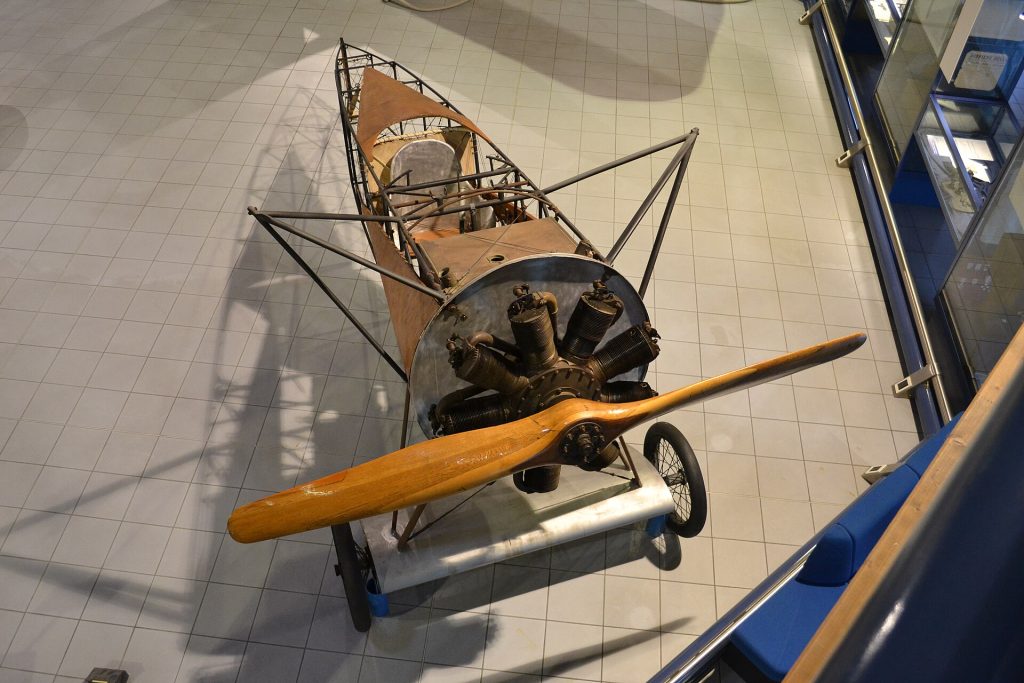
Survivors, stated precisely. Original airframes: none complete. One original D.VIII fuselage is preserved at the Museo dell'Aeronautica Gianni Caproni in Trento, Italy, and it is the only substantial original structure of the type known to exist. Everything else that carries D.VIII or E.V markings anywhere in the world is a reproduction: a replica D.VIII at the Alberta Aviation Museum in Edmonton; a replica E.V marked 001 as Fok.E.V 185/18 at the Polish Air Force Museum at Dęblin; two airworthy replicas operated by The Vintage Aviator at Masterton, New Zealand; a flying replica built by Brian Coughlin at Old Rhinebeck Aerodrome, New York; a full-scale flyable E.V replica registered OK-TAL 07 in the Czech Republic, marked as Fok.E.V 153/18 and associated with the Metoděj Vlach air museum at Mladá Boleslav; and a seven-eighths scale replica at the Wings of Freedom Aviation Museum in Horsham, Pennsylvania. The Airdrome Aeroplanes Fokker D-VIII sold as a homebuilt kit is a modern light aircraft of similar appearance and is not a reproduction of the original structure. For a type that has one of the strongest reputations in the whole of First World War aviation, the physical remainder is a single fuselage.
Fokker D.VIII timeline: from competition winner to Armistice
Adlershof competition
Fokker enters a parasol-wing monoplane by Reinhold Platz at the second D-type fighter competition; the design impresses.
Ordered into production
Idflieg orders the monoplane as the Fokker E.V, intended as a light, cheap, fast-climbing interceptor.
Front-line debut as the E.V
The E.V reaches Jagdstaffeln on the Western Front; a first victory is recorded on 17 August 1918.
Fatal wing failures & grounding
After several in-flight wing collapses kill their pilots, the E.V is grounded within weeks of entering service.
Investigation & rebuild
Inquiries blame a mix of poor wartime workmanship and mandated structural changes; the wing is rebuilt to a stronger standard.
Return as the D.VIII
The cleared fighter re-enters service, redesignated D.VIII — with only weeks of the war left to run.
Armistice
The war ends before the D.VIII can be deployed in numbers; it is sometimes credited with one of the last aerial victories.
Post-war service
Poland flies E.V/D.VIIIs in the Polish–Soviet War; the Netherlands and others operate or evaluate the type.
Last of the rotaries
A US-evaluated D.VIII (P-165) survives at McCook Field as the last rotary-engined aircraft on the US Army’s inventory.
The Fokker D.VIII in its own words: stories from 1918 and after
A promising arrival
Pilots who first flew the E.V praised its light controls, strong climb and superb visibility — many thought Fokker had produced a war-winner.
Read the story
The wings that folded
Within days of reaching the front, E.Vs began shedding their wings in the air, killing experienced pilots for no reason anyone could see.
Read the story
Whose fault was the wing?
The investigation split the blame between Fokker’s factory and the authorities’ own specification changes — and it has never been cleanly resolved.
Read the story
Made strong again
New, heavier-built wings were fitted and tested, and the cleared aircraft returned as the D.VIII — the same airframe, a second chance.
Read the story
From E.V to D.VIII
The switch from "E" (monoplane) to "D" (single-seat fighter) marked both a bureaucratic reclassification and a fresh start for a tainted reputation.
Read the story
Weeks from the end
By the time enough D.VIIIs were cleared for the front, the war had almost run out; relatively few saw combat before 11 November.
Read the story
A claim at the finish
A Fokker D.VIII is sometimes credited with scoring one of the very last aerial victories of the First World War.
Read the story
A second war
After 1918 Poland assembled and flew captured E.V/D.VIII airframes against Soviet forces in the Polish–Soviet War of 1919–21.
Read the story
Fokker comes home
Anthony Fokker returned to the Netherlands after the war, and a small number of D.VIIIs served there — close to where the marque would build its post-war future.
Read the story
Evaluated and flown on
Captured examples were shipped to the United States for evaluation; one flew at McCook Field into 1927 as the Army’s last rotary-engined aircraft.
Read the story
Originals behind glass
No genuine D.VIII still flies, but original airframes and relics survive in museums in Poland, Italy and elsewhere.
Read the story
The Razor flies again
Beautifully built airworthy reproductions — at Old Rhinebeck and elsewhere — let modern audiences watch the Flying Razor in its element.
Read the story
Fokker D.VIII in photographs: 1918 service, museums and reproductions
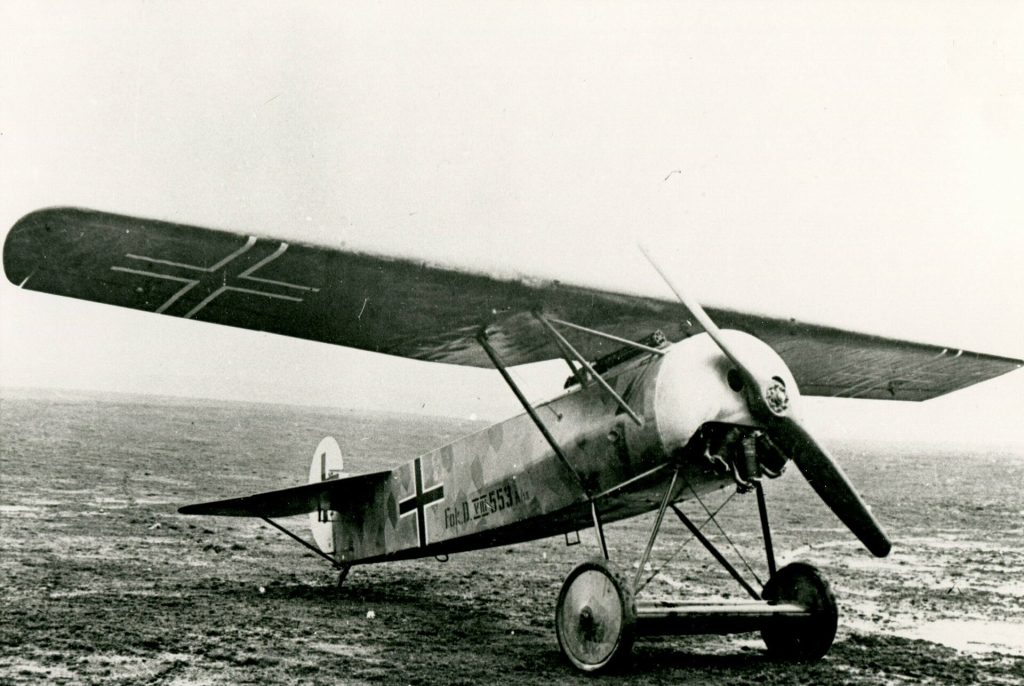
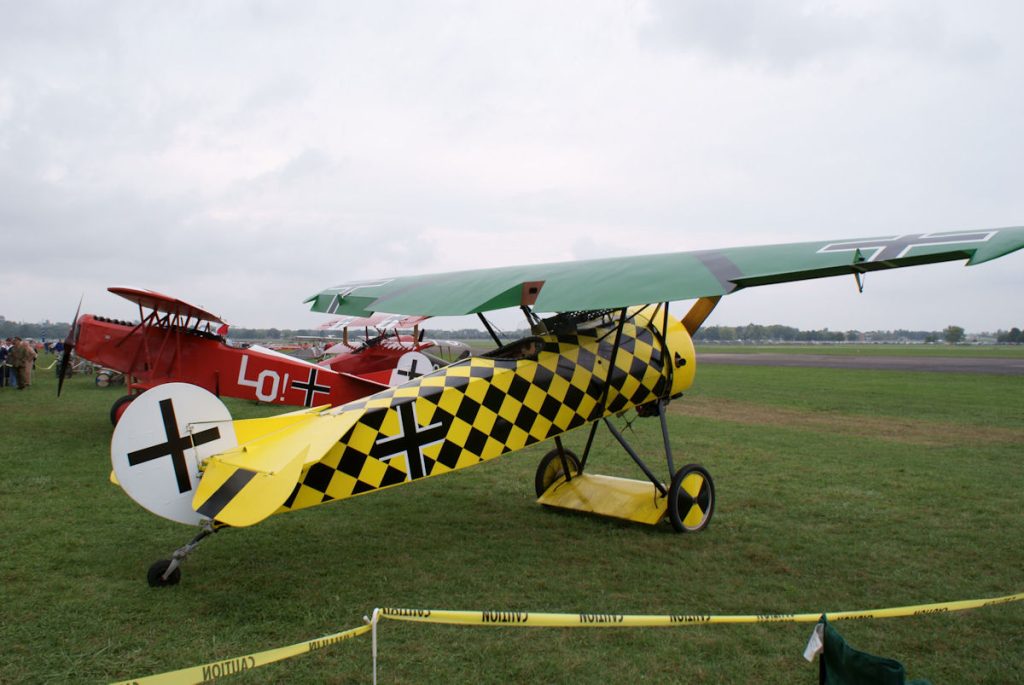
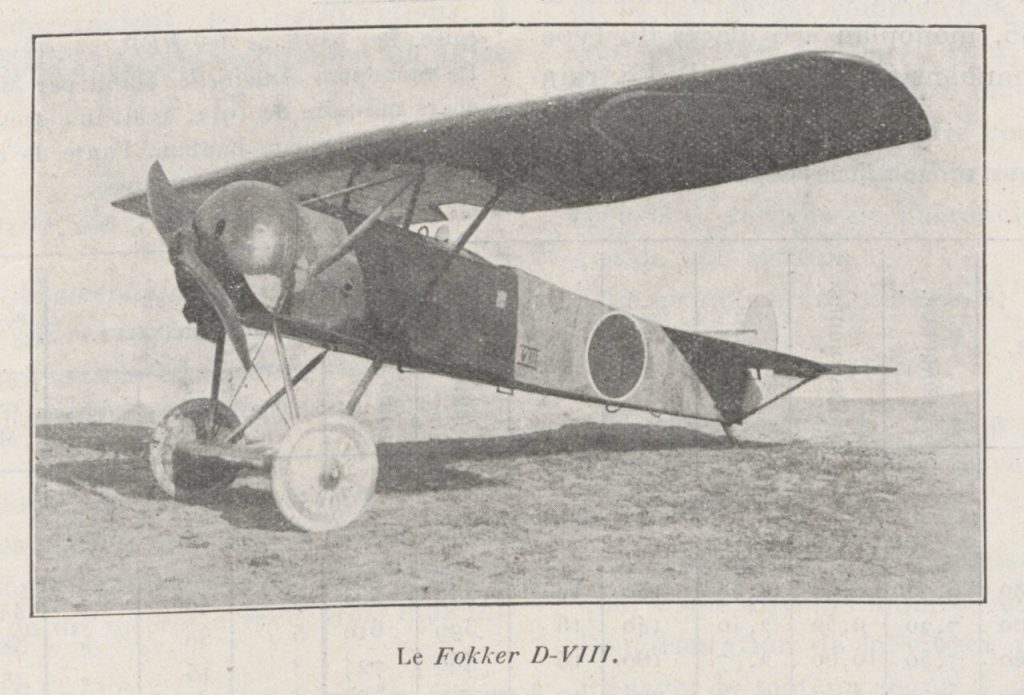
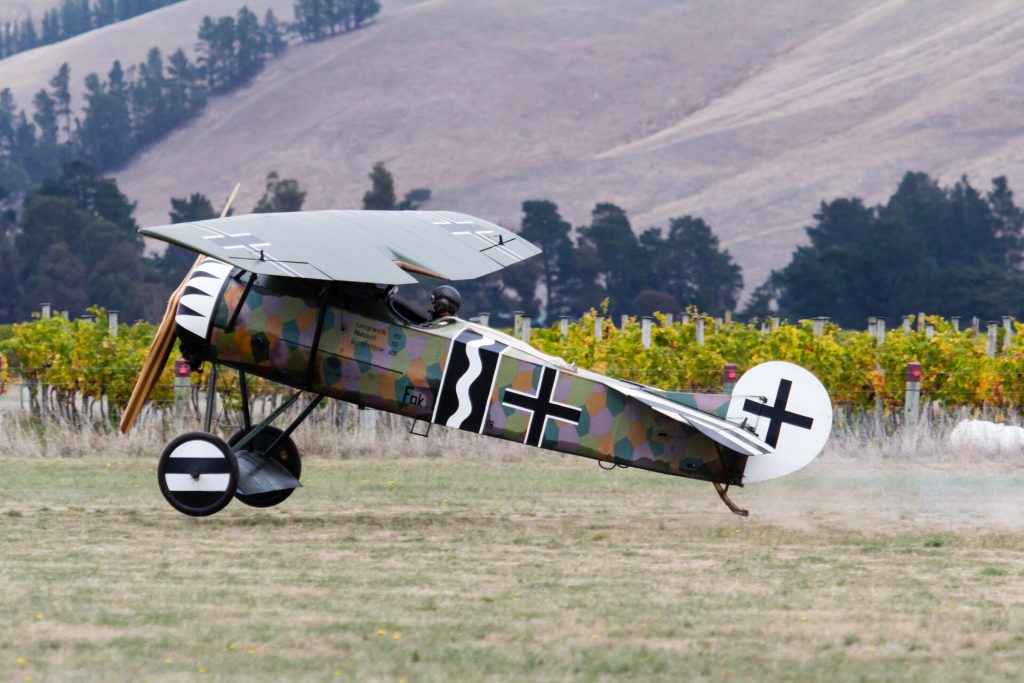
Fly along in a Fokker D.VIII: the Smithsonian’s cockpit film
“Strap into the cockpit of a WWI airplane — fly along in a Fokker D.VIII (D8), 360° video.” Filmed in an airworthy reproduction by the Smithsonian National Air and Space Museum (≈ 40,700 views). Drag inside the frame to look around the cockpit and out past that famous parasol wing.
Where the Fokker D.VIII flew: origin, front-line service and survivors
One country designed and flew it in anger; a few others gave it a second life. Toggle the categories to see its German origin, its brief Western-Front service in the autumn of 1918, the post-war operators who flew or evaluated it, and where original airframes and replicas survive today. Hover or tap a country for detail.
The Fokker D.VIII’s war record: brief, promising and cut short
The E.V/D.VIII reached the front for only a few weeks of active combat before the Armistice, and spent part of even that time grounded. Its record is therefore thin by an accident of history rather than any fault of the aircraft. The numbers below are best understood as a measure of how little time the type was given, not of how good it was — most assessments, then and now, rate its raw fighting potential very highly.
A first victory is recorded on 17 August 1918, and historians suspect two or three more; a D.VIII is sometimes credited with one of the very last aerial victories of the war. Hedge: late-1918 records are incomplete, so exact totals are uncertain.
Fokker D.VIII: frequently asked questions
Can I fly in a Fokker D.VIII?
Why was the Fokker D.VIII called the “Flying Razor”?
Was the Fokker D.VIII a good fighter?
What was the Fokker E.V, and how is it related to the D.VIII?
Why did the Fokker E.V’s wings fail?
How many Fokker D.VIIIs were built?
Are there any surviving Fokker D.VIIIs?
What engine and armament did the Fokker D.VIII have?
Was the Fokker D.VIII a monoplane or a biplane?
You can’t fly the Fokker D.VIII.
These, you can.
Some legends only live in museums — others are fuelled and waiting. MiGFlug has put civilians in real military jet cockpits since 2004.
 Fly the L-39 AlbatrosThe world’s most-flown jet trainer — aerobatics included
 Fly the F-104 Starfighter“The missile with a man in it”
 Fly the MiG-21The Cold War’s most-produced jet
 Fly the T-33 Shooting StarAmerica’s first jet trainer
 Fly the DH VampireA piece of early jet history
 Fly the S.211Agile Italian jet trainer
 Fly the MB-326The classic Aermacchi jet
 Fly the MiG-15The Soviet legend of the Korean War
More from the Fokker stable
Sources & further reading on the Fokker D.VIII
- Military Aviation MuseumType history, production numbers, the August 1918 groundings and post-war Polish service.
- Smithsonian National Air and Space MuseumInstitutional collection and the 360° cockpit film of an airworthy D.VIII reproduction.
- Aeropedia — D. C. EyreDetailed specifications: engine, speed, ceiling, weights and dimensions.
- The Museum of FlightNotes on the parasol layout and a museum reproduction of the D.VIII.
- Old Rhinebeck AerodromeHome of an airworthy flying Fokker D.VIII reproduction and pilot commentary.
- The Armory LifeAccessible feature on the D.VIII, the "Flying Razor" nickname and its troubled debut.
- Fighter Factory / Military Aviation MuseumWWI-era collection context for the E.V/D.VIII and its contemporaries.
Photographs via Wikimedia Commons under the licences credited beside each image; historical figures for production, performance and victories vary between sources and are hedged in the text. Encyclopedia entry compiled by MiGFlug. This page is editorial — MiGFlug does not operate Fokker D.VIII flights.