
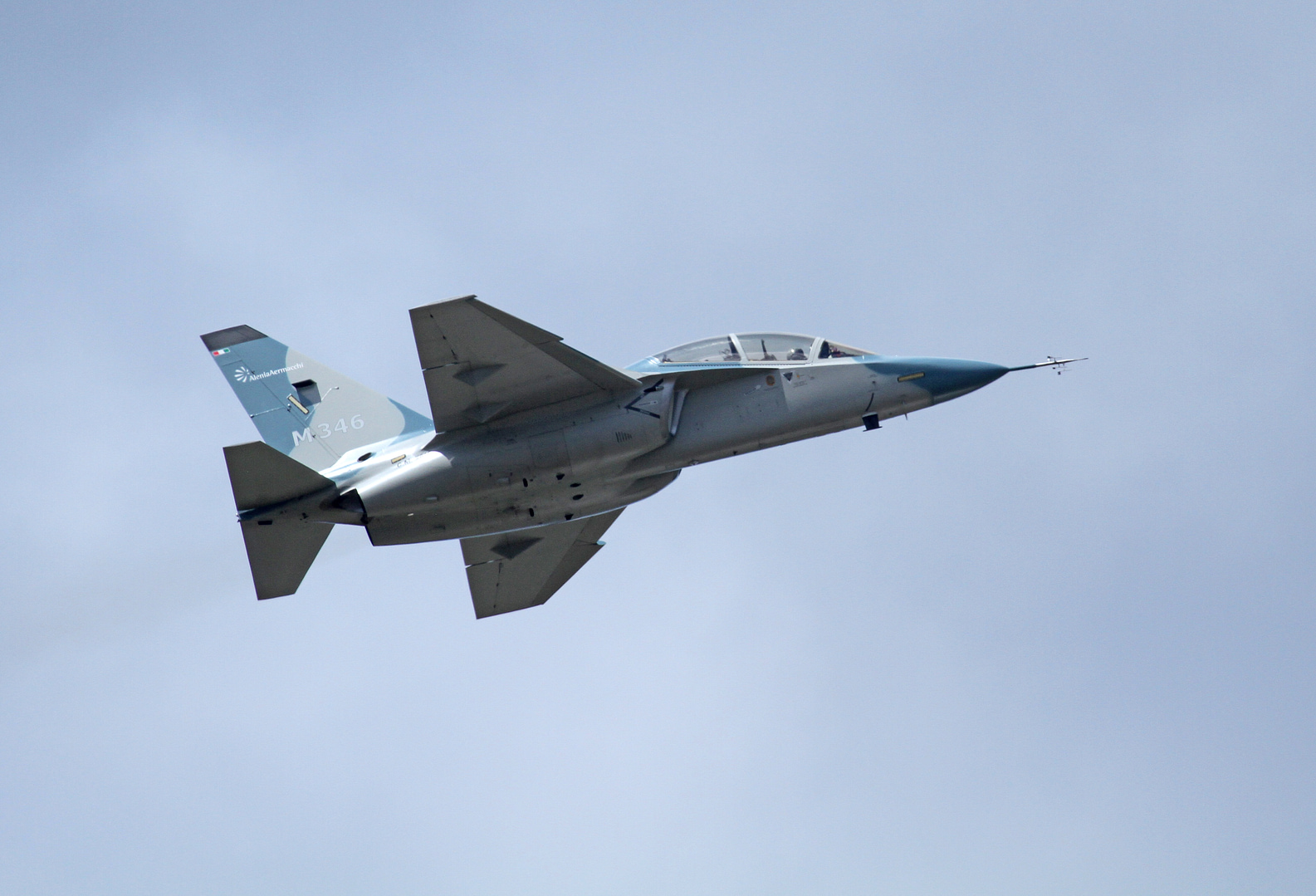
Aermacchi M-346
“Master”
Italy’s digital fly-by-wire advanced jet trainer — a twin-engine machine built to teach pilots to fly fourth- and fifth-generation fighters like the F-35, and now offered as the FA-346 light-attack aircraft.
The Aermacchi M-346 Master: the jet that teaches pilots to fly the F-35
The M-346 began not in Italy but as a Russian-Italian collaboration. In the early 1990s, with the Cold War over and defence budgets shrinking, the Russian design bureau Yakovlev and Italy’s Aermacchi joined forces to build a new advanced jet trainer, designated the Yak/AEM-130. The idea was to share the enormous cost of developing a modern trainer: Yakovlev brought the aerodynamic design and a flying demonstrator, Aermacchi brought Western avionics, systems and money. A joint aircraft flew in 1996.
The partnership did not last. By around 2000 the two companies split, dividing the intellectual property between them. Yakovlev went on to develop the aircraft for Russia and the export market as the Yak-130; Aermacchi took the rights to sell a Western-equipped version and redrew it around Honeywell engines, Western avionics and a digital fly-by-wire flight-control system. That aircraft became the M-346 Master. The two jets are visibly cousins — the same broad layout and shoulder-mounted wing — but under the skin they diverged into different machines for different customers.
Aermacchi’s M-346 prototype rolled out on 7 June 2003 and first flew on 15 July 2004. What set it apart was its purpose. Modern fighters — the Eurofighter Typhoon, the Rafale, the Gripen and above all the F-35 Lightning II — are so capable and so expensive to operate that flying training on the jets themselves is wasteful and, at the edges of their envelope, dangerous. The M-346 was designed to be a lead-in fighter trainer: a relatively cheap jet that behaves like a front-line fighter, so that a student arrives at an operational conversion unit already fluent in high angle-of-attack manoeuvring, sensor management and tactics.
Its defining trick is aerodynamic and digital. A vortex-lift wing and a full-authority quadruplex fly-by-wire system let the M-346 stay fully controllable at angles of attack beyond 35 degrees — deep into the region where older trainers depart into a spin. Because the flight-control laws are software, instructors can even make the trainer feel like a heavier, twitchier fighter. On top of that sits an embedded training system that generates simulated radar contacts, threats and weapons inside the real cockpit, letting a student fight an entire mock engagement against enemies that are not physically there.
Italy took the type into service as the T-346A, with first aircraft delivered from 2011, and built its training around it at the International Flight Training School (IFTS) — a joint Leonardo and Italian Air Force enterprise that now trains student fighter pilots from many nations at Decimomannu in Sardinia. Israel, Singapore, Poland, Greece, Qatar and others followed, each adapting the jet to its own pipeline: Israel flies it as the “Lavi,” Poland as the “Bielik.”
Leonardo has since pushed the design beyond training. The M-346FA (Fighter Attack) — sometimes styled the FA-346 — adds a multi-mode fire-control radar and a genuine combat fit across seven hardpoints, turning the trainer into a light-attack and air-policing aircraft that smaller air forces can afford. It is the same airframe that teaches pilots to fly fighters, now able to act as a modest one itself.
01The M-346 and the Yak-130: how one 1990s design became two rival jets
The M-346 and Russia’s Yak-130 share a common ancestor: the Yak/AEM-130 advanced trainer developed jointly by Yakovlev and Aermacchi from 1993. When the partnership dissolved around 2000, the two firms split the intellectual property and each finished its own aircraft. Yakovlev produced the Yak-130 with Russian engines and systems for Russia and export customers; Aermacchi produced the M-346 with Western engines, avionics and a digital fly-by-wire system.
They are best described as cousins, not the same aircraft. Both keep the shared aerodynamic layout — a shoulder-mounted wing with prominent leading-edge root extensions for vortex lift — but they differ in engines, flight-control philosophy, avionics and structure. The M-346 is aimed squarely at NATO and Western-aligned air forces training on aircraft like the F-35; the Yak-130 serves Russia and its export partners. It is one of the clearest modern cases of a single collaborative design splitting into two competing production aircraft.
What makes the M-346 special
Fly-by-wire that flies past 35 degrees
The M-346 uses a full-authority quadruplex digital fly-by-wire flight-control system with no mechanical backup — unusual in a trainer. Combined with a vortex-lift wing, it keeps the aircraft fully controllable at angles of attack beyond 35 degrees, deep into the regime where an older trainer would depart into a spin. The control laws can even be tuned to make the jet handle like a heavier front-line fighter.
An embedded ‘virtual’ battlefield
Its defining training feature is an embedded tactical training system that injects simulated radar contacts, threats, wingmen and weapons into the real cockpit displays. A student can fly a complete mock air-combat or strike mission — locking, launching and being shot at — against enemies that do not physically exist, an approach now extended into full Live-Virtual-Constructive networked training.
Two clean turbofans, no afterburner
Power comes from two Honeywell F124-GA-200 turbofans of about 28 kN (6,250 lbf) each — non-afterburning, chosen for low running cost and reliability. Twin engines give a genuine multi-engine fighter feel and safety margin, while a large internal fuel load and an air-to-air refuelling probe give the endurance to run long, layered training sorties.
02The M-346 as a lead-in trainer: bridging the gap to the F-35 and Eurofighter
Fifth-generation fighters such as the F-35, and advanced fourth-generation types like the Eurofighter Typhoon and Rafale, are extraordinarily expensive to fly and demanding to master. Air forces do not want students learning basic fighter skills on them. The M-346 fills the lead-in fighter training gap: a comparatively cheap jet whose handling, cockpit philosophy and embedded sensors deliberately mimic a front-line fighter, so a pilot arrives at the operational aircraft already competent in high-alpha manoeuvring, sensor and weapons management and tactical thinking.
This is why the aircraft sits at the heart of the International Flight Training School in Italy, where student fighter pilots from several nations — including those destined for the F-35 — complete their advanced phase before converting to type. The economic argument is blunt: every hour a student can spend on an M-346 instead of an F-35 saves a great deal of money and airframe fatigue.
03The M-346FA: turning the Master trainer into a light-attack fighter
De M-346FA (Fighter Attack), sometimes referred to as the FA-346, is the combat-capable development of the trainer. It keeps the M-346 airframe but adds a multi-mode fire-control radar (a Grifo-family or similar set), a defensive aids suite and a full weapons capability across seven hardpoints, carrying air-to-air missiles, precision-guided bombs and rockets up to roughly a three-tonne external load.
The pitch is affordability: for air forces that cannot justify a dedicated fleet of front-line fighters, a single M-346 fleet can provide advanced training and a credible light-attack, close-air-support and air-policing capability from the same aircraft and support chain. It will not out-fight a true multirole fighter, but it offers a large share of the utility at a fraction of the cost, which is exactly why it has drawn export interest.
Full Aermacchi M-346 Master specifications
Airframe & Performance
- Bemanning
- 2 (tandem, instructor and student)
- Lengte
- ~11.49 m
- Spanwijdte
- ~9.72 m
- Hoogte
- ~4.76 m
- Leeggewicht
- ~4,610 kg
- Max takeoff weight
- ~9,500 kg
- Max speed
- ~Mach 0.9 · ~1,060 km/h (transonic)
- Max angle of attack
- >35° (fully controllable)
- Serviceplafond
- ~13,700 m (45,000 ft)
- Ferry range
- ~1,900–2,000 km
Propulsion & Systems
- Engines
- 2 × Honeywell F124-GA-200 turbofan
- Thrust (each)
- ~28 kN / 6,250 lbf (no afterburner)
- Flight control
- Quadruplex digital fly-by-wire
- Training
- Embedded tactical / LVC simulation
- Hardpoints
- 7 (M-346FA) · up to ~3,000 kg
- Radar (FA)
- Multi-mode fire-control (M-346FA)
- First flight
- 15 July 2004
- Service entry
- Italy (T-346A) from 2011
- Unit cost
- ~US$30–40 million (estimate)
- Cost per flight hour
- No firm public figure · far below a fighter
04The M-346’s operating costs: cheap by fighter standards
The M-346’s entire commercial argument is cost. Precise figures are rarely published and vary by contract and configuration, but a flyaway unit cost commonly cited in the US$30–40 million range is a reasonable order of magnitude, and the cost per flight hour is a small fraction of a front-line fighter’s — the whole point of using it as a lead-in trainer. Independent, audited cost-per-hour numbers are not consistently public, so any exact dollar figure should be read as an estimate. What is not in doubt is the direction: an M-346 hour is dramatically cheaper than an F-35 or Eurofighter hour, which is why air forces buy it to offload as much training as possible from their expensive front-line jets.
From a Russian-Italian trainer to a global fighter school
Yak/AEM-130 partnership
Yakovlev and Aermacchi join forces to develop a new advanced trainer, sharing the cost of a modern design.
The partnership splits
The two firms divide the intellectual property. Yakovlev pursues the Yak-130; Aermacchi keeps the rights to a Western-equipped derivative.
M-346 flies
The Aermacchi M-346 prototype rolls out on 7 June 2003 and makes its first flight on 15 July 2004, now with Honeywell engines and digital fly-by-wire.
Italy takes delivery
The Italian Air Force begins receiving the type as the T-346A, building its advanced fighter training around it.
First export wins
Singapore and Israel select the M-346; Israel names its aircraft the “Lavi” and begins replacing its ageing trainer fleet.
Poland, Qatar and more
Poland (the “Bielik”), Qatar and others order the type, and the International Flight Training School expands into a multinational fighter school.
The M-346FA appears
Leonardo unveils the M-346FA light-attack variant with a fire-control radar and full weapons fit, broadening the aircraft from trainer to light fighter.
A widening fleet
Greece, Azerbaijan, Turkmenistan and further customers join Italy, Israel, Singapore, Poland and Qatar, and the IFTS relocates its live-flying to Decimomannu in Sardinia.
Twelve M-346 Master stories
A Russian-Italian jet
The M-346 was born from a 1990s partnership between Yakovlev and Aermacchi.
Read the full story
One design, two aircraft
When the partnership broke up around 2000, the shared design became two rival jets.
Read the full story
Built to be flown, cheaply
The whole point of the M-346 is to be a fighter you can afford to train on.
Read the full story
Controllable past the stall
A quadruplex digital flight-control system lets the M-346 fly where older trainers spin.
Read the full story
Fighting invisible enemies
The M-346 can conjure radar contacts, missiles and threats that are not really there.
Read the full story
The T-346A and the IFTS
Italy flies the Master as the T-346A and built an international fighter school around it.
Read the full story
The Lavi
Israel replaced its ageing Skyhawk trainers with the M-346, naming it the Lavi.
Read the full story
Trainer far from home
Singapore, short of airspace at home, flies its M-346s from bases abroad.
Read the full story
The Bielik
Poland flies the Master as the Bielik, the white-tailed eagle of its national emblem.
Read the full story
Growing teeth
The M-346FA turns the trainer into an affordable light-attack fighter.
Read the full story
A quiet best-seller
The M-346 has become one of the West’s most successful modern trainers.
Read the full story
The school jet of the F-35 age
The M-346 has become the aircraft that quietly stands behind a generation of fighter pilots.
Read the full story
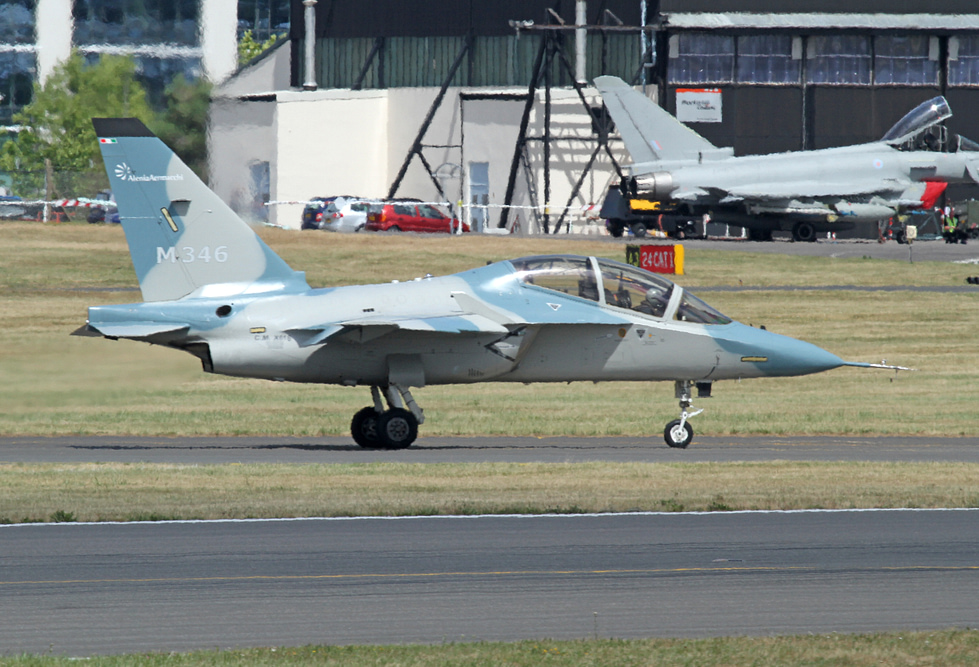
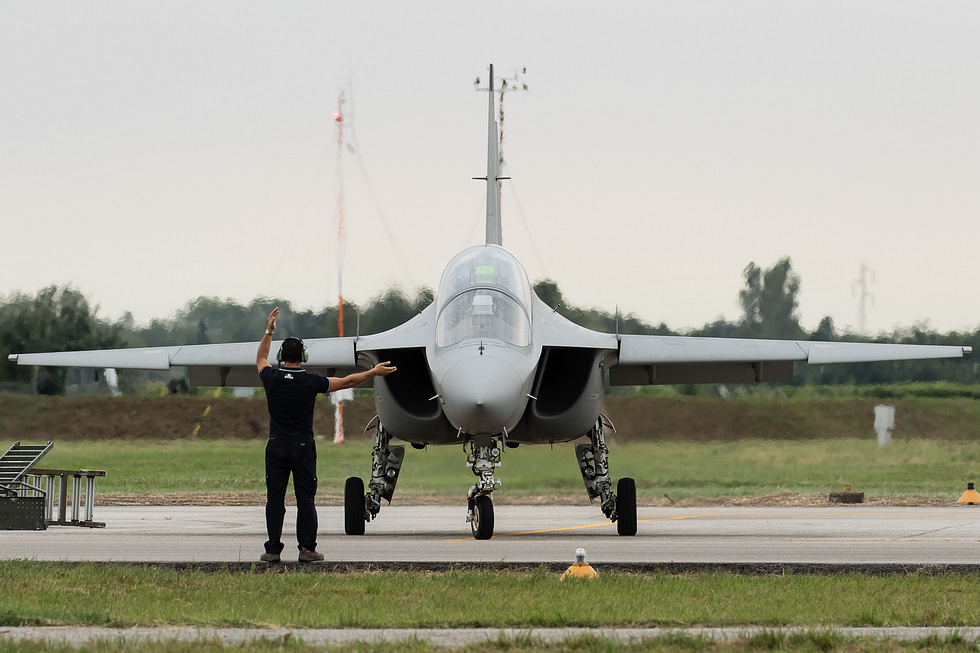
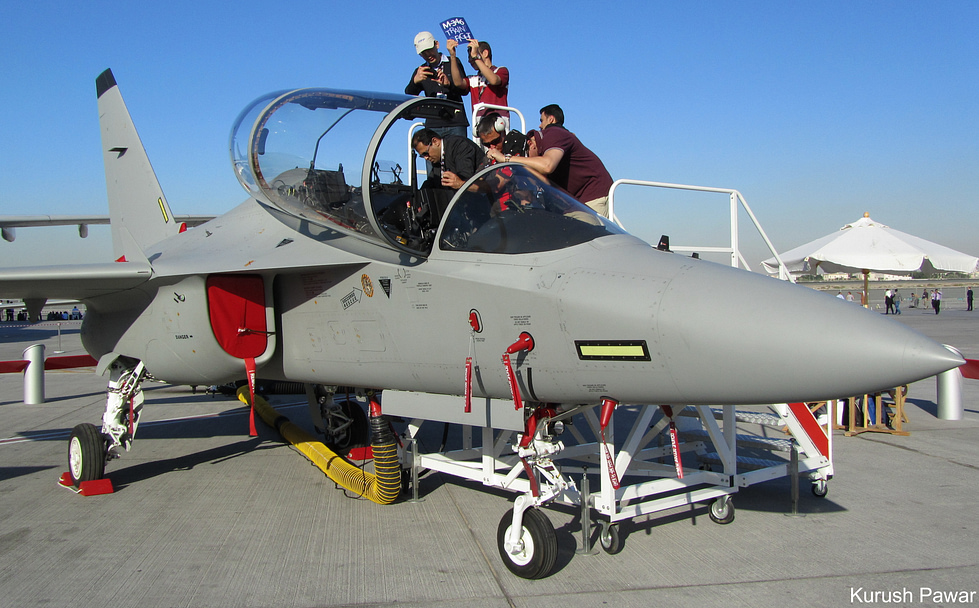
The M-346 Master in pictures


Where the M-346 Master flies
A trainer measured in pilots, not kills
The M-346 has no air-to-air record — that is not its purpose. Its success is measured in the number of air forces that have chosen it and the pilots it puts through advanced training every year. From Italy’s T-346A fleet and the multinational International Flight Training School to operators in Israel, Singapore, Poland, Greece, Qatar and beyond, the Master has become one of the West’s standard lead-in fighter trainers. The armed M-346FA now extends that into a genuine light-attack and air-policing capability.
See the wider combat record of every military aircraft. The M-346 is a training and light-attack aircraft, not a front-line fighter.
Everything people ask about the M-346 Master
Can I fly in an M-346?
What is the Aermacchi M-346 Master?
Is the M-346 related to the Russian Yak-130?
Does the M-346 train F-35 pilots?
Which countries fly the M-346?
Can the M-346 carry weapons?
You can’t fly the M-346.
These, you can.
Some legends only live in museums — others are fuelled and waiting. MiGFlug has put civilians in real military jet cockpits since 2004.
 Fly the L-39 AlbatrosThe world’s most-flown jet trainer — aerobatics included
 Fly the F-104 Starfighter“The missile with a man in it”
 Fly the MiG-21The Cold War’s most-produced jet
 Vlieg met de T-33 Shooting StarAmerica’s first jet trainer
 Fly the DH VampireA piece of early jet history
 Fly the S.211Agile Italian jet trainer
 Fly the MB-326The classic Aermacchi jet
 Fly the MiG-15The Soviet legend of the Korean War
Continue the tour
Every fact, checked
- Leonardo — M-346 product pageManufacturer data on the trainer, fly-by-wire, embedded training and the M-346FA.
- GlobalSecurity.org — M-346 MasterFly-by-wire, high angle-of-attack performance, embedded training and the lead-in fighter role.
- MilitaryFactory — Leonardo M-346 MasterDimensions, weights, engines, performance, hardpoints and the Yak-130 shared origin.
- Global Military — M-346 MasterOperator list and quantities, development history and the International Flight Training School.
- The War Zone — Flying the M-346First-hand account of handling, high-alpha behaviour and the embedded training system.
- Defense.info — M-346 and LVC trainingLive-Virtual-Constructive training architecture and the F-35-era training role.
- European Airshows — M-346 first flightReference for the 7 June 2003 rollout and 15 July 2004 first flight.
- AeroCorner — Alenia Aermacchi M-346Consolidated specifications and variant overview.