
Supermarine Swift
Britain’s first swept-wing fighter and one of its most public procurement embarrassments — a jet that failed as an interceptor, then quietly redeemed itself as a low-level reconnaissance aircraft and, for eight days in 1953, held the world air speed record.
The Supermarine Swift: the insurance policy that briefly became a scandal
In the early 1950s Britain was in a hurry. The Korean War had made it painfully clear that the RAF’s straight-wing jets were a generation behind the swept-wing MiG-15, and Whitehall wanted a modern day-fighter in service as fast as industry could build one.
Rather than bet everything on a single design, the Air Ministry hedged. Two swept-wing fighters were ordered straight off the drawing board as insurance against one another: Hawker’s elegant Hunter, and Supermarine’s Swift. Both were “super-priority” programmes, and both were ordered in quantity before they had been properly tested — a practice the period called “concurrency,” and one the Swift would come to symbolise.
Supermarine, the firm that had given the world the Spitfire, arrived at the Swift by a winding road. Its first jet, the straight-wing Attacker, was already obsolescent. From it grew a series of experimental swept-wing machines — the Type 510, 517, 528 and 535 — that were reworked, stretched and re-engined into the production Swift. On paper the aircraft looked formidable: a powerful Rolls-Royce Avon, a genuine swept wing and a battery of 30 mm ADEN cannon.
Reality was less kind. Rushed into production, the early fighter marks — the F.1, F.2, F.3 and F.4 — proved a bitter disappointment. The Swift tended to tighten alarmingly in hard turns, could pitch up without warning, and its handling deteriorated badly at the high altitudes where an interceptor was supposed to earn its keep. Worse, the guns could not always be fired reliably at height without the engine surging. After a string of accidents the F.1 and F.2 were grounded, and by 1955 the whole affair had become a very public scandal, debated in Parliament and the press as a symbol of wasted money and misplaced haste.
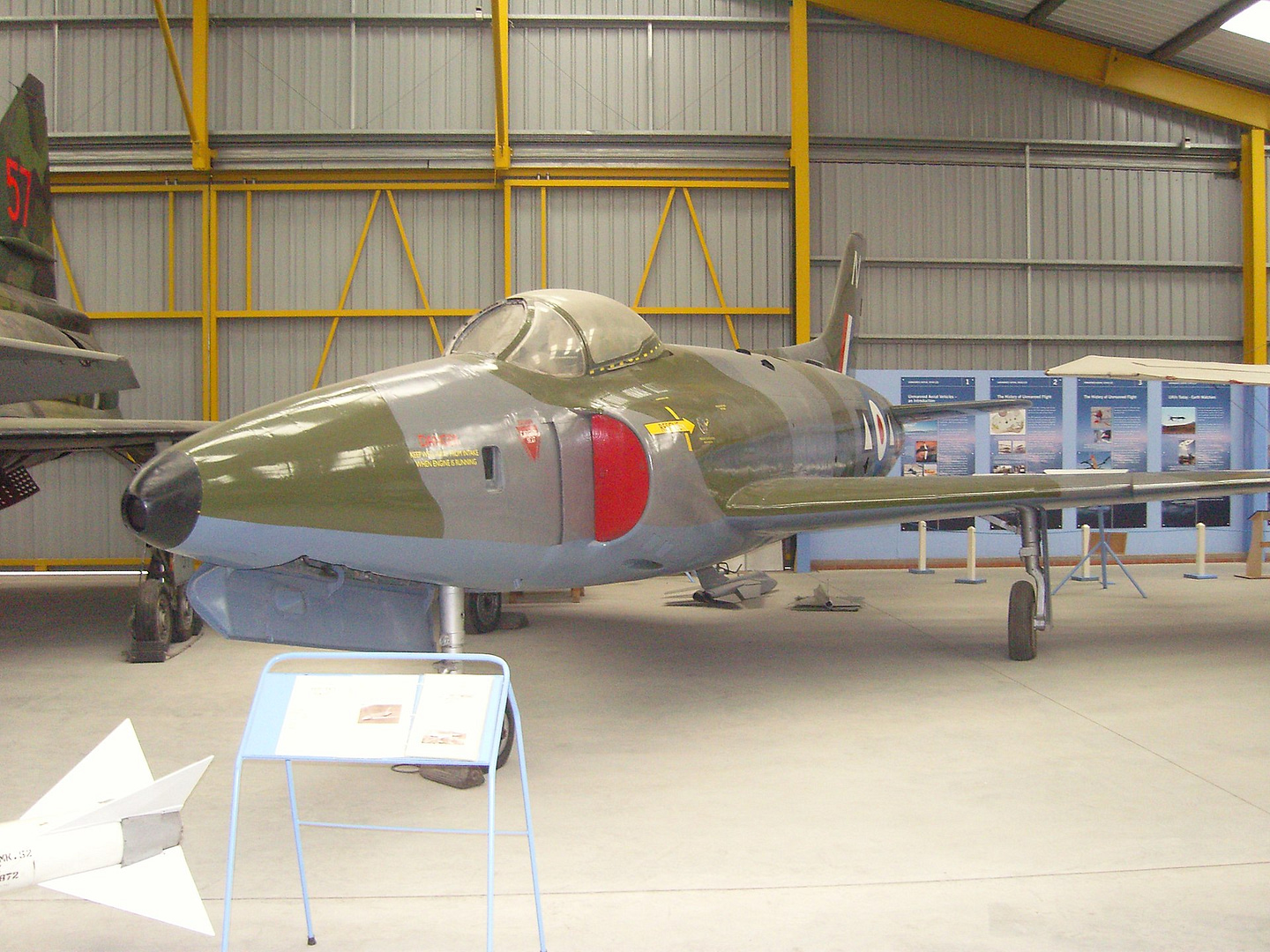
And yet the Swift was not finished. Someone realised that everything wrong with it as a high-altitude interceptor mattered far less down low, where it was fast, stable and strong. The fighter-reconnaissance FR.5, with a lengthened camera nose and reheated Avon, went to the squadrons of RAF Germany and there, at last, the Swift found the job it could do well — and did it until 1961.
At a glance
- First flight
- Type 510: 29 Dec 1948; F.1: Aug 1952
- Into service
- Feb 1954 (No. 56 Sqn)
- Retired
- 1961 (FR.5, RAF Germany)
- Built
- ~197 (of a far larger order)
- Manufacturer
- Supermarine / Vickers-Armstrongs
- Best role
- Low-level tactical recon
01Why Britain ordered the Supermarine Swift and the Hawker Hunter at the same time+
The twin order was deliberate risk management. In 1950–51 the RAF’s front line still rested on the straight-wing Gloster Meteor and de Havilland Vampire, types that the swept-wing MiG-15 had comprehensively out-classed over Korea. The Air Staff wanted a swept-wing day-fighter in numbers, and quickly.
Ordering two competing designs — the Hunter and the Swift — was meant to guarantee that at least one would succeed and to keep two design teams and two production lines warm. Both were placed under the “super-priority” scheme and both were ordered in bulk before flight testing was complete. The Hunter matured into one of the great post-war fighters; the Swift became the cautionary tale that sat beside it. Supporters of the approach point out that the insurance paid off: Britain got the Hunter. Critics point out how much the premium cost.
02The Supermarine Swift’s lineage: from the Spitfire and Attacker to a swept wing+
Supermarine’s jet story began with the Attacker, a naval fighter that mated a jet engine to a wing derived from the piston-engined Spiteful — itself a late-Spitfire descendant. It flew, but it was already behind the times, still using a tail-wheel undercarriage and a straight wing.
To catch up, Supermarine built a family of research aircraft. The Type 510 was essentially an Attacker fuselage given a swept wing and tail; in 1950 it became the first swept-wing aircraft to take off from and land on an aircraft carrier, HMS Illustrious. The Type 517, 528 and 535 followed, adding an afterburner, a nose-wheel and a revised wing. The production Swift emerged from this line — which is why, for all its faults, it represents a genuine and rapid leap from wartime piston technology to the swept-wing jet age in barely half a decade.
The irony was not lost on contemporaries. Supermarine was the house of R.J. Mitchell and the Spitfire, the most famous fighter Britain ever built. Its designers were talented and its pedigree impeccable. Yet the transition from the piston era to the jet-and-swept-wing era was one of the hardest that any aircraft industry ever made, and pedigree was no guarantee of success. Hawker, another old and distinguished firm, happened to get its swept-wing sums right with the Hunter; Supermarine, working to the same brutal timetable, did not. The Swift is a reminder that in aviation, a great name buys you nothing that the wind tunnel and the flight-test programme do not confirm.
03The Supermarine Swift as a political scandal: the 1950s procurement row+
What lifted the Swift from a technical disappointment to a national story was the money and the manner of its ordering. Because the aircraft had been bought in bulk before it was proven, the failure of the fighter marks meant cancelling or converting a large, already-funded production order — a very visible waste at a time when defence budgets were under intense scrutiny.
Newspapers seized on it, and the affair was raised repeatedly in Parliament as an example of what could go wrong when procurement outran testing. It fed a wider 1950s debate about how Britain chose and paid for its combat aircraft, a debate that would sharpen still further with the notorious 1957 Defence White Paper. For Supermarine the damage was lasting: the Swift was effectively the end of the firm as a supplier of front-line RAF fighters.
It is worth keeping the criticism proportionate, though. The twin-track order that produced the Swift also produced the Hunter, and the Hunter was superb. Judged as a whole, the insurance policy worked — Britain got a world-class day-fighter. The Swift was the premium paid for that certainty, and the argument over whether the premium was worth it has never entirely stopped.
How the Supermarine Swift was built — and where it went wrong
A true swept wing, powered by the Avon
The Swift paired a moderately swept wing with the Rolls-Royce Avon axial turbojet — the same engine family that powered the Hunter, Canberra and Comet. Later marks (F.3, F.4 and FR.5) added an afterburner, making the Swift one of the first British production aircraft with reheat.
Heavy cannon, unreliable at height
Armament was the hard-hitting 30 mm ADEN cannon — two in the F.1 and FR.5, four in the F.2, F.3 and F.4. It was a serious battery, but firing the guns at high altitude could disturb the engine airflow, one of several problems that undermined the aircraft’s value as an interceptor.
Fixes bolted on, mark by mark
Each mark tried to cure the last one’s vices: a “sawtooth” or extended leading edge to tame the wing, a variable-incidence tailplane on the F.4 to address pitch control. The changes helped, but never fully solved the high-altitude handling that a day-interceptor needed.
04The Supermarine Swift’s handling problems: tightening, pitch-up and the guns+
Three faults did most of the damage to the Swift’s reputation as a fighter. The first was a tendency to “tighten” in a hard turn — the aircraft would try to pull harder into the turn than the pilot commanded, a dangerous trait in combat manoeuvring. The second was pitch-up, a sudden nose-rise near the limits of the envelope that could flick the aircraft out of control. The third was gun-firing trouble at altitude, where the disturbance of firing could cause the engine to surge or flame out.
For an interceptor meant to fight at 40,000 feet and above, these were disqualifying. Supermarine chased the problems across successive marks with leading-edge modifications and a powered, variable-incidence tailplane, and the aircraft did improve — but never enough, quickly enough, to save the fighter role.
05The Supermarine Swift’s afterburning Avon and limited high-altitude performance+
The Swift was fast and it climbed well, especially down low, thanks to a reheated Avon that gave it strong acceleration. But its service ceiling — commonly quoted at around 45,000 feet — and its handling in thin air fell short of what Fighter Command wanted from a high-altitude interceptor in the age of high-flying Soviet bombers.
That mismatch is the key to the whole story. The very qualities that made the Swift a poor interceptor — a preference for low, fast flight and a solid, stable ride near the ground — were exactly what a low-level reconnaissance aircraft needed. When the FR.5 was sent down to the weeds over Germany, the Swift stopped fighting its own design and started using it.
The reheat system itself deserves a note. Afterburning — injecting fuel into the hot exhaust for a burst of extra thrust — was still a young technology when the Swift adopted it, and the type was among the first British production aircraft to fly with it. Getting the reheated Avon to light reliably and to behave across the flight envelope was part of the aircraft’s long development struggle, but it also gave the FR.5 the low-level dash that made it competitive in the reconnaissance role.
06The Supermarine Swift FR.5’s camera nose and low-level reconnaissance fit+
The FR.5 was not simply a fighter with a job change; it was rebuilt for the reconnaissance mission. The most obvious difference was a lengthened, reshaped nose housing a battery of cameras able to shoot obliquely and forward, so a pilot streaking along at low level could photograph targets to the side and ahead without slowing or climbing into danger.
It kept two of its 30 mm ADEN cannon, so it could defend itself or make a strafing pass, and it retained the reheated Avon for the speed that was its main protection down low. In an era before satellites and long before drones, a fast jet skimming the treetops with a camera was one of the few ways NATO could see what lay behind the Iron Curtain’s forward edge — and the Swift, at last, was good at exactly that.
07Supermarine Swift versus Hawker Hunter: why one succeeded and one failed+
The two aircraft were ordered together, used the same Rolls-Royce Avon and were meant to do the same job, which makes their divergent fates all the more instructive. The Hunter had a cleaner aerodynamic solution and, crucially, better high-altitude handling; once early teething troubles with its own gun-firing and engine surge were cured, it became a delight to fly and a superb gun platform. It went on to serve for decades and to be exported around the world.
The Swift never resolved its high-altitude vices in time. Its wing and its longitudinal control simply did not behave well enough in thin air, and no amount of leading-edge sawteeth or tailplane fixes fully cured it within the schedule available. So the Hunter took the fighter role and the export orders, while the Swift was left to find a second life at low level. If you want the shortest possible summary of 1950s British fighter procurement, it is this: the RAF ordered two swept-wing fighters to be safe, and it needed both to find out which one it should have ordered.
Supermarine Swift specifications and cost
Figures below are representative of the afterburning FR.5 / F.4 marks and are drawn from published sources; several vary between references and are flagged as estimates. Crew: 1.
| Airframe | |
|---|---|
| Bemanning | 1 (pilot) |
| Lengte | ~12.9 m (42 ft 3 in), FR.5 |
| Spanwijdte | ~9.8 m (32 ft 4 in) |
| Hoogte | ~4.0 m (13 ft 2 in) |
| Vleugelgebied | ~30.4 m² (327 sq ft) |
| Leeggewicht | ~6,100 kg (13,400 lb) est. |
| Max takeoff weight | ~9,800 kg (21,700 lb) est. |
| Powerplant & performance | |
|---|---|
| Motor | 1× Rolls-Royce Avon turbojet (RA.7R / Avon 114 with reheat on later marks) |
| Thrust | ~32 kN dry / ~42 kN with afterburner est. |
| Max speed | ~1,100–1,150 km/h (~680–710 mph) at low level est. |
| Serviceplafond | ~14,000 m (~45,800 ft) est. |
| Klimsnelheid | ~75 m/s (~14,700 ft/min) est. |
| Gevechtsradius | Short; typical of a 1950s day-fighter est. |
| Bewapening | 2× 30 mm ADEN cannon (F.1 / FR.5); 4× 30 mm ADEN (F.2 / F.3 / F.4) |
| Cost & programme | |
|---|---|
| Unit cost (period) | Not reliably recorded in comparable modern terms |
| Cost per flight hour | Not reliably recorded |
| Development programme cost | Reportedly on the order of £20 million in period money before the fighter order was cut back contested figure |
| Total built | ~197 airframes, from an original order of several hundred that was drastically reduced figures vary |
08Supermarine Swift variants: F.1 through FR.9 explained+
F.1 — first production fighter, two 30 mm ADEN cannon, non-reheated Avon; entered service with No. 56 Squadron in 1954 and was quickly grounded after accidents.
F.2 — four cannon and a revised wing leading edge; introduced new problems and was also grounded.
F.3 — added an afterburner but never entered operational RAF service.
F.4 — reheated Avon and a variable-incidence tailplane; the last fighter mark accepted, and the mark that set the 1953 speed record (WK198). The fighter programme was cancelled soon after.
FR.5 — the success: a lengthened nose housing cameras, reheated engine and two cannon, optimised for low-level tactical reconnaissance. It equipped RAF Germany squadrons from 1956 to 1961.
F.7 — a small batch carrying early Fairey Fireflash guided missiles, used mainly for trials rather than front-line service.
PR.6 / FR.9 — further reconnaissance proposals; the PR.6 was cancelled, and reconnaissance work centred on the FR.5. Designations and totals differ between sources, so treat mark-by-mark counts as approximate.
09The Supermarine Swift’s operating costs: what the record shows+
Unlike modern types, the Swift was never costed in the per-flight-hour terms used today, and any single figure would be a guess dressed up as data. What the record does show is a programme whose political cost was enormous: a large production order placed up front, then cut back drastically when the fighter marks failed, with the write-off and the parliamentary criticism that followed.
The honest entry for the Swift’s cost per flight hour is therefore “not reliably recorded.” The more meaningful cost was reputational — to the Air Ministry, to the RAF procurement system and to Supermarine, whose name never again appeared on a front-line RAF fighter.
10Supermarine Swift facts and myths: what the numbers really say+
“It was simply a bad aeroplane.” Only half true. As a high-altitude interceptor the Swift genuinely failed; as a low-level reconnaissance aircraft the FR.5 succeeded and won competitions. The same airframe was both, depending on the job.
“It held the speed record for years.” No — about eight days, in September and October 1953. Its lasting distinction is being the last British production aircraft to hold the outright record, not the longest holder.
“Exactly 197 were built.” Treat all Swift totals as approximate. Around 197 is the figure most often quoted, from an original order several times larger that was slashed; mark-by-mark totals differ between sources, and prototypes and research aircraft muddy the count further.
“It fought in combat.” No. The Swift never fired its guns in anger and never scored an air-to-air kill. Its entire reputation rests on peacetime events: a speed record, a procurement scandal and a quietly effective reconnaissance career.
11What came after: the Supermarine Type 545 and the end of Supermarine fighters+
Supermarine did not stop trying. It proposed the Type 545, a developed supersonic swept-wing fighter meant to move beyond the Swift’s limitations, and it built the big twin-engined naval Scimitar for the Royal Navy. But the Type 545 was cancelled, and the Scimitar — though it reached the Fleet Air Arm — had a hard and accident-prone career of its own.
Taken together, the Swift, the cancelled 545 and the troubled Scimitar mark the twilight of Supermarine as an independent fighter house. The firm that had built the Spitfire never again produced a successful front-line RAF fighter, and its name was gradually absorbed into the wider British aircraft industry. The Swift stands at the start of that decline — not the cause of it, but its most public early chapter.
The Supermarine Swift: a short, turbulent history
The Supermarine Swift in twelve stories
Ordered before it was tested
Lees meer
735.7 mph over the Libyan desert
Lees meer
Mike Lithgow, Supermarine’s chief test pilot
Lees meer
The turn that tightened itself
Lees meer
Cannon that could stall the engine
Lees meer
From front line to grounded in months
Lees meer
Debated in Parliament
Lees meer
Sent down to the weeds
Lees meer
Nos. 2, 4 and 79 Squadrons
Lees meer
Winning NATO recon contests
Lees meer
First swept wing to land on a carrier
Lees meer
The Fireflash guided-missile trials
Lees meer
Where to see a Swift today
Lees meer
Supermarine Swift in photographs
Every image below is a real, credited photograph. Click any picture to enlarge it.
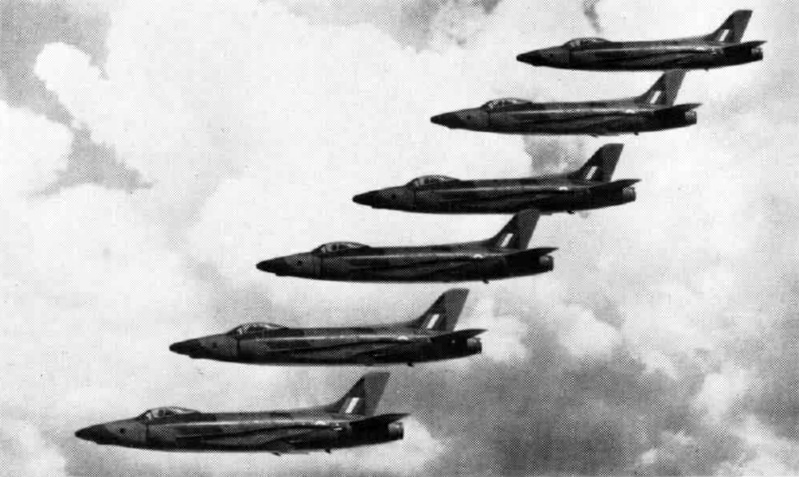
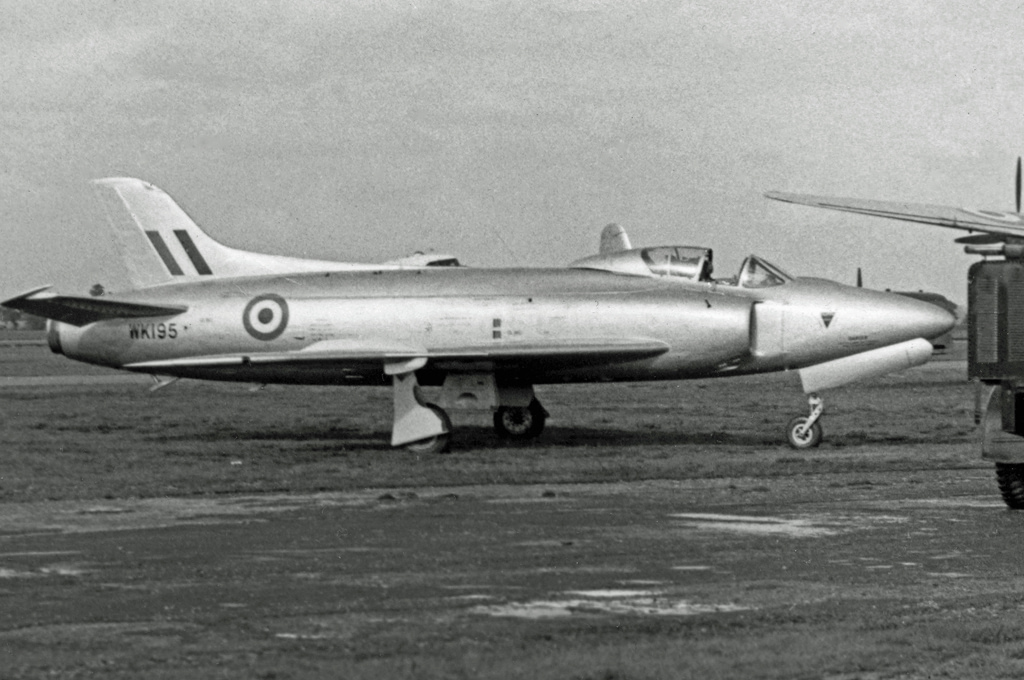
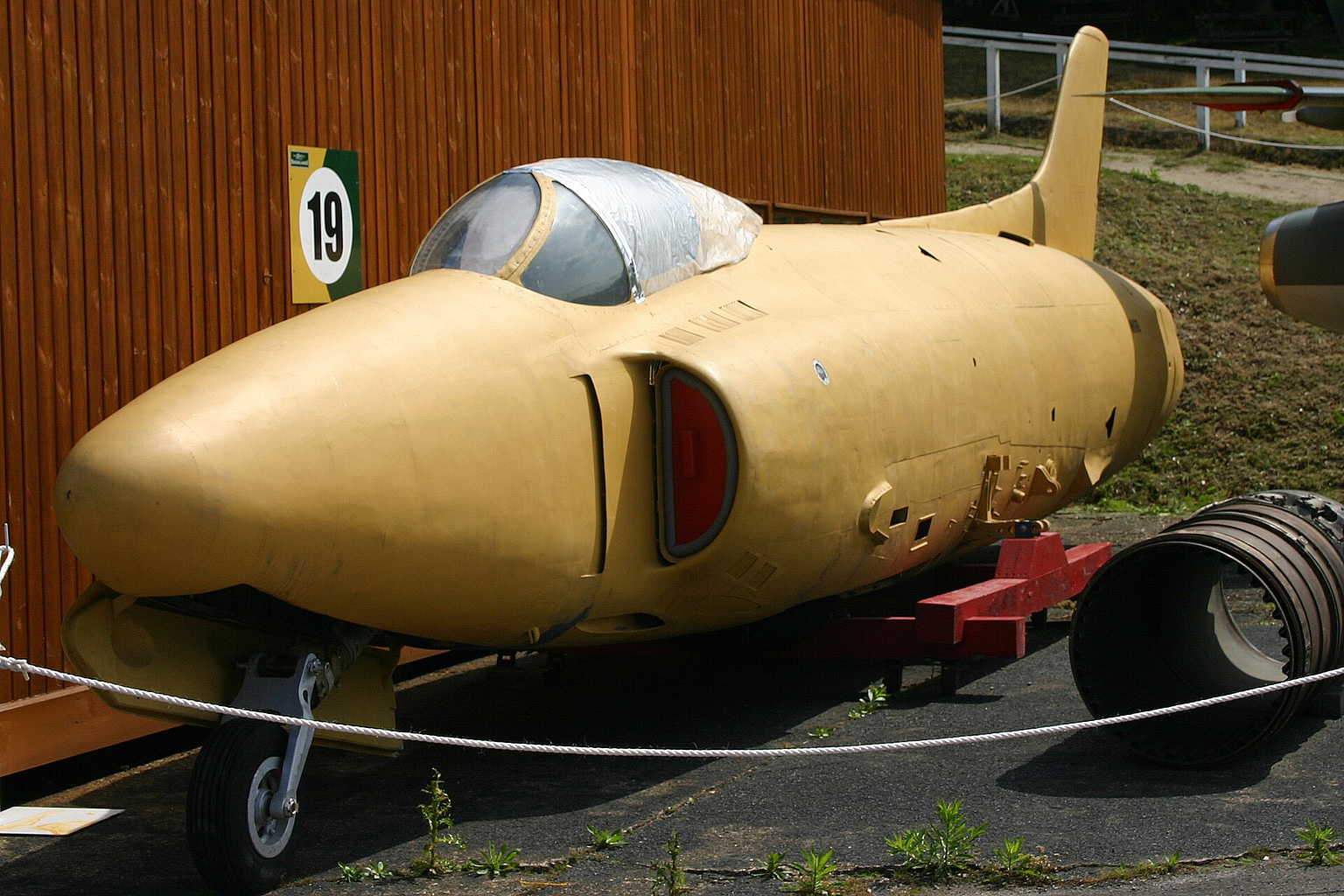
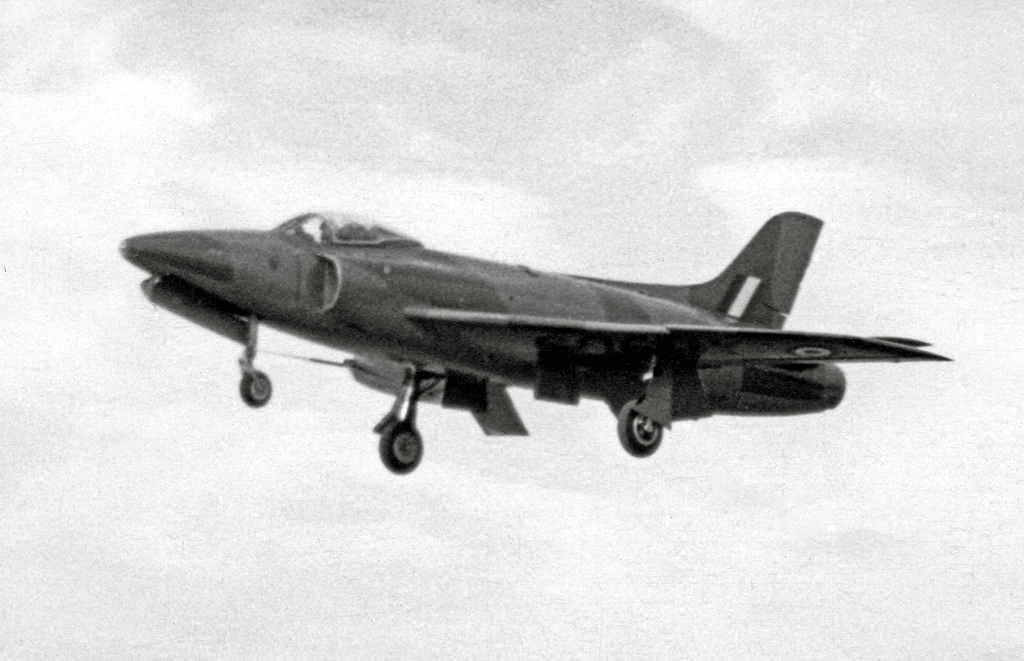

Watch: the Supermarine Swift’s troubled story
“Flying Failures — Supermarine Swift” by aviation-history channel Ruairidh MacVeigh (about 138,000 subscribers; roughly 17,700 views). A concise, well-sourced account of why the Swift failed as a fighter and succeeded as a reconnaissance aircraft.
Where the Supermarine Swift operated
The Swift was never exported and saw no combat. Its footprint is small but distinct: designed and built in Britain, flown operationally in RAF service at home and in Germany, and holder of a world record set in the Libyan desert. Toggle the categories below.
The Supermarine Swift’s two defining moments: a record and a redemption
The 1953 world air speed record
By the autumn of 1953 the world absolute air speed record had become a fiercely contested prize, traded back and forth between British and American jets. Supermarine wanted it for the Swift, both as a genuine demonstration of the aircraft’s low-level speed and as a badly needed piece of good publicity for a programme already under strain.
The attempt was flown not in Britain’s damp autumn air but over the hot, dense, low-lying desert near Tripoli in Libya, where conditions suited a high-speed low-level run. On 26 September 1953, Supermarine’s chief test pilot, Lieutenant Commander Mike Lithgow, flew the Swift F.4 WK198 down the measured course and set a new world record commonly cited at 735.7 mph — roughly 1,184 kilometres per hour, though sources round the figure slightly differently.
The glory was brief. Only about eight days later the American Douglas F4D Skyray took the record back, and the absolute record would soon climb far beyond anything a gun-armed day-fighter could reach. But the Swift’s run has a permanent place in the record books for one reason: it was the last time a British production aircraft ever held the outright world air speed record. That the same airframe, WK198, survives in part in a British collection gives the story a tangible endpoint.
Redemption over Germany
The FR.5 reached the squadrons of RAF Germany from 1956, equipping units of the 2nd Tactical Air Force whose task was to range low and fast over the potential battlefield of central Europe and bring back photographs. This was among the most demanding flying the RAF asked of anyone: very low, very fast, in European weather, navigating by map and stopwatch with a target you might see for only seconds.
Here the Swift’s character finally fitted the mission. Stable and quick at low level, strongly built and hard to catch near the ground, the FR.5 did the reconnaissance job well enough to win NATO’s low-level reconnaissance competitions in the late 1950s — beating aircraft that, higher up, would have run rings around it. For the pilots who flew it in the role it was designed around, the Swift was not a failure at all but a fast, purposeful tool.
The FR.5 soldiered on until 1961, when it was replaced by the reconnaissance Hunter, the FR.10 — the very rival that had beaten the Swift to the fighter role now inheriting its reconnaissance one too. The Swift left RAF service having never fired a shot in anger, never been exported, and never quite escaped the shadow of its early failure — yet having, in the end, done one difficult job genuinely well.
The Supermarine Swift by the numbers
The Swift is one of very few RAF fighters remembered almost entirely for peacetime events — a speed record and a procurement scandal — rather than for combat. Its real operational value lay in unglamorous, dangerous low-level reconnaissance work that rarely made headlines.
Supermarine Swift: frequently asked questions
Can I fly in a Supermarine Swift?–
Why was the Supermarine Swift considered a failure?+
Was the Supermarine Swift any good at all?+
Did the Supermarine Swift set a world speed record?+
How many Supermarine Swifts were built?+
Why did Britain order the Swift and the Hawker Hunter together?+
Where can I see a Supermarine Swift today?+
What engine did the Supermarine Swift use?+
Did the Supermarine Swift ever see combat?+
The Supermarine Swift is grounded forever. A real fighter-jet flight is not.
No Swift will ever fly again — but MiGFlug puts you in the cockpit of genuine ex-military jets around the world, from Cold War trainers to a MiG-29 climbing to the edge of space. Here is a selection of aircraft you can actually fly right now.


Explore more of the Aircraft Museum


Sources and further reading
- Royal Air Force Museum — institutional history of RAF swept-wing fighters and the Swift’s service record.
- Fleet Air Arm Museum, Yeovilton — holdings including the Supermarine Type 517 research airframe.
- Newark Air Museum — preserved Swift FR.5 WK277 and its service background.
- Tangmere Military Aviation Museum — Swift FR.5 WK281 exhibit notes.
- Solent Sky Museum, Southampton — Supermarine heritage and the F.7 airframe.
- Brooklands Museum — Vickers-Armstrongs / Supermarine production history and the WK198 fuselage.
- Fédération Aéronautique Internationale (FAI) — world air speed record listings for 1953.
- Thunder & Lightnings — detailed British Cold War aircraft type histories and survivor list for the Swift.
- Ruairidh MacVeigh, “Flying Failures: Supermarine Swift” — documentary video summarising the type’s design, service and fate.
- Imperial War Museums (IWM) — collections and photographs documenting RAF jet aircraft of the 1950s.
- Vintage Aviation News — “Today in Aviation History: First Flight of the Supermarine Swift” and related articles.
- Key Aero / Key Publishing — features on the Swift FR.5 and on the preservation of surviving airframes.
- Wikimedia Commons — source of the credited photographs used on this page (licences noted in each caption).
This is an independent aircraft-history exhibit by MiGFlug. Figures marked as estimates or contested vary between published sources and should be treated as approximate. MiGFlug does not operate or offer flights in the Supermarine Swift.