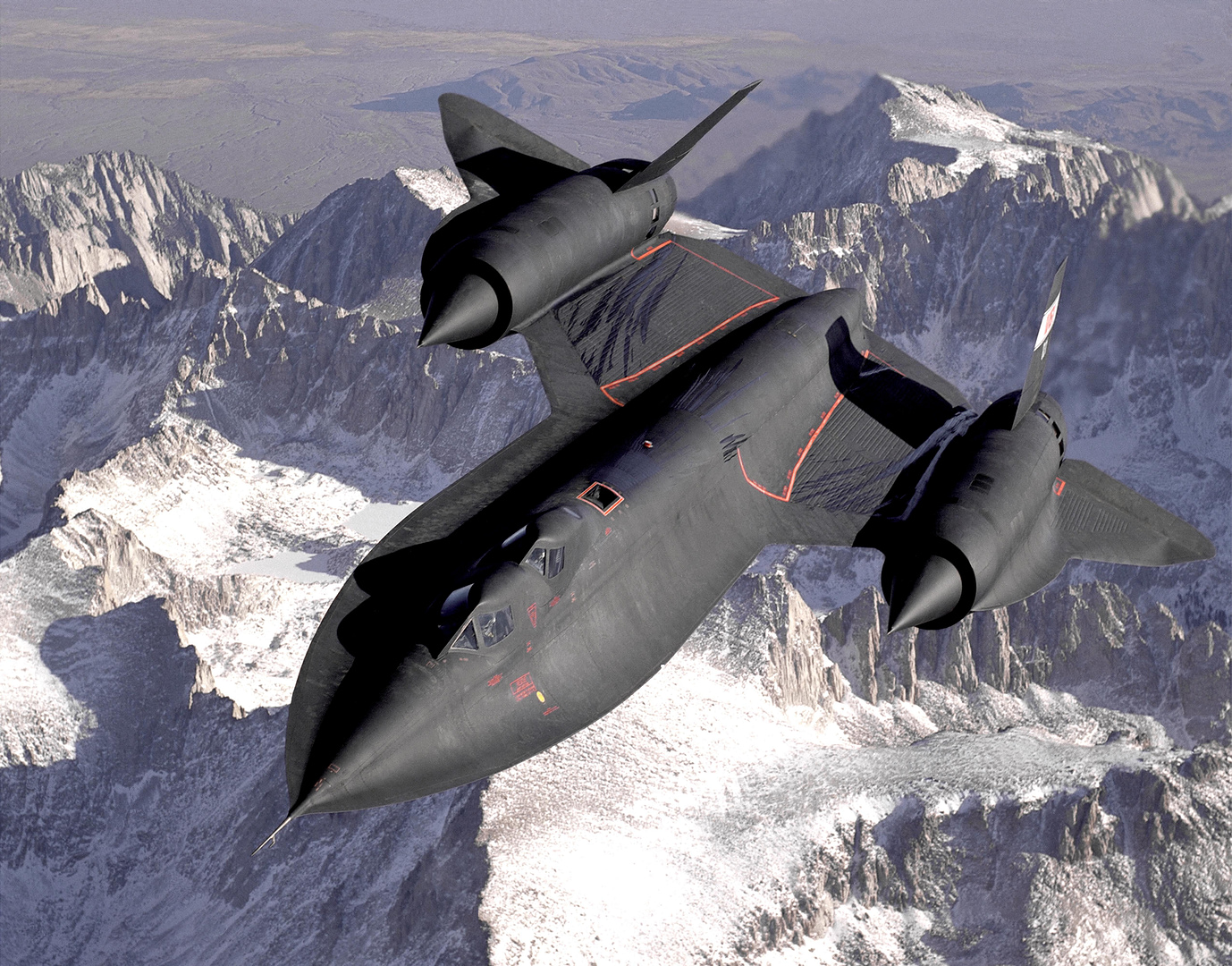
Lockheed SR-71
“Blackbird”
The fastest air-breathing manned aircraft ever built. Designed in secret, made of titanium bought from the country it spied on, and never once shot down.
Built because a U-2 fell out of the sky
On 1 May 1960, a Soviet SA-2 missile brought down Francis Gary Powers’ U-2 over Sverdlovsk — and with it, America’s assumption that altitude alone could keep a spy plane safe. The answer, already taking shape behind the fences of Lockheed’s Skunk Works under Clarence “Kelly” Johnson, was not to fly a little higher or a little faster. It was to fly so high and so fast that no missile, no interceptor, and no radar operator could do anything but watch.
The design brief was without precedent: sustain Mach 3+ for hours, at the edge of space, over the most heavily defended territory on Earth. At those speeds, airframe surfaces heat past 300 °C — aluminium gives up. So the Blackbird became the first aircraft built almost entirely of titanium, painted in radar-absorbing deep blue-black that also radiated heat away, giving the aircraft its name.
From 1966 to 1998 the SR-71 flew reconnaissance missions over Vietnam, North Korea, the Middle East and along the borders of the Soviet Union. Its standard evasive manoeuvre when a missile launch was detected remains the most quoted line in its story: simply accelerate.
01The SR-71 Blackbird’s lineage: from the A-12 Oxcart to the fastest jet ever
The Blackbird most people know is actually the third act of the story. It evolved directly from the Lockheed A-12 Oxcart, a single-seat CIA aircraft that was lighter, marginally faster, and so secret its existence wasn't acknowledged for decades. Between them came the YF-12, an experimental interceptor version armed with missiles — the only Blackbird ever meant to shoot rather than photograph.
The Air Force variant was originally designated RS-71, for "Reconnaissance Strike." When President Lyndon B. Johnson publicly revealed the programme in July 1964, he announced it as the SR-71 — "Strategic Reconnaissance." The popular legend says Johnson misread his script and the Air Force quietly renamed the aircraft rather than correct a president; historians lean toward a deliberate change made before the speech. Either way, thousands of blueprints had to be revised.
Everything about the programme ran on that kind of secrecy. Crews were recruited by invitation only, families couldn't be told what the aircraft did, and the jet's radar-evading shape and special fuel were decades ahead of the public state of the art — the SR-71 was practising low observability before the word "stealth" existed.
What makes it special
Titanium — bought from the enemy
Over 85% of the airframe is titanium alloy, the only metal that could take sustained Mach 3 heat. The USSR was the world’s main supplier — so the CIA quietly sourced the ore through third-party shell companies. The Blackbird that spied on the Soviet Union was, in part, made of Soviet titanium.
An engine that transforms in flight
The Pratt & Whitney J58 is a hybrid: a turbojet at low speed that progressively behaves like a ramjet as the moving inlet spikes channel air around the core. Above Mach 3, most of the thrust comes from the inlets and afterburner — the faster it flew, the more efficient it got.
It leaked fuel by design
Panels were fitted loosely on the ground because the airframe stretches several centimetres and seals itself as friction heats it in flight. A Blackbird dripped JP-7 on the ramp, took off with light tanks, and refuelled from a tanker once airborne — then outran everything.
02The SR-71’s titanium: how the CIA secretly bought it from the Soviet Union
Roughly 85% of the airframe needed titanium — the only metal light enough and heat-tolerant enough for sustained Mach 3. The problem: the United States lacked an adequate domestic supply of the necessary rutile ore, and the world's dominant source was the Soviet Union itself.
So the CIA built a procurement network of third-country shell corporations and bogus front companies — reportedly including operations posing as manufacturers of pizza ovens — to quietly buy Soviet titanium and route it to Burbank. The aircraft built to spy on the USSR was, in a very real sense, made of the USSR.
Even with the metal in hand, nobody had ever manufactured with titanium at this scale. Early on, Lockheed was scrapping the majority of machined parts: the alloy cracked if it touched chlorine (the plant's tap water was banned from contact with it) and drill bits that cut steel all day were ruined in moments. The Skunk Works essentially had to invent titanium manufacturing for the entire aerospace industry.
03The SR-71’s J58 engine: how it turns into a ramjet in flight
At takeoff, the J58 works like a conventional afterburning turbojet. As speed builds, the story changes completely — and the key is the pointed inlet spike ahead of each engine, which translates rearward up to 66 cm to position the supersonic shock wave precisely, slowing and compressing incoming air before it ever reaches the compressor.
Above roughly Mach 2, six bypass tubes open and duct air from the fourth compressor stage around the engine core, straight to the afterburner — effectively converting the engine into a ramjet with a turbojet idling at its centre. At Mach 3.2 cruise, the majority of thrust is generated by the inlet and afterburner. The consequence pilots loved: the faster it flew, the more efficient it became — range figures were actually better at Mach 3 than at Mach 2.8.
J58 airflow at different speeds — how the same engine breathes three different ways.
04Why touching the SR-71 Blackbird can cut you
Museum docents warn visitors for good reason — this aircraft is physically hostile to human hands, in at least three ways.
Intentional panel gaps
The airframe was engineered with loose, unsealed titanium panels to absorb massive thermal expansion at Mach 3. Cold on the ground, those panels contract, leaving exposed, razor-sharp edges and gaps across the fuselage.
Knife-edge chines
The long lateral extensions running from the nose along the fuselage — the chines — are remarkably thin and sharp. They generate lift, improve stability, and scatter radar, and they will slice an unwary finger.
Corrugated wing skin
Large sections of the wing use corrugated titanium so the skin can flex instead of warping under heat. Sliding a bare hand quickly across those rigid ridges can cut skin like a serrated edge.
And don't touch it after landing
Aerodynamic friction heats the skin to around 316 °C and the windshield to 260 °C — crews waited for the airframe to cool before ground handling. Add the film of leaked JP-7 on the skin and the toxic triethylborane (TEB) used to ignite the engines, and the world's fastest aircraft is also one you approach with respect on the ground.
05The SR-71’s fuel: JP-7 and TEB explained
JP-7 was created specifically for this aircraft: a fuel with a flashpoint so high you could reportedly drop a lit match into a bucket of it and watch the match go out. That safety at 300 °C skin temperatures came with a catch — it's so reluctant to ignite that a conventional igniter can't light it at all.
The answer was triethylborane (TEB), a chemical that bursts into flame on contact with air. Each engine carried a small sealed tank with enough TEB for 16 injections — one for every engine start and every afterburner light. Crews counted them like ammunition: run out of TEB shots, and no amount of fuel on board will relight your engine. The fuel also doubled as coolant and hydraulic fluid, circulating heat away from the crew and systems before being burned.
Feeding all this was its own operation: a dedicated fleet of KC-135Q tankers, the only aircraft plumbed for JP-7, choreographed along every mission route.
Full specifications
Baseline note: the figures below describe the SR-71A, the 29-aircraft production model flown by the 9th Strategic Reconnaissance Wing from Beale AFB between 1966 and 1990. Deltas for the two-seat SR-71B trainer and the one-off SR-71C are in grey. Three aircraft are routinely confused with this one and are not it: the A-12 Oxcart was the CIA’s single-seat predecessor, shorter, lighter, a little faster and higher, 13 built, retired in 1968; the YF-12A was an armed interceptor prototype, 3 built, cancelled in 1968; and the M-21 was a two-seat A-12 built to launch the D-21 drone, 2 built. All four types share the J58 powerplant and most of the airframe, and none of their numbers should be quoted for the SR-71. Where the flight manual and the published literature disagree — chiefly on maximum speed — both figures are given rather than reconciled.
Dimensions & weights
- Crew
- 2 in tandem: pilot and reconnaissance systems officer (RSO), the RSO working the sensors, the astro-inertial navigation set and the defensive systems. The SR-71B trainer raised the instructor’s cockpit above the pupil’s, and added two fixed ventral fins and a fin under each nacelle to restore the directional stability lost to the taller forward fuselage
- Length
- 32.74 m (107 ft 5 in) — about 1.7 m (5 ft 6 in) longer than the A-12, the extra fuselage bought fuel and a second cockpit
- Wingspan
- 16.94 m (55 ft 7 in)
- Height
- 5.64 m (18 ft 6 in)
- Wheel track and wheelbase
- 5.08 m (16 ft 8 in) track, 11.53 m (37 ft 10 in) wheelbase. Main tyres by B. F. Goodrich, impregnated with aluminium and filled with nitrogen, cost about US$2,300 each and were changed roughly every 20 missions
- Wing area
- 167.2 m² (1,800 sq ft), aspect ratio 1.7 — a very low-aspect delta, which is efficient at Mach 3 and ungainly at every speed below it
- Empty weight
- 30,620 kg (67,500 lb)
- Gross weight
- 68,950 kg (152,000 lb)
- Maximum take-off weight
- 78,020 kg (172,000 lb)
- Internal fuel
- ~46,250 litres (~12,220 US gal; ~10,175 imp gal) of JP-7 in six tank groups made up of nine tanks, a maximum load of 36,420 kg (80,285 lb). Most of the aeroplane is a fuel tank: the tank walls are the outer skin
- Mission equipment
- 1,590 kg (3,500 lb) of sensors across the detachable nose, the chine bays and the mission bays. No weapon is included in that figure because no weapon was ever fitted
- Structure
- 85 per cent titanium by weight, the balance largely polymer composite in the wing leading edges, chines and fin surfaces. Lockheed chose a softer, more workable titanium alloy to control cost; at one point 80 per cent of delivered titanium was rejected for metallurgical contamination, welds had to be washed in distilled water because tap-water chlorine corroded them, and cadmium-plated spanners had to be banned from the shop floor for the same reason. The ore itself was largely Soviet: the United States could not produce metallic titanium in the quantity required, so the CIA bought it through cut-out companies from the country the aircraft was built to photograph
- Wing loading
- 410 kg/m² (84 lb/sq ft)
Performance
- Maximum speed
- Mach 3.3, 3,540 km/h (2,200 mph; 1,910 kn) at 24,400 m (80,000 ft). The operating limit was Mach 3.2; Mach 3.3 was permitted only while compressor inlet temperature stayed at or below 427 °C (801 °F), which is a temperature limit wearing the costume of a speed limit
- Cruise speed
- Mach 3.2, about 3,400 km/h (2,110 mph; 1,835 kn) true at 24,000 m. Mach 3.2 on a standard day was the design point, but the aircraft was measurably more efficient faster and colder: 17,240 kg/h (38,000 lb/h) of fuel at Mach 3.0 against 16,330 kg/h (36,000 lb/h) at Mach 3.15
- Service ceiling
- 25,900 m (85,000 ft)
- Absolute altitude record
- 25,929 m (85,069 ft), set on 28 July 1976 by 61-7962 flown by Captain Robert Helt. Still the record for a manned air-breathing aeroplane, half a century later
- Rate of climb
- 60.0 m/s (11,820 ft/min)
- Ferry range
- 5,230 km (3,250 mi; 2,824 nmi) on internal fuel
- Supersonic leg between tankers
- Rarely more than 90 minutes. Range was never the constraint that endurance was: the mission was flown as a series of Mach 3 dashes hung between KC-135Q rendezvous, and a fair part of an SR-71 sortie was spent subsonic behind a tanker
- Take-off
- 1,370 m (4,500 ft) in about 20 seconds, unstick at 390 km/h (240 mph; 210 kn). Aircraft launched with a partial fuel load to spare the brakes and tyres and to guarantee a single-engine abort, then took on a full load from a tanker
- Time to cruise
- 6,100 m (20,000 ft) in under two minutes; 24,400 m (80,000 ft) and Mach 3 about 17 minutes after that, by which point roughly a third of the fuel was gone
- Landing
- Touchdown above 315 km/h (196 mph; 170 kn) with a drag parachute to save the brakes and tyres
- Skin temperature
- Above 260 °C (500 °F) over most of the airframe in the cruise, 316 °C (600 °F) on the outside of the windscreen and 121 °C (250 °F) on the inside of it. The airframe grew several inches in length. Fuselage panels were built deliberately loose on the ground and only came into alignment hot, which is why the aeroplane dripped fuel on the apron: no sealant then available survived that thermal cycle, and the tanks sealed only once the skin had warmed
- Radar cross-section
- About 10 m² (110 sq ft) against a wing area of 170 m² (1,800 sq ft) — chines, inward-canted fins, sawtooth radar-absorbing skin panels and a caesium fuel additive to damp the plume return. An early and serious attempt at stealth, but Kelly Johnson later conceded that Soviet radar improved faster than his countermeasures did. Speed and altitude, not signature, are what kept the aeroplane alive
- Turnaround
- About one sortie per aircraft per week. Aircraft routinely came home with missing rivets, delaminated panels and damaged inlets; a month on the ground for repair was not unusual. Lockheed’s own estimate for a hangared aircraft with no mission planned was 19 hours to a safe take-off
Propulsion & systems
- Engines
- 2 × Pratt & Whitney J58 (JT11D-20J or JT11D-20K), afterburning turbojets with compressor bleed-bypass. 9-stage axial compressor, eight burner cans in an annular casing, 2-stage turbine; 4.57 m (180 in) long, growing about 150 mm (6 in) when hot, 1.27 m (50 in) in diameter, about 2,720 kg (6,000 lb)
- Thrust
- 151.2 kN (34,000 lbf) wet per engine for the JT11D-20K with two-position inlet guide vanes; 144.6 kN (32,500 lbf) for the fixed-vane JT11D-20J. Installed at sea level and zero airspeed the same engine gives only 113.4 kN (25,500 lbf) wet, because the inlet is choking it; thrust is recovered by ram as speed builds, reaching 133.4 kN (30,000 lbf) by unstick
- Turboramjet cycle
- The J58 is not a ramjet and not a conventional turbojet. Six external bleed tubes — the pipes visible along the outside of the engine — take about 20 per cent of the compressor air straight to the afterburner from Mach 2.1 upward, unloading the rear compressor stages that would otherwise choke and break on 427 °C inlet air. Robert Abernethy’s patented fix raised installed thrust by 47 per cent and, with two-position inlet guide-vane flaps, matched engine airflow to inlet airflow. The result behaves as an afterburning turbojet for take-off, a low-bypass augmented turbofan while accelerating, and something very close to a ramjet in the cruise, where pressure loss from compressor to exhaust reaches 80 per cent. The afterburner runs continuously at 1,760 °C (3,200 °F) with ceramic thermal barrier coatings, and the turbine runs continuously at 1,093 °C (2,000 °F)
- Inlet and spike
- This is where the aircraft’s thrust actually comes from. Each mixed-compression inlet carries a translating conical spike that retracts up to 660 mm (26 in) aft above Mach 1.6, dragging the shock system inside the cowl so that supersonic compression happens in a converging duct ahead of a terminal shock held in place by an analogue controller. Above Mach 3 in full afterburner the split of net thrust is 54 per cent from the inlet, 28.4 per cent from the ejector nozzle and 17.6 per cent from the engine itself. Dumping unwanted air overboard through the forward bypass doors cost 26.7 kN (6,000 lbf) of drag at cruise against a total aircraft drag of 62.3 kN (14,000 lbf), so inlet scheduling was not a refinement but the difference between cruising and not cruising
- Unstart
- If duct back-pressure rose while the spike sat wrong, the terminal shock let go and shot forward outside the cowl. The inlet instantly became a subsonic pitot intake at Mach 3, the afterburner usually blew out, and asymmetric thrust yawed the aircraft hard enough that crews’ helmets hit the canopy, often with a loud banging as the opposite engine sympathetically stalled. The standard response was to unstart both inlets deliberately and restart them together. From 1980 the analogue controllers were replaced by DAFICS, the Digital Automatic Flight and Inlet Control System, which largely ended the problem after fifteen years of it
- Fuel
- JP-7, developed specifically for this powerplant: flash point 60 °C (140 °F), freezing near −30 °C, density 779–806 kg/m³, blended rather than distilled to almost eliminate benzene, sulphur and volatile fractions, with a fluorocarbon lubricity additive and a caesium compound, A-50, to suppress the exhaust plume’s radar and infrared signature. It is also the aircraft’s only heat sink: fuel cools the cockpit air, the hydraulics, the engine and accessory oil and the nozzle actuators, absorbing about 700 kW before reaching the burners at 316 °C (600 °F)
- Ignition
- JP-7 will not light from a spark, so each engine carries a nitrogen-pressurised tank of 600 cm³ (about 21 fl oz) of triethylborane, which ignites on contact with air and burns with the green flash seen at every SR-71 start. Roughly 50 cm³ goes in per shot, giving at least 16 shots per flight for starts, restarts and afterburner relights. That count was a real endurance limit: every post-refuelling acceleration spent one. Ground crews refilling the TEB tank wore silver fire suits, while JP-7 was safe enough that maintenance carried on during fuelling
- Navigation
- Nortronics NAS-14V2 astro-inertial navigation system, adapted from the cancelled AGM-48 Skybolt missile’s guidance. A blue-light star tracker looked up through a fused-quartz window ultrasonically welded into the titanium behind the RSO and shot stars in daylight, correcting the inertial platform against an ephemeris of 56 stars, later 61. Colonel Richard Graham put the resulting cross-track drift at under 300 m (1,000 ft) at Mach 3. It also steered the autopilot, pointed the cameras and cued the radar at fixed points loaded before take-off — there was no GPS, and at 900 m per second there is no time to navigate by eye
- Sensors
- Itek Optical Bar Camera or paired Operational Objective Cameras for wide-area film; HYCON Technical Objective Cameras steerable 45 degrees either side of track; a Fairchild tracking camera and an infrared camera running for the whole sortie; Goodyear side-looking airborne radar in the removable nose, replaced in later life by Loral ASARS-1; and an AIL Electro Magnetic Reconnaissance System in the chine bays for ELINT. A datalink capable of passing ASARS-1 and ELINT from about 3,700 km (2,000 nmi) of track came only at the very end, and its long absence was used against the programme
- Defensive systems
- A rotating set of electronic countermeasures and warning packages known only by letters — Systems A, A2, A2C, B, C, C2, E, G, H and M — fitted in combinations chosen for the expected threat on each sortie. Crews used them sparingly: RSO Major Jerry Crew described jamming a tracking radar and then switching the jammer off the moment his warning receiver said a missile was in the air, so the missile had nothing to home on
- Crew systems
- Lockheed zero-zero ejection seats and David Clark full-pressure suits, the direct ancestors of the Space Shuttle launch suit. Above 13,000 m a mask cannot supply enough oxygen, and an ejection at Mach 3.2 exposes the crew to about 232 °C (450 °F), so the suit had its own oxygen supply to stay pressurised all the way down. Food came in toothpaste tubes and water through a long straw guided into the helmet port with a mirror
- First flight
- 22 December 1964, USAF Plant 42, Palmdale, California, Bob Gilliland flying (A-12: 25 April 1962 at Groom Lake; YF-12A: 7 August 1963)
- Service entry
- January 1966, 4200th (later 9th) Strategic Reconnaissance Wing, Beale AFB. First operational sortie 21 March 1968 from Kadena, Okinawa, by Majors Jerome O’Malley and Edward Payne in 61-7976
- Number built
- 32 (29 SR-71A, 2 SR-71B, 1 SR-71C). The tooling was ordered destroyed in 1968, which is why no more were ever built and why the reactivated aircraft of the 1990s had to be rebuilt from museum pieces
- Cost
- No official per-airframe price was ever published. What is on the record is the operating side: Defense Secretary Dick Cheney told the Senate Appropriations Committee the aircraft cost US$85,000 per flight hour, opponents put annual programme support at US$400–700 million, and Colonel Graham’s figure, drawn from the programme’s own books, is closer to US$300 million a year. In 1995 the Skunk Works returned three aircraft to flight status for US$72 million, under the US$72.5 million Congress had appropriated. Treat any quoted unit cost for this aircraft with suspicion
06Every Blackbird variant: A-12 Oxcart, YF-12 and SR-71A/B/C — including the “Bastard”
The family tree: the CIA's single-seat A-12 Oxcart (13 built, lighter and marginally faster), the missile-armed YF-12 interceptor prototype (3 built), the mainline SR-71A (29 built), the twin-cockpit SR-71B trainer with its raised instructor station (2 built), and the one-off SR-71C — assembled from the front half of a static test airframe and the back half of a crashed YF-12, flying slightly crooked its whole life and known to crews as "the Bastard."
07The SR-71 Blackbird’s operating costs: what Mach 3 actually cost
Each SR-71 cost about $34 million in 1960s dollars — several hundred million per airframe in today’s money. But buying the jet was the cheap part.
Operating it is commonly estimated at around $85,000 per flight hour in then-year dollars, and analyses that include the dedicated KC-135Q tanker fleet, the special JP-7 fuel chain and the pressure-suit crew infrastructure put the true figure at up to $200,000 per hour — among the most expensive aircraft ever operated.
Across 34 years the fleet logged 53,490 total flight hours, of which 11,675 were flown above Mach 3. Set against a development and production programme on the order of a billion 1960s dollars, every single flight hour carried roughly $20,000 of programme cost before a drop of fuel was burned. That arithmetic — more than any missile — is what finally retired the Blackbird: reconnaissance satellites don’t bill by the hour.
The thirst behind those numbers: at cruise the Blackbird burned 36,000–44,000 lbs of JP-7 per hour — about 5,500–6,700 US gallons, or 3–4 gallons every second, roughly 20 lbs of fuel per mile. Its six tanks held up to 80,000 lbs (~12,200 gallons), yet it typically took off with a partial load, met a KC-135Q tanker minutes after takeoff, and refuelled roughly every 90 minutes for the rest of the mission.
Armament & payload
The SR-71 never carried a weapon, and the six cards below describe the sensors it carried instead
This is the whole armament entry and it is a short one: the SR-71 was unarmed for its entire 32-year career. No gun, no missile, no bomb, no rocket, no pylon, no bay from which anything could be released. The nearest the family came to being armed was the YF-12A interceptor, a different aircraft on the same airframe, and a bomber study briefly designated B-71 that was never built. What the Blackbird carried was 1,590 kg of reconnaissance equipment distributed between a detachable nose, the two fuselage chine bays and a row of mission bays lettered A through T.
The intelligence value came from the combination rather than from any one sensor: film for area coverage, steerable long-focal-length cameras for detail, radar for weather-proof imaging, and receivers listening across the whole route while the cameras ran. All of it was cued and pointed by the astro-inertial navigation set, and almost all of it had to be flown home and developed, which is the flaw the programme’s opponents eventually used to kill it. Fits varied by mission, by detachment and by year, several packages were never declassified in detail, and the letter-coded defensive systems are still only partly documented; what follows is the publicly established baseline, not an inventory.
Armament
- None carried, at any point, on any SR-71. There is no gun, no hardpoint, no rail, no pylon and no weapons bay on the aircraft.
- The design brief never included one. Speed and altitude were the defence, and they worked: no SR-71 was lost to enemy action in 32 years, though crews were fired at repeatedly over North Vietnam, North Korea, the Middle East and the Baltic.
- The armed member of the family was the YF-12A, three prototypes carrying a Hughes AN/ASG-18 look-down, shoot-down fire-control radar and three Hughes AIM-47A Falcon missiles in internal fuselage bays. It was cancelled in 1968; its missile grew into the AIM-54 Phoenix and its radar into the AN/AWG-9 in the F-14.
- A bomber variant was briefly designated B-71, and the SR designation itself is a survival of that pre-1962 bomber series. Nothing was built, and nothing was ever hung on an SR-71.
- The tactics that substituted for armament were simple and are documented in the flight manual: accelerate. A missile that has spent its boost and sustainer phases climbing to 25,000 m has nothing left but a ballistic arc, and a change of speed, altitude or heading was usually enough to break the lock outright.
Optical Bar Camera
- Itek Optical Bar Camera — a rotating-lens panoramic wet-film camera giving continuous horizon-to-horizon coverage along the entire flight track, the sensor of choice when the requirement was to photograph a lot of ground rather than one building.
- Its alternative for wide-area work was a pair of Itek Operational Objective Cameras, which produced stereo imagery across the width of the track instead of a single continuous swathe.
- Film, not data. Every frame had to be flown home, unloaded and processed, which at Mach 3 still meant the imagery was hours old rather than days old — but it was the argument used against the aircraft from the mid-1980s onward, when the U-2 got a datalink and the SR-71 did not.
- No weapon is associated with this or any other Blackbird sensor. The same Optical Bar Camera design outlived the aircraft, flying on the U-2 until its last operational sortie in July 2022.
Technical Objective Cameras
- HYCON Technical Objective Cameras (TEOC) — long-focal-length framing cameras that could be pointed up to 45 degrees either side of the flight path, so a target could be photographed obliquely without overflying it.
- That oblique reach mattered politically as much as technically: after 1960 the United States was far more careful about whose airspace it entered, and standing off at Mach 3 and 25 km while shooting sideways was often the only permitted way to see something.
- The trade-off is honest and worth stating: because the SR-71’s second cockpit took the volume the A-12 used for one very large camera, early TEOCs could not match the CIA aircraft’s resolution. Camera and film improvements closed most of that gap through the 1970s.
- Nothing on these mounts is a weapon. A Fairchild tracking camera and an infrared camera also ran continuously for the whole sortie, purely to establish where every frame was taken.
The interchangeable nose and its radar
- The entire nose and forward chine section unbolts. Mission definition was largely a matter of which nose was fitted, and noses were swapped between sorties rather than aircraft being modified.
- Goodyear side-looking airborne radar in the original removable nose, replaced in later life by Loral ASARS-1, the Advanced Synthetic Aperture Radar System — ground-mapping imagery in fixed swathes either side of track, or spot collection at higher resolution.
- Radar is what made tasking dependable. A film mission is at the mercy of the weather over the target; ASARS-1 sees through cloud and at night, and it is the sensor the 1990s reactivation was built around, with a near-real-time datalink finally fitted to feed it to the ground.
- No nose ever carried a weapon or a targeting system for one. The nose bays held cameras, radar and, on the YF-12A alone, a fire-control radar for an aircraft that was not an SR-71.
Signals intelligence
- Electro Magnetic Reconnaissance System by AIL, carried in the fuselage chine bays — ELINT receivers programmed in advance to recognise and record emitters of interest as the aircraft flew through their fields.
- Because the aircraft crossed a defended country in minutes, its signals collection was a snapshot of what an air-defence network did when startled, which is precisely the data that is hardest to get any other way. Provoking radars into transmitting was, unofficially, part of the job.
- Recordings from the ELINT set, the radar and the maintenance data recorder were all analysed after landing. Only at the very end of the type’s life could any of it be sent down in flight.
- Collection only. The SR-71 listened and recorded; it did not attack what it found, and it carried nothing with which it could have.
Defensive electronic countermeasures
- Warning receivers and active jammers designated only by letter — Systems A, A2, A2C, B, C, C2, E, G, H and M — several of which were carried on any given sortie in a combination chosen for the threats expected on that route.
- These are the only genuinely defensive equipment the aircraft had, and they were used with discipline. RSO Major Jerry Crew described jamming a tracking radar and then shutting the jammer down the instant his receiver announced a launch, so that the missile had no emission to home on.
- Their contribution should not be overstated. Kelly Johnson conceded that Soviet radar development outran the aircraft’s stealth features, and by the 1980s an SR-71 was reliably tracked. What it was not, was catchable.
- No chaff, no flares, no decoys, no escort, and no weapon. The countermeasures bought seconds; the J58s did the rest.
Three typical mission fits
- Habu sortie from Kadena (Detachment 1, 1968–1990)
- Radar nose, Technical Objective Cameras in the chine bays, ELINT receivers running, defensive systems selected for SA-2 and later SA-5 coverage. Out over North Vietnam, North Korea or the Chinese coast at Mach 3.2 and 24,000 m, two or three tanker rendezvous, film developed at Kadena or flown to the continental United States. No weapon of any kind aboard.
- Baltic Express from RAF Mildenhall (Detachment 4, 1976–1990)
- Optical Bar Camera or ASARS-1 nose with a full signals fit, flown through Jutland and the Danish Straits into the corridor between Scania and Western Pomerania, a counter-clockwise 30-minute loop along the Soviet coast, then a deliberate deceleration to Mach 2.54 south of Åland so the turn would not stray into Swedish airspace. Swedish JA 37 Viggens routinely set up head-on intercepts at a combined closing speed of Mach 5; in 2018 four of those pilots received the US Air Medal for escorting a crippled Blackbird in 1987.
- Reactivation-era sortie (Detachment 2, Edwards AFB, 1995–1997)
- ASARS-1 nose with the near-real-time datalink that had been withheld for a decade, flown by recalled crews from a renovated hangar under the 9th Reconnaissance Wing. Three aircraft, US$72 million, and an annual appropriation fight it eventually lost. Still unarmed.
Sourcing caveat: sensor identifications follow Crickmore, Graham and the declassified SR-71 flight manual, with the thrust-split and inlet figures taken from David Campbell’s 1974 AIAA and SAE papers on F-12 series propulsion. The letter-coded defensive systems have never been fully described in public, individual mission fits by tail number are not published, and the frequently repeated claim that more than 4,000 missiles were fired at Blackbirds without a hit comes from programme veterans rather than from any documented tally — the verifiable statement is the narrower one, that no SR-71 was ever lost to enemy action.
Variants
Lockheed built four different aircraft on one airframe, and only three of the thirty-two SR-71s were not A models
The Blackbird family is small, tangled and constantly misreported, so it is worth separating cleanly. The CIA’s A-12 came first: single-seat, shorter, lighter, and because it carried one pilot and one very large camera instead of two crew, genuinely faster and higher than the aircraft that replaced it. Thirteen were built. The YF-12A was an interceptor prototype; three were built and the programme was killed in 1968. The M-21 was a two-seat A-12 modified to launch the D-21 ramjet drone from its back; two were built and the concept was abandoned after a fatal separation accident in 1966.
The SR-71 itself was the Air Force’s version, originally designated R-12 by Lockheed: longer, heavier, with reshaped chines, more fuel and a second cockpit for a reconnaissance systems officer. It flew overt missions in USAF markings with crews carrying Geneva Convention cards, while the A-12 flew covert ones. The designation is a fossil of the pre-1962 bomber series, and the durable story that President Johnson misread "RS-71" is only half true — General Curtis LeMay lobbied for the SR ordering before the speech, and the press transcript still carried the old form in places.
What follows is every variant that flew, plus the ones that did not. Note how few aircraft this is: 32 SR-71s, 18 of the earlier types, 50 airframes in the entire Blackbird programme.
- A-12 Oxcart (first flight 25 April 1962; 13 built)
- Not an SR-71. CIA single-seater, initially flown on J75s until J58s were ready. Flew Operation Black Shield over North Vietnam from 31 May 1967 and three missions over North Korea in 1968, including the search for USS Pueblo. Cancelled 28 December 1966 on cost grounds and because the SR-71 was coming; last mission 8 May 1968.
- YF-12A (first flight 7 August 1963; 3 built)
- Not an SR-71. Two-seat interceptor prototype with an AN/ASG-18 radar in a modified chine and three AIM-47A Falcon missiles in internal bays. Revealed by President Johnson in February 1964 partly to cover the A-12’s existence. Cancelled by Robert McNamara in 1968; one later flew for NASA into 1978.
- M-21 (2 built, 1963)
- Not an SR-71. A-12 rebuilt with a second cockpit for a launch control officer and a dorsal pylon for the Lockheed D-21 drone. The fourth launch attempt on 30 July 1966 destroyed the aircraft and killed the launch control officer; the programme moved to B-52 carriage.
- SR-71A (first flight 22 December 1964; 29 built)
- The production aircraft and the subject of this page. Two crew, interchangeable nose, chine and mission bays, J58 turboramjets. From 1980 the analogue inlet controllers were replaced by DAFICS, which is the single most consequential mid-life change the type received.
- SR-71B (2 built, 1965–1966)
- The trainer, with the instructor raised behind and above the pupil for any forward view at all, plus two ventral fins and a fin under each nacelle to recover directional stability. One was lost on 11 January 1968 to a double generator failure and double flame-out on approach, crew safe. The survivor, 61-7956, flew its 1,000th sortie in 1982 and went to NASA as 831.
- SR-71C (1 built, 1969)
- Nicknamed "The Bastard": the rear fuselage of the first YF-12A, wrecked in a 1966 landing accident, married to the forward fuselage of an SR-71 static test article after the B-model loss left the wing short of a trainer. A long-standing story that it flew crooked traces to a misaligned pitot tube reading four degrees of yaw that was not there.
- B-71 and RS-71 (designations only; none built)
- The bomber study that briefly carried the B-71 designation, and the RS-71 reconnaissance-strike designation inherited from the rival XB-70 Valkyrie proposals. Neither produced an aircraft; both produced a great deal of confusion.
- NASA SR-71A and SR-71B (3 airframes on loan; 1991–1999)
- 61-7980, 61-7971 and the SR-71B 61-7956 flown from Dryden as high-speed research aircraft, including linear aerospike rocket experiments. NASA kept two flying to 1999, a year after the Air Force finished with the type for good.
- Export variants (none, ever)
- The SR-71 was never exported, never offered and never operated by any foreign service. The single aircraft outside the United States is 61-7962, displayed at the American Air Museum at Duxford in England.
Closing note, with the fleet arithmetic, since there is no operator chart on this page: 32 SR-71s were built and 12 were lost, all of them to accidents and eleven of them between 1966 and 1972. None was ever lost to enemy action, and only one man died — Jim Zwayer, a Lockheed flight-test specialist, killed in the Mach 3 break-up of 61-7952 near Tucumcari, New Mexico, on 25 January 1966, from which the pilot Bill Weaver walked away. That leaves 20 surviving airframes, all of them displayed or stored: at the Smithsonian’s Udvar-Hazy Center, the National Museum of the USAF at Wright-Patterson, Pima, Evergreen, the Air Zoo (the SR-71B), the Blackbird Airpark at Palmdale, the Air Force Flight Test Museum at Edwards, March Field, Castle, the Cosmosphere, the Strategic Air Command museum at Ashland, Beale, Barksdale, Lackland, Eglin, Robins, the Science Museum of Virginia, Armstrong Flight Research Center, Hill (the SR-71C) and Duxford. The cockpit of 61-7977 survives separately at the Museum of Flight in Seattle. The type was retired by the USAF in 1990, reactivated by Congress against the Air Force’s wishes in 1995, retired again in 1998 after a line-item veto fight that reached the Supreme Court, and finally stopped flying when NASA parked its last two in 1999. Sixty years after its first flight nothing has taken the altitude or speed records off it, and nothing has replaced it.
Thirty-five years at Mach 3
First flight
22 December — the SR-71 flies from Palmdale, California, exceeding Mach 1 on its maiden flight.
First operational missions
Blackbirds begin overflights of Vietnam and North Korea from Kadena Air Base, Okinawa.
The records that still stand
28 July — 3,529.6 km/h absolute speed and 25,929 m sustained altitude, both still unbeaten by any air-breathing manned aircraft.
A retirement flight for the ages
On its delivery flight to the Smithsonian, an SR-71 crosses the USA — Los Angeles to Washington D.C. — in 64 minutes 20 seconds.
Final flight
After a brief mid-90s reactivation and final service with NASA as a research platform, the last Blackbird flight closes the programme.
From the cockpit: twelve Blackbird stories
The Los Angeles speed check
A Cessna, a Beechcraft and a Navy F/A-18 ask ATC for ground-speed readouts. Far above them, Brian Shul and Walter Watson key the radio.
Read the full story
Coast to coast in about an hour
On 6 March 1990, Ed Yeilding and Joseph Vida flew SR-71 #972's last Air Force flight — its delivery to the Smithsonian.
Read the full story
The man who survived Mach 3.18
Bill Weaver's SR-71 broke apart around him at 24,000 metres. He never ejected — the aircraft simply disintegrated.
Read the full story
Three days over Libya
After the April 1986 airstrikes, Brian Shul and Walter Watson flew three consecutive daily reconnaissance missions over the strike zones.
Read the full story
The Hanoi sonic boom
In May 1972, three SR-71s overflew North Vietnam in coordination — and their overlapping sonic booms became a weapon of their own.
Read the full story
To the Yom Kippur War — from New York
When war erupted in October 1973, Blackbirds mapped the battlefield for Washington, flying round trips of over ten hours from the continental USA.
Read the full story
New York to London in under two hours
On 1 September 1974, an SR-71 crossed the Atlantic in 1 hour 54 minutes — a record that still stands.
Read the full story
The day the Swedes escorted a wounded Blackbird
An engine failed at Mach 3 over the Baltic. What happened next stayed classified for 30 years.
Read the full story
The "bow-tie" missions and the phantom city
On moonless nights over the Korean DMZ, crews flew looping double-circuit patterns — and once photographed a city that didn't exist.
Read the full story
Finding the Silkworms
Flying from Kadena, Blackbird crews patrolled the Persian Gulf during the Tanker War — and found the missiles threatening the world's oil shipping.
Read the full story
The Blackbird's own drone
Before satellites took over, the Blackbird family briefly carried its own Mach 3 drone on its back. It ended in tragedy.
Read the full story
The Habu
Why crews at Kadena wore a snake patch: locals thought the black jet resembled the habu pit viper — and the name stuck.
Read the full story
The Blackbird in pictures
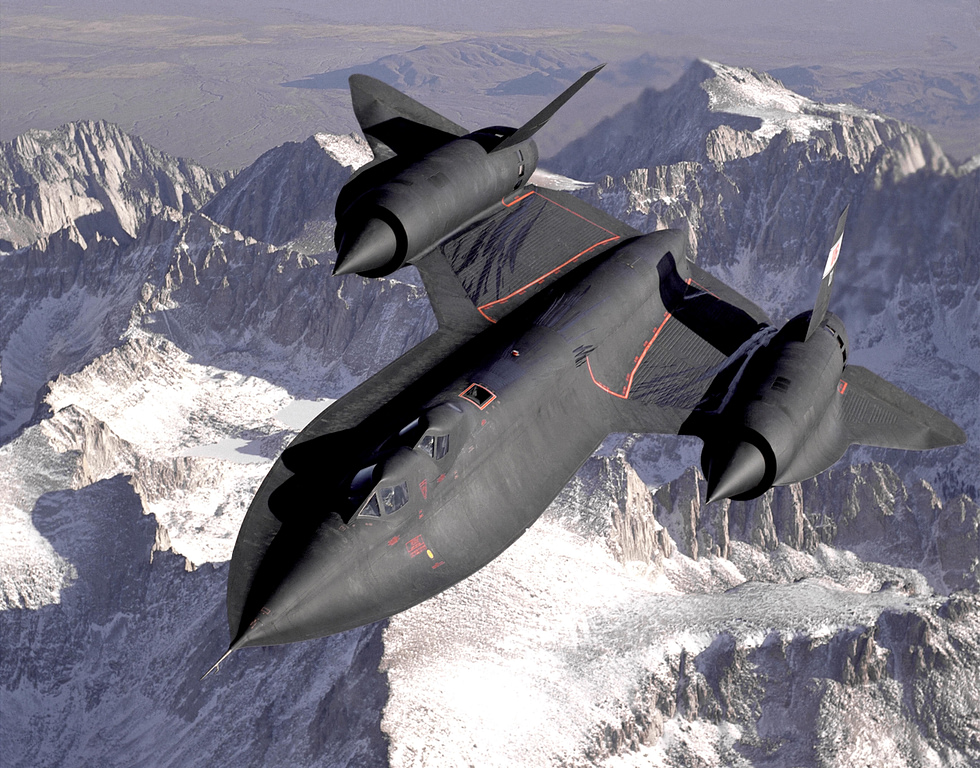
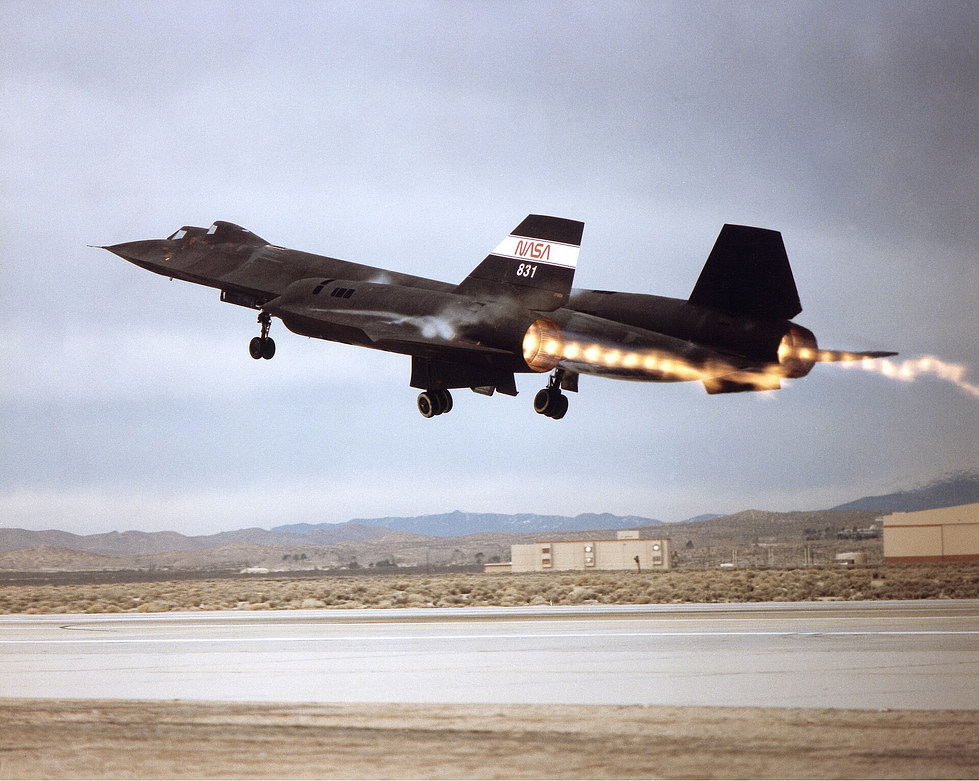
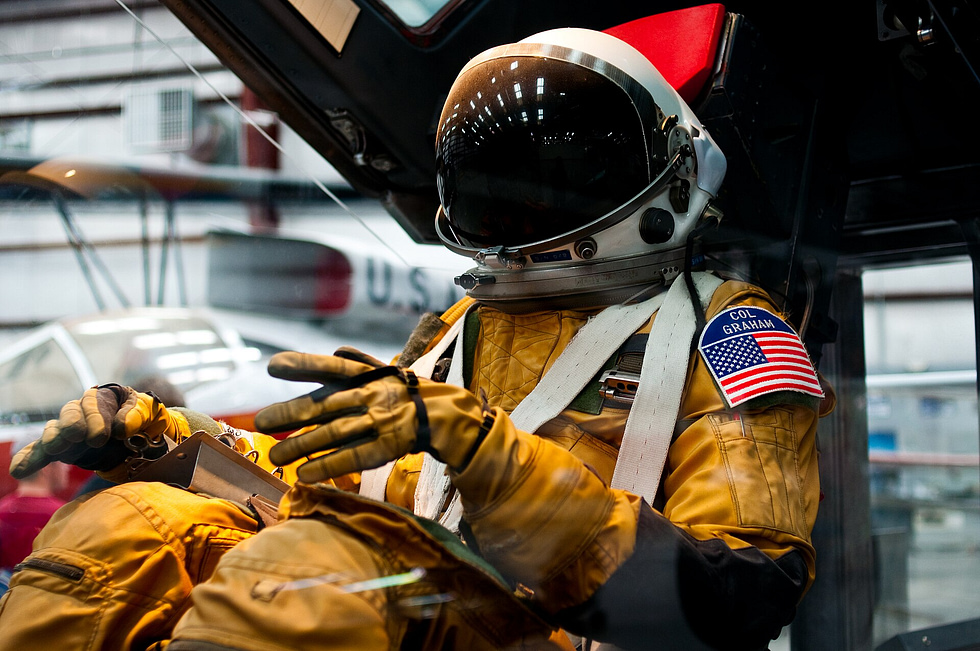
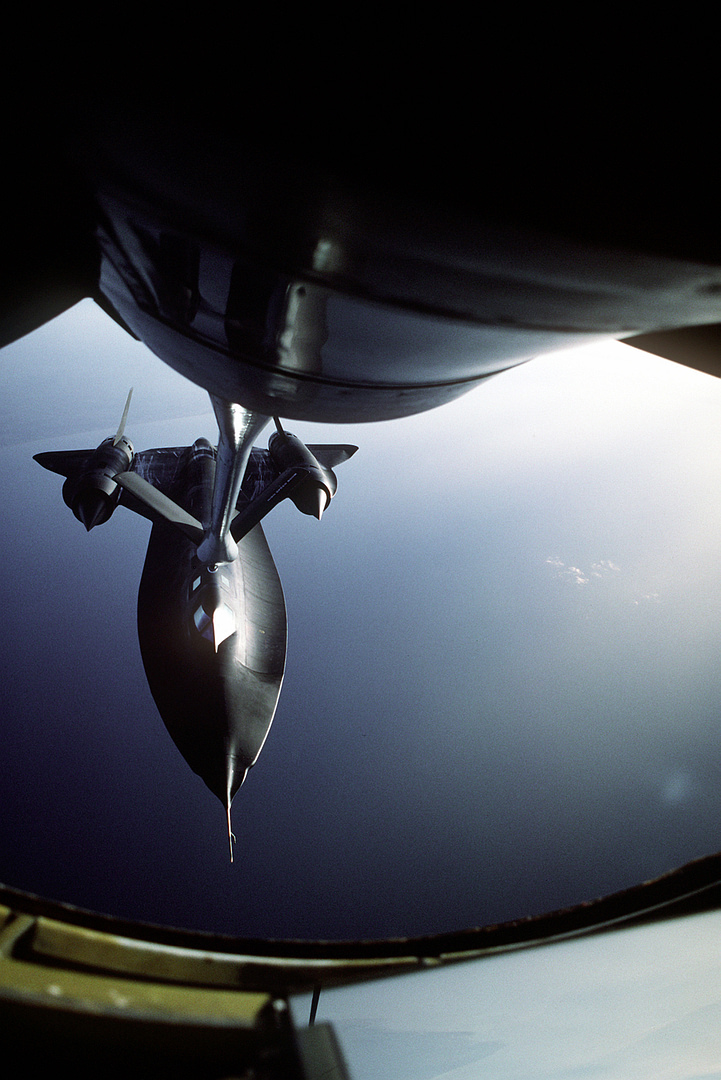
The Blackbird in motion
Real Engineering: The Insane Engineering of the SR-71 Blackbird — 10 million views, the definitive technical breakdown.
Where the Blackbird flew
The score that defines it
Over more than two decades of missions into defended airspace, interceptors scrambled and surface-to-air missiles rose to meet the Blackbird again and again. The outcome never changed.
Compare the combat record of every military aircraft. Data as of July 2026.
Everything people ask about the SR-71
Can I fly in an SR-71 Blackbird?
What is the fastest aircraft in the world?
How fast was the SR-71 really?
Why did the SR-71 leak fuel on the ground?
How much fuel did the SR-71 burn per hour?
Was the SR-71 ever shot down?
Why did SR-71 crews wear spacesuits?
What replaced the SR-71?
Where can I see an SR-71 today?
You can’t fly the Blackbird.
These, you can.
Some legends only live in museums — others are fuelled and waiting. MiGFlug has put civilians in real military jet cockpits since 2004.
Continue the tour
Every fact, checked
- Smithsonian National Air and Space Museum — Lockheed SR-71 BlackbirdMuseum record of airframe #972, including the 1990 coast-to-coast record
- Smithsonian NASM — 10 cool things about the SR-71Panel gaps, skin temperatures and museum handling
- Smithsonian Magazine — Cold War spycraftProgramme history and the RS-71/SR-71 designation
- NASA Armstrong — SR-71 fact sheetTechnical data and NASA research flights
- Imperial War Museums — SR-71 BlackbirdOperational history including Persian Gulf missions
- Evergreen Aviation & Space MuseumTitanium procurement and construction
- Hush-Kit — "I flew the SR-71 in the Cold War"First-hand pilot interview, incl. Yom Kippur missions
- theSR71blackbird.com — crew stories archiveMission accounts collected from programme veterans
- The National Interest — the strangest SR-71 missionsThe Korean DMZ "bow-tie" sorties
- Brian Shul — Sled Driver: Flying the World's Fastest JetPilot memoir; source of the LA speed check and Libya accounts
- MiGFlug Afterburner — why the SR-71 leaked fuelJP-7 fuel system deep-dive
Hero and gallery photography: U.S. Air Force / NASA, public domain. Combat statistics as of July 2026. Spotted an error? Every page in the Aircraft Museum is fact-checked before publication — write to us and we'll correct it.