
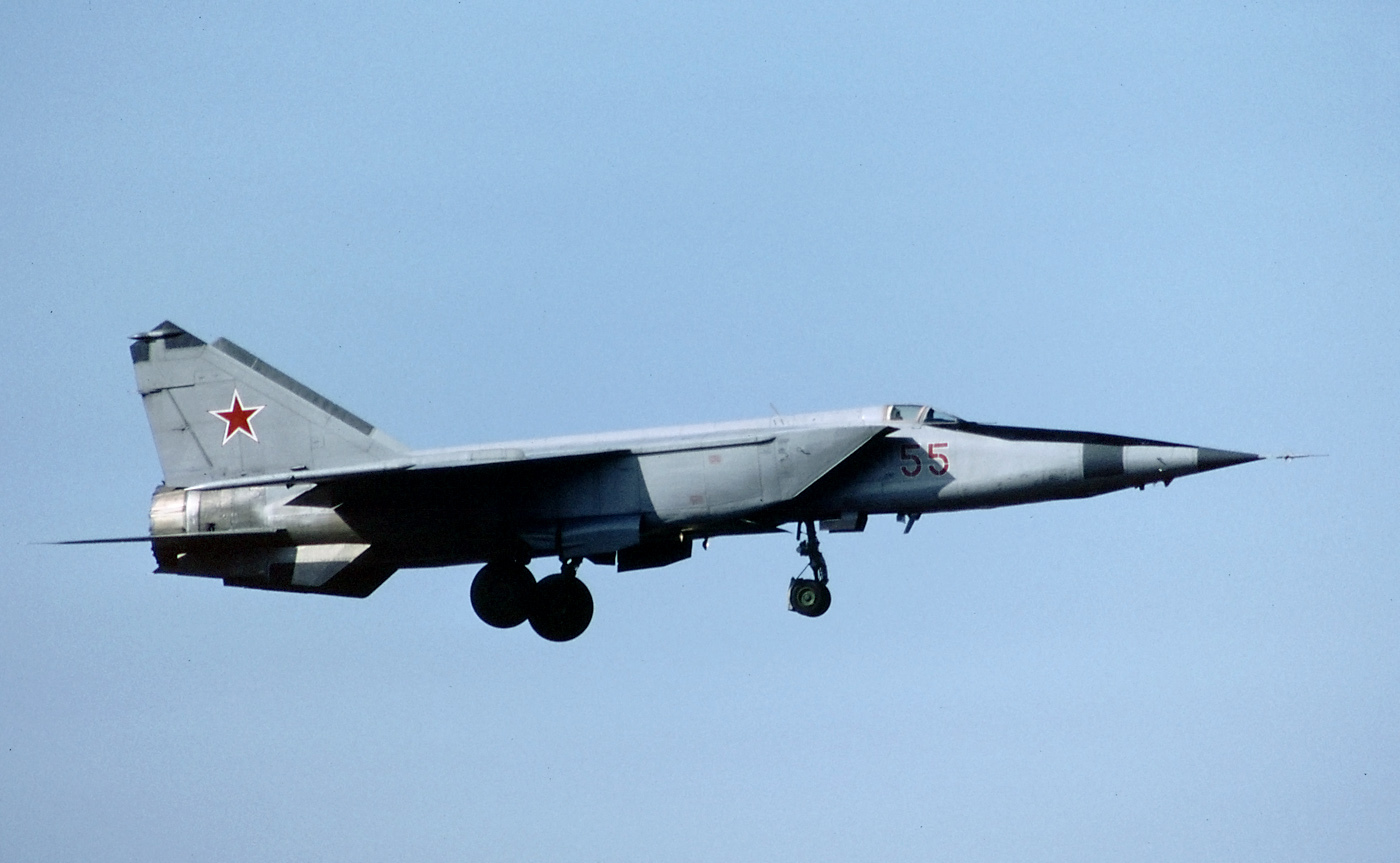
Mikoyan-Gurevich MiG-25
“Foxbat”
The fastest interceptor ever mass-produced — a stainless-steel monster built to catch aircraft at the edge of space, and the jet whose myth terrified the West until a defector landed one in Japan.
Built to catch the uncatchable
In the late 1950s, Soviet air-defence planners faced a nightmare menu of American high-altitude, high-speed threats — the U-2 spyplane, the Mach-2 B-58 Hustler, and above all the Mach-3 XB-70 Valkyrie bomber then in development. No Soviet interceptor could reach that flight envelope. In 1958 the PVO issued a requirement for a manned interceptor able to reach roughly 3,000 km/h at nearly 27,000 metres, and the Mikoyan-Gurevich bureau began work on the aircraft that became the MiG-25.
The result, first flown in 1964 and in service by 1970, was unlike anything in the West: a huge twin-tailed machine built around two enormous turbojets, welded largely from nickel-steel rather than titanium, and optimised for one thing above all — straight-line speed and altitude. When it broke cover through a 1967 flypast and a string of world records, Western analysts saw the colossal wing and blistering numbers and concluded the USSR had fielded a super-agile Mach-3 fighter. That fear helped launch the F-15 Eagle.
They were wrong. The MiG-25 was a specialised high-speed interceptor and reconnaissance platform — heavy, thirsty and structurally limited in a turn, never meant to dogfight. The truth was only fully exposed on 6 September 1976, when Lieutenant Viktor Belenko defected to Japan with an intact example and Western engineers finally took the myth apart. It remains, even so, the fastest and among the highest-flying combat aircraft ever mass-produced — beaten only by the SR-71.
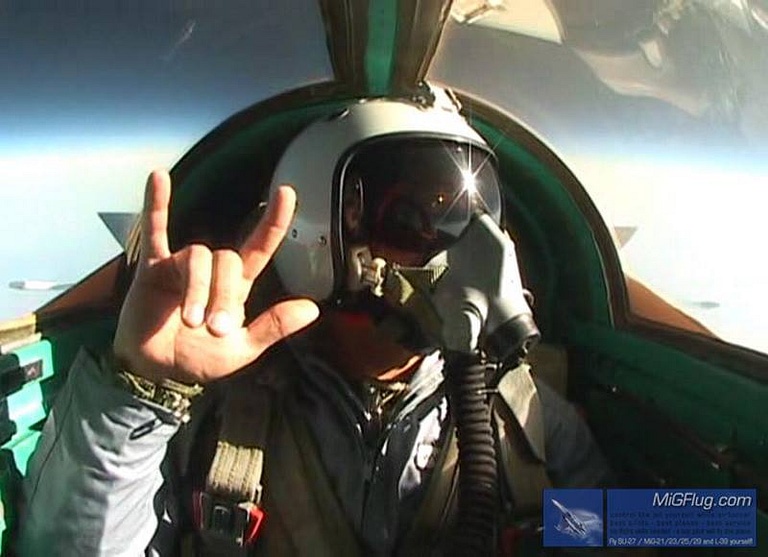
And for a brief, remarkable window, you could ride one yourself: from 2004 to 2006, MiGFlug flew civilian passengers to the edge of space in a MiG-25 — the only way an ordinary person ever got to experience the Foxbat’s Mach-speed climb to the stratosphere.
01The MiG-25’s great deception: how record flights fooled NATO into building the F-15
From 1965 the Soviets set a run of world speed and altitude records with the type, flown under the cover designation “Ye-266.” To Western eyes the numbers were terrifying: a machine that could apparently sprint past Mach 3 and climb near the edge of space. Combined with its enormous wing — which analysts read as a sign of tight-turning agility — the intelligence community concluded the USSR had built a Mach-3 air-superiority fighter that would outclass anything America flew.
That assessment shaped a generation of US procurement, feeding directly into the requirement for the F-15 Eagle. The reality — a heavy, steel, straight-line interceptor with a big wing needed simply to carry it at altitude, not to turn — only became undeniable when Belenko’s aircraft was dismantled in 1976. The Foxbat is perhaps the Cold War’s greatest case of an adversary being frightened by a machine that was never what it seemed.
What makes it special
A fighter built mostly of steel
About 80% of the MiG-25’s weight is nickel-steel alloy, with only ~9% titanium and ~11% aluminium. Titanium would have been lighter and better in the heat of Mach-2.8 flight, but the Soviets couldn’t reliably weld it and it was ruinously costly. Steel was heavy but cheap, weldable, and could take the kinetic heating — skin temperatures climb past 300 °C — of sustained supersonic flight.
Two giant turbojets — and the Mach 3.2 legend
Power came from two Tumansky R-15B-300 afterburning turbojets, about 100 kN each in reheat — roughly 200 kN combined. The airframe could touch Mach 3.2 in a dash, but doing so destroyed the engines: above about Mach 2.83 the compressors ran away. Pilots were red-lined at Mach 2.83, and even then only for minutes before the airframe overheated.
The ‘Fox Fire’ burn-through radar
The interceptor’s RP-25 Smerch-A radar (NATO “Fox Fire”) was a brute — a vacuum-tube set commonly cited at around 600 kW, designed to overpower enemy jamming by sheer output. Its weakness, exposed in 1976, was that it couldn’t look down and shoot down low-flying targets — a gap closed only in the later MiG-25PD and the MiG-31.
02The MiG-25’s steel airframe: why the Soviets skipped titanium
The SR-71 solved the heat problem of sustained supersonic flight with titanium. The Soviets could not: welding titanium reliably was beyond their production base in the 1960s, and the metal was extraordinarily expensive. So Mikoyan-Gurevich built the Foxbat overwhelmingly from a nickel-steel alloy — roughly 80% of its weight — assembled largely by welding, some of it by hand. When Western engineers took Belenko’s jet apart in 1976 they reportedly found rust bleeding through the paint. Steel made the aircraft heavy and thirsty, but it was cheap, robust and could survive the ~300 °C skin temperatures of Mach 2.8 flight.
03The MiG-25’s engines: the Mach 3.2 dash that wrecked them
The most famous demonstration of the Foxbat’s speed — and its limits — came over the Sinai in 1971, when a Soviet-crewed reconnaissance MiG-25 accelerated to Mach 3.2 to outrun an intercepting Israeli F-4 Phantom and its missiles. It escaped clean, but the over-revved engines were ruined and had to be scrapped. That was the deal the airframe offered: it could exceed Mach 3, but only by sacrificing its engines. In everyday service the type was firmly limited to Mach 2.83.
Full specifications
Airframe & Performance
- Crew
- 1 (two-seat trainers seat 2)
- Length
- 23.82 m
- Wingspan
- 14.01 m
- Height
- 6.10 m
- Max takeoff weight
- ~36,720 kg
- Max speed (service limit)
- Mach 2.83 · ~3,000 km/h
- Dash speed
- ~Mach 3.2 (engine-destroying)
- Service ceiling
- ~20,700 m
- Record altitude
- 37,650 m (1977, special aircraft)
- Combat radius
- ~1,730 km
Propulsion & Systems
- Engines
- 2 × Tumansky R-15B-300
- Thrust (each)
- ~100 kN with afterburner
- Radar
- RP-25 Smerch-A (“Fox Fire”)
- Armament
- 4 × R-40 (AA-6 Acrid) AAMs
- Sensors (recon)
- Cameras, SLAR, ELINT
- First flight
- 6 March 1964
- Built
- ~1,186 (1964–1984)
- Unit cost
- ~$3–5 million (estimate)
- Cost per flight hour
- No reliable public figure
04The MiG-25’s operating costs: why no reliable price exists
The MiG-25 was a Soviet state product, never sold on an open dollar market, so a firm flyaway unit price simply does not exist in the public record. Period estimates place it in the low single-digit millions of US dollars — very roughly $3–5 million in 1970s–80s terms — but that should be read as an order-of-magnitude guess, not a sourced figure. No credible cost-per-flight-hour number exists for the type in open sources either. Any precise dollar figure you see attached to a MiG-25 is, in practice, an estimate.
From Cold-War threat to Cold-War relic
Programme begins
The Mikoyan-Gurevich bureau starts work on the Ye-155 to counter US Mach-3 threats such as the XB-70 Valkyrie.
First flight
The reconnaissance prototype Ye-155-R1 flies on 6 March; the interceptor prototype follows in September.
Enters service
The MiG-25 joins the Soviet PVO air-defence force as a dedicated high-speed interceptor.
The Sinai sprint
Soviet-crewed reconnaissance Foxbats overfly Israeli-held Sinai, outrunning intercepting F-4 Phantoms at Mach 3.2.
Belenko defects
On 6 September, Lt Viktor Belenko lands an intact MiG-25 at Hakodate, Japan — an intelligence windfall for the West.
Edge of space
Test pilot Alexander Fedotov zoom-climbs to 37,650 m — still the absolute altitude record for an air-breathing aircraft.
The Speicher kill
An Iraqi MiG-25 downs a US Navy F/A-18 on the first night of Desert Storm — the only US fixed-wing air-to-air loss of the war.
MiGFlug flies civilians to the edge of space
MiGFlug offers Edge of Space flights in the MiG-25 from 2004 to 2006 — paying passengers ride the Foxbat to the stratosphere. The highest a MiGFlug customer ever reached was 25.5 km (about 83,600 ft), well into the black-sky edge of space with the curvature of the Earth in view.
The last Foxbats
Algeria retires its fleet (2022); Syria’s surviving airframes are reportedly destroyed (2024). The type passes into history.
From the cockpit: twelve Foxbat stories
The bomber that started it all
The Mach-3 XB-70 Valkyrie and other US high-fliers drove the PVO’s 1958 requirement.
Read the full story
The Sinai sprint
A Soviet-crewed recon MiG-25 hit Mach 3.2 to escape an Israeli F-4 — and wrecked its engines doing it.
Read the full story
Belenko’s 30-second landing
Lt Viktor Belenko reportedly touched down at Hakodate with about 30 seconds of fuel left, overshooting the runway.
Read the full story
“Rust through the paint”
Western engineers expected titanium and microchips. They found steel and vacuum tubes.
Read the full story
Burn-through radar
The ‘Fox Fire’ radar’s huge vacuum-tube output was meant to overpower jamming by brute force.
Read the full story
The Eagle’s inspiration
Western fear of a ‘super-Foxbat’ helped justify the F-15 Eagle programme.
Read the full story
Fedotov’s edge of space
On 31 August 1977 test pilot Alexander Fedotov zoom-climbed to 37,650 m.
Read the full story
The Speicher mystery
The 1991 loss of Scott Speicher’s F/A-18 was blamed for years on a SAM, then on a MiG-25.
Read the full story
Buried Foxbats
After 2003, coalition forces found Iraqi MiG-25s buried in the desert sand.
Read the full story
Colonel Rayyan’s tally
Iraq’s leading Foxbat pilot scored multiple kills before being shot down by Iranian F-14s.
Read the full story
Foxbat to Foxhound
The MiG-25’s limits led directly to the MiG-31 ‘Foxhound.’
Read the full story
The record that fooled the West
The 1960s ‘Ye-266’ record flights convinced NATO the USSR had a Mach-3 super-fighter.
Read the full story
The Foxbat in pictures
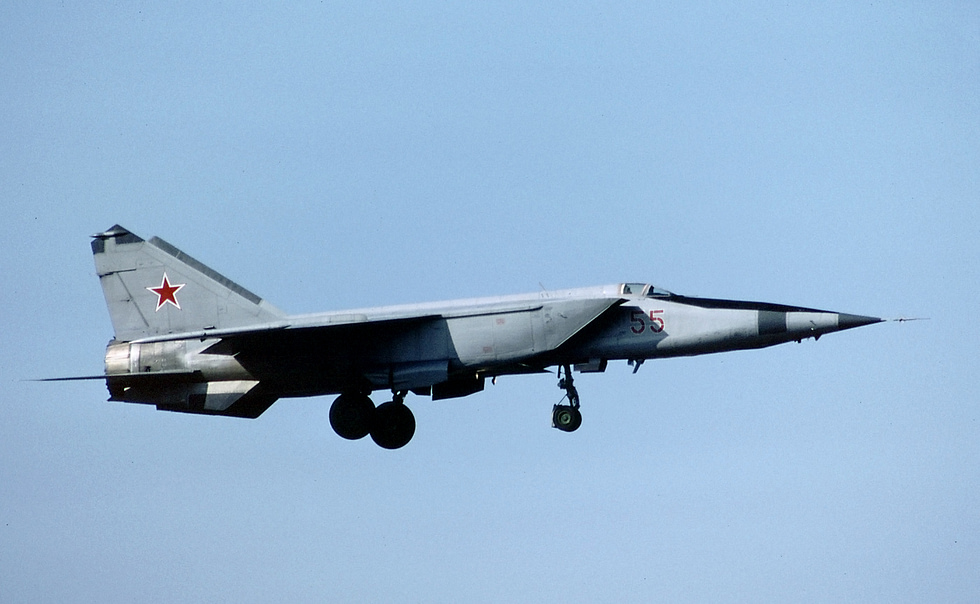
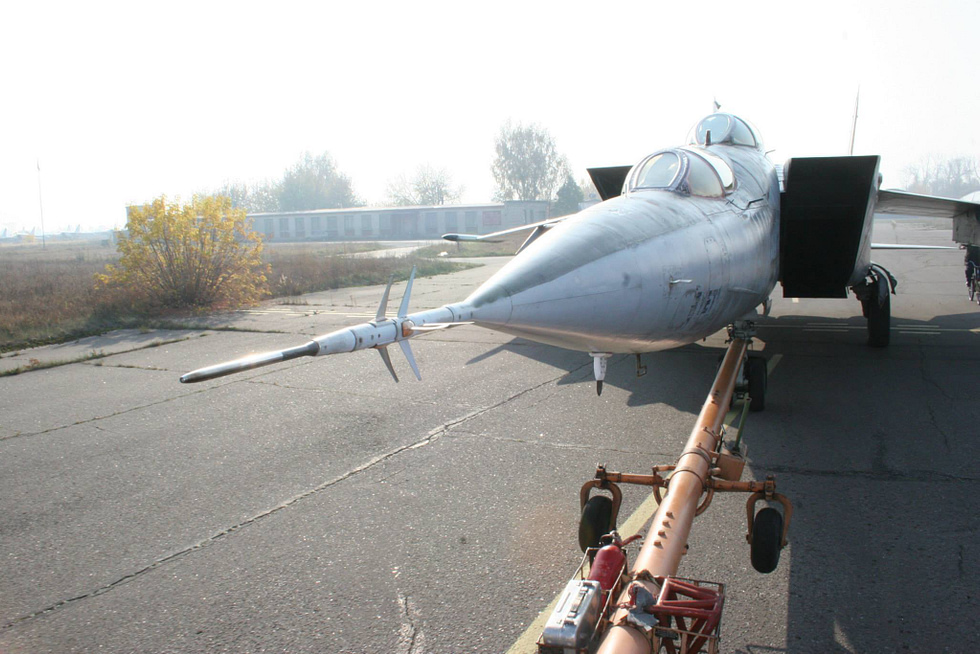
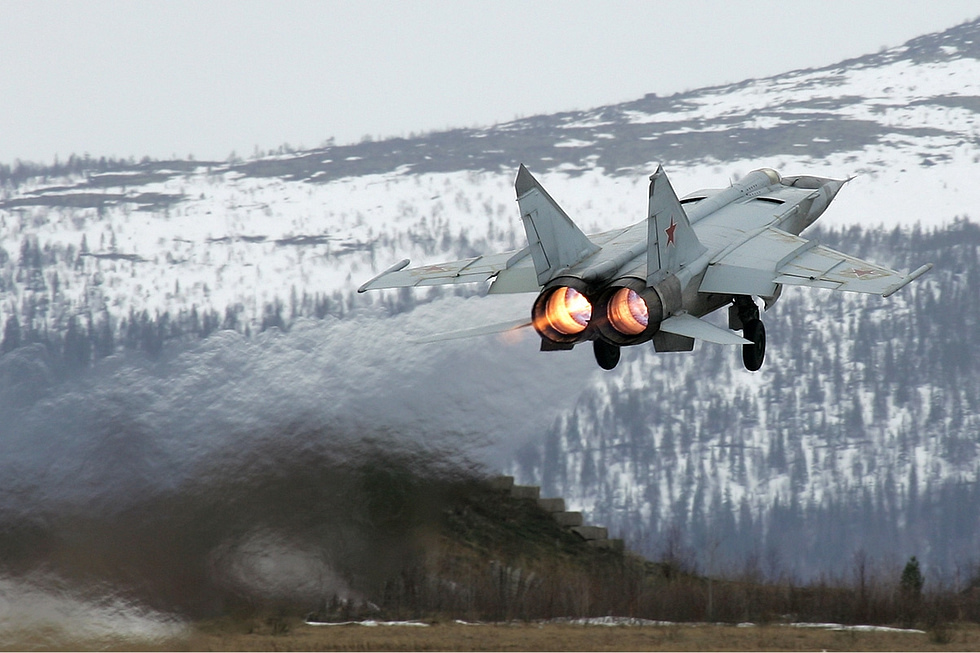








The Foxbat in motion
Mustard: This Jet Terrified the West — The MiG-25 Foxbat. A polished documentary on the West’s Foxbat panic, the engineering and the Belenko defection — several million views.
Where the Foxbat flew
The score that defines it
The MiG-25 rarely dogfought — that was never its job. Its record is written in speed, altitude and a single, famous night kill over Iraq. Every confirmed air-to-air kill in its history was scored by Iraq; its most enduring victories were the ones where it simply outran everything sent to catch it.
Compare the combat record of every military aircraft. Figures as of July 2026.
Everything people ask about the MiG-25
Can I fly in a MiG-25?
How fast is the MiG-25?
Is the MiG-25 made of titanium?
Did a MiG-25 ever shoot down a US jet?
How high can a MiG-25 fly?
Why did Viktor Belenko defect?
What replaced the MiG-25?
Is the MiG-25 still in service?
You can no longer fly the MiG-25.
These, you still can.
Some legends only live in museums — others are fuelled and waiting. MiGFlug has put civilians in real military jet cockpits since 2004.
 Fly the L-39 AlbatrosThe world’s most-flown jet trainer — aerobatics included
 Fly the F-104 Starfighter“The missile with a man in it”
 Fly the MiG-21The Cold War’s most-produced jet
 Fly the T-33 Shooting StarAmerica’s first jet trainer
 Fly the DH VampireA piece of early jet history
 Fly the S.211Agile Italian jet trainer
 Fly the MB-326The classic Aermacchi jet
 Fly the MiG-15The Soviet legend of the Korean War
Continue the tour
Every fact, checked
- John Barron — MiG Pilot: The Final Escape of Lieutenant Belenko (1980)The definitive account of the 1976 defection and primary source for the Belenko anecdotes.
- The AviationistBelenko defection retrospective and the Sinai overflight history.
- The Aviation Geek ClubFedotov’s 1977 altitude record and the Israeli-front reconnaissance flights.
- FAI records databaseOfficial world-record classifications flown under the “Ye-266” cover name.
- Guinness World RecordsOfficial highest-altitude flight: 37,650 m, Fedotov, 1977.
- 19FortyFiveMiG-25 origins, technical analysis and the Speicher shootdown.
- The National InterestSinai spy-flights and the record-altitude story.
- National Museum of the US Air ForceReference for preserved MiG-25 airframes on display.