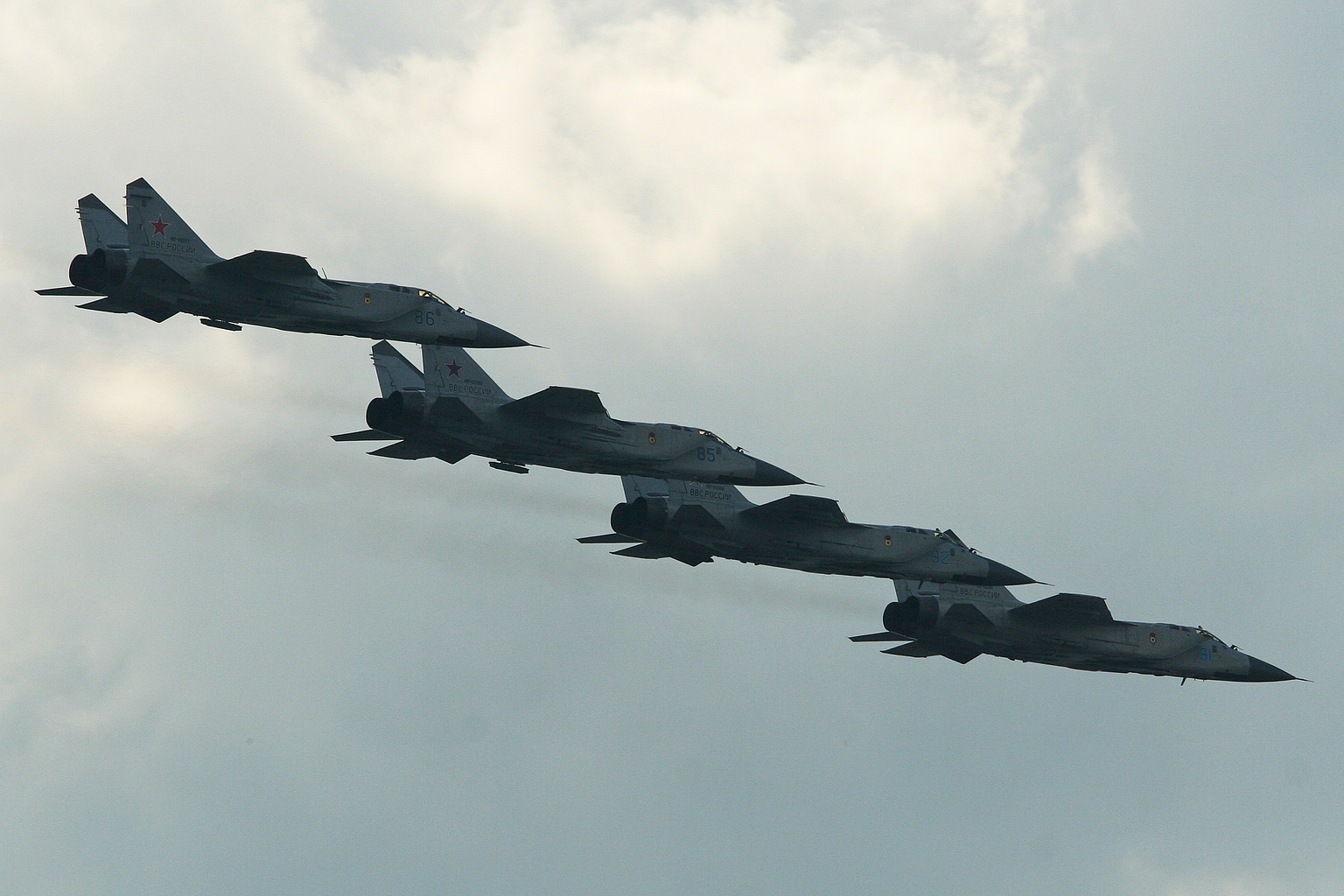
Mikoyan-Gurevich MiG-31
“Foxhound”
The fastest combat aircraft still flying — a Mach-2.83 long-range interceptor whose 1981 Zaslon radar was the world’s first operational fighter PESA, and which today carries Russia’s Kinzhal hypersonic missile.
The interceptor built to fix the Foxbat
The MiG-31 was born from the shortcomings of its famous ancestor. The MiG-25 Foxbat could sprint to Mach 2.8, but it couldn’t look down and shoot down: its radar was blinded by ground clutter, it handled poorly at low altitude, and its thirsty turbojets gave it short legs. Against the low-flying bombers and cruise missiles of the 1970s, the Foxbat was nearly useless. The answer was the Ye-155MP — a new aircraft that only looked like a Foxbat.
First flown on 16 September 1975 by test pilot Alexander Fedotov and in service from 1981, the MiG-31 kept the Foxbat’s brute speed but added everything it lacked: a second crewman to work the sensors, genuine afterburning turbofans that could sustain Mach 2.83 without wrecking themselves, and above all the Zaslon radar — the world’s first electronically-scanned array to enter service on a fighter. The sprinter had become a long-range interception system.
Unlike the widely-exported MiG-21, the Foxhound was never sold abroad in numbers — only the Soviet Union, then Russia, and briefly Kazakhstan have flown it. Around 500 were built before production ended in 1994, and roughly 130 modernised MiG-31BM/BSM remain the backbone of Russian long-range air defence. Today the type is globally famous again as the launch platform for the Kh-47M2 Kinzhal — and, at Mach 2.83, it is simply the fastest combat aircraft still flying anywhere in the world.
01The MiG-31’s Zaslon radar: how the first operational fighter PESA rewrote air defence
When the MiG-31 entered service in 1981, Western fighters like the F-14 and F-15 still swept the sky with mechanically-rotated radar dishes. The Foxhound’s Zaslon S-800 (NATO “Flash Dance”) had no moving antenna at all: it steered its beam electronically in milliseconds, the first passive electronically-scanned array (PESA) ever fielded on a fighter. It could track around ten targets and engage several at once with the long-range R-33 missile — and, crucially, it could look down and pluck a low-flying cruise missile out of ground clutter, the exact task that had defeated the MiG-25.
Netted together by datalink, four MiG-31s could patrol a barrier nearly 900 km wide across the Arctic approaches to the USSR — each jet feeding the others a shared picture. The modernised Zaslon-M of the MiG-31BM is claimed to reach much further still, feeding today’s very-long-range R-37M. Treat the biggest range numbers with caution, but the through-line is real: from the Cold War Foxhound to the missile-truck of the 2020s, the Foxhound has always been a radar first and an airframe second.
What makes it special
The Zaslon PESA radar
The MiG-31’s heart is the Zaslon S-800 — the world’s first passive electronically-scanned array to enter service on a fighter, in 1981. With no moving antenna it steers its beam electronically, tracking around ten targets and engaging several simultaneously, and it can look down to kill low-flying cruise missiles in clutter. The modernised Zaslon-M feeds today’s R-37M very-long-range missiles.
D-30F6 turbofans
Where the MiG-25 used thirsty turbojets, the Foxhound carries two Soloviev D-30F6 afterburning turbofans of about 152 kN each. They let it sustain Mach 2.83 and even supercruise without tearing themselves apart — giving the MiG-31 genuine long range and endurance rather than a single wasteful dash.
Two crew, one network
A pilot flies while a dedicated weapons officer works the Zaslon in the back seat. Linked by the APD-518 datalink, four MiG-31s form a single picket line nearly 900 km wide, each sharing its radar picture — a networked hunting pack built decades before “network-centric warfare” had a name.
02The MiG-31’s engines: why turbofans beat the Foxbat’s turbojets
The MiG-25’s R-15 turbojets were optimised for one thing — a flat-out Mach 2.8 dash — and they drank fuel so fast that sustained high-speed flight risked damaging them. The MiG-31’s Soloviev D-30F6 afterburning turbofans changed the equation: more efficient at cruise, they let the Foxhound hold Mach 2.83 at altitude and reach out to a combat radius of around 720 km at high speed, or roughly 1,450 km subsonic. It is the difference between a sprinter that must dash and recover, and an interceptor that can actually patrol.
03The MiG-31’s picket line: four jets, one 900-kilometre radar wall
A single MiG-31 is formidable; four are a system. Using the APD-518 datalink, a flight of four Foxhounds could space themselves out and share a single fused radar picture, sweeping a corridor almost 900 km wide across the northern approaches to the Soviet Union. One jet could detect a target and hand it to another to engage. In an era when Western fighters still fought largely as individuals, this networked, look-down barrier was a genuinely radical piece of air-defence doctrine — and it is the direct ancestor of the datalinked missile-launch tactics Russia uses with the R-37M today.
Full specifications
Baseline note: the figures below describe the Mikoyan MiG-31BM (NATO reporting name Foxhound) — the modernised interceptor rebuilt from existing airframes since 2008, powered by two Soloviev D-30F6 afterburning turbofans and carrying the Zaslon-AM development of the original S-800 radar. That mark is the right baseline because no other one is still relevant: the production line at Sokol in Gorky, now Nizhny Novgorod, closed in 1994, and every MiG-31 delivered to a regiment in the last twenty years has been an old aeroplane stripped and put back together. Deltas for the original MiG-31 (izdeliye 01, accepted 6 May 1981), the MiG-31B and its MiG-31BS conversions, the MiG-31BSM and the Kinzhal-carrying MiG-31K/I are given in grey. One boundary first. The MiG-25 is a separate aircraft with its own page, and the two are relatives rather than the same machine in different clothes. The MiG-31 grew out of the Ye-155MP, a development of the Ye-155 line that produced the Foxbat, and it kept the Foxbat’s general layout: shoulder wing, twin canted fins, rectangular side intakes with movable ramps. Almost everything that matters underneath is different. The MiG-25 is a single-seater; the MiG-31 carries a pilot and a dedicated weapons systems officer. The MiG-25 is 80 per cent nickel steel; the MiG-31 is 49 per cent steel, 33 per cent light alloy and 16 per cent titanium, with a stronger, larger wing carrying root extensions and, on the main units, tandem twin-wheel bogies for snow and unpaved strips. The MiG-25 has two Tumansky R-15B-300 turbojets of 100 kN in reheat; the MiG-31 has two D-30F6 turbofans of 152 kN, and the bypass is what turns a sprinter with about eight minutes of useful supersonic fuel into an aeroplane that can hold Mach 2.35 across a theatre. The MiG-25P had the Smerch-A, a valve-driven radar of enormous power and no useful look-down; the MiG-31 had the first electronically scanned array ever flown operationally on a fighter. Viktor Belenko flew a MiG-25P to Hakodate on 6 September 1976, eleven months after the Ye-155MP’s first flight, and the Western exploitation that followed confirmed what the Soviets already knew and were already fixing. The MiG-31 is the fix. The world first, stated precisely. The Zaslon (S-800, factory index N007, service designation RP-31, NATO Flash Dance) was developed at the Tikhomirov institute between 1975 and 1980 and entered service on the MiG-31 in 1981. Its 1.1 m antenna is a fixed passive electronically scanned array — roughly 1,700 X-band phase shifters around a central feed, with 64 further L-band emitters for identification — steered by phase rather than by a motor, with a beam repositioning time of about 1.2 milliseconds. That makes it the first passive electronically scanned array radar carried by any fighter aircraft anywhere, and the claim survives being stated carefully: phased arrays already existed on ground radars and would appear on the B-1B’s AN/APQ-164 in 1986, but no fighter had one before the MiG-31, and none other had one until the Mitsubishi F-2 entered service in 2000 with an active array. Nineteen years is an unusually long lead for Soviet avionics and it is worth saying why it mattered rather than simply that it happened: a mechanically scanned dish must physically slew to each target, so tracking many contacts while continuing to search is a compromise. Zaslon tracked ten targets and engaged four at once from the start, and the later Zaslon-A and -AM track 24 and engage six. Against the actual threat — formations of B-52s and, from 1982, AGM-86B cruise missiles crossing the Arctic at low level over featureless ice — that combination of look-down clutter rejection and simultaneous engagement was the whole point of the aeroplane. Two men, and why. The MiG-31 has a second cockpit because one man cannot fly at Mach 2.35 and run this radar at the same time. The weapons systems officer sits behind the pilot with no forward view and only two small vision ports in the canopy sides; his world is the radar display, the tactical situation display and the datalink. He has no flight controls. This was a real institutional decision and not an afterthought: the MiG-25 had shown that a single pilot in a Mach 2.8 interceptor is a passenger to his ground controller, and the MiG-31 was built to be the controller. Four aircraft, nine hundred kilometres. The APD-518 digital datalink lets four MiG-31s fly line abreast up to 200 km apart, share radar pictures and cue one another, so a single flight covers a front of 800 to 900 km. Through the RK-RLDN link the same flight can pass targets to ground control and to other fighters — MiG-23, MiG-25, MiG-29, Su-15 and Su-27 — with each MiG-31 directing up to four of them. In practical terms a flight of four became a small airborne early warning and control node for a stretch of Arctic frontier where no ground radar existed and no A-50 was going to loiter. Nothing in Western service did this in 1981. Four cautions about the numbers. First, ceiling. Russian service documents and most reference works give a practical ceiling of 20,600 m; the figure of 25,000 m that circulates widely, including in the English Wikipedia specification box, is a dynamic or zoom ceiling reached in a ballistic climb and not a height the aircraft can hold. Second, dimensions. Length is given as 22.69 m by Russian sources and 22.62 m by others; height is 6.15 m in the standard references and 6.10 m in some German data tables, while the English Wikipedia box prints 6.456 m. The spread is small but real and none of it is a typographical error. Third, speed. Mach 2.83 at 17,500 m is a service limit set by the engines and the intake, not by the airframe; the same discipline that governed the MiG-25 applies, and pilots do not exceed it twice. Fourth, fleet size. Published totals for Russia range from about 85 to about 250 depending on whether stored, reserve and naval aviation airframes are counted; the honest numbers, with their sources, are set out in the variants note below rather than dressed up as a chart. Why the g limit is five. A MiG-31 at normal take-off weight is a 41-tonne aeroplane with 61.6 m² of wing, which is a wing loading of 665 kg/m² — about half as much wing per tonne again as an F-15C. Half the structure is arc-welded nickel steel, chosen because it tolerates the kinetic heating of sustained Mach 2.8 flight and because it can be welded rather than riveted, and steel is heavy. The result is an aircraft cleared to about 5 g supersonically, and it is not an oversight. The MiG-31 was never intended to turn with anything. It was intended to be somewhere very far away, very high, very fast, having already fired. Judged as a dogfighter it is hopeless; judged as what it is, it has no equivalent in any air force, then or now.
Dimensions & weights
- Crew
- 2 — pilot and weapons systems officer, in tandem on K-36DM zero-zero ejection seats
- Length
- 22.69 m (74 ft 5 in), including the nose probe; some sources give 22.62 m (74 ft 3 in)
- Wingspan
- 13.46 m (44 ft 2 in)
- Height
- 6.15 m (20 ft 2 in); the English Wikipedia box gives 6.456 m (21 ft 2 in), German data tables 6.10 m
- Wing area
- 61.6 m² (663 sq ft)
- Aspect ratio
- 2.94
- Empty weight
- 21,820 kg (48,105 lb)
- Normal take-off weight
- 41,000 kg (90,390 lb) on internal fuel with four R-33
- Maximum take-off weight
- 46,200 kg (101,850 lb) with two underwing drop tanks
- Internal fuel
- about 16,130 kg (35,560 lb) in fuselage, wing and fin tanks; some Russian sources give 16,350 kg (36,050 lb). This is roughly the empty weight of a MiG-21 carried as fuel
- External fuel
- 2 × 2,500 L (660 US gal) underwing tanks, jettisonable
- Maximum external stores
- about 9,000 kg (19,840 lb) quoted for the MiG-31BM; in practice the useful load is four belly missiles and four underwing rounds
- Undercarriage
- Tricycle, with tandem twin-wheel main bogies, the rear wheels offset outboard to spread load on unpaved and snow-covered strips
- Airframe materials
- 49% arc-welded nickel steel, 33% light alloy, 16% titanium, 2% composites the MiG-25 was 80% steel, 11% aluminium, 9% titanium
Performance
- Maximum speed, altitude
- 3,000 km/h (1,864 mph, 1,620 kn), Mach 2.83 at 17,500 m — a service limit set by the engines and intakes
- Maximum speed, sea level
- 1,500 km/h (932 mph, 810 kn), Mach 1.23
- Supersonic cruise
- 2,500 km/h (1,553 mph, 1,350 kn), Mach 2.35 — sustained in reheat, not supercruise; the D-30F6 bypass is what makes it affordable in fuel
- Subsonic cruise
- Mach 0.80 at 10,000 m (about 850 km/h, 528 mph true); the speed at which the combat range below is quoted
- Rate of climb
- 288 m/s (56,700 ft/min) at sea level, clean
- Time to 20,000 m
- 8 min 54 s from brakes-off
- Service ceiling
- 20,600 m (67,600 ft) sustained; the widely printed 25,000 m (82,000 ft) is a dynamic zoom ceiling, not a height the aircraft can hold
- Combat range, supersonic
- about 720 km (447 mi, 389 nmi) flown at Mach 2.35 and 18,000 m
- Combat range, subsonic
- about 1,450 km (901 mi, 783 nmi) at Mach 0.8 and 10,000 m; about 2,200 km (1,367 mi) with two drop tanks
- Ferry range
- 3,000 km (1,864 mi, 1,620 nmi) on internal and external fuel; 5,400 km (3,355 mi) with one aerial refuelling
- Endurance
- 3.6 h with drop tanks; 6–7 h with in-flight refuelling, which is what an Arctic barrier patrol actually requires
- g limit
- +5 supersonic. The aircraft is not stressed, and was never intended, for close combat
- Take-off run / landing roll
- 1,200 m / 800 m (3,940 ft / 2,625 ft), the landing figure with the brake parachute
- Wing loading
- 665 kg/m² (136 lb/sq ft) at normal take-off weight
- Thrust-to-weight
- 0.85 at normal take-off weight in full reheat
Propulsion & systems
- Powerplant
- 2 × Soloviev (later Aviadvigatel) D-30F6 afterburning low-bypass turbofans the first turbofan in a Soviet interceptor, and the reason the MiG-31 has range where the MiG-25 had none
- Dry thrust
- 93.0 kN each (9,500 kgf, 20,900 lbf)
- Afterburning thrust
- 152.0 kN each (15,500 kgf, 34,170 lbf)
- Engine life
- About 300 hours between overhauls production of the D-30F6 ended with the airframe; by 2024 Russian officials were publicly discussing restarting it, which is the fleet’s real constraint
- Intakes and nozzle
- Rectangular two-dimensional side intakes with movable upper ramps and auxiliary doors, inherited from the MiG-25; fully variable convergent-divergent nozzles
- Radar
- Zaslon-AM (S-800 / N007 family, NATO Flash Dance): 1.1 m fixed passive electronically scanned array, about 1,700 X-band phase shifters plus 64 L-band identification emitters, scanning ±70° in azimuth and +70/−60° in elevation MiG-31: original Zaslon; MiG-31M: 1.4 m Zaslon-M; MiG-31K: radar reportedly removed and replaced by ballast
- Radar performance
- 200 km detection against a 16–19 m² target, 120 km automatic track, 24 targets tracked and 6 engaged simultaneously the 1981 Zaslon tracked 10 and engaged 4; Zaslon-M is credited with 400 km against an airborne early warning aircraft and 282 km against a 5 m² target
- Infrared search and track
- 8TK retractable sensor under the forward fuselage, about 56 km against a heat source — a passive channel for closing on a target without radiating
- Datalinks
- APD-518 aircraft-to-aircraft digital link, four aircraft spaced up to 200 km apart covering an 800–900 km front; RK-RLDN link to ground control and to other fighters, each MiG-31 directing up to four of them
- Mission computer
- Argon-15A digital computer on the original aircraft replaced by Baget-series processors and multi-function colour displays on the MiG-31BM and BSM
- Crew stations
- Pilot forward; weapons systems officer aft with no forward view, two small side vision ports and no flight controls
- Navigation
- Marshrut long-range radio navigation with inertial reference, sized for Arctic operation where beacons and ground radar do not exist
- Self-protection
- SPO-15 Beryoza radar warning receiver, SPS-series jammers and chaff and flare dispensers in the tail sting
- In-flight refuelling
- Retractable probe on the port side of the nose, introduced on the MiG-31DZ and standard from the MiG-31B
04The MiG-31’s operating costs: what open sources actually show
Hard numbers for the MiG-31 are scarce and unreliable. It was and remains a Soviet-then-Russian state product that was never openly exported, so there is no export price list to anchor an estimate. Figures circulating online range from soft estimates of roughly $30–50 million per airframe to an often-repeated but unsourced “$100 million” — treat all of them as guesswork. No credible cost-per-flight-hour figure exists in open sources either. What is certain is that the MiG-31 is un-buildable: production ended in 1994 and cannot be restarted, so every jet lost is gone for good — a fleet Russia keeps flying precisely because it can no longer make more.
Armament & payload
The MiG-31 exists to carry four very long missiles and a radar big enough to use them
The whole aeroplane is a mounting for the R-33 (NATO AA-9 Amos) and the radar that guides it. Four rounds sit semi-recessed in tandem pairs under the fuselage: 490 kg each, 4.14 m long, a 47.5 kg warhead, Mach 4.5, inertial mid-course guidance with semi-active radar homing at the end, and about 120 km of reach for the baseline round. The comparison everybody reaches for is the AIM-54 Phoenix and the AWG-9, and it is a fair one, but the platforms are not comparable: an F-14 launching Phoenix was a subsonic loiterer, while a MiG-31 shoots from Mach 2.35 at 18,000 m and hands the missile a great deal of energy before the motor even lights.
The modern weapon is the R-37M (AA-13 Axehead), in service since 2019: 510 kg, a dual-pulse solid motor, a 60 kg warhead, an active radar seeker so the launching aircraft need not keep illuminating, Mach 6 and a quoted 200 km for the export RVV-BD with 300 km or more claimed for the Russian round. Over Ukraine it has been the MiG-31’s only real contribution to the air war. RUSI recorded up to six R-37M launches a day at the peak of the autumn 2022 fighting, and Russian sources claimed a kill at 190 km in 2025. What is corroborated is narrower and more interesting than the kill claims: the missile’s effect has been overwhelmingly behavioural, pushing Ukrainian fighters down to low level and out of whole blocks of airspace without needing to hit them. Hard kills attributed to it are few and individually hard to verify.
Everything else on the aircraft is thin, and it is worth being blunt about that. The gun is a six-barrel 23 mm buried in the fuselage side that a Mach 2 interceptor will essentially never use. There is no bombing capability worth the name. The air-to-ground fit advertised for the MiG-31BM from 2008 has almost no operational evidence behind it. And the one MiG-31 variant that has genuinely struck ground targets, the MiG-31K, did so by giving up the interceptor role entirely: no air-to-air missiles, reportedly no radar, one very large weapon on the centreline. Clearances differ sharply by mark. The R-37M is a MiG-31BM and BSM weapon only; the R-77-1 and the claimed air-to-ground stores likewise. The original 1981 aircraft was cleared for R-33 and R-40TD only. The proposed MiG-31E and MiG-31FE export standards would have been degraded, and neither was ever sold.
Gun
- 1 × Gryazev-Shipunov GSh-6-23M six-barrel 23 mm rotary cannon, 260 rounds, in a fairing low on the starboard side of the fuselage behind the nose gear bay
- Gas-operated rather than externally driven, firing the 23 × 115 mm round at a nominal 8,000 rounds per minute and quoted as high as 10,000 — the 260-round magazine is roughly two seconds of fire
- Aimed through the radar and weapons system rather than a dedicated fighting sight; on an aircraft that engages at 100 km and pulls 5 g it is close to vestigial
- The gun bay was faired over on the MiG-31M, which deleted the cannon outright to make room for a sixth belly missile station
- No MiG-31 is known to have fired its gun in anger in more than forty years of service
Air-to-air
- 4 × R-33 or R-33S (AA-9 Amos) semi-recessed in tandem pairs under the fuselage: 490 kg, 47.5 kg warhead, Mach 4.5, about 120 km, inertial guidance with semi-active radar terminal homing; the export R-33E is credited with 160 km
- 4 × R-37M (AA-13 Axehead) on the MiG-31BM and BSM: 510 kg, dual-pulse motor, 60 kg warhead, active radar seeker, Mach 6, 200 km for the export RVV-BD and 300 km or more claimed for the Russian round
- 2–4 × R-40TD or R-40TD1 (AA-6 Acrid) on the underwing pylons of earlier marks, 50–80 km, infrared or semi-active radar — inherited directly from the MiG-25
- 4 × R-60M (AA-8 Aphid) or R-73 (AA-11 Archer) on the underwing pylons for self-defence; the MiG-31BM adds 4 × R-77-1 (AA-12 Adder)
- The radar tracks 24 and engages six, but the belly has only four stations, so a single MiG-31 can put four R-33 or R-37M into the air at once and no more — the remaining two channels are for the underwing rounds
Air-to-surface guided
- 1 × Kh-47M2 Kinzhal on the fuselage centreline of the MiG-31K and MiG-31I — an air-launched derivative of the 9K720 Iskander’s 9M723 with a modified guidance section, quoted at 460–480 km when lofted from a supersonic climb, conventional or a 5–50 kt nuclear warhead
- The MiG-31 does not aim the Kinzhal. The aircraft is a first stage: it delivers altitude and Mach number, and the missile flies a quasi-ballistic trajectory of its own from there
- MiG-31BM brochures list Kh-31P and Kh-58 anti-radiation missiles and Kh-29 and Kh-59 stand-off weapons; there is very little photographic or operational evidence that any of them has been carried by a squadron aircraft
- 2 × 79M6 Kontakt anti-satellite missile on the two MiG-31D prototypes — actually one round on the centreline; the programme was abandoned around 1993 and revived only as a paper study
- No targeting pod has ever been fitted, and the aircraft cannot self-designate for a laser-guided weapon
Bombs
- None, in more than forty years of front-line service. The MiG-31 has never had a bomb rack, a bombing computer or an attack sight in any squadron aircraft
- MiG-31BM promotional material lists KAB-500 guided bombs among the modernised aircraft’s options; no credible photograph or operational report shows one carried
- The MiG-31F and MiG-31FE multirole export proposals of the 1990s offered free-fall and guided bombs on six underwing pylons. No customer was ever found and no aircraft was built to that standard
- Keeping this card honest matters, because the type is often described as multirole on the strength of the Kinzhal. It is not: one very specialised missile on one very specialised conversion is not a strike capability
Rockets
- No unguided rocket pod has ever been integrated on any MiG-31 variant, in Soviet, Russian or proposed export configuration
- The aircraft has no low-level attack mode, no dive-attack sight and a 5 g limit that would make a rocket pass hazardous to fly
- The MiG-31F export study notionally offered S-8 and S-25 rockets alongside its bomb fit; like the bombs, this existed only in brochures
- The one large rocket a MiG-31 was ever meant to carry was not a weapon at all: the Ishim air-launch system, a Russian-Kazakh project unveiled in March 2006, would have slung a 10-tonne three-stage solid rocket under a modified MiG-31 to put microsatellites into orbit from about 17,000 m. Tests were promised for 2007 and never happened
Pods & other stores
- 2 × 2,500 L jettisonable drop tanks on the underwing pylons — the only stores the aircraft carries as a matter of routine besides missiles
- Retractable in-flight refuelling probe on the port side of the nose, from the MiG-31DZ onwards, mating with Il-78 tankers and with Su-24M buddy stores; this is what turns a 3.6-hour patrol into a 6–7 hour one
- SPS-series active jammers, SPO-15 Beryoza warning receiver and chaff and flare dispensers in the tail sting; no podded electronic warfare fit
- No reconnaissance pod, no buddy refuelling store, no targeting pod — the MiG-31 has never been asked to do anything but intercept, and latterly to throw one missile
- The most important thing a MiG-31 carries is not a store at all: the APD-518 datalink, which is what allows four aircraft to behave as one sensor across 900 km of frontier
Three typical loadouts
- Arctic barrier patrol, MiG-31BM
- 4 × R-33S semi-recessed under the fuselage, 2 × R-73 on the inboard wing pylons, 2 × 2,500 L drop tanks outboard. Flown as a four-ship line abreast at up to 200 km spacing, linked by APD-518, covering an 800–900 km front over water and ice with no ground radar beneath it. Refuelled once from an Il-78, this is a six-hour sortie.
- Long-range denial, MiG-31BM over Ukraine
- 4 × R-37M under the fuselage, 2 × R-73 for self-defence, no external tanks. Flown high and fast inside friendly air defence cover, lofting shots at 150–200 km against aircraft that cannot reach back. The purpose is less to score kills than to make a block of airspace unusable.
- Kinzhal strike, MiG-31K
- 1 × Kh-47M2 on the fuselage centreline and nothing else: no air-to-air rounds, no tanks, the radar reportedly removed and replaced by ballast. The aircraft climbs and accelerates to release altitude, launches, and turns for home; it is a first stage with a crew.
Sourcing caveat: Russian missile ranges are manufacturer figures quoted against large, non-manoeuvring, head-on targets at optimum altitude, and the no-escape zone is a fraction of them. The R-37M’s 300 km and the Kinzhal’s Mach 10 are both promotional numbers; a Ukrainian Patriot crew tracking a Kinzhal on 4 May 2023 measured about 1,240 m/s, roughly Mach 3.6, which is about a third of the advertised speed. Where a weapon is listed here as claimed rather than demonstrated, that distinction is deliberate.
Variants
The MiG-31 has been rebuilt five times and replaced none
The Ye-155MP first flew on 16 September 1975 and the MiG-31 was accepted for service on 6 May 1981, the same decision that put the R-33 into service. Production at Sokol ran to about 500 aircraft, commonly given as 519 including prototypes and pre-production machines, and stopped in 1994. Nothing has been built since. Every subsequent variant is a conversion, and the numbering reflects that: a MiG-31BSM is a MiG-31 that was made into a MiG-31BS that was made into something like a BM.
The successor existed and was good. The MiG-31M flew in December 1985 with a 1.4 m Zaslon-M, six belly missile stations, no gun and a one-piece windscreen, and in April 1994 it made a recorded air-to-air kill at 300 km, which was then a world record. Seven were built. The Soviet budget disappeared, and with it the Mikoyan 701 clean-sheet interceptor, the MiG-301 and MiG-321 studies, and the MiG-31D anti-satellite programme. The MiG-41, formally the PAK DP or izdeliye 41, has been announced since about 2013 with promises of Mach 4 and near-space operation. Development was said to have begun in 2021. As of 2026 no prototype, mock-up or photograph has been shown, service entry has slipped past 2023 and 2025 to the mid-2030s, and the honest description is a research programme, not an aircraft.
What keeps the fleet flying is not modernisation but arithmetic. Airframe life was extended from 2,500 to 3,500 hours in 2020, notionally carrying the type to 2030 and beyond. The binding constraint is the D-30F6, which needs overhaul roughly every 300 hours and is no longer in production; by 2024 Russian officials were discussing restarting the line. An interceptor that cannot be built and whose engines cannot be replaced is being asked to hold an Arctic frontier and to carry the country’s most publicised missile at the same time.
- Ye-155MP (izdeliye 83, 1975–1979 / 2 prototypes and a small pre-series)
- The MiG-25 stretched for a second cockpit, given D-30F6 turbofans, a new wing with root extensions and the Zaslon array. First flight 16 September 1975.
- MiG-31 (izdeliye 01, 1976–1990 / about 350)
- The original production interceptor with Zaslon, four R-33 and no refuelling probe. Accepted 6 May 1981; served with the PVO, the separate air defence service that owned the strategic interception mission.
- MiG-31DZ (1989–1991 / about 101)
- Production aircraft with the retractable in-flight refuelling probe, which more than doubled useful patrol time over the Arctic.
- MiG-31B and MiG-31BS (1990–1994 / 69 new, about 40 converted)
- Improved Zaslon-A, better electronic counter-countermeasures, R-33S clearance and the refuelling probe as standard. The BS is an earlier izdeliye 01DZ brought up to B standard rather than a new-build aircraft.
- MiG-31M (izdeliye 05, 1985–1994 / 7)
- The real successor: 1.4 m Zaslon-M, six R-37 stations, gun deleted, one-piece windscreen, new cockpit. Recorded a 300 km missile kill in April 1994 and was cancelled for money, not for merit.
- MiG-31D (izdeliye 07, 1987–1993 / 2)
- Anti-satellite carrier with wingtip end plates and no radar, built to launch the 79M6 Kontakt missile. Trials ended when funding did.
- MiG-31E and MiG-31FE (1992–2000s / none sold)
- Downgraded export interceptor and a proposed multirole version with six underwing pylons for bombs and rockets. Offered to China, India, Syria and others; no customer ever signed.
- MiG-31BM and MiG-31BSM (2008–present / about 130 converted)
- Zaslon-AM with Baget processors and colour displays, R-77-1 and R-37M clearance and a nominal air-to-ground capability. The BSM is the same work applied to a MiG-31BS. Contracts for 60 airframes were signed in 2011 and a further 60 from 2014.
- MiG-31K (2017–present / about 10–24)
- Kinzhal carrier: one Kh-47M2 on the centreline, air-to-air armament and reportedly the radar removed. Ten were on experimental combat duty by May 2018 and a dedicated regiment formed in 2021. The IISS counted twelve; Ukrainian assessments suggest as many as 24 by 2024.
- MiG-31I (izdeliye 81, flight tests from April 2024)
- A further Kinzhal-carrier standard with revised launch automation. The same designation was used in 2006 for the unrelated Ishim satellite-launch demonstrator, a Russian-Kazakh project that never flew.
Fleet note, current to 3 September 2026. Russia is now the only operator. Kazakhstan inherited MiG-31s from the Soviet Union — the 356th Fighter Aviation Regiment at Semipalatinsk among them — flew them until 2023, then retired the type and put its Soviet-era fighters up for auction that October; reports that the aircraft were bought by the United States were denied by the Kazakh state arms exporter. Because a single-operator chart is not a chart, the numbers are given here instead. Published Russian totals disagree widely and the disagreement is mostly about what is being counted. FlightGlobal’s World Air Forces gave 129 active MiG-31s in 2023 and the 2025 edition put MiG-31BM, BSM and K together at 128 to 247; the IISS Military Balance 2024 counted 88 MiG-31BM, 24 MiG-31K and 30 MiG-31 in naval aviation, about 142 in all; trade reporting through 2026 settles on roughly 85 to 131 upgraded interceptors plus ten to twenty-odd Kinzhal carriers, with a further 130 to 150 airframes in storage as of 2018. Losses since 2022 have been few and none is confirmed as air-to-air: three MiG-31BM were confirmed lost by September 2024, at least one aircraft was damaged in the Ukrainian strike on Savasleyka on 9 June 2025, and a MiG-31K was written off near Lipetsk on 9 October 2025 after an undercarriage failure, both crew ejecting. Many airframes counted on paper are stored, in deep overhaul or waiting on engines. Sources: IISS The Military Balance and FlightGlobal World Air Forces; entries that could not be corroborated are omitted.
Fifty years of the Foxhound
The Ye-155MP programme
Soviet designers begin an aircraft to fix the MiG-25’s inability to look down and shoot down low-flying targets.
First flight
Test pilot Alexander Fedotov takes the prototype up on 16 September 1975.
Service & the first PESA
The MiG-31 enters PVO service, carrying the Zaslon radar — the world’s first operational fighter PESA.
The 900 km wall
Four datalinked MiG-31s adopt the doctrine of a continuous radar picket line across the Arctic approaches.
The MiG-31B
An improved variant adds aerial refuelling and upgraded avionics.
Production ends
After roughly 500–519 built, the line closes for good — the type can no longer be manufactured.
The BM upgrade
The modernised MiG-31BM/BSM brings Zaslon-M, a glass cockpit and the very-long-range R-37M missile.
Kinzhal revealed
Russia unveils the MiG-31K carrying the Kh-47M2 Kinzhal air-launched missile.
Combat over Ukraine
MiG-31s reportedly fire R-37M air-to-air missiles and MiG-31K launch Kinzhals — both widely reported but contested.
Twelve things to know about the Foxhound
The world’s first PESA fighter
In 1981 the MiG-31 fielded an electronically-scanned radar years before the West.
Read the full story
The 900-kilometre wall
Four datalinked MiG-31s could sweep a corridor almost 900 km wide.
Read the full story
Looking down at last
The MiG-31 could do the one thing the MiG-25 never could.
Read the full story
The “AWACS killer”
The modernised MiG-31BM carries the very-long-range R-37M missile.
Read the full story
The longest shot in history?
Claims of a 200 km-plus air-to-air kill are widely repeated but unverified.
Read the full story
Intercepting at the edge
With a ~20 km ceiling and a zoom climb, the MiG-31 reaches where few fighters can.
Read the full story
It can’t dogfight — and doesn’t need to
The Foxhound is a straight-line missileer, not a turning fighter.
Read the full story
Carrying the Kinzhal
Since 2018 the MiG-31K has launched Russia’s Kh-47M2 Kinzhal.
Read the full story
Supercruise without reheat
The D-30F6 turbofans give sustained speed the MiG-25 never had.
Read the full story
Two brains, one jet
A dedicated weapons officer works the radar while the pilot flies.
Read the full story
The quickest combat jet flying
At Mach 2.83, nothing in frontline service is faster.
Read the full story
Fighting with a jet it can no longer make
Production ended in 1994 and cannot be restarted.
Read the full story
The Foxhound in pictures
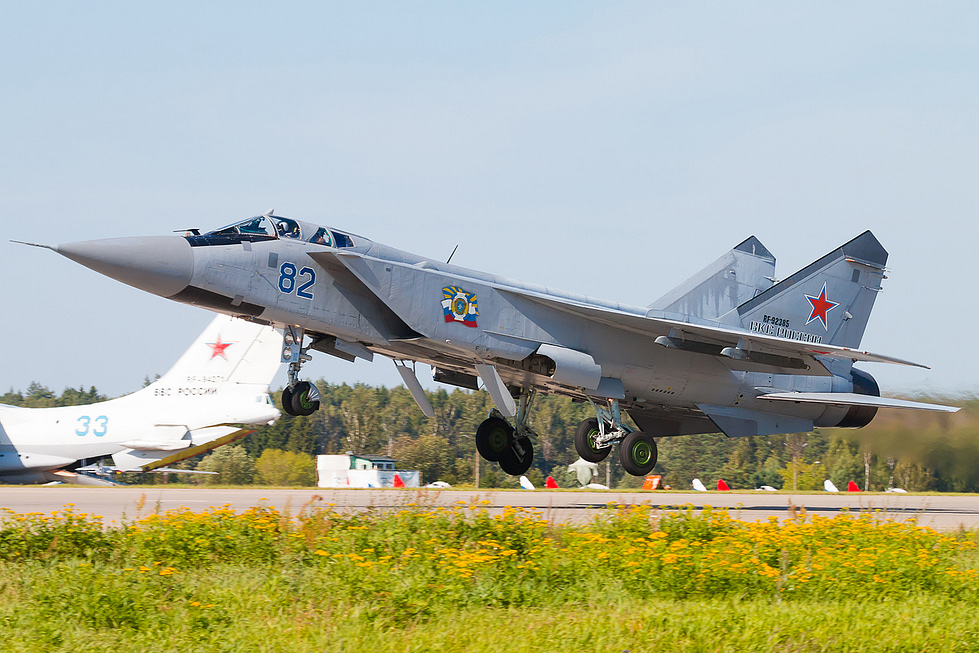
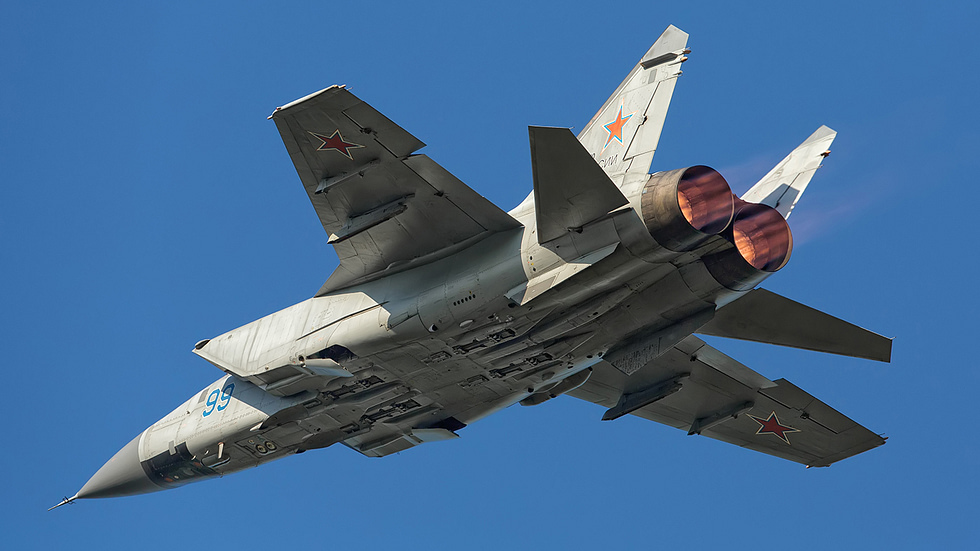
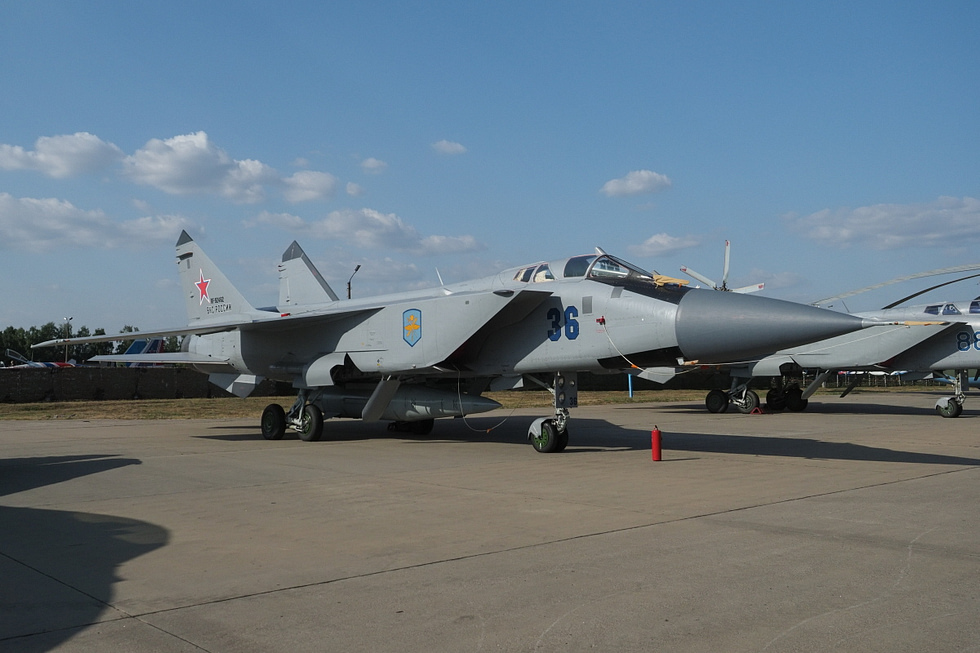
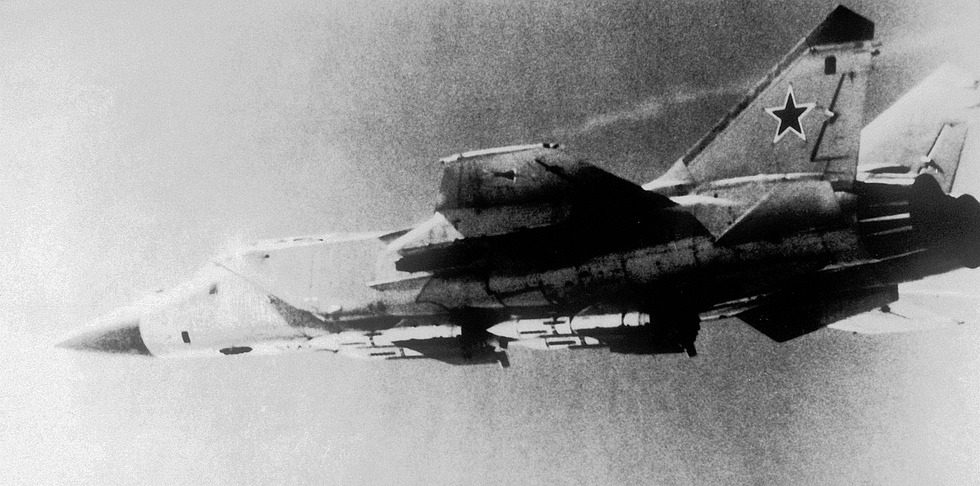
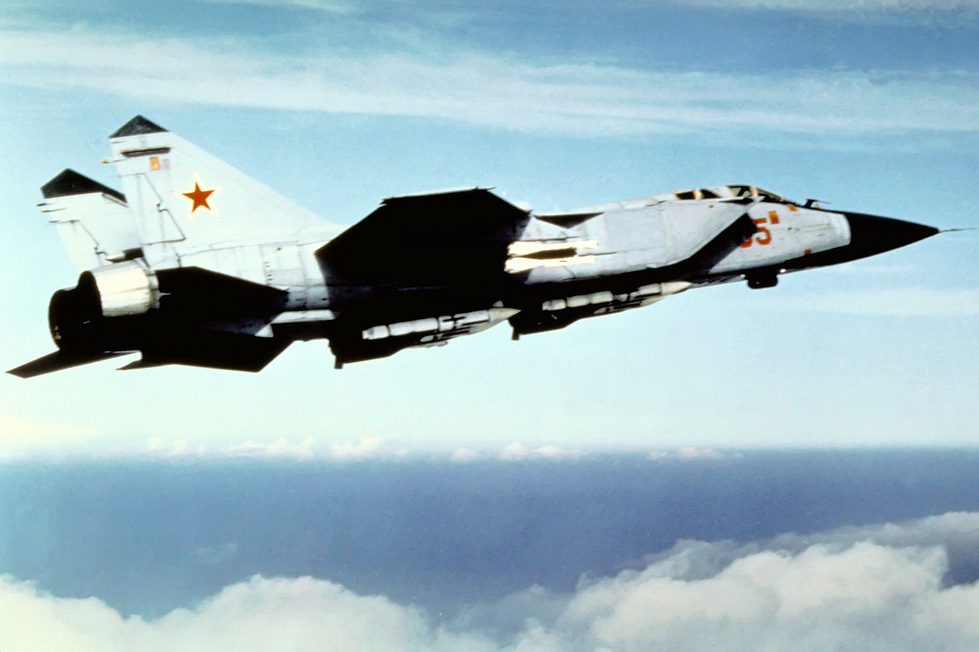
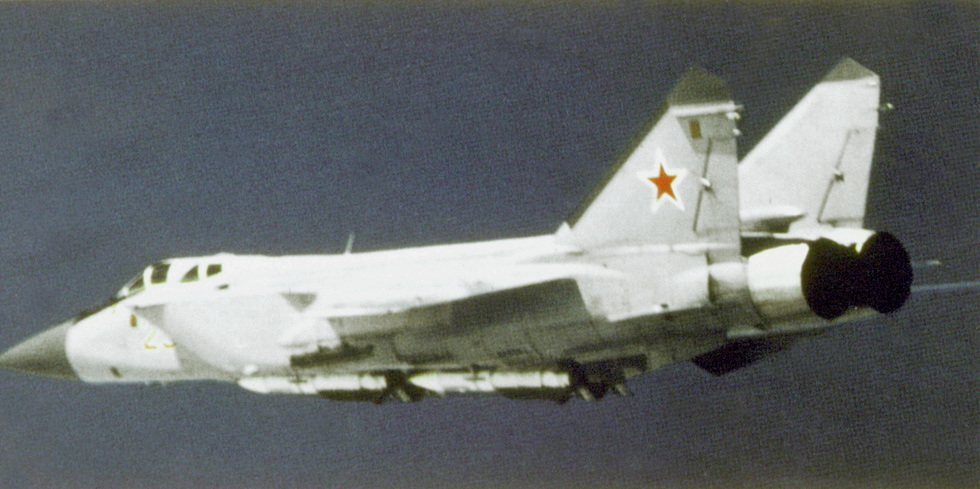
The Foxhound in motion
A documentary look at the MiG-31 — the Cold War interceptor still setting the pace.
Where the Foxhound flies
The fastest jet still in the fight
For most of its life the MiG-31’s job was deterrence — shadowing NATO patrols and guarding the Soviet, then Russian, frontiers rather than fighting. Since 2022 it has been widely reported firing R-37M air-to-air missiles and, as the MiG-31K, launching Kinzhal missiles over Ukraine. Treat the specific claims as contested: kill counts, record ranges and interception claims are all disputed and rarely independently verified.
Compare the combat record of every military aircraft. Figures as of July 2026.
Everything people ask about the MiG-31
Can I fly in a MiG-31?
How fast is the MiG-31?
Is the MiG-31 still in service?
What is the Kinzhal missile?
What is the Zaslon radar?
How is the MiG-31 different from the MiG-25?
You can’t fly the MiG-31.
These, you can.
Some legends only live in museums — others are fuelled and waiting. MiGFlug has put civilians in real military jet cockpits since 2004.
Continue the tour
Every fact, checked
- Airforce TechnologyMiG-31 airframe, radar and weapons overview (note: their cannon calibre is misstated).
- 19FortyFiveOrigins of the Foxhound and its 2020s status as an un-buildable but still-vital interceptor.
- CSIS Missile ThreatThe Kh-47M2 Kinzhal air-launched missile and the MiG-31K launch platform.
- Military Watch MagazineThe R-37M very-long-range missile and modernised MiG-31BM (claims treated as contested).
- MilitarnyiUkrainian assessment of MiG-31 and R-37M activity since 2022.
- The National InterestContext on Russian MiG-31s briefly based in Syria (a hosting arrangement, not a Syrian operator).
- The War Zone (TWZ)MiG-31 modernisation, Kinzhal operations and the type’s continuing role.
- The Aviation Geek ClubZaslon PESA radar history and MiG-31 development background.