
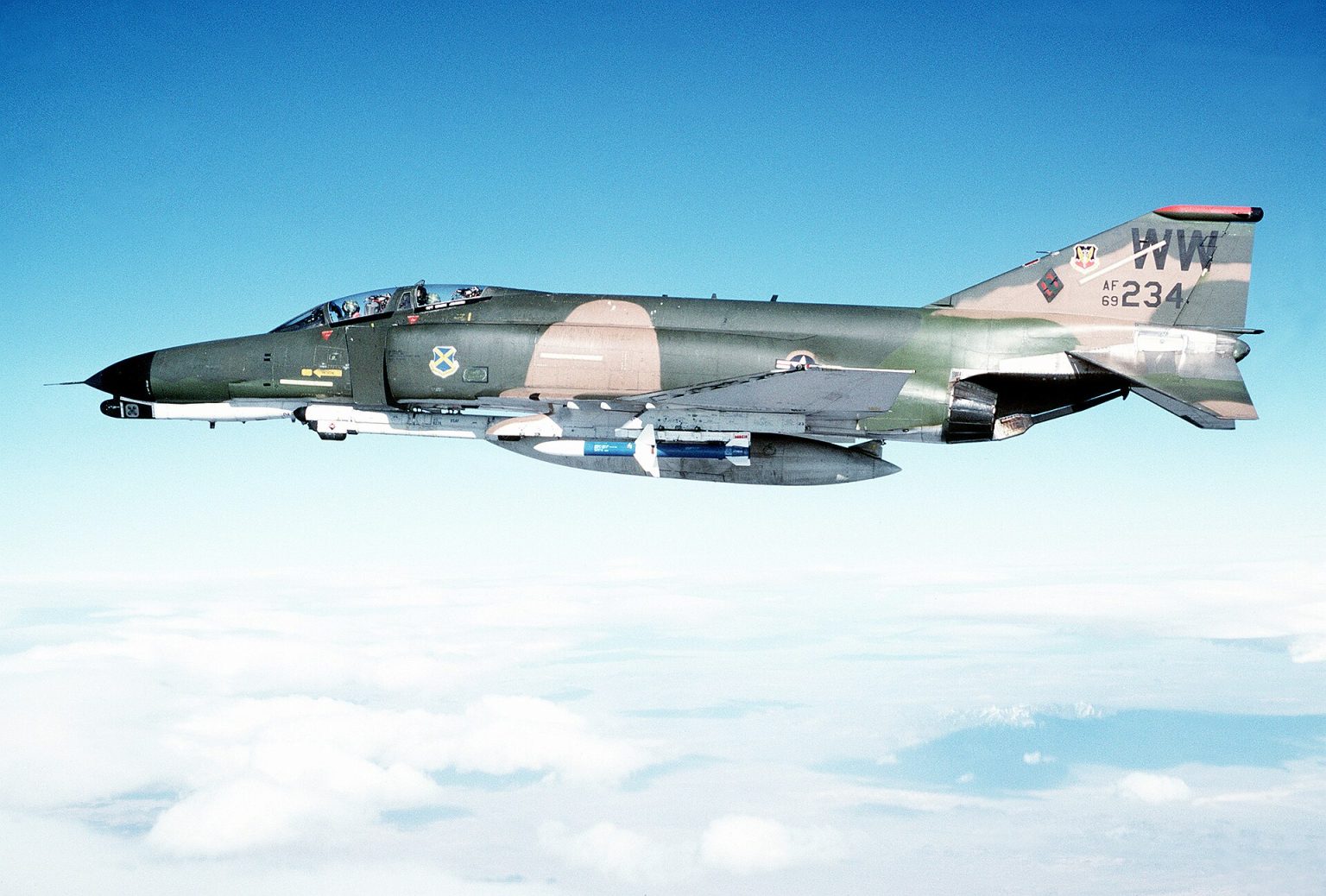
McDonnell Douglas F-4
“Phantom II”
The brute-force icon of the Cold War — a big, smoke-trailing twin-J79 fighter that served the US Navy, Air Force and Marines at once, produced every American ace of Vietnam, was exported across three continents, and still flies front-line missions in 2026, more than six decades after its first flight.
The Phantom: the brute-force icon of the Cold War
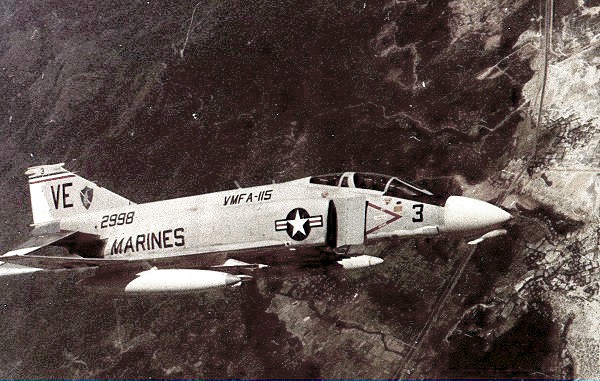
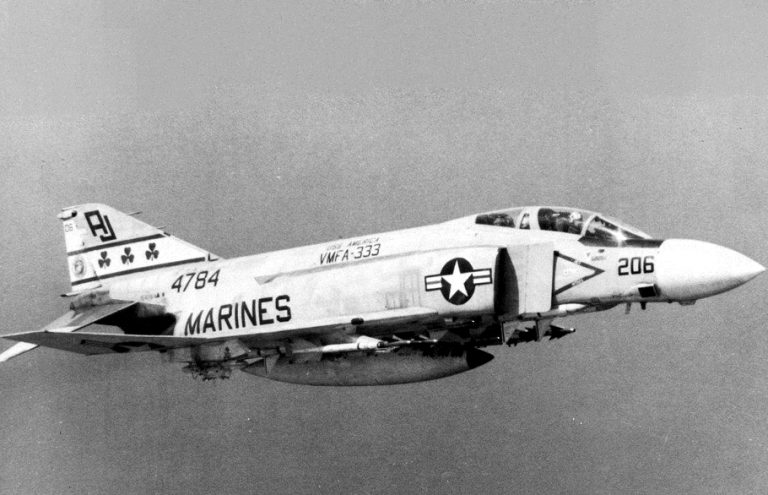
The Phantom is the brute-force icon of the Cold War: a big, heavy, smoke-trailing twin-J79 workhorse that muscled its way to Mach 2 and dominated the skies over Vietnam in USAF, Navy and Marine hands at once. Born as a US Navy fleet-defence interceptor, its raw performance was so far ahead of contemporaries that the Air Force adopted it too — a rare cross-service success — followed by the Marine Corps.
Early Phantoms carried only missiles — the era’s doctrine held that the guided missile had made the dogfight obsolete. Combat proved otherwise: against nimble MiG-17s and MiG-21s, unreliable early Sparrows and Sidewinders and the lack of a gun cost kills, and the lesson was written into the F-4E, which added an internal M61 Vulcan cannon in a reshaped nose.
Crews joked the Phantom was “proof that, given enough thrust, even a brick can fly,” and — for the many MiGs it downed and the many airframes shot down over North Vietnam — that McDonnell was “the world’s leading distributor of MiG parts.” Loved for its power, it remains the definitive multirole fighter of its generation.
01The F-4 Phantom’s numbers: how 5,195 airframes made it the most-produced US supersonic jet
Production ran from 1958 to 1981, with 5,195 built — 5,057 in St. Louis plus 138 assembled under licence in Japan by Mitsubishi. That makes the Phantom the most-produced American supersonic jet in history. Major variants spanned the F-4B/N (Navy), F-4C/D (USAF), the definitive gun-armed F-4E, the F-4G Wild Weasel SAM-hunter, the camera-nosed RF-4 reconnaissance jets and the upgraded Navy F-4J/S.
The type was exported very widely — to NATO air forces, the Middle East and East Asia — which is why, decades after US retirement, Phantoms still fly for a handful of operators around the world.
What makes the F-4 Phantom special
Twin J79 turbojets and raw thrust
A pair of afterburning General Electric J79 axial-flow turbojets — about 17,900 lbf each in the F-4E — gave the Phantom overwhelming thrust and climb. Between 1959 and 1962 it set 16 world records for speed, altitude and time-to-climb, several unbeaten until the F-15. The trade-off was the J79’s signature dark smoke trail, which made Phantoms visible for miles.
The unmistakable “bent” airframe
To fix stability problems without a full redesign, engineers gave the outer wing panels 12° dihedral (upturned tips) and the all-moving tailplane a pronounced 23° anhedral (downward droop). This aggressive, unmistakable silhouette became the Phantom’s visual trademark.
Heavy radar and missiles — then a gun
A large nose radar and a dedicated back-seat operator let the Phantom fight beyond visual range with AIM-7 Sparrow radar missiles, backed by AIM-9 Sidewinder heat-seekers. The gunless doctrine’s failure over Vietnam led to the F-4E’s built-in M61A1 20 mm Vulcan cannon.
02The F-4 Phantom’s bent wings: engineering fixes that became a trademark
The Phantom’s upturned wingtips and drooping tailplane were not styling — they were cheap fixes for stability problems found during development. Rather than redesign the whole wing, engineers cranked the outer panels up 12° and drooped the stabilator 23° to restore handling. The awkward geometry stuck, and became one of aviation’s most recognisable silhouettes.
03The F-4 Phantom’s gunless gamble: the doctrine Vietnam disproved
Early Phantoms carried only missiles, on the theory that dogfighting was dead in the missile age. Against agile MiG-17s and MiG-21s the theory failed: early Sparrows and Sidewinders were unreliable, and pilots caught in a close turning fight had nothing to shoot. Crews begged for a gun, and the F-4E answered with an internal M61 Vulcan in a reshaped nose — a hard-won lesson still taught in fighter design.
Full F-4 Phantom specifications
All three tables below are anchored on the F-4E, the gun-armed USAF version and the most-produced of the family. Major differences for other marks are given in grey.
Dimensions & weights
- Crew
- 2 (pilot and weapon systems officer in tandem) — USAF F-4C/D/E carried full flight controls in the rear cockpit; Navy back-seaters flew as radar intercept officers
- Length
- 19.20 m (63 ft 0 in) — F-4E; the gunless F-4B/C/D nose is shorter at 17.76 m (58 ft 3 in)
- Wingspan
- 11.70 m (38 ft 5 in) — 8.40 m (27 ft 7 in) with the outer panels folded
- Height
- 5.00 m (16 ft 5 in)
- Wing area
- 49.2 m² (530 sq ft) — aspect ratio 2.77, with the Phantom's trademark 12-degree outer-panel dihedral and anhedral tailplane
- Empty weight
- 13,757 kg (30,328 lb) — the German F-4F was roughly 1,500 kg lighter, stripped of the rear fuselage tank and Sparrow capability
- Loaded weight
- 18,824 kg (41,500 lb) — gross weight, clean
- Max takeoff weight
- 28,030 kg (61,795 lb) — maximum landing weight 16,706 kg (36,831 lb)
- Internal fuel
- ~5,880 kg (~12,960 lb / ~7,550 litres / ~1,994 US gal) — rises to about 21,680 lb with two 370 US gal wing tanks and a 600 or 610 US gal centreline tank
Performance
- Max speed (altitude)
- 2,370 km/h (1,473 mph / Mach 2.23) at 12,200 m (40,000 ft) — late slatted F-4Es traded a little top speed for high-alpha handling
- Max speed (sea level)
- 1,453 km/h (903 mph / Mach 1.19) — the Operation Sageburner record of 28 August 1961, flown below 125 ft; at low level the Phantom is held back by its indicated-airspeed limit, not by thrust
- Cruise speed
- 940 km/h (584 mph) — typical high-altitude cruise
- Rate of climb
- 210 m/s (41,300 ft/min) at sea level, clean — the number that made the Phantom's reputation
- Service ceiling
- 18,300 m (60,000 ft) — combat ceiling with a useful load is nearer 17,000 m (56,000 ft)
- Combat radius
- ~680 km (~423 mi / ~367 nmi) — mission-dependent; a hi-lo-hi strike profile with tanks and ordnance gives far less
- Ferry range
- ~2,700 km (~1,677 mi / ~1,457 nmi) with external tanks — the Phantom was a thirsty aircraft and lived off tankers
- Takeoff run
- 1,369 m (4,490 ft) at 24,410 kg (53,814 lb)
- Landing run
- 1,122 m (3,680 ft) at 16,706 kg (36,831 lb), drag chute deployed
- Load factor
- +8.5 g / −3.0 g design limit — the permitted symmetric g falls steeply with gross weight and external stores, and the flight manual's placarded limits are lower than the headline figure
Propulsion & systems
- Engines
- 2 × General Electric J79-GE-17A afterburning turbojets — F-4B used J79-GE-8, F-4C/D the -15, F-4J the -10; the British F-4K/M were uniquely re-engined with Rolls-Royce Spey 202/203 turbofans, which needed a fattened rear fuselage and enlarged intakes
- Thrust each
- 52.9 kN dry / 79.4 kN with afterburner (11,905 lbf / 17,845 lbf, often rounded to 17,900 lbf) — the early J79 trailed a black smoke plume that gave Phantoms away at long range; the smokeless -17C/-17E and F-4S -10A combustors eventually cured it
- Cannon
- 1 × 20 mm M61A1 Vulcan, 640 rounds internal, under the nose — F-4E onward only. The F-4A/B/C/D and the Navy's F-4J were built with no gun at all: doctrine held that missiles had made the gunfight obsolete. Vietnam disproved it expensively, and crews made do with drag-inducing, poorly boresighted SUU-16 and SUU-23 podded Vulcans until the F-4E arrived in 1967
- Hardpoints & max ordnance
- 9 stations, up to ~8,480 kg (~18,650 lb) — four semi-recessed fuselage wells for AIM-7 Sparrow plus centreline and four wing pylons; the practical load is much smaller once fuel is carried
- Radar
- AN/APQ-120 on the F-4E, shrunk in cross-section to make room for the cannon — F-4B AN/APQ-72, F-4C AN/APQ-100, F-4D AN/APQ-109, F-4J AN/AWG-10 with AN/APG-59 (the first look-down/shoot-down Phantom); Greek AUP aircraft carry AN/APQ-65YG, Turkish 2020 Terminators the Elta EL/M-2032, German ICE the AN/APG-65
- Ejection seats
- 2 × Martin-Baker Mk.H7 rocket-assisted seats — earlier Phantoms used the Mk.H5; the F-4J introduced zero-zero capability
- First flight
- 27 May 1958 (YF4H-1 prototype) — the gun-armed F-4E first flew in August 1965 and reached the USAF in October 1967
- Service entry
- 1961 with the US Navy (F-4B) — USAF F-4C from 1963, US Marine Corps from 1962; production ran until 1981
- Built
- 5,195 (1958–1981) — the most-produced American supersonic military aircraft ever. Largest single batch was the F-4E at ~1,370; ~138 F-4EJ were assembled in Japan by Mitsubishi under licence, the only Phantoms built outside the United States
- Unit cost
- ~USD 2.4 million flyaway per F-4E in 1965 dollars (airframe ~1.66 m, engines ~393,000, electronics ~299,000) — very roughly USD 20–25 million in today's money, which is why the Phantom was bought by the thousand and its successors are not
- Cost per flight hour
- ~USD 870 (1965 US Air Force accounting for the F-4E, of which ~545 was maintenance) — that is on the order of USD 8,000–9,000 in today's money. No current operator publishes a figure, and secondary compilations for late-life Phantom operation run higher still, around USD 10,000–11,000 per hour. Treat any of these as an order of magnitude, not a quotation
04The F-4 Phantom’s cost: what a Cold War workhorse was worth
A 1965 flyaway F-4 is commonly cited at around US$2.4 million, though figures vary widely by source, variant and year — other citations put it nearer $3 million. Adjusted for inflation that is a fraction of what a modern multirole fighter costs, which helps explain how so many air forces could afford and sustain the type for decades. Treat any single dollar figure as an approximation: procurement costs shifted across the long 1958–1981 production run.
Armament & payload
F-4 Phantom II armament and payload
The Phantom was designed as a fleet interceptor that would kill bombers with radar-guided missiles before ever seeing them. What it actually became was the most heavily worked multi-role aircraft of the Cold War: nine stations, some eight and a half tonnes of stores, and a weapons list that runs from 1950s beam-riding missiles to laser-guided bombs and anti-radiation missiles it helped invent. Almost every lesson the West learned about air combat and strike between 1965 and 1975 was learned on a Phantom's wing.
Gun
One 20 mm M61A1 Vulcan with 640 rounds, mounted internally under the nose — but only from the F-4E of 1967 onward. Every earlier mark was built without a gun on the doctrine that missiles had ended the dogfight. They had not. USAF F-4Cs carried SUU-16 and later SUU-23 podded Vulcans on the centreline from 1965 as a stopgap; the pods cost speed and drag, needed frequent boresighting to hit anything, and early USAF cockpits lacked a lead-computing sight. Crews said so plainly at the time. The internal gun was the single most requested fix in the programme's history.
Air-to-air
Four AIM-7 Sparrow (D/E/E-2, later F and M) semi-recessed in the fuselage wells, plus up to four AIM-9 Sidewinder (B/D/E/J/L/M) on wing pylon rails. USAF F-4Ds arrived in Vietnam in 1967 carrying the AIM-4 Falcon instead — a weapon built to kill straight-and-level bombers, with a complex firing sequence and a seeker whose cooling ran out on a fixed clock. Against manoeuvring MiGs it was close to useless, and squadrons rewired their aircraft back to Sidewinders. Later upgrades widened the envelope again: AIM-120 AMRAAM on Greek AUP and German ICE aircraft, Skyflash on British Phantoms, Python-3 on Israeli Kurnass, AAM-3 on the Japanese F-4EJ Kai.
Air-to-surface
AGM-12 Bullpup in the early years, then the weapons that defined Wild Weasel work: AGM-45 Shrike, AGM-78 Standard ARM and, on the F-4G, AGM-88 HARM. For precision attack, up to six AGM-65 Maverick (F-4E from Block 53) and four AGM-62 Walleye glide bombs. Turkish and Israeli upgrades added the AGM-142 Popeye / Have Nap stand-off missile. Nuclear delivery was a core mission throughout: B28, B43, B57 and B61 weapons were all cleared.
Bombs
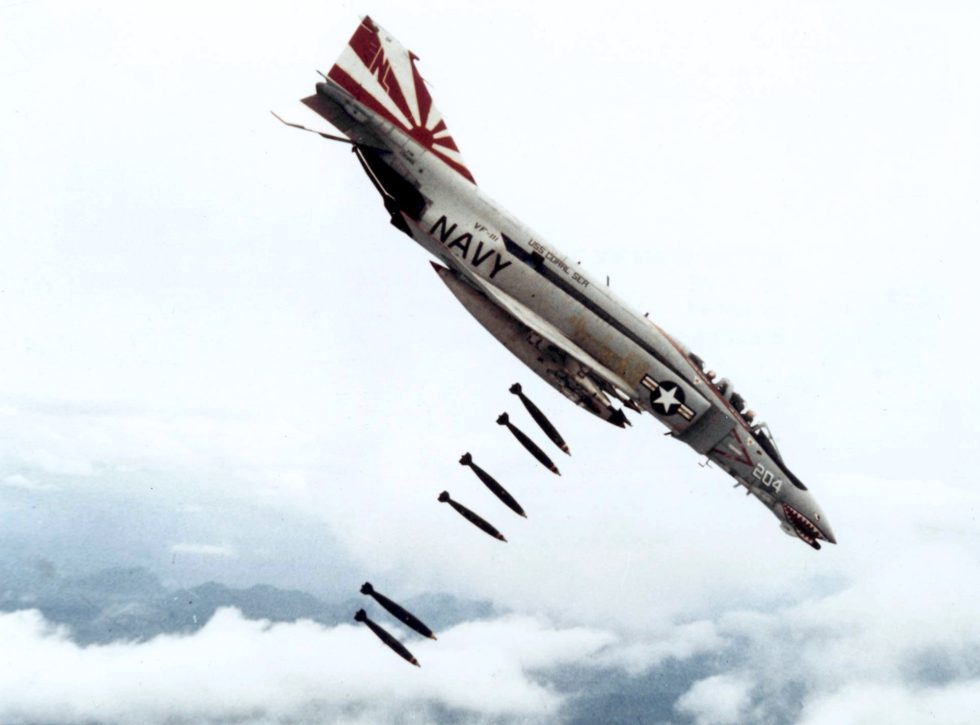
Iron bombs by the dozen: up to eighteen Mk 82 500 lb, or five Mk 84 2,000 lb, with Mk 83 in between. Cluster weapons including CBU-24, CBU-52, CBU-58, CBU-87, CBU-89 and Mk 20 Rockeye. The Phantom also carried some of the very first laser-guided bombs into combat — Paveway I kits on Mk 84 and Mk 117 bodies from 1968, and the GBU-10/GBU-12 families that followed. F-4s with Paveways finally dropped the Thanh Hoa Bridge in May 1972 after years of unguided attacks had failed against it. Later marks added GBU-15, GBU-24 and GBU-8 HOBOS.
Rockets & pods
LAU-3 nineteen-round pods of 2.75 in folding-fin rockets and LAU-10 four-round pods of 5 in Zuni — the latter notorious after an electrical fault fired a Zuni from a Phantom on USS Forrestal's deck in July 1967, starting a fire that killed 134 men. Pod stations otherwise carried the Phantom's electronic life-support: ALQ-87, ALQ-101, ALQ-119 and ALQ-131 jamming pods, chaff and flare dispensers, and the LORAN navigation fit whose dorsal aerial gave the "Pave Phantom" F-4D its distinctive towel-rail spine.
Other stores
Laser designation came from podded optics: Pave Knife (AN/AVQ-10) slung on an inboard pylon, then the much neater Pave Spike (AN/ASQ-153 / AN/AVQ-23) carried in a forward Sparrow well, and later Litening II on Turkish 2020 aircraft. Fuel was near-permanent: two 370 US gal wing tanks and a 600 or 610 US gal centreline. And the RF-4B/C/E gave up weapons entirely for sensors — KS-87 and KS-72 frame cameras, KA-55A and KA-91 panoramic cameras, AN/APQ-102 side-looking radar, AN/AAD-4 infrared linescan, and the enormous HIAC-1 long-range oblique camera in a centreline pod.
Representative F-4 Phantom II loadouts
- MiGCAP escort — F-4E, Linebacker, 1972
- Four AIM-7E-2 Sparrow in the fuselage wells, four AIM-9E Sidewinder on inboard pylon rails, 640 rounds for the internal M61A1, and a 600 US gal centreline tank. The first Phantom fit in which the crew had every option: beyond visual range, within visual range, and guns.
- Wild Weasel V — F-4G, Desert Storm, 1991
- The cannon removed and replaced by the AN/APR-47 radar homing and warning receiver, two AGM-88 HARM on the inboard pylons, an AIM-7 for self-defence, an ALQ-131 jamming pod, two 370 US gal wing tanks and a centreline tank. The F-4G was the reason coalition strike packages could fly at all in the first nights of the war.
- LGB strike — F-4D/E, Linebacker, 1972
- Two GBU-10 or GBU-12 Paveway laser-guided bombs on the inboard pylons, a Pave Knife or Pave Spike designator, an ECM pod in a rear Sparrow well, two AIM-7 retained, and wing tanks. Frequently flown as a pair: one aircraft designating, the other dropping.
Carriage is strongly mark-dependent and changed repeatedly over more than fifty years of service. Only the F-4E and later marks have an internal gun; the German F-4F was delivered without Sparrow capability at all; the F-4G traded its cannon for a radar-hunting receiver; the RF-4 series were built unarmed, though most export customers had them rewired for weapons. National upgrade programmes — Greek AUP, German ICE, Israeli Kurnass 2000, Turkish 2020 — each cleared their own distinct weapon sets. Treat any single stores list as a snapshot of one variant in one air force in one decade.
Variants
F-4 Phantom II variants
Five thousand one hundred and ninety-five airframes across twenty-three years produced a family tree of unusual breadth — carrier interceptor, land-based fighter-bomber, unarmed reconnaissance platform, radar killer, target drone. These are the marks that matter.
- F-4A / F-4B
- The originals. Forty-five F-4A development and early-production aircraft, then 649 F-4B carrier fighters for the US Navy and Marine Corps from 1961 — no gun, four Sparrows, and the performance that swept up fifteen world records from 1959, the absolute speed and absolute altitude marks among them. 228 were later rebuilt as F-4N.
- F-4C
- The Air Force's first Phantom, briefly designated F-110A Spectre: boom refuelling, cartridge starting, dual controls in the back seat, AN/APQ-100 radar. 583 built. It fought the opening years of the air war over North Vietnam without a gun.
- F-4D
- An F-4C with USAF-specific avionics and AN/APQ-109 radar; 825 built. Arrived in 1967 armed with the AIM-4 Falcon, which squadrons quickly abandoned for the Sidewinder. Later LORAN-equipped "Pave Phantom" F-4Ds became the first dedicated laser-guided-bomb delivery aircraft.
- F-4E
- The definitive Phantom and the most-produced variant at 1,370 aircraft: internal M61A1 Vulcan in a lengthened nose, slimmer AN/APQ-120 radar, J79-GE-17 engines, and from 1972 leading-edge slats that transformed its turning fight. Widely exported and the basis of nearly every later upgrade.
- F-4G Wild Weasel V
- 134 F-4Es converted into dedicated defence-suppression aircraft, cannon deleted in favour of the AN/APR-38 and later AN/APR-47 emitter-locating system, armed with Shrike, Standard ARM and HARM. The most capable SEAD platform of its generation; it left combat service in 1996.
- F-4J / F-4S
- 522 F-4Js for the Navy and Marines from 1966 — AN/AWG-10 fire control with genuine look-down/shoot-down, drooping ailerons, slatted tailplane, zero-zero seats. 302 were later rebuilt as F-4S with leading-edge slats and smokeless engines.
- RF-4B / RF-4C / RF-4E
- Unarmed tactical reconnaissance: 46 RF-4B for the Marines, 503 RF-4C for the USAF, 149 RF-4E for export. Cameras, side-looking radar and infrared linescan in a stretched nose; RF-4Cs flew combat reconnaissance from Vietnam to Desert Storm.
- F-4K / F-4M
- Britain's Phantoms, re-engined with Rolls-Royce Spey turbofans in a fattened fuselage with enlarged intakes — more thrust off short British carrier decks, but more drag and a lower top speed. 50 F-4K Phantom FG.1 for the Royal Navy and 116 F-4M Phantom FGR.2 for the RAF.
- F-4EJ
- Japan's simplified F-4E for the Air Self-Defense Force, initially built without ground-attack or in-flight refuelling capability for constitutional reasons. 140 aircraft, of which 138 were licence-built by Mitsubishi — the only Phantoms ever produced outside the United States. Later modernised as the F-4EJ Kai with AN/APG-66J radar and ASM-1 anti-ship missiles.
- F-4F ICE
- 175 lightened, simplified F-4Fs for West Germany, delivered without Sparrow capability. From the late 1980s some 110 were rebuilt under the ICE / KWS programme with AN/APG-65 radar and AIM-120 AMRAAM, turning a stripped-down fighter-bomber into a credible late-Cold-War interceptor.
- Kurnass 2000 & Terminator 2020
- Israel's Kurnass 2000, rebuilt by IAI with AN/APG-76 radar, new displays and a digital databus, entered service in 1989 and retired in 2004. Turkey had 54 F-4Es rebuilt on the same pattern as the F-4E 2020 Terminator, with Elta EL/M-2032 radar, HOTAS, a wide-angle HUD and some 20 km of new wiring; they entered service in 2000 and remain the most modern Phantoms flying.
The Phantom is now all but finished as a front-line aircraft. Germany retired its last F-4F ICE on 29 June 2013. Greece withdrew its RF-4E reconnaissance Phantoms in 2017 and began drawing down its fighter units the same year, though — contrary to a widely repeated claim — it has not retired the type: roughly 17 upgraded F-4E AUP were still flying with 338 Squadron at Andravida as of 2024. Japan retired the last F-4EJ Kai in 2021 and South Korea flew its final F-4E sorties in June 2024. That leaves three operators, all small: Greece, Turkey (about 30 F-4E 2020 Terminators with 111 Filo at Eskisehir, intended to serve until at least 2030) and Iran, whose F-4D, F-4E and RF-4E fleet is usually put at around 60 airframes — a figure that is not independently verifiable and which says nothing about how many are actually airworthy. Even the afterlife has ended: the USAF's QF-4 full-scale aerial target programme, which fed 314 converted Phantoms to missile trials, closed with a four-ship flight at Holloman on 21 December 2016. It is a quiet end for an aircraft built in greater numbers — 5,195 — than almost any other Western supersonic jet.
Seven decades of the F-4 Phantom
First flight
The XF4H-1 prototype takes to the air, flown by McDonnell test pilot Robert C. Little.
Sixteen world records
The Phantom sets 16 speed, altitude and time-to-climb records — Top Flight, Skyburner, LANA and Sageburner among them.
Enters Navy service
The type joins the US Navy fleet; the USAF and Marine Corps soon adopt it too.
Tri-service redesignation
Under the new joint system the Navy F4H-1 becomes the F-4B and the USAF version the F-4C.
Combat debut over Vietnam
The Phantom becomes the principal US air-superiority and strike fighter of the war.
The F-4E arrives
The definitive USAF version enters service with an internal M61 Vulcan cannon and slatted wing.
The first US aces
Navy crew Cunningham and Driscoll become the first US aces of the Vietnam War with five kills.
Kurnass at war
Israeli F-4E “Kurnass” Phantoms fight through the Yom Kippur War.
Last US active-duty Phantoms retire
The F-4G Wild Weasel bows out; QF-4 target drones fly on until 2016.
From the flight line: twelve Phantom stories
The five who made ace
Vietnam’s only US aces all flew Phantoms — three USAF, two Navy.
Read the full story
The gunless Phantom
Early F-4s carried only missiles, on the theory dogfighting was dead.
Read the full story
Britain’s Spey Phantoms
The RAF and Royal Navy flew unique Rolls-Royce Spey-engined F-4K/M variants.
Read the full story
Project Top Flight
A Phantom zoom-climbed to 98,557 ft in 1959, smashing the altitude record.
Read the full story
Wild Weasel
The F-4G hunted enemy radar and surface-to-air missile sites.
Read the full story
The QF-4 target drones
Retired Phantoms flew on pilotless as full-scale aerial targets.
Read the full story
Kurnass — Sledgehammer
Israel’s F-4E was a workhorse of the War of Attrition and 1973.
Read the full story
The Phantoms that won’t quit
Iran flew F-4s hard in the 1980s — and still flies them in 2026.
Read the full story
Distributor of MiG parts
Crews called the Phantom “the world’s leading distributor of MiG parts.”
Read the full story
The camera-nosed RF-4
Unarmed RF-4s swapped guns for cameras in a lengthened nose.
Read the full story
Fifty years and counting in Turkey
Turkey modernised its F-4Es into the F-4E/2020 “Terminator.”
Read the full story
The bent-wing brute
The upturned tips and drooping tail were stability fixes turned trademark.
Read the full story
The Phantom in pictures
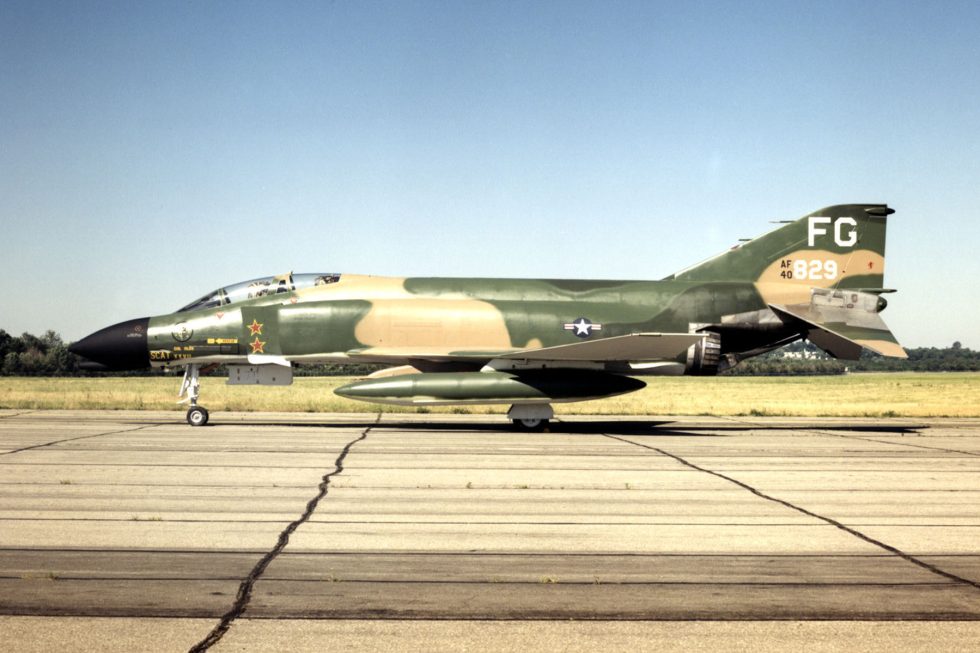
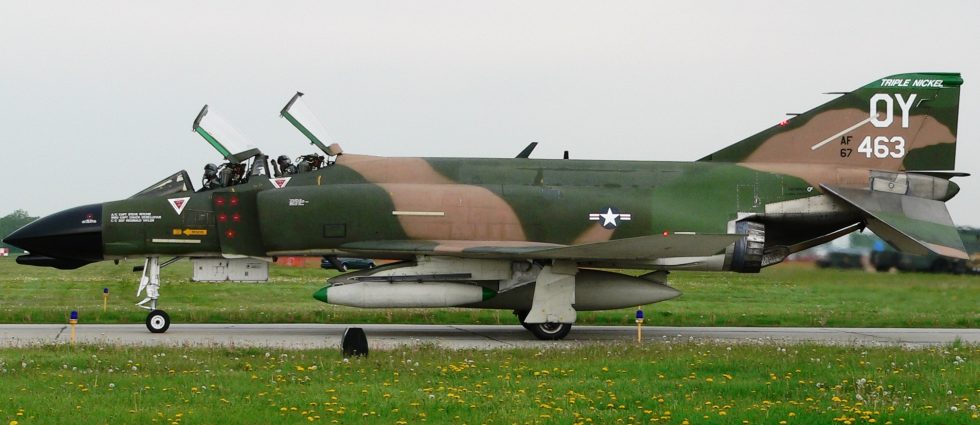
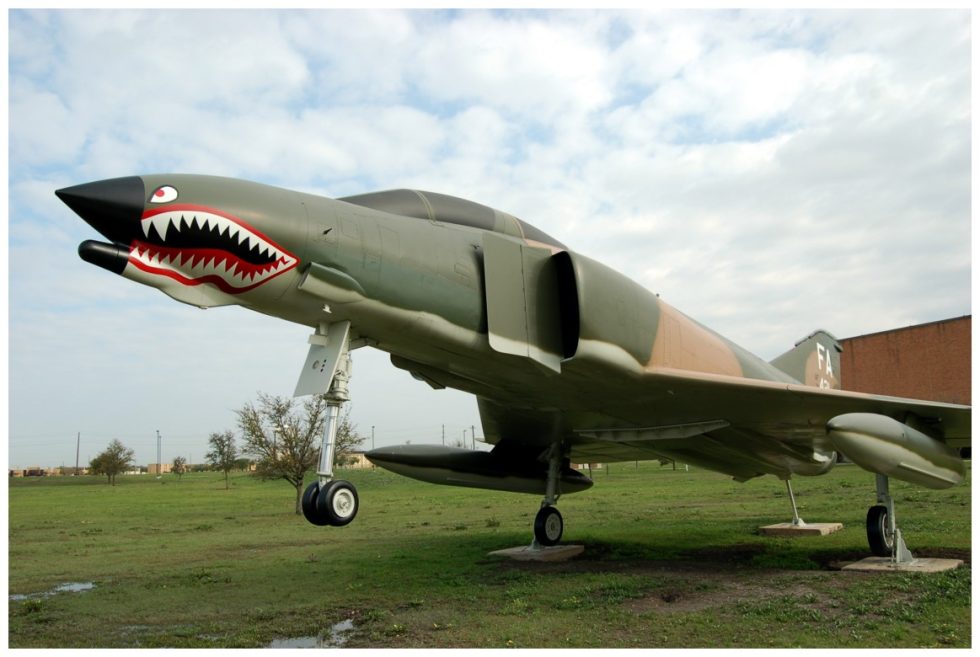
The F-4 Phantom in motion
Video coming soon — we’re sourcing a properly licensed clip of the F-4 Phantom and the unmistakable sound of its twin J79s. Check back shortly.
The F-4 Phantom II in motion
Extreme Mysteries — one of the most-watched F-4 Phantom II films on YouTube.
Where the Phantom flew
The F-4 Phantom’s combat record
The Phantom was the principal US air-superiority and strike fighter over Vietnam, and fought in the Arab–Israeli and Iran–Iraq wars too. Its Vietnam kill and loss tallies are genuinely contested between sources — always cite them as claims, not settled scores. What is beyond dispute is the breadth of its fighting career.
Compare the combat record of every military aircraft. Figures as of July 2026.
Everything people ask about the F-4 Phantom
Can I fly in an F-4 Phantom?
How fast is the F-4 Phantom?
Is the F-4 Phantom still in service?
What was the gun controversy?
What was its Vietnam record?
How many F-4 Phantoms were built?
What is a Wild Weasel?
You can’t fly the F-4 Phantom.
These, you can.
Some legends only live in museums — others are fuelled and waiting. MiGFlug has put civilians in real military jet cockpits since 2004.
 Fly the L-39 AlbatrosThe world’s most-flown jet trainer — aerobatics included
 Fly the F-104 Starfighter“The missile with a man in it”
 Fly the MiG-21The Cold War’s most-produced jet
 Fly the T-33 Shooting StarAmerica’s first jet trainer
 Fly the DH VampireA piece of early jet history
 Fly the S.211Agile Italian jet trainer
 Fly the MB-326The classic Aermacchi jet
 Fly the MiG-15The Soviet legend of the Korean War
Continue the tour
Every fact, checked
- GlobalMilitary.net — F-4 Phantom IISpecifications and operator overview (2026).
- 163d Attack Wing (US Air National Guard)Official F-4E Phantom II fact sheet.
- The AviationistRecords set by the F-4, and South Korea’s final Phantom retirement (2024).
- 19FortyFiveTurkey flying the F-4E/2020 “Terminator” until 2030 (Feb 2026).
- Naval History and Heritage CommandF-4N Phantom II service history.
- Key.AeroHow the Hellenic Air Force is still flying F-4 Phantoms after 50 years.
- The Aviation Geek ClubThe F-4 set 16 world records between 1959 and 1962.