
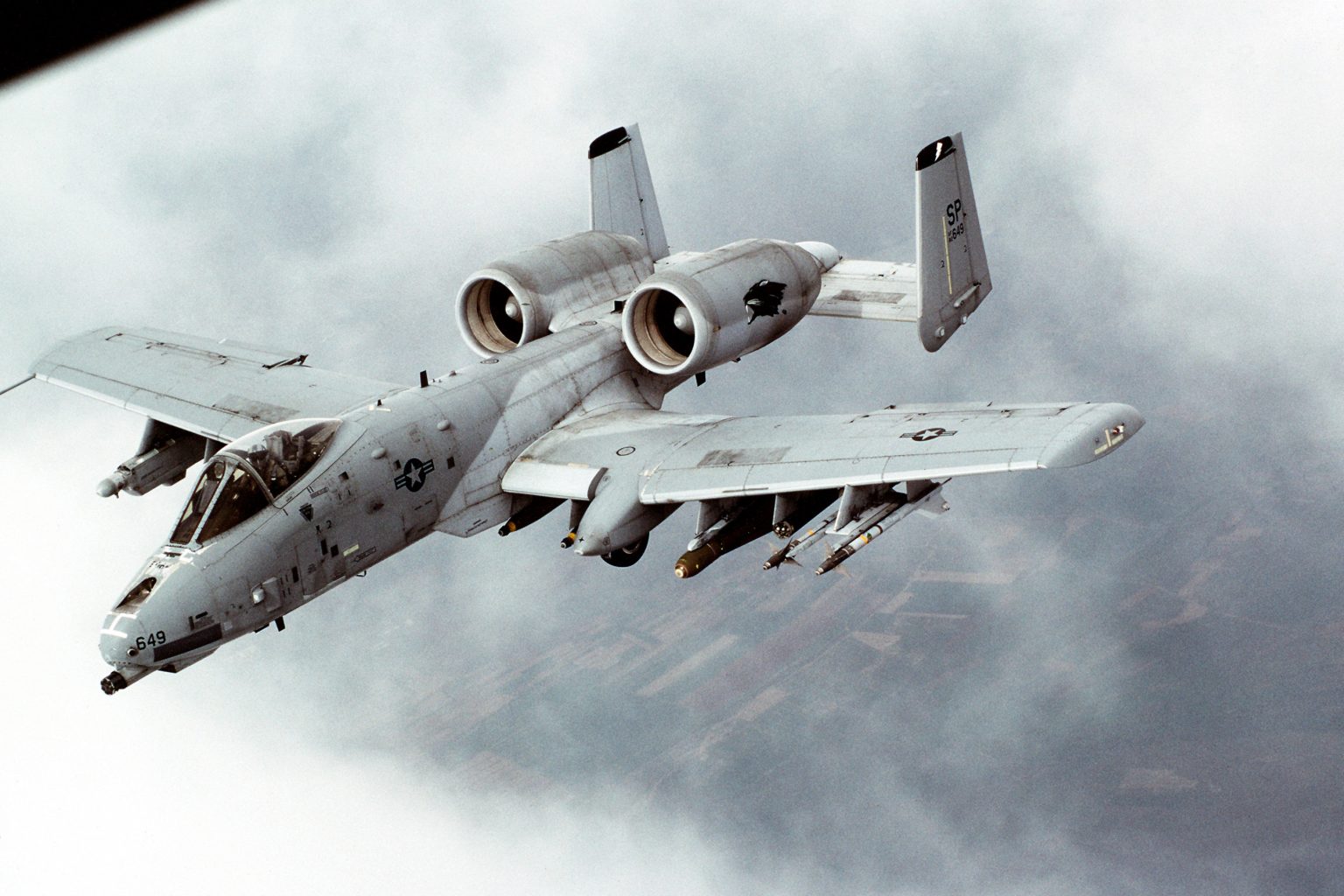
Fairchild Republic A-10
Thunderbolt II “Warthog”
The only American jet ever designed around a single weapon — the massive GAU-8 Avenger cannon. Deliberately ugly, brutally slow and almost impossible to kill, the Warthog became the close-air-support legend that ground troops adore and the Air Force keeps trying, and failing, to retire.
The plane they built around a gun
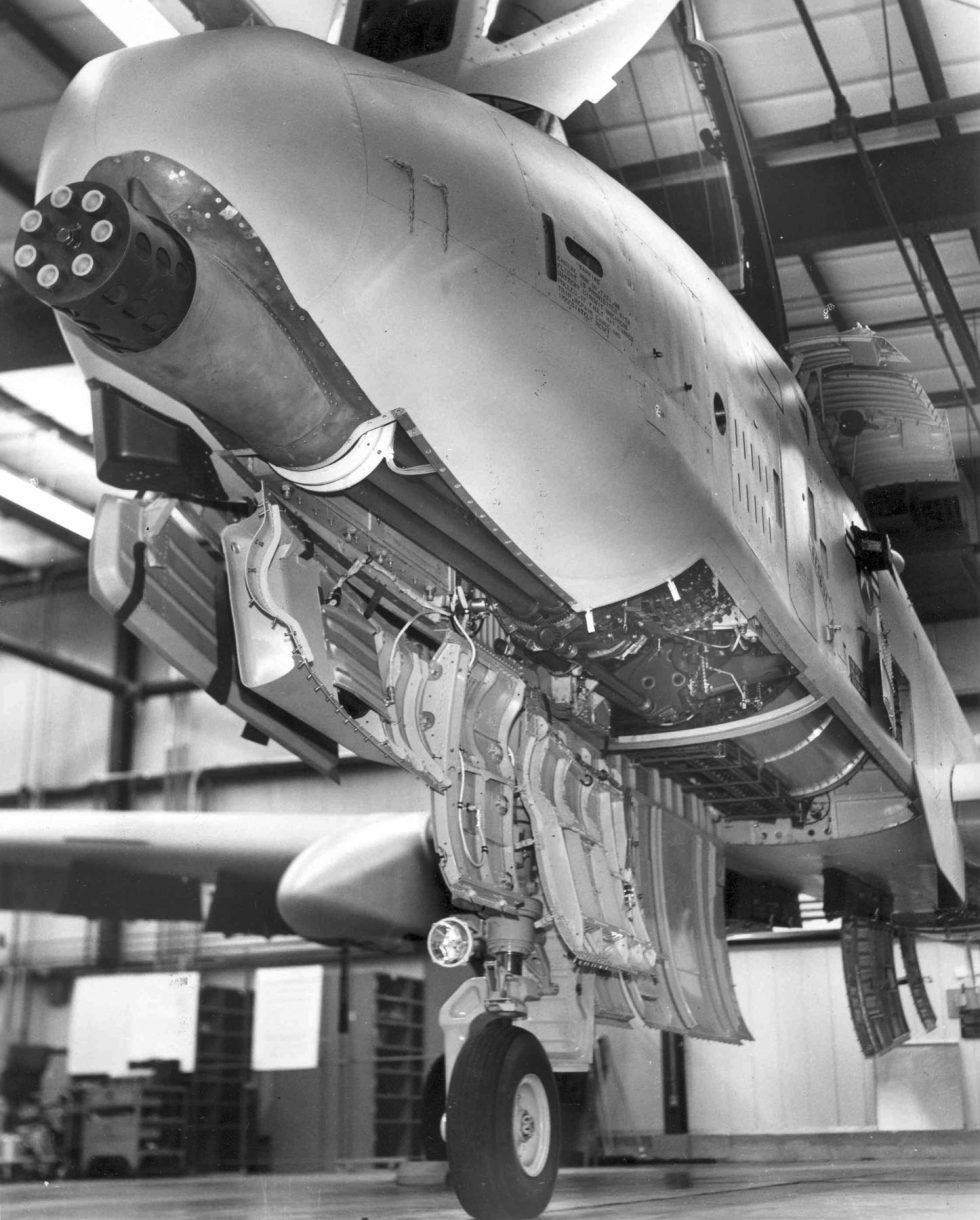
Most aircraft are designed and then armed. The A-10 was the reverse. Engineers took the GAU-8/A Avenger — a 30mm rotary cannon roughly the size and weight of a small car — and built an airplane around it. The result is deliberately ugly, slow and utterly single-minded: a flying gun that also happens to carry bombs and missiles. Born from the close-air-support lessons of Vietnam, the A-10 won a 1972–73 fly-off against the Northrop YA-9A and reached the squadrons in 1977.
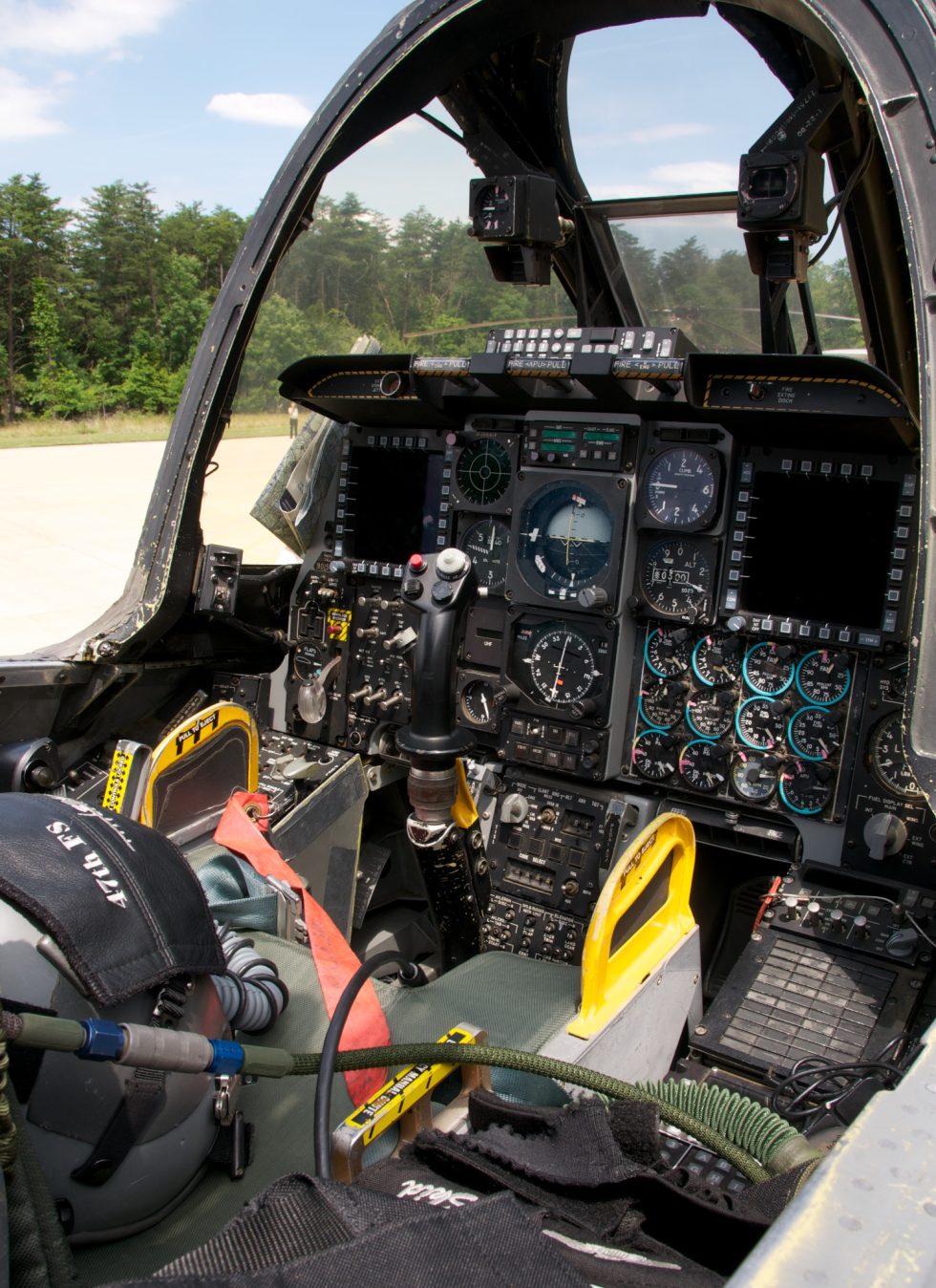
It is also one of the most survivable combat aircraft ever fielded. The pilot sits inside a titanium “bathtub” rated to shrug off armour-piercing rounds; the flight controls have a manual cable-and-crank backup; and the widely spaced, high-mounted engines and redundant systems let a hammered Warthog limp home missing an engine, a tail or half a wing.
Over Iraq in 1991 the A-10 became the tank-buster of Desert Storm, and it has protected troops in every American war since. Ground crews and soldiers love it precisely because it is built to absorb punishment — and to make that unmistakable “BRRRT.”
01The A-10 Warthog’s origin: how Vietnam’s lessons produced a jet built around a cannon
In the mid-1960s the U.S. Air Force learned a hard lesson over Vietnam: fast jets made poor close-air-support aircraft. They were too quick to see the battlefield, too fragile to loiter in the weeds, and too thirsty to stay overhead. The A-X (Attack Experimental) programme, launched in 1966–67, demanded something new — a survivable, heavily armed, long-loiter gun platform able to kill Soviet armour in a European war and take battle damage and keep flying.
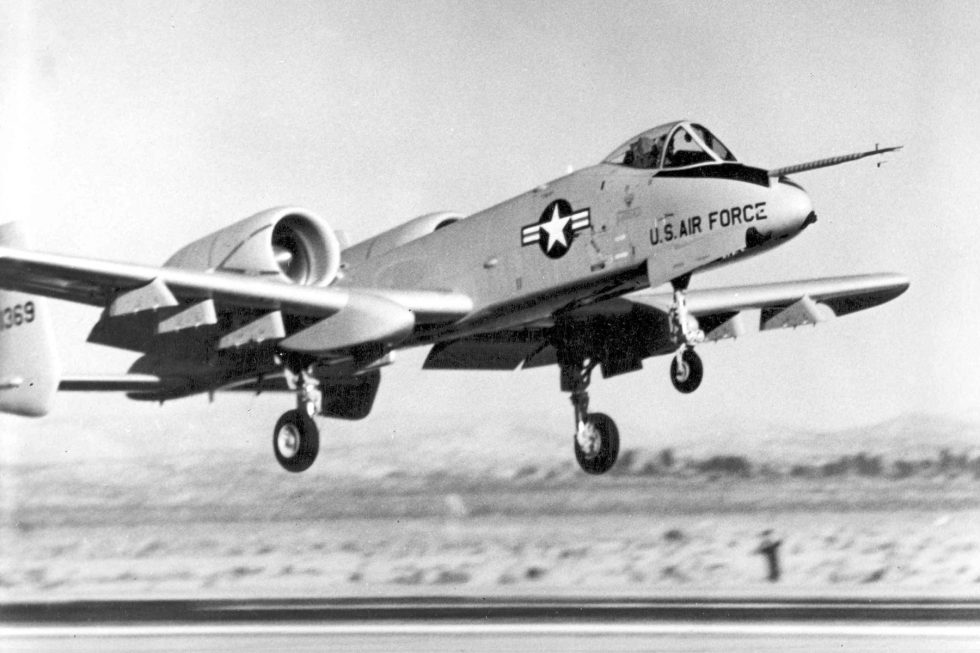
Fairchild Republic’s YA-10A beat the Northrop YA-9A in a competitive fly-off. The prototype first flew on 10 May 1972 and the type reached initial operational capability in October 1977. Roughly 716 were built into the mid-1980s, and the fleet was later rebuilt to the digital A-10C standard with precision weapons and a glass cockpit. No other combat jet has ever been so completely defined by a single weapon.
What makes the A-10 special
The GAU-8/A Avenger cannon
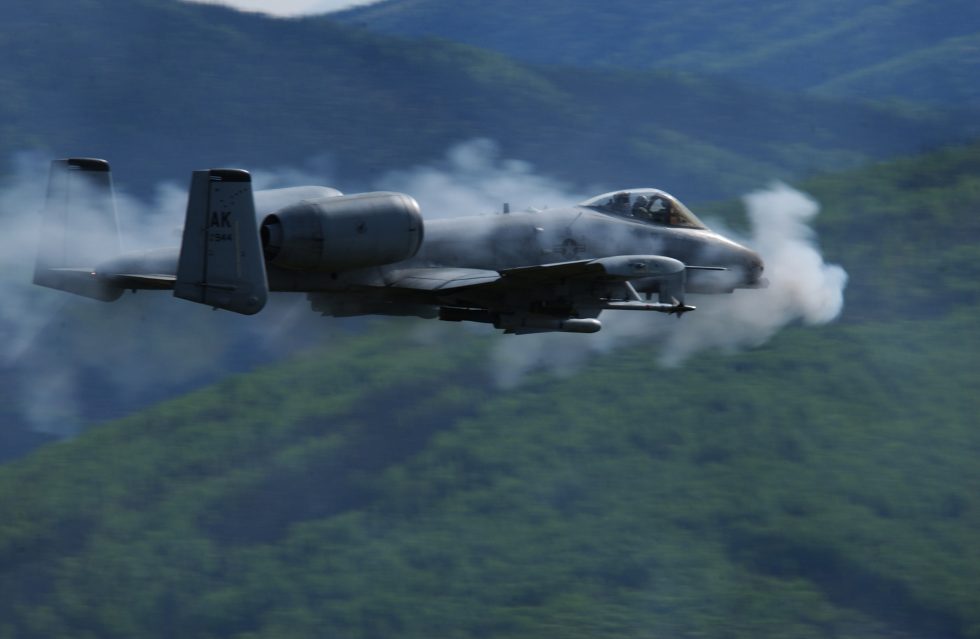
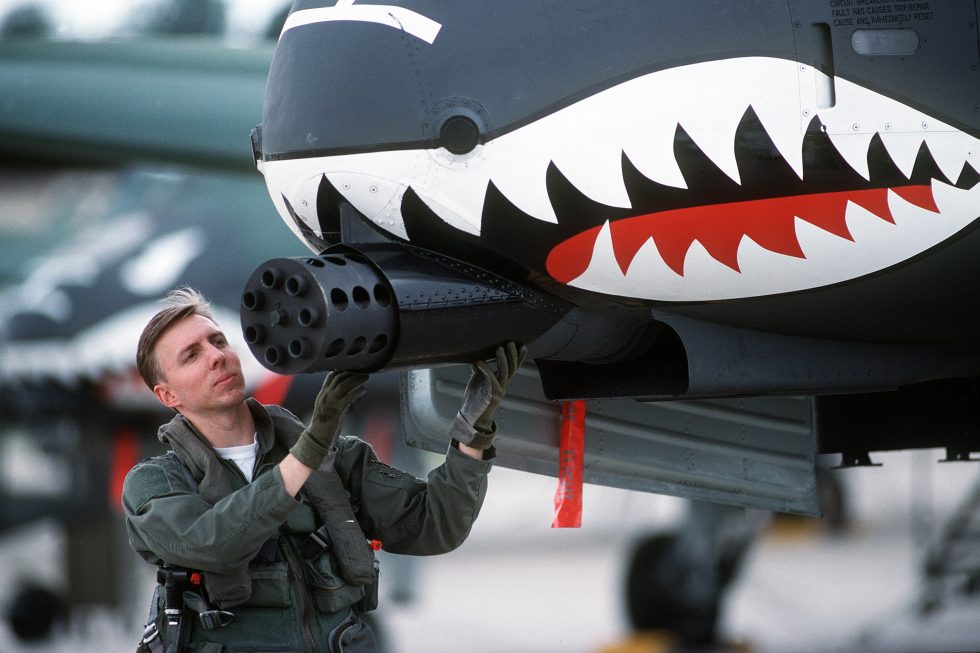
A seven-barrel 30mm Gatling gun firing depleted-uranium armour-piercing and high-explosive rounds at roughly 3,900 rounds a minute. The whole gun-and-ammunition system weighs about as much as a compact car, and it is mounted slightly off-centre so the firing barrel sits on the jet’s axis. Its recoil is strong enough to be felt in flight — the source of the unmistakable “BRRRT.”
The titanium bathtub
The cockpit is wrapped in a tub of titanium armour — roughly 550 kg — rated to stop hits up to 23mm. Flight controls include manual reversion: cranks, cables and pulleys that let a pilot with zero hydraulics still fly and land. The A-10 can keep flying with one engine, one tail, one elevator and half a wing shot away.
Twin high-mounted TF34 turbofans
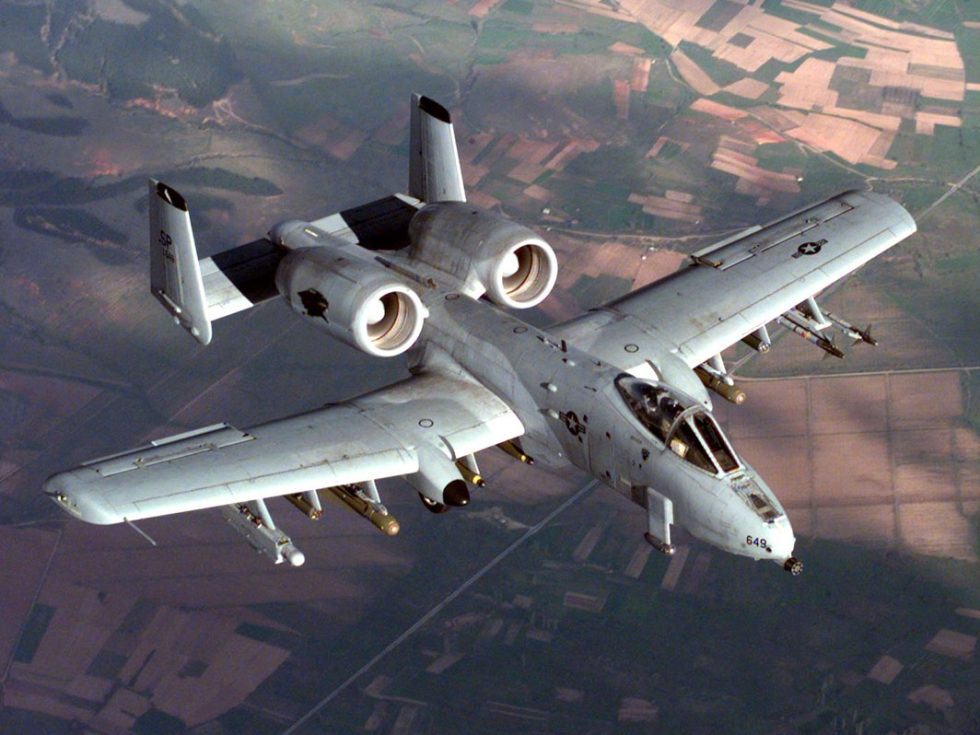
Two General Electric TF34-GE-100 turbofans are podded high and far aft. The placement shields them from ground fire and debris on rough forward airstrips, keeps the infrared signature down and eases engine changes. It is a survivability-first, austere-basing design — not a speed design.
02The A-10’s GAU-8: the cannon the whole jet was designed around
The GAU-8/A Avenger is the heart of the Warthog. Carrying 1,174 rounds in a drum behind the cockpit, it spits 30mm shells so fast the individual shots blur into a single ripping growl. Fired from distance, the rounds often strike before the sound of the gun arrives. It was designed to punch through the top armour of Soviet tanks, and the airframe — even the off-centre nose gear — was arranged to make room for it and to keep the firing barrel on the centreline. No other combat aircraft has ever been so completely subordinated to one weapon.
03The A-10’s survivability: why the Warthog is so hard to shoot down
Survivability was the whole point. Beyond the titanium bathtub, the A-10 has self-sealing, foam-filled fuel tanks, redundant hydraulic flight controls with a full manual-reversion backup, and widely spaced engines and twin tails so that damage to one side need not be fatal. Pilots have flown home jets riddled with hundreds of holes, missing large sections of tail or wing. It is the opposite philosophy to a fast, fragile interceptor: the Warthog is built on the assumption that it will be hit, and engineered to bring its pilot back anyway.
Full specifications
A-10 Thunderbolt II — dimensions & weights
- Crew
- 1 (single pilot)
- Length
- 16.26 m (53 ft 4 in)
- Wingspan
- 17.53 m (57 ft 6 in)
- Height
- 4.47 m (14 ft 8 in)
- Wing area
- 47.0 m² (506 ft²)
- Empty weight
- 11,320 kg (24,959 lb)
- Normal takeoff weight
- 21,360 kg (47,094 lb) typical close-air-support mission
- Max takeoff weight
- 23,000 kg (50,000 lb)
- Internal fuel
- ~4,990 kg (~11,000 lb) in four self-sealing tanks; published figures vary slightly
A-10 Thunderbolt II — performance
- Max speed
- 706 km/h (439 mph, 381 kn) clean, at sea level
- Cruise speed
- 560 km/h (348 mph, 302 kn)
- Rate of climb
- 30.5 m/s (6,000 ft/min)
- Service ceiling
- 13,700 m (45,000 ft)
- Combat radius
- ~460 km (~250 nmi) on the CAS profile, with roughly 1.5–2 hours of loiter over the target area; radius trades directly against loiter time and ordnance load
- Ferry range
- ~4,150 km (~2,240 nmi) with external tanks and reserves
- Takeoff run
- 1,220 m (4,000 ft) at maximum weight; far shorter at light CAS weights, from semi-prepared strips
- Landing run
- 610 m (2,000 ft)
- Load factor
- +7.33 g clean; reduced with external stores
- Why so slow
- Deliberate design choice — straight, thick, high-lift wing and unaugmented high-bypass turbofans were chosen for endurance, low-speed manoeuvrability and tight turns beneath low cloud, the flight regime where a gun and unguided stores actually hit. Speed was traded away on purpose for time over the target and battle damage tolerance.
A-10 Thunderbolt II — propulsion & systems
- Engines
- 2 × General Electric TF34-GE-100 high-bypass turbofans mounted in podded nacelles high on the rear fuselage — shielded from ground fire by the wing and tailplanes, kept clear of debris on rough strips, and with the exhaust masked between the twin fins to cut the infrared signature
- Thrust each
- 40.3 kN (9,065 lbf) dry; no afterburner
- Cannon
- 1 × GAU-8/A Avenger 30 mm seven-barrel rotary cannon — the aircraft’s defining feature, roughly 5.9 m (19 ft 5 in) long with its feed system and mounted on the centreline, with the firing barrel on the aircraft centreline and the nose gear offset to starboard. About 1,174 rounds carried (1,150 is a common combat load), firing at 3,900 rounds per minute; early aircraft had a selectable 2,100/4,200 rpm rate.
- Hardpoints & max ordnance
- 11 stations (8 underwing, 3 under the fuselage); ~7,260 kg (~16,000 lb) maximum external load, rarely carried in full because fuel and loiter matter more
- Armour
- ~540 kg (~1,200 lb) titanium “bathtub” enclosing the cockpit, rated against direct hits from armour-piercing rounds up to 23 mm; flight controls are redundant with a manual reversion mode
- Avionics & targeting
- AN/AAS-35(V) Pave Penny laser spot tracker on early aircraft — a receiver only, unable to designate; the A-10C added LITENING and Sniper targeting pods, a digital stores management system and multifunction displays
- Ejection seat
- ACES II zero-zero
- First flight
- 10 May 1972 (YA-10A prototype)
- Service entry
- 1977 first operational squadron; deliveries to training units began in 1975
- Built
- ~716 including prototypes and pre-production aircraft; production ended in 1984
- Unit cost
- ~US$18.8 million (USAF figure in fiscal 1998 constant dollars)
- Cost per flight hour
- ~US$20,000–25,000 estimate; published USAF figures move year to year and depend heavily on which support costs are counted, but the A-10 is consistently among the cheapest fast jets in the inventory to fly
04The A-10’s numbers and cost: how many Warthogs were built — and what happens next
Production totals for the A-10 are usually given as about 716, though some sources cite 713; the difference reflects how prototypes and pre-production airframes are counted. Air & Space Forces Magazine lists roughly 162 still in USAF inventory as of 2026. The often-quoted unit cost of about $18.8 million is a 1998 flyaway figure and should be treated as historical — real costs vary widely by source and year.
On retirement: the A-10 is being retired through the 2020s, but its service life has now been extended toward ~2030. The Air Force spent years trying to divest the whole fleet to fund the F-35, but Congress repeatedly reversed a full-fleet retirement, keeping selected squadrons flying. The final A-10 pilot training class graduated in April 2026. Do not call the Warthog “retired” — it is bowing out slowly, and later than the Air Force planned.
What the A-10 Thunderbolt II carries
The A-10 was designed around its gun and then given eleven pylons for everything else. In practice a Warthog flies with far less than its maximum load: fuel, a targeting pod, a couple of precision weapons and a full ammunition drum buy more useful time over a target than a full rack of iron bombs.
Gun
GAU-8/A Avenger, a 30 mm seven-barrel hydraulically driven rotary cannon firing at 3,900 rounds per minute from a drum of roughly 1,174 rounds — about 15–20 seconds of total firing time, used in short bursts. Two round types dominate: PGU-14/B API with a depleted-uranium penetrator, and PGU-13/B HEI for soft targets and vehicles, usually belted in a mixed load. The gun’s tank-killing record is genuinely debated: post-Desert Storm analyses credited the A-10 fleet with large numbers of armour kills, but later battle-damage assessment teams found many claims could not be confirmed, and several analysts argue Maverick missiles and other platforms accounted for more armour than the cannon did. What is not in dispute is the gun’s effect on trucks, light armour, artillery, air defences and dug-in infantry — and its psychological effect on troops on the receiving end.
Air-to-air
AIM-9 Sidewinder, typically a pair on an outboard station, carried strictly for self-defence. The A-10 has no radar and no beyond-visual-range capability; the missile exists so a Warthog caught by a hostile aircraft is not defenceless, not so it can go hunting.
Air-to-surface missiles
AGM-65 Maverick in its A-10 variants — the electro-optical AGM-65B, the imaging-infrared AGM-65D and G for night and poor weather, and later laser-guided AGM-65E/L versions used where the warhead and guidance suit troops in close contact. Maverick gave the aircraft a stand-off armour-killing shot well outside the range at which the gun forces it to fly.
Bombs
Mk 82 (500 lb) and Mk 84 (2,000 lb) general-purpose bombs, GBU-38 and GBU-31 JDAM satellite-guided weapons, GBU-12 and other Paveway laser-guided bombs, and cluster munitions including CBU-87, the CBU-89 mine dispenser and the wind-corrected CBU-103. Cluster weapons have largely fallen out of routine use on policy grounds.
Rockets & pods
Hydra 70 rockets in LAU-61/LAU-68/LAU-131 launchers, including white-phosphorus marking rockets used by A-10 and OA-10 crews to mark targets for other aircraft — one of the oldest jobs the type performed. Laser-guided APKWS rockets were added later. Targeting is carried externally: AN/AAQ-28 LITENING or AN/AAQ-33 Sniper pods, alongside ALQ-131 or ALQ-184 electronic countermeasures pods.
Other stores
External fuel tanks on the fuselage and inboard wing stations for ferry flights — rarely carried in combat, since they cost drag and stations. Internal ALE-40 chaff and flare dispensers, with expendables also carried in wing-mounted dispensers, remain the primary defence against infrared missiles and radar-guided threats at the low altitudes the aircraft works in.
Representative fits
- Classic close air support
- Full gun load, six Mk 82 bombs, two LAU-131 rocket pods with a mix of high-explosive and white-phosphorus marking rockets, one ALQ-131 ECM pod, two AIM-9 for self-defence.
- Anti-armour
- Full gun load, four to six AGM-65 Mavericks on triple-ejector racks, ECM pod, two AIM-9, chaff and flares — the Desert Storm tank-plinking configuration.
- Modern precision CAS (A-10C)
- Full gun load, Sniper or LITENING targeting pod, two GBU-38 JDAM, two GBU-12 Paveway II, a rocket pod with APKWS guided rockets, ECM pod and self-defence AIM-9.
Loadouts above are representative rather than fixed. Real configurations are built mission by mission around fuel, expected threat, weather and the ground commander’s requirement, and published payload maxima are almost never flown.
A-10 Thunderbolt II variants
- A-10A
- The original single-seat production aircraft, analogue cockpit, Pave Penny laser spot tracker, built from 1975 until production ended in 1984.
- OA-10A
- Not a separate airframe but A-10As assigned to the forward air control mission, marking targets with white-phosphorus rockets and directing other aircraft onto them.
- A-10B
- A two-seat night and adverse-weather demonstrator converted from a single airframe; evaluated but not produced in quantity, and the requirement was never funded.
- A-10C
- The Precision Engagement upgrade that brought the fleet up to modern standard: multifunction displays and a glass cockpit, digital stores management, hands-on-throttle-and-stick controls, integrated targeting pods and satellite- and laser-guided weapons.
- Wing replacement programme
- A re-winging effort begun in the 2000s fitted new-build enhanced wing assemblies to much of the fleet, intended to extend structural life well past the original airframe hours and keep the type flyable into the 2030s if the service chose to.
The A-10 has flown with only one operator in its entire career: the United States Air Force, across active-duty, Air National Guard and Air Force Reserve Command units. It was never exported, and no foreign air force has operated the type. Of roughly 716 aircraft built, the fleet has been progressively retired since the 2010s; something on the order of 150 aircraft — a rounded estimate, not an official inventory — remained in the mid-2020s. The USAF has stated its intention to divest the remaining A-10s within the next few years, but that should be read as a plan rather than a settled date: retirement proposals have been advanced, blocked, partially approved and rescheduled repeatedly by Congress since 2014, and the timeline has shifted more than once.
Five decades of the Warthog
The A-X programme
The USAF launches Attack Experimental for a dedicated, survivable close-air-support aircraft after Vietnam.
YA-10A first flight
The Fairchild Republic prototype takes to the air — an airframe designed around the GAU-8 cannon.
Wins the fly-off
The YA-10A beats the Northrop YA-9A in a competitive fly-off for the A-X requirement.
Enters service
The A-10A reaches initial operational capability with the U.S. Air Force.
Production ends
The line closes after roughly 716 aircraft, all for the United States.
Desert Storm
The Warthog’s combat debut and defining campaign — tank-busting fame over Iraq and Kuwait.
Kosovo to anti-ISIS
Close air support over Kosovo, Afghanistan and Iraq, then heavy use against ISIS from 2014.
The digital A-10C
The fleet is rebuilt to A-10C standard with precision weapons and a glass cockpit; re-winging extends airframe life.
The long goodbye
The USAF begins retiring squadrons; Congress repeatedly slows it, and service life is now extended toward ~2030.
From the flight line: twelve Warthog stories
The plane built around a gun
They started with the cannon and drew the jet behind it.
Read the full story
BRRRT
The most famous sound in modern aviation.
Read the full story
The titanium bathtub
A tub of armour that keeps pilots alive.
Read the full story
23 tanks in one day
25 February 1991.
Read the full story
Kim Campbell’s manual landing
7 April 2003, over Baghdad.
Read the full story
The jet that refused to die
The Air Force has tried to retire it for years.
Read the full story
Warthog nose art
Shark-mouth teeth on an ugly face.
Read the full story
The close-air-support legend
Slow, low and loyal.
Read the full story
Fly on one engine, half a wing
Built to be shot and survive.
Read the full story
Rough-field warrior
No pampered runway needed.
Read the full story
Back in the fight, 2014
Four decades on, still relevant.
Read the full story
The long goodbye, 2020s
An expiration date that keeps moving.
Read the full story
The Warthog in pictures
The Warthog in motion
A hand-picked A-10 film is on the way — video coming soon.
The A-10 Thunderbolt II in motion
Real Engineering — one of the most-watched A-10 Thunderbolt II films on YouTube.
Where the Warthog flies
The Gulf War’s tank-buster
The A-10’s defining campaign was Desert Storm in 1991, its combat debut. Warthogs flew thousands of sorties and were credited with destroying huge numbers of Iraqi armour and vehicles — figures that are official USAF-attributed claims and hard to verify independently, so treat them as claims rather than settled totals. The jet went on to fight in Kosovo, Afghanistan, Iraq and the anti-ISIS campaign.
Compare the combat record of every military aircraft. Figures as of July 2026.
Everything people ask about the A-10 Warthog
Can I fly in an A-10?
Is the A-10 fast?
What is that famous gun?
Is the A-10 still in service?
Why is the A-10 so survivable?
How many A-10s were built?
Why is it so ugly — and so loved?
You can’t fly the A-10.
These, you can.
Some legends only live in museums — others are fuelled and waiting. MiGFlug has put civilians in real military jet cockpits since 2004.
 Fly the L-39 AlbatrosThe world’s most-flown jet trainer — aerobatics included
 Fly the F-104 Starfighter“The missile with a man in it”
 Fly the MiG-21The Cold War’s most-produced jet
 Fly the T-33 Shooting StarAmerica’s first jet trainer
 Fly the DH VampireA piece of early jet history
 Fly the S.211Agile Italian jet trainer
 Fly the MB-326The classic Aermacchi jet
 Fly the MiG-15The Soviet legend of the Korean War
Continue the tour
Every fact, checked
- Air & Space Forces Magazine — A-10 weapons profileSpecifications, weapons and inventory figures for the Thunderbolt II.
- Air & Space Forces Magazine — retirement delayed to 2030The Air Force’s decision to extend A-10 service life toward 2030.
- The AviationistA-10 service life extended to 2030 (April 2026).
- Military TimesThree A-10 squadrons extended through 2030.
- Smithsonian (Air & Space) — “The Day We Took Out 23 Tanks”First-hand account of the 25 February 1991 tank-killing sorties.
- Task & Purpose — Kim CampbellCapt Kim Campbell’s manual-reversion landing over Baghdad.
- The Aviation Geek ClubDesert Storm tank-killing and GAU-8 engineering detail.
- Hill Aerospace MuseumA-10A history and technical data.