Lockheed Martin F-35 Lightning II — History, Specs & Stories

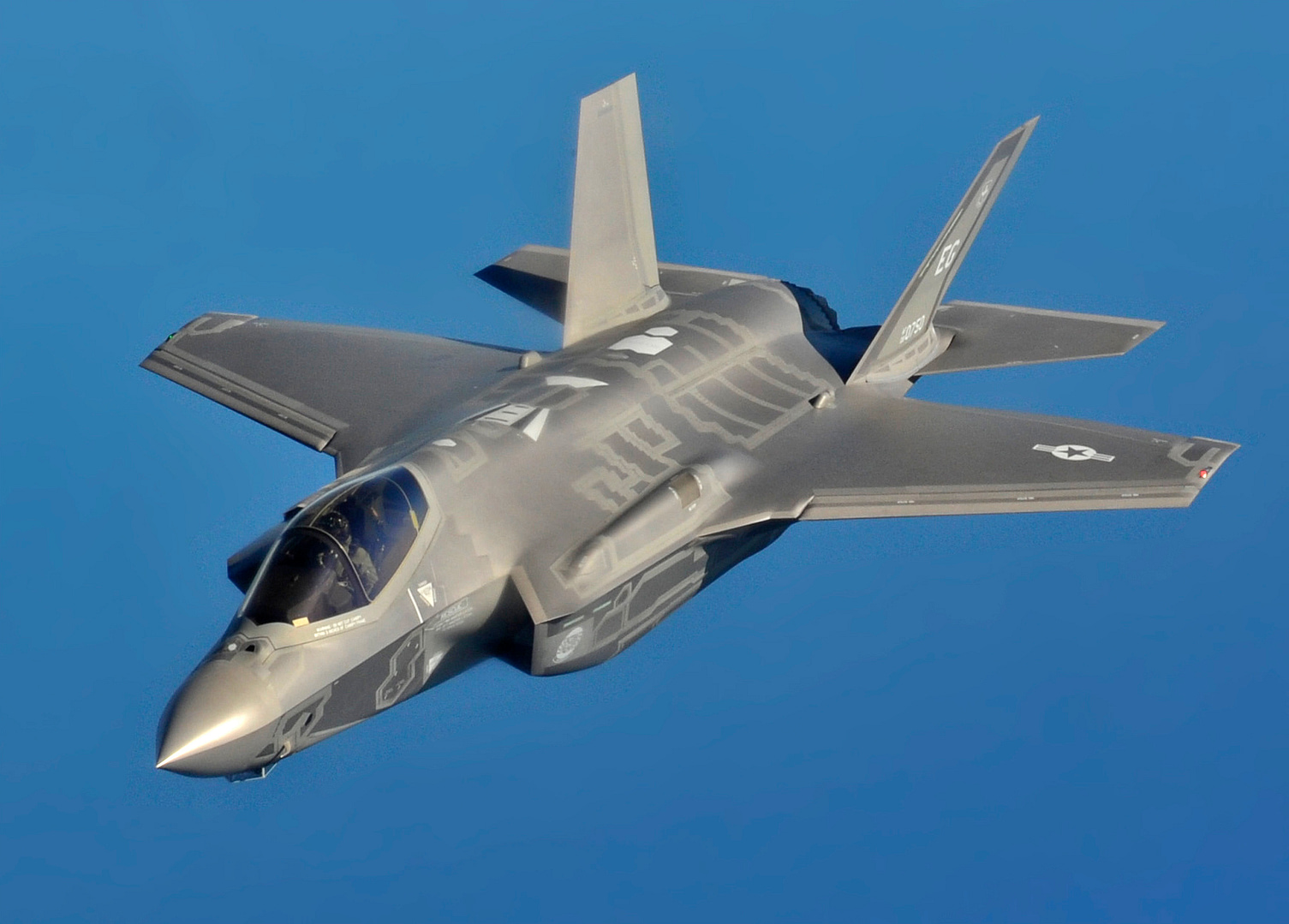
Lockheed Martin F-35 Lightning II in flight
Aircraft MuseumStealth FighterF-35 Lightning II

Lockheed Martin F-35
Lightning II

The West’s global stealth multirole fighter — a single stealthy airframe built in three flavours, flown by roughly 20 nations, and armed less with missiles than with information. The most-produced fifth-generation fighter in the world, and by lifetime cost the most expensive weapons programme in history.

>1,000Built by 2026 — and rising
Mach 1.6Top speed
~20Nations flying or ordering it
3 variantsA (runway) · B (vertical) · C (carrier)
Photo: U.S. Air Force / Master Sgt. Donald R. Allen · Public domain
RoleFifth-gen stealth multirole fighterEra2006 – presentEnginePratt & Whitney F135OriginUSA · Lockheed MartinStatusFrontline / multinationalCan a civilian fly the F-35?
The Story

The F-35: one airframe, three shapes, twenty air forces

The F-35 grew out of the U.S. Joint Strike Fighter programme of the 1990s — an attempt to build a single, affordable stealth fighter family for the Air Force, Navy and Marine Corps plus allies. In a competitive fly-off, Lockheed Martin’s X-35 beat Boeing’s X-32; its shaft-driven lift fan impressed evaluators, and in October 2001 the aircraft became the F-35. The first F-35 flew in December 2006, and after a long, troubled and hugely expensive development the type entered service across three services and many nations.

What makes the F-35 unusual is that it is three variants on one design language: the land-based F-35A, the vertical-landing F-35B, and the big-winged carrier F-35C. Cockpit, sensors and stealth are common; only about a fifth of each airframe differs. That compromise is what made a shared, multinational programme possible — and it is why the F-35 has become the standard-issue stealth fighter for NATO and key Pacific partners.

But the F-35’s real weapon is not a missile — it is information. Radar, infrared, electronic-warfare and off-board sensors are fused into one clear picture and handed to a single pilot who acts as the “quarterback of the sky.” Fiercely criticised for delays and a lifetime cost running into the trillions, the F-35 has nonetheless become the backbone of American and allied air power, with more than a thousand built and orders still climbing.

The F-35’s deadliest weapon isn’t a missile — it is a fused picture of the battlespace, shared across an entire formation.The quarterback of the sky — why the F-35 fights with information
01The F-35’s origins: how the Joint Strike Fighter became one jet for three services

The Joint Strike Fighter programme set out to do something the U.S. had never quite managed: replace a whole generation of legacy jets — F-16s, A-10s, F/A-18s, AV-8B Harriers — with one affordable stealth family. In a 1996–2001 fly-off, Boeing’s X-32 met Lockheed Martin’s X-35. The X-35 first flew on 24 October 2000, and its clever shaft-driven lift fan let it take off short, go supersonic and land vertically in a single demonstration. On 26 October 2001 Lockheed Martin won the contract, and the X-35 became the F-35.

The result was the costliest weapons programme in history — U.S. GAO estimates the lifetime cost above $2 trillion — but also the most-produced fifth-generation fighter in the world. Lockheed Martin delivered the 1,000th F-35 in 2024, and the planned fleet runs well past 3,000 aircraft across the U.S. services and around 20 partner and export nations.


Design & Engineering

What makes the F-35 special

01

Stealth with internal weapons

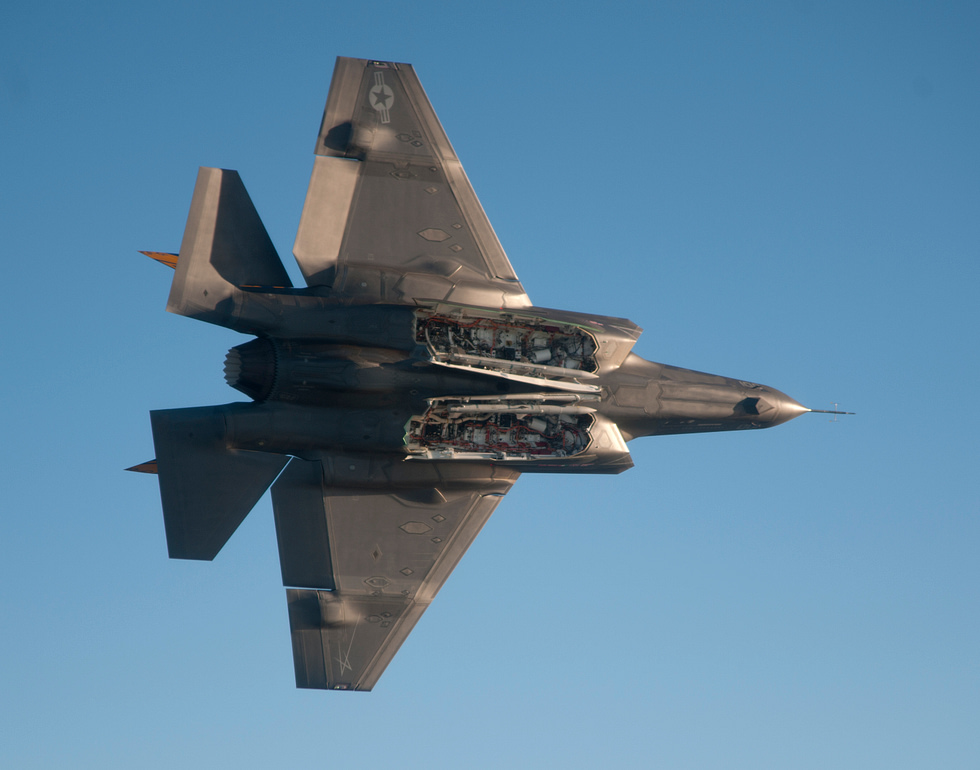
The F-35’s shaping, radar-absorbent materials and internal carriage give it a very low radar signature. In “clean” stealth configuration every weapon rides in internal bays — air-to-air missiles and precision bombs — so nothing hangs outside to reflect radar. When stealth isn’t needed, external pylons let it haul heavy loads in “Beast Mode.”

02

The lift system that hovers a stealth jet

The F-35B hovers using the Rolls-Royce LiftSystem: a driveshaft off the main engine spins a counter-rotating LiftFan behind the cockpit, while a Three-Bearing Swivel Module rotates the rear nozzle roughly 95° downward and roll posts in the wings balance the jet. Together they push some 40,000 lbf straight down — letting a supersonic stealth fighter land vertically on a ship deck.

03

Sensor fusion, DAS and the helmet

An AESA radar, an electro-optical targeting system and the Distributed Aperture System — six cameras giving 360° coverage — are fused into one battlespace picture. The Gen III Helmet-Mounted Display projects that data, plus a see-through-the-airframe view, onto the pilot’s visor. Data links let a whole flight of F-35s share a single fused track picture.

02The F-35B’s lift fan: how a supersonic stealth fighter lands like a helicopter

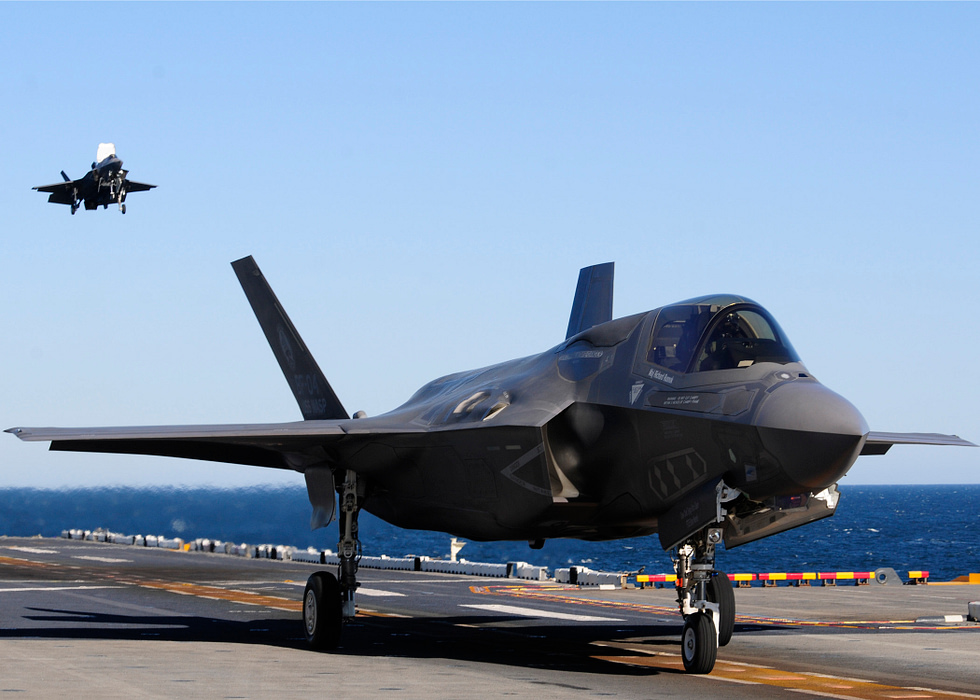
Behind the F-35B’s cockpit sits a counter-rotating LiftFan, driven by a driveshaft off the main engine and producing roughly 20,000 lbf of cool vertical thrust. At the tail, a Three-Bearing Swivel Module rotates the exhaust nozzle about 95° downward in around 2.5 seconds, while small roll posts in the wings keep the jet level. The combination lets the F-35B settle vertically onto a flight deck or an austere strip — a feat no other production stealth jet can match, and the single hardest engineering problem the whole programme had to solve.

03The F-35’s $400,000 helmet: a flight helmet that lets pilots see through the jet

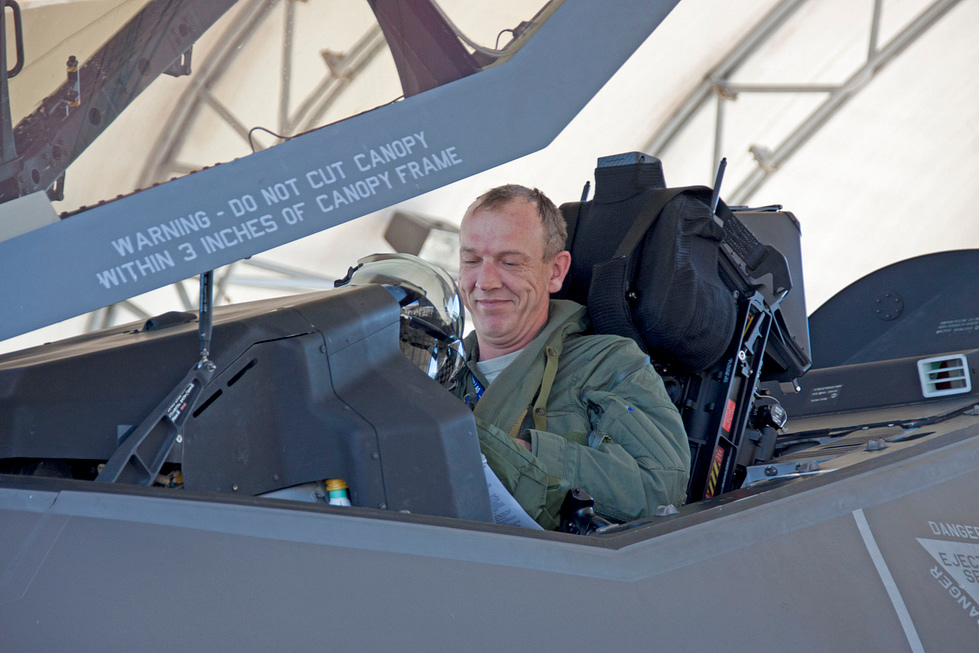
The F-35’s Gen III Helmet-Mounted Display is custom-fitted to each pilot’s head and reportedly costs around $400,000. It streams flight data, targeting cues and night vision directly onto the visor, and — fed by the Distributed Aperture System’s six cameras — lets a pilot literally look through the floor and walls of the aircraft. There is no traditional head-up display; the helmet is the display, and it is central to how the F-35 turns raw sensor data into a picture a single pilot can act on.


Technical Data

Full F-35A specifications

Baseline note: the figures describe the F-35A, the conventional take-off and landing variant that makes up most of the fleet and is the only one with an internal gun. Deltas for the STOVL F-35B and the carrier F-35C in grey.

Dimensions & weights

Crew
1
Length
15.70 m (51 ft 6 in)
Wingspan
10.70 m (35 ft 0 in) — F-35C 13.10 m (43 ft 0 in), folding to 9.11 m (29 ft 11 in)
Height
4.38 m (14 ft 4 in) — F-35C 4.48 m (14 ft 8 in)
Wing area
42.7 m² (460 sq ft) — F-35C 62.1 m² (668 sq ft)
Empty weight
13,290 kg (29,300 lb) — F-35B 14,650 kg (32,300 lb); F-35C 15,790 kg (34,800 lb)
Internal fuel
~8,280 kg (~18,250 lb) — F-35B ~6,125 kg (~13,500 lb), the lift fan eats the tankage; F-35C ~8,960 kg (~19,750 lb)
Max take-off weight
29,900 kg (65,900 lb) — F-35B 27,200 kg (60,000 lb); F-35C 31,800 kg (70,000 lb)
Internal weapons load
~2,600 kg (~5,700 lb) — F-35B ~1,500 kg (~3,300 lb)
Max weapons load
~8,160 kg (~18,000 lb), internal plus external — F-35B ~6,800 kg (~15,000 lb)
Weapon stations
10 (4 internal, 6 external, of which the two outboard are AIM-9X rails)
Weapons bay limit
907 kg (2,000 lb) class per inboard station — F-35B only 454 kg (1,000 lb) class; its bays are shorter

Performance

Max speed
Mach 1.6, 1,960 km/h (1,220 mph) at altitude
Dash without afterburner
Mach 1.2 for ~240 km (~150 miles) — a dash, not true supercruise
Service ceiling
15,240 m (50,000 ft)
Rate of climb
Not published (the programme has never released a figure)
Combat radius, internal fuel
~1,090 km (~590 nm) — F-35B ~830 km (~450 nm); F-35C ~1,110 km (~600 nm). USAF quotes a higher A-model radius on a different profile
Range, internal fuel
~2,500 km (~1,350 nm) — F-35B ~1,670 km (~900 nm); F-35C ~2,200 km (~1,200 nm)
g limit
+9.0 g — F-35B +7.0 g; F-35C +7.5 g
Thrust-to-weight
~0.87 at max take-off weight (~1.07 at 50% internal fuel)
Wing loading
526 kg/m² (107.7 lb/sq ft) at loaded weight — F-35C 429 kg/m² (87.8 lb/sq ft)
Short take-off run, F-35B
168 m (550 ft) from a ship deck, vertical landing (rolling vertical landings are now standard on the Queen Elizabeth class to bring back unspent stores)
Frontal radar cross-section
Classified (~0.001 m² is the figure everyone repeats; it has never been confirmed, and it applies to one aspect, clean, with the doors shut)

Propulsion & systems

Engine
1 × Pratt & Whitney F135-PW-100 afterburning turbofan — F-35B F135-PW-600 driving the Rolls-Royce LiftSystem; F-35C F135-PW-400 with marinised parts
Thrust
125 kN (28,000 lbf) dry, 191 kN (43,000 lbf) with afterburner — F-35B 111 kN (25,000 lbf) dry, 178 kN (40,000 lbf) reheat
Lift system, F-35B
Shaft-driven Rolls-Royce LiftFan ~89 kN (~20,000 lbf), three-bearing swivel nozzle and wing roll posts; ~187 kN (~41,900 lbf) total vertical thrust
Refuelling
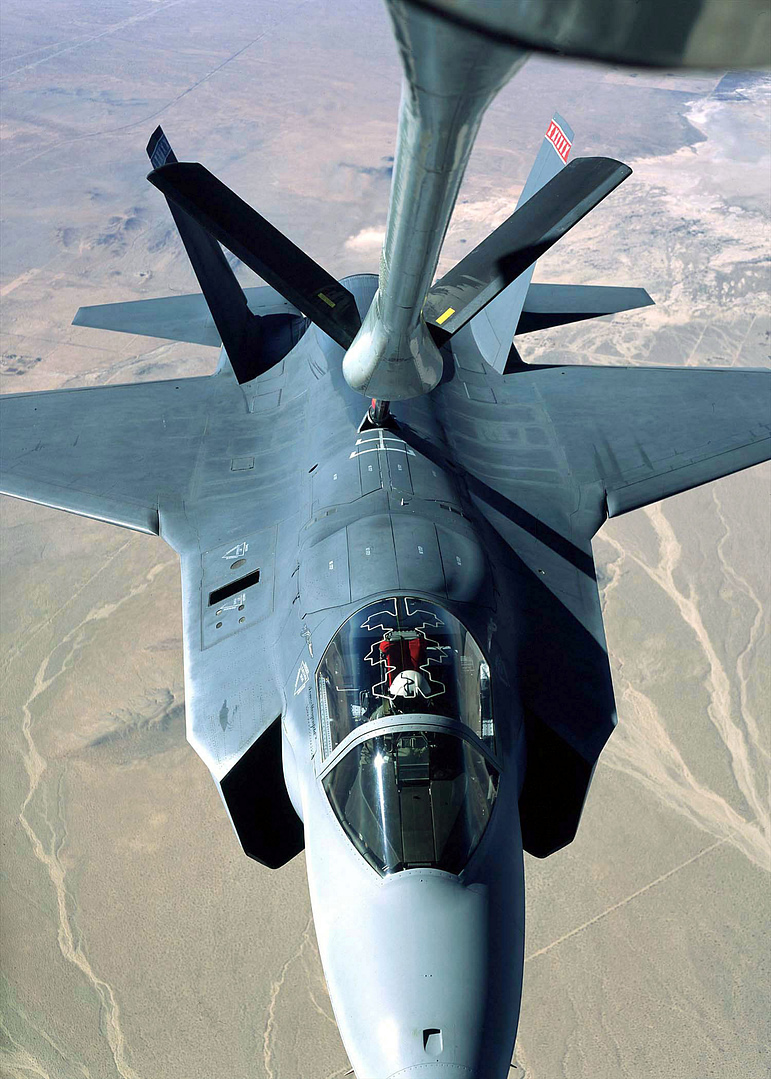
Flying-boom receptacle behind the cockpit — F-35B and F-35C use a retractable probe instead
Radar
Northrop Grumman AN/APG-81 AESA (AN/APG-85 for later Block 4 lots)
Electro-optics
AN/AAQ-40 EOTS in a faceted chin fairing, plus the AN/AAQ-37 Distributed Aperture System — six infrared cameras giving spherical coverage and missile warning
Electronic warfare
BAE Systems AN/ASQ-239 Barracuda, integrated with the radar rather than podded
Datalinks
Link 16 outward, plus MADL — a directional, low-probability-of-intercept link that fuses the picture between F-35s (MADL does not talk to anything else, which is a running complaint)
Cockpit
Single 51 × 20 cm (20 × 8 in) touchscreen panoramic display, no head-up display; Gen III Helmet-Mounted Display System projects everything onto the visor
Ejection seat
Martin-Baker US16E, zero-zero (lightweight pilots under 62 kg / 136 lb were grounded from 2015 until a lighter helmet and head-support panel cleared the problem)
First flight
15 December 2006 — F-35B 11 June 2008; F-35C 6 June 2010
Service entry
2 August 2016, USAF — F-35B first, USMC 31 July 2015; F-35C USN 28 February 2019
Number built
~1,300 delivered by January 2026 (191 in 2025 alone, a programme record; well over 3,000 planned)
Unit cost
~US$82.5m F-35A, ~US$109m F-35B, ~US$102m F-35C (Lot 17 flyaway; the figure excludes much of what makes the aircraft work)
Cost per flight hour
~US$35,000–42,000 (the affordability target was US$25,000; GAO now puts programme life-cycle cost above US$2 trillion)
04The F-35’s cost: the trillion-dollar fighter, explained

Three very different numbers get quoted for the F-35, and they mean different things. The flyaway unit cost of an F-35A has fallen toward roughly US$80 million in recent baseline lots — comparable to older fourth-generation jets — though recent production lots (Lot 18) have been reported above ~US$100M per aircraft. The figure critics cite, however, is the lifetime programme cost: the U.S. Government Accountability Office estimates it will exceed US$2 trillion across decades of development, procurement and sustainment for a fleet of thousands. When you read that the F-35 is “the most expensive weapon in history,” that is the programme-lifetime figure — not the price of one jet.


Armament & payload

The F-35 fights its first night with four weapons inside and nothing on the wing

The F-35 was designed around a magazine of four. In the stealthy fit that justifies the whole programme, an F-35A carries two 907 kg (2,000 lb) class bombs and two AMRAAM in two small internal bays, and that is the entire load; the trade is that it is supposed to be somewhere nothing else can go, cued by a fused sensor picture it hands to the rest of the package. Everything beyond that hangs on six wing pylons in what the fleet calls beast mode, which roughly triples the load and throws away the low observability — a configuration for day three, after the air defences are down. The uncomfortable part is how much of the interesting inventory is not there yet: Meteor, the Joint Strike Missile, SPEAR 3, StormBreaker, AARGM-ER and JSOW C-1 are all Block 4 items, and Block 4 has slid to roughly 2031. Clearances vary sharply by variant, software block and national programme — a Norwegian F-35A, a British F-35B and a US Navy F-35C do not carry the same list, and no single published table is right for all of them.

Gun

  • GAU-22/A 25 mm four-barrel rotary cannon, 3,300 rounds per minute
  • F-35A: internal, buried in the port wing root behind a hinged door, 180 rounds — about two seconds of fire
  • F-35B and F-35C: no internal gun. A stealth-shaped Missionized Gun System centreline pod carries the same weapon with 220 rounds, and is fitted only when the mission wants it
  • Gun accuracy was a genuine scandal: US test authorities found the F-35A mount misaligned and the weapon effectively unusable for strafing for years before the fix was worked through
  • Nobody plans around the gun. It exists for the day the missiles are gone or the rules of engagement demand a visual pass

Air-to-air

  • AIM-120C-7, C-8 and AIM-120D AMRAAM — four carried internally, the standard combat air patrol load
  • AIM-9X Sidewinder Block II, external pylons only; the planned internal cheek rail was cut, so any short-range missile costs stealth
  • MBDA ASRAAM on UK F-35Bs, externally — cleared and in service, the RAF's within-visual-range answer while Meteor waits
  • MBDA Meteor, sponsored by the UK and Italy: bay fit checks and ground vibration testing done, flight test still pending, fielding tied to Block 4
  • Block 4 adds the Sidekick rack, taking internal AMRAAM from four to six, and eventually AIM-260 JATM

Air-to-surface guided

  • GBU-12 Paveway II and GBU-49 Enhanced Paveway II laser-guided bombs, carried internally
  • Raytheon UK Paveway IV — the Royal Air Force and Royal Navy workhorse, and for years very nearly the only air-to-ground weapon a British F-35B could drop
  • Kongsberg Joint Strike Missile, the only stealthy anti-ship and land-attack missile sized for the internal bay: two per F-35A, sponsored by Norway with Japan and Australia buying in. Block 4
  • MBDA SPEAR 3 for the UK, a small turbojet-powered swarm weapon — nine years late in the telling and now widely quoted as early 2030s
  • AGM-88G AARGM-ER, AGM-154C JSOW and externally carried AGM-158 JASSM-ER and LRASM: all Block 4, none operational on the type today

Bombs

  • GBU-31(V)1/B 907 kg (2,000 lb) JDAM — two internally on the F-35A and F-35C; the F-35B's shorter bay tops out at the 454 kg (1,000 lb) GBU-32
  • GBU-38 227 kg (500 lb) JDAM and the laser JDAM variants
  • GBU-39/B Small Diameter Bomb I — eight carried internally, the density argument for the whole aircraft
  • GBU-53/B StormBreaker (SDB II), the tri-mode moving-target weapon: fielded on other types, still a Block 4 item on the F-35
  • B61-12 guided nuclear bomb, F-35A only. Nuclear design certification was completed in October 2023, making it the first fifth-generation aircraft cleared for the mission; the UK ordered twelve F-35As in June 2025 to rejoin NATO's air-delivered deterrent

Rockets

  • None carried. No rocket pod has ever been integrated on any F-35 variant.
  • The internal bays cannot take a pod, and hanging one externally would forfeit the stealth the aircraft exists for
  • Laser-guided rockets such as APKWS have been floated for permissive close air support and cheap counter-drone work, but nothing is cleared
  • The role the F-35 does not do is the strafing-and-rockets pass; that stayed with the A-10, the AH-64 and now with drones

Pods & other stores

  • Missionized Gun System pod for the F-35B and F-35C — the only gun those variants have
  • No targeting pod is carried or needed: EOTS and the Distributed Aperture System are built into the airframe, which is the single biggest reason the aircraft can stay clean
  • Six external pylons for beast mode, plus outboard AIM-9X rails; four inboard stations are rated for heavy stores
  • External fuel tanks were designed into the original layout, then deferred and never fielded. Interest revived for Pacific distances, but the F-35 still flies on internal fuel and tankers
  • Luneburg lenses — small radar reflectors bolted on for peacetime flying and air-traffic transit, so the aircraft shows up as an ordinary fighter

Three typical loadouts

Day one, contested airspace — F-35A
2 × GBU-31(V)1/B JDAM and 2 × AIM-120C-8 AMRAAM, all internal; 180 rounds of 25 mm; nothing on the wings. Roughly 2,600 kg (5,700 lb) of ordnance and a radar cross-section measured in fractions of a square metre.
Carrier strike — Royal Navy F-35B from HMS Prince of Wales
2 × Paveway IV and 2 × AIM-120C internal; 2 × ASRAAM on outboard rails. The short bay caps the bomb at 454 kg (1,000 lb) class, and the ASRAAMs cost the low-observable fit — an accepted trade for a ship's air defence.
Beast mode, permissive airspace — F-35A
Up to 6 × GBU-31 or a mix of GBU-38 and GBU-39 externally plus the internal four, approaching ~8,160 kg (~18,000 lb). Comparable to an F-15E's load, with none of the stealth and a good deal more drag.

Weapon clearances on this aircraft are a moving target and are routinely misreported. The list above separates what is fielded today from what is contracted under Block 4; where a weapon is Block 4, it is said so plainly, because integration dates on this programme have slipped repeatedly. Internal-bay figures follow Lockheed Martin and US service publications; combat loads seen in service — particularly Israeli ones — are frequently non-standard and not publicly documented.


Variants

The F-35 is three quite different aeroplanes sharing one designation

The Joint Strike Fighter's founding bet was commonality: one airframe, three services, one supply chain, enormous savings. What emerged instead were three aircraft that share a cockpit, an engine core and a mission system but differ in wing, structure, fuel, undercarriage and roughly a fifth of their parts. The STOVL requirement drove the fuselage cross-section for all three, which is why the conventional F-35A is fatter than it needed to be — the design compromise that critics have never let go of.

The other axis of variation is software, and it matters more than the letters. Early Block 2B and 3i jets were declared operational with capability that later blocks had to backfill. Block 3F closed most of the gap in 2018. Technology Refresh 3 — a new core processor, memory and cockpit display — is the hardware foundation for Block 4, and it went badly: deliveries were halted from July 2023 to July 2024 with around 110 finished aircraft parked at Fort Worth, then resumed with deliberately truncated software. By September 2025 the US test authority reported that 158 aircraft had been handed over in TR-3 configuration and none of them were combat-capable. Block 4 itself has been cut from its original 66 capabilities and pushed to roughly 2031.

X-35A / X-35B / X-35C (2000–2001, 2 demonstrators)
Lockheed Martin's competitors to Boeing's X-32. The X-35B's shaft-driven lift fan, and its single flight doing a short take-off, supersonic dash and vertical landing, effectively won the contest.
F-35A — conventional take-off and landing (first flight 2006, IOC 2016)
The baseline and the volume seller. Internal 25 mm gun, boom refuelling, 9 g, the longest internal fuel load of the land-based pair, and the only variant certified for the B61-12.
F-35B — short take-off, vertical landing (first flight 2008, IOC July 2015)
Rolls-Royce LiftSystem behind the cockpit costs it fuel, bay length and two g. It is also the only Western fighter that lets a light carrier or an amphibious ship operate fifth-generation aircraft, which is why the UK, Italy, Japan and Singapore bought it.
F-35C — carrier variant (first flight 2010, IOC February 2019)
Bigger folding wing, larger control surfaces, beefed-up undercarriage and a redesigned tailhook after the first one would not catch a wire. Most internal fuel, longest legs, slowest to reach the fleet.
F-35I "Adir" (Israel, from December 2016)
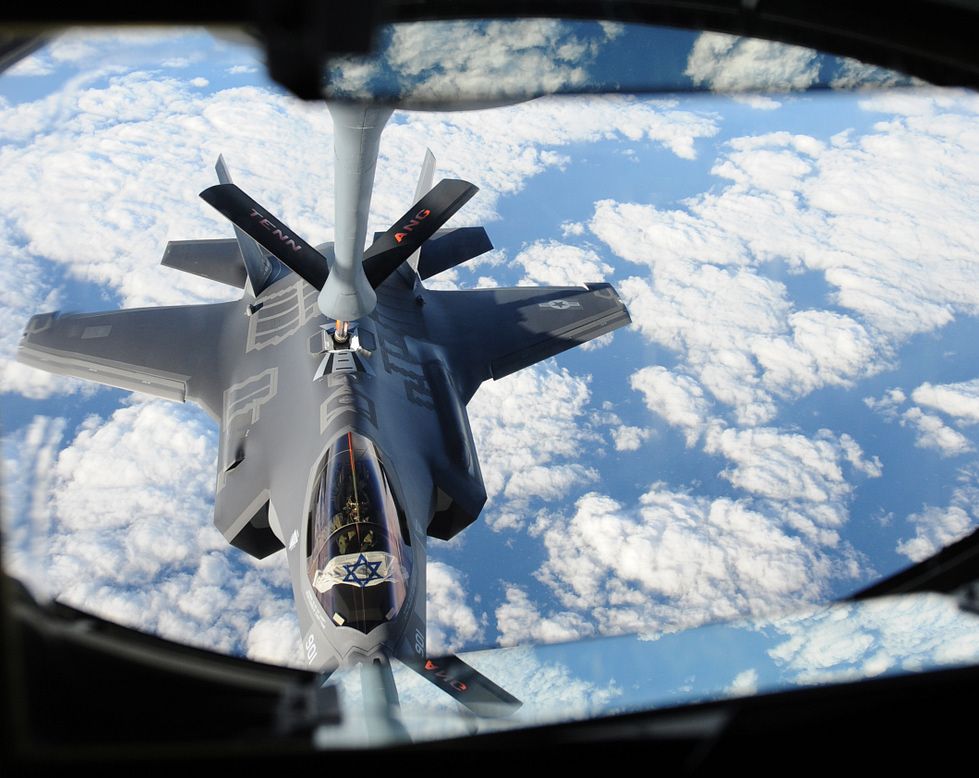
The only customer allowed to insert its own systems and software into the aircraft, with indigenous electronic warfare and command-and-control integration. Also the first F-35 to be used in combat, in May 2018, and the type has flown Israel's deepest strikes since.
F-35A with drag chute (Norway, Netherlands, from 2015)
A dorsal drag-chute housing for icy, short northern runways. Small change, but the only externally visible national modification on the A model.
Block 2B / Block 3i (2015–2017)
The software states in which the Marine Corps and Air Force declared initial operational capability — limited weapons, limited sensor fusion, and a decision widely read as political rather than technical.
Block 3F (2018)
Full baseline capability: the complete Block 3 weapons set, working gun, mature fusion. The end of System Development and Demonstration, six years late.
TR-3 — Technology Refresh 3 (deliveries resumed July 2024)
New L3Harris integrated core processor, expanded memory and a new panoramic display. Necessary for Block 4, and the direct cause of the year-long delivery halt and the parked-jet backlog.
Block 4 (now roughly 2031, scope reduced)
The upgrade that unlocks most of the weapons customers thought they were buying, plus the AN/APG-85 radar. Descoped from 66 capabilities, with items needing more electrical power and cooling deferred to the F135 Engine Core Upgrade around 2033.

Block designations on this programme are not clean generational breaks — capability arrives in increments, differs between national fleets, and aircraft in the same squadron are frequently in different configurations. The UK reported in 2025 that under 30% of its F-35B fleet was configured for Block 4. Treat any single-line statement about what "the F-35" can do with scepticism.


Timeline

Three decades of the F-35 Lightning II

1993–96

The JSF programme forms

Earlier JAST/CALF efforts merge into the Joint Strike Fighter: one affordable stealth fighter sought for three U.S. services plus allies.

24 Oct 2000

X-35 first flight

Lockheed Martin’s X-35 demonstrator flies, competing against Boeing’s X-32 in the JSF fly-off.

26 Oct 2001

Lockheed wins

The X-35 wins the JSF competition and becomes the F-35; the X-32 becomes aviation’s most famous runner-up.

15 Dec 2006

First flight of the F-35A

The first F-35 — a conventional A-model — takes to the air.

2008–11

The B and C fly

First flights of the STOVL F-35B and the carrier F-35C; ship trials begin.

July 2015

First F-35 combat-ready

The U.S. Marine Corps declares the F-35B operational (IOC) — the first F-35 variant ready for combat.

2016 / 2019

USAF and Navy IOC

The USAF F-35A reaches IOC in August 2016; the U.S. Navy’s F-35C follows in 2019.

2018

Combat debut, twice

Israel’s F-35I Adir makes the type’s first-ever combat use in May; a USMC F-35B flies the first American F-35 strike in Afghanistan in September.

2024–26

1,000th delivered

Lockheed delivers the 1,000th F-35 in 2024; the fleet passes 1,000+ flying as Poland, Germany, Canada and Finland join.


Stories & Eyewitnesses

From the flight line: twelve F-35 stories

Origins

X-35 vs X-32 — the fly-off that shaped a generation

Two very different stealth fighters battled for the biggest fighter contract ever.

Read the full story
In the Joint Strike Fighter competition, Boeing’s belly-breathing X-32 met Lockheed’s X-35. The X-35’s clever shaft-driven lift fan let it take off short, go supersonic and land vertically in one demonstration. In October 2001 Lockheed won — and the X-32 became aviation’s most famous runner-up.
Design

One jet, three shapes

How do you build a stealth fighter for runways, ships and vertical landings at once?

Read the full story
The F-35 answers with three variants sharing one design language: the land-based A, the vertical-landing B, and the big-winged carrier C. Roughly 20–25% differs between them, but cockpit, sensors and stealth are common — the compromise that made a shared programme possible.
Engineering

The lift fan that hovers a stealth jet

A supersonic fighter that lands like a helicopter.

Read the full story
Behind the F-35B’s cockpit, a driveshaft spins a counter-rotating LiftFan while the rear nozzle swivels 95° downward. Together they push some 40,000 lbf straight down, letting a stealth fighter settle vertically onto a flight deck — a feat no other production stealth jet can match.
Tech

The $400,000 helmet

A flight helmet that costs more than a house — and is worth it.

Read the full story
The F-35’s Gen III Helmet-Mounted Display is custom-fitted to each pilot’s head and streams flight data, targeting cues and night vision onto the visor. Fed by the Distributed Aperture System, it lets pilots literally look through the floor of the jet.
Tech

The quarterback of the sky

The F-35’s deadliest weapon is information.

Read the full story
Radar, infrared and electronic sensors are fused into one clear picture and shared across a whole formation. One F-35 can detect, identify and hand off targets to other jets, ships and ground units — acting less like a lone dogfighter and more like an airborne quarterback.
Combat

Israel’s “Adir” draws first blood

The F-35’s combat debut came not over America, but the Middle East.

Read the full story
In May 2018 Israel became the first nation ever to use the F-35 in combat, flying its customised F-35I Adir. Israel has since made the Adir central to strikes across the region — including its high-profile 2024–25 operations against Iran. (Claims contested.)
Cost

The trillion-dollar fighter

Is it the most expensive mistake — or the best deal — in military history?

Read the full story
Critics point to decades of delays and a lifetime programme cost estimated above $2 trillion. Supporters note the per-jet flyaway price has fallen toward that of older fighters, and that over a thousand are now flying. Few weapons are as loved and loathed at once.
Fleet

The West’s standard-issue stealth

Buy an F-35 and you join a club of allies.

Read the full story
Around 20 nations fly or have ordered the type, from Norway to Japan to Australia. Common jets mean common tactics, training and logistics across NATO and Pacific partners — turning the F-35 into a shared backbone rather than just another national fighter.
Milestone

First combat, twice over

1918? No — 2018.

Read the full story
Within four months in 2018 the F-35 fired in anger twice: Israel’s Adir in May, then a U.S. Marine F-35B striking Taliban targets in Afghanistan in September — the first American combat use, and the first ever by the vertical-landing variant.
Naval

Stealth on the deck

The F-35B put fifth-gen airpower on small carriers.

Read the full story
Ships too small for catapults — Britain’s Queen Elizabeth class, Italy’s and Japan’s flat-tops, U.S. amphibious assault ships — can now field stealth fighters thanks to the B’s vertical landing. It rewrote which navies can operate a modern strike fighter.
Production

Most-produced fifth-gen ever

Built faster than any other stealth fighter.

Read the full story
Lockheed rolled out the 1,000th F-35 in 2024, and by 2026 more than a thousand are flying with production still climbing toward 3,000+. No other fifth-generation jet comes close in numbers.
Variants

A vs C — same family, different job

Why the Navy’s F-35 looks “fatter.”

Read the full story
The carrier F-35C has larger wings, stronger gear and a tailhook for catapult launches and arrested landings; the F-35A is lighter and lands on runways. Same cockpit and sensors, very different structure — one design stretched across the whole battlespace.

Gallery

The F-35 Lightning II in pictures
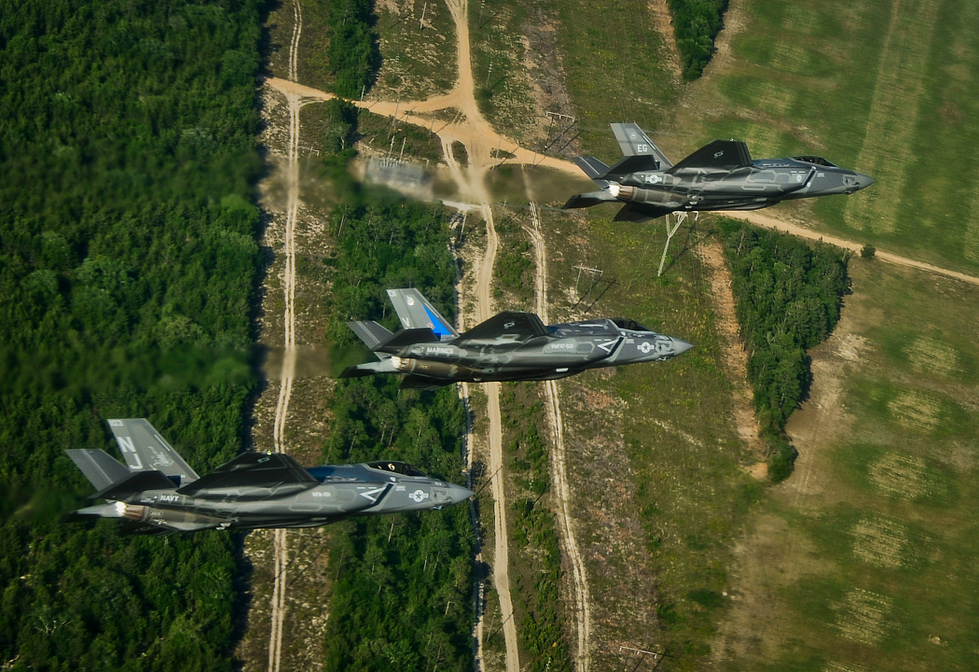
Three variants in formation  the F-35A, F-35B and F-35C share one stealth airframe family.
Three variants in formation — the F-35A, F-35B and F-35C share one stealth airframe family.Photo: U.S. Air Force / Staff Sgt. Katerina Slivinske · Public domain
An F-35B Lightning II manoeuvres after a vertical landing  a first for a production stealth jet.
An F-35B Lightning II manoeuvres after a vertical landing — a first for a production stealth jet.Photo: U.S. Navy · Public domain
An F-35 pilot wearing the Gen III helmet-mounted display that streams a fused battlespace picture.
An F-35 pilot wearing the Gen III helmet-mounted display that streams a fused battlespace picture.Photo: U.S. Air Force / Ministerie van Defensie · CC BY-SA 4.0
An F-35 shows its internal weapons bay  in stealth mode, every weapon is carried inside.
An F-35 shows its internal weapons bay — in stealth mode, every weapon is carried inside.Photo: U.S. Navy · Public domain
An Israeli Air Force F-35I Adir  the variant that made the F-35s combat debut in 2018.
An Israeli Air Force F-35I Adir — the variant that made the F-35’s combat debut in 2018.Photo: U.S. Air Force · Public domain
The Lockheed Martin X-35 demonstrator that won the Joint Strike Fighter fly-off in 2001.
The Lockheed Martin X-35 demonstrator that won the Joint Strike Fighter fly-off in 2001.Photo: U.S. Department of Defense / Tom Reynolds · Public domain

Watch

The F-35 Lightning II in motion

A dedicated F-35 Lightning II video is coming soon.


Watch

The F-35 Lightning II in motion

Real Engineering — one of the most-watched F-35 Lightning II films on YouTube.


Operations

Where the F-35 Lightning II flies


Operators today

The F-35 has become the default Western fighter, and most of it is American

Twelve nations were flying the F-35 by the start of 2026, with around 1,300 aircraft delivered and roughly 191 handed over in 2025 alone — a record year, and a production rate no other allied fighter line comes close to. Australia and Norway have completed their orders; Belgium, Denmark, Finland, Poland, Switzerland, Germany, Canada, Greece and Romania are at various points on the delivery ramp, most of them barely started. The chart below is deliberately unflattering to the newcomers, because it shows only what has actually arrived.

United States (USAF, USMC, USN)~870
Australia72
Norway52
Netherlands~50
Israel48
United Kingdom~48
Japan~45
South Korea~40
Italy~35
Denmark~27
Belgium~10

This chart shows aircraft delivered, not aircraft on order — and for the F-35 the gap between the two is enormous. Canada has ordered 88 and Germany 35 with almost nothing yet in national hands; Finland's 64, Poland's 32, Switzerland's 36 and Romania's 32 are largely still to come; the United Kingdom has committed to 138 in total against the roughly 48 it holds. Counting orders would roughly double every bar outside the United States. These are estimates, rounded hard. Many airframes counted on paper are stored, in deep overhaul, in TR-3 configuration without combat software, or simply not mission-capable — US auditors put full mission capability across the fleet at about one aircraft in four in 2025. Sources: Lockheed Martin delivery announcements, IISS The Military Balance and FlightGlobal World Air Forces; entries that could not be corroborated are omitted.


Combat Record

The F-35 in combat

The F-35’s combat career began in 2018 and has grown quickly, though many of its most recent operations are announced by the operators themselves and remain hard to verify independently — treat the newest figures as provisional. What is clear is the breadth of its use across the Middle East and Europe.

May 2018First-ever F-35 combat use — Israel’s F-35I Adir
Sept 2018First U.S. F-35 strike — USMC F-35B, Afghanistan
~20Nations flying or ordering the type

The USAF F-35A conducted its first strikes against ISIS in Iraq in April 2019, and the Navy’s F-35C made its combat debut in the Middle East in 2024–25. Israeli F-35Is were reported central to strikes on Iranian targets in 2024–25, with Israeli sources also claiming the first air-to-air kill by an F-35 — claims that are contested and largely single-source. Compare the combat record of every military aircraft. Figures as of July 2026.


Questions & Answers

Everything people ask about the F-35 Lightning II

Can I fly in an F-35?
No. The F-35 is a frontline stealth fighter and is not available for civilian flights anywhere. However, you can fly several genuine military jets today — see MiGFlug’s fighter jet flights and prices at migflug.com/flights-prices/.
How fast is the F-35?
About Mach 1.6 (~1,200 mph / ~1,900 km/h) — fast, though speed is not its main advantage; sensor fusion and stealth are.
What are the three F-35 variants?
The F-35A (conventional runway takeoff and landing), the F-35B (short takeoff / vertical landing), and the F-35C (carrier variant with larger wings and a tailhook).
Is the F-35 still in production?
Yes — it is actively built in 2026, with deliveries and new orders ongoing toward a planned fleet well over 3,000 aircraft.
How many nations fly the F-35?
Roughly 20 current operators and customers combined, across NATO and key Pacific partners.
How many F-35s have been built?
More than 1,000 by 2026, and rising. Lockheed Martin delivered the 1,000th aircraft in 2024.
How is the F-35 different from the F-22 Raptor?
The F-22 is a dedicated twin-engine air-superiority fighter that was never exported. The F-35 is a single-engine multirole stealth strike fighter built in three variants, exported widely, and focused on sensor fusion and ground and maritime strike as well as air combat.
Why is the F-35 so expensive?
The often-quoted figure is the lifetime programme cost — estimated above $2 trillion by U.S. GAO — not the price of one jet. The flyaway cost of an F-35A has fallen toward roughly $80 million, comparable to older fourth-generation fighters.

Sources & Further Reading

Every fact, checked