
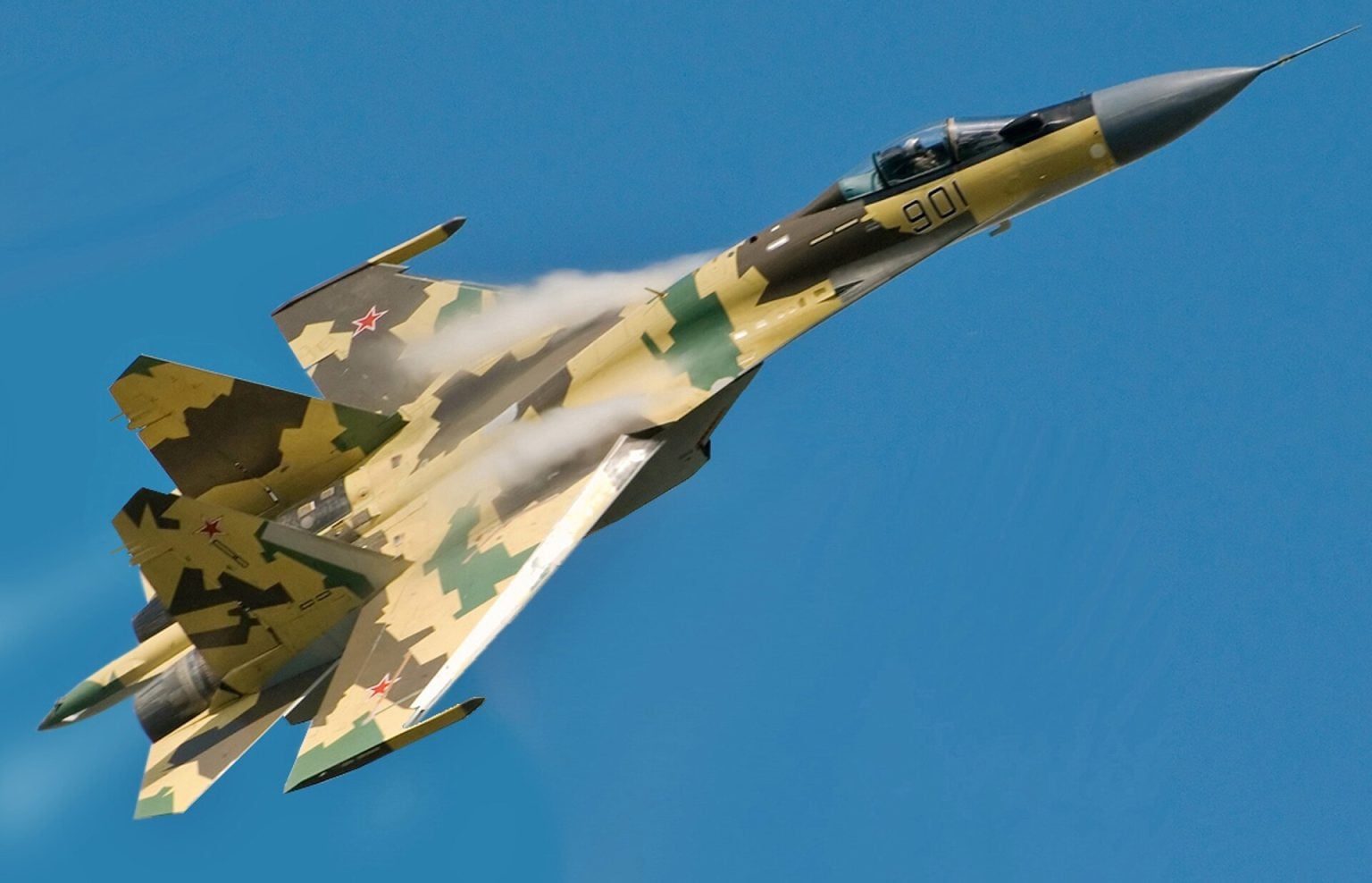
Sukhoi Su-35
“Flanker-E”
The ultimate expression of the Flanker bloodline — a thrust-vectoring “4++ generation” super-manoeuvrable heavyweight that is Russia’s frontline air-superiority fighter, built on brute performance and a huge radar rather than stealth.
The ultimate Flanker
The Su-35S is a heavily reworked, 4++ generation derivative of the Soviet-era Su-27 “Flanker.” The name “Su-35” first appeared on 1980s–90s demonstrators — the canard-equipped Su-27M/Su-35 and the thrust-vectoring Su-37 — but the modern jet is a near clean-sheet modernisation internally called the Su-35BM (bolshaya modernizatsiya, “big modernisation”), unveiled at MAKS in August 2007. Crucially, the production Su-35S has no canards: its agility comes from a reinforced airframe, relaxed stability and thrust vectoring instead.
Its signature is raw manoeuvrability. Paired AL-41F1S turbofans with 3D thrust-vectoring nozzles let it point its nose almost anywhere in the sky, sustaining post-stall airshow routines — Pugachev’s Cobra, the flat “pancake” spin, the Kulbit somersault — that look like gravity has been switched off. Beyond the theatrics it pairs that agility with a huge internal fuel load, long combat range and a heavy 12-hardpoint payload, plus the powerful long-range N035 Irbis-E radar.
Russia positions the Su-35 as its workhorse air-superiority fighter — a “4++ gen” answer to Western fifth-generation jets built on brute performance rather than low observability. It has flown combat over Syria (from 2016) and Ukraine (from 2022), where it remains Russia’s premier air-superiority Flanker despite documented combat losses. The first Su-35BM prototype flew on 18 February 2008; the serial Su-35S reached operational service in 2014.
01The Su-35’s lineage: how a 1970s Flanker became Russia’s most capable operational fighter
The Su-35S distils roughly 40 years of Flanker evolution into one airframe: bigger, thrust-vectoring engines, a strengthened frame, a powerful radar and a glass cockpit. Where the earlier Su-30MKI/Su-35/Su-37 line experimented with canards, the production Su-35S dropped them, achieving its aerodynamic and (modest) signature refinements through the airframe and flight-control system instead.
Roughly 150+ airframes have been built across Russian service and export. It is not a stealth aircraft — it is the heavyweight Russia relies on to hold air-superiority when a true fifth-generation fleet is not available in numbers, and it was marketed aggressively for export, with China the first foreign buyer and further deals with Iran and Egypt reported and contested.
What makes the Su-35 special
Twin thrust-vectoring engines
Two Saturn AL-41F1S turbofans (izdeliye 117S), each about 86 kN dry and ~142 kN in afterburner, carry independently steerable 3D vectoring nozzles. That gives the Su-35 extreme post-stall controllability and super-agility — controlled flight at very high angles of attack and its trademark Cobra and Kulbit manoeuvres.
The N035 Irbis-E radar
A large X-band passive electronically scanned array with a ~900 mm antenna and high peak power, reported to track around 30 targets at once. Manufacturer figures cite detection of a large target at up to ~400 km — a best-case number; real-world detection of smaller or stealthy targets is far shorter. It is Russia’s brute-force workaround for lacking stealth of its own.
Range and heavy payload
A large internal fuel load gives roughly 3,600 km range on internal tanks (~4,200 km with external tanks), and 12 hardpoints carry up to ~8,000 kg of ordnance. That combination of persistence, reach and weapons load is rare for a fighter of its class, from the R-77 and R-73 up to the very-long-range R-37M.
02The Su-35’s Irbis-E: why the headline radar ranges are best-case
The Irbis-E is deliberately enormous and power-hungry, trading the efficiency of a modern AESA for sheer peak output. The manufacturer’s often-quoted ~400 km figure applies to a very large, non-stealthy target under ideal conditions; against fighter-sized or low-observable targets the practical detection range collapses to a fraction of that. Treat the big numbers as marketing ceilings, not operational reach — the design intent was to partly offset the Su-35’s own lack of stealth, not to match a fifth-generation sensor suite.
03The Su-35’s engines: AL-41F1S, not the old AL-31F
The production engine is the Saturn AL-41F1S (izdeliye 117S), a substantially upgraded development of the Su-27’s AL-31F with more thrust and the thrust-vectoring nozzle. Some older references label it “AL-31F-117S,” and different power and range figures circulate across sources; the values here are representative rather than definitive. What is not in doubt is the effect: independently vectoring nozzles give control authority long after the wings stop flying.
Full Su-35S specifications
Baseline note: the figures below describe the Su-35S — Sukhoi’s internal T-10BM, the aircraft in production at Komsomolsk-on-Amur since 2011 and the one flying combat missions today. It is not the aircraft that first carried the Su-35 name. The 1980s Su-27M, marketed as the Su-35, was a canard-equipped Su-27 derivative with a dorsal airbrake of which only about a dozen prototypes and pre-production aircraft were built; it never entered mass production, and the Su-35S deliberately deleted both its canards and its airbrake. Export aircraft are designated Su-35SK (China) and Su-35SE. NATO reporting names are inconsistent across sources: Flanker-E properly belongs to the Su-27M, and the Su-35S is variously reported as Flanker-E+ or Flanker-M.
Dimensions & weights
- Crew
- 1 — there is no two-seat Su-35S. The Su-35UB trainer was a single aircraft built by KnAAPO on the older canard airframe and was never produced
- Length
- 21.90 m (71 ft 10 in)
- Wingspan
- 15.30 m (50 ft 2 in)
- Height
- 5.90 m (19 ft 4 in)
- Wing area
- 62.0 m² (667 sq ft), 5% thickness ratio
- Empty weight
- 19,000 kg (41,890 lb) — a heavy fighter by any measure, and the increased use of aluminium-lithium, titanium alloys and composites was what kept it from being heavier still than the Su-27M
- Gross weight
- 25,300 kg (55,780 lb) at 50% internal fuel — the reference condition for most of the quoted performance
- Maximum take-off weight
- 34,500 kg (76,060 lb)
- Internal fuel
- 11,500 kg (25,350 lb) — an enormous internal load, and the single most underrated feature of the aircraft. Nothing in NATO service carries that much fuel inside a fighter
- External fuel
- 2 × 2,000-litre PTB-2000 tanks, plus a retractable in-flight refuelling probe on the port side of the nose
- Maximum ordnance
- ~8,000 kg (~17,635 lb)
- Store stations
- 12 — two wingtip rails plus ten wing and fuselage stations, including two tandem stations between the engine nacelles that carry the heaviest weapons
- Wing loading
- 408 kg/m² (83.6 lb/sq ft) at 50% fuel, rising to 501 kg/m² (102.6 lb/sq ft) with full internal fuel — the aircraft is a very different machine at the start and end of a sortie
Performance
- Maximum speed, altitude
- 2,400 km/h (1,490 mph), Mach 2.25
- Maximum speed, sea level
- 1,400 km/h (870 mph), Mach 1.13
- Supercruise
- Mach 1.1 at medium altitude without afterburner — Sukhoi’s claim, and a limited one: it is a marginal supersonic cruise in a clean configuration, not the sustained Mach 1.5 of an F-22
- Service ceiling
- 18,000 m (59,050 ft)
- Rate of climb
- 280 m/s (55,100 ft/min)
- Range, altitude
- 3,600 km (2,237 mi) on internal fuel; 1,580 km (982 mi) at sea level
- Ferry range
- 4,500 km (2,796 mi) with two external tanks
- Combat radius
- ~1,600 km (~995 mi) — roughly double an F-16’s on internal fuel, and the reason Su-35S combat air patrols can sit over Russian territory and still threaten targets deep inside Ukraine
- Load factor limit
- +9 g
- Thrust-to-weight
- 1.13 at 50% internal fuel; 0.92 with full internal fuel
- Radar cross-section
- ~1–3 m² frontal — reported rather than measured. Radar-absorbent material on the intakes and the front compressor stages is said to halve the figure against a bare Su-27. It is a large, conventional airframe with an unshielded canopy and external stores; treat any low-observability claim sceptically
Propulsion & systems
- Engine
- 2 × Saturn AL-41F1S afterburning turbofans (izdeliye 117S) — a deep upgrade of the AL-31F, closely related to the Su-57’s AL-41F1 and differing mainly in the engine control system
- Thrust
- 86.3 kN (19,400 lbf) dry, 137.3 kN (30,865 lbf) with afterburner, and 142.2 kN (31,970 lbf) in emergency rating, each
- Thrust vectoring
- Axisymmetric nozzles deflecting in a single plane, but with their rotational axes canted — so differential deflection produces yaw and roll as well as pitch. The arrangement was first flown on the Su-30MKI and is used again on the Su-57. It is what lets the aircraft hold controlled flight past the stall, and it is also a weight, cost and maintenance burden that Western air forces have consistently declined to accept
- Fuel and refuelling
- 11,500 kg internal, 2 × 2,000-litre external tanks, retractable refuelling probe. Nozzle and engine service life is claimed at about 4,000 hours; Russian hot-section life claims have historically been optimistic and sanctions have not helped
- Radar
- N035 Irbis-E X-band hybrid passive electronically scanned array from Tikhomirov NIIP — 1,772 radiating elements fed by two 10 kW Chelnok travelling-wave tubes for 20 kW peak and about 5 kW average power. 30 targets tracked, 8 engaged; electronic scan to ±60° augmented by a hydraulic drive that swings the antenna a further 60°, giving ±120° total coverage. The much-quoted 400 km figure is against a 3 m² target in a narrow, long-dwell search sector, not a normal detection range. And it is a PESA, not an AESA: one transmitter feeding phase shifters, so no simultaneous independent beams, no graceful degradation, and a far worse low-probability-of-intercept signature than a modern active array
- Infrared search and track
- OLS-35 electro-optical system ahead of the windscreen, combining infrared search and track, a television channel and a laser rangefinder — a passive means of tracking and shooting without radiating, and genuinely useful
- Electronic warfare
- L175M Khibiny-M, integrated with the radar into the Sh135 weapons control complex, plus an OAR missile approach warning system. Khibiny is often carried in wingtip pods in place of missile rails, which costs two air-to-air stations
- Cockpit
- Two 229 × 305 mm (9 × 12 in) multi-function liquid-crystal displays, head-up display and HOTAS controls, replacing the Su-27M’s smaller cathode-ray-tube layout. The redesign was forced by air force pilots at Akhtubinsk and Lipetsk who described weapons trials with the Su-27M as a "negative experience" because of single-pilot workload
- Ejection seat
- NPP Zvezda K-36D-3.5E zero-zero seat
- First flight and service entry
- First flight 19 February 2008 at Zhukovsky with Sergey Bogdan at the controls; first series Su-35S flew May 2011; first six production aircraft handed over December 2012; first operational regiment 2014. First combat deployment four aircraft to Syria, January 2016
- Number built
- ~200 — the 100th series aircraft was announced in December 2018 and production has continued at roughly eight to fifteen a year since, plus 24 for China and about 25 built against the cancelled Egyptian order. A precise total is not published and Russian delivery announcements no longer state quantities
- Cost
- ~US$83 million export — derived from China’s 2015 contract of about US$2 billion for 24 aircraft. Russian domestic pricing is not published in comparable terms
04The Su-35’s price tag: why the cost figures vary so widely
No single authoritative unit price exists for the Su-35. Export and estimate figures circulate across a wide band — commonly cited in the region of $40–65 million — but they vary enormously by customer, contract year, weapons and support package, and whether the number reflects flyaway or programme cost. Treat any single dollar figure as an unverified estimate. The same caution applies to headline performance numbers: sources disagree on exact speed, range and engine-power values, so the specifications above are representative rather than definitive.
Armament & payload
The Su-35S carries the longest-ranged air-to-air missile in regular service, and spends most of its war dropping glide bombs
On paper the Su-35S is one of the most heavily armed fighters ever built: twelve stations, 8,000 kg of stores, and a missile inventory running from the R-73 out to the R-37M, a Mach 6 weapon quoted by Jane’s at 300–400 km and originally built to kill airborne early-warning aircraft. In Ukraine that combination has produced a specific and effective way of fighting: Su-35S orbit deep inside Russian airspace, take cueing from ground radar and A-50 aircraft, and take very long shots at Ukrainian fighters that cannot answer at that range. It works well enough to push Ukrainian aviation down and back. It has not produced air superiority.
The second job is more consequential. Since 2023 the type has joined the Su-34 in delivering FAB-500 and FAB-1500 bombs fitted with UMPK glide kits, released from about 12,000 m for 40–70 km of stand-off. That is a crude weapon guided by satellite navigation and jammed with some success, but it is cheap, it is delivered in enormous quantity, and it has done more damage than every air-to-air missile the Russian Aerospace Forces have fired in the war. Export clearances are narrower than the Russian list: Chinese Su-35SK were delivered with a restricted weapons set, and the R-37M in particular is not an export item.
Gun
- 1 × Gryazev-Shipunov GSh-30-1 30 mm autocannon in the starboard wing root extension, 150 rounds
- A single-barrel, short-recoil, water-cooled gun weighing only 46 kg — the lightest 30 mm aircraft cannon in service anywhere, and one of the genuinely excellent pieces of Soviet engineering in the aircraft
- Roughly 1,500 to 1,800 rounds per minute, with a barrel life measured in a few thousand rounds because of the very high chamber pressures
- 150 rounds is thin — about six seconds of fire — but the aircraft was never expected to reach gun range
- No gun kill by an Su-35S has been documented in Syria or Ukraine
Air-to-air
- R-73E and R-74M (AA-11 Archer) short-range infrared missiles, up to six, helmet-cued — the weapon that forced NATO to build ASRAAM and AIM-9X
- R-77-1 / RVV-SD (AA-12 Adder) active-radar medium-range missile, up to twelve, with an effective reach usually assessed at 80–110 km. The improved K-77M is reported in service
- R-27ER, R-27ET and R-27EP (AA-10 Alamo) semi-active radar, infrared and anti-radiation variants — legacy weapons, still carried, still occasionally the only thing available
- R-37M (AA-13 Axehead), 2 carried, Mach 6+, 300–400 km per Jane’s. Documented in use from Su-35S over Ukraine and the single most disruptive weapon the type carries
- The Irbis-E can only guide two semi-active weapons at once in track-while-scan; the eight-target engagement figure applies to active-radar missiles
Air-to-surface guided
- Kh-31P and Kh-31PD (AS-17 Krypton) anti-radiation missiles, up to six — the Russian Aerospace Forces’ principal SEAD weapon, and the one most often seen on Su-35S over Ukraine
- Kh-31A and Kh-31AD (AS-17 Krypton) anti-ship variants, and the subsonic Kh-35U (AS-20 Kayak)
- Kh-58UShE (AS-11 Kilter) long-range anti-radiation missile, up to five
- Kh-29L and Kh-29TE (AS-14 Kedge) laser and television-guided missiles, up to six; Kh-59MK and Kh-59M2 (AS-18 Kazoo) television-guided stand-off missiles, up to five
- Marketing brochures list the 3M-54AE1 and P-800 Oniks anti-ship cruise missiles. Neither has been observed on an operational Su-35S
Bombs
- FAB-500 and FAB-1500 general-purpose bombs fitted with UMPK glide and guidance kits — two to four per sortie, released from about 12,000 m for 40–70 km. This is the aircraft’s most important weapon in practice
- KAB-500L and KAB-1500L laser-guided bombs; KAB-500KR and KAB-1500KR television-guided; KAB-500S-E satellite-guided
- KAB-500OD fuel-air bomb, up to eight
- Unguided FAB and OFAB bombs and RBK cluster dispensers — the standard fit in Syria in 2016, and a reminder that the Su-35S deployed to combat with almost no precision capability
- UMPK accuracy is poor by Western standards and degrades sharply under GPS jamming, but the kits cost a fraction of a guided bomb and Russia builds them in the thousands
Rockets
- S-8 80 mm rockets in B-8M1 pods, 20 rounds per pod
- S-13 122 mm rockets in B-13L pods, five rounds per pod — a heavier round intended for hardened targets and runways
- S-25 340 mm heavy rockets in single O-25 launchers
- All three are cleared, all three are legacy, and none belongs anywhere near the modern air-defence environment over Ukraine. The Su-35S has not been observed using them there
Pods & other stores
- T-220 / UOMZ electro-optical targeting pod for laser designation — carried rarely, and the shortage of pods across the Russian fleet is a real constraint on precision strike
- Khibiny-M electronic warfare emitters in wingtip pods, which occupy the two stations that would otherwise carry R-73
- 2 × 2,000-litre PTB-2000 drop tanks, seldom needed given 11,500 kg of internal fuel
- No targeting or reconnaissance pod is standard, and there is no conformal sensor fit — the Su-35S is an air-superiority fighter with a bomb rack, not a strike aircraft
- Chaff and flare dispensers in the tail boom between the engines, alongside the brake parachute
Three typical loadouts
- Long-range combat air patrol, Ukraine, 2023–2026
- 2 × R-37M on the tandem fuselage stations, 4 × R-77-1 underwing, 2 × R-73 or R-74M on the wingtips, no external fuel. Flown in an orbit inside Russian airspace with A-50 or ground-radar cueing, shooting at 100–200 km. This is the profile that has made Ukrainian fighter operations near the front line so costly
- Glide-bomb strike, Ukraine, 2024–2026
- 2–4 × FAB-500M-62 with UMPK kits on the wing stations, 2 × R-77-1 and 2 × R-73 retained for self-defence, released from 12,000–14,000 m short of the front line. Crude, heavily jammed, and the most destructive thing Russian tactical aviation does
- Escort and suppression, Syria, 2016–2019
- 4 × R-27ER and 2 × R-73, or a mixed load with 2 × Kh-31P, plus unguided FAB bombs. The Syrian deployment was as much an advertising campaign and a shakedown for the avionics as a combat need — Sukhoi has said openly that it resolved a number of avionics problems
Sourcing caveat: the cleared-stores list comes from KnAAPO and Rosoboronexport export brochures reproduced in Jane’s All the World’s Aircraft, and manufacturer lists describe what an aircraft can be certified to carry rather than what it does carry. Where a weapon has been observed in service the text says so. Missile ranges in particular are marketing maxima flown at optimum altitude against a non-manoeuvring target; the R-37M’s 300–400 km and the R-77-1’s 110 km should both be read as a fraction of that in a real engagement.
Variants
Two entirely different aircraft have been called the Su-35, and only the second one was built in numbers
The confusion is Sukhoi’s own doing. In 1983 the Soviet Council of Ministers ordered a deep upgrade of the Su-27, designated Su-27M and coded T-10M. It gained canards, taller fins, a twin-wheel nose leg and the N011 radar, and it was shown in the West as the Su-35. It never entered mass production: about a dozen prototypes and pre-production aircraft were built by 1995, and three of them ended their days as spares donors for the Russian Knights display team.
The Su-35 that exists today began in December 2003 as a separate programme, T-10BM. Sukhoi had concluded from its own testing that thrust-vectoring nozzles could recover the manoeuvrability that deleting the canards would cost, without the canards’ weight penalty — so the canards went, and so did the dorsal airbrake. Lighter avionics moved the centre of gravity aft and paid for the rest. In airframe terms the result resembles a plain Su-27 far more closely than it resembles the Su-27M.
- Su-27M / Su-35 (T-10M) (1988–1995, ~14 airframes)
- The ancestor and the source of the naming confusion. Canards, taller vertical tails, dorsal airbrake, twin-wheel nose gear, in-flight refuelling, N011 radar, AL-31FM engines. Two prototypes, nine pre-production and three production aircraft, plus two static-test airframes. Not the aircraft on this page.
- Su-37 (1996, 1 converted)
- The eleventh Su-27M, T10M-11, rebuilt as a technology demonstrator with digital fly-by-wire, a glass cockpit, N011M radar and thrust-vectoring AL-31FP engines. The aircraft that made supermanoeuvrability famous at Farnborough, and a one-off.
- Su-35UB (2000, 1 built)
- A two-seat combat-capable trainer on the canard airframe with a Su-30MKK-style forward fuselage. One aircraft, T-10UBM-1, and no production. There has never been a two-seat Su-35S.
- Su-35BM (T-10BM) (2007–2009, 3 flying prototypes)
- The prototype standard of the current aircraft — canards and airbrake deleted, smaller fins and tail boom, Irbis-E, AL-41F1S. The fourth airframe was destroyed on a taxi run at Dzyomgi on 26 April 2009 when the engine management system failed to cut the afterburner; the pilot ejected with burns. "Su-35BM" is a journalists’ label, never Sukhoi’s.
- Su-35S (2011–present, ~150 for Russia)
- The production standard for the Russian Aerospace Forces; the S stands for stroyevoy, combatant. Launch order 48 aircraft at MAKS 2009, followed by orders for 50, 30 and at least two further contracts, one of them signed after the invasion of Ukraine.
- Su-35SK (China, 2016–2018, 24 delivered)
- The only completed export batch. A US$2 billion contract signed in November 2015 after four years of argument over intellectual property, minimum quantities and Chinese-made components. Delivered in three batches to the 6th Aviation Brigade at Suixi; the deal triggered US sanctions on China’s Equipment Development Department in 2018.
- Su-35SE (export designation, no confirmed deliveries under this name)
- The general export standard offered to Indonesia, Algeria, Egypt, Iran and others, with a reduced weapons clearance and no R-37M. Indonesia signed for eleven in February 2018 and has never received one.
- Egyptian batch (2020–2021, ~25 built, none accepted)
- Production began in May 2020 and about 25 airframes were completed in Egyptian markings. Under CAATSA pressure and having agreed instead to buy American aircraft, Cairo never took delivery. The airframes sat at Komsomolsk-on-Amur and have since been redirected; at least a handful reached Algeria in 2025.
- Su-30SM2 (Russia, from 2021, ongoing conversions)
- Not an Su-35 variant but its most important consequence: the two-seat Su-30SM rebuilt with the Su-35S’s Irbis-E radar and AL-41F1S engines. Russia now has considerably more Irbis-equipped aircraft than the Su-35S fleet alone would suggest.
- Su-57 (related programme)
- The Su-35S was explicitly conceived as an interim aircraft pending the PAK FA, sharing its engine family and much of its systems philosophy. Two decades later the interim aircraft is still the more numerous of the two by a wide margin.
Closing caveat: production totals for the Su-35S are not published. Russia announced its 100th series aircraft in December 2018 and has since reported four to seven delivery batches a year without stating quantities, and independent estimates of the annual rate vary by a factor of two. The figure of about 200 built in total is a reconciliation of the Russian order book, the Chinese contract and the Egyptian batch, and should be treated as an estimate. Ethiopian and Vietnamese orders have been reported from leaked documents and press claims respectively, with no confirmed deliveries.
From demonstrator to frontline Flanker
The first “Su-35”
Canard-equipped Su-27M/Su-35 and thrust-vectoring Su-37 demonstrators are developed from the Su-27.
Su-35BM finalised
The modernised, canard-less Su-35BM design is completed and unveiled publicly at MAKS 2007.
First flight
The first Su-35BM prototype takes to the air.
Serial production begins
Flight testing runs in parallel as serial Su-35S production spins up at Komsomolsk-on-Amur.
Enters VKS service
The Su-35S reaches operational service with the Russian Aerospace Forces.
Combat debut over Syria
First foreign deployment — air-superiority patrols and escort in crowded, contested airspace.
China buys 24
China becomes the first foreign customer, receiving 24 Su-35s; no follow-on order follows.
The Ukraine war
Extensive air-superiority and stand-off missions over Ukraine — and multiple documented combat losses.
The Iran deal
A reported deal for up to 48 jets and shelters at Hamadan; deliveries remain contested and slip toward 2026–27.
From the flight line: twelve Su-35 stories
The ultimate Flanker
How a 1970s Soviet design became Russia’s most capable operational fighter.
Read the full story
Cobra, Kulbit & the pancake
The manoeuvres that should not be possible.
Read the full story
Steering with the exhaust
Thrust vectoring means control long after the wings stop flying.
Read the full story
The Irbis-E eye
A radar built to see through the stealth era — on paper.
Read the full story
Syrian debut
First blood abroad, 2016.
Read the full story
The Ukraine reckoning
Confirmed losses, contested tallies.
Read the full story
Friendly fire over Tokmak
Shot down by its own side?
Read the full story
China, the first buyer
24 jets, then the door closed.
Read the full story
The Iran deal
A multi-billion-dollar question mark.
Read the full story
Egypt’s sanctioned Flankers
Reportedly built, then stranded.
Read the full story
No stealth, but deadly agile
Does manoeuvrability still matter?
Read the full story
Flanker vs the West
Where it sits against the F-15 and F-22.
Read the full story
The Su-35 in pictures
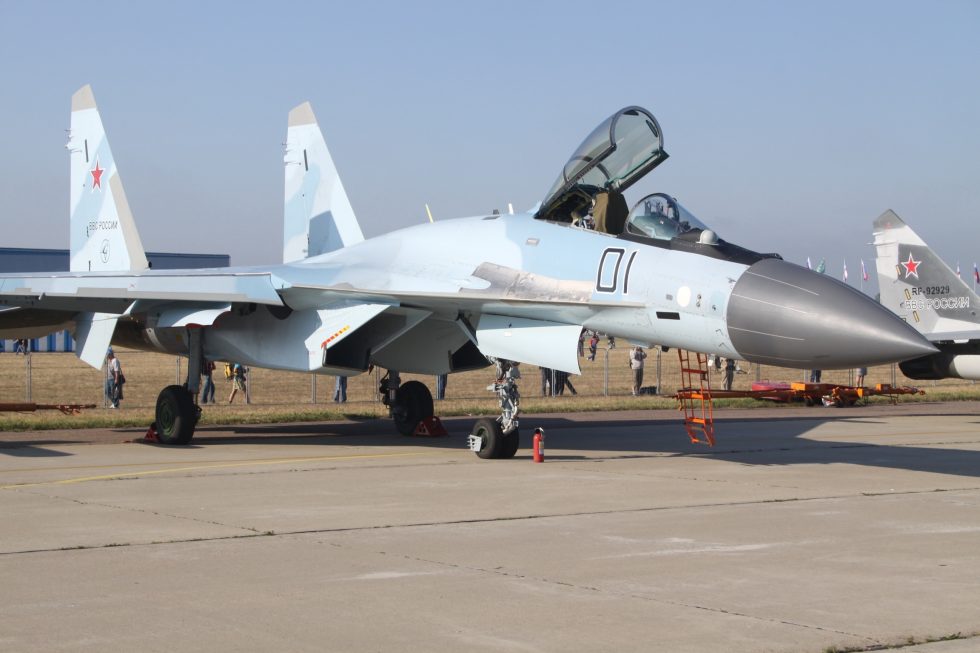
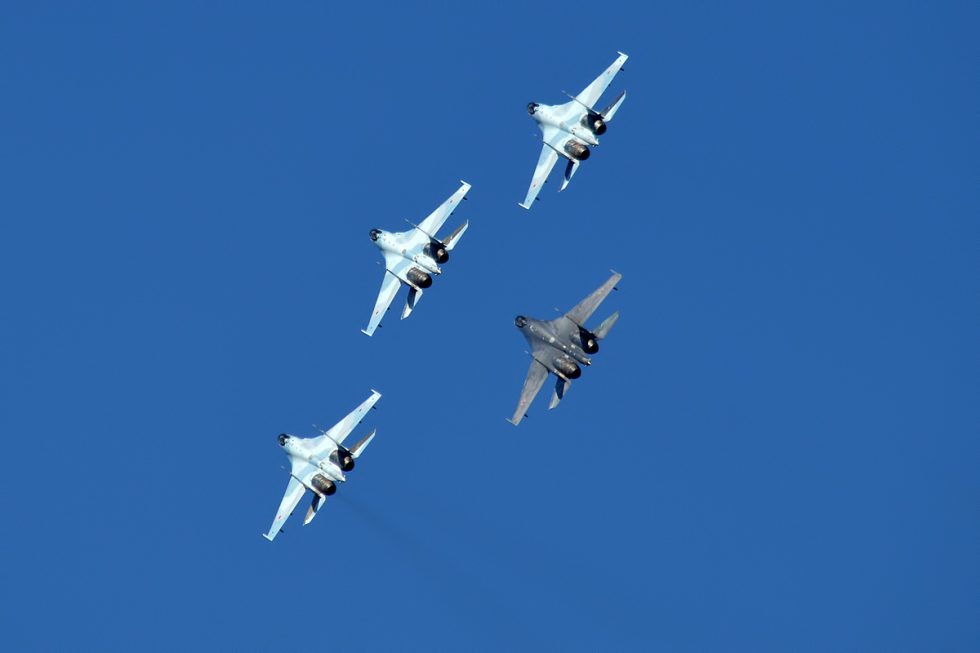
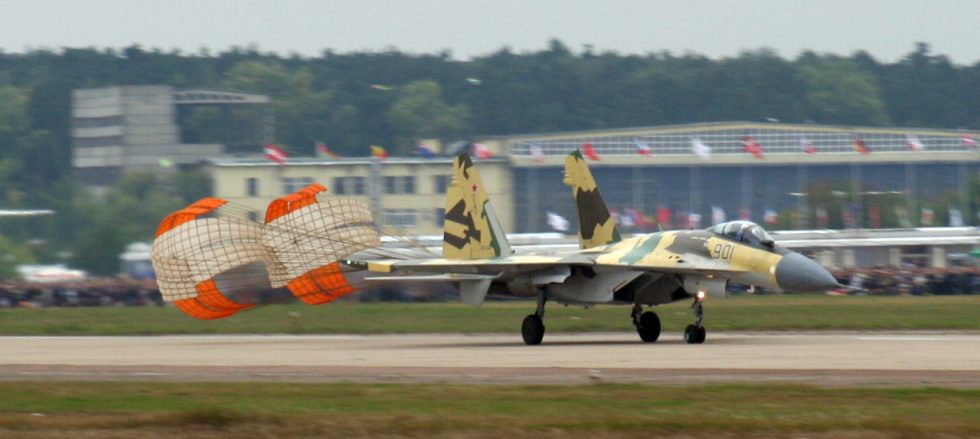
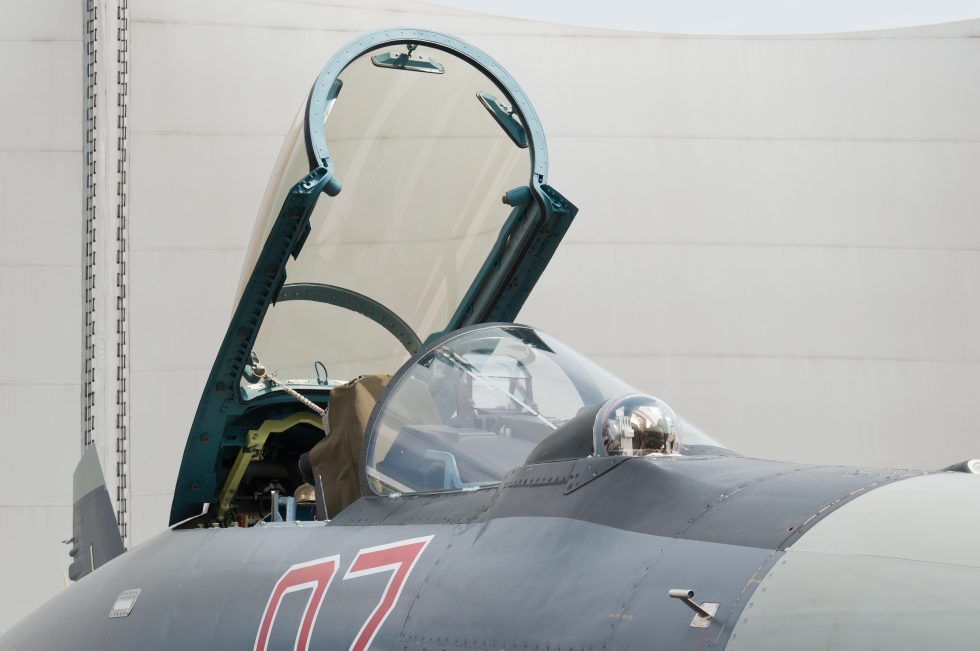
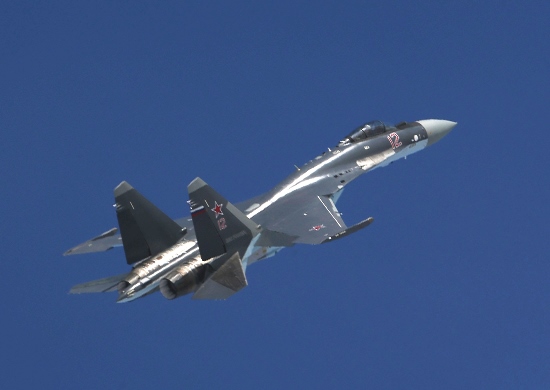
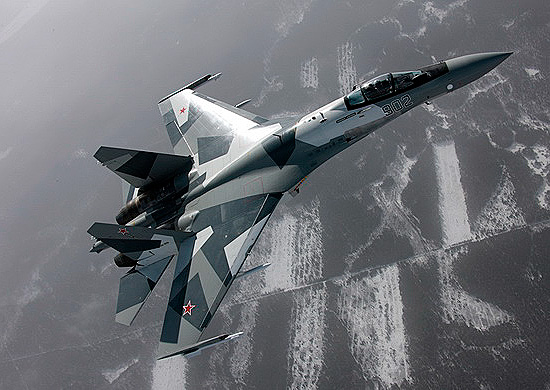
The Su-35 in motion
A Su-35 airshow display — the Cobra, Kulbit and flat-spin manoeuvres that thrust vectoring makes possible.
The Su-35 in motion
maxispeed0 — one of the most-watched Su-35 films on YouTube.
Where the Su-35 flies
Operators today
Three air forces fly the Su-35, and only one of them bought it willingly at full price
The Su-35 was designed for export and has failed at it almost completely. Sukhoi forecast a market of 160 to 200 aircraft split evenly between Russia and foreign customers; in twenty years it has landed one completed export contract, for 24 aircraft to China in 2015, and China has said publicly that it does not intend to buy more. Brazil, India, Indonesia, Turkey, South Korea, Venezuela, the United Arab Emirates and Pakistan all looked and all declined, several of them under explicit American sanctions pressure. The bars below count only aircraft for which delivery can be corroborated, and the Russian figure is a moving one: Oryx’s photographically verified tally stands at roughly eight Su-35S destroyed since February 2022 — two to Patriot ambushes over Bryansk in May 2023, one to friendly S-300 fire near Tokmak in September 2023, others to Ukrainian air defences and accidents — and on 8 July 2026 a Ukrainian F-16 shot one down with an AMRAAM near Mostky in Luhansk, the first fighter-versus-fighter kill by Ukraine’s F-16 fleet, confirmed by General Dan Caine to the US Senate later that month. Ukrainian official claims and some open-source trackers put the total two to three times higher; the visually confirmed number is the one to trust.
Only three bars, because only three fleets can be corroborated — and this is a case where a short chart is the honest one. Russia’s figure is an estimate: 110 aircraft were on strength at the end of 2022, deliveries have continued in four to seven unquantified batches a year since, and combat losses have to be subtracted, so a range of roughly 110 to 140 in inventory is defensible and about 125 is the middle of it. China’s 24 Su-35SK were delivered in three batches between December 2016 and 2018 and are all with the 6th Aviation Brigade at Suixi in Guangdong; that number is firm and is not growing. Algeria’s aircraft are the clearest of the redirected Egyptian airframes: An-124 movements from Komsomolsk-on-Amur in March 2025 and satellite imagery of Su-35s in Algerian markings at Oum el Bouaghi support a small number in country, probably around eight, but Algiers has never announced a contract and the true figure is not known. Egypt is deliberately absent. About 25 Su-35 were built to Egyptian order and flown in Egyptian markings from 2020, and Egypt never accepted a single one: under threat of CAATSA sanctions Cairo walked away and bought American instead. Those airframes are the stock from which the Algerian and reported Iranian aircraft come. Iran is also absent. Tehran has announced the purchase repeatedly since 2022, Russian production of a batch for Iran is supported by leaked documents, and Iranian officials have said aircraft are "on the way" — but as of this writing no delivery has been corroborated by imagery or by any operational sighting, and an announced order is not a fleet. Ethiopia’s reported order for six and Vietnam’s reported interest are on the same footing. Sources: IISS The Military Balance, FlightGlobal World Air Forces, Rosoboronexport and Russian Ministry of Defence delivery statements, and open-source satellite imagery; entries that could not be corroborated are omitted.
Syria, Ukraine and contested tallies
The Su-35 has flown combat over Syria since 2016 and extensively over Ukraine since 2022. Its loss accounting is heavily contested — always read the numbers as claims, not settled scores. Notably, not a single Su-35 loss has been independently confirmed as an air-to-air kill; all verified losses are attributed to ground-based air defences.
Independent assessments (e.g. RUSI) estimate Russia lost only around 20 Su-35S/Su-30SM2 combined beyond repair since February 2022, with the Komsomolsk-on-Amur plant continuing to deliver — though production and attrition figures are themselves estimates. Compare the combat record of every military aircraft. Figures as of July 2026.
Everything people ask about the Su-35
Can I fly in a Su-35?
How fast is the Su-35?
What makes it so manoeuvrable?
How does it compare to the F-15 and F-22?
Is the Su-35 stealthy?
Is it still in service?
How many were built?
What’s the difference between the Su-35 and the Su-27?
You can’t fly the Su-35.
These, you can.
Some legends only live in museums — others are fuelled and waiting. MiGFlug has put civilians in real military jet cockpits since 2004.
 Fly the L-39 AlbatrosThe world’s most-flown jet trainer — aerobatics included
 Fly the F-104 Starfighter“The missile with a man in it”
 Fly the MiG-21The Cold War’s most-produced jet
 Fly the T-33 Shooting StarAmerica’s first jet trainer
 Fly the DH VampireA piece of early jet history
 Fly the S.211Agile Italian jet trainer
 Fly the MB-326The classic Aermacchi jet
 Fly the MiG-15The Soviet legend of the Korean War
Continue the tour
Every fact, checked
- Airforce Technology — Su-35 Flanker-EDevelopment, design and specification overview.
- Key.Aero — All you need to know about the Su-35Background, variants and capability summary.
- 19FortyFiveRussia’s Su-35 losses over Ukraine and continued production.
- The War Zone (TWZ)The contested friendly-fire shoot-down near Tokmak (Sept 2023).
- Defense ExpressLeaked contract data on reported Su-35 orders (Iran, Algeria, Ethiopia).
- Defence Security AsiaSatellite imagery of Iran’s Su-35 preparations at Hamadan.
- The Washington InstituteThe Egyptian military’s perspective on the collapsed Su-35 deal.
- Military Watch MagazineThe Su-35 as an export product and its 2025 sales turnaround.