
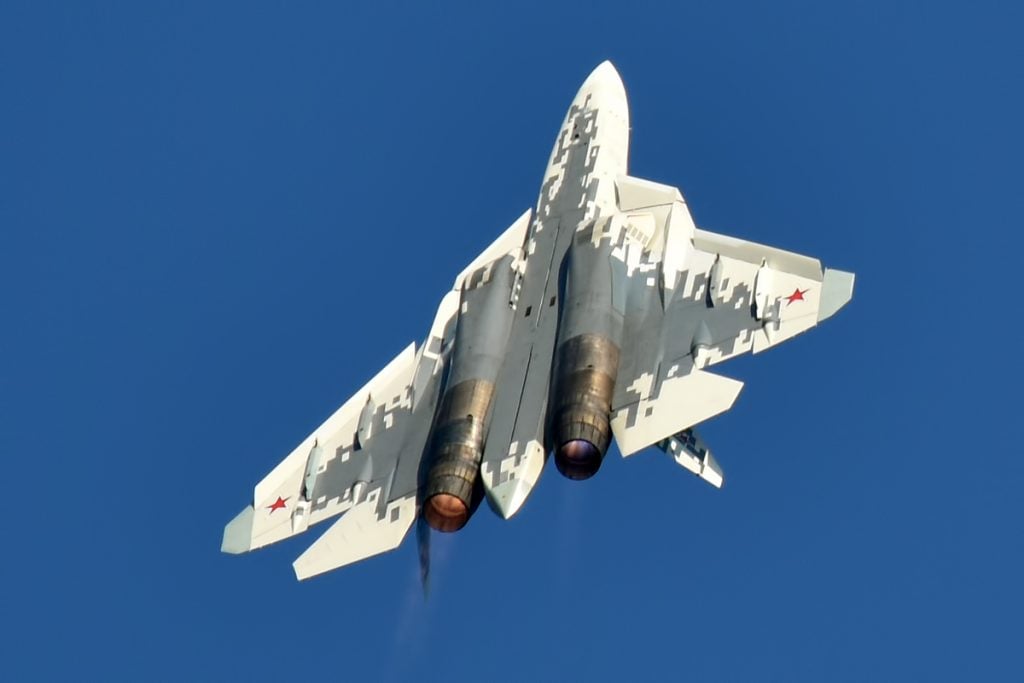
Sukhoi Su-57
“Felon”
Russia’s first fifth-generation stealth fighter — heavily promoted, built in small numbers, and still largely unproven in open sources. An ambitious design whose real-world capability is best read with caution rather than taken from the sales pitch.
The Su-57: ambition, advertised
The Su-57 is Russia’s first stealth fighter — and its most heavily marketed, least battle-proven one. It grew out of the PAK FA programme, Moscow’s post-Soviet answer to the American F-22, with Sukhoi selected as lead over Mikoyan in 2002 and the prototype designated T-50. On paper it is a genuine leap for Russian aviation: internal weapons bays, a blended low-observable planform, thrust-vectoring supermaneuverability and a claimed sensor-fusion suite. The story that actually defines it, though, is the gap between advertisement and reality.
Development ran long and troubled. Structural-fatigue problems, an early Indian co-development partner that later walked away, and Western sanctions all slowed progress. The first serial aircraft was lost in a crash in December 2019, before delivery; the Russian Aerospace Forces received their first operational Su-57 only in December 2020. Production has stayed slow — credible tallies cluster at a disputed few dozen airframes by 2026, against hundreds of American F-35s.
Independent analysts widely judge its stealth shaping and finish less refined than Western fifth-generation jets, and its combat use over Ukraine has, by most open-source accounts, been cautious stand-off missile launches from inside Russian airspace rather than penetrating stealth strikes. None of that is settled fact in the way Russian state media presents it — and neither are the Ukrainian counter-claims. The honest read sits between the two: an ambitious, still-maturing programme wrapped in unusually loud promotion.
01The Su-57’s numbers: how many Felons really exist?
Production figures for the Su-57 are genuinely disputed. Open-source estimates for delivered serial aircraft by 2026 range from roughly 22 to 40 airframes — a spread that reflects how little independently verified data exists. Russia has stated a target of about 76 jets by the late 2020s, but that is an ambition, not an achievement, and earlier targets have already slipped.
Whatever the exact number, the scale point holds: sanctions and industrial constraints have kept the Su-57 fleet tiny next to the hundreds of F-35s in Western and allied service. Any comparison of the two should start there. Treat single precise production figures with caution — the range is the honest answer.
What the Su-57 is built to do
Reduced-signature design (contested degree)
The Su-57 has a faceted forward fuselage, internal main and side weapons bays, radar-absorbent treatments and aligned edges — features intended to reduce its radar signature. Independent experts, however, widely judge it less stealthy than the F-22 or F-35, pointing to visible rivets, exposed engine faces and gaps. It is best described as designed for a reduced signature, not as F-22-class stealth.
Supermaneuverability
Thrust-vectoring nozzles, relaxed stability and a large lifting body give the Su-57 extreme high-alpha, post-stall agility — a Sukhoi signature familiar from the Flanker family and a staple of MAKS airshow displays. Spectacular to watch, though analysts caution that airshow agility is not the same as an advantage against modern radar and long-range missiles.
Engines and sensors — still maturing
Serial jets fly on twin Saturn AL-41F1 (izdeliye 117) turbofans derived from the Su-35’s. The definitive engine — izdeliye 30 / AL-51F1, promising more thrust and true supercruise — has been slow to enter series. Paired with the N036 Byelka AESA radar and claimed multi-sensor fusion, the capability figures are largely Russian-stated and should be treated with caution.
02The Su-57’s stealth: why experts hedge the claims
Stealth is not a single number, and the Su-57’s is hard to assess from the outside. Its shaping reduces radar return from some aspects, and it carries its main weapons internally — both genuine low-observable measures. But visible surface detail, the treatment of its engine inlets and exhausts, and gaps in its finish have led many Western analysts to rate it below the F-22 and F-35 in all-aspect stealth. Crucially, no independent open-source measurement exists, and Russian capability claims are promotional. The responsible framing is “designed for reduced signature, real-world performance unverified” — not the peer-to-Western-stealth billing Moscow prefers.
03The Su-57’s engine problem: still flying on interim power
The Su-57 was designed around a new engine, the izdeliye 30 (AL-51F1), promising more thrust and true supercruise. That engine has been slow to reach series production, so serial aircraft continue to fly on the AL-41F1 (izdeliye 117), an evolution of the Su-35’s powerplant. Until the definitive engine is fielded in numbers, the jet arguably operates on interim power — one more reason to treat headline performance figures, especially supercruise claims, as targets rather than demonstrated facts.
Su-57 specifications (estimated & contested)
Most Su-57 figures are Russian-stated or Western-estimated and are not independently verified. Treat the numbers below as approximate.
Baseline note: the figures below describe the single-seat Su-57 as fielded with the Russian Aerospace Forces, powered by two NPO Lyulka-Saturn AL-41F1 (izdeliye 117) turbofans, using the best-attested open figures as they stood on 3 September 2026. Four warnings before the tables. First, the specification set reproduced almost everywhere, including here, is Rosoboronexport’s Su-57E export sheet, cross-checked against United Aircraft Corporation brochures issued at Dubai in November 2023 and Zhuhai in November 2024. That is a seller’s document describing an export aircraft, not a certified performance manual for the Russian machine, and no independent party has ever measured any line of it. Second, the brief this page was written from conflated two engines, and the distinction matters. The second-stage engine is the AL-51F-1, development designation izdeliye 30; it first flew on a Su-57 on 5 December 2017 and is still not in series production nine years later. Izdeliye 177, shown at Dubai in November 2025 and first flown on 22 December 2025, is a different and deliberately less ambitious engine that fuses AL-41F1 hardware with AL-51F-1 technology. Izdeliye 177S is a third engine again, intended to re-engine the Su-30, Su-34 and Su-35 fleets, and has nothing to do with the Su-57. Third, the radar cross-section row is the least trustworthy line on this page and is dealt with at length where it sits. Fourth, the published dimensions do not fully reconcile with the published weights, which is noted in the wing loading row rather than smoothed over. Deltas for izdeliye 177 and the AL-51F-1, for the Su-57M / Su-57M1 upgrade, for the two-seat Su-57D that first flew on 19 May 2026, and for the S-70 Okhotnik-B unmanned partner are in grey.
Dimensions & weights
- Crew
- 1 — two in tandem on the Su-57D, which first flew on 19 May 2026 with a raised second station behind the pilot. Rostec described that aircraft as a United Aircraft Corporation initiative rather than a Ministry of Defence requirement, which is an unusual thing to say about a prototype of a national fighter
- Length
- 20.1 m (65 ft 11 in) — the Rosoboronexport figure. Older reference tables and several standard works give 19.8 m (65 ft 0 in) or 19.7 m (64 ft 8 in); the difference is probably the pitot boom or the refuelling probe fairing rather than a change to the airframe. For scale, an F-22A is 18.92 m (62 ft 1 in) and an Su-27 21.94 m (72 ft 0 in)
- Wingspan
- 14.1 m (46 ft 3 in) — some listings give 13.95 m (45 ft 9 in). Against the F-22A’s 13.56 m (44 ft 6 in) this is a big aeroplane by fifth-generation standards, and its size is one reason low-frequency early-warning radars have an easier time with it
- Height
- 4.6 m (15 ft 1 in) — measured to the tips of the canted vertical stabilisers, which are all-moving rather than fixed fins with rudders
- Wing area
- 78.8 m² (848 sq ft) — a generous wing on a heavy airframe, and the basis of the type’s genuinely exceptional low-speed handling. The figure includes the large leading-edge root extensions carrying the movable LEVCON surfaces
- Empty weight
- 18,500 kg (40,785 lb) — a manufacturer statement, never a weighed figure. For comparison, the F-22A is quoted at 19,700 kg (43,430 lb) and the Su-35S at about 19,000 kg (41,890 lb)
- Normal take-off weight
- 26,700 kg (58,864 lb) — the requirement early in the programme was 22 to 23 tonnes; the production aircraft came out some four tonnes heavier, which is the single most consequential number in the whole specification because it is what the delayed engine was supposed to compensate for
- Loaded weight, full fuel
- 29,800 kg (65,700 lb) — empty weight plus full internal fuel, pilot, gun ammunition and a nominal six-missile air-to-air fit. This, not the 26,700 kg figure, is the weight a real interception sortie leaves the ground at
- Maximum take-off weight
- 34,000 kg (74,957 lb) — against 38,000 kg (83,776 lb) for the F-22A and 34,500 kg (76,060 lb) for the Su-35S. The Su-57 is not a light aircraft pretending to be stealthy; it is a Flanker-sized machine with a Flanker-sized appetite for runway and fuel
- Internal fuel
- 9,700 kg (21,385 lb) — rising to 12,900 kg (28,440 lb) with two PTB-2000 tanks of 2,000 litres (528 US gal) each. The drop tanks are for ferrying and for peacetime patrol; carrying them on a combat sortie forfeits the entire reason for the aeroplane
- Maximum payload
- ~7,500 kg (~16,535 lb) across twelve hardpoints, six internal and six external. The maximum is an external-carriage figure. Nothing approaching it has been photographed on a Su-57, and the internal-only load is a small fraction of it
- Main weapons bay, each
- 4.4 m (14 ft 5 in) long by 0.9 m (2 ft 11 in) wide — two of them, in tandem, in the ventral volume between the widely spaced engine nacelles. This is the one design decision on which the Su-57 is unambiguously ahead of the F-22: Sukhoi explicitly rejected the American layout because it had no room between the engines for large air-to-surface stores
- Wing loading
- 371 kg/m² (76.0 lb/sq ft) as published for normal take-off weight — but the arithmetic does not close. Divide the quoted 26,700 kg by the quoted 78.8 m² and you get 339 kg/m² (69.4 lb/sq ft); the published 371 implies a weight nearer 29,200 kg. Either the wing area or the reference weight in the brochure is not the one used to compute the loading, and this is a fair illustration of how carefully the standard figures should be handled
Performance
- Maximum speed, altitude
- 2,135 km/h (1,153 kn; 1,327 mph) — Mach 2.0. The original requirement was Mach 2.35, cut to Mach 2.15 and then to Mach 2.0 in 2006 to allow more composite material in the airframe. That is a designed-in trade, not a shortfall, but it does mean the Su-57 is slower flat out than the Su-27 it replaces
- Maximum speed, sea level
- 1,350 km/h (729 kn; 839 mph) — Mach 1.1, the usual limit for a fighter with external stores pylons and a large frontal area at dense-air conditions
- Supercruise
- Mach 1.3 (1,400 km/h; 756 kn; 870 mph) at altitude — the most disputed performance claim on the aircraft. The Indian Air Force stated in 2014 that the AL-41F1 did not give the type a true supercruise capability, and that objection helped kill the FGFA partnership. The figure is a manufacturer claim, has never been independently demonstrated, and is precisely what the AL-51F-1 was supposed to secure
- Rate of climb
- not published — neither Sukhoi nor Rosoboronexport has ever released a climb figure for this aircraft, and any number you see quoted elsewhere is somebody’s estimate. It is worth saying plainly rather than filling the row
- Range, subsonic
- 3,500 km (2,175 mi; 1,890 nmi) on internal fuel — a genuinely long-legged aeroplane, and the quality that makes it useful as a standoff missile carrier operating from inside Russian airspace
- Range, supersonic
- 1,500 km (932 mi; 810 nmi) — stated by Sukhoi as more than twice the Su-27’s supersonic range, which is the more meaningful comparison because it depends on the same fuel fraction and the same engine family
- Combat radius
- ~1,250 km (~777 mi; ~675 nmi) — profile unstated, which makes it close to meaningless as a planning number. It is quoted here because it is what the export sheet says, not because anyone can reconstruct it
- Ferry range
- 4,500 km (2,796 mi; 2,430 nmi) with two outboard drop tanks. A retractable in-flight refuelling probe is fitted, mounted on the port side ahead of the cockpit, which is why the infrared search-and-track turret sits offset to starboard
- Service ceiling
- 18,800 m (61,680 ft) — higher than the F-35A’s quoted 15,000 m (50,000 ft) and comparable with the F-22A. High-altitude launch matters more for the R-37M class of very long-range missile than for anything the aircraft does itself
- g limit
- +9.0 — the SOZhE-50 life support system and PPK-7 flight suit are rated to sustain the pilot at 9 g for up to 30 seconds at a stretch. The K-36D-5 seat allows ejection from zero to 20,000 m (65,600 ft) and from zero to 1,300 km/h (808 mph) indicated
- Thrust-to-weight
- 1.09 at normal take-off weight — falling to 0.97 at loaded weight with full fuel, computed from two AL-41F1 at full reheat. With the AL-51F-1’s claimed 16.5 tonnes-force per engine the loaded figure would rise above 1.1, which is the whole argument for the second-stage engine and the whole cost of its delay
Propulsion & systems
- Engines
- 2 × NPO Lyulka-Saturn AL-41F1 (izdeliye 117) afterburning turbofans — each about 1,600 kg (3,527 lb) dry with a 932 mm (36.7 in) fan inlet. This is an uprated AL-31 derivative, not a new engine: it is a close relative of the izdeliye 117S fitted to the Su-35S, the main difference being the engine control system. The Su-57 has flown its entire service life on what was always meant to be its interim powerplant
- Thrust, dry
- 88.3 kN (19,840 lbf; 9.0 tonnes-force) per engine
- Thrust, reheat
- 142.2 kN (31,970 lbf; 14.5 tonnes-force) per engine, rising to 147.1 kN (33,070 lbf; 15.0 tonnes-force) in emergency "special" power. Against the F-22A’s two F119 at roughly 156 kN (35,000 lbf) apiece, the Su-57 is meaningfully down on installed thrust while being of similar weight
- Thrust vectoring
- axisymmetric nozzles canted about their rotational axes — each nozzle vectors in one plane only, but the cant lets differential deflection generate pitch, yaw and roll moments. The arrangement descends from the Su-30MKI and Su-35S. Sukhoi cited the F-22’s inability to use vectoring in roll and yaw as a specific deficiency it set out to fix, and on this narrow point it did
- Second-stage engine
- Saturn AL-51F-1 (izdeliye 30) — 107.9 kN (24,250 lbf; 11.0 tf) dry and 162 kN (36,380 lbf; 16.5 tf) in reheat, 1,450 kg (3,197 lb), with glass-fibre inlet guide vanes and a serrated-flap nozzle to cut radar and infrared signature. It first flew on prototype T-50-2 on 5 December 2017, was formally named AL-51 in 2023, and has still not entered series production. It is the pivot of the whole programme: without it the Su-57M1 is an avionics upgrade rather than a new aircraft
- Interim alternative
- izdeliye 177 — 107.9 kN (24,250 lbf; 11.0 tf) dry and 157 kN (35,270 lbf; 16.0 tf) reheat, with a claimed 6,000-hour life. Unveiled at Dubai in November 2025 and first flown on a Su-57 on 22 December 2025, it grafts AL-51F-1 technology onto AL-41F1 hardware and is probably the product of the Udlinitel fallback programme. Ukrainian analysts at Defense Express noted the obvious point on 23 December 2025: it does not carry the flat, low-signature nozzle that was the AL-51F-1’s stealth argument. Do not confuse it with izdeliye 177S, a separate engine of 14,500 kgf reheat intended to re-engine the Su-30, Su-34 and Su-35
- Radar
- Tikhomirov NIIP N036 Byelka — a nose-mounted N036-1-01 X-band active array of 1,514 transmit/receive modules, tilted back for signature reasons, plus two N036B-1-01 cheek arrays of 404 modules each for angular coverage and two N036L-1-01 L-band arrays in the wing leading-edge flaps used for identification friend or foe and electronic warfare. Claimed to track 60 targets and engage 16 in the air. The director general of Tikhomirov-NIIP said in 2021 that the radar had yet to complete debugging, nine years after ground testing began
- Electro-optics
- UOMZ 101KS Atoll — the 101KS-V infrared search and track offset to starboard ahead of the windscreen, 101KS-O laser directional infrared countermeasures in two turrets, 101KS-U ultraviolet missile approach warning, 101KS-P thermal imager for low-level flight and night landing, and the podded 101KS-N for targeting. The Su-57 is the first fighter in the world to carry a directional infrared countermeasures turret, which is a real and under-remarked first. The search and track head rotates rearwards when idle, its back face treated with radar-absorbent material
- Electronic warfare
- L402 Himalayas — built by the Kaluga Research Radio Engineering Institute, using both its own apertures and the N036 arrays, with one antenna in the dorsal sting between the engines. Countermeasure dispensers, radar decoys and single-use programmable jammers are carried in the same tail boom
- Flight control & structure
- KSU-50 digital flight control system — the airframe is deliberately unstable in pitch and yaw, with adjustable leading-edge vortex controllers on the root extensions that trim the aircraft and recover it from a departure if thrust vectoring fails. Materials are 40.5 to 44.5 per cent aluminium alloy and 18.6 per cent titanium alloy, with composites making up 22 to 26 per cent of structural weight and about 70 per cent of the outer surface
- Cockpit
- two 380 mm (15 in) colour displays, a wide-angle head-up display of 30° by 22° — no analogue instruments, hands on throttle and stick, a two-piece canopy whose forward section slides aft and which carries 70 to 90 nm metal oxide coatings. NPP Zvezda K-36D-5 seat, ZSh-10B helmet with the NSTsI-50 digital sight and pupil tracking. The integrated modular avionics suite IMA BK runs on over four million lines of code across fibre-optic channels
- Radar cross-section
- not publicly known — and this is the row where the three usual sources of exaggeration meet. What is established: Sukhoi’s own patent for the T-50’s low-observable features states an intention to bring average radar cross-section to roughly 0.1 to 1 m², against about 10 to 15 m² for the Su-27, and the measures themselves are real and documented — planform edge alignment, serrated skin-panel edges, internal carriage, recessed antennas, radar-absorbent material lining partial serpentine intake ducts, and a slanted blocker grid ahead of the inlet guide vanes at 0.7 to 1.2 duct diameters. What is claimed: a signature thirty times smaller than the Su-27’s, which is arithmetic performed on the patent’s own target rather than a measurement of an aeroplane. What is not publicly known: the actual value, in any aspect, at any frequency, for any airframe. The figures repeated everywhere — 0.1 to 0.5 m² for the Su-57 against 0.005 m² for the F-35 and 0.0005 m² for the F-22 — are third-party estimates by undisclosed method set against American numbers that are themselves estimates. Treat the ordering as plausible and the digits as ornament. Two things can be said with confidence. The design optimises the forward hemisphere, roughly the frontal 60-degree arc, with the aft fuselage and engine installation less carefully treated than on the F-22 or F-35 — consistent both with cost control and with a doctrine that keeps the aircraft under a friendly integrated air defence umbrella. And when prototype T-50-4 stopped at Taiyuan in November 2024 on its way to Zhuhai and a member of the public photographed it at arm’s length, the images showed proud rivets and screws, mismatched slotted, cross-head and hex bolts on the tail, misaligned panels with visible gaps, and a weapons bay door that would not shut. Production aircraft are reported to be built to a better standard than the trials machines; nobody outside Russia has measured those either
04The Su-57’s cost: why the price tag is hard to trust
Public cost figures for the Su-57 should be read sceptically. Russian sources cite unit prices in the region of US$35–50 million, strikingly low for a fifth-generation fighter; Western estimates tend to run higher, and none are independently audited. Currency effects, sanctions, small production runs and state accounting all distort the picture. No credible cost-per-flight-hour figure exists in open sources at all. As with the jet’s capability claims, the honest position is that the true economics of the Su-57 are not publicly known.
Armament & payload
The Su-57’s weapons bays are the best thing about it, and almost everything meant to go inside them is still arriving
Two tandem ventral bays of 4.4 by 0.9 metres, plus two small triangular side bays at the wing roots, give the Su-57 more usable internal volume than any other fighter of its generation. That was a deliberate choice: Sukhoi looked at the F-22, judged its inter-engine volume too small and its payload too narrowly air-to-air for a multirole aeroplane, and spaced the engines to open a corridor down the middle of the fuselage. The result is a stealth fighter that can carry a 500 kg guided bomb or a 400 km cruise missile internally, which the F-22 cannot, and it is the strongest single argument in the type’s favour.
The difficulty is that the bays were designed around a weapons family that arrived late and in part has not arrived at all. The internal air-to-air fit depends on the R-77M (izdeliye 180) with its active array seeker and dual-pulse motor and on the R-74M2 (izdeliye 760) reshaped to fit a side bay; the very long-range internal option, izdeliye 810, is a shortened R-37M still in development. Meanwhile the weapon the Su-57 has demonstrably fired in anger is the Kh-69 — a stealthy 400 km cruise missile which the Su-34 and Su-35 can also carry externally. That is the honest shape of the aircraft’s combat record: a fifth-generation launch platform used mostly as a standoff truck for a missile that does not need a fifth-generation aeroplane to launch it. Almost none of the internal fits below have been photographed on an operational Russian aircraft; the lists are what Sukhoi, Rosoboronexport and the Tactical Missiles Corporation advertise, and the Su-57E export configuration differs from the Russian aircraft in identification systems, cockpit instrumentation and fire-control modes.
Gun
- One 30 mm 9A1-4071K, the internal-carriage variant of the Gryazev-Shipunov GSh-30-1, mounted near the root of the starboard leading-edge vortex controller with 150 rounds.
- Single-barrel, gas-operated, roughly 1,500 to 1,800 rounds per minute, 30 × 165 mm ammunition. It is the same weapon carried by every MiG-29 and Su-27 derivative since the early 1980s, and the one system on the aircraft whose behaviour is beyond argument.
- Effective range is given as 800 m (875 yd) against aerial targets and 1,800 m (1,970 yd) against surface targets.
- Aimed through the head-up display and the NSTsI-50 helmet sight. On an aircraft designed to shoot from beyond visual range it is a last-resort weapon, and its presence is more about doctrine than expectation.
Air-to-air
- R-77M / izdeliye 180 (AA-12 Adder derivative), active radar homing, with an active array seeker, dual-pulse motor and conventional rear fins in place of the original lattice control surfaces. Four in the two main bays is the standard internal beyond-visual-range fit.
- R-74M2 / izdeliye 760 (AA-11 Archer derivative), infrared homing, reshaped and slimmed for the side bays; one in each. A clean-sheet replacement, K-MD or izdeliye 300, is in development to succeed it.
- Izdeliye 810, a shortened R-37M (AA-13 Axehead) with reduced-span control surfaces and a new motor and seeker, two per main bay. The full-size R-37M can only be carried externally, at direct cost to signature and drag.
- Russian sources credited the type with shooting down a Ukrainian Su-27 and an Su-24 with R-37Ms after General Sergey Surovikin’s claim of 19 October 2022. No corroborating evidence for either kill has ever been published.
- The one air-to-air firing that is not in dispute is the least flattering: on 5 October 2024 a Su-57 shot down a Russian S-70 Okhotnik-B that had lost its datalink and drifted about 16 km (10 miles) into Ukrainian-held territory.
Air-to-surface guided
- Kh-69 (AS-22 Kazoo), the stealthy subsonic cruise missile derived from the Kh-59MK2 — 800 kg, at least 400 km range, able to fly as low as 20 m above ground. This is the weapon the Su-57 has actually used in combat, from 18 February 2024 onwards, and it fits the main bays.
- Kh-38M family, the modular short-range air-to-ground missile with laser, infrared, radar or satellite guidance; four internally.
- Kh-58UShK (AS-11 Kilter), anti-radiation, four internally — the weapon behind the June 2022 claim of networked Su-57s suppressing Ukrainian air defences, a claim never independently confirmed.
- Kh-35U (AS-20 Kayak) sea-skimming anti-ship, two internally; the supersonic Kh-31 externally.
- S-71K Kovyor, a new standoff cruise missile designed for external carriage and first reported publicly in April 2026. Nuclear capability is expected by American assessments via a shortened weapon of the Kh-47M2 Kinzhal type sized for the internal bays; nothing of the kind has been shown.
Bombs
- KAB-500 series, 500 kg, in television, laser or satellite-guided forms, carried on the UVKU-50U ejection launcher rated to 700 kg (1,543 lb).
- KAB-250, 250 kg, the smaller precision weapon developed specifically so that more rounds fit a bay designed around length rather than depth.
- Drill, a 500 kg cluster munition dispensing self-targeting submunitions with active seekers, announced for the type in 2018 and not seen since.
- Unguided general-purpose bombs can be hung on the six external hardpoints, but a Su-57 carrying iron bombs externally is a Su-35 with worse economics, and no operational photograph shows one doing it.
Rockets
- No rocket fit has ever been published, photographed or advertised for this aircraft, and the card is kept rather than padded because the absence is informative.
- Unguided rockets are a low-altitude, within-visual-range weapon. Carrying them means flying into the envelope of exactly the short-range air defences the Su-57 was built never to enter, in pods that would wreck its signature.
- The six external hardpoints could physically take B-8M1 pods of 80 mm S-8 rockets or B-13L pods of 122 mm S-13, since they accept most Russian tactical stores; nothing suggests the fit has been cleared or intended.
- Russia has Su-25s, Su-34s and attack helicopters for that work, and has expended them heavily in Ukraine. The Su-57 has been kept well away from it.
Pods & other stores
- 101KS-N navigation and targeting pod, the podded member of the otherwise internal Atoll suite, needed to designate for the laser-guided bombs.
- Two PTB-2000 drop tanks of 2,000 litres (528 US gal), taking usable fuel from 9,700 kg to 12,900 kg at the cost of two external stations and any pretence of low observability.
- Twelve hardpoints in total: six internal stations across the two main and two side bays, six external. Maximum external payload is quoted as 7,500 kg (16,535 lb); the internal maximum is far smaller and has never been stated.
- Vympel UVKU-50L ejection launchers for internal stores to 300 kg (661 lb) and UVKU-50U for stores to 700 kg (1,543 lb); VPU-50 rails in the side bays.
- The S-70 Okhotnik-B is best understood as a store the Su-57 carries at a distance: a 20 tonne flying-wing unmanned aircraft with two internal bays for up to 2,000 kg (4,409 lb), first flown 3 August 2019 and flown in company with a Su-57 from September 2019.
Three typical loadouts
- Internal air-to-air, penetration
- Four R-77M in the two main bays and one R-74M2 in each side bay, gun with 150 rounds, internal fuel only. Six missiles is the clean fit and the configuration every published performance figure assumes.
- Standoff strike, the sortie actually flown
- Two to four Kh-69 cruise missiles in the main bays, R-74M2 in the side bays for self-defence, launched from over Kursk, Bryansk or occupied Luhansk without leaving airspace Russia controls. Escorted by a pair of Su-35s on the 18 February 2024 strike. This is what the Su-57 has done in the war, and it uses the bays and the range while asking nothing of the signature.
- Non-stealthy maximum load
- Internal bays filled plus external hardpoints carrying R-37M, Kh-31 or drop tanks, up to a quoted 7,500 kg. A brochure configuration for a permissive day, and a straightforward admission that on that day an Su-35S would do the same job for less money.
Sourcing caveat: apart from the gun and the Kh-69, essentially none of the above has been confirmed on an operational Russian Su-57 by imagery or by an independent source. The lists come from Rosoboronexport and United Aircraft Corporation brochure material, from Tactical Missiles Corporation announcements, and from Russian defence press. Several weapons named here — izdeliye 810, K-MD, the Kinzhal derivative, the S-71K — are development programmes with no confirmed service date. Where a NATO reporting name is given it belongs to the parent weapon rather than to the specific Su-57 variant, which in most cases has never been assigned one.
Variants
One production mark, one export mark, one two-seater, and a decade of upgrade designations that keep changing name
The Su-57 has a thin variant list for an aircraft sixteen years past its first flight, and the reason is the engine. Almost everything designated M, M1 or second-stage is a promise resting on the AL-51F-1, which flew in December 2017 and is still not in series production. In the meantime the fielded aeroplane has changed relatively little, and the naming has changed a great deal, which is why published variant tables disagree with one another and with themselves.
One correction to the brief this page was written from. There is no established Su-57M2. The upgrade programme is Megapolis; its product is designated Su-57M in Sukhoi and English-language sources and Su-57M1 in Russian ones, and they appear to be the same aircraft. The two-seater that first flew on 19 May 2026 is the Su-57D, not an M2, and Rostec presented it as a manufacturer initiative rather than a Ministry of Defence programme. Where a designation below is contested, it says so.
- T-50 (izdeliye 701) (2010–2019, ten flying and three ground airframes)
- The prototypes. T-50-1 flew on 29 January 2010 at Dzemgi with Sergey Bogdan at the controls, a 47-minute sortie. Airframe cracking after MAKS-2011 grounded the fleet for over a year for structural reinforcement; T-50-5 was gutted by an engine fire after landing on 10 June 2014 and rebuilt from the sixth airframe under the same bort number. The sixth aircraft was the first to the revised second-stage airframe standard.
- Su-57 (2019–present, 44 or more built including ten test aircraft as of 2026)
- The production single-seater, named Su-57 in July 2017 after seven years as T-50. Serial production began July 2019; the first production aircraft crashed on 24 December 2019 during factory trials with a flight control malfunction, so the second became the first delivered, on 25 December 2020. Three regiments of 76 aircraft are contracted to 2028 under a deal reported at up to 170 billion roubles.
- Su-57E (unveiled MAKS-2019, 28 August 2019)
- Export standard: different identification friend or foe equipment, instruments in imperial units, English cockpit labelling, adjusted fire-control modes and provision to integrate non-Russian weapons. Marketed by Rosoboronexport as the Perspective Multirole Fighter. It is the Su-57E whose specification table the world quotes for the Russian aircraft.
- Su-57M / Su-57M1 (Megapolis; contract 2018, no confirmed delivery)
- The upgrade: AL-51F-1 engines, a broadened airframe for more lift and better supersonic stability, flatter fuselage and bay contours, new radar, an artificial-intelligence pilot aide, a new helmet sight and the izdeliye 810 missile. An upgraded airframe flew on 21 October 2022 without the second-stage engine, which rather makes the point. Russian sources expected production from early 2026 and service entry by the end of 2026; nothing has been confirmed.
- Su-57D (first flight 19 May 2026)
- Two-seat, with a raised rear station under a lengthened canopy. Announced in July 2021 as a trainer and as a controller for the S-70 Okhotnik-B, with the back-seater able to serve as weapon systems officer or airborne controller. The stretch costs signature and performance. The configuration is close to what India asked for and did not get.
- Sukhoi/HAL FGFA (2007–2018, cancelled, no prototype built)
- The Indian derivative, contracted 18 October 2007 with a preliminary design agreement in December 2010 and roughly six billion dollars of investment expected from each side. India wanted 166 single-seat and 48 two-seat aircraft, then 214 single-seaters, then 144 by 2012, and asked for 40 to 45 changes. It withdrew in April 2018.
- Naval Su-57 (proposal only)
- A carrier variant with folding wings and stabilators proposed for the Project 23000 Shtorm supercarrier, shown only as models. Shtorm was never funded, and after the decision to scrap Admiral Kuznetsov there is no Russian deck for it to land on.
- Sukhoi LTS Checkmate (Su-75) (mock-up MAKS-2021)
- Not a Su-57 variant but its declared technological offspring: a single-engine light tactical aircraft sharing radar, main weapons bay, fins and wing with the Su-57 and intended for the AL-51F-1. Shown as a mock-up in July 2021, it has not flown, and sanctions have pushed it further out.
- S-70 Okhotnik-B (first flight 3 August 2019)
- The unmanned partner rather than a variant: a flying wing of about 20 tonnes maximum take-off weight and 20 m (65 ft) span, one AL-31F-derived turbofan, about 1,000 km/h (620 mph; Mach 0.82), two internal bays to 2,000 kg. It flew in company with a Su-57 in September 2019 to extend the fighter’s sensor reach. Serial production was projected for the second half of 2024 and has not been confirmed.
Closing caveat: the Russian and English variant tables are not consistent with each other. Russian-language reference sites and much Russian press use Su-57M1 for the Megapolis upgrade where English sources use Su-57M; the two-seater appears as Su-57D and occasionally as Su-57UB; there is no sourced basis for an Su-57M2 in single-seat or two-seat form, and pages that list one are extrapolating. Engine nomenclature is worse: izdeliye 117 is the current AL-41F1, izdeliye 117S the Su-35S engine, izdeliye 30 the AL-51F-1 second-stage engine, izdeliye 177 an interim Su-57 engine flown from December 2025, and izdeliye 177S a fourth engine for the Su-30, Su-34 and Su-35 fleets. Sources that treat any two of those as the same engine should not be relied on for anything else.
Operators today
Russia flies almost every Su-57 in existence, and the second bar on this chart rests on a company statement and two grainy videos
Start with the honest problem: nobody outside the Russian Ministry of Defence knows how many Su-57s there are. The programme has never published a delivery return. What can be assembled from serial observations and standard reference work is that 44 or more airframes had been built by 2026, of which about ten are prototypes and trials machines, and that open-source estimates put roughly 30 aircraft in operational or quasi-operational hands at the start of 2026. A further batch was handed over on 9 February 2026, described by United Aircraft Corporation only as substantial. One aircraft was lost near Moscow on 23 July 2026; the Ministry of Defence called it a technical failure, while Ukrainian sources suggested Russian air defences had been induced to shoot it down. The number below is therefore a considered estimate with a wide error bar, not a count.
Set that against the contract. Vladimir Putin announced on 15 May 2019 that 76 aircraft would be delivered by 2028, and the contract was signed that June for a reported 170 billion roubles — the largest order in modern Russian aviation. Seven years into a nine-year schedule, somewhere between a third and a half of it has been built. Deliveries by year, where they can be reconstructed: one in 2020, four by May 2022 and six by that December, about twelve more through 2023, an intended twenty in 2024 that was probably not met, and by the assessment of several Western outlets few if any in 2025. The first operational unit is the 23rd Guards Fighter Aviation Regiment at Dzyomgi, with aircraft also at Lipetsk and at the 929th State Flight Test Centre at Akhtubinsk. Five Su-57s were visible at Akhtubinsk on commercial satellite imagery in December 2022, some 500 km from Ukraine, and it was Akhtubinsk that Ukrainian military intelligence struck with drones on 9 June 2024 — a raid Russian military Telegram channels confirmed, with at least one Su-57 damaged by shrapnel and Maxar imagery showing a crater beside a parked aircraft. That an air force with a few dozen of its most expensive aeroplanes was parking them in the open, unsheltered, 500 km from Ukraine, is the most revealing single fact in this section.
Algeria is the second bar, and it is a weak one. A contract for 14 aircraft was reported in December 2019; leaked Rostec documentation from October 2025 put the order at 12 for roughly two billion dollars. On 18 November 2025 the head of United Aircraft Corporation said two aircraft had been delivered to an unnamed foreign customer and had entered combat duty. Video said to show a Su-57 over Algerian territory, near Oum El Bouaghi air base, appeared on TikTok and X on 6 and 7 February 2026 and again in March; the footage is grainy, carries no visible markings or serials, and has never been confirmed by the Algerian government, which has said nothing at all. No satellite imagery of Algerian Su-57s has been published. The row is included because several independent outlets, Russian and Western, now treat the delivery as having happened, and because Algeria appears as an Su-57 operator in reference listings; it is marked as reported rather than corroborated, and a reader who chooses to discount it entirely is not being unreasonable.
Everything else is campaign, not fleet. India withdrew from FGFA in April 2018 over stealth, avionics, cost and workshare, was offered the Su-57E again at Aero India in February 2025 with an offer of Hindustan Aeronautics Limited production at Nashik and full technology transfer, and by late 2025 was reported to be weighing two squadrons from Russia as a long-range strike stopgap rather than as a fifth-generation fighter, with a Hindustan Aeronautics assessment that its plant matched about half the requirement. Turkey looked and chose its own programme in February 2020. The United Arab Emirates looked and declined to risk American sanctions. Vietnam expressed intent in July 2021 and criticised the workmanship. Iraq expressed interest in 2021 with no negotiations following. Iran has been the subject of recurrent reports of Su-57 or Su-35 discussions; no Su-57 contract with Iran has ever been substantiated, and it is not charted. None of these are operators.
These are estimates. Many airframes counted on paper are stored, in deep overhaul, or not operational. Sources: IISS The Military Balance and FlightGlobal World Air Forces; entries that could not be corroborated are omitted. For this type the caveat is unusually heavy. The Russian figure is a midpoint between 44 or more airframes built including about ten test aircraft and an open-source estimate of about 30 in service at the start of 2026, adjusted for the February 2026 delivery and the July 2026 loss; a reader who prefers 30 or 40 has as much basis as this page does. The Algerian figure rests on a single United Aircraft Corporation statement of 18 November 2025 and on unverified social media footage from February and March 2026, with no acknowledgement from Algiers, no serials and no satellite confirmation, and is flagged accordingly rather than dropped. Prototypes and trials aircraft at Akhtubinsk and Zhukovsky are included in the Russian total because they cannot reliably be separated from it. No other country operates the type.
The Su-57 from PAK FA to today
PAK FA launched
Russia launches the PAK FA programme — a next-generation fighter to answer the American F-22.
Sukhoi selected
Sukhoi is chosen as lead over Mikoyan; the prototype is designated T-50.
First flight
The T-50 makes its maiden flight on 29 January at Komsomolsk-on-Amur, with test pilot Sergey Bogdan.
Public debut
The new fighter is shown publicly at the MAKS airshow near Moscow.
Named Su-57
The type formally receives the designation Su-57.
Brief Syria deployment (reported)
Two prototypes are reported to have deployed briefly to Syria for trials and publicity, not sustained combat.
First serial jet crashes
The first series-production Su-57 is lost in a crash before delivery; the pilot ejects safely.
Enters service
The Russian Aerospace Forces receive their first operational Su-57.
Cautious use over Ukraine (reported)
Analysts assess the Su-57 has been used sparingly, mostly for stand-off missile launches from Russian airspace.
Reported drone strike at Akhtubinsk
Ukraine claims a long-range drone reached a Su-57 at a flight-test centre deep inside Russia; damage extent is disputed.
Twelve honest stories about the Su-57
Russia’s first stealth fighter
The Felon breaks a Soviet mould — on paper.
Read the full story
From T-50 to Su-57
A long, troubled road to service.
Read the full story
Cautious over Ukraine
A stealth jet used with stand-off tactics.
Read the full story
Hit on the ground
A drone reportedly reached the Felon at home.
Read the full story
Few and far between
A fifth-gen fleet you can almost count.
Read the full story
The engine problem
Still waiting on its definitive powerplant.
Read the full story
Cobra and beyond
Thrust-vectoring theatre.
Read the full story
The customers that weren’t
Orders claimed, deliveries unclear.
Read the full story
The jet that never delivered
A crash before the handover.
Read the full story
Felon vs Raptor vs F-35
The comparison Russia invites.
Read the full story
Why “Felon”?
A NATO reporting name, not a Russian one.
Read the full story
Propaganda vs proof
Reading the Felon honestly.
Read the full story
The Su-57 in pictures
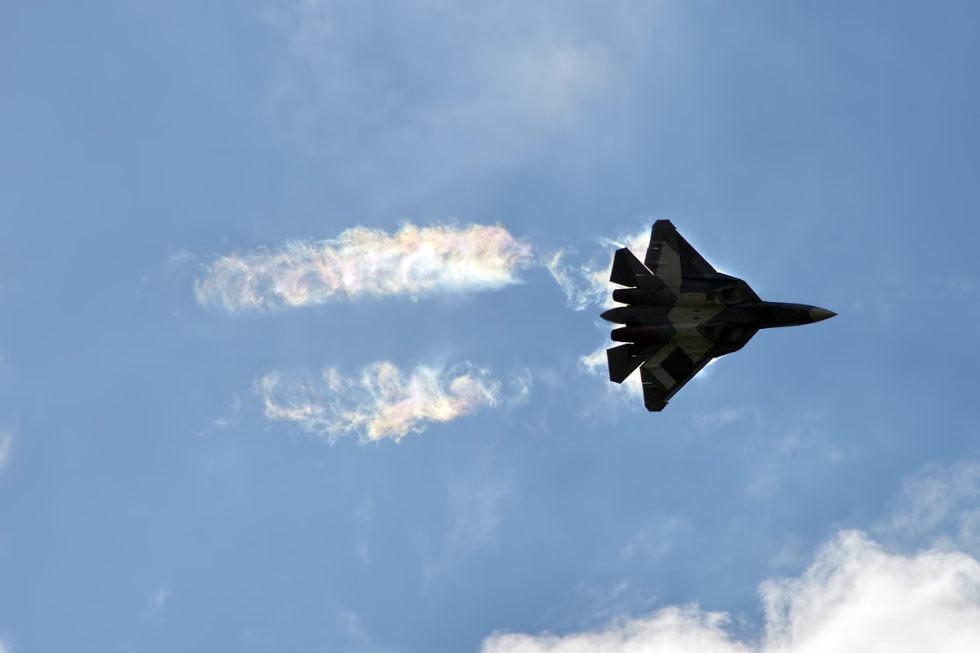
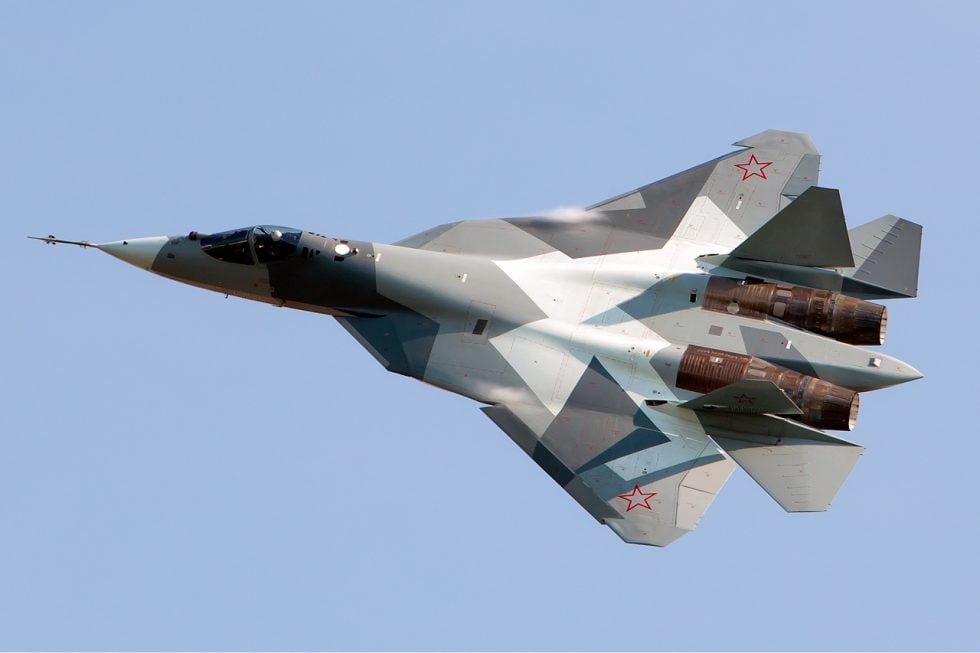
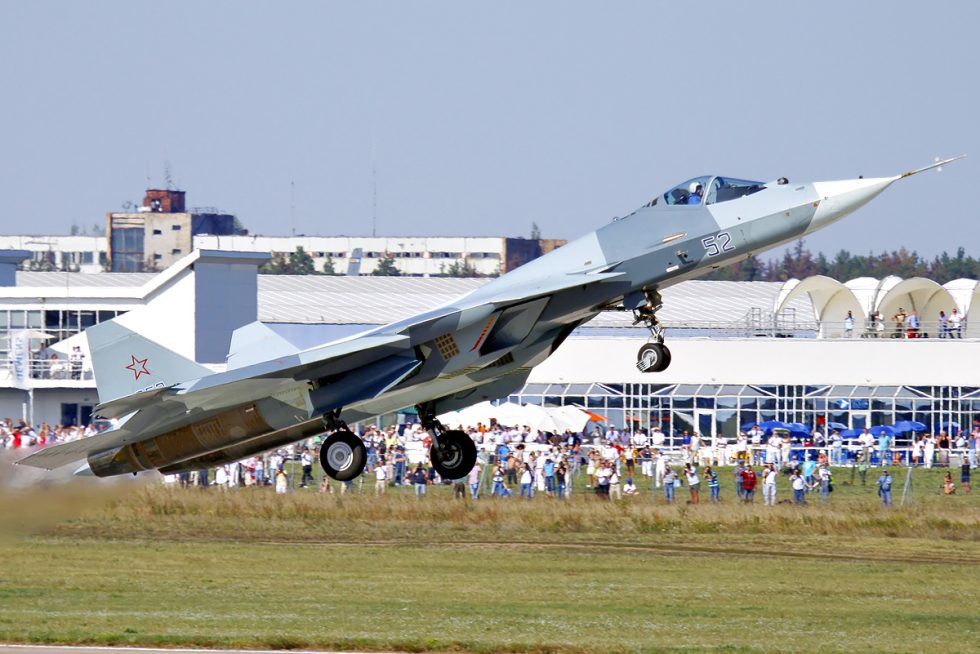
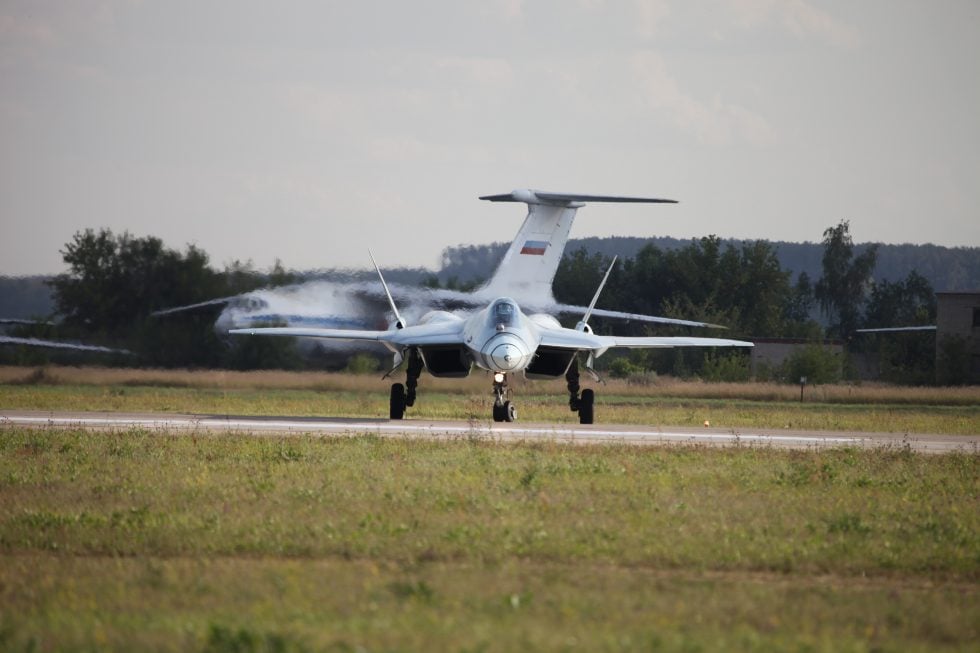
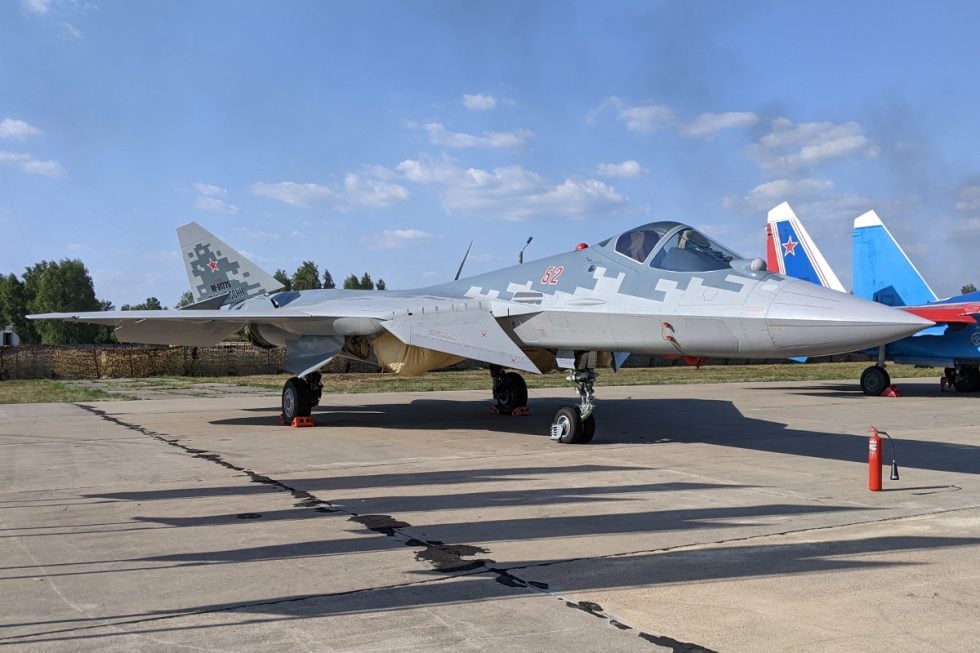
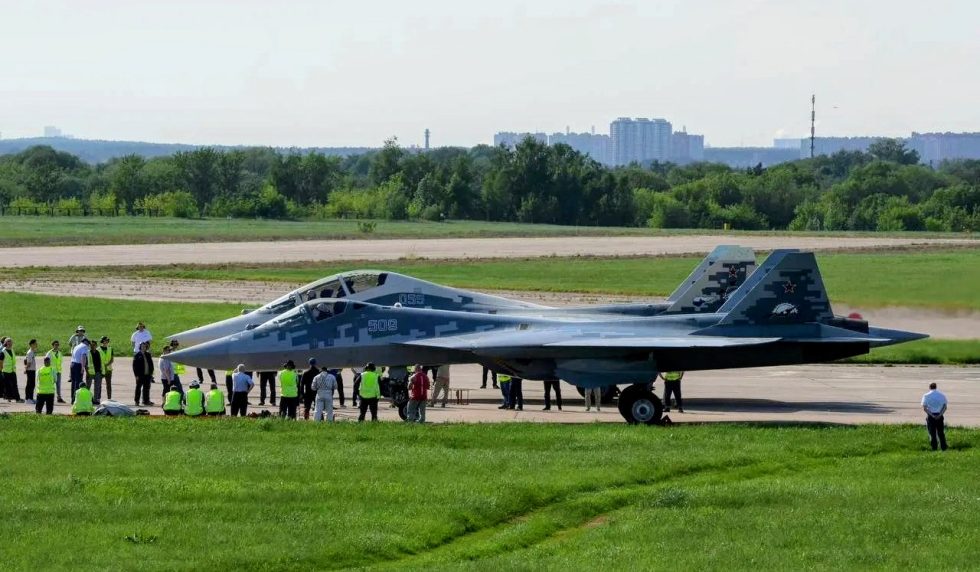
The Su-57 in motion
A neutral video on the Su-57 will be added here.
The Su-57 Felon in motion
Found And Explained — one of the most-watched Su-57 Felon films on YouTube.
Where the Su-57 operates
The Su-57’s combat record — reported, not proven
The Su-57 has no verified air-to-air combat record — no confirmed kills and no confirmed air-to-air losses. Reported use over Ukraine since 2022 has, by most independent accounts, been cautious stand-off missile launches from inside Russian airspace, not penetrating stealth strikes. Russian capability claims and Ukrainian strike claims alike should be treated as contested. The jet should not be described as combat-proven.
Compare the combat record of every military aircraft. Figures as of July 2026.
Everything people ask about the Su-57
Can I fly in a Su-57?
Is the Su-57 stealthy?
How fast is the Su-57?
Is the Su-57 combat-proven?
Was a Su-57 really destroyed?
How many Su-57s exist?
Who flies the Su-57?
Why is it called “Felon”?
You can’t fly the Su-57.
These, you can.
Some legends only live in museums — others are fuelled and waiting. MiGFlug has put civilians in real military jet cockpits since 2004.
 Fly the L-39 AlbatrosThe world’s most-flown jet trainer — aerobatics included
 Fly the F-104 Starfighter“The missile with a man in it”
 Fly the MiG-21The Cold War’s most-produced jet
 Fly the T-33 Shooting StarAmerica’s first jet trainer
 Fly the DH VampireA piece of early jet history
 Fly the S.211Agile Italian jet trainer
 Fly the MB-326The classic Aermacchi jet
 Fly the MiG-15The Soviet legend of the Korean War
Continue the tour
Every claim, checked and hedged
- Forbes — David AxeAnalysis of the June 2024 Akhtubinsk drone-strike claim and Su-57 vulnerability.
- RUSICommentary on Russian airbase vulnerability and the Akhtubinsk incident.
- Kyiv PostUkrainian strike claims — clearly a Ukrainian-sourced perspective, to be weighed against Russian promotion.
- The National InterestDoctrine and vulnerability analysis of the Su-57 programme.
- Army RecognitionSpecifications and operator overview (Russian-stated figures noted as such).
- Encyclopaedia BritannicaGeneral overview of the Su-57 and PAK FA programme.
- EDR MagazineRosoboronexport export marketing at LIMA 2025 — treated as promotional.