
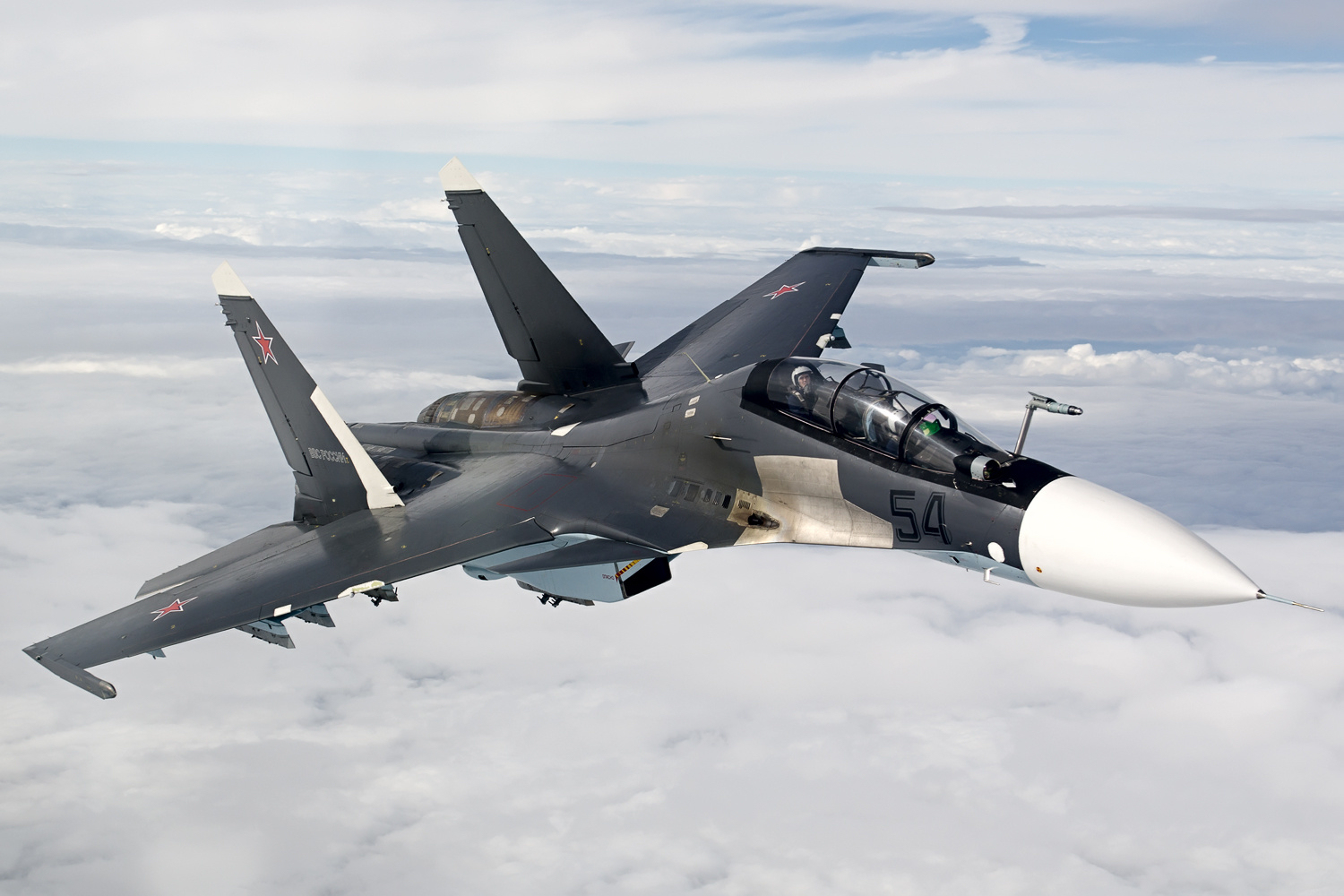
Sukhoi Su-30
“Flanker-C”
The two-seat, thrust-vectoring multirole Flanker — a supermaneuverable heavyweight that grew from a Cold-War interceptor into the best-selling fighter family Russia has ever exported, and the backbone of the Indian Air Force.
The Flanker that learned to do everything
The Su-30 began life as a chore. In the mid-1980s the Soviet air-defence force needed a two-seater that could loiter for hours over the Arctic and act as a flying command post, vectoring single-seat Su-27s toward intruders. Sukhoi took the twin-stick Su-27UB trainer, added an aerial-refuelling probe and better navigation, and flew the result — the Su-27PU — in December 1989. Renamed Su-30, it looked like a niche interceptor with a short future.
Instead it became a dynasty. After the Soviet collapse cut domestic orders, Sukhoi turned the design into a multirole export fighter, the Su-30MK, with a heavier weapons load and a takeoff weight pushed toward 38 tonnes. Two factories then split the family: Irkut in Siberia built the agile, canard-and-thrust-vectoring branch, while KnAAPO at Komsomolsk built a strike-optimised branch with neither. Buyers effectively chose between a dogfighter and a bomb-truck wearing the same silhouette.
The flagship arrived through India. Co-developed from a 1996 deal, the Su-30MKI married AL-31FP thrust-vectoring engines and foreplane canards to a multinational avionics suite, and is licence-built by Hindustan Aeronautics (HAL). India now flies the largest Flanker fleet on earth. Russia fields the domestic Su-30SM and re-engined SM2; more than a dozen other air forces fly export variants. Few post-Cold-War fighters have spread so far.
01The Su-30’s two bloodlines: why not every Flanker has canards
The Su-30 is really two aircraft sharing a name. The Irkut line builds the canard, thrust-vectoring, air-superiority-leaning branch — India’s MKI, Malaysia’s MKM, Algeria’s MKA and Russia’s domestic SM/SM2. The KnAAPO line at Komsomolsk-on-Amur builds a strike-optimised branch with no canards and no thrust vectoring — China’s MKK and the anti-ship MK2 series flown by Vietnam, Indonesia, Venezuela, Uganda and others. The two branches use different radars and different structural reinforcement, so a customer’s choice of factory shaped what the jet could do. It is why a Malaysian Su-30 can tumble through post-stall manoeuvres a Chinese Su-30 cannot.
What makes the Su-30 special
Thrust vectoring & canards
On the Irkut branch, two AL-31FP afterburning turbofans (~12,500 kgf each in reheat) have nozzles that deflect in the vertical plane, canted so differential deflection also gives yaw control. Paired with foreplane canards, this lets the Su-30 hold controlled flight at extreme angles of attack and perform post-stall manoeuvres — the direct heir of the Su-27’s legendary Pugachev’s Cobra. It is genuine supermaneuverability, not just an airshow trick.
Two crew for the long haul
Unlike single-seat rivals, the Su-30 carries a pilot plus a rear-seat weapons systems officer. On multi-hour strike or maritime missions the back-seater runs the radar, electronic warfare and complex weapons like BrahMos while the pilot flies — a real workload advantage. The rear cockpit can even act as a command node cueing other aircraft, echoing the type’s origins as a flying command post.
Big radar, heavy load, long legs
The MKI carries the large N011M Bars passive electronically scanned radar, backed by an infrared search-and-track. Twelve hardpoints lift up to ~8,000 kg of missiles and bombs — from R-77 air-to-air rounds to the ~2.5-tonne BrahMos cruise missile on Indian jets. Internal fuel gives roughly 3,000 km of range, stretched toward 8,000 km with two aerial refuellings via the retractable probe.
02The Su-30’s supermaneuverability: from the Cobra to the Kulbit
At the 1989 Paris Air Show, Sukhoi test pilot Viktor Pugachev pitched an Su-27 to a near-vertical, tail-first attitude while still tracking down the runway, then recovered — the manoeuvre the West named Pugachev’s Cobra. Western engineers had assumed any fighter doing that would stall and depart. On the thrust-vectoring Su-30MKI and Su-30SM, the Cobra evolved into sustained tumbling manoeuvres — the kulbit or “Frolov’s Chakra” — that keep the jet controllable at airspeeds where a conventional fighter is simply falling. In a close fight, that post-stall control can point the nose and its missiles at an opponent no fly-by-wire limiter would allow.
03The Su-30MKI’s BrahMos: the heaviest missile ever carried by a fighter
On 22 November 2017 an Indian Air Force Su-30MKI became the first aircraft in the world to launch the air-breathing BrahMos-A — a roughly 2.5-tonne, Mach-2.8 supersonic cruise missile with a range around 300 km. Fitting it meant strengthening the jet’s centreline and years of joint software work by the IAF, HAL and BrahMos Aerospace. Around 40 airframes were modified to carry one missile each, turning the MKI into a long-range, standoff precision-strike platform able to hit ships and hardened targets from well outside most air defences. It was reportedly used operationally during the May 2025 India–Pakistan clashes.
Full specifications
Baseline note: these figures describe the Su-30MKI as built for the Indian Air Force — two seats in tandem, two Saturn AL-31FP turbofans with two-plane thrust-vectoring nozzles, canard foreplanes on the leading-edge root extensions, and the NIIP N011M Bars passive electronically scanned radar — because it is at once the most numerous Su-30 ever built and the most capable branch of the family. Deltas for the original Su-30 (Su-27PU), for the Chinese-line Su-30MKK and Su-30MK2, for the Russian Su-30SM and Su-30SM2, and for the Su-30MKM, Su-30MKA and Su-30MKV export marks are in grey. Figures reflect sources available on 3 September 2026; fleet counts are drawn from IISS The Military Balance 2024 and 2025 with later national updates where they exist. One thing has to be said before a single number is read, because it is the most confusing fact about this aeroplane: there are two entirely different Su-30s. The Irkutsk line — Irkut, the old IAPO plant in eastern Siberia — built the Su-27PU, then the Su-30MKI for India and its cousins the MKM for Malaysia, the MKA for Algeria and the SM/SM2 for Russia. These have canards, thrust vectoring and the Bars radar, and they are heavy, manoeuvre-obsessed, agility-first aircraft. The Komsomolsk-on-Amur line — KnAAPO, four thousand kilometres east — built the Su-30MKK and Su-30MK2 for China and for the export customers that followed China: Vietnam, Venezuela, Indonesia, Uganda. These have no canards, no thrust vectoring, squared-tip Su-35-style fins with integral fuel tanks, the simpler N001VE radar, and a strike bias rather than a dogfighting one. They are not marks of one aeroplane; they are two aeroplanes that share a designation, an ancestor and a fuselage cross-section, and almost nothing else in the systems that matter. Where a figure below differs sharply between the two lines it is flagged. The Su-27, Su-33, Su-34 and Su-35 are separate aircraft with their own pages, and nothing here should be read across to them.
Dimensions & weights
- Crew
- 2 in tandem, on Zvezda K-36DM zero-zero seats. Unlike the F-15E or the Su-34, the back-seater is not merely a weapon-system operator: on Indian and Russian practice he is a qualified pilot with full controls, and on long-range BrahMos or maritime sorties he flies the aircraft while the front-seater works the targeting. Every Su-30 of every mark is a two-seater; there has never been a single-seat production version.
- Length
- 21.94 m (72 ft 0 in) including the nose probe. Effectively identical across the family: 21.9 m for the Su-30MKK.
- Wingspan
- 14.70 m (48 ft 3 in), unchanged from the Su-27 and shared by every mark. No wing fold, no folding tailplane — those belong to the Su-33.
- Height
- 6.36 m (20 ft 10 in) on the undercarriage
- Wing area
- 62.0 m² (667 sq ft), the standard Su-27 wing. The Su-33’s enlarged 67.8 m² wing was never adopted here; the extra lift on the MKI comes from the canards instead.
- Canard foreplanes
- Fitted to the Irkutsk marks only, mounted on the leading-edge root extensions and driven by the flight-control computer. They add pitch authority at very high angle of attack, unload the wing in the manoeuvre, and are the visual signature that tells an MKI, MKM, MKA, SM or SM2 from an MKK or MK2 at a glance. The original Su-30 and the whole Komsomolsk line have none.
- Empty weight
- 18,400 kg (40,565 lb). About 17,700 kg for the Su-30MKK, which carries neither canards nor vectoring nozzles nor the Bars antenna. The MKI is roughly 1,700 kg heavier than a bare Su-27S, and that mass is the price of the two seats, the strengthened structure and the extra systems.
- Normal take-off weight
- 26,090 kg (57,519 lb) on a typical air-defence fit
- Maximum take-off weight
- 38,800 kg (85,540 lb). This is the number that separates the lines more than any other: the Su-30MKK and MK2 are cleared to 34,500 kg (76,060 lb) and the original Su-30 to 33,000 kg. The MKI’s structure was rebuilt for the extra four tonnes, which is what makes a 2.5-tonne BrahMos on the centreline possible at all.
- Internal fuel
- about 9,640 kg (about 21,250 lb) in wing, fin and fuselage tanks. The Flanker family carries no drop tanks; this is the whole of it, and everything beyond it comes through the probe.
- Maximum ordnance
- about 8,130 kg (about 17,920 lb). Quoted as 8,000 kg for the Komsomolsk marks. As always with the Flanker, ordnance and fuel compete for the same take-off weight, and a full weapons load means a partial fuel load.
- Hardpoints
- 12 — two wingtip rails, six under the wings, two under the engine nacelles and two in tandem on the centreline "arch" between the engines. Indian aircraft can be taken to 14 stations with multiple ejector racks. The centreline arch is the only station strong enough for BrahMos, which is why the aircraft carries exactly one.
Performance
- Maximum speed, altitude
- 2,120 km/h (1,320 mph, Mach 2.0) clean at height. Several Indian and Russian sources give Mach 1.9 for the MKI with canards fitted; the foreplanes cost a little top-end drag, and the difference is real rather than a rounding error.
- Maximum speed, sea level
- 1,350 km/h (840 mph, Mach 1.09)
- Rate of climb
- 300 m/s (59,000 ft/min) at low level, clean and light. 230 m/s is the figure usually given for the non-vectoring marks.
- Service ceiling
- 17,300 m (56,800 ft)
- Range, internal fuel
- 3,000 km (1,860 miles) at cruising altitude, about 1,270 km at sea level
- Ferry range
- 8,000 km (4,970 miles) with two in-flight refuellings
- Combat radius
- roughly 1,500 km (about 930 miles) on a high-altitude air-defence profile, and appreciably less with heavy stores or a low-level run-in. A warning about a widely mirrored error: the 3,000 km figure that appears in many tables as "combat radius" is the internal-fuel range, misread. No Su-30 has a 3,000 km radius on internal fuel.
- Endurance
- about 3.75 hours on internal fuel; up to 10 hours with air refuelling. Indian Su-30MKIs have flown sorties beyond eight hours behind Il-78MKI tankers; the crew, not the aeroplane, is usually the limiting component.
- Load factor
- +9 g (−3 g negative)
- Wing loading
- 401 kg/m² (82 lb/sq ft) at normal take-off weight
- Thrust-to-weight
- about 1.0 at 56 per cent internal fuel; about 0.86 with full internal fuel. Full tanks and a war load put a Flanker firmly below unity, which is why the spectacular airshow manoeuvres are flown light.
- Take-off run
- 550 m (1,800 ft) at normal weight; landing run about 670 m (2,200 ft) with the brake parachute
Propulsion & systems
- Engines
- 2 × Saturn AL-31FP afterburning turbofans, built by UMPO in Ufa and under licence by HAL at Koraput. The Komsomolsk marks and the original Su-30 use the plain non-vectoring AL-31F; the Su-30SM2 has moved to the AL-41F1S, the Su-35S engine, with roughly 142 kN in reheat and a much longer life.
- Thrust
- 76.5 kN (17,200 lbf) dry and 122.6 kN (12,500 kgf, 27,560 lbf) with full afterburner, each
- Thrust vectoring
- Axisymmetric nozzles deflecting ±15° in one plane at up to 30° per second, the hinge axes canted 32° outboard from the engine centreline. The cant is the clever part: because the two nozzles are inclined in opposite senses, differential deflection produces yaw and roll as well as pitch, giving control about all three axes from a mechanism that only moves in one plane. It is a cheaper solution than the fully gimballed nozzle and it works.
- Engine life
- 1,000 hours between overhauls, 500 hours on the vectoring nozzle, about 2,000–3,000 hours total. This is the Indian Air Force’s oldest and loudest complaint about the type. A Western engine of the same generation runs several thousand hours between shop visits; the AL-31FP comes off the aircraft at a thousand and the nozzle at five hundred, so a large fleet spends a large fraction of its life in the overhaul queue. Defence Minister Manohar Parrikar told parliament that there had been 69 engine-related failures between the end of 2012 and early 2015 — bearing failures from metal fatigue, low oil pressure — and fleet availability has repeatedly been reported in the 55 to 65 per cent band. India ordered 240 more AL-31FP from HAL in September 2024 for about 26,000 crore rupees, with the first delivered on 1 October 2024, precisely because the fleet consumes engines faster than it consumes airframes.
- Flight control
- KSU-30 quadruplex digital fly-by-wire, integrating canards, tailplanes, leading-edge flaps, flaperons, rudders and the vectoring nozzles as one system. The aircraft is longitudinally unstable and unflyable without it. The Komsomolsk marks use a simpler analogue-derived system with no nozzle channel.
- Radar
- NIIP N011M Bars, a passive electronically scanned array on a hydraulic repositioner that swings the whole antenna, giving a very wide effective field of regard. Tracks 15 targets and engages 4. Detection is usually given as 140–150 km against a fighter-sized target head-on and about 60 km astern; the 350–400 km figure quoted in promotional material applies to large, high-contrast targets. Ground mapping picks out tank-sized objects at 40–50 km. The Komsomolsk marks carry the mechanically scanned N001VE (N001VEP on the MK2), a much less capable set. The Su-30SM2 has the Irbis-E derivative, and India’s Super Sukhoi programme intends to replace Bars with the DRDO Virupaksha gallium-nitride AESA.
- Infra-red search and track
- OLS-30 combined IRST and laser ranger under the windscreen, detection to about 90 km against a rear aspect, laser ranging to roughly 3.5 km. India contracted in 2022 for an indigenous dual-band replacement combining television, infra-red, ultraviolet and laser channels in one window.
- Electronic warfare
- Indian aircraft: DRDO Tarang radar warning receiver with a programmable threat library, the Israeli Elta EL/M-8222 self-protection jammer pod, and chaff and flare dispensers. Russian Su-30SM aircraft use SPO-32 warning and the KNIRTI SAP-518 or Khibiny-M jamming pods instead; Malaysian MKMs use South African Avitronics equipment; Algerian MKAs replace the Israeli kit with Russian and French systems. This is the layer where "the same aircraft" is least the same aircraft.
- Navigation and displays
- SAGEM Sigma-95 ring-laser-gyro inertial platform with GPS, an Elbit Su 967 holographic head-up display and seven colour multi-function displays. From 2010 the HUD and displays have been built in India by Samtel. Russian, Chinese and Vietnamese aircraft use wholly Russian cockpits, and the Su-30SM was created in the first place by stripping the French and Israeli content out of the MKI so that Russia could fly it without export dependence.
- Air refuelling
- Retractable probe on the port side of the nose, plus the ability to carry a UPAZ-1 buddy refuelling store and, on Indian aircraft, Cobham 754 pods. The probe is what turns a 1,500 km radius into a genuinely strategic reach, and it is the reason the Indian fleet is tied so tightly to its small force of Il-78MKI tankers.
- Ejection seats
- 2 × NPP Zvezda K-36DM, zero-zero, inclined 30° to raise g tolerance. The seat that saved both crews at the Paris Air Show on 12 June 1999 when an Su-30MK struck the ground during a tailslide, and again at Le Bourget-style low altitude on several occasions since.
04The Su-30’s price: why the numbers are estimates
Export Su-30s are sold in government-to-government package deals that bundle spares, weapons, training and support, so a clean flyaway unit price is rarely published. Open-source figures for recent contracts cluster very roughly in the $35–50 million range per aircraft, but that varies widely with variant, avionics fit and the size of the support package — India’s HAL-built MKIs, with their multinational avionics, are often cited higher. No credible cost-per-flight-hour figure exists in open sources. Treat any precise dollar figure attached to a Su-30 as an estimate, not a quoted price.
Armament & payload
The Su-30MKI carries more, and more varied, weapons than any other Flanker, because four countries have been bolting things to it for thirty years
Twelve hardpoints and something over eight tonnes is the headline, but the interesting thing about the Su-30 is not capacity, it is catalogue. The Indian aircraft alone will carry Russian R-27 and R-77 missiles, Israeli I-Derby ER and Spice 2000, indigenous Astra, Rudram and SAAW, and the Indo-Russian BrahMos, which is a combination no other fighter in the world is cleared for. That breadth is a direct consequence of India owning the integration rights that came with licence production: HAL and DRDO can put a weapon on the aeroplane without asking Moscow, and they have.
The single most consequential integration is BrahMos-A. It is a 2.5-tonne ramjet cruise missile flying at about Mach 2.8, carried on the centreline arch between the engines, and it required the airframe to be strengthened before it could be hung at all. HAL first flew an Su-30MKI with the missile on 25 June 2016 from Nashik; the first live air launch was against a sea target in the Bay of Bengal on 22 November 2017; the IAF declared integration complete on 17 December 2019. About 40 aircraft had been modified by mid-2024, with another 84 planned under the Super Sukhoi programme. It made the Su-30MKI the only fighter able to deliver a supersonic sea-skimming cruise missile of that weight from the air, and on the night of 9–10 May 2025 between fifteen and eighteen of them were fired at Pakistani airbases, roughly one per aircraft.
The Komsomolsk marks are a much narrower proposition. The Su-30MKK was built around the Kh-29, Kh-31P and Kh-59ME with the N001VE, and the Su-30MK2 added the Kh-31A anti-ship round with a modified weapons controller. There is no thrust vectoring, no Bars, no Astra and no BrahMos, and the Chinese fleet has been overtaken by indigenous J-16s that do the same job better. Nothing in the lists below is carried by every mark. Russian, Indian, Chinese, Vietnamese, Algerian and Malaysian aircraft each have their own cleared inventory, and clearance on one operator’s aircraft says nothing about another’s.
Gun
- 1 × 30 mm Gryazev-Shipunov GSh-30-1, single-barrel, in the starboard leading-edge root extension
- 150 rounds; roughly 1,500–1,800 rounds per minute
- Unchanged across every mark from the Su-27PU of 1989 to the Su-30SM2
- Aimed through the OLS-30 laser ranger and the head-up display
- Notable chiefly for the incident of 22 September 2020, when a Russian Su-35S shot down an Su-30M2 with it during a training sortie
Air-to-air
- R-73 and R-74M (AA-11 Archer) short-range infra-red, helmet-cued, normally on the wingtip and outboard stations
- R-27R/ER and R-27T/ET (AA-10 Alamo), semi-active radar and infra-red, the legacy medium-range rounds still carried by every operator
- R-77 and R-77-1 (AA-12 Adder) active radar homing, up to ten carried; the standard modern round and the reason the Bars radar exists
- R-37M (AA-13 Axehead) very-long-range, on the Russian Su-30SM2 only — used to shoot down a Ukrainian Su-27 on 2 February 2025
- Indian additions: DRDO Astra Mk1 and Mk2 active-radar rounds, and the Israeli I-Derby ER. The Astra is the first Indian air-to-air missile to reach squadron service, and the MKI is its launch platform.
Air-to-surface guided
- BrahMos-A, 2.5 t ramjet cruise missile on the centreline, roughly 300 km as first fielded and about 450 km for the extended-range round. Published figures range from 290 to 500 km depending on the variant and the source; treat any single number with suspicion.
- Kh-31A and Kh-31P (AS-17 Krypton) supersonic anti-ship and anti-radiation rounds; the Kh-31A is the defining addition of the Su-30MK2 over the MKK
- Kh-29T/L (AS-14 Kedge), Kh-59ME (AS-18 Kazoo), Kh-35 (AS-20 Kayak) anti-ship, Kh-38 on later Russian aircraft
- Indian indigenous: Rudram-1 and Rudram-2 anti-radiation missiles, and the Israeli Rampage supersonic stand-off round — one of which was released inadvertently at Pokhran on 23 August 2024
- The Nirbhay subsonic cruise missile has been proposed for the type; it is not in service on it
Bombs
- KAB-500L and KAB-500KR laser- and television-guided 500 kg bombs; KAB-1500L in the 1,500 kg class
- FAB-250, FAB-500T, OFAB-250-270, OFAB-100-120, BETAB-500 penetrators and ODAB-500PM thermobarics
- RBK-500 cluster munitions with SPBE-D self-forging submunitions
- Indian aircraft add the Israeli Spice 2000 glide bomb, the indigenous Sudarshan laser kit, the Smart Anti-Airfield Weapon and DRDO glide bombs. Spice 2000 was the weapon used on the Balakot strike of 26 February 2019, though it was carried by Mirage 2000s that night, with Su-30MKIs escorting.
- Russian aircraft over Syria and Ukraine lean heavily on the Gefest SVP-24 computing system, which gives unguided bombs near-guided accuracy without the cost of guidance kits
Rockets
- S-8 80 mm rockets in B-8M1 twenty-round pods
- S-13 122 mm rockets in B-13L five-round pods
- S-25 340 mm heavy rockets in single O-25 launch tubes
- Standard Flanker fit, inherited from the Su-27 rather than developed for the Su-30
- Used in earnest by Russian Su-30SMs over Syria in dive attacks, a delivery method that says more about the permissiveness of that airspace than about the weapon
Pods & other stores
- Targeting: Israeli Litening on Indian aircraft, Thales Damocles on Malaysian MKMs and Algerian MKAs, Russian SAPSAN-E on later Su-30SMs
- Electronic warfare: Elta EL/M-8222 jammer pod (India), KNIRTI SAP-518 and Khibiny-M (Russia), Avitronics equipment (Malaysia)
- Reconnaissance: Elta EL/M-2060P synthetic-aperture radar pod on Indian aircraft
- Buddy refuelling: UPAZ-1 store, and Cobham 754 pods on the Indian fleet — a squadron can extend itself without a tanker, at the cost of one aircraft’s sortie
- No external fuel tanks: the Flanker family has never used them, so the probe is the only way to add fuel
Three typical loadouts
- Indian air-defence patrol
- Full internal fuel, four R-77 on the wing and nacelle stations, two Astra Mk1, two R-73 on the wingtips, gun loaded, EL/M-8222 pod. The everyday configuration of the largest Flanker fleet on earth and the fit flown on 27 February 2019, when two Su-30MKIs on combat air patrol were engaged by Pakistani F-16s firing AMRAAMs, manoeuvred and jammed their way clear, and returned. India later displayed recovered AMRAAM debris; Pakistan claimed an Su-30MKI shot down, and the IAF flew that specific airframe publicly on 8 October 2019 to answer the claim.
- BrahMos stand-off strike
- One BrahMos-A on the centreline arch, two R-77 and two R-73 for self-escort, partial fuel, tanker support outbound. The heaviest single store any fighter routinely carries and the reason the MKI airframe was strengthened to 38.8 tonnes. Flown for real on the night of 9–10 May 2025 during Operation Sindoor against Pakistani airbases at Murid, Rafiqui and Sukkur among others, striking a UAV command shelter, a tactical wing operations room, a hangar and early-warning radars.
- Russian Su-30SM escort and suppression
- Two Kh-31P anti-radiation missiles, two R-77-1, two R-73, Khibiny-M jamming pods, part fuel. The configuration flown over Syria from 2015 and over Ukraine from 2022, where the Su-30SM has been used to escort strike packages, hunt radars and fly air-superiority patrols. It has scored: at least seven air-to-air victories over Ukrainian aircraft plus a Mi-14 helicopter. It has also paid: multiple aircraft shot down in March 2022 around Bashtanka, Ochakov and Izium, at least three destroyed on the ground at Saky on 9 August 2022, four damaged by drones at Kursk on 27 August 2023, one downed by a Ukrainian Magura naval drone firing an AIM-9X on 2 May 2025 — the first aircraft ever shot down by a surface drone — and one lost to friendly fire over Crimea on 16 October 2025.
Sourcing caveat: weapon clearances are the least reliably documented aspect of this aircraft. Manufacturer brochures list what an aeroplane could carry after integration work that may never have been funded; operator inventories are classified. Where a weapon appears here it has been photographed on the type, named in an official statement, or reported by more than one independent source. Combat claims from Ukraine and from the May 2025 India–Pakistan exchange are contested by both sides and should be read as claims.
Variants
Two factories, two philosophies, and a designation that hides the difference
The Su-30 began as the Su-27PU, an attempt to turn the Su-27UB trainer into a long-range interceptor that could loiter for ten hours and direct other fighters — a flying command post for the Soviet air defence forces, with a refuelling probe and a second crewman to work the radar. Development started in 1986, a proof-of-concept flew on 6 June 1987, the first Su-27PU flew at Irkutsk on 31 December 1989, and about five reached the PVO. The Soviet Union then collapsed, and what should have been a modest interceptor programme became instead the most commercially successful Russian combat aircraft of the post-Soviet era, because export customers wanted it and the Russian state could not afford to buy anything.
From that point the story forks. Irkutsk, which had built the two-seat Su-27UB, took the Indian requirement and turned it into the Su-30MKI: canards, thrust vectoring, a phased-array radar, and avionics bought from France and Israel because Russia could not supply them. Komsomolsk-on-Amur, which had built the single-seat Su-27 and the Su-33, took the Chinese requirement and turned it into the Su-30MKK: no canards, no vectoring, a strengthened structure and a strike-oriented weapons suite. Both were called Su-30. NATO eventually gave them separate reporting names — Flanker-G for the Komsomolsk aircraft, Flanker-H for the Irkutsk ones — but by then the confusion was permanent, and it persists in reference tables to this day.
The Irkutsk line proved the more durable. Its export marks fed Malaysia, Algeria and Indonesia’s neighbours, and in 2012 it came home: the Su-30SM is simply the MKI with the French and Israeli content stripped out and Russian equipment put back in, which is why Russia’s standard heavy fighter of the 2020s is a derivative of an aeroplane designed for India. The Komsomolsk line ended with Uganda in 2012 and has built no new Su-30 since.
- Su-27PU / Su-30 (1989–1992, about 5)
- The original: an Su-27UB with a refuelling probe, uprated navigation and the ability to act as an airborne command post for a flight of Su-27s. No canards, no vectoring, N001 radar, 33,000 kg maximum weight. Redesignated Su-30 by the Russian defence ministry in 1996.
- Su-30K / Su-30MK (1996–1999, 18 to India)
- Interim export aircraft delivered to India while the MKI was still being designed, so that the IAF could begin conversion training. Later returned to Russia, stored at Baranovichi in Belarus, refurbished, and 12 sold on to Angola.
- Su-30MKI (Irkutsk, 1997–present, 272 built plus 12 more ordered)
- The definitive aircraft. Canards, AL-31FP vectoring engines, N011M Bars, Indian, French and Israeli avionics. India signed for 50 Russian-built aircraft in November 1996 for 1.46 billion dollars, then in December 2000 for licence production of 140 at HAL Nashik with progressively rising Indian content, then 40 more in March 2007 and 42 in December 2012. The 272nd was delivered by March 2020; a further 12 were approved in December 2024 at 13,500 crore rupees with 62.6 per cent indigenous content, to replace crash losses.
- Su-30MKK (Komsomolsk, 1999–2003, 76 to China)
- The other aeroplane. Prototype converted from a damaged Russian Su-27UB, first flight May 1999, deliveries from December 2000. Strengthened airframe and undercarriage, squared-tip carbon-fibre fins with integral fuel tanks borrowed from the Su-35 programme, N001VE radar with genuine air-to-ground modes, no canards and no thrust vectoring. Cost about 1.8 billion dollars for the first 38.
- Su-30MK2 / MK2V / MKV (Komsomolsk, 2003–2016, about 100 exported)
- MKK with the N001VEP radar, a revised head-up display and, decisively, clearance for the Kh-31A anti-ship missile. China took 24 for naval aviation; Vietnam 35 as the MK2V in four batches between 2004 and 2016; Venezuela 24 as the MKV from 2006; Indonesia 11; Uganda 6 in a 635-million-dollar deal signed in 2010.
- Su-30MKM (Irkutsk, 2003 order, 18 to Malaysia, delivered 2007–2009)
- MKI airframe with canards and vectoring, but a different avionics mix: Thales head-up display and Damocles targeting pod, South African Avitronics electronic warfare, Russian core. Malaysia’s serviceability problems with the type have been publicly acknowledged and are the standing counter-argument to buying Russian in small numbers.
- Su-30MKA (Irkutsk, 2006–2021, about 73 to Algeria)
- MKI with the Israeli equipment removed for obvious political reasons and Russian and French systems in its place. Delivered in batches from 2007; Algeria is the largest Su-30 operator in Africa and the third largest anywhere. Sources disagree on the total: some tables still give 58, others 72 or 73 delivered.
- Su-30M2 (Komsomolsk, 2010–2015, 20 for Russia)
- A stopgap: an MKK-derived two-seater bought by the Russian air force in small numbers as a conversion trainer for its single-seat Su-35S and Su-27SM3 units, because the Su-30SM line at Irkutsk could not meet the whole requirement at once. No canards, no vectoring.
- Su-30SM / SME (Irkutsk, 2012–present, 116 ordered for Russia plus exports)
- The MKI made Russian. Radar, radios, identification, ejection seats and weapons all changed to domestic equipment. First flight 21 September 2012, first two delivered 22 November 2012, 60 on the initial two contracts, 36 more in April 2016 split 88 air force and 28 navy. The SME is the export version: Kazakhstan 29, Belarus, Armenia 4 from 2020, Myanmar 6 delivered 2022 to 2024, Mongolia 4 from 2019.
- Su-30SM2 (Irkutsk, 2020–present, new-build and conversions)
- The current standard: AL-41F1S engines from the Su-35S, an Irbis-E radar derivative, and clearance for the R-37M very-long-range missile. A contract for 21 was signed for naval aviation in August 2020, and existing SMs are being converted. It closes most of the capability gap to the Su-35S at a lower price and with two crew.
Closing caveat: more than 630 Su-30s of all marks had been built by 2019 and the Irkutsk line is still running, which makes this the most-produced Russian-designed combat aircraft since the Cold War and comfortably the most exported Flanker. Production totals are nonetheless approximate: Russian output figures are not published in detail, Indian licence assembly overlapped with Russian deliveries in ways that make double-counting easy, and several announced export contracts — the Mongolian batch among them — were never completed as signed. India’s Super Sukhoi upgrade, approved in principle by the Defence Acquisition Council on 30 November 2023 at 66,829 crore rupees for 84 to 90 aircraft, had still not received final Cabinet Committee on Security clearance as of early 2026; if it proceeds it will keep Su-30MKIs flying into the 2050s with an Indian AESA radar, an Indian electronic warfare suite and Indian weapons, at which point calling the aeroplane Russian will be a courtesy.
Operators today
India flies more Su-30s than Russia and China combined, and that is the whole story of this aeroplane
Fourteen air forces operate the Su-30 in 2026, and one of them dwarfs the rest. The Indian Air Force took delivery of 272 Su-30MKIs, has lost about fourteen to accidents, and keeps roughly 260 on strength across a dozen squadrons from Halwara in the Punjab to Thanjavur on the southern coast. That is not merely the largest Su-30 fleet; it is the largest fleet of any single Flanker variant anywhere in the world, and it is roughly twice the size of Russia’s own Su-30 force. An aeroplane designed in Irkutsk is, in practice, an Indian aircraft built in Nashik.
Russia is second, with something over a hundred Su-30SM, Su-30SM2 and Su-30M2 split between the Aerospace Forces and Naval Aviation, a number that has been eroded by combat losses in Ukraine and topped up by new production and SM2 conversions. China is third and static: 76 Su-30MKK and 24 Su-30MK2 were bought between 2000 and 2004, a handful have been lost, and the PLA has since built its own far more capable J-16 from the same lineage, so the Chinese Su-30s are now second-line. Algeria is a distant but significant fourth. Below that, the operators divide neatly along the two production lines: Kazakhstan, Belarus, Armenia and Myanmar fly Irkutsk aircraft, while Vietnam, Venezuela, Indonesia and Uganda fly Komsomolsk ones. Angola’s dozen are the refurbished ex-Indian Su-30K, sold on after years in storage in Belarus.
These are estimates. Many airframes counted on paper are stored, in deep overhaul, or not operational — the AL-31’s thousand-hour overhaul interval makes that unusually true of this type, and Indian fleet availability has repeatedly been reported between 55 and 65 per cent. Venezuelan and Malaysian serviceability is believed to be much worse, and Angola’s Su-30K deliveries have never been independently confirmed in full. Algeria’s total is disputed between about 58 and 73 delivered. Mongolia is omitted because its four announced aircraft cannot be corroborated in service. Sources: IISS The Military Balance 2024 and 2025 and FlightGlobal World Air Forces, with national updates to early 2026; entries that could not be corroborated are omitted.
From interceptor to export blockbuster
Su-27PU first flight
The two-seat, refuellable interceptor that becomes the Su-30 flies at Irkutsk — the same year the Su-27 Cobra debuts at Paris.
Su-30MK export path
A multirole demonstrator flies with a heavier weapons load, opening the commercial family that will spread worldwide.
First Su-30MKI
The India-co-developed prototype flies with thrust-vectoring engines and canards — the definitive Flanker.
China’s Su-30MKK
KnAAPO’s strike Flanker — no canards, no thrust vectoring — flies in 1999; PLAAF deliveries begin in 2000.
MKI enters IAF service
The Su-30MKI joins the Indian Air Force; HAL licence production follows, building the world’s largest Flanker fleet.
Cope India
IAF Flankers rout USAF F-15Cs in an exercise (under restrictive rules), fuelling the debate that helped fund the F-22.
Su-30SM at war
Russia fields the domestic Su-30SM (2012); it makes its combat debut flying top cover over Syria from 2015.
BrahMos and beyond
An MKI fires the first air-launched BrahMos (2017); re-engined Su-30SM2s fly in Ukraine and new export deals continue.
From the flight line: twelve Su-30 stories
The interceptor that became a dynasty
The Su-30 was born to babysit other jets, not to dogfight.
Read the full story
Pugachev’s Cobra stops Paris cold
A jet rears up like a snake at 120 degrees nose-up — and keeps flying.
Read the full story
The 9-to-1 that scared Washington
Indian Flankers beat America’s best fighter — and Congress noticed.
Read the full story
Two factories, two very different Flankers
Not all Su-30s have those famous canards.
Read the full story
India builds its own Russian fighter
Most of India’s Flankers are made in Nashik, not Irkutsk.
Read the full story
The big-eye Bars
A radar the size of a dustbin lid, feeding a two-man crew.
Read the full story
The world’s heaviest fighter missile
A 2.5-tonne supersonic cruise missile bolted under a fighter.
Read the full story
Flankers as bodyguards over Latakia
Russia’s newest two-seater went to war as a bouncer.
Read the full story
Vulnerable even at supersonic speed
A drone boat reportedly shot down a supersonic fighter.
Read the full story
A new heart for an old Flanker
Russia gave the Su-30 the Su-35’s engines.
Read the full story
From Algiers to Caracas
The Flanker that speaks a dozen languages.
Read the full story
Two brains beat one
On a long strike, the back-seater is the secret weapon.
Read the full story
The Su-30 in pictures
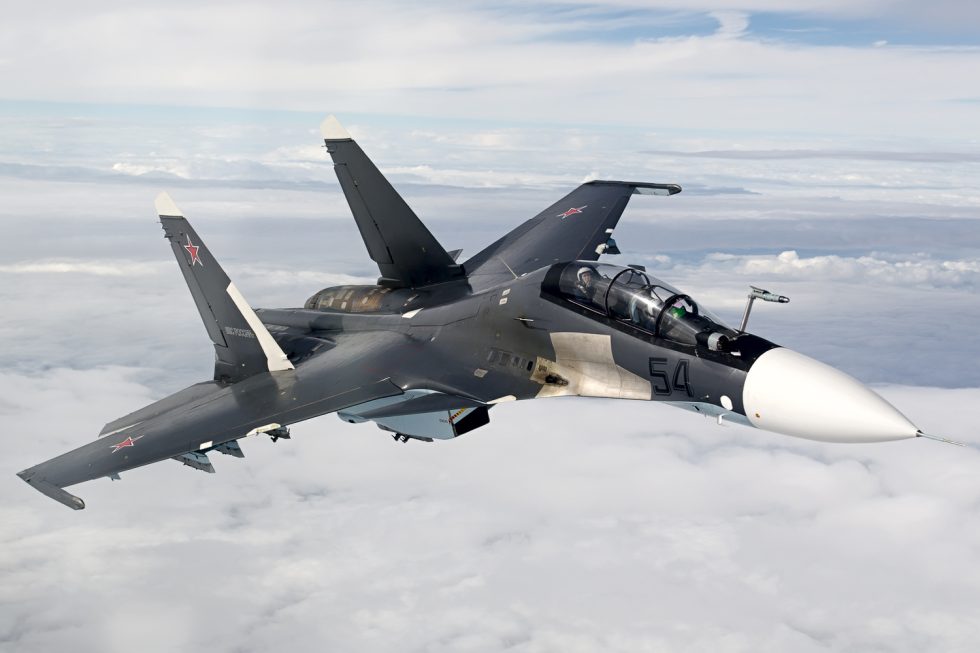
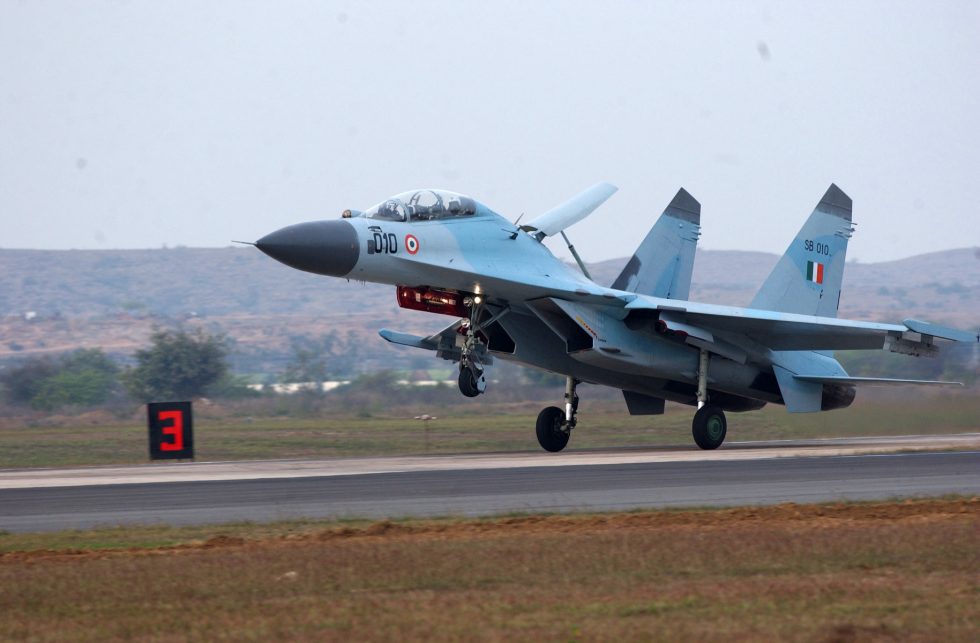
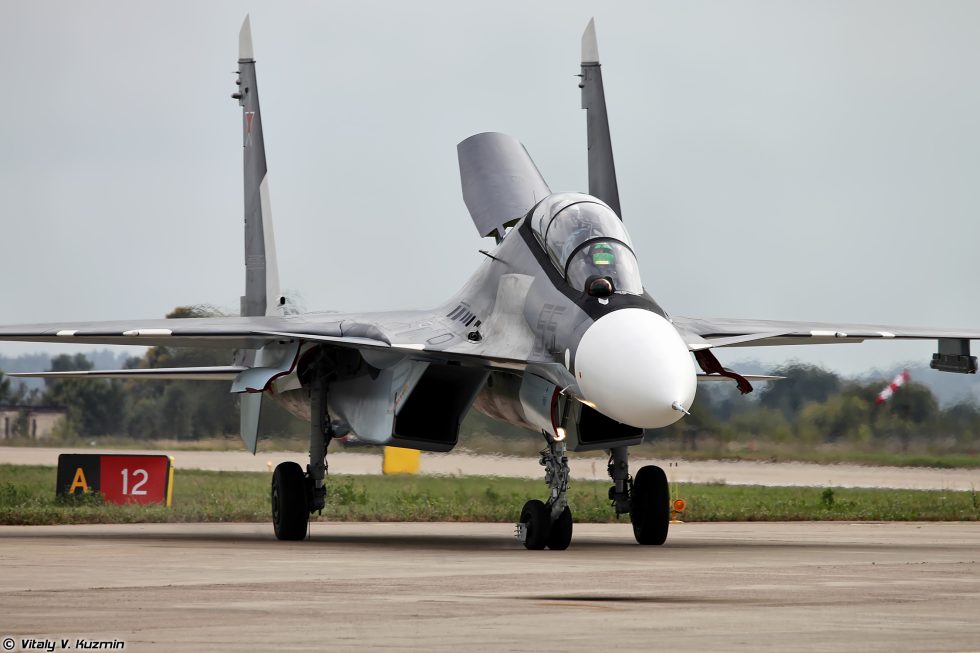
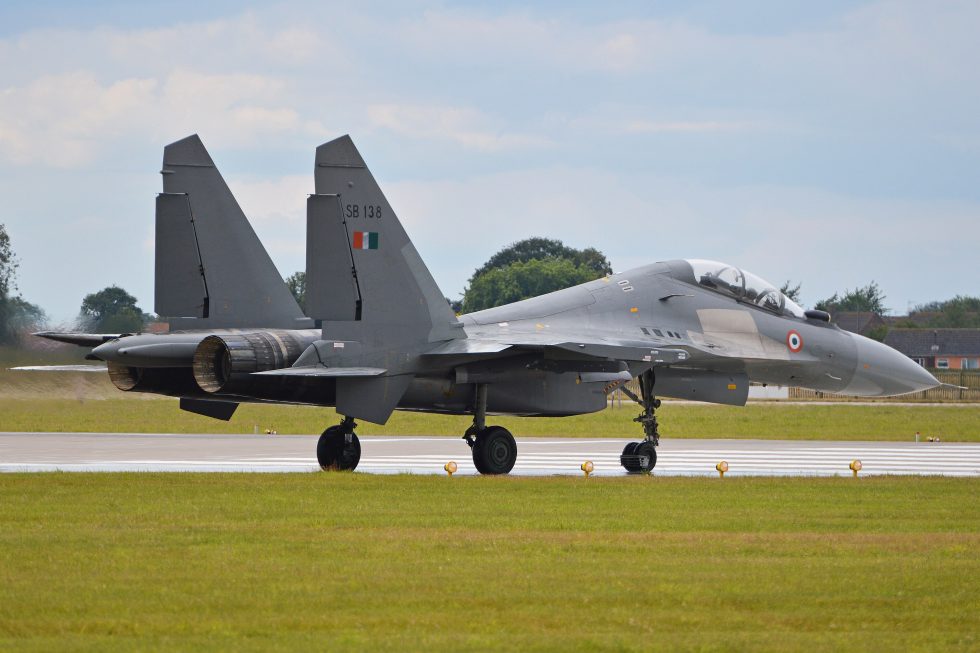
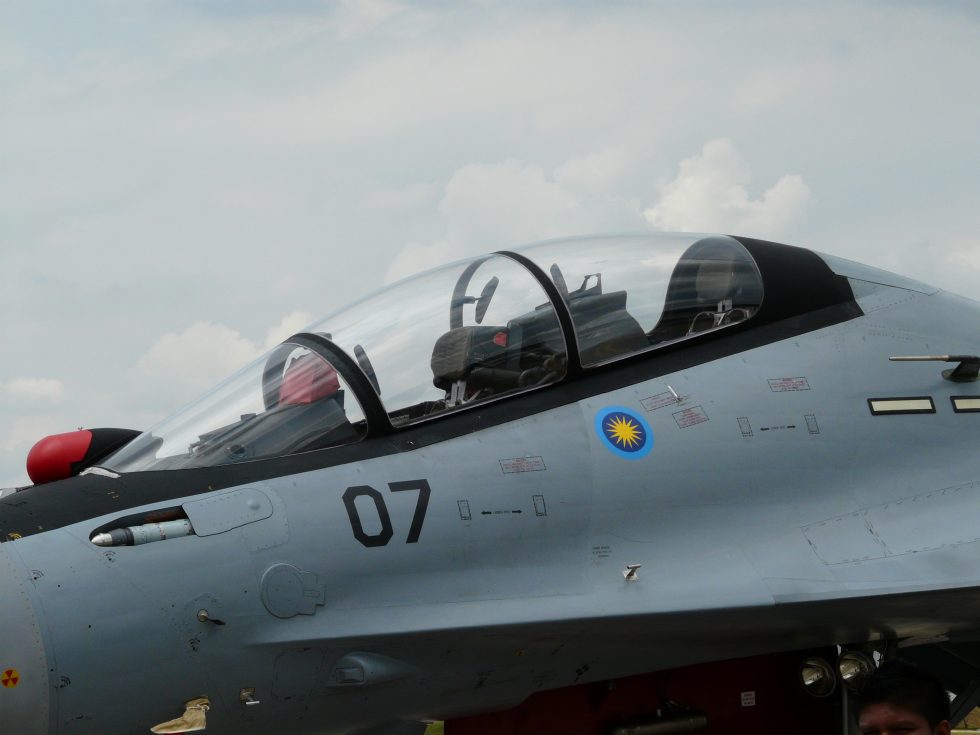
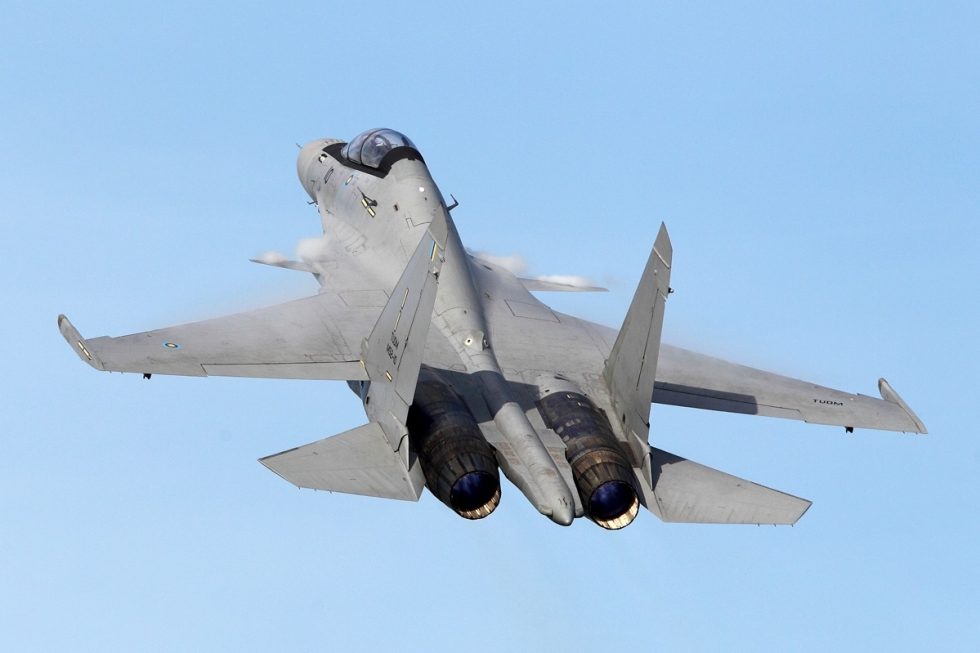
The Su-30 in motion
Video coming soon — we are curating the best Su-30 flight-display footage, from the kulbit at MAKS to low-level strike runs. In the meantime, explore the gallery and the twelve stories above.
The Su-30 in motion
Australian Military Aviation History — one of the most-watched Su-30 films on YouTube.
Where the Su-30 flies
What the Su-30 has actually done
The Su-30’s record is mixed and, in places, hotly contested. It has shone in exercises, pioneered air-launched cruise-missile strikes, and flown in Syria and Ukraine — where it has also taken losses. Claims around the India–Pakistan clashes of 2019 and 2025 are disputed by both sides and are not independently confirmed; we present them with that caveat, and note that no Su-30 loss in those clashes has been independently verified.
Compare the combat record of every military aircraft. Figures as of July 2026 and, where contested, presented neutrally.
Everything people ask about the Su-30
Can I fly in a Su-30?
How fast is the Su-30?
Does the Su-30 really have thrust vectoring?
What is the difference between the Su-30MKI and the Su-30MKK?
Su-30 or Su-35 — what is the difference?
Does the Su-30 have a gun?
Is the Su-30 still in service?
What is the Su-30’s combat record?
You can’t fly the Su-30.
These, you can.
Some legends only live in museums — others are fuelled and waiting. MiGFlug has put civilians in real military jet cockpits since 2004.
 Fly the L-39 AlbatrosThe world’s most-flown jet trainer — aerobatics included
 Fly the F-104 Starfighter“The missile with a man in it”
 Fly the MiG-21The Cold War’s most-produced jet
 Fly the T-33 Shooting StarAmerica’s first jet trainer
 Fly the DH VampireA piece of early jet history
 Fly the S.211Agile Italian jet trainer
 Fly the MB-326The classic Aermacchi jet
 Fly the MiG-15The Soviet legend of the Korean War
Continue the tour
Every fact, checked
- Airforce Technology — Su-30MKI project profileDimensions, engines, Bars radar, weapons and Indian development and fleet figures.
- GlobalSecurity.org — Su-30Su-27PU origins, the Irkut and KnAAPO production lines and the Su-30MK export lineage.
- The Aviationist — Cope India 2004The reported 9:1 result, the restrictive rules of engagement and the F-22 debate.
- BrahMos AerospaceThe first air-launched BrahMos from an Su-30MKI (22 November 2017) and missile data.
- The War ZoneReported Su-30 losses over the Black Sea, including drone-boat AIM-9 engagements.
- Military Watch MagazineSu-30SM2 modernisation, the AL-41F engine and export developments.
- Key AeroVariant overviews, operator updates and Flanker-family production history.
- FlightGlobalWorld air-forces fleet data used to cross-check operator numbers.