
Lockheed F-117
“Nighthawk”
The world’s first operational stealth aircraft — a faceted black jet built in total secrecy at Lockheed’s Skunk Works, flown only in the dark, and the machine that finally made radar-evading warplanes real.
The jet that made radar blind
By the mid-1970s the United States had a problem: Soviet radar-guided surface-to-air missiles had grown so lethal that flying into defended airspace was close to suicide. The answer was not to fly faster or higher, but to disappear. In 1975 Lockheed’s legendary Skunk Works, then led by Ben Rich, began chasing an idea that sounded absurd — an aircraft so shaped that enemy radar would barely see it at all.
The breakthrough came from an unlikely place: a 1962 paper by Soviet physicist Pyotr Ufimtsev, which gave engineers the maths to predict how radar waves scatter off flat panels. A Skunk Works mathematician, Denys Overholser, realised those equations meant a jet built entirely from angled facets could deflect radar energy away from the sender. The demonstrator that proved it — the Have Blue — first flew in 1977, and the operational aircraft, code-named Senior Trend, followed on 18 June 1981.
For seven years the F-117 flew only at night, from a remote base at Tonopah in the Nevada desert, its very existence a state secret. The world did not see it until the Pentagon released a single blurry photograph in November 1988. When it finally went to war — over Panama, then in a spectacular debut over Baghdad in 1991 — it rewrote the rules of air power. It was not the fastest or the most agile jet ever built. It was simply the one radar could not find.
01How the F-117 Nighthawk was built in total secrecy at Tonopah
The F-117 was one of the most closely guarded programmes of the Cold War. The operational jets were based at the Tonopah Test Range Airport in Nevada, and for years they flew only at night so they could not be photographed or tracked. Pilots and maintainers commuted from Nellis Air Force Base on unmarked contractor Boeing 737s, working a nocturnal life their own families knew almost nothing about — many were told only that they worked on a classified project in the desert.
Because the aircraft did not officially exist, the Air Force even flew A-7 Corsairs from Tonopah as a cover story to explain the flying-hours and personnel. The secret held remarkably well. The type was not publicly acknowledged until 10 November 1988, and the first F-117 was not shown to the public in daylight until 1990 — nearly a decade after its first flight.
What makes the F-117 special
A shape made of flat facets
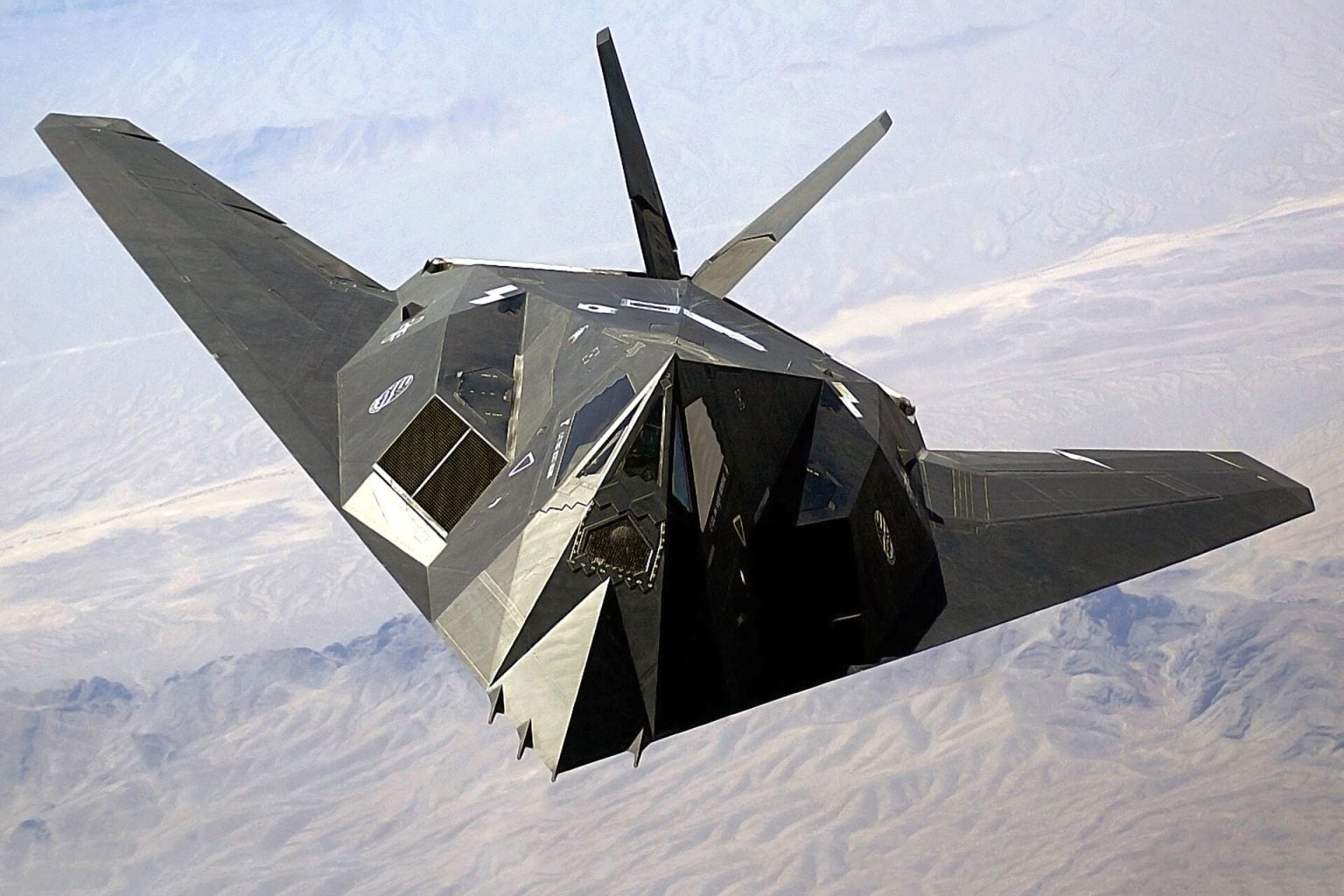
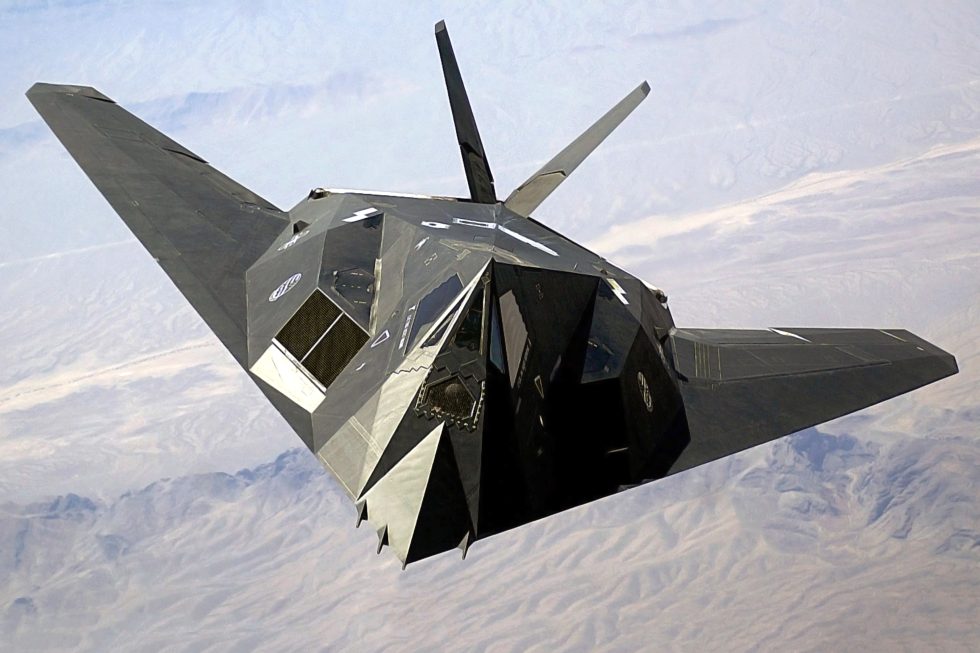
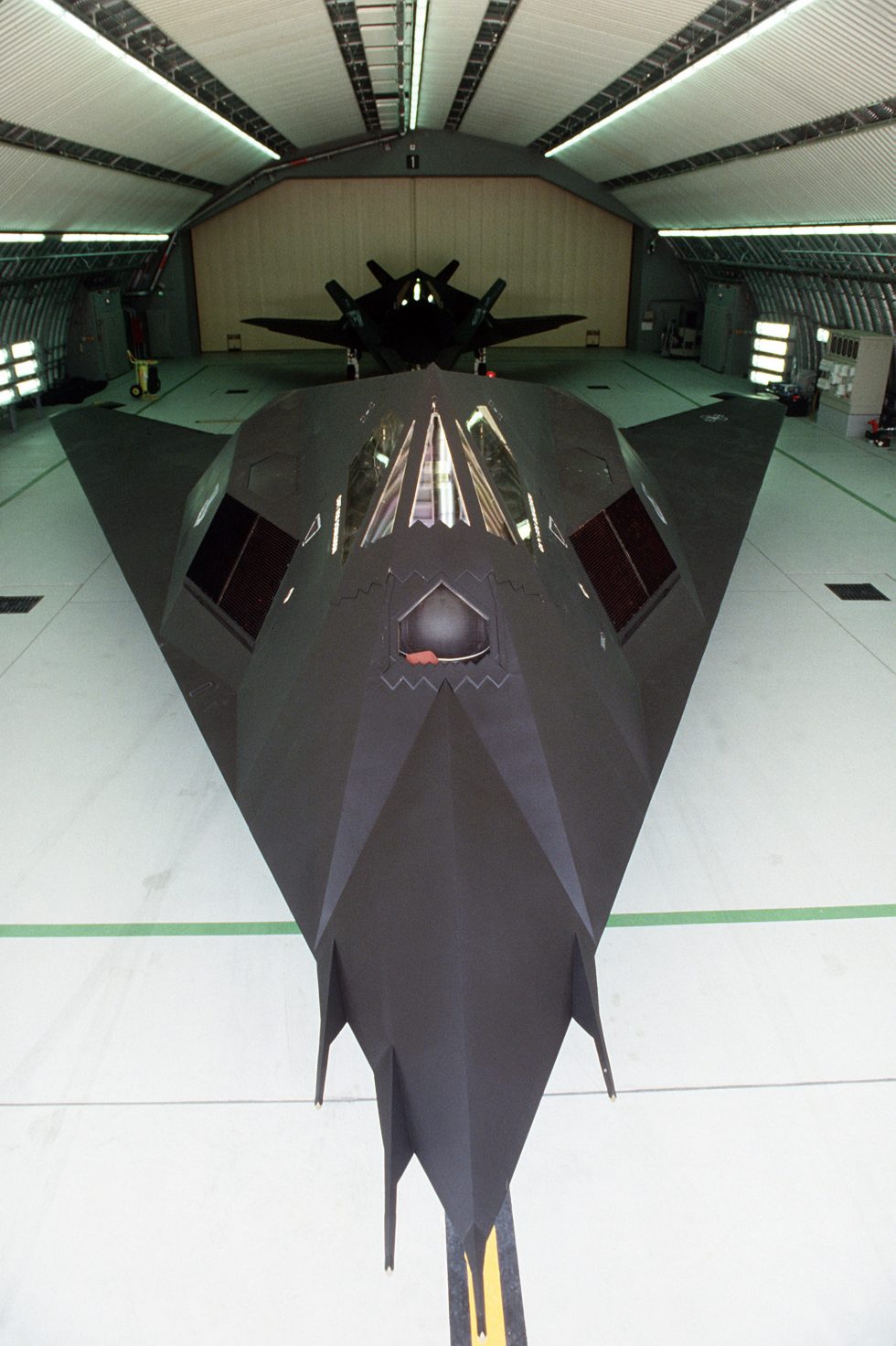
The Nighthawk’s strange, angular body is not styling — it is physics. Its surface is broken into dozens of flat panels (facets) angled to bounce radar energy away from the sender rather than back to it, and the whole airframe is wrapped in radar-absorbent material (RAM). Together they gave the F-117 a radar signature commonly likened to a small bird. The design was only possible because Soviet physicist Pyotr Ufimtsev’s equations let Skunk Works predict a faceted jet’s radar return before it was ever built.
Precision bombing in the dark
The F-117 could not use radar — radar emissions would give it away — so it navigated by GPS and inertial systems and aimed with a pair of infrared sensors (FLIR and a downward-looking DLIR) that let the single pilot find, track and laser-designate a target in total darkness. Its two GBU-27 or GBU-10 laser-guided bombs rode in internal bays so nothing hung outside to reflect radar. The result was a stealthy aircraft that could put a 2,000-lb bomb through a specific doorway at night.
Subsonic, silent to radar, and unstable
Stealth drove every choice. Two General Electric F404 turbofans run without afterburner — no supersonic dash, no telltale reheat plume — and exhaust through flattened ‘platypus’ slots that cool and hide the heat. Carrying no radar and emitting almost nothing, the jet is nearly passive. The faceted shape is so aerodynamically unstable that it can only be flown by a quadruple-redundant fly-by-wire computer making constant corrections a human never could.
02The physics behind the F-117: Ufimtsev, the ‘Hopeless Diamond’ and edge waves
In 1962 a Soviet physicist named Pyotr Ufimtsev published a paper on how electromagnetic waves scatter from the edges of flat surfaces. Moscow considered it academic and let it circulate freely; a Skunk Works engineer, Denys Overholser, found it and realised it was the key to predicting an aircraft’s radar cross-section from simple flat facets. Lockheed’s early faceted test model was so ungainly the engineers nicknamed it the “Hopeless Diamond,” yet on the radar range it all but disappeared.
Ben Rich later joked that Ufimtsev had done more for American stealth than any US engineer. The irony is complete: the aircraft that would help win the air war over Iraq was made possible by a paper the Soviet Union gave away for free.
03Flying a brick: why the F-117 needed computers to stay in the air
Designing for radar, not for flight, produced a shape that no pilot could control unaided. The faceted airframe is aerodynamically unstable in pitch and yaw, so the F-117 relies on a quadruple-redundant fly-by-wire flight-control system that senses the aircraft’s attitude and corrects it many times a second. Take the computers away and the jet would tumble.
Early instability during the Have Blue and development years earned the type the mocking nickname “Wobblin’ Goblin,” though operational pilots insisted the finished aircraft flew steadily and disliked the name, preferring simply “the Black Jet.”
Full F-117 specifications
Baseline note: every figure below describes a production F-117A in its late Single Configuration Fleet standard — one pilot, two non-afterburning General Electric F404-GE-F1D2 turbofans, two internal weapon stations, no gun, no radar and no external hardpoint of any kind — as flown by the 49th Fighter Wing from Holloman Air Force Base, New Mexico, between 1992 and the retirement ceremony of 22 April 2008. Sixty-four airframes were built: five YF-117A full-scale development aircraft and fifty-nine production F-117As, the last delivered on 3 July 1990. The differences between them are small enough that one set of tables covers the type; deltas for the YF-117A, for the pre-1990 avionics fit and for the naval and two-seat proposals that never left paper are in grey. Five numbers need settling before the tables start. Wing sweep: the leading edge is swept 67° 30′, a figure Lockheed Martin and the trade references agree on. The English Wikipedia infobox gives "50°", which does not describe the leading edge of an F-117 and should not be quoted as though it does; the number that matters for this aeroplane is the 67-and-a-half degrees that keeps the wing edge outside the forward radar sector. Wing area: 72.5 m² (780 sq ft) is the standard published figure. German Wikipedia gives 105.9 m², which is an outlier and inconsistent with the 329 kg/m² wing loading the same sources quote; 72.5 m² is used here. Thrust: the F404-GE-F1D2 is normally rated at 47.2 kN (10,600 lbf) uninstalled at sea level. The English Wikipedia infobox gives 40.2 kN (9,040 lbf), which is closer to an installed figure behind the F-117’s gridded intakes and long serpentine ducts; both numbers circulate and the difference is real inlet and nozzle loss, not a typing error. Radar cross-section: no official number has ever been released. Published estimates run from 0.001 m² to 0.01 m² (10 to 100 cm²) at X-band, head-on. Ben Rich’s marble and ball-bearing analogies are memorable but are not measurements, and every specific square-centimetre figure in print is an outsider’s estimate. The number that governed the aeroplane’s career is not a number at all: faceting is frequency-dependent, and against metre-wavelength VHF radar the F-117 was very much less invisible than against the centimetric fire-control sets it was shaped to beat. Cost: 42.6 million dollars flyaway per aircraft in programme-year dollars is the figure Lockheed and the Air Force used. The Federation of American Scientists gives 122 million dollars as a fiscal-year-1998 total programme unit cost, and 111.2 million dollars also appears; the three are not contradictory, they are flyaway, programme and average procurement cost respectively, and quoting one against another is the commonest way this aeroplane’s price is misreported.
Dimensions & weights
- Crew
- 1 — a single pilot, no weapon systems officer, no navigator, and for most of the type’s life no second aircraft in visual formation either. The F-117 flew alone, at night, in radio silence, on a route computed on the ground hours earlier
- Length
- 20.09 m (65 ft 11 in) — Airforce Technology gives 19.4 m (63 ft 9 in), an older figure that predates the final nose and probe fit
- Wingspan
- 13.21 m (43 ft 4 in) — narrow for the length, because span costs radar return along the wing edge
- Height
- 3.78 m (12 ft 5 in) — to the tips of the ruddervators, which are the tallest thing on the aircraft
- Wing area
- 72.5 m² (780 sq ft) — a modified delta with a straight, sharply swept leading edge and a notched, forward-swept trailing edge in two panels
- Wing sweep
- 67° 30′ leading edge — chosen so that the strongest edge return is thrown into four narrow spikes well off the nose, rather than smeared across the forward sector. Every major edge on the airframe is aligned to one of the same handful of angles for the same reason: intake grids, bay doors, undercarriage doors and panel joins are all parallel to a wing or tail edge
- Tail
- V-tail, two all-moving ruddervators canted outward — roughly 65° from horizontal. There is no fin, no rudder and no tailplane; the two surfaces do all of it. On the YF-117A they were smaller, and were enlarged on production aircraft after flight test found them short of authority
- Facets
- Flat panels only, no compound curves — the entire external mould line is made of plane surfaces. This is not a style; it is the direct consequence of what a 1975 computer could solve, and it is the single fact from which every other number in these tables follows
- Empty weight
- 13,381 kg (29,500 lb) — of which roughly a tonne is radar-absorbent material carried purely as signature, contributing nothing to structure, lift or payload
- Max take-off weight
- 23,814 kg (52,500 lb)
- Internal fuel
- ~8,550 kg (~18,850 lb, about 10,650 litres) — carried entirely internally in the wing and centre fuselage. There were no drop tanks and no way to fit any, so range came from the tanker or it did not come at all
- Wing loading
- 329 kg/m² (67.3 lb/sq ft) — heavy for a subsonic aircraft with a modest thrust-to-weight ratio, which is why the approach speed is what it is
- Weapon load
- ~2,300 kg (~5,000 lb) in a split internal bay, one trapeze station in each half, two weapons maximum — less than a Second World War Lancaster, delivered from an aircraft that cost more than forty million dollars each
Performance
- Maximum speed
- 1,100 km/h (684 mph, 594 kn) at altitude, about Mach 0.92 — and that is a limit, not a cruise. Faceted plates and slot exhausts do not survive transonic drag rise, and the aircraft has no afterburner to push through it
- Cruise speed
- Mach 0.8 — roughly 850 km/h (530 mph) at altitude, the speed at which mission routes were planned and timed to the second so that dozens of aircraft could cross the same defended airspace without seeing each other
- Supersonic capability
- None — the F-117 never went supersonic in level flight and was never intended to. This is the aerodynamic bill for the shape: a fighter designation on an aircraft slower than a 1950s bomber
- Rate of climb
- 860 m/min (2,820 ft/min) — about a third of what a clean F-16 of the same era managed
- Service ceiling
- 13,700 m (45,000 ft) — sources give 13,000 to 14,000 m (43,000 to 45,000 ft)
- Typical attack altitude
- 6,000 to 8,000 m (20,000 to 26,000 ft) — high enough to stay out of anti-aircraft artillery and shoulder-launched missiles, low enough for the infrared sensors to hold a target through haze. Vega 31 was at about 8,000 m when it was hit
- Range
- 1,720 km (930 nmi, 1,070 miles) unrefuelled
- Combat radius
- ~1,110 km (~600 nmi) with a war load, unrefuelled — German Wikipedia gives 1,112 km. In practice every operational sortie was tanked, often four or five times; Desert Storm missions from Khamis Mushait to Baghdad and back ran five hours and more
- Range with air refuelling
- Limited by the pilot, not the aircraft — the deployment flights from Nevada to Saudi Arabia and to Aviano were flown non-stop behind tankers
- Approach speed
- 305 to 335 km/h (165 to 180 kn) — fast, flat and unforgiving, with a braking parachute deployed on every landing and an arrestor hook for emergencies
- Thrust-to-weight
- 0.40 at maximum take-off weight — a bomber’s figure. The F-117 could not turn with anything and was not meant to; the tactical doctrine was that it would never be in a position where turning mattered
- Load factor
- +6 g — nominal design limit, rarely relevant. The flight control laws and the mission profile both discouraged hard manoeuvring, which disturbs the signature as well as the pilot
Propulsion & systems
- Engines
- 2 × General Electric F404-GE-F1D2 turbofan — the F/A-18’s engine with the afterburner deleted and the accessory drives rearranged. Buying an existing engine saved years and hundreds of millions, and the absence of reheat was a signature decision as much as a cost one: an afterburner plume is a beacon in the infrared and a strong radar reflector in its own right
- Thrust
- 47.2 kN (10,600 lbf) each, 94.4 kN (21,200 lbf) total, uninstalled and dry. Installed thrust behind the gridded intakes, the serpentine ducts and the slot nozzles was substantially lower; the English Wikipedia figure of 40.2 kN (9,040 lbf) each is in that region
- Intakes
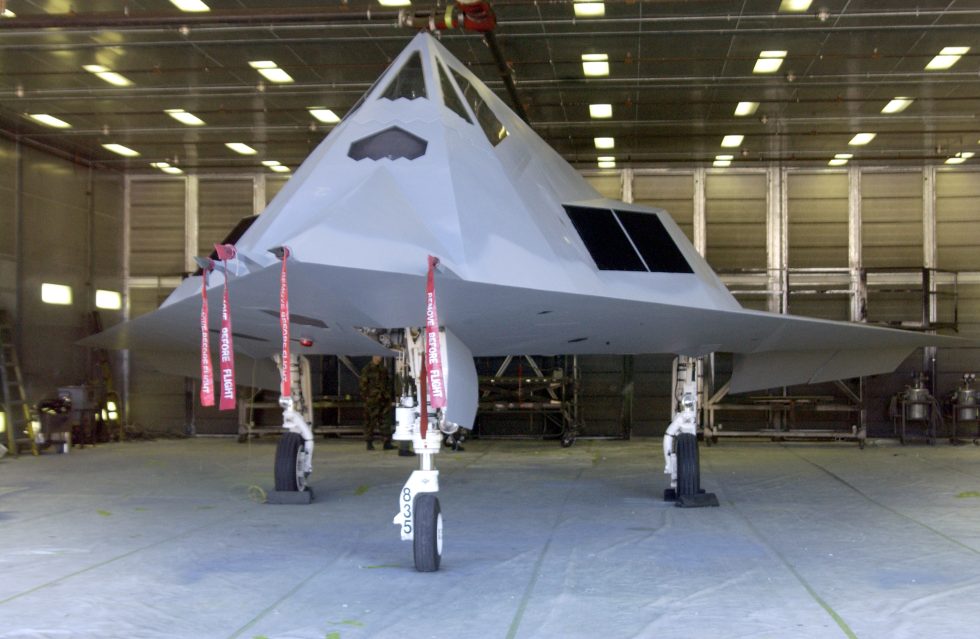
- Flush rectangular inlets covered by fine grids — roughly 1.5 cm mesh, coated in radar-absorbent material and electrically heated against icing. The grid is smaller than the wavelength of a fire-control radar, so the compressor face behind it — one of the brightest reflectors on any aeroplane — is simply not visible to the radar at all. The cost is a permanent loss of inlet pressure recovery, paid on every flight
- Exhaust
- Two wide, flat "platypus" slot nozzles — nickel-alloy honeycomb structures built by Astech/MCI, with internal vanes that hide the turbine from any line of sight and spread the efflux into a thin sheet that mixes with cold air within a short distance. The trailing edge of the shelf below each nozzle is serrated. This is the single most demanding piece of hardware on the aircraft and took ten months to get right
- Flight controls
- Quadruplex digital fly-by-wire — four computers derived from the F-16 programme, driving four elevons and two ruddervators. The F-117 is statically unstable in pitch, roll and yaw simultaneously; with the computers off it is not a difficult aeroplane, it is an impossible one. The first production aircraft, 80-0785, was written off on 20 April 1982 when the flight control sensor leads were connected in reverse and it flipped on its first take-off, injuring Robert Riedenauer badly enough to end his flying career
- Targeting sensors
- IRADS, Infra-Red Acquisition and Designation System — built by Texas Instruments, later Raytheon. Two turrets: a forward-looking infrared set in a recess ahead of the windscreen and a downward-looking set with a laser designator in the lower forward fuselage, which took over as the aircraft passed over the target. Both apertures sit behind fine wire screens. Wholly passive, with no radar and no active illumination other than the designator itself in the last seconds
- Navigation
- Honeywell SPN/GEANS inertial platform, later RNIP-Plus — the original mechanical-gyro system was replaced from 1997 by a ring-laser-gyro unit integrated with GPS. Navigation accuracy was the whole mission: an aircraft with no radar, flying alone at night in radio silence, hits its target only if it arrives at a computed point at a computed second
- Cockpit and mission systems
- Kaiser Electronics head-up display, Harris colour moving-map display, IBM AP-102 mission computer — with an automated mission planning system that could fly the route and release the weapons without pilot intervention. Cockpit hardware was drawn from the F-16 and F/A-18
- Defensive systems
- Effectively none — no radar, no radar warning receiver for most of the type’s career, no self-protection jammer, no towed decoy. Emitting anything defeats the point. The aeroplane’s only defence was not being seen, and on 27 March 1999 that defence failed once
- Low-observable materials
- Sheet and sprayed radar-absorbent material — close to a tonne of it, originally applied as flat sheets bonded with adhesive and sealed at the joints with a putty the maintainers called butter. Every panel opened for servicing had to be resealed and cured, which is why early availability was poor. The Single Configuration Fleet programme from 1996 replaced much of it with sprayed coatings and standardised the fleet on one build state
- Borrowed hardware
- F/A-18 engines, F-16 flight control computers, C-130 environmental control system, B-52 navigation elements — a deliberate policy. Everything that did not affect signature was bought off an existing shelf so that the money and the schedule could be spent on the shape. Design go-ahead to first flight took thirty-one months
- Upgrades
- OCIP I and II, SCF, JDAM integration — the Offensive Combat Improvement Program brought a new cockpit, an autothrottle and a four-dimensional flight management system; the Single Configuration Fleet programme (1996 to 2006) ended the era in which almost every airframe was slightly different; GPS-guided GBU-31 JDAM and the enhanced EGBU-27 were added in the 2000s, finally giving the aircraft a weapon that worked through cloud
04What the F-117 Nighthawk actually cost
Because it was a black programme, the F-117’s finances were hidden for years, and the numbers you see depend on what is counted. The flyaway cost of an individual airframe is usually put in the low-to-mid $40 millions (1980s dollars). Spread the enormous secret research, development and infrastructure bill across the small fleet of 64 aircraft, however, and the program unit cost rises to roughly $111 million each. No reliable public cost-per-flight-hour figure exists for the type. Any single dollar figure attached to the Nighthawk should be read with that ambiguity in mind.
Armament & payload
The F-117 carried two bombs, no gun and no missile, and every other decision on the aircraft was made to buy those two bombs a clear run
The armament of an F-117A is a single sentence: two guided weapons on two trapeze stations in a split internal bay, about 2,300 kg (5,000 lb) in all, and nothing else anywhere on the aeroplane. There is no gun and no provision for one. There is no air-to-air missile, no rocket pod, no external pylon, no drop tank and no targeting pod, because there is no external hardpoint of any kind and adding one would have undone the shape. A Second World War Lancaster carried three times the tonnage; what the F-117 carried instead was the ability to put its two bombs on the roof of a building in the most heavily defended airspace on earth and fly home.
That trade only works if the weapon is accurate enough that two is enough, and for most of the type’s life it was a laser-guided weapon designated by the aircraft’s own downward-looking infrared turret in the final seconds of the run. The consequence is the aircraft’s real limitation, and it is not stealth: infrared does not see through cloud. On nights when the weather over Baghdad or Belgrade closed in, the most survivable strike aircraft in the world could reach its target and not be able to hit it. GPS-guided GBU-31 JDAM and the enhanced EGBU-27 fixed that only in the last few years of service, from the mid-2000s.
The bay doors are the other half of the story. They are hinged, serrated-edged and open for a matter of seconds; while they are open the aircraft’s radar cross-section rises sharply, because a cavity is a corner reflector and no amount of edge alignment fixes that. Weapon release was therefore the most dangerous moment of any F-117 sortie, and it was timed and scripted accordingly. Everything below describes the USAF F-117A, the only operator the type ever had. There is no export variant, no licence production and no foreign fit, so there is no operator variation to report; the only meaningful variation is chronological, between the pre-OCIP fleet of the 1980s, the Single Configuration Fleet standard from 1996, and the JDAM-capable aircraft of the final years.
Gun
- None. The F-117A carried no cannon, no machine gun, no ammunition and no gun bay, and none was ever proposed for a production aircraft.
- The reason is not weight. A gun port is a cavity in the skin with a muzzle in it, which is a radar reflector and an infrared source, and the whole external surface of the aircraft was laid out to avoid exactly that kind of feature.
- Nor was there a mission for one. The F-117 flew alone at night against fixed targets and was forbidden to look for anything to strafe; the flight control laws and the aircraft’s 0.40 thrust-to-weight ratio made a gun pass a bad idea even if the hardware had existed.
- This is the clearest single illustration of why the F designation is a misnomer. The aeroplane is an attack aircraft, and General Robert J. Dixon of Tactical Air Command is generally credited with insisting on "F" so that the programme would attract first-rate fighter pilots rather than the men the Air Force assigned to bombers.
Air-to-air
- None carried, ever, on any operational sortie. The card stays because its emptiness is the point: this was the only tactical aircraft in the United States inventory with an F in its designation and no air-to-air capability at all.
- The aircraft had no radar, no radar warning receiver for most of its career and no missile launch rails. It could not detect a fighter, could not be told about one without breaking radio silence, and could not have shot at one.
- Studies for an AIM-9 Sidewinder fit on the trapeze stations were floated more than once and went nowhere. Carrying a missile means opening the bay to launch it, at which point the aircraft is visible, which is the situation the missile was supposed to solve.
- The doctrine was avoidance, absolutely. Route planning kept F-117s away from known fighter combat air patrols; the aircraft were escorted by nothing and protected by nobody, and in Desert Storm this worked for 1,300 sorties without a scratch.
- In Allied Force the same doctrine was strained by NATO’s limited target set and limited airspace, and on 27 March 1999 an S-125 battery found one of them. No fighter ever did.
Air-to-surface guided
- GBU-27/B Paveway III — the signature F-117 weapon: a 2,000 lb-class laser-guided bomb pairing Paveway III seeker electronics with a shortened Paveway II-style wing kit so that it would fit the bay, usually on a BLU-109/B hardened penetrator body. This is the weapon that went through the roofs of Baghdad on the first night of Desert Storm.
- GBU-10 Paveway II — the older and cheaper 2,000 lb laser-guided bomb, on a Mk 84 general-purpose or BLU-109/B penetrator body. Widely used in Desert Storm alongside the GBU-27.
- GBU-12 Paveway II — the 500 lb laser-guided bomb on a Mk 82 body, carried when the target did not justify a 2,000-pounder.
- GBU-31(V)1/B and (V)3/B JDAM — GPS and inertially guided 2,000 lb weapons on Mk 84 or BLU-109 bodies, integrated from about 2006. The first munition the F-117 could deliver through solid cloud, arriving less than two years before the type was retired.
- EGBU-27 — a GPS-aided enhanced Paveway III that could be released on coordinates and refined by laser if the target became visible. Two of these opened the 2003 invasion of Iraq. AGM-65 Maverick and AGM-88 HARM appear in some reference works as F-117 weapons; they were studied and in some accounts trialled, but no F-117 ever flew an operational sortie with a missile of any kind.
Bombs
- Mk 84 — the standard 2,000 lb (907 kg) general-purpose bomb body underneath most of the guided weapons above. Two unguided Mk 84s were what the two aircraft over Rio Hato dropped in December 1989, in a deliberate attempt to stun rather than kill.
- BLU-109/B — hardened steel penetrator with a reduced explosive fill, designed to punch through concrete before detonating. Against the Iraqi leadership bunkers and hardened aircraft shelters of 1991 this was the reason the F-117 was sent rather than something cheaper.
- BLU-116 — an advanced unitary penetrator developed in the 1990s for deeper targets, cited in the F-117’s later weapon list.
- B61 nuclear gravity bomb — the F-117 was certified for two, including in later years the B61 Mod 11 earth-penetrating variant. It never carried one operationally and never sat nuclear alert in the way a bomber wing did, but the capability was real and is part of why the type was hard to justify retiring and hard to justify keeping.
- BDU-33 and inert training rounds — the everyday load on ranges at Tonopah and later over the White Sands and Nellis complexes, where the fleet did the overwhelming majority of its flying.
Rockets
- None, at any point, in any configuration. Unguided rockets are carried in external pods, and the F-117 had nowhere to hang one.
- Even if a pod could have been fitted internally, rocket delivery means a shallow dive at low level in visual conditions against a target of opportunity — the exact opposite of everything the aircraft was built and crewed to do.
- The card is kept because reference works occasionally pad F-117 weapon lists with items the aircraft could theoretically have lifted. It could not lift these, and did not.
Pods & other stores
- No external stores of any kind. There is not one pylon, rail, ejector rack or attachment lug on the outside of an F-117A, and there is no way to add one without cutting into the mould line the whole aeroplane exists to preserve.
- No targeting pod, because the targeting system is internal: the FLIR and DLIR turrets of IRADS sit behind wire-screened apertures in the airframe, which is why the F-117 needed no Pave Tack or LANTIRN and could not have carried one.
- No electronic countermeasures pod, no chaff-and-flare-heavy self-protection fit, no towed decoy. A jammer radiates, and radiating is precisely what this aircraft was designed not to do.
- No drop tanks. Range came from the boom of a KC-135 or KC-10; a Desert Storm sortie from Khamis Mushait typically involved several refuellings and lasted more than five hours.
- Luneburg lens radar reflectors — the one thing regularly bolted to the outside, and the exception that proves the rule. Small removable reflectors were fitted for ferry flights, peacetime transits and any occasion when civil or friendly air traffic control had to be able to see the aircraft. Photographs of F-117s with obvious lumps on the fuselage sides are showing this, not a weapon.
Three typical loadouts
- First night over Baghdad, 17 January 1991
- 2 × GBU-27/B Paveway III on BLU-109/B penetrator bodies, total about 1,800 kg (4,000 lb), plus full internal fuel. Ten F-117s opened the air campaign against the Iraqi integrated air defence network, communications nodes and leadership targets. This is the load that produced the gun-camera imagery the world watched on television, and also the load that missed roughly 40 per cent of the first night’s assigned air-defence targets, the Baghdad Air Defence Operations Centre among them — a fact that took years to surface.
- Hardened shelter or buried command bunker
- 2 × GBU-10 Paveway II with BLU-109/B penetrator warheads, self-designated by the DLIR turret. The classic F-117 task: one aircraft, one pass, two aim points on the same structure or on two structures within a few seconds of each other. Post-war analysis credited F-117s with roughly eighteen times more targets attacked per aircraft than non-stealthy types, because they did not need the escort, jamming and defence-suppression package that everything else in the theatre required.
- Dora Farms, 20 March 2003
- 2 × EGBU-27 GPS-aided enhanced Paveway III, released on coordinates in poor visibility, plus Navy Tomahawks against the same complex. Two F-117s of the 8th Expeditionary Fighter Squadron dropped the first bombs of Operation Iraqi Freedom in an attempt to kill Saddam Hussein on the strength of a few hours’ intelligence. The weapons worked; the intelligence did not, and Hussein had left. It was the last combat mission profile the type would ever fly.
Sourcing caveat: weapon lists for the F-117 vary between the USAF fact sheet, the Federation of American Scientists, Airforce Technology and Lockheed Martin’s own material, and several of them include stores — AGM-65, AGM-88, wind-corrected munitions dispensers — that were cleared on paper or trialled but never used in anger. Where this page distinguishes between what the aircraft could carry and what it did carry, it says so. Bay dimensions, exact release envelopes and the radar cross-section penalty of open doors have never been published and any specific figure for them is an estimate from outside the programme.
Variants
Sixty-four airframes, two demonstrators and a shelf of naval and two-seat proposals that never left paper
The F-117 has almost no variants, which is unusual for an aircraft that served for twenty-five years, and the reason is that it was never sold to anyone. There was no export customer, no licence production, no two-seat trainer and no reconnaissance or electronic-warfare derivative. Sixty-four airframes were built in a single basic configuration, upgraded twice as a fleet, and retired together. What the type has instead of variants is an ancestry, and the ancestry is the interesting part.
It begins with a paper. In 1962 the Soviet physicist Pyotr Ufimtsev published Method of Edge Waves in the Physical Theory of Diffraction, which showed that the strength of a radar return depends on the configuration of an object’s edges rather than on its size. The USAF Foreign Technology Division translated it in 1971 and it sat unread until Lockheed’s Denys Overholser, a radar specialist rather than an aerodynamicist, found it and understood what it meant: if you could compute the return from a flat plate and an edge, you could compute the return from an aircraft made entirely of flat plates and edges. Overholser and the retired Lockheed mathematician Bill Schroeder turned the theory into a program called Echo 1, and Echo 1 produced the shape.
The faceting is therefore not a design philosophy but a computing constraint, and this is the single most misunderstood thing about the aeroplane. Nobody at the Skunk Works believed flat panels were aerodynamically or even electromagnetically ideal; curved surfaces would have been better on both counts. But a mid-1970s computer could only solve the radar cross-section of simple plane geometry, so the aircraft was built out of the only shapes the mathematics could handle. Ben Rich’s team called the first model the Hopeless Diamond, and the joke was aerodynamic, not electromagnetic. When Northrop built the B-2 a decade later with far greater computing power behind it, the facets vanished and the curves came back — which tells you exactly what the F-117’s angles were for.
The price was an aeroplane that could not fly itself. Statically unstable in pitch, roll and yaw at the same time, subsonic, short on thrust, heavy on the wing, with an approach speed that demanded a braking parachute and a handling reputation that earned it the name Wobblin’ Goblin, which its pilots have spent forty years insisting it did not deserve. They called it the Black Jet. Five hundred and fifty-eight Air Force pilots flew it, each issued a sequential Bandit number on completing his first flight, and for most of the type’s career they flew it only at night, from a base that did not officially exist.
- Hopeless Diamond (1975 / none flown)
- The concept model that started it: a faceted pole-test shape produced by Echo 1, roughly two metres across, tested on the radar range at Palmdale and later at White Sands against Northrop’s competing design. It won because it measured better, not because it looked better; the name records what the aerodynamicists thought of it.
- Have Blue, XST (1977–1979 / 2 built, HB1001 and HB1002)
- The DARPA-funded technology demonstrators, about 40 per cent smaller than the F-117 and unmistakably its parent: same faceting, same buried inlets, but with the tail surfaces canted inwards rather than outwards. Two General Electric J85 turbojets, quadruplex fly-by-wire lifted from the F-16. First flight 1 December 1977 with Bill Park at Groom Lake. Both aircraft were lost — HB1001 on 4 May 1978 after a hard landing jammed the undercarriage, HB1002 on 11 July 1979 to a hydraulic fire caused by a loosened exhaust clamp — and both pilots ejected safely. The programme was still judged a success, because by then it had proved the only thing it needed to prove.
- YF-117A, Senior Trend full-scale development (1981–1984 / 5 built, 79-10780 to 79-10784)
- The five development aircraft, funded from the November 1978 decision to build an operational aeroplane. Hal Farley flew 79-10780 at Groom Lake on 18 June 1981, thirty-one months after go-ahead. Flight test drove the enlargement of the ruddervators and a long list of systems fixes; the airframes are externally close to production standard and all five survive.
- F-117A (1982–1990 / 59 built)
- The production aircraft and the only version to enter service, delivered from August 1982 to 3 July 1990 at about 42.6 million dollars flyaway each. Initial operating capability October 1983 with the 4450th Tactical Group at Tonopah Test Range, Nevada, a unit that flew A-7D Corsair IIs by day as a cover story and F-117s by night, and that swapped the A-7s for T-38A Talons in 1989 once the secret was out. The Pentagon acknowledged the aircraft’s existence on 10 November 1988 with a single deliberately poor photograph. The 4450th became the 37th Tactical Fighter Wing in October 1989; the fleet moved to Holloman Air Force Base and the 49th Fighter Wing in 1992.
- F-117A OCIP (1984–1995 / fleet retrofit, no new airframes)
- Offensive Combat Improvement Program, in two phases: a rebuilt cockpit with colour multifunction displays and a moving map, an autothrottle, and a four-dimensional flight management system that let a pilot fly a route to a time as well as a place. It made a difficult aeroplane manageable on a five-hour night sortie and is the reason Desert Storm went as well as it did.
- F-117A SCF (1996–2006 / fleet retrofit)
- Single Configuration Fleet, the programme that ended the situation in which almost every airframe had a slightly different signature treatment and a slightly different systems fit. Sprayed radar-absorbent coatings replaced much of the bonded sheet material, cutting the maintenance burden that had crippled early availability, and the fleet was standardised. GPS-guided GBU-31 JDAM and EGBU-27 integration followed in the same period.
- F-117N Seahawk (1993–1994 / none built)
- Lockheed’s unsolicited carrier proposal to the US Navy: a reshaped, larger-winged, tailhook-equipped derivative with afterburning General Electric F414 engines and, in the A/F-117X development of it, external hardpoints and an air-to-air capability. The Navy was not interested in an aircraft that would have required a new production line for a small buy, and Congress did not fund it. Nothing was built and no metal was cut.
- F-117B and RAF proposals (late 1980s–1990s / none built)
- A land-based derivative of the Seahawk work, offered at various points to the United States Air Force and to the United Kingdom, with greater range and payload. Britain was reportedly sounded out about the F-117A itself in the 1980s. Nothing came of any of it, and no F-117 airframe has ever worn a foreign roundel.
- Export and licence production (never / none)
- There is none, and the entry exists to close the question. The F-117 was among the most tightly held programmes in United States history; not one airframe, kit or licence was ever released to another country. The only F-117 outside American hands is the wreckage of 82-0806 in Belgrade, which arrived there by being shot down.
- Post-2008 test and aggressor aircraft (2008 to date / no separate designation)
- Not a variant on paper, but in practice a distinct fleet: a handful of airframes kept flying from Tonopah after the type was officially retired, doing work the original aircraft was never built for. Two were photographed in January 2022 wearing an unexplained mirror-like coating that is generally read as an infrared signature experiment. They fly as red air against F-22 and F-35 crews, as radar and infrared sensor testbeds, and as surrogates for stealthy subsonic cruise missiles in air-defence exercises.
Closing note on losses, survivors and the aircraft that never stopped flying, current as of 3 September 2026. Of the sixty-four airframes built, six were destroyed. The first production aircraft, 80-0785, was written off at Groom Lake on 20 April 1982 when its flight control sensor leads were connected in reverse and it flipped on take-off, severely injuring Robert Riedenauer; it never flew again and its remains stand today as the Skunk Works monument at Air Force Plant 42, Palmdale. Major Ross Mulhare was killed near Bakersfield, California on 11 July 1986 in 81-10792, the finding being spatial disorientation. Major Michael Stewart was killed near Tonopah on 14 October 1987. One aircraft was lost to an engine bay fire traced to a maintenance error in August 1992, the pilot ejecting safely. Captain Kenneth Levens was killed near Zuni, New Mexico on 10 May 1995. On 14 September 1997, 81-10793 shed a wing in front of a crowd at Martin State Airport, Middle River, Maryland, after four fasteners were left out of a wing panel during maintenance; Major Bryan Knight ejected and survived, the aircraft destroyed two houses, and nobody on the ground was killed. All three fatal accidents involved pilots with fewer than a hundred hours on type. The one combat loss was 82-0806 "Something Wicked", callsign Vega 31, on the night of 27 March 1999 over Serbia during Operation Allied Force, and it deserves to be told without the myths that have grown around it. The aircraft was flown by Lieutenant Colonel Dale Zelko of the 8th Fighter Squadron, a Desert Storm veteran. It was shot down at about 20:15 local time near Budađevac by the 3rd Battalion of the 250th Air Defence Missile Brigade of the Army of Yugoslavia, commanded by Lieutenant Colonel Zoltán Dani — a Hungarian-Serb officer who was promoted to Colonel later, and who is frequently and incorrectly given that rank on the night itself. His battery used the S-125 Neva-M, the NATO SA-3 Goa, a Soviet system already thirty years old. Dani acquired the aircraft at about 23 km on a low-frequency P-18 metre-wavelength early-warning radar, which faceting is far less effective against than the centimetric fire-control radars the F-117 was shaped to defeat, then illuminated with his fire-control radar for bursts of no more than about seventeen to twenty seconds so that NATO defence-suppression aircraft could not lock him up. He fired two missiles at a slant range of roughly 13 km with the aircraft at about 8,000 m. The first passed close without detonating and buffeted the aeroplane; the second detonated near enough to tear it out of controlled flight. Zelko ejected, landed in a field south of Ruma about a kilometre from the wreck and from the E70 motorway, hid in a drainage ditch he had picked out during his descent while Serbian search parties came within a few hundred metres of him, and was recovered roughly eight hours later in the early hours of 28 March by a combat search and rescue package of two MH-53s and an MH-60. What is not established, and should not be repeated as fact: that the Serbs used a Czech Tamara or VERA passive surveillance system; that the F-117 was hit because its bomb bay doors happened to be open at that instant, which is plausible and widely stated but has never been confirmed; that a second F-117 was shot down at any point, a claim that appears on Serbian commemorative posters and nowhere credible. What is contested rather than fabricated: that NATO had flown the same corridors on successive nights and that no EA-6B Prowler jamming support was available that night because of weather. Both are widely reported by participants and both are more accurate as descriptions of a systemic complacency than as a single cause. A second F-117 is alleged to have been damaged on 30 April 1999 and to have returned to Spangdahlem and never flown again; another F-117 pilot corroborated the incident in 2020, but it remains officially unacknowledged. In 2011 Dani, by then running a bakery, met Zelko in Serbia; the two became friends, which is the part of this story most worth remembering. Pieces of 82-0806 are on display at the Aeronautical Museum in Belgrade; other components were examined by Russian and, by several accounts, Chinese specialists. Retirement and afterwards. Program Budget Decision 720 of 28 December 2005 brought the planned 2011 retirement forward to 2008 to release about 1.07 billion dollars towards F-22 purchases. The fleet was retired in eight phases between 13 March 2007 and 22 April 2008, the ceremony being held at Holloman; the last aircraft, 86-0831, flew from Palmdale to Tonopah on 11 August 2008. One airframe, 79-10784, was deliberately scrapped at Palmdale on 26 April 2008 to develop and test destruction methods. The rest went into Type 1000 recallable storage in their original climate-controlled hangars at Tonopah with the wings removed, a condition Congress mandated in the 2007 National Defense Authorization Act; the 2017 Act relaxed it and authorised demilitarisation at a few airframes a year. Survivors. Every displayed F-117 is an original airframe — there are no reproductions of this aircraft anywhere, and there could not usefully be, since the shape was the classified part. All four surviving YF-117As are preserved: 79-10780 as gate guardian at Nellis Air Force Base since 16 May 1992, 79-10781 at the National Museum of the United States Air Force at Wright-Patterson, 79-10782 at Holloman, and 79-10783 with the Air Force Flight Test Museum at Edwards. Production aircraft are on display at the Museum of Aviation at Warner Robins, the Hill Aerospace Museum in Utah, the Ronald Reagan Presidential Library at Simi Valley, the Pima Air and Space Museum at Tucson, the Castle Air Museum at Atwater, the Evergreen Aviation and Space Museum at McMinnville, the Air Zoo at Kalamazoo, the Stafford Air and Space Museum in Oklahoma, the Strategic Air Command and Aerospace Museum in Nebraska, the Palm Springs Air Museum, and the Palmdale Skunk Works monument. And a number of them are still flying. This is not a rumour, and it is not classified any more: the Air Force published photographs of airborne F-117s on DVIDS in 2021, which was the first official acknowledgement, and the aircraft have since appeared openly at Fresno Yosemite in September 2021 alongside 144th Fighter Wing F-15s, in the Savannah Sentry exercise in 2022, in Northern Edge 23-1 in Alaska in 2023 — their first acknowledged appearance outside the continental United States since retirement — over the R-2508 complex in the Mojave in February 2024, and taking fuel from a tanker over Los Angeles in September 2025. As of reporting in the first half of 2026, roughly forty-five airframes remain on charge in flying or regenerable stored condition at Tonopah, of which only about five are flying at any one time; contractor maintenance and logistics support is funded through at least 2034, and airframes are being demilitarised or handed to museums at about two or three a year. On that timetable the last F-117 will fly more than half a century after the type entered service, and more than a quarter of a century after it was officially retired. The Air Force has never explained why it kept them, and does not need to: an aeroplane that is stealthy against some radars and not others, subsonic, unarmed and available in small numbers is close to the perfect adversary and the perfect test bed, and there is nothing else in the inventory that does the job.
From black project to retirement
Have Blue flies
Lockheed’s faceted stealth demonstrator, Have Blue, takes to the air and proves a radar-evading shape can actually fly.
First Senior Trend flight
The first operational F-117A flies on 18 June from Groom Lake — still one of the most secret aircraft in the world.
Declared operational
The 4450th Tactical Group reaches initial operating capability at Tonopah, flying the jet exclusively at night.
The Pentagon reveals it
On 10 November the Air Force releases a single grainy photograph, finally admitting the F-117 exists.
Combat debut over Panama
During Operation Just Cause, F-117s fly their first combat mission, dropping bombs near Rio Hato — with mixed results.
Desert Storm
Around 40 Nighthawks strike the most heavily defended targets in Baghdad on the opening night, losing none.
Vega 31 shot down
On 27 March a Serbian SA-3 battery downs an F-117 over Yugoslavia — the only combat loss in the type’s history. The pilot is rescued.
Retired — but not gone
The Air Force retires the F-117 in April 2008, yet keeps airframes flyable; Nighthawks are still seen flying as test and adversary aircraft into the 2020s.
Twelve stories from the shadows
A Soviet paper built it
American stealth began with maths the USSR gave away for free.
Read the full story
The Hopeless Diamond
The first stealth shape was so ugly engineers laughed — then it vanished on radar.
Read the full story
A life lived at night
For years F-117 crews commuted to a secret desert base and flew only in the dark.
Read the full story
‘Wobblin’ Goblin’
The unstable stealth shape earned a mocking nickname its pilots hated.
Read the full story
The F-19 that never was
Before the reveal, the world was sure the secret stealth jet was called the F-19.
Read the full story
One blurry photo
After a decade of secrecy, the F-117 was unveiled with a single grainy picture.
Read the full story
A rocky debut over Panama
The F-117’s first combat mission was overshadowed by a bombing controversy.
Read the full story
First bomb on Baghdad
A Nighthawk dropped the opening bomb of Desert Storm on the enemy capital.
Read the full story
Why it only flew at night
Stealth against radar left the F-117 exposed by day, so it became a creature of darkness.
Read the full story
The night stealth died
A Serbian missile crew did what no one thought possible and shot down an F-117.
Read the full story
The pilot and the man who shot him down
Years later, the F-117 pilot and the Serbian officer who downed him became friends.
Read the full story
Retired, but still flying
Officially gone since 2008, Nighthawks keep turning up in the desert skies.
Read the full story
The Nighthawk in pictures
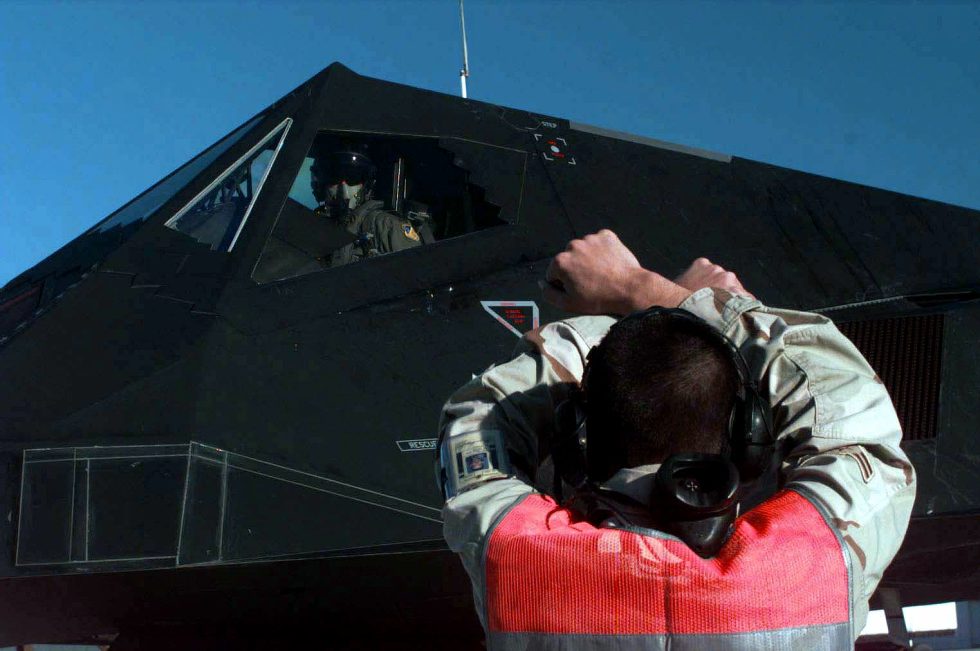
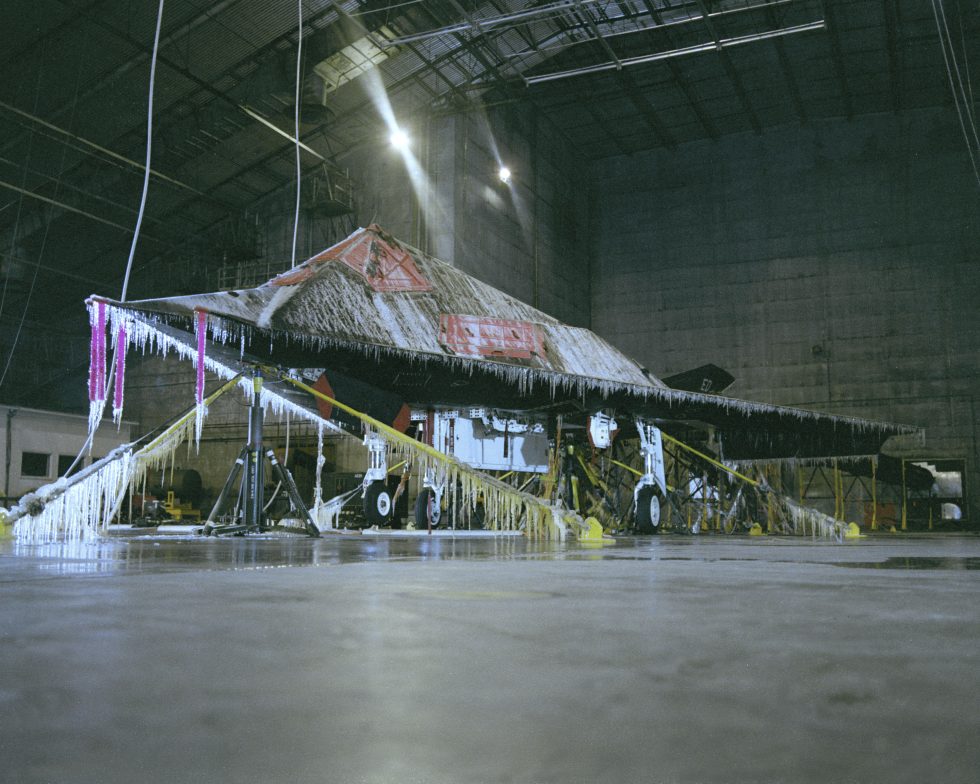
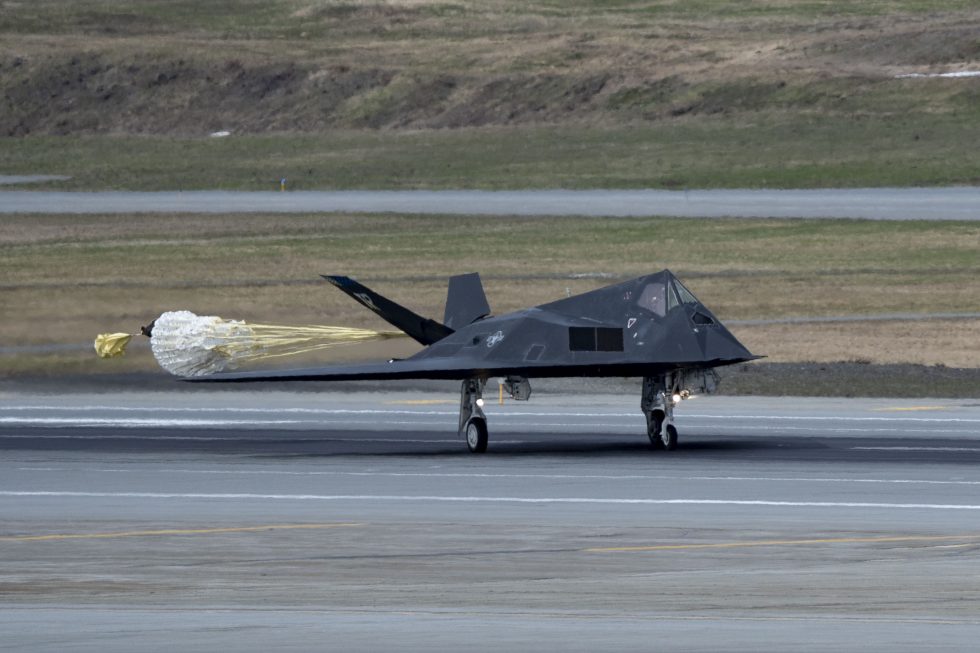
The F-117 in motion
A hand-picked F-117 Nighthawk documentary is coming soon to this page. In the meantime, explore the stories, gallery and operations map above — or read the full account of the 1999 shootdown in the stories below.
The F-117 Nighthawk in motion
Real Engineering — one of the most-watched F-117 Nighthawk films on YouTube.
Where the F-117 operated
The score that defines it
The F-117 never fired a shot in air-to-air combat — it carried no guns or missiles and never needed them. Its record is one of stealthy precision strikes against the hardest targets, and of a single, historic loss. In Desert Storm it flew a small fraction of the sorties yet hit a large share of the strategic targets, and it did so without losing an aircraft. Only once, over Serbia in 1999, did a defender manage to bring a Nighthawk down.
Compare the combat record of every military aircraft. Figures as of July 2026.
Everything people ask about the F-117
Can I fly in an F-117?
Why is the F-117 called a “fighter” if it only drops bombs?
How was the F-117 kept secret for so long?
Was an F-117 ever shot down?
How fast is the F-117?
Why was it thought to be called the F-19?
Is the F-117 still flying?
You can’t fly the F-117.
These, you can.
Some legends only live in museums — others are fuelled and waiting. MiGFlug has put civilians in real military jet cockpits since 2004.
 Fly the L-39 AlbatrosThe world’s most-flown jet trainer — aerobatics included
 Fly the F-104 Starfighter“The missile with a man in it”
 Fly the MiG-21The Cold War’s most-produced jet
 Fly the T-33 Shooting StarAmerica’s first jet trainer
 Fly the DH VampireA piece of early jet history
 Fly the S.211Agile Italian jet trainer
 Fly the MB-326The classic Aermacchi jet
 Fly the MiG-15The Soviet legend of the Korean War
Continue the tour
Every fact, checked
- National Museum of the U.S. Air Force — F-117A fact sheetOfficial specifications, development and service history.
- Lockheed Martin — F-117 Nighthawk historyThe manufacturer’s account of the Skunk Works stealth programme.
- Air & Space Forces Magazine — F-117Reference specifications and operational timeline.
- The Aviation Geek Club — F-117 over BaghdadDesert Storm sortie figures and first-night strikes.
- Defense Media Network — The Rescue of Vega 31Detailed account of the 1999 shootdown and pilot rescue.
- The Aviationist — the 1999 F-117 shootdownZoltan Dani’s SA-3 battery, tail number 82-0806 and why stealth failed.
- Code One Magazine — F-117 Nighthawk MemoriesFirst-hand recollections of the secret Tonopah years.
- 19FortyFive — How the F-117 redefined stealthDevelopment, Ufimtsev’s physics and the aircraft’s legacy.