
Sukhoi Su-33
“Flanker-D”
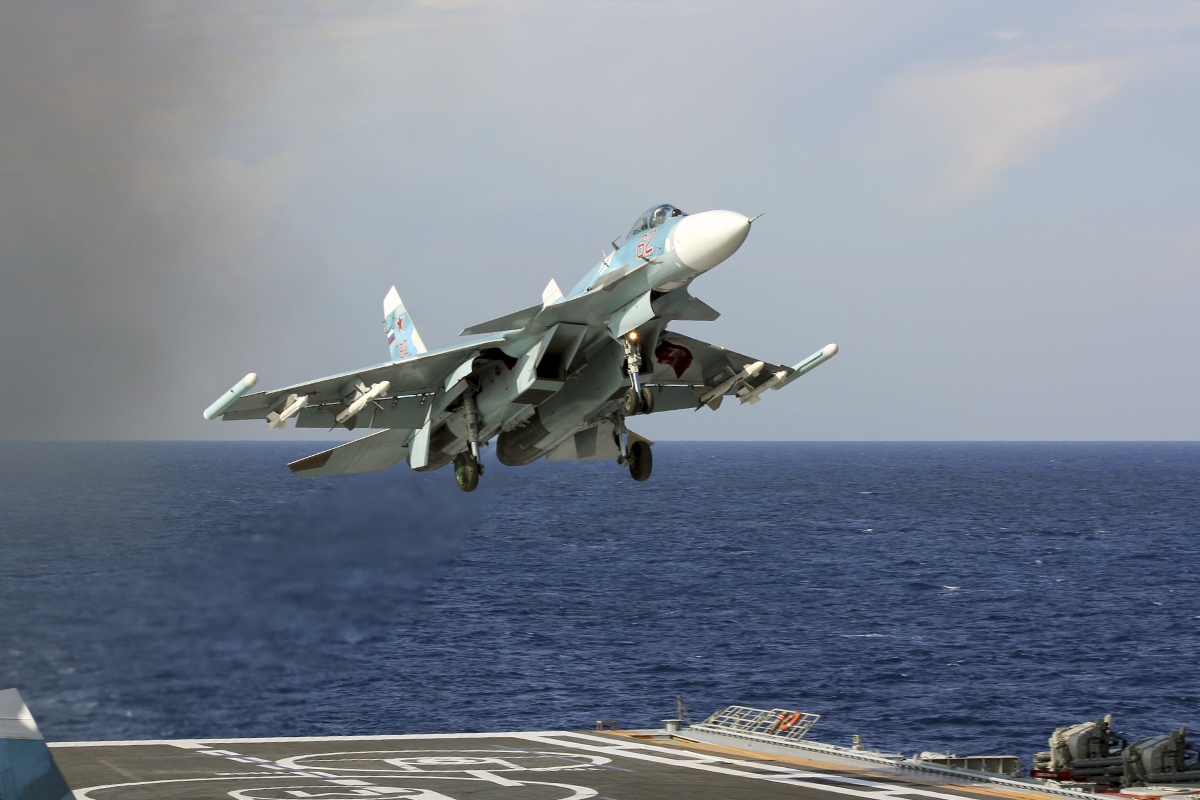
The navalised Flanker — folding wings, canards and an arrestor hook — built to fly heavy air-superiority missions from Russia’s only aircraft carrier, launching off a ski-jump ramp instead of a catapult.
How the Su-33 took the Flanker to sea
The Sukhoi Su-27 “Flanker” is one of the great fighters of the late Cold War — big, long-legged and superbly agile. But the Soviet Navy wanted one thing the land-based Flanker could not do: operate from the deck of an aircraft carrier. The answer was the Su-27K (“Korabelny,” meaning ship-borne), navalised so heavily that it earned its own NATO reporting name — Flanker-D — and eventually the service designation Su-33.
Turning a heavy land fighter into a carrier aircraft meant rebuilding it around the deck. Sukhoi added folding wings and folding tailplanes so the big jet could be packed below a crowded deck, small canard foreplanes for the lift and pitch control needed at slow approach speeds, a strengthened structure, a beefed-up twin-wheel nose leg, and an arrestor hook to catch the wires on recovery. A retractable refuelling probe extended its already long reach.
Russia’s carrier, Admiral Kuznetsov, has no steam catapults. Instead the Su-33 uses a STOBAR method — Short Take-Off But Arrested Recovery — sprinting up a 14-degree ski-jump ramp at the bow and trapping on wires when it lands. First flown in 1987 and formally adopted in 1998, the Su-33 remains in limited service today, the heaviest fighter routinely flying from a ski-jump carrier.
01Why the Su-33 exists: giving the Soviet Navy a real carrier fighter
For most of the Cold War the Soviet Navy flew short-ranged vertical-takeoff jets like the Yak-38 from its small carriers — useful for show, marginal in combat. When the larger Admiral Kuznetsov-class ship was designed with a full-length flight deck and a ski-jump, the Navy finally had room for a proper fighter. Rather than start from scratch, Sukhoi navalised its excellent Su-27, producing the Su-27K / Su-33.
The result gave the fleet, for the first time, a carrier aircraft with the range, radar and missile load of a front-line air-superiority fighter. It was never built in large numbers — only around two dozen production airframes — and it remains a niche type tied to a single ship. But as an engineering exercise it proved the heavy Flanker could be adapted to the punishing world of carrier flying.
What makes the Su-33 special
Navalised from nose to tail
Turning the Su-27 into the Su-33 meant far more than adding a hook. Sukhoi fitted folding wings and folding horizontal tails for deck stowage, added canard foreplanes behind the cockpit for extra lift and control at slow approach speeds, strengthened the airframe, and reinforced the landing gear with a twin-wheel nose leg. An arrestor hook and a retractable refuelling probe complete the carrier fit.
Ski-jump launch, no catapult
Admiral Kuznetsov has no catapults, so the Su-33 launches using a STOBAR technique: it accelerates along the deck and up a 14-degree ski-jump ramp that flings it into the air at low speed. That limits the fuel and weapons it can carry off the deck compared with a catapult launch — a real constraint of Russia’s carrier design, not of the aircraft itself.
A big Flanker’s reach at sea
Beneath the carrier kit, the Su-33 keeps the Flanker’s strengths: two AL-31F3 afterburning turbofans, a large internal fuel load giving roughly 3,000 km of range, a refuelling probe, and up to 12 hardpoints. For fleet air defence far from home, that combination of range, endurance and missile load is exactly what a navy wants overhead.
02The Su-33’s canards: why a carrier Flanker grew foreplanes
Landing on a carrier means flying a stable, controllable approach at low speed and thumping the deck hard enough to catch a wire. To give the heavy Flanker better behaviour in that regime, Sukhoi added canard foreplanes ahead of the wing. They increase lift and improve pitch authority at high angles of attack, letting the Su-33 fly a slower, more precise approach than the tail-only Su-27. The same foreplanes also sharpen its agility — a side benefit of a change made mainly for the deck.
03STOBAR vs catapult: the ski-jump’s hidden cost
Western supercarriers use steam or electromagnetic catapults to fling aircraft off the deck at flying speed regardless of weight. Kuznetsov instead uses a ski-jump: the Su-33 must generate its own takeoff speed along a limited deck run. That works, but it caps the weight the jet can lift off — so in practice a ski-jump-launched Su-33 often trades fuel or weapons for the performance to get airborne safely. It is one reason the type is regarded as a capable fighter tied to a limited launch system.
Full Su-33 specifications
Baseline note: these figures describe the production Su-33 as delivered to Russian Naval Aviation and as flown from Admiral Kuznetsov — single-seat, two Saturn AL-31F3 turbofans, N001K radar, canards, folding wings and folding tailplanes — because that is the only mark that ever reached a squadron. Deltas for the T-10K prototypes and pre-production machines of 1987–1990 and for the abandoned side-by-side Su-27KUB / Su-33UB of 1999 are in grey. Figures reflect sources available on 3 September 2026. Two warnings belong above the table rather than beneath it. First, this aeroplane is defined by a number that is not in any specification: Kuznetsov has no catapult, so every figure below that depends on take-off weight is capped not by the airframe but by 105 or 195 metres of steel deck and a bow ramp. The 33,000 kg maximum take-off weight is a runway number; at sea the aircraft launches several tonnes lighter, and the fuel and ordnance it gives up are the real specification. Second, the widely mirrored claim that Russia operates "40+" or even 48 Su-33s — it appears in several widely read online references and in the tables copied from them — is arithmetically impossible: only about two dozen production aircraft were ever built, and three have been destroyed. Any source quoting a fleet in the forties has multiplied a notional squadron establishment rather than counted airframes. The Su-27, Su-30, Su-34 and Su-35 are separate aircraft with their own pages; nothing here should be read across to them.
Dimensions & weights
- Crew
- 1 (2 side by side in the Su-27KUB / Su-33UB, which never went beyond a single prototype)
- Length
- 21.19 m (69 ft 6 in) including the nose probe. The tail cone aft of the engines is shortened and blunted against the Su-27’s long sting so that it cannot strike the deck during the high-alpha, high-sink-rate arrival a carrier landing demands.
- Wingspan, spread
- 14.70 m (48 ft 3 in), against 14.70 m on the Su-27 — the span is unchanged, but the wing itself is not
- Wingspan, folded
- 7.40 m (24 ft 3 in) with the outer panels raised. The tailplanes fold as well, which is the less obvious half of the trick: an aircraft this long is stowage-limited by its tail span as much as by its wings.
- Height
- 5.93 m (19 ft 5 in) on the undercarriage
- Wing area
- 67.84 m² (730 sq ft), roughly 10 per cent more than the Su-27’s 62 m². Enlarged leading-edge slats, double-slotted inboard flaps and drooping outboard flaperons come with it; the extra area exists to buy approach speed, not top-end performance.
- Canards
- Fixed-pivot foreplanes on the leading-edge root extensions, deflecting with the flight-control system. They cut the approach speed and unstick distance and add instantaneous pitch authority, at the cost of a reshaped LERX and a heavier forward structure.
- Empty weight
- 18,400 kg (40,565 lb), some 1,700 kg more than a bare Su-27S. That difference is the navalisation bill: strengthened centre section and undercarriage, twin nosewheel, arrestor hook and its backing structure, wing and tailplane fold mechanisms, corrosion protection.
- Normal take-off weight
- 29,940 kg (66,006 lb)
- Maximum take-off weight
- 33,000 kg (72,750 lb) from a runway. At sea the ramp sets the limit instead — see the deck launch weights under Performance.
- Internal fuel
- about 9,500 kg (20,900 lb) in the wing and fuselage tanks. The Flanker family carries no drop tanks, so this is all of it; the only way to add fuel in flight is the probe.
- Maximum ordnance
- about 6,500 kg (14,330 lb) across 12 hardpoints. A theoretical figure at sea: the deck-launch weight limit is reached long before the pylons run out.
Performance
- Maximum speed, altitude
- 2,300 km/h (1,430 mph, Mach 2.17) at 10,000 m and above, clean
- Maximum speed, sea level
- 1,300 km/h (810 mph)
- Approach speed
- 240 km/h (150 mph, 130 kt) over the ramp. The single most important number on this table. The canards, the bigger wing and the reprofiled flaps exist to bring the Su-27’s approach down to something an arrestor wire and a human being can absorb.
- Rate of climb
- 246 m/s (48,400 ft/min) at low level, clean and light
- Service ceiling
- 17,000 m (55,800 ft)
- Range, internal fuel
- 3,000 km (1,860 miles) at height. Roughly 1,000 km at sea level, and both figures assume a full launch, which a ramp does not always allow.
- Combat radius
- roughly 1,000 km (620 miles) on a fleet air-defence profile, less with ordnance and less again from a short deck position
- Deck take-off run
- 105 m (345 ft) from either of the two forward positions, 195 m (640 ft) from the long position aft. Holdback gear restrains the aircraft on full afterburner until the deck officer releases it.
- Deck launch weight
- up to about 28 t from the 105 m positions, up to about 32 t from the 195 m position. Only one aircraft at a time can use the long run, which is why a ramp carrier generates sorties far more slowly than a catapult ship: light and quick, or heavy and one at a time.
- Arrested landing rollout
- about 90 m (295 ft) into the wires
- Wing loading
- 486 kg/m² (100 lb/sq ft) at maximum weight, about 440 kg/m² (90 lb/sq ft) at normal take-off weight
- Thrust-to-weight
- 0.83 at the 29,940 kg normal take-off weight, about 0.76 at maximum weight, and above 1.0 only at the light fuel states a short deck run forces on it. Limit load factor +8 g.
Propulsion & systems
- Engines
- 2 × Saturn (Lyulka) AL-31F3 afterburning turbofans, the naval derivative of the Su-27’s AL-31F. In 2017 the United Engine Corporation restarted production of the AL-31F series 3 specifically to re-engine the surviving fleet, the first batch delivered that year — a small line reopened for fewer than twenty aeroplanes.
- Dry thrust
- 74.5 kN (16,750 lbf) each
- Afterburning thrust
- 122.6 kN (27,560 lbf, 12,500 kgf) each at the normal maximum rating
- Special take-off rating
- 125.5 kN (28,200 lbf, 12,800 kgf) each, a short-duration contingency rating cleared for the ramp launch and for a waved-off go-around. This is where published tables disagree: several reference works quote the 125.5 kN special rating as if it were the ordinary afterburner figure, which flatters every derived number that follows from it.
- Radar
- N001K Myech (NATO Slot Back), a twist-Cassegrain set derived directly from the early Su-27’s, with a maritime surface-search mode added. Track-while-scan against roughly ten targets, engagement of one or two. It was already a generation behind when the aircraft entered service in 1998, and it is the reason the Su-33 stayed an interceptor.
- Optics
- OEPS-27 infrared search and track with laser ranger, the ball offset to starboard of the windscreen because the retractable refuelling probe occupies the port side of the nose. It is also mounted to give a better downward view than the Su-27’s, for looking down at sea-skimming targets against the water.
- Self-protection
- SPO-15 Beryoza radar-warning receiver, chaff and flare dispensers in the tail boom. No integral jammer of consequence and no towed decoy.
- Attack computer
- Gefest & T SVP-24 sighting and computing system, fitted to at least six aircraft in September 2016 before the Syrian deployment. It solves the release problem for unguided bombs using aircraft state, target data and atmospheric conditions, giving cheap iron bombs something close to guided accuracy without touching the radar.
- Deck fit
- Arrestor hook under the shortened tail cone, hydraulic wing and tailplane folding, strengthened centre section, twin-wheel nose leg with a longer stroke and a deck-launch bar arrangement, plus a carrier approach and landing system working with the ship’s Luna optical aid and Resistor guidance. The ship’s Svetlana-2 arresting gear is the other half of the system, and it is the half that failed twice.
- Refuelling
- Retractable probe in the port side of the nose, extended for a probe-and-drogue transfer. Since Russian Naval Aviation has no carrier-borne tanker, the practical method is buddy refuelling from another Su-33 carrying a UPAZ-1 store — a way of turning a light ramp launch back into a useful sortie, at the price of a second aeroplane.
- Gun
- 1 × 30 mm Gryazev-Shipunov GSh-30-1 in the starboard leading-edge root extension, 150 rounds
04The Su-33’s cost: why no firm price exists
The Su-33 was a Soviet, then Russian, state product built in tiny numbers for a single customer and never offered on an open export market. As a result there is no reliable public flyaway price or cost-per-flight-hour for the type. With only around two dozen aircraft ever built, unit costs would have been high by fighter standards simply because the development bill was spread across so few airframes — but any specific dollar figure you see attached to a Su-33 should be treated as an estimate, not a sourced number.
Armament & payload
The Su-33 was armed as a fleet interceptor and never properly rearmed as anything else
The Su-33 carries twelve hardpoints and up to about 6,500 kg of stores, which sounds generous until you notice what it is allowed to hang on them. Its weapons control system is essentially the early Su-27’s, so the missile inventory is the R-27 family and the R-73, and nothing newer: the R-77 that arms the Su-30, Su-34 and Su-35 has never been integrated, because the N001K cannot provide the mid-course datalink it needs. There is no integrated anti-ship missile, no anti-radiation missile and no guided air-to-surface weapon of any kind — the Kh-41 Moskit was studied and never fitted, and the Kh-31 and Kh-25MP that appear in some Western reference tables are not evidenced in service. That left the aircraft an air-defence fighter with a secondary capability to drop dumb bombs.
The one meaningful change came in September 2016, when at least six aircraft received the Gefest & T SVP-24 computing system before sailing for Syria. It gave iron bombs a release solution good enough that the Su-33’s combat debut, on 15 November 2016, could be flown with 500 kg weapons rather than nothing. It is a revealing upgrade: rather than integrate a guided weapon, Russia made the unguided ones accurate enough, because that could be done without replacing the radar. Loadouts on this aircraft are governed less by the pylons than by the ramp: a launch from one of the 105 m positions caps take-off weight near 28 tonnes, and the fuel almost always wins that argument over the ordnance.
Gun
- 1 × 30 mm Gryazev-Shipunov GSh-30-1, single-barrel, in the starboard leading-edge root extension
- 150 rounds, roughly 1,500–1,800 rounds per minute
- Same installation and ammunition as the land-based Su-27; unchanged by navalisation
- Aimed through the OEPS-27 laser ranger and the head-up display
Air-to-air
- R-27R and R-27ER (AA-10 Alamo-A and Alamo-C), semi-active radar homing, the long-burn ER being the primary interception round
- R-27T and R-27ET (AA-10 Alamo-B and Alamo-D), infrared homing, launched without illuminating the target
- R-27EM, a naval sub-variant credited with the ability to engage sea-skimming anti-ship missiles
- R-73 (AA-11 Archer) for close combat, cued through the helmet sight, normally on the wingtip and outboard stations
- Up to twelve missiles in theory; six R-27E and four R-73 is the usual quoted maximum. No R-77 (AA-12 Adder): the N001K cannot support it, and claims to the contrary are copied error.
Air-to-surface guided
- None. This card is empty in service and it is the defining weakness of the aircraft
- The Kh-41 Moskit heavy anti-ship missile was proposed for the type and never carried operationally
- Kh-31 (AS-17 Krypton) and Kh-25MP appear in some Western reference tables; no Russian source or photograph supports their integration
- The N001K has no air-to-ground mapping or designation capability worth the name, and there is no targeting pod
- By contrast the MiG-29K that replaced it in Russian planning carries Kh-31A, Kh-35 and Kh-38, which is much of why it was chosen
Bombs
- FAB-250 and FAB-500 general-purpose bombs, the 500 kg class being the standard Syrian load
- RBK-500 cluster munitions
- Nothing heavier than 500 kg is normally quoted, and nothing guided at all
- From September 2016 released through the SVP-24, which computes the trajectory from aircraft state, target and atmospheric data and gives unguided bombs near-guided accuracy
Rockets
- S-8 80 mm rockets in B-8M1 twenty-round pods
- S-13 122 mm rockets in B-13L five-round pods
- S-25 340 mm heavy rockets in single launch tubes
- Standard Flanker fit, inherited rather than developed; rarely carried at sea and not reported used over Syria
Pods & other stores
- UPAZ-1 buddy refuelling store, letting one Su-33 tank another — the workaround for a carrier with no organic tanker and a ramp that forces light launches
- No external fuel tanks: the Flanker family has never used them, so internal fuel is the whole of it
- No targeting pod, no reconnaissance pod, no towed decoy
- Chaff and flare dispensers in the tail boom; SPO-15 Beryoza warning receiver
- Off-board, the aircraft leans on the Kamov Ka-31 airborne early-warning helicopter, because its own radar has neither the range nor the look-down discrimination to run an intercept unaided
Three typical loadouts
- Fleet air defence, long position
- Launched from the 195 m position at close to 32 t: full internal fuel, four R-27ER and four R-73, gun loaded. The design case — combat air patrol over the carrier group against maritime patrol aircraft, bombers and their missiles. Only one aircraft at a time can use this run, so a full-weight launch cycle is slow.
- Deck alert, short position
- Launched from one of the 105 m positions near 28 t: part fuel, two R-27ER and two R-73. Quick off the deck and able to launch in pairs, but short-legged, and dependent either on a buddy tanker or on a very close threat. This is the compromise a ski-jump imposes and a catapult does not.
- Ground attack, Syria 2016
- SVP-24-equipped aircraft with FAB-500 bombs on the fuselage and inboard wing stations, two R-73 retained for self-defence, part fuel to stay within the launch limit. Flown from 15 November 2016 against targets in Idlib and Homs provinces. Within weeks most of the air group was flying the same missions from Hmeimim on shore instead.
Sourcing caveat: Russia has never published a weapons clearance document for the Su-33, and the type flew barely two months of combat operations. Missile fits above follow Sukhoi and Russian Ministry of Defence material and photographs of the 2016 deployment; the air-to-surface entries deliberately record what could not be corroborated as well as what could, because several widely reprinted tables list weapons for this aircraft that no Russian source claims for it.
Variants
Two dozen aeroplanes, one abandoned trainer, and a Chinese fighter built from a prototype Russia never sold
The Su-33 exists because of a decision taken in 1981 that had nothing to do with aerodynamics. The Soviet Navy’s next carrier was to have catapults; the catapults were cancelled, and a bow ramp was substituted. Everything that distinguishes this aircraft from an Su-27 follows from that: the canards, the enlarged wing with its double-slotted flaps, the twin-wheel nose leg, the hook, the shortened tail cone, the folding wings and folding tailplanes, the probe. Design work began under Konstantin Marbyshev in 1984, ramp trials had already started at the NITKA shore facility in the Crimea in August 1982, and Viktor Pugachyov flew the first T-10K on 17 August 1987. On 1 November 1989 he put the second prototype down on the deck of the carrier then named Tbilisi — the first conventional arrested landing by a Soviet aeroplane on a Soviet ship.
Then the Soviet Union ended. The follow-on carriers were cancelled or sold, the sister ship Varyag went to China as a casino and came back as Liaoning, and Sukhoi built about two dozen aircraft instead of the several hundred a proper carrier fleet would have needed. Formal acceptance did not come until 31 August 1998, seven years after the aircraft was in effect already in service. The aircraft that resulted is a strange object: superb in the specific thing it was made for — getting a very large fighter off a very short deck and back on again — and obsolete in almost everything else, because the sensors and weapons were frozen at the 1980s Su-27 standard and never unfrozen.
The most consequential variant is not Russian. In 2001 Shenyang bought the unfinished T-10K-3, an early pre-production airframe, from Ukraine, which had inherited the NITKA facility and its contents. Russian-Chinese talks for the real thing ran in parallel and collapsed: Rosoboronexport wanted a minimum order of about fifty aircraft for some 2.5 billion dollars to justify restarting the line, with two machines first for evaluation; Moscow had by then discovered that China’s J-11B was an unlicensed reworking of the Su-27SK, and Beijing judged the terms uneconomic. A last unsuccessful Russian offer was made in March 2009. By then the J-15 had been under development for years, and it flew on 31 August 2009. Russia sold nothing and lost the design anyway.
- T10-3, T10-24 and T10-25 (1982–1984, 3 conversions)
- Early Su-27 airframes used at the NITKA shore complex at Saki in the Crimea to prove ramp launch, canards and arrested recovery. Nikolai Sadovnikov made the first ramp take-off on 28 August 1982; the flat ramp was reprofiled into a true ski-jump as a direct result of what those flights showed.
- T-10K-1 and T-10K-2 (1987, 2 built)
- The first purpose-built naval prototypes, with canards, folding wings, twin nosewheel and hook. First flight 17 August 1987 by Viktor Pugachyov; the second flew on 22 December 1987 and made the first deck landing on 1 November 1989. Accounts of the fate of the first airframe differ and none is well documented; it did not enter the carrier trials programme.
- T-10K-3 to T-10K-9 (1989–1990, 7 pre-production)
- Pre-series machines used for carrier qualification, weapons trials and the 1989–1990 deck work in which 227 sorties and 35 landings were flown in three weeks. T-10K-3 was left unfinished in Ukraine and sold to China in 2001.
- Su-27K, from 1998 Su-33 (1990–1996, about 24 production aircraft)
- The only production mark, built by KnAAPO at Komsomolsk-on-Amur. Seven rolled out in 1990–1991, state acceptance trials passed in 1994, formal entry into service 31 August 1998 under the new designation. All served with the 279th Independent Shipborne Fighter Aviation Regiment at Severomorsk-3.
- Su-27KUB / Su-33UB (first flight 29 April 1999, 1 prototype)
- A radically different aeroplane despite the designation: side-by-side seating in a widened forward fuselage, a larger wing and tailplanes, revised slats. Intended as a deck trainer with a combat role and pitched as a multi-role naval strike aircraft. Flown by Pugachyov and Sergey Melnikov. No production; the airframe survives as a testbed and the programme was abandoned.
- Su-33 modernisation, first stage (2016, at least 6 aircraft)
- Gefest & T SVP-24 sighting and computing system fitted ahead of the Syrian deployment, giving unguided bombs near-precision accuracy. A second stage promising new engines and sensors was announced by Naval Aviation chief Major General Igor Kozhin and has not visibly happened.
- Su-33 re-engining (2017, 18 aircraft planned)
- The United Engine Corporation restarted AL-31F series 3 production to re-engine the survivors, the first batch delivered in 2017. An earlier 2010 proposal for the more powerful AL-31F-M1 at 132 kN was not taken up on this type.
- Su-33 export proposals to China and India (2006–2009, none built)
- China negotiated for about 50 aircraft at roughly 2.5 billion dollars, with two for evaluation; talks stalled in 2006 over the J-11B intellectual-property dispute and a final offer failed in March 2009. India assessed the type for Vikramaditya and chose the MiG-29K instead, citing outdated avionics and the Su-33’s sheer size on a smaller deck.
- Shenyang J-15 Feisha (China, first flight 31 August 2009; 70-plus built)
- Developed from the T-10K-3 bought from Ukraine in 2001, combined with J-11B avionics and Chinese systems, with more composite structure and a lower landing speed. First deck landing on Liaoning 25 November 2012. The catapult-capable J-15T and the J-15D electronic-warfare variant became operational in October 2024 and now fly from the catapult carrier Fujian — the Su-33 airframe finally getting the launch system it was designed around and then denied. The J-15 has its own history and is not covered further here.
- Su-25UTG (companion type, not a Su-33 variant)
- The hooked, unarmed Frogfoot trainer that shares the deck and the regiment, used for carrier qualification because no two-seat Su-33 was ever built. Its existence is the practical consequence of the Su-33UB’s cancellation.
Closing note, in place of an operators chart. There is only one operator and the fleet is too small for a bar chart to tell anyone anything, so the numbers are here instead. About 24 production Su-33s were built, all for the Russian Navy’s 279th Independent Shipborne Fighter Aviation Regiment at Severomorsk-3; roughly 17 to 19 airframes remain on charge and the 2017 re-engining programme was sized for 18, of which considerably fewer are likely to be flyable. The frequently repeated figures of "40+" or 48 in service are inventions derived from squadron establishment tables and cannot be true of an aircraft built in the twenties. Three have been lost: Major General Timur Apakidze was killed at an air display in Pskov oblast on 17 July 2001; an aircraft was lost in the North Atlantic on 5 September 2005 when an arrestor cable parted, the pilot ejecting safely and the wreck later destroyed on the seabed to keep it from recovery; and one was lost in the Mediterranean on 3 December 2016 when a cable again failed on a second landing attempt after a strike over Syria, the pilot again ejecting unhurt. The Russian Ministry of Defence announced that loss on 5 December, and many sources date the accident itself to the 5th; a MiG-29K from the same ship had been lost on 13 November after running out of fuel while the deck was cleared following an earlier cable failure, and after the second accident much of the air group was moved ashore to Hmeimim. Over the whole 2016–17 deployment the air group flew about 420 sorties against a claimed 1,252 targets. As for the ship: Admiral Kuznetsov has not sailed since 2017. Her refit lost the floating dock PD-50, which sank in October 2018 and dropped a 70-tonne crane through the flight deck; a fire in December 2019 killed two men; another broke out in December 2022. In July 2025 Russian reporting, led by Izvestia, stated that repair and modernisation had been suspended and that scrapping was under consideration, with senior figures including the former Pacific Fleet commander Admiral Sergei Avakyants arguing publicly that large carriers are no longer worth having. As of 3 September 2026 no formal decision to withdraw or scrap her has been published, and Russia has previously announced repairs resuming and then not resumed them — but the practical position is a carrier aircraft with no carrier.
From carrier prototype to combat deployment
Navalisation begins
Sukhoi starts adapting the Su-27 into the carrier-capable Su-27K, with folding wings, canards and an arrestor hook.
First flight
The T-10K prototype of the navalised Flanker makes its maiden flight on 17 August 1987.
First carrier landing
Test pilot Viktor Pugachyov makes the first arrested landing aboard the carrier (then named Tbilisi) on 1 November 1989.
Enters service
The type is formally adopted by the Russian Navy as the Su-33, equipping the Northern Fleet’s carrier air regiment.
First combat
Su-33s deploy aboard Admiral Kuznetsov off Syria — the type’s combat debut — striking ground targets with bombs.
A jet lost at sea
In December a Su-33 is lost on approach after an arrestor cable reportedly snapped; the pilot ejects safely.
Upgrades
Surviving Su-33s receive avionics and targeting upgrades to extend their air-to-ground capability.
Still flying, in small numbers
The Su-33 remains in limited Russian naval service, tied to the fortunes of a single, often-refitting carrier.
Twelve stories about the Su-33
From land Flanker to sea Flanker
The Su-27K was the Soviet Navy’s bid to put a heavy, capable fighter on a carrier deck.
Read the full story
No catapult, so a ramp
Admiral Kuznetsov has no steam catapults, so the Su-33 sprints up a 14-degree ski-jump.
Read the full story
Foreplanes for the deck
Small canards behind the cockpit give the Su-33 the lift and control it needs on a slow approach.
Read the full story
A Flanker that folds
Wings and tailplanes fold so the big fighter fits below a crowded carrier deck.
Read the full story
The T-10K takes off
The navalised Flanker prototype first flew on 17 August 1987.
Read the full story
Trapping aboard for the first time
Test pilot Viktor Pugachyov made the first arrested carrier landing on 1 November 1989.
Read the full story
Officially a Su-33
The type was formally adopted by the Russian Navy in 1998.
Read the full story
The Flanker goes to war
The Su-33 saw its first combat during the 2016 Admiral Kuznetsov deployment off Syria.
Read the full story
A snapped arrestor cable
One Su-33 was lost on approach in December 2016 when a wire reportedly failed; the pilot ejected safely.
Read the full story
The J-15 question
China’s J-15 is derived from a Su-27K prototype — but it is not a Su-33.
Read the full story
A very small fleet
Only around two dozen production Su-33s were ever built.
Read the full story
Flanker or Fulcrum at sea?
Russia selected the lighter MiG-29K as the future carrier fighter.
Read the full story
The Su-33 in pictures
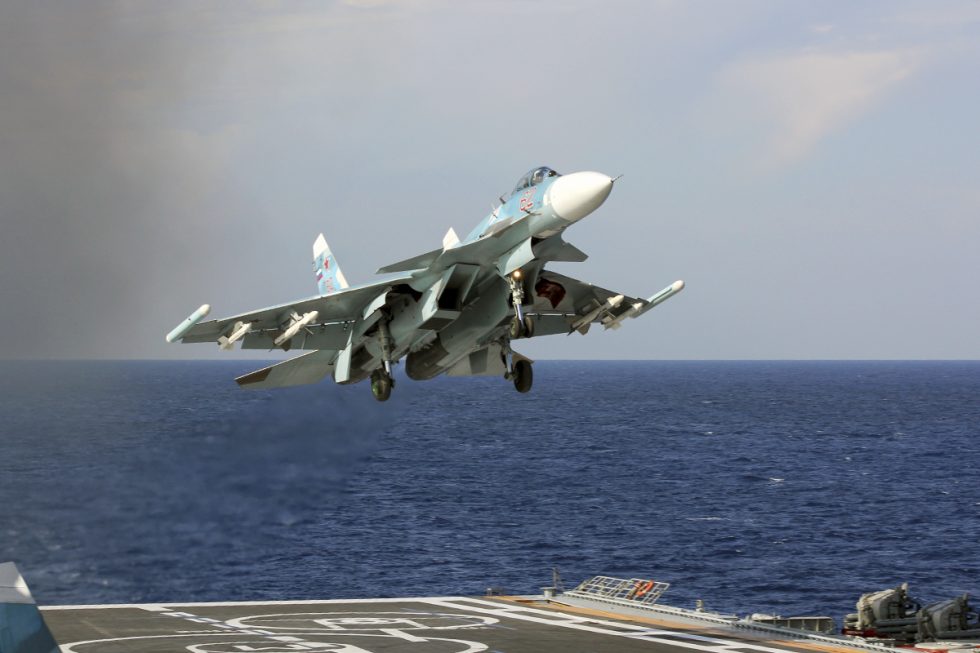
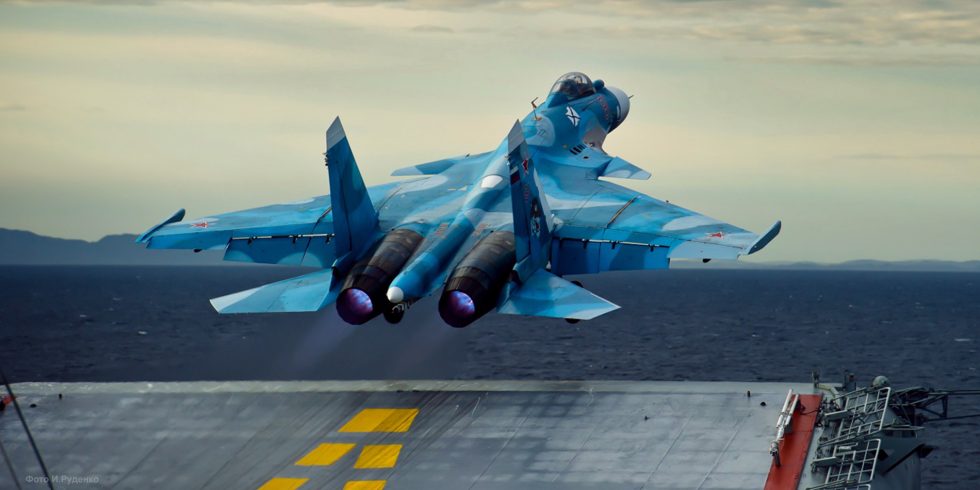
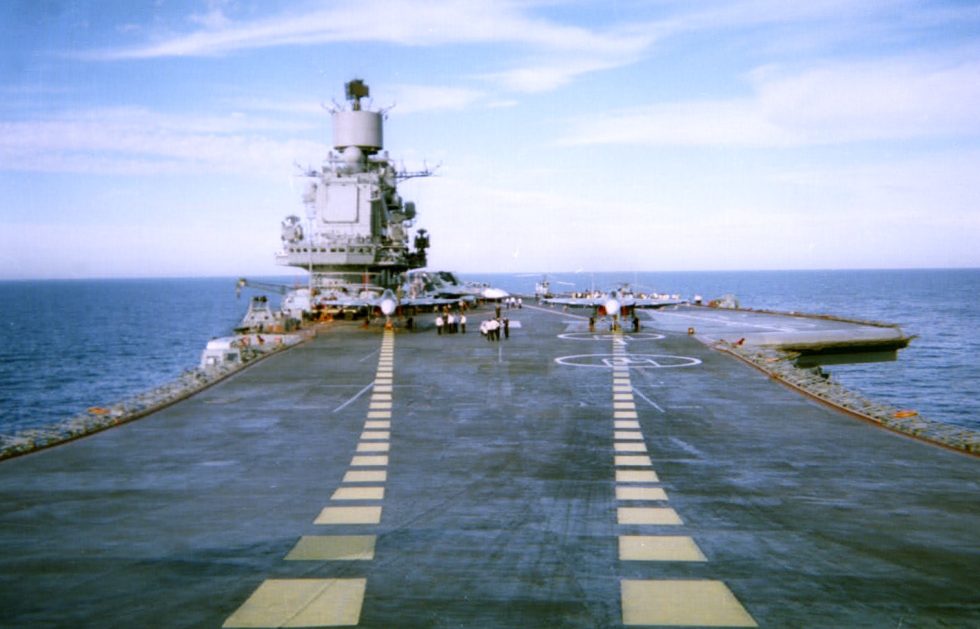
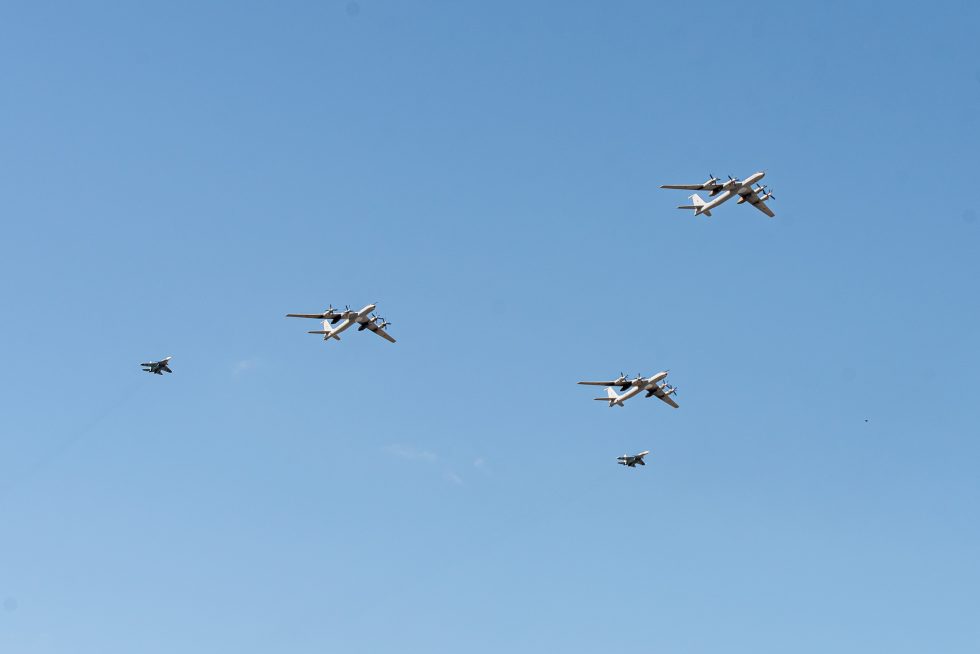
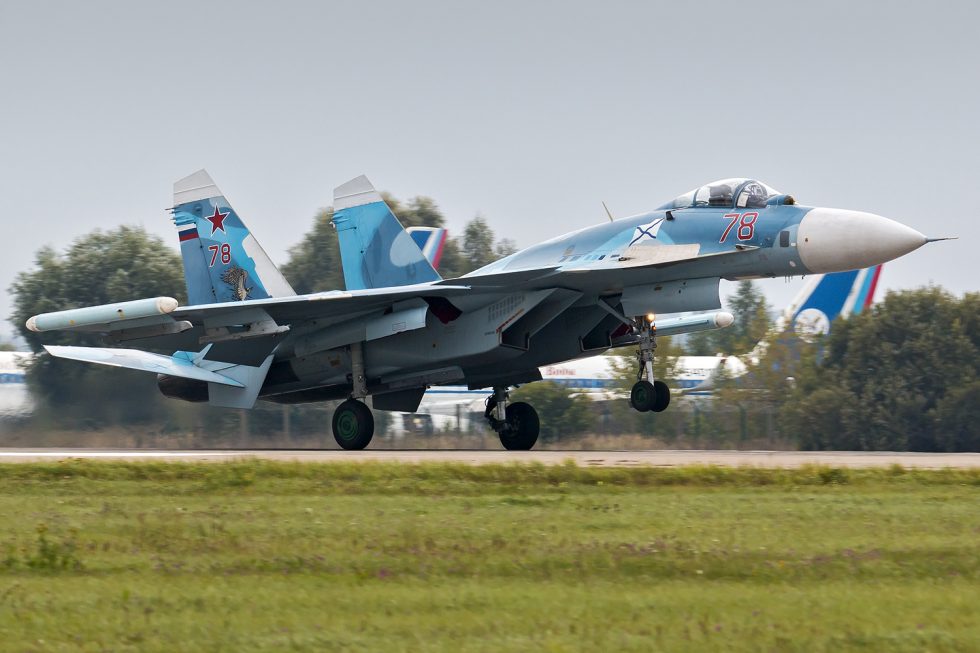
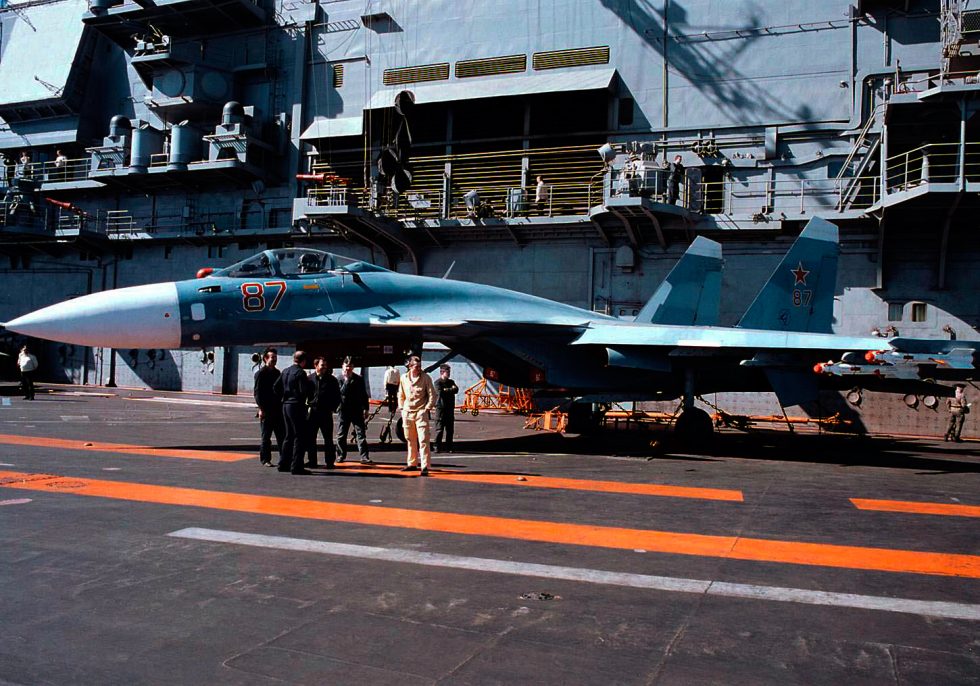
The Su-33 in motion
A hand-picked Su-33 video feature is coming soon. In the meantime, explore the photo gallery above and the stories from the deck of Admiral Kuznetsov.
The Su-33 in motion
yolkhere — one of the most-watched Su-33 films on YouTube.
Where the Su-33 flies
A brief, single deployment
The Su-33 has fought in only one campaign. During the 2016–17 Admiral Kuznetsov deployment off Syria, its jets flew the type’s first-ever combat missions, striking ground targets. It has no confirmed air-to-air combat record. These figures are best read as a record of a small fleet on a single, difficult cruise rather than a sustained combat history — and casualty and sortie claims from that deployment should be treated with caution.
Compare the combat record of every military aircraft. Figures as of July 2026.
Everything people ask about the Su-33
Can I fly in a Su-33?
What is the Su-33 and how is it different from the Su-27?
How does the Su-33 take off from a carrier without a catapult?
Is the Su-33 the same as the Chinese J-15?
How many Su-33s were built?
Did Russia lose a Su-33 in Syria?
Is the Su-33 still in service?
You can’t fly the Su-33.
These, you can.
Some legends only live in museums — others are fuelled and waiting. MiGFlug has put civilians in real military jet cockpits since 2004.
 Fly the L-39 AlbatrosThe world’s most-flown jet trainer — aerobatics included
 Fly the F-104 Starfighter“The missile with a man in it”
 Fly the MiG-21The Cold War’s most-produced jet
 Fly the T-33 Shooting StarAmerica’s first jet trainer
 Fly the DH VampireA piece of early jet history
 Fly the S.211Agile Italian jet trainer
 Fly the MB-326The classic Aermacchi jet
 Fly the MiG-15The Soviet legend of the Korean War
Continue the tour
Every fact, checked
- The AviationistContemporary reporting on the December 2016 arrestor-cable landing loss off Syria.
- USNI NewsUS Naval Institute coverage of the Kuznetsov carrier-fighter losses in 2016.
- The National InterestAnalysis of Su-33 production numbers, navalisation and STOBAR limitations.
- Global MilitaryReference specifications and operator summary for the Su-33 Flanker-D.
- Military FactoryAirframe dimensions, weights and armament reference data.
- TASSRussian official statement on the December 2016 carrier landing accident.
- Russia BeyondContext on Russian carrier operations and the 2016 deployment losses.