SEPECAT Jaguar — History, Specs & Stories

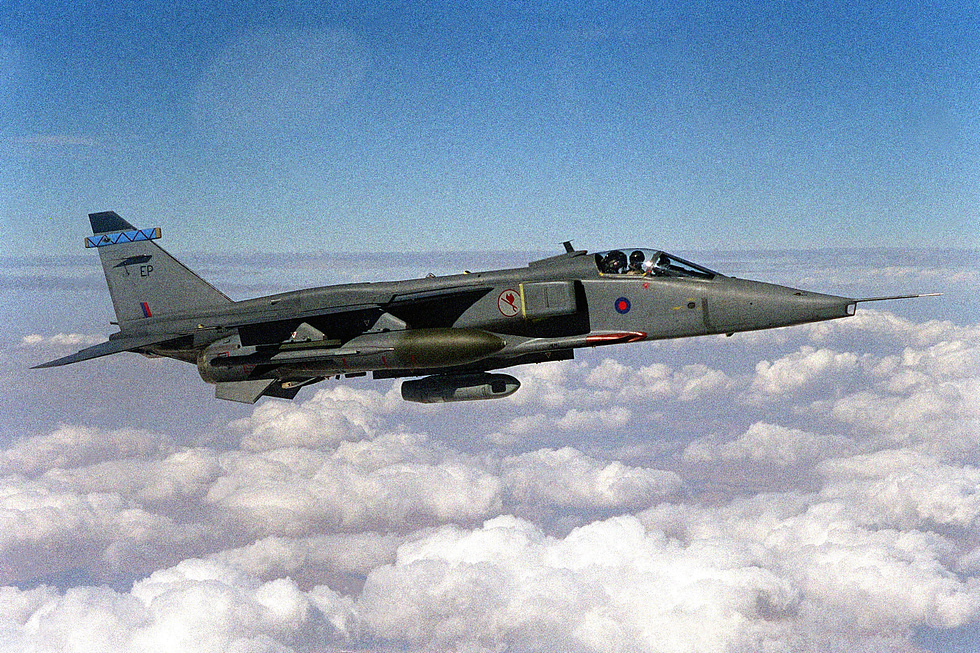
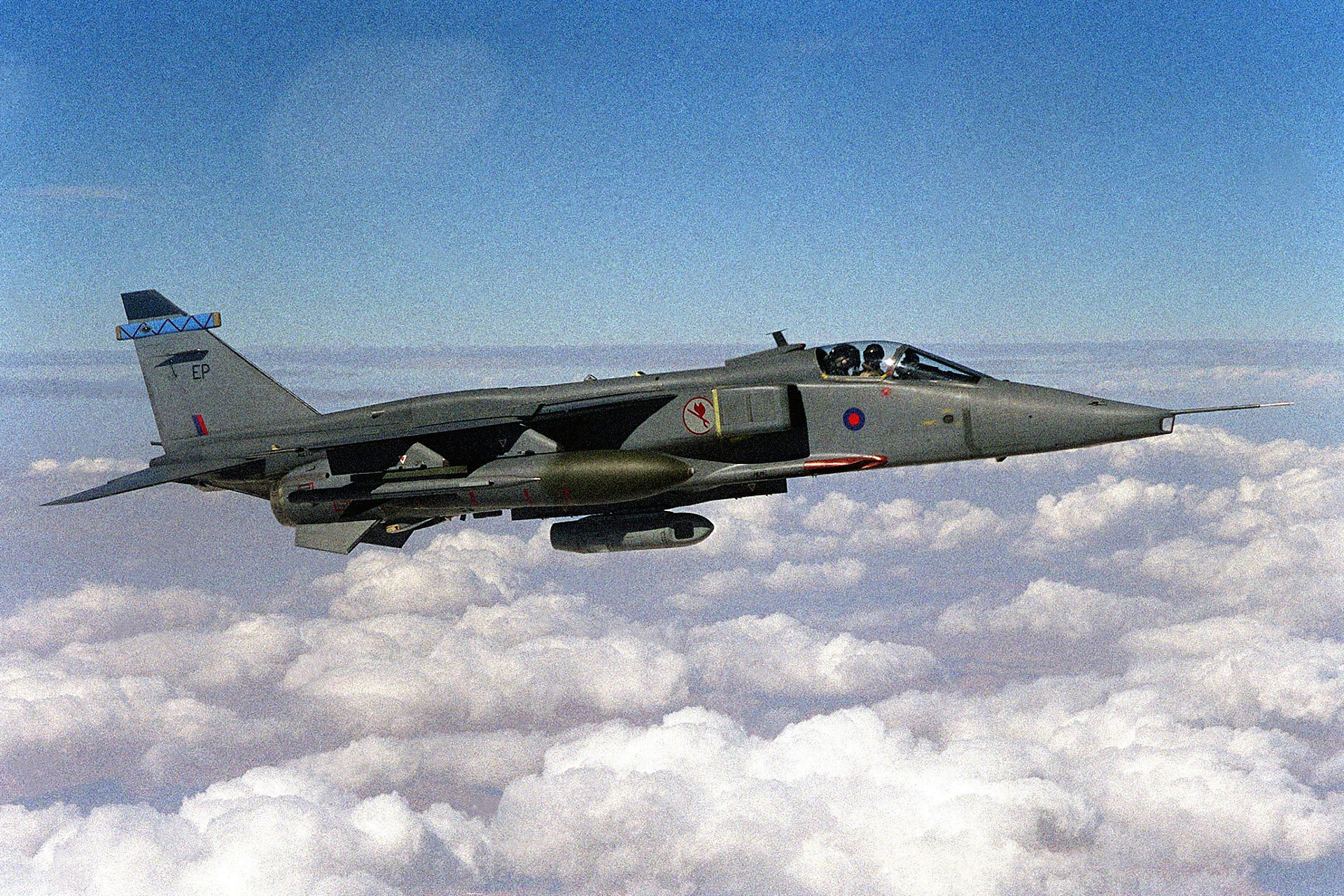
RAF SEPECAT Jaguar GR3 low-level strike jet in flight
Aircraft MuseumStrike & AttackJaguar

SEPECAT Jaguar
“Shamsher”

The Anglo-French strike jet built to sprint under the radar at treetop height with a nuclear or conventional load — a tough, no-nonsense workhorse still flying frontline missions in India half a century after its first flight.

Mach 1.6Top speed at altitude
~4,500 kgExternal ordnance load
~573Aircraft built · 1968–1981
1973–todayIn service · India still flies it
Photo: SMSgt. John Chapman · USAF · Public domain
RoleLow-level strike & ground attackEraCold War to presentEngine2 × Rolls-Royce/Turbomeca AdourOriginUK & France · SEPECATStatusIn service (India only)Fly a fighter jet yourself
The Story

How the Jaguar became an Anglo-French workhorse

The Jaguar was born of a compromise. In the mid-1960s Britain wanted a supersonic advanced trainer to replace the Gnat and Hunter, while France needed a cheap tactical strike aircraft after the exotic Mirage IIIV vertical-takeoff project collapsed. Rather than each pay for its own jet, the two governments merged their requirements and, in May 1966, created a joint company: SEPECAT — the Société Européenne de Production de l’Avion d’École de Combat et d’Appui Tactique — owned equally by Britain’s BAC and France’s Breguet.

What started as a trainer grew teeth. The requirement swelled to include supersonic performance, reconnaissance and even tactical nuclear strike, and the finished aircraft first flew on 8 September 1968. Breguet built the nose, centre fuselage and landing gear; BAC built the wings, tail and rear fuselage; and Rolls-Royce and Turbomeca jointly developed a brand-new engine, the Adour, for it. Both nations put it into squadron service in 1973.

The RAF and the French Air Force flew the Jaguar hard for three decades — over the Sahara, in the 1991 Gulf War and the Balkans — before retiring it in 2005 and 2007. But the type’s longest and largest career belongs to India, where Hindustan Aeronautics licence-built roughly 120 of them as the Shamsher (“Sword of Justice”). Repeatedly upgraded, India’s Jaguars remain a frontline deep-strike force well into the 2020s — the last of the breed still on active duty anywhere in the world.

A jet designed as a trainer that ended up carrying nuclear bombs — and outlived every rival on the low-level battlefield.The Jaguar paradox — humble brief, half-century career
01Why the Jaguar was an Anglo-French jet — and how the workshare actually worked

The 1965 Anglo-French memorandum that launched the Jaguar was one of the first serious European defence collaborations, and it set the template for later joint projects like the Tornado and Eurofighter. The industrial split was genuinely shared: Breguet (soon absorbed into Dassault) was responsible for the nose, centre fuselage and undercarriage, while BAC handled the intakes, wings, tail and rear fuselage. Two identical assembly lines ran in parallel — one in France, one at Warton in England — and the engine was itself a joint venture between Rolls-Royce and Turbomeca.

It was not a smooth marriage. The RAF’s demand for supersonic performance forced a heavy redesign of Breguet’s original subsonic baseline, engine development ran late, and early prototypes were lost to fires and undercarriage failures. But the collaboration held together, and the result was an aircraft neither country would have built as cheaply alone.


Design & Engineering

What makes the Jaguar special

01

Twin Adours for low-level penetration

The Jaguar was built to do one thing brilliantly: fly fast and very low, under enemy radar, to deliver ordnance on a target and get out. Its two Rolls-Royce/Turbomeca Adour afterburning turbofans gave it the punch for a high-subsonic dash on the deck, while a stable airframe and a moving-map nav-attack system let a single pilot navigate and bomb at 100 metres and 900 km/h. Early RAF jets were criticised as underpowered, and successive Adour marks (Mk.104, Mk.106) steadily added thrust.

02

Rugged gear for rough, short fields

Because NATO expected its runways to be cratered in a war, the Jaguar was engineered to operate from damaged strips and improvised sites. It rides on tough, high-flotation tandem-wheel main landing gear with big low-pressure tyres, and the airframe was stressed for short, hard landings. The point was famously proved in 1975 when an RAF Jaguar landed on the unfinished M55 motorway, was armed with four bombs, and took off again.

03

India’s DARIN upgrades and nuclear role

India kept the Jaguar relevant far longer than anyone expected by rebuilding its brain. HAL developed the indigenous DARIN (Display Attack and Ranging Inertial Navigation) suite, evolving through DARIN III with a modern multi-mode radar, new cockpit displays and precision weapons. Cleared for a tactical nuclear-strike role and later fitted with Israeli AESA radar and ASRAAM missiles, the Shamsher became a genuinely modern deep-strike platform on a 1960s airframe.

02The Jaguar’s rough-field promise — and how rarely it was used

Dispersed, austere operations were central to the Jaguar’s design brief: in a European war, front-line airfields were expected to be among the first targets, so a strike jet that could work from a stretch of motorway or a semi-prepared strip was hugely valuable. The famous M55 motorway landing of 1975 demonstrated the concept perfectly — land, rearm, relaunch from a public road. In practice, though, the RAF and other operators almost always flew the Jaguar from conventional bases, and the rough-field capability was rarely exercised operationally. It remained an insurance policy more than a routine, but it shaped the aircraft’s tough gear and simple systems.

03From NAVWASS to DARIN III: fifty years of upgrading the Jaguar

The Jaguar entered RAF service with an ambitious but unreliable NAVWASS nav-attack computer that was quickly replaced by inertial navigation. That set the pattern for the whole type: a sound airframe endlessly re-equipped. RAF jets gained laser designators and thermal imaging for the Balkans and Iraq; French Jaguars added laser and Atlis pods. India went furthest, with HAL’s DARIN family taking the aircraft from analogue to a glass cockpit, GPS-aided attack, a multi-mode radar in the DARIN III standard, the Israeli EL/M-2052 AESA radar on a portion of the fleet, and modern air-to-air missiles — keeping a Cold-War strike jet combat-credible into the 2020s.


Technical Data

Full Jaguar specifications

Baseline note: the figures below describe the SEPECAT Jaguar GR.1 as delivered to the Royal Air Force from 1973 — two Rolls-Royce Turbomeca Adour Mk 102 afterburning turbofans, the Marconi NAVWASS navigation and weapon-aiming system, and the Ferranti laser ranger and marked-target seeker in the chisel nose — and, from 1983, the same airframe re-fitted with the Ferranti FIN1064 inertial set as the GR.1A. It is the right baseline because the GR.1 is the aeroplane the whole argument was about. France asked for a cheap subsonic trainer with a light attack secondary role (ECAT, 1964); Britain asked for an advanced supersonic trainer (Air Staff Target 362); the two were welded together in the May 1965 memorandum of understanding, SEPECAT was formed in 1966, and then the RAF quietly converted its half of the buy into a nuclear-armed low-level strike aircraft without ever buying it an engine sized for the new job. Everything good and everything bad about the Jaguar follows from that substitution. Deltas for the GR.3/GR.3A with the Adour Mk 106, the French Jaguar A/E, the export Jaguar International for Oman, Ecuador and Nigeria, and the Indian HAL Jaguar (Shamsher) with its DARIN upgrades are in grey. All figures were checked against published sources on 3 September 2026. Six cautions before any number on this page is reused. First, and it governs everything else: the Jaguar family contains a thrust spread of roughly fifteen per cent, and most published tables do not say which engine they mean. The Adour Mk 102 gives 7,305 lbf in reheat; the Mk 104 about 8,040 lbf; the Mk 106 of the GR.3A 8,430 lbf; the Mk 811 built under licence by HAL 8,400 lbf. A performance table that does not name the mark is an average of aeroplanes rather than an aeroplane. Second, length. 16.83 m (55 ft 3 in) is the figure with the nose probe fitted; 15.52 m (50 ft 11 in) is the airframe without it; the two-seat E, T.2, T.4 and IB are 17.53 m (57 ft 6 in). All three numbers circulate as "the" Jaguar length and all three are correct about something different. Third, Mach 1.6. That is a clean aeroplane, no stores, no tanks, at 11,000 m, which is a condition an operational Jaguar essentially never saw. The type spent its career at 250 ft and 450 kt with two 1,200-litre tanks, an ECM pod and a bomb load, where it is comfortably subsonic and, in reheat, drinking fuel faster than it can usefully spend it. Printing Mach 1.6 next to a strike radius describes two aircraft that never met. Fourth, the 7,000 kg empty weight is a round, typical figure that varies by mark and fit; it should not be differenced against the maximum take-off weight to derive a payload. Fifth, the 4,500 kg (10,000 lb) external load is pylon-rating arithmetic. With full internal fuel and a war load the Jaguar was take-off-limited, and in the heat and altitude where it actually fought — Chad, Oman, the Indian plains in summer — noticeably so. This is the underpowering story in one line: the airframe had the hardpoints, the engines did not have the surplus. Sixth, production totals. Adding the current per-variant figures gives 403 Anglo-French aircraft, 94 new-build export airframes and roughly 128 credited to HAL, which lands near 635 with prototypes; the total most often printed elsewhere is 543. The gap is almost entirely a question of whether Indian kit assembly is counted as manufacture, and it is not resolvable from open sources.

Dimensions & weights

Crew
1 (two in the Jaguar E, B/T.2, T.4 and Indian IB)
Length, probe fitted
16.83 m (55 ft 3 in)
Length, probe removed
15.52 m (50 ft 11 in); two-seaters 17.53 m (57 ft 6 in)
Wingspan
8.69 m (28 ft 6 in)
Height
4.89 m (16 ft 1 in)
Wing area
24.18 m² (260.3 sq ft)
Empty weight
7,000 kg (15,432 lb), typical
Typical mission weight
10,954 kg (24,150 lb), clean with full internal fuel
Max take-off weight
15,700 kg (34,613 lb)
Internal fuel
~4,200 litres (924 imp gal / 1,110 US gal), about 3,340 kg (7,360 lb)
External fuel
up to three 1,200-litre tanks (264 imp gal each)
Max external stores
~4,500 kg (10,000 lb) across all stations; a rating, not a mission load
Hardpoints
five (four underwing, one centreline), plus two overwing rails on RAF, Omani, Ecuadorian and Indian aircraft; French Jaguar A were never modified for them
Design load factor
+8.6 g (ultimate +12 g)

Performance

Max speed, altitude
1,699 km/h (1,056 mph, 917 kt) at 11,000 m — Mach 1.6, clean
Max speed, sea level
1,350 km/h (839 mph, 729 kt) — Mach 1.1
Operational low-level speed
780–890 km/h (420–480 kt) at 250 ft — the band the aeroplane actually worked in
Time to 9,145 m
1 min 30 s (to 30,000 ft)
Service ceiling
14,000 m (45,900 ft)
Combat radius, hi-lo-hi
~815 km (506 mi, 440 nmi)
Combat radius, lo-lo-lo
~575 km (357 mi, 310 nmi)
Ferry range
3,524 km (2,190 mi, 1,903 nmi) with external tanks
Take-off run
580 m (1,900 ft)
Landing run
470 m (1,540 ft), brake parachute streamed
Thrust-to-weight
0.61 at typical mission weight (0.42 at maximum take-off weight, Adour Mk 102 in reheat)
Wing loading
453 kg/m² (92.8 lb/sq ft) typical; 649 kg/m² (133 lb/sq ft) at maximum weight

Propulsion & systems

Engines
two Rolls-Royce Turbomeca Adour Mk 102 afterburning turbofans — the first Anglo-French engine, and its first flight was the Jaguar’s first flight, 8 September 1968
Thrust, dry
22.75 kN (5,115 lbf) each
Thrust, reheat
32.5 kN (7,305 lbf) each
Other marks
Mk 101 (early Jaguar A, no modulated reheat); Mk 104 (RAF, 1981) about 8,040 lbf; Mk 106 (GR.3A, 1999) 26.7 kN / 6,000 lbf dry and 37.5 kN / 8,430 lbf reheat; Mk 804 (Oman, Ecuador, first Indian batch) 35.6 kN / 8,000 lbf; Mk 811 (HAL production) 37.4 kN / 8,400 lbf
Engine size
2.90 m long, 0.57 m diameter, 809 kg dry (114 in, 22.3 in, 1,784 lb — Mk 106 figures); bypass ratio about 0.8
Navigation and attack
Marconi NAVWASS with projected moving map — replaced by the Ferranti FIN1064 in the GR.1A from 1983; GPS and TERPROM terrain-referenced navigation on the GR.3; India’s indigenous DARIN I, II and III
Sensors
Ferranti LRMTS laser ranger and marked-target seeker in the chisel nose; Marconi ARI.18223 radar warning receiver in the fin
Radar
none as built — the Jaguar was a visual and inertial bomber. Thomson-CSF Agave fitted to the Indian Jaguar IM for maritime strike; Israeli EL/M-2052 AESA on DARIN III, 54 built by HAL from 2021
Ejection seat
Martin-Baker Mk 9 rocket-assisted, zero-zero
Undercarriage
twin-wheel main units on long-stroke oleos with low-pressure tyres, sized for semi-prepared strips; brake parachute standard — in April 1975 a Jaguar flew repeated take-offs and landings from the unopened M55 motorway, the last with a full weapons load. The capability was never used operationally
Refuelling
detachable in-flight refuelling probe on the starboard nose
Nuclear
one WE.177 (RAF Germany, declared to SACEUR from 1975) or one AN-52 (France; never assigned to the Force de frappe and withdrawn in September 1991)
Reconnaissance
centreline BAe reconnaissance pod — replaced on the GR.3A by the EO GP1 digital pod; Indian aircraft carry Israeli Litening pods
04What did a Jaguar cost — and what does it cost India to keep flying?

Because the Jaguar was procured through several very different routes — direct Anglo-French government buys in the 1970s, export sales to Oman, Ecuador and Nigeria, and licence production in India — there is no single meaningful flyaway price for the type. Period figures put the 1970s unit cost in the low millions of pounds, but that is not directly comparable across decades and currencies. India’s continued operation of the fleet is driven less by purchase price than by sustainment: spares for a long-out-of-production aircraft are scarce, which is why India has bought retired Jaguars from Oman, Nigeria and elsewhere purely to cannibalise them for parts. Any precise dollar cost-per-flight-hour you see for the Jaguar should be treated as an estimate.


Armament & payload

The Jaguar carried two 30 mm cannon and a nominal 4,500 kg of stores, and its engines were the reason it rarely carried them

On paper the Jaguar is a well-armed aeroplane: a pair of belt-fed 30 mm revolver cannon, five pylons, overwing rails for self-defence missiles on most operators, and clearance for everything from a WE.177 nuclear bomb to a Sea Eagle anti-ship missile. In practice the Adour set the ceiling. A Jaguar leaving a hot runway with full internal fuel, two 1,200-litre tanks and an ECM pod had very little left to spend on ordnance, and crews traded fuel against bombs on almost every sortie. What the type did have was accuracy: the LRMTS and a good inertial set made it a precise low-level bomber years before precision was routine, and the RAF and the Armée de l’Air both used it as their sharpest instrument for pinpoint work. Weapon fits diverge sharply by operator and by decade — the RAF fired CRV7 and CBU-87 in 1991 because its own BL755 was a low-level weapon and the Gulf War was fought from medium level; France never fitted overwing rails at all; and India’s DARIN III aircraft carry a weapons suite that has almost nothing in common with a 1974 GR.1.

Gun

  • Two 30 mm ADEN Mk 4 revolver cannon in the lower forward fuselage on RAF aircraft, 150 rounds per gun
  • Two 30 mm DEFA 553 on French, Omani, Ecuadorian, Nigerian and Indian aircraft — same installation, different gun
  • The two-seaters carry only one cannon; the second bay is given up to the rear cockpit and its equipment
  • Gun aiming ran through the LRMTS and the nav/attack computer, which made the Jaguar a genuinely good strafing platform

Air-to-air

  • AIM-9G and later AIM-9L Sidewinder on overwing rails — an unusual fit, adopted because the underwing pylons were needed for strike stores; retro-fitted to RAF aircraft in the run-up to Operation Granby in 1990
  • Matra R.550 Magic and Magic 2 on French and Indian aircraft, carried underwing
  • ASRAAM is being integrated on the Indian fleet; the Ministry of Defence invited bids covering 74 aircraft in April 2026
  • Astra beyond-visual-range missiles have been displayed on Indian Jaguar overwing rails
  • This was always self-defence armament. The Jaguar has no air-to-air radar and was never intended to fight for air superiority; Ecuador used it for that role in 1995 only because it had nothing better free

Air-to-surface guided

  • Martel AS.37 anti-radiation missile — a French Jaguar killed a Libyan radar with one on 7 January 1987
  • AS.30L laser-guided missile, the French precision weapon of choice, cued by the ATLIS pod
  • Paveway II and Paveway III laser-guided bombs on RAF GR.1B and GR.3 aircraft, self-designated with TIALD
  • BAe Sea Eagle sea-skimming anti-ship missile on the Indian Jaguar IM, paired with the Agave radar
  • Rampage long-range supersonic stand-off missiles were fired by Indian Jaguars against Pakistani airbases in May 2025

Bombs

  • 1,000 lb Mk 13/18 free-fall and retarded bombs, the RAF staple
  • BL755 cluster bomb — a low-level weapon, which is precisely why it was useless over Iraq in 1991 and had to be replaced in theatre by the American CBU-87
  • Belouga cluster bombs and BAP-100 anti-runway munitions on French aircraft; eleven Jaguars used BAP-100 against Wadi Doum airfield in Chad on 16 February 1986
  • Durandal runway-cratering bombs
  • Nuclear: one WE.177 for RAF Germany squadrons declared to SACEUR from 1975, or one French AN-52

Rockets

  • Matra F2 and F4 pods with 68 mm SNEB rockets, the standard French and export fit
  • CRV7 70 mm rockets, adopted by the RAF for the Gulf War because their flat trajectory and long stand-off suited medium-level attack
  • Indian aircraft carry 68 mm rocket pods for the same close-support work
  • Rocketry mattered more to the Jaguar than to most contemporaries because unguided rockets are light, and light was the constraint

Pods & other stores

  • TIALD thermal-imaging airborne laser designator on RAF GR.1B and GR.3 aircraft, from 1995
  • ATLIS II designator pod on French Jaguar A
  • AN/ALQ-101 jamming pod and Phimat chaff dispenser, the RAF self-protection pair, plus AN/ALE-40 flare dispensers
  • Reconnaissance pods: the BAe centreline pod on the GR.1A, the EO GP1 digital pod on the GR.3A, Israeli Litening on Indian aircraft
  • Three 1,200-litre drop tanks, which on most operational sorties occupied the pylons that could otherwise have held bombs

Three typical loadouts

RAF Germany nuclear alert, Brüggen or Laarbruch, late 1970s
One WE.177 on the centreline, two 1,200-litre tanks on the inboard pylons, full ammunition for both ADEN. Profile: a low-level lay-down delivery against a fixed target in the Warsaw Pact rear, flown alone, at night, with the aircraft’s survival resting entirely on flying below the radar horizon. This is the mission a supersonic trainer requirement had turned into.
Operation Granby / Desert Storm, January–February 1991
Two CBU-87 cluster bombs or two CRV7 rocket pods, two overwing AIM-9L, an AN/ALQ-101 pod and a Phimat dispenser, two 1,200-litre tanks. Flown from Muharraq at medium level after the first week, with a hastily fitted GPS set to compensate for a navigation system designed in the 1960s. Twelve RAF Jaguars flew 612 combat sorties and lost nothing; French Jaguars flew 615 in the same campaign.
Indian Jaguar IS, DARIN III, 2020s
Litening targeting pod on the centreline, two laser-guided bombs or a Rampage stand-off missile underwing, two overwing air-to-air missiles, two drop tanks, EL/M-2052 AESA in the nose. The same airframe as the 1974 GR.1, with roughly fifty years of avionics grafted on and an engine that was already marginal when it was new.

Sourcing caveat: weapon clearances are not the same thing as weapons carried. Published Jaguar armament lists routinely merge RAF, French, Omani and Indian fits into one inventory, and add trials clearances that never reached a squadron. Where a weapon is named above it is because a specific operator is documented as having used or fielded it; anything that appears only as a manufacturer’s option has been left out. Maximum-load figures are pylon ratings and were never flown alongside full internal fuel.


Variants

The Jaguar was designed as a trainer, sold as a strike aircraft, and outlived both of its parent air forces in India

The Jaguar exists because two countries wanted different aeroplanes and agreed to build one. France’s 1964 ECAT requirement was for a cheap, subsonic, twin-engined trainer with a light attack sideline, based on the Breguet Br.121. Britain’s Air Staff Target 362 wanted an advanced supersonic trainer. The May 1965 memorandum of understanding merged them, SEPECAT was set up in 1966 as a Breguet–BAC joint venture, and Rolls-Royce and Turbomeca were told to produce an engine for it — the Adour, which first flew in the Jaguar prototype on 8 September 1968.

Then the requirement moved. The RAF decided it did not need a supersonic trainer after all — the Hawk covered that — and instead wanted a low-level strike and reconnaissance aircraft to replace the Phantom in Germany, with a nuclear role. Britain demanded better avionics, a laser nose and genuine supersonic performance, which turned the Breguet design into what amounted to a new aeroplane. What did not change proportionately was the engine. The Adour had been sized for a trainer; it was asked to lift a strike load, and it never quite caught up. Every subsequent Jaguar programme — the Mk 104, the Mk 106, the Mk 811, India’s abandoned attempt to fit the Honeywell F125IN — is an argument about the same shortfall.

What the compromise did produce was toughness. The Jaguar was built for dispersed operation from damaged or improvised strips, with long-stroke undercarriage, low-pressure tyres and widely separated engines, and it acquired a reputation for coming home from things that should have stopped it: French aircraft took ground fire over Chad and Kuwait and flew out of it, three of the twelve that struck Ahmad al-Jaber air base on 17 January 1991 were hit and all twelve returned, and the RAF finished the Gulf War with 612 sorties and no losses at all. That reputation, not the top speed, is what kept it selling and kept it flying.

Jaguar A (1973–2005 / 160 built plus 2 prototypes)
The French single-seat strike aircraft, simpler than the British version: no LRMTS on early airframes, no overwing rails ever, and a laser designator only when the ATLIS pod arrived. Cleared for the AN-52 nuclear bomb but never assigned to the strategic force.
Jaguar E (1972–2005 / 40 built plus 2 prototypes)
The French two-seat trainer — and, in a neat comment on the programme, the version closest to what was originally asked for. The first Jaguar to fly was an E prototype.
Jaguar M (1969–1973 / 1 prototype)
Navalised single-seater for the Aeronavale, with a strengthened structure, arrester hook and single main wheels. Cancelled in 1973 in favour of the cheaper Dassault Super Étendard — a rejection that says something about how much weight growth the Adour could absorb.
Jaguar S, GR.1 and GR.1A (1973–late 1990s / 165 built)
The RAF single-seater, and the baseline for this page. NAVWASS with a projected moving map and the LRMTS nose; from 1983 some 75 aircraft were re-fitted with the far more reliable Ferranti FIN1064 as the GR.1A. Nuclear-armed with the WE.177 in RAF Germany.
Jaguar B, T.2 and T.2A (1973–2007 / 38 built plus 1 prototype)
The RAF two-seat conversion trainer, retaining one cannon and a secondary strike capability. Ten GR.1A and two T.2A were given TIALD capability as GR.1B and T.2B for Bosnia.
Jaguar GR.3, GR.3A and T.4 (1997–2007 / rolling conversions)
The final RAF standard: new head-up display, hand controller, integrated GPS and TERPROM terrain-referenced navigation; the GR.3A added the EO GP1 digital reconnaissance pod, a helmet-mounted display, a datalink, night-vision-goggle compatibility, and the Adour Mk 106. The aeroplane the Jaguar should probably always have been, arriving twenty-three years late and withdrawn ten years later.
Jaguar International (1976–1985 / 94 new-build)
The export line, built on the S and B airframes with the more powerful Adour Mk 804 and later Mk 811, overwing missile rails and an optional Agave radar. Oman took 10 OS and 2 OB delivered from March 1977 and a second batch of twelve in the mid-1980s; Ecuador 10 ES and 2 EB from January 1977, later topped up with three ex-RAF GR.1s; Nigeria 13 SN and 5 BN from May 1984. Nigeria withdrew the whole fleet in 1991 as an economy measure and never flew them again — the shortest and least happy Jaguar career of any operator. Ecuador flew hers in ground attack, and briefly in air defence, during the 1995 Cenepa war with Peru. Oman retired her last four on 6 August 2014.
Jaguar ACT demonstrator (1981–1984 / 1 converted)
A single airframe rebuilt with a quadruplex digital fly-by-wire system and no mechanical reversion at all, first flown on 20 October 1981 — the first aircraft in the world to fly in that configuration, and the direct technical ancestor of the Eurofighter Typhoon’s flight controls. The Jaguar’s most important legacy is arguably this, not anything it dropped.
Jaguar IS, IB and IM "Shamsher" (1979–present / 40 UK-built plus ~128 by HAL)
India leased 18 ex-RAF aircraft as a stopgap from July 1979, bought 35 IS and 5 IB from BAe, and began licence production at Hindustan Aeronautics in May 1981. The name means "sword of justice". The IM is a dedicated maritime striker with the Agave radar and Sea Eagle missiles. Indian Jaguars flew reconnaissance over Sri Lanka from 1987, struck Pakistani positions in the 1999 Kargil war, and fired Rampage missiles at Pakistani airbases in May 2025.
DARIN I, II and III (1980s–present / rolling upgrade)
India’s indigenous Display Attack and Ranging Inertial Navigation suite, developed because no one else was going to keep a 1960s design current for fifty years. DARIN III brought a glass cockpit, a new mission computer and the Israeli EL/M-2052 AESA radar, 54 of which HAL built from 2021. The one thing India could not fix was the engine: a re-engining with the Honeywell F125IN was studied at length and dropped on cost, leaving the fleet on Adour Mk 811s that are out of production and sustained by cannibalisation.

Closing note on today’s fleet, checked 3 September 2026. India is the only remaining Jaguar operator anywhere — France retired hers on 1 July 2005, the RAF on 30 April 2007 with five days’ notice, Nigeria in 1991, Oman on 6 August 2014, and Ecuador some years earlier. The Indian Air Force holds roughly 115 to 120 airframes across six squadrons: No. 5 "Tuskers" and No. 14 "Bulls" at Ambala, No. 16 "Cobras" and No. 27 "Flaming Arrows" at Gorakhpur, and No. 6 "Dragons" and No. 224 "Warlords" at Jamnagar; a widely reproduced inventory figure of 139 is stale and includes airframes long since written off or reduced to spares. About 60 aircraft have been brought to DARIN III. The announced plan retires the oldest 60 airframes between 2028 and 2031, with the DARIN III aircraft running on into the early-to-mid 2030s as Tejas Mk1A and Mk2 deliveries allow; the Mirage 2000 fleet is being extended to about 2038–2039 partly to cover the gap. Sustainment is now openly scavenging: 31 ex-French airframes were bought and cannibalised in 2018, 20 ex-Omani aircraft were acquired in December 2025, and nine more ex-RAF airframes were ordered in June 2026, all for spares. Because a single-operator chart is not worth drawing, no operators-today bar chart is published for this type; the numbers above are the whole picture. They come from Indian defence reporting of March 2026 and should be treated as approximate — the IAF does not publish serviceable-airframe counts.


Timeline

From joint trainer to last strike jet standing

1965

Anglo-French deal

Britain and France sign a memorandum to jointly develop a combined trainer and tactical strike aircraft.

1966

SEPECAT formed

BAC and Breguet create the joint company SEPECAT in May to build the aircraft, splitting the workshare.

1968

First flight

The prototype E.01 flies on 8 September; the British single-seat prototype goes supersonic on its first flight in 1969.

1973

Enters service

The Jaguar joins both the French Air Force and, from May, the RAF as a low-level strike and reconnaissance aircraft.

1977

First shots & first exports

French Jaguars see combat over Mauritania; Ecuador and Oman receive their first export aircraft.

1979–81

India’s Shamsher

India begins operating loaned RAF Jaguars, then licence-builds them at HAL as the Shamsher deep-strike fighter.

1991

Gulf War

RAF and French Jaguars fly hundreds of strike sorties in Desert Storm, praised for reliability and taking no combat losses.

1999

Kargil

Indian Jaguars fly deep-penetration reconnaissance and strike missions over the Kargil heights against Pakistani positions.

2005–07

Europe bows out

France retires the Jaguar in 2005 and the RAF follows in April 2007, ending 34 years of European service.

2020s

India flies on

Upgraded to DARIN III with AESA radar and new missiles, India’s Jaguars remain frontline, with phased retirement planned from around 2027–2031.


Stories & Eyewitnesses

Twelve stories from the Jaguar’s career

Origins

A trainer that grew teeth

Britain wanted a trainer, France wanted a striker — the compromise became a nuclear-capable attack jet.

Read the full story
The Jaguar exists because two countries wouldn’t pay for two aircraft. Britain needed a supersonic trainer; France needed a cheap tactical striker. Merging the requirements produced a jet far more capable than either brief — supersonic, reconnaissance-capable and cleared to carry tactical nuclear weapons. What began as an economy measure became one of the Cold War’s hardest-working strike aircraft, and the template for later European collaboration on the Tornado and Eurofighter.
Engineering

The M55 motorway landing

In 1975 an RAF Jaguar landed on an unfinished motorway, was bombed up, and took off again.

Read the full story
To prove the Jaguar could fight from bombed-out airfields, in 1975 the RAF landed a GR.1 on a not-quite-finished stretch of the M55 motorway near Blackpool, had it armed with four bombs, and flew it off again. It was a vivid demonstration of the dispersed-operations philosophy baked into the design — tough landing gear, simple systems, short-field performance. In reality the capability was rarely used operationally, but it captured exactly what the aircraft was built to survive.
Consortium

Two countries, one aeroplane

Breguet built the front, BAC built the back, and Rolls-Royce and Turbomeca jointly built the engine.

Read the full story
The Jaguar was genuinely shared. Breguet was responsible for the nose, centre fuselage and undercarriage; BAC for the wings, tail, intakes and rear fuselage. Two identical production lines ran in France and England, and even the engine — the Adour — was a joint venture between Rolls-Royce and Turbomeca. It was one of the first big Anglo-French defence programmes, and despite friction over the supersonic redesign and late engines, it held together and delivered.
Combat · 1977

Debut over the Sahara

French Jaguars first fired in anger against Polisario columns in Mauritania.

Read the full story
The Jaguar’s combat debut came in December 1977, when French Air Force jets struck Polisario Front forces during Operation Lamantin in Mauritania. It was the start of a long African career for the French Jaguar, which would go on to fight repeatedly in Chad against Libyan-backed forces through the 1980s — including the 1986 raid on the Wadi Doum airfield — establishing the type as France’s go-to-expeditionary strike aircraft.
Combat · 1991

Gulf War workhorse

RAF and French Jaguars flew hundreds of Desert Storm sorties without a single combat loss.

Read the full story
In the 1991 Gulf War the Jaguar proved its worth as a reliable, rugged bomb-truck. RAF Jaguars flew more than 600 sorties and the French flew a similar number, hitting airfields, artillery, ships and Silkworm missile sites. Despite operating in a dense air-defence environment, not one was lost to enemy action — a tribute to low-level tactics and the aircraft’s toughness. One RAF jet, “Sadman,” flew 47 missions, the most of any RAF aircraft in the war.
India

Enter the Shamsher

India licence-built the Jaguar as the “Sword of Justice” — and never let it go.

Read the full story
India selected the Jaguar in 1978 and named it Shamsher, meaning “Sword of Justice.” After operating loaned RAF jets from 1979, Hindustan Aeronautics built roughly 120 under licence. India became by far the largest and most committed operator, developing maritime-strike and reconnaissance versions and a domestic upgrade path that would keep the aircraft flying long after every other air force had given up on it.
Combat · 1999

Eyes over Kargil

Indian Jaguars flew deep reconnaissance and precision strikes during the 1999 Kargil War.

Read the full story
During the 1999 Kargil conflict, IAF Jaguars were used as deep-penetration reconnaissance and strike aircraft, photographing and bombing Pakistani positions dug into the high Himalayan ridgelines. The type’s long range, steady low-level ride and growing precision-weapons capability made it a natural fit for the mission, cementing its reputation in Indian service as the air force’s dedicated deep-strike platform.
Nuclear

The bomb the Jaguar almost carried

Both France and India cleared the Jaguar for a tactical nuclear-strike role.

Read the full story
From the start the Jaguar’s brief included tactical nuclear delivery. French Jaguar A aircraft were assigned a nuclear-strike role with the AN-52 bomb, and India cleared its Jaguars as part of its nuclear-capable strike force. In practice the aircraft’s limited ground clearance made a large gravity nuclear weapon awkward to carry, and India chose not to develop a dedicated nuclear variant — but the capability was real and central to the type’s Cold-War purpose.
Export

Jaguars in the desert and the Andes

Oman, Ecuador and Nigeria all flew the Jaguar — and Ecuador took it to war.

Read the full story
Beyond the four core operators, the Jaguar found export homes. Oman bought 24 and flew them from 1977 to 2014. Nigeria received 18 in the mid-1980s but withdrew them by 1991 for economic reasons. Ecuador operated a small fleet from 1977 and actually used it in combat during the 1995 Cenepa War against Peru — the only South American operator to take the Jaguar into battle.
Design

Why it flew so low so well

A stable airframe and a moving-map attack system made the Jaguar a superb low-level bomber.

Read the full story
The Jaguar was optimised for the most dangerous flying in the strike business: fast and very low, hugging terrain to stay under radar. A relatively stable airframe, good ride quality in turbulence and an integrated nav-attack system let a single pilot navigate precisely and deliver weapons at around 100 metres altitude and near the speed of sound. It was never a dogfighter — it was a delivery system, and on the deck it was one of the best of its generation.
Longevity

The last Jaguars flying

Every operator retired the Jaguar except India, which is still upgrading it.

Read the full story
France retired the Jaguar in 2005, the RAF in 2007, Ecuador in 2006 and Oman in 2014. Only India kept faith. Through the DARIN upgrade programme — culminating in DARIN III with an AESA radar, modern cockpit and new weapons — India turned a 1960s design into a credible 21st-century strike aircraft. As of the mid-2020s the IAF remains the sole operator, with retirement now planned in phases toward the end of the decade.
Legacy

The collaboration that led to Tornado

The Jaguar proved multinational fighter programmes could work.

Read the full story
For all its awkward birth, the Jaguar showed that Britain, France and their industries could jointly design, build and field a successful combat aircraft. That lesson fed directly into the multinational Panavia Tornado and, later, the Eurofighter Typhoon. The Jaguar’s deep-strike role in RAF service was itself handed to the Tornado — but the collaborative model it pioneered outlasted the aircraft by decades.

Gallery

The Jaguar in pictures

An RAF Jaguar GR3 in flight  the low-level strike jet in its element.
An RAF Jaguar GR3 in flight — the low-level strike jet in its element.Photo: SMSgt. John Chapman · USAF · Public domain
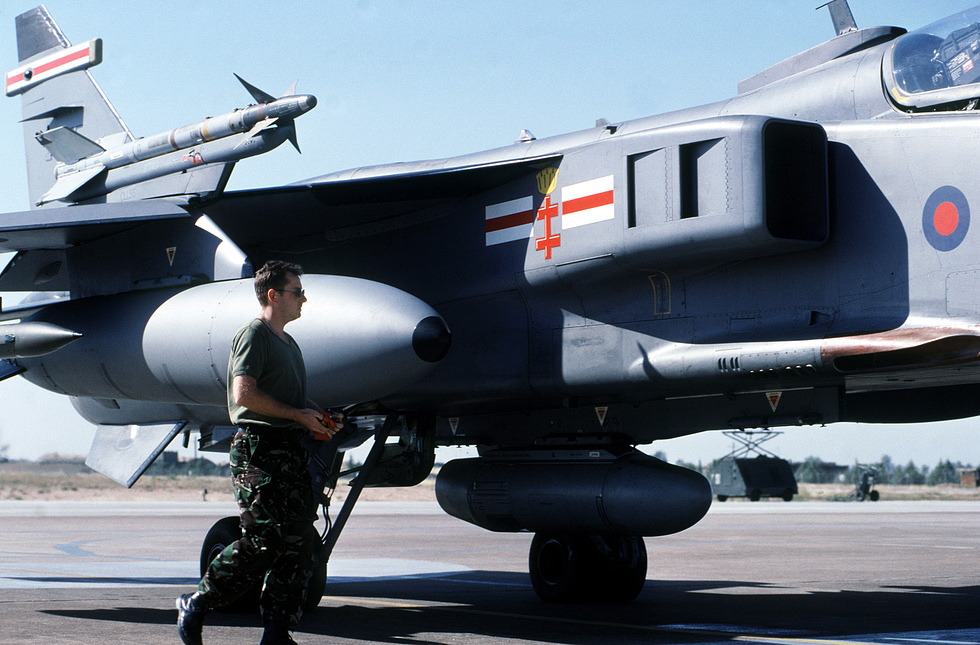
A Jaguar GR3 of No. 41 Squadron RAF, the types reconnaissance and strike unit.
A Jaguar GR3 of No. 41 Squadron RAF, the type’s reconnaissance and strike unit.Photo: SSgt. Vince Parker · USAF · Public domain
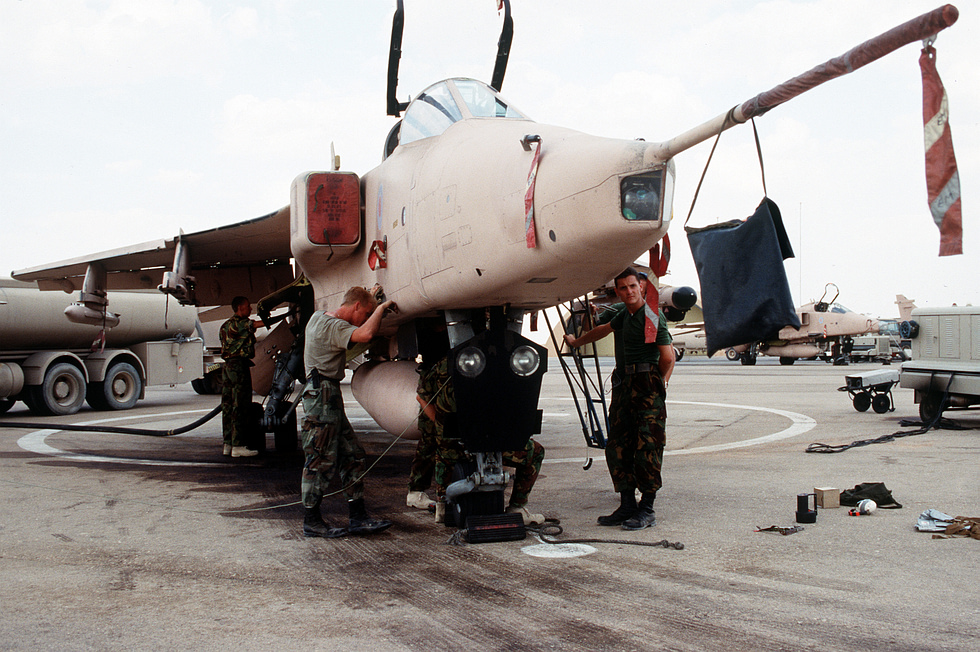
An RAF Jaguar GR1 refuelling during the 1991 Gulf War  hundreds of sorties, no losses.
An RAF Jaguar GR1 refuelling during the 1991 Gulf War — hundreds of sorties, no losses.Photo: TSgt. Rose S. Reynolds · USAF · Public domain
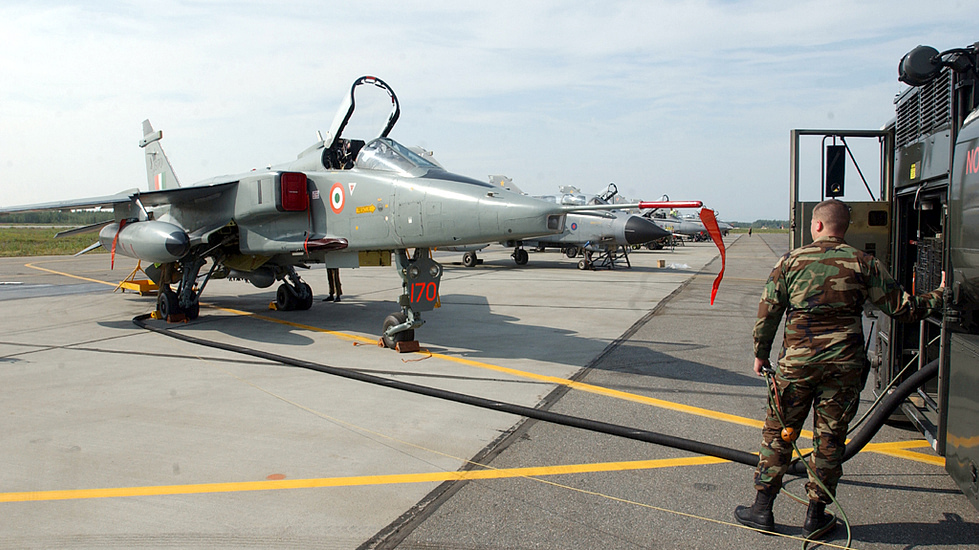
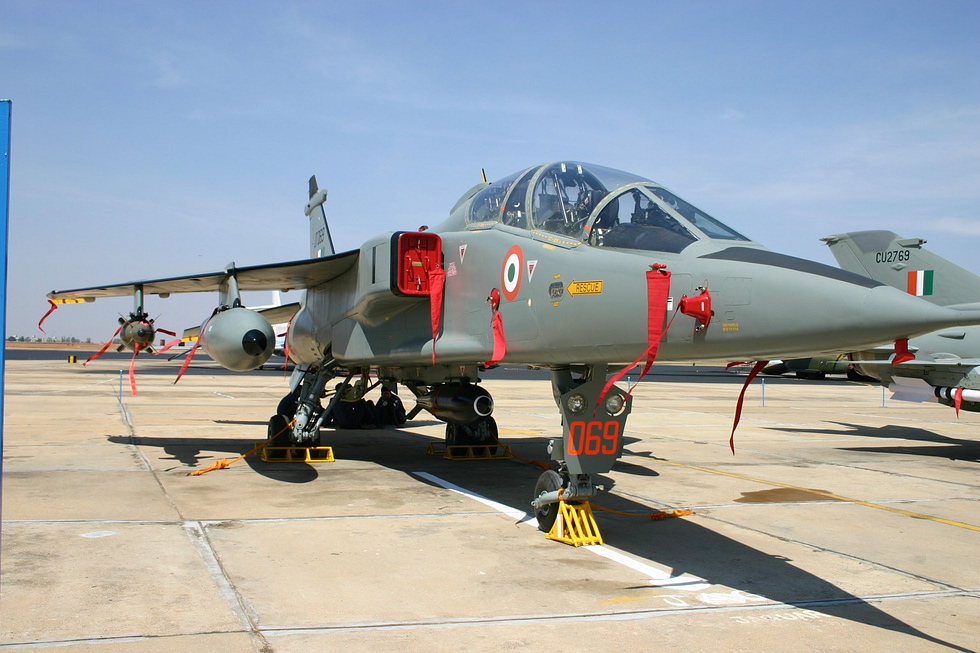
An Indian Air Force Jaguar  the Shamsher, still frontline half a century on.
An Indian Air Force Jaguar — the Shamsher, still frontline half a century on.Photo: SrA Joshua Strang · USAF · Public domain
An IAF Jaguar in flight, wearing Indias deep-strike camouflage.
An IAF Jaguar in flight, wearing India’s deep-strike camouflage.Photo: Aeroprints.com · CC BY-SA 3.0
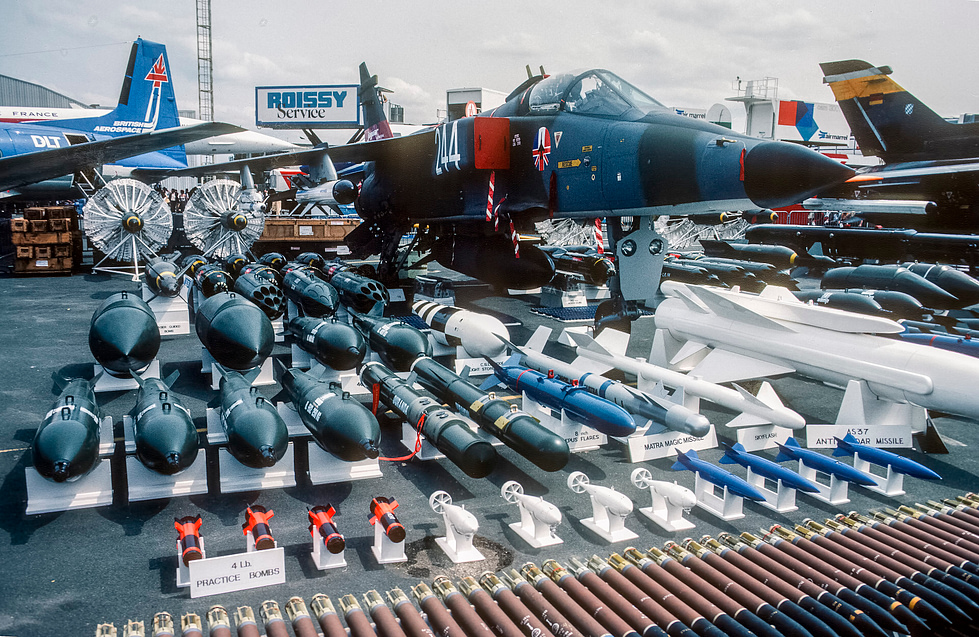
A Jaguar on display at the 1981 Paris Air Show, early in its European career.
A Jaguar on display at the 1981 Paris Air Show, early in its European career.Photo: Acroterion · CC BY-SA 4.0

Watch

The Jaguar in motion

DroneScapes — one of the most-watched Jaguar films on YouTube.


Operations

Where the Jaguar served


Combat Record

The Jaguar in action

The Jaguar was never an air-superiority fighter and has no meaningful air-to-air tally — its job was to hit ground targets and come home. Judged on that mission it delivered for decades, from the Sahara to the Himalayas, and its most striking statistic is how little it lost.

0RAF Jaguars lost to enemy action in the 1991 Gulf War
1,200+Allied Jaguar strike sorties flown in Desert Storm
50+ yrsContinuous frontline service, still ongoing in India

Compare the combat record of every military aircraft. Figures as of July 2026.


Questions & Answers

Everything people ask about the SEPECAT Jaguar

Can I fly in a Jaguar?
No — the Jaguar is a single-seat military strike aircraft (with two-seat trainers), and there are no public passenger or ride experiences in one. The type is only still flown by the Indian Air Force. You can, however, fly in several genuine military jets today — see migflug.com/flights-prices/.
Why is it called an Anglo-French aircraft?
Because Britain and France designed and built it together. The joint company SEPECAT, owned by Britain’s BAC and France’s Breguet, produced the Jaguar from 1966, with the work and the assembly lines split between the two countries and the engine a Rolls-Royce/Turbomeca joint venture.
How fast is the Jaguar?
Its top speed is about Mach 1.6 at altitude. But the Jaguar was built to fight low and fast, and it spent most of its working life near the ground at high subsonic speed, not chasing its maximum Mach number.
Is the Jaguar still in service?
Yes, but only in India. France retired its Jaguars in 2005 and the RAF in 2007; Ecuador and Oman followed. India’s upgraded Shamsher fleet remains frontline into the 2020s, with a phased retirement planned from around 2027 onward.
What does “Shamsher” mean?
Shamsher is the Indian Air Force name for its Jaguars and means “Sword of Justice” (from a Persian word for a curved sword). India licence-built roughly 120 of them at Hindustan Aeronautics.
Could the Jaguar carry nuclear weapons?
Yes. Tactical nuclear strike was part of its brief from the outset. French Jaguars were assigned a nuclear role with the AN-52 bomb, and India cleared its Jaguars as part of its nuclear-capable strike force, though no dedicated Indian nuclear variant was developed.
Did the Jaguar ever see combat?
Extensively — but almost entirely air-to-ground. French Jaguars fought in Mauritania and Chad, RAF and French Jaguars flew hundreds of sorties in the 1991 Gulf War and the Balkans, Ecuador used it against Peru in 1995, and India flew it in the 1999 Kargil War.
What replaced the Jaguar in the RAF?
Its deep-strike role passed largely to the swing-wing Panavia Tornado — itself another multinational programme that the Jaguar’s collaboration helped make possible.

Sources & Further Reading

Every fact, checked