
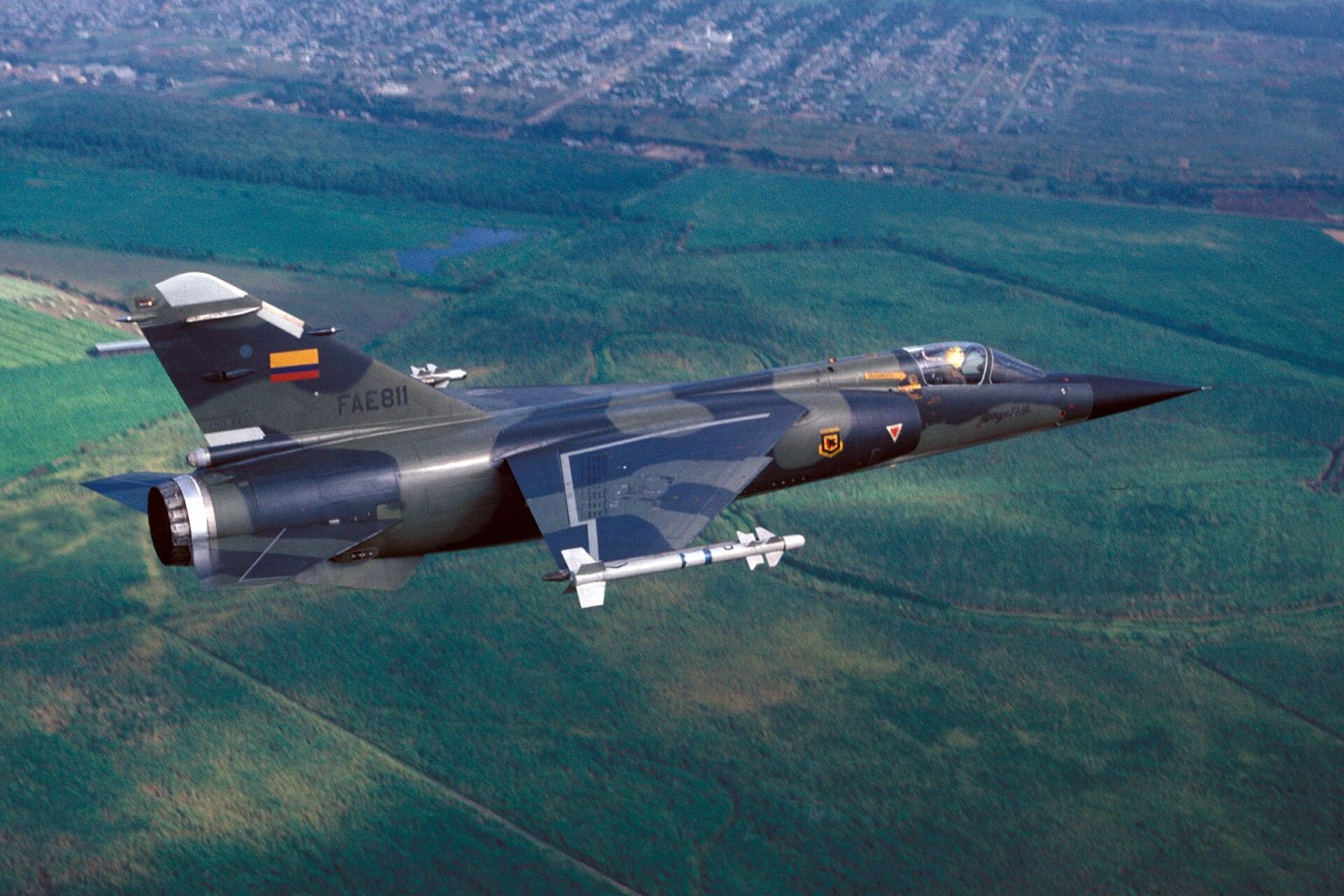
Dassault Mirage F1
The swept-wing Mirage
France’s answer to a problem its own delta had created — a rugged, short-field multirole fighter that traded the Mirage III’s delta for a swept wing, then went on to fight on three continents and outsell almost every rival in its class.
The Mirage that gave up the delta
The Dassault Mirage III made France a fighter superpower — but its tailless delta wing came with a price. Deltas are wonderful at high speed and altitude, yet they bleed energy in hard turns and land fast, needing long runways. As air forces looked past the III in the early 1960s, they wanted a machine that could still hit Mach 2 but also operate from shorter, rougher strips and turn with an enemy at lower speed.
Dassault’s answer, developed largely as a private venture from the mid-1960s, was the Mirage F1: outwardly a Mirage, but with a conventional high-mounted swept wing fitted with leading-edge slats and double-slotted flaps. The new wing dramatically improved low-speed handling and field performance, cut approach speed to around 125 knots, and — being thinner and carrying more internal fuel — gave the F1 markedly better range than the delta III on the same class of engine.
The prototype first flew on 23 December 1966. It was lost to flutter in 1967, but the programme survived; production aircraft flew from 1973 and reached the French Air Force in 1974. Powered by the SNECMA Atar 9K-50 and carrying the Thomson-CSF Cyrano radar, the F1 became one of the great export fighters of its era — roughly 720 were built and sold to a dozen air forces from South America to the Middle East and southern Africa.
01Why Dassault abandoned the delta for the Mirage F1
The delta wing that defined the Mirage III was chosen for simplicity and high-speed performance, but it forced compromises: high induced drag in manoeuvre, a fast landing approach, and a long take-off run. For a new generation of multirole and interception work, Dassault and the French Air Force wanted better sustained turn performance and the ability to use shorter runways.
The company studied several layouts — including the larger, ill-fated Mirage F2 — before settling on the compact F1 with a shoulder-mounted swept wing, full-span leading-edge slats and large flaps. The result carried more fuel internally, approached far more slowly and turned better at combat speeds, all while keeping Mach-2 performance. It was a deliberate step away from the delta orthodoxy that had made Dassault famous.
What makes the Mirage F1 special
A swept wing, not a delta
The F1’s defining feature is its high-mounted swept wing with leading-edge slats and double-slotted flaps. Compared with the Mirage III’s delta, it lands slower (about 125 kt), takes off in less distance, sustains harder turns and carries more internal fuel — giving noticeably better range and field performance on the same class of engine.
Atar 9K-50 and the Cyrano radar
A single SNECMA Atar 9K-50 afterburning turbojet of about 70 kN pushed the F1 past Mach 2. Behind the nose sat the Thomson-CSF Cyrano IV monopulse radar, which gave the interceptor variants a genuine beyond-visual-range punch when paired with the Matra Super 530 missile — a real capability jump over many contemporaries.
Built to do everything
Twin 30 mm DEFA cannon, Magic dogfight missiles, Super 530 and Sidewinder for air combat, plus bombs, rockets and the sea-skimming Exocet for strike — and dedicated recon (F1CR) versions. That versatility, at an affordable price, is why the F1 became a favourite of export air forces worldwide.
02The Mirage F1 wing: slats, flaps and short-field performance
Where the Mirage III relied on a large delta with no separate horizontal tail, the F1 uses a smaller swept wing plus a conventional tailplane. Full-span leading-edge slats and large trailing-edge flaps let the wing generate high lift at low speed, so the F1 can approach at roughly 125 knots and operate from runways that would be marginal for a delta Mirage. The thinner, higher-aspect wing also leaves more volume for internal fuel, which is a major reason the F1 out-ranges the III despite using a similar Atar engine.
03The Mirage F1’s weapons: from DEFA cannon to Exocet
The F1 was designed as a true multirole aircraft. For air defence it carried two internal 30 mm DEFA cannon, short-range Matra Magic missiles and, on radar-equipped interceptors, the semi-active radar-homing Matra Super 530 for beyond-visual-range shots. For strike it could haul bombs, rocket pods and, in Iraqi service, the AM39 Exocet anti-ship missile. Reconnaissance F1CR models swapped radar and guns for cameras and sensors. Few fighters of its generation covered so many roles from a single, affordable airframe.
Full Mirage F1 specifications
Baseline note: the figures below describe the single-seat Mirage F1C as delivered to the French Air Force from 1973 — Cyrano IV radar, Atar 9K-50, two DEFA cannon — because that is the aircraft the type was designed to be and the standard from which every export mark departs. Deltas for the F1CR reconnaissance version, the F1CT ground-attack conversion and the export F1EQ, F1AZ and F1EH in grey. Airframe figures follow Jane’s All the World’s Aircraft; Dassault never published a full data set and the export marks differ in fuel, avionics and weight in ways that are not consistently documented.
Dimensions & weights
- Crew
- 1 (2 in the F1B, F1D and F1BQ trainers, which add only 30 cm to the fuselage but give up both cannon and some internal fuel to do it)
- Length
- 15.30 m (50 ft 2 in); 15.37 m (50 ft 5 in) on the F1C-200 and later marks, which added 7 cm of fuselage to carry a fixed refuelling probe
- Wingspan
- 8.40 m (27 ft 7 in) over the wingtip missile rails — almost a metre less than the delta-winged Mirage III it replaced
- Height
- 4.50 m (14 ft 9 in)
- Wing area
- 25.0 m² (269 sq ft) — against 34.85 m² (375 sq ft) for the Mirage IIIE. A much smaller wing that lifts better, because it has flaps and slats and the delta had neither
- Empty weight
- 7,400 kg (16,315 lb); the two-seaters are about 200 kg heavier, partly because of their Martin-Baker Mk 10 seats
- Clean take-off weight
- 10,900 kg (24,030 lb)
- Maximum take-off weight
- 16,200 kg (35,715 lb)
- Internal fuel
- ~4,300 litres (~3,350 kg; ~7,385 lb) — roughly 40% more than the Mirage IIIE carried, and the single biggest practical gain from abandoning the delta
- External fuel
- 1 × 1,200-litre centreline tank and 2 × 1,200-litre underwing tanks as the standard fit; larger 2,200-litre tanks cleared on some marks
- Maximum external load
- 6,300 kg (13,890 lb) on paper; the practical maximum load is about 4,000 kg (8,820 lb), and that is the number pilots flew to
- Store stations
- 7 — one centreline, four underwing and two wingtip missile rails
- Wing loading
- 436 kg/m² (89 lb/sq ft) at clean take-off weight — high, and the reason the F1 was never a match for a MiG-21 in a sustained turn. What it bought was the ability to fly slowly and land short, which mattered more to most of its customers
Performance
- Maximum speed, altitude
- 2,338 km/h (1,453 mph), Mach 2.2 at 11,000 m (36,000 ft)
- Maximum speed, low level
- 1,470 km/h (913 mph), about Mach 1.2 at sea level — a genuinely fast aircraft down low, which is what made the Iraqi Exocet profiles work
- Service ceiling
- 20,000 m (65,620 ft)
- Rate of climb
- 243 m/s (47,835 ft/min)
- Take-off and landing
- Runway requirement reduced by more than 50% against the Mirage IIIE, with approach speed about 25% lower — the double-slotted trailing-edge flaps and full-span leading-edge slats doing the work the delta could not. This is the design’s central claim and it is well documented
- Combat radius
- 425 km (264 mi) hi-lo-hi at Mach 0.75/0.88 with 14 × 250 kg bombs — a punishing load; with two bombs and tanks the radius roughly doubles
- Combat air patrol endurance
- 2 hours 15 minutes with two Super 530 missiles and a centreline drop tank
- Ferry range
- 3,300 km (2,050 mi) with maximum external fuel
- Load factor limit
- +7.5 / −3.6 g as commonly published; the F1 was stressed for a hard low-level ride rather than for air-combat manoeuvring, and its structure held up well to the sustained low-altitude work the South Africans and Iraqis put it through
- Thrust-to-weight
- 0.66 at clean take-off weight — modest, single-engined and honest. The F1 was never an energy fighter
- Angle of attack
- The automatic leading-edge slats deploy in manoeuvring flight to tighten the turn radius, giving the aircraft usable handling at angles of attack where the Mirage III simply ran out of lift and sank
Propulsion & systems
- Engine
- 1 × SNECMA Atar 9K-50 afterburning turbojet — the same engine family as the Mirage IV bomber. Flight International called it "unexpectedly simple", which was the point: it could be maintained by air forces with limited depth
- Thrust
- 49.0 kN (11,020 lbf) dry, 70.6 kN (15,870 lbf) with afterburner
- Intakes
- Side intakes with movable half-cone shock bodies, inherited more or less unchanged from the Mirage III. An improved engine, the Super Atar, was intended for later production aircraft; it became the SNECMA M53 and went into the Mirage 2000 instead
- Fuel and refuelling
- ~4,300 litres internal. The F1C-200 and all later marks carry a fixed refuelling probe offset to starboard; the F1A and F1AZ have a retractable one
- Radar
- Thomson-CSF Cyrano IV monopulse radar, developed from the Mirage IIIE’s Cyrano II, with three modes: air intercept, ground mapping and terrain avoidance. Cyrano IV-1 added a limited look-down capability. Later marks diverge sharply: Cyrano IVM with sea search on the Spanish F1M, Cyrano IVQ/C5 on the Exocet-capable Iraqi F1EQ-5, Cyrano IV-SP1 on the F1EQ-6, and the Thales RC400 (RDY-3) derived from the Mirage 2000-5’s radar on the Moroccan MF2000. The F1A and South African F1AZ have no search radar at all — only an EMD AIDA 2 ranging set and a laser rangefinder
- Navigation and flight systems
- Inertial platform, TACAN, instrument landing system, radar altimeter, autopilot, yaw damper and a ground data link. The F1CR added a navigation-grade inertial system good enough that French F1CRs routinely led formations of Jaguars in the 1991 Gulf War
- Sights and attack system
- Head-up display with a fixed and a computed sight. The South African F1AZ went much further, with two attack computers, a nose-mounted laser rangefinder and continuously computed release point bombing — a passive system that needed no radar emission, and one the SAAF still treats its accuracy figures as classified
- Defensive aids
- Radar warning receiver and chaff and flare dispensers; Thomson-CSF Barracuda and Barax jamming pods, Remora and Caiman on export fleets. Iraq’s F1EQ-6 introduced the digital Sherloc receiver — a real improvement, and one reason the type survived the Tanker War as well as it did
- Ejection seat
- Martin-Baker Mk 4 in the F1C, which carries a minimum forward-speed limitation; Mk 10 zero-zero seats in the two-seaters and later marks
- First flight and service entry
- First flight 23 December 1966; Mach 2 exceeded on the fourth flight; the first prototype lost to flutter at Istres on 18 May 1967, killing its pilot. Service entry with the French Air Force during the second half of 1974
- Number built
- ~726 (1966–1992), the exact figure disputed and no official total published. Includes 246 for France and roughly 480 exported. SABCA in Belgium shared production under the offset arrangement attached to Belgium’s Mirage 5 order
04What did a Mirage F1 cost to buy and fly?
Because the Mirage F1 was sold through a mix of government-to-government deals and package contracts — often bundled with training, spares and weapons — no single, clean flyaway price exists in the open record, and quoted figures vary widely between customers and years. Likewise there is no reliable published cost-per-flight-hour for the type. Any precise dollar figure you see attached to an F1 should be treated as an estimate rather than a sourced fact; the aircraft’s reputation was built on being relatively affordable and easy to support, which is exactly why so many air forces bought it.
Armament & payload
The Mirage F1 fought more wars than almost any other Western fighter, and its most consequential weapon was an anti-ship missile
Dassault sold the F1 as an all-weather interceptor with a secondary attack role, and its French armament reflected that: a Matra R.530 under the belly, Magic missiles on the wingtips, two 30 mm cannon. What made the aircraft historically important was the second half of the sales brochure. Iraq bought 106 of them and, from 1984, used the Exocet-capable F1EQ-5 and F1EQ-6 to attack shipping in the Gulf on a scale nobody had planned for — including, on 17 May 1987, the frigate USS Stark, which took two AM39 Exocets, lost 37 sailors and never saw the missiles coming.
The other end of the spectrum is the South African F1AZ, which had no search radar at all and instead carried a laser rangefinder and two attack computers that solved the bombing problem without emitting a thing. Over Angola from 1980 it delivered unguided iron with an accuracy that Jane’s later compared to an F-15E in ballistic mode. Two very different answers to the same airframe. Fits vary enormously by customer: Greek aircraft carried four AIM-9P rather than two Magic, Ecuadorian aircraft flew Israeli Python III, Moroccan MF2000 aircraft carry MICA and AASM, and the two-seat trainers of every fleet have no internal gun whatsoever.
Gun
- 2 × DEFA 553 30 mm revolver cannon in the lower fuselage, 150 rounds per gun (the South African F1AZ is usually quoted at 125)
- About 1,300 rounds per minute each — the standard French fighter cannon of the era, and a heavier round than the 20 mm carried by most American light fighters
- No two-seat Mirage F1 has an internal gun: the F1B, F1D, F1BE, F1BQ and F1BK all trade both cannon for the second cockpit, and compensate with podded guns if they must
- The F1CR gives up the port cannon to make room for its SAT SCM2400 Super Cyclope infrared linescan unit, and flies with one
- The cannon did real work: Major Johan Rankin of 3 Squadron SAAF shot down two Angolan MiG-21s in 1981 and 1982, one of them with guns after his missiles failed to lock, and the other finished with guns after a Magic only damaged it
Air-to-air
- Matra R.530, one on the centreline — the original French medium-range weapon, available in semi-active radar and infrared seeker versions, and by the mid-1970s already mediocre
- Matra Super 530F, two underwing, guided by the Cyrano IV — a serious snap-up interceptor missile, and the weapon an Iraqi F1EQ used to shoot down a Turkish F-100F over Zakho on 14 September 1983
- Matra R550 Magic and Magic II on the wingtip rails, the standard short-range weapon across almost every fleet
- AIM-9 Sidewinder, integrated at Spanish and Greek request; the Hellenic Air Force F1CG carried four AIM-9P rather than the usual pair of Magic
- Later and export-specific: Rafael Python Mk III on Ecuadorian F1JA, the indigenous V3B Kukri on South African aircraft, and MBDA MICA on the Moroccan MF2000 — a modern active-radar missile on a 1966 airframe
Air-to-surface guided
- Aérospatiale AM39 Exocet anti-ship missile — one on the F1EQ-5, two on the F1EQ-6. The weapon that defined the type’s combat record, used by Iraq against Iranian oil terminals and neutral shipping throughout the Tanker War
- AS.30L laser-guided missile, two carried, designated through an ATLIS II pod — the French precision weapon of the 1980s and 1990s
- ARMAT anti-radiation missile, the French successor to the Martel, for defence suppression
- Safran AASM Hammer guided bombs and the Damocles designator pod on Moroccan MF2000 ASTRAC aircraft, a 350 million euro upgrade of 27 airframes begun in 2005
- Iraq’s Exocet operation is a genuinely contested subject. The 17 May 1987 attack on USS Stark is attributed by US Central Command to a Mirage F1, and the ship’s crew recorded a Cyrano IV lock; some Iraqi and French accounts insist a modified Falcon 50 carried the missiles. Both aircraft were used in that campaign and the point has never been settled
Bombs
- SAMP 250 kg and 400 kg general-purpose bombs — up to 14 of the 250 kg class on the paper maximum load, a fraction of that in practice
- Matra Belouga cluster bombs, and the BAP 100 and Durandal anti-runway penetrators designed to crater a hardened strip
- South African 250 kg and 460 kg bombs with daisy-cutter and later South African Jupiter airburst fuses — a fusing choice Morocco adopted for the same reason, because the targets were people and vehicles in open ground rather than structures
- GBU-12 Paveway II laser-guided bombs on later French and Moroccan aircraft, once a designator pod was available
- Unguided bombs delivered by the F1AZ’s computed release point system were the type’s most accurate weapon for most of its career, which says something about the state of guided munitions in the 1980s
Rockets
- Matra pods with 18 × SNEB 68 mm rockets, up to eight pods on the paper load and normally two or four
- Matra M155 pods, the fit the SAAF used for its early Angolan strike sorties while the F1AZ was still suffering teething problems and the radar-equipped F1CZ had to do the bombing
- Thomson-Brandt 100 mm rockets, a heavier round for hardened targets
- Rockets remained a standard and heavily used weapon on this aircraft right through the 1980s, particularly for Morocco over the Western Sahara and for South Africa over Angola
Pods & other stores
- Raphaël TH side-looking airborne radar pod and the ASTAC electronic intelligence pod on the F1CR — the two stores that made the French reconnaissance fleet genuinely strategic rather than tactical
- RP35P optical reconnaissance pod, plus internal Thomson-TRT 40 panoramic and TRT 33 vertical cameras in the F1CR nose and a Super Cyclope infrared linescan where the port gun used to be
- ATLIS II and later Damocles laser designator pods, the enabler for AS.30L and Paveway
- Thomson-CSF Barracuda and Barax jamming pods, Remora and Caiman on export aircraft
- 1,200-litre drop tanks on the centreline and inboard wing stations — on a single-engined interceptor with a 2 hour 15 minute patrol endurance, effectively permanent equipment
Three typical loadouts
- Interception, French Air Force Mirage F1C, late 1970s
- 1 × Matra R.530 on the centreline or 2 × Super 530F underwing, 2 × R550 Magic on the wingtip rails, 2 × 1,200-litre tanks, 300 rounds of 30 mm. Cyrano IV in air-intercept mode under ground control. The job the aeroplane was built for, and the one it held until the Mirage 2000 arrived
- Anti-shipping, Iraqi Mirage F1EQ-5, Tanker War, 1984–88
- 1 × AM39 Exocet on the centreline, 1 × large drop tank, 2 × Magic for self-defence. Flown low and fast down the Gulf with a single radar sweep at the end, the missile released at 25–35 km. This profile put two missiles into USS Stark on 17 May 1987 and drove maritime insurance rates across the Gulf
- Interdiction, South African Mirage F1AZ over Angola, 1987–88
- 8 × 250 kg bombs with airburst fuses on multiple ejector racks, 2 × 1,200-litre tanks, 2 × V3B Kukri on the wingtips, no radar emission at all. Laser rangefinder and two computers solving the release point. 683 combat sorties in the last phase of the Border War, more than 100 surface-to-air missiles fired at them, and two F1AZ lost
Sourcing caveat: French and export clearances for this type are documented unevenly. The baseline list follows Jane’s All the World’s Aircraft 1988–89; South African weapon and accuracy data remain partly classified by the SAAF and the figures here rest on Jane’s analysis and on Commandant Dick Lord’s published account; Iraqi Mirage operations were flown under wartime secrecy and Iraqi, Iranian, French and American accounts of them frequently contradict one another. Where a claim is disputed the text says so.
Variants
Dassault threw away the delta wing, and the Mirage F1 is what it got in exchange
The Mirage III and Mirage 5 were commercial triumphs built around a tailless delta, and the delta had two faults that no amount of engine could fix: it needed a great deal of runway, and it bled energy alarmingly in a hard turn because a tailless delta has no way to fit trailing-edge flaps. The Mirage F1 kept the Mirage III fuselage and threw the wing away. In its place went a small, shoulder-mounted swept wing with double-slotted trailing-edge flaps and automatic full-span leading-edge slats, and a conventional tailplane to trim it. The wing is a third smaller than the delta. It cut required runway length by more than half, lowered approach speed by about a quarter, and left room inside the fuselage for roughly 40% more fuel. That last figure is the one that sold the aeroplane.
The F1 began as a private venture alongside the larger Mirage F2, which was cancelled in May 1967 as too expensive. It went on to be built in 726 examples for fourteen air forces and to fight in the Western Sahara, the Paquisha and Cenepa wars, the Iran–Iraq War, the Gulf War, the South African Border War, Chad, Afghanistan, Libya and Mali. Very few Western fighters have a combat record that broad.
- Mirage F1C (France, 1973–1983, 162 built)
- The baseline all-weather interceptor with Cyrano IV. The F1C-200 of the 1977–83 run added a fixed refuelling probe and 7 cm of fuselage; 79 were built to that standard.
- Mirage F1B / F1D (from 1980, 20 for France plus exports)
- Two-seat conversion trainers, combat-capable, 30 cm longer, no internal cannon, less internal fuel, Martin-Baker Mk 10 seats. Exported as F1BE (Spain), F1BQ (Iraq), F1BK (Kuwait), F1BJ (Jordan), F1BD (Libya) and F1DDA (Qatar).
- Mirage F1A / F1AZ / F1AD (1975–1979, 32 for South Africa and 16 for Libya)
- Daylight ground-attack version with no search radar: an EMD AIDA 2 ranging set, a laser rangefinder under a slimmer nose, more fuel and a retractable probe. The South African F1AZ added two attack computers and computed release point bombing, and became the most accurate bomber the type ever produced.
- Mirage F1CR (France, 1981–1989, 64 built)
- Tactical reconnaissance version replacing the Mirage IIIR. Super Cyclope infrared linescan in place of the port gun, panoramic and vertical cameras under the nose, Cyrano IVM-R with extra mapping modes, and Raphaël TH radar or ASTAC ELINT pods on the centreline. ER 2/33 Savoie flew them until 2014 under the unofficial motto "find, identify, and photograph or destroy".
- Mirage F1CT (France, 1991–1995, 55 converted)
- Surplus F1C-200 interceptors rebuilt as interim ground-attack aircraft to replace the Mirage IIIE, after the Mirage 2000 took over air defence. A frugal, unglamorous conversion that kept 55 airframes usefully employed for another twenty years.
- Mirage F1E family (export multi-role, ~330 built)
- The all-weather multi-role export standard, sold as F1EE (Spain, 22), F1EH and F1EH-200 (Morocco, 20), F1JA (Ecuador, 16), F1EJ (Jordan, 17), F1EDA (Qatar, 12) and F1CK-2 (Kuwait, 9).
- Mirage F1EQ series (Iraq, 1981–1989, 106 delivered)
- The largest export order and the most heavily developed line. The EQ-2 was an air-defence fighter; the EQ-4 added a refuelling probe and reconnaissance; the EQ-5 introduced the Cyrano IVQ/C5 and one Exocet; the EQ-6 added the Sherloc digital radar warning receiver, Cyrano IV-SP1 and two Exocets. Of 88 on strength in January 1991, 23 were destroyed, 24 were flown to Iran and interned, and 23 remained serviceable at the end of the Gulf War.
- Mirage F1CZ (South Africa, 1974–1975, 16 plus 2 attrition)
- The radar-equipped South African interceptor, and the only F1 to shoot down enemy aircraft in air combat — two Angolan MiG-21s, both to Johan Rankin, in November 1981 and October 1982. Retired 1992; the F1AZ followed in 1997.
- Mirage F1M and Mirage F1 MF2000 ASTRAC (Spain 1998–2001, 52 upgraded; Morocco from 2005, 27 upgraded)
- The two mid-life rebuilds. Spain’s FFr700 million Thomson-CSF programme covered 48 single-seaters and four F1EDA with colour displays, a Smart head-up display, inertial navigation with GPS, Have Quick 2 radios, Mode 4 IFF and a Cyrano IVM radar with sea search and Exocet compatibility — these are the airframes Draken International now flies in the United States. Morocco’s MF2000 went deeper still for about 350 million euros: the Cyrano IV replaced by the Thales RC400 (RDY-3) derived from the Mirage 2000-5’s radar, a new cockpit, MICA missiles, Damocles pods and AASM guided bombs.
- Mirage F1 M53 (1974, 1 prototype)
- Re-engined with the SNECMA M53 for the four-nation NATO competition to replace the F-104G. It finished second to the General Dynamics F-16 — the "sale of the century", and the moment the Mirage F1’s ceiling as a Western fighter was set.
No operator chart accompanies this page, and that is deliberate: the Mirage F1 is a retired type and a fleet-count bar chart would imply an operational reality that no longer exists. The retirement chronology instead: South Africa withdrew the F1CZ in 1992 and the F1AZ in 1997; Greece retired its last 27 F1CG on 30 June 2003 after 160,000 flying hours; Kuwait, Jordan and Qatar had gone before that; Ecuador retired its survivors in 2011 after 33,000 hours and replaced them with ex-South African Cheetahs; Spain decommissioned its fleet in February 2013; the last French squadron, ER 2/33 Savoie at Mont-de-Marsan, disbanded on 13 June 2014; and Morocco — the last operator of a large, modernised, front-line F1 fleet — retired the MF2000 in favour of F-16s after some 45 years of service. What remains is residual and hard to corroborate: Iran holds the 24 F1EQ and F1BQ flown out of Iraq in 1991 and had roughly 17 in service as of late 2021, Gabon flies a handful of ex-South African F1AZ refurbished by Aerosud, the Republic of the Congo has reported two, and Libya’s status has been unclear since 2011. The busiest Mirage F1 fleets in the world today are civil: Airborne Tactical Advantage Company, a Textron subsidiary, bought 63 ex-French F1B, F1CT and F1CR in 2017, and Draken International operates 20 ex-Spanish F1M and two F1B — both flying adversary sorties against the United States Air Force under contract. The aircraft that lost the sale of the century to the F-16 now spends its retirement being shot at by them.
Operators
France ordered 246 Mirage F1s and ten export customers took most of the rest, making it Dassault’s best-selling fighter between the Mirage III and the Mirage 2000 — and the type that ended up, improbably, as the backbone of America’s hired aggressor fleets.
The centre of gravity was always France: 246 aircraft in four marks — 84 F1C, 78 F1C-200, 20 F1B trainers and 64 F1CR reconnaissance jets — flown from 1974 until the last F1CRs and F1Bs were retired on 13 June 2014, after four decades of African and Middle Eastern detachments. What made the F1 commercially is that it sold where the Mirage III had sold and then some: around 726 to 731 were built, and Iraq alone took more than 120 of them, with Spain, South Africa, Greece, Morocco, Libya, Jordan, Kuwait, Ecuador, Qatar following, and Gabon buying ex-South African aircraft later. What is still flying is mostly second-hand: Morocco’s MF2000-standard jets, a handful of Iraqi aircraft interned in Iran since 1991, two or three survivors in Libya, and ex-South African F1AZs in Gabon and Congo-Brazzaville — while the largest airworthy fleets of all now belong to two American civilian contractors flying adversary-air sorties for the Pentagon. Quantities are airframes on charge now for a current operator, at the date given in each note, and the number the operator held for a former one; totals ordered or delivered are in the notes, not the column. Several airframes are counted twice because they were sold on: Qatar’s jets reappear under Spain, the 24 Iraqi aircraft flown to Iran in 1991 reappear under Iran, and the South African, Spanish, French and Jordanian fleets reappear under Gabon, Congo, Draken International and ATAC. The two contractor rows are not air arms and are marked as such; their figures are airframes acquired, because neither company publishes how many are airworthy at any one time.
Current strength, largest fleet first. Where a figure is a range or an estimate the bar is drawn at the middle of it and the number keeps its published form.
In service with
- Royal Moroccan Air ForceMorocco · 50 taken on charge in all — 30 F1CH ordered from December 1975 and delivered to December 1979, plus 14 F1EH and 6 F1EH-200 delivered between December 1979 and July 1982; 27 F1CH, F1EH and F1EH-200 airframes were rebuilt from 2005 under a €350 million programme to F1MF2000 standard, with new radar, cockpit and weapons broadly equivalent to the Mirage 2000-5. Roughly 25 remain listed in service and no retirement date has been announced; twelve were lost in the Western Sahara war
- ~25 · 1977–
- Islamic Republic of Iran Air ForceIran · not a customer but a beneficiary — 24 Iraqi Mirage F1s were flown to Iran in 1991 and interned, then taken into Iranian service; at least 18 airframes were operational by 2004 and 12 F1EQ plus 5 F1BQ were listed as active as of December 2021. These aircraft are also counted under Iraq
- ~17 · 1991–
- Libyan Air ForceLibya · 38 delivered in 1978–1979 — 16 F1AD ground-attack, 16 F1ED multirole and 6 F1BD two-seaters; the fleet was effectively grounded for want of spares after 2011 and further airframes were destroyed during the civil war, but at least two were returned to flight in 2021 with foreign technical help. Numbers currently airworthy are not reliably published
- ~2 · 1978–
- Gabonese Air ForceGabon · ex-South African F1AZs bought through Paramount after that company acquired the whole surplus SAAF Mirage F1 package in 2006 — six delivered in all, the first two in August 2006 and two more in November 2007, all six in Gabonese hands and five flown in the flypast for the fiftieth anniversary of independence on 17 August 2010; six were still listed in service as of December 2021. These airframes are also counted under South Africa
- 6 · 2006–
- Congolese Air ForceCongo · two ex-South African F1AZs delivered to the Force aérienne congolaise from the same Paramount stock that supplied Gabon — four aircraft left Pietersburg on 9 August 2010, two of them for Congo — and confirmed delivered in April 2011; still listed as in service. Also counted under South Africa
- 2 · 2010–
- Airborne Tactical Advantage CompanyUnited States · not an air arm — ATAC, a Textron subsidiary, is a civilian contract adversary-air company that bought 63 surplus ex-French Mirage F1s in 2017 for a reported €21 million and had taken delivery of all of them, refurbished, by April 2019. They fly red-air and threat-simulation sorties under contract to the US armed forces rather than in any military service, and are the largest single privately owned fleet of the type. Also counted under France
- 63 · 2017–
- Draken InternationalUnited States · not an air arm — a civilian contract adversary-air company. 22 ex-Spanish Mirage F1M and F1B airframes were bought in November 2017 and regenerated at Lakeland, Florida with Paramount Aerospace Systems; the first flew in 2019 and the type entered US red-air work thereafter. A number of ex-Jordanian airframes followed from 2020, the first an F1DJ. How many are airworthy at any one time is not published. Also counted under Spain and Jordan
- 22 · 2017–
Formerly operated by
- French Air and Space ForceFrance · the launch and largest operator — 84 F1C, 78 F1C-200 with refuelling probe, 20 F1B two-seat trainers and 64 F1CR reconnaissance aircraft; 57 F1C-200s were later rebuilt as F1CT strike aircraft, declared operational on 6 November 1992. Entered service in 1974 with the Normandie-Niemen regiment; the F1CT went in 2012 and the last 11 F1CRs and three F1Bs were retired from operational service on 13 June 2014, with six aircraft flown in that year’s Bastille Day flypast. 63 surplus airframes went to ATAC
- 246 · 1974–2014
- Iraqi Air ForceIraq · Around 121 taken on charge from 31 January 1981 to 1989, in F1EQ strike, anti-ship and reconnaissance sub-variants plus F1BQ trainers; sources disagree on the exact split and on how many of the last contract were blocked in France by the 1990 embargo. The force effectively ceased to exist in 1991; surviving airframes were destroyed or found buried in 2003.
- 121 · 1981–1991
- Spanish Air ForceSpain · 91 taken on charge: 45 F1CE, 22 F1EE and 6 F1BE new-build, 13 ex-Qatari F1EDA and F1DDA bought in 1994, and further second-hand French airframes. Sources differ on the exact second-hand count.
- 91 · 1975–2013
- South African Air ForceSouth Africa · 16 F1CZ interceptors, the first two arriving on 5 April 1975, and 32 F1AZ ground-attack aircraft delivered between November 1975 and October 1976 — the only F1AZ customer. The F1CZs were retired in 1992 and the F1AZs in 1997; Paramount bought the entire surplus package in 2006 and resold airframes to Gabon and Congo-Brazzaville
- 48 · 1975–1997
- Hellenic Air ForceGreece · 40 F1CG single-seaters ordered in 1974, the first European export order; in service from 1975 and the surviving 27 retired on 30 June 2003 after 28 years
- 40 · 1975–2003
- Royal Jordanian Air ForceJordan · 17 F1CJ, 17 F1EJ and two F1BJ new-build aircraft, chosen over the F-16/79 after the 1979 Egypt–Israel treaty; French sources put the eventual Jordanian total at 38, and at least one airframe was bought second-hand from Spain in 1995. Replaced by the F-16. No withdrawal date has ever been published; the last hard datum is the sale of surplus airframes to Draken International from 2020, the first arriving in April that year.
- 36 · 1981–
- Kuwait Air ForceKuwait · 33 ordered in 1974 — 18 F1CK, nine F1CK-2, two F1BK and four F1BK-2 — the first batch arriving between 1975 and 1977 and the second running to 1983. The survivors of the 1990 Iraqi invasion were withdrawn after the Gulf War and replaced by the F/A-18C
- 33 · 1975–1991
- Ecuadorian Air ForceEcuador · the only Latin American customer — 16 F1JA single-seaters and two F1JE trainers received between 1979 and 1980; the survivors were retired in 2011
- 18 · 1979–2011
- Qatar Emiri Air ForceQatar · 15 taken on charge — 12 F1EDA and 2 F1DDA ordered, plus one F1DDA attrition replacement — delivered March 1983 to July 1984; 13 were sold on to Spain in 1994.
- 14 · 1983–1994
16 operators, 7 current. Dates are first delivery to last retirement, and the basis of the quantity column is stated above. Air forces with a MiGFlug Order of Battle page are linked (1 so far); the rest follow as the database grows.
From private venture to private aggressor
Private venture begins
Dassault starts work on an affordable swept-wing successor to early Mirage IIIs, able to use shorter runways.
First flight
The prototype flies on 23 December at Melun-Villaroche. It is later lost to flutter, but the programme continues.
Enters service
The first production F1 flies in 1973; the French Air Force receives its first aircraft in 1974.
Export boom
South Africa, Spain, Greece, Iraq, Morocco, Kuwait, Jordan, Ecuador, Libya and Qatar all order the F1.
First SAAF kill
A South African Mirage F1CZ downs an Angolan MiG-21 — reportedly the SAAF’s first air-to-air victory since the Korean War.
Iran–Iraq War
Iraq uses its large F1 fleet hard as interceptor and strike aircraft, including Exocet attacks on Gulf shipping.
Gulf War
Iraqi F1s see little success against the coalition; a number flee to Iran, which keeps them.
France retires the type
The last French Mirage F1s — recon F1CRs of Escadron 2/33 ‘Savoie’ — bow out after 40 years of service.
A second life in the US
Contractors ATAC and Draken buy dozens of ex-French and Spanish F1s to fly as adversary ‘red air’ for the US military.
From the cockpit: twelve Mirage F1 stories
The delta had a problem
The Mirage III was fast, but it landed hot and needed long runways — the F1 was the fix.
Read the full story
Dassault’s private gamble
The F1 was largely a company-funded venture — and its first prototype was lost to flutter.
Read the full story
Slats, flaps and more fuel
The swept wing let the F1 land slow, take off short and fly farther than the delta III.
Read the full story
The Mirage that sold everywhere
From Quito to Baghdad to Pretoria, the F1 became one of the great export fighters of its age.
Read the full story
Rankin’s MiG-21
A SAAF Mirage F1CZ scored what is widely called South Africa’s first air-to-air kill since Korea.
Read the full story
Mirage versus Flogger
SAAF F1s dueled Cuban-flown MiG-23s over Angola in some of the Cold War’s last jet-versus-jet clashes.
Read the full story
Iraq’s workhorse
Iraq bought more than a hundred F1s and flew them hard as both interceptor and strike jet.
Read the full story
The USS Stark
An Iraqi Mirage F1 fired the Exocets that killed 37 US sailors — in an attack Baghdad called a mistake.
Read the full story
War in the Sahara
Moroccan F1s flew strike and patrol missions in the long conflict over Western Sahara.
Read the full story
From Chad to the Gulf
French F1s fought Libya over Chad, patrolled the 1991 Gulf, and flew recon into the 2010s.
Read the full story
American aggressors
Dozens of retired F1s now wear US colours — flying as ‘red air’ enemies for training.
Read the full story
Eyes without a radar
The F1CR swapped its radar and guns for cameras, becoming France’s tactical recon backbone.
Read the full story
The Mirage F1 in pictures
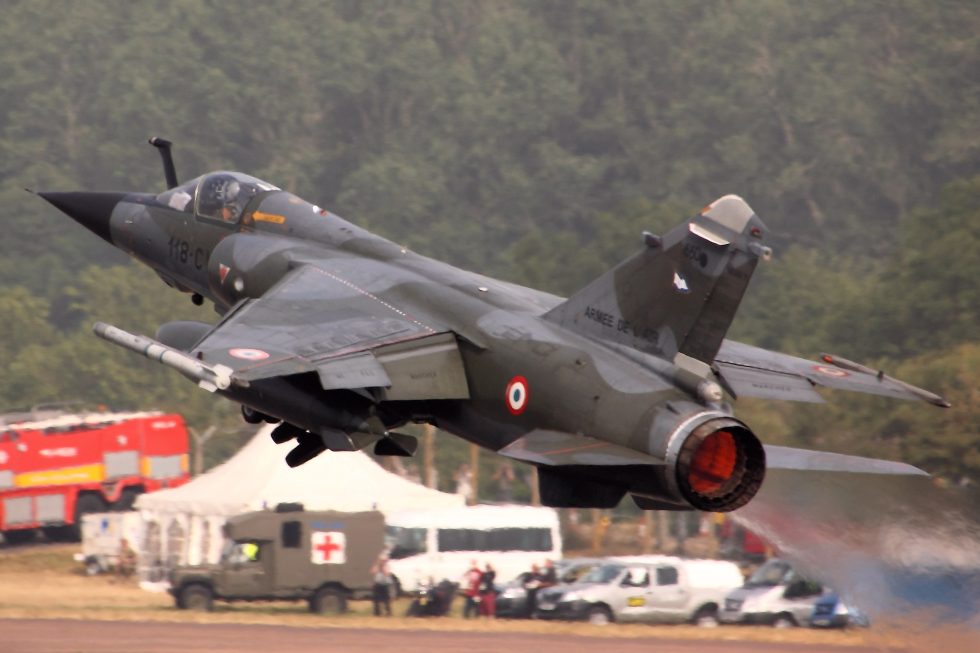
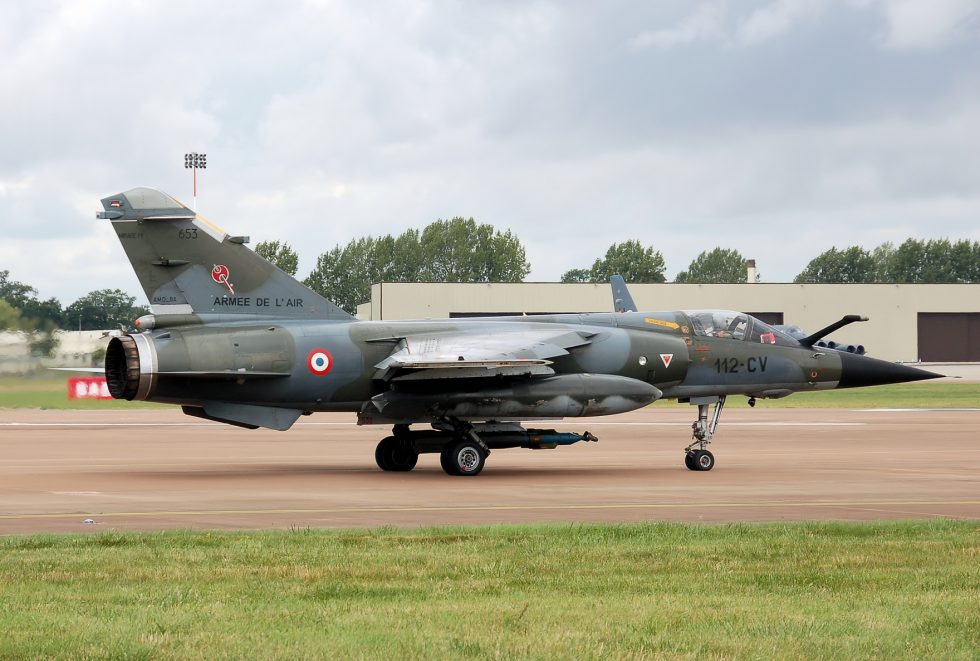
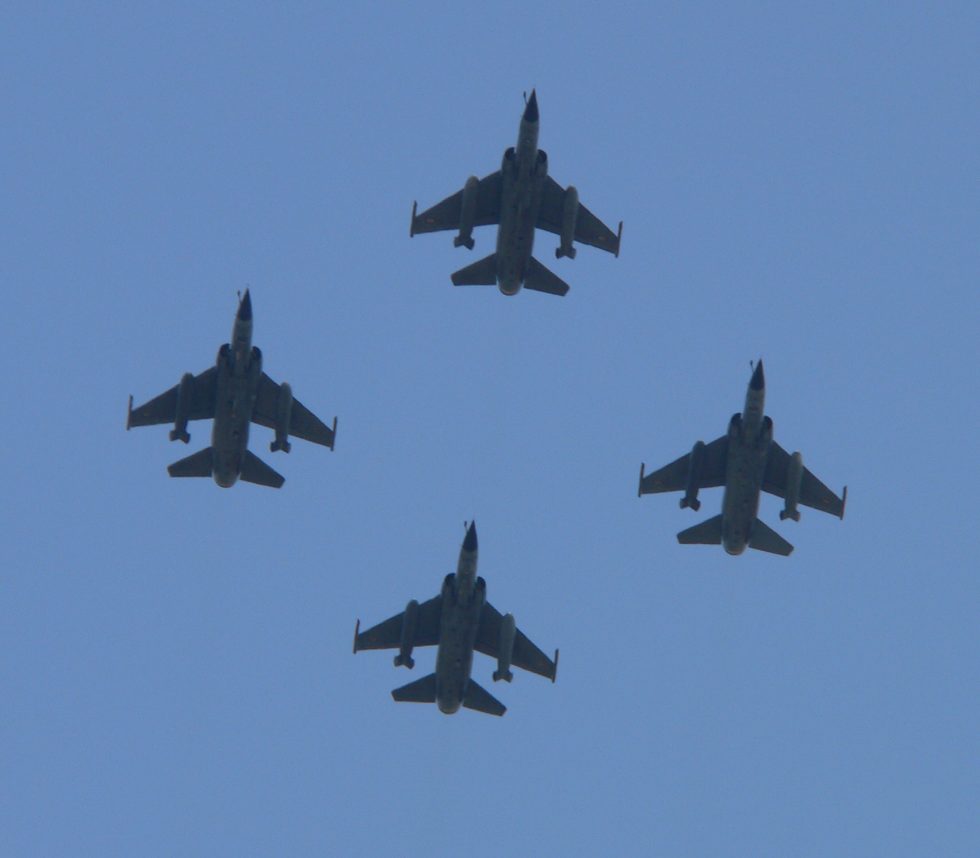
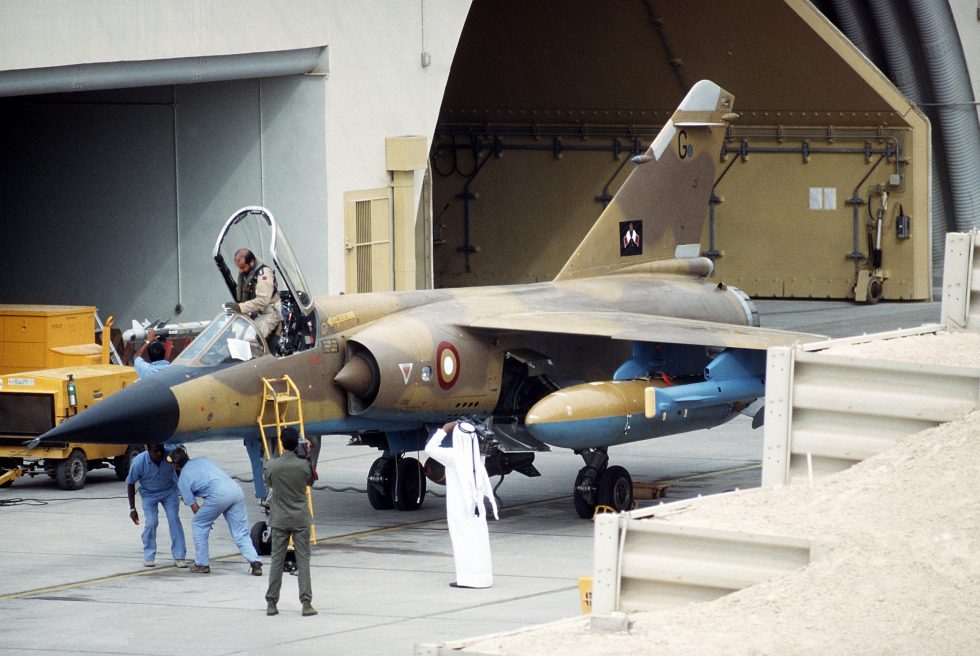
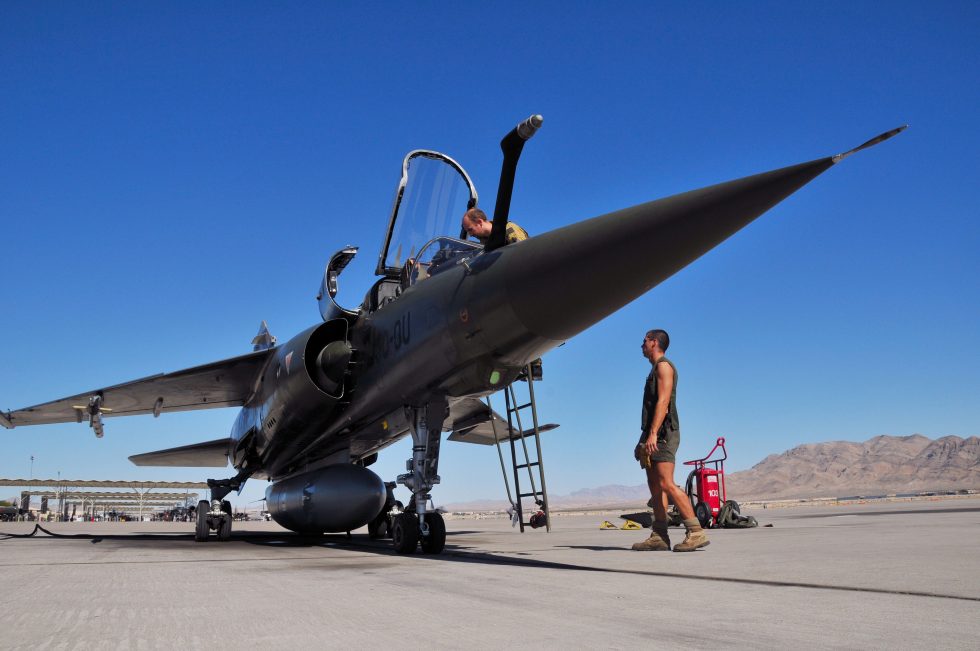
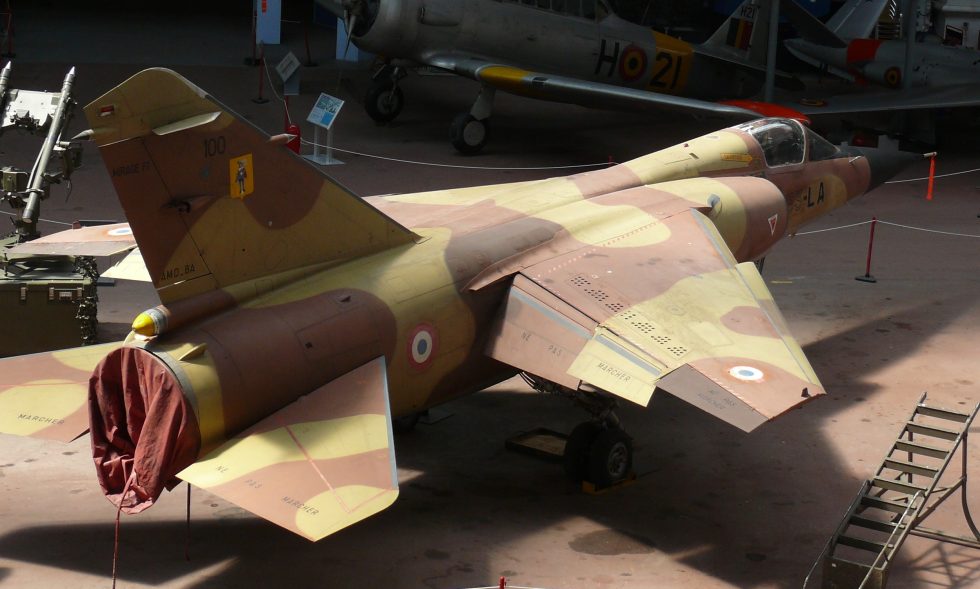
The Mirage F1 in motion
A dedicated Mirage F1 video feature is coming soon. In the meantime, explore the gallery above and the operations map below to see where this swept-wing Mirage flew — and read on for the stories behind its combat career.
The Mirage F1 in motion
Dark Skies — one of the most-watched Mirage F1 films on YouTube.
Where the Mirage F1 flew
A fighter that fought everywhere
Few export fighters saw as much combat as the Mirage F1. It scored air-to-air kills over Angola, fought the length of the Iran-Iraq War, patrolled the deserts of Western Sahara and flew French missions from Chad to the Sahel. Its combat tally is genuinely contested — many claims come from opposing sides that never agreed — so the figures below are best read as indicative rather than exact.
Compare the combat record of every military aircraft. Figures as of July 2026 and, for the F1, deliberately hedged.
Everything people ask about the Mirage F1
Can I fly in a Mirage F1?
How is the Mirage F1 different from the Mirage III?
How fast is the Mirage F1?
Did the Mirage F1 see combat?
Did a Mirage F1 attack the USS Stark?
Is the Mirage F1 still flying?
Who flew the Mirage F1 besides France?
You can’t fly the Mirage F1.
These, you can.
Some legends only live in museums — others are fuelled and waiting. MiGFlug has put civilians in real military jet cockpits since 2004.
 Fly the L-39 AlbatrosThe world’s most-flown jet trainer — aerobatics included
 Fly the F-104 Starfighter“The missile with a man in it”
 Fly the MiG-21The Cold War’s most-produced jet
 Fly the T-33 Shooting StarAmerica’s first jet trainer
 Fly the DH VampireA piece of early jet history
 Fly the S.211Agile Italian jet trainer
 Fly the MB-326The classic Aermacchi jet
 Fly the MiG-15The Soviet legend of the Korean War
Continue the tour
Every fact, checked
- Dassault Aviation — Mirage F1Manufacturer history: origins, first flight, swept-wing design and specifications.
- The Aviation Geek ClubSAAF Mirage F1 versus Cuban/Angolan MiGs, and the ATAC F1 purchase.
- Key.AeroCombat reports on South African F1s versus Angolan MiG-21s and MiG-23s.
- The War Zone (TWZ)ATAC and Draken F1 aggressor operations for the US military.
- FlightGlobalFrance’s 2014 Mirage F1 retirement and the final reconnaissance units.
- The National InterestOverview of the F1’s worldwide service and export success.
- Air & Space Forces MagazineAirpower Classics reference data on the Mirage F1.
- MilitaryFactoryDimensions, weights, powerplant and armament reference figures.