
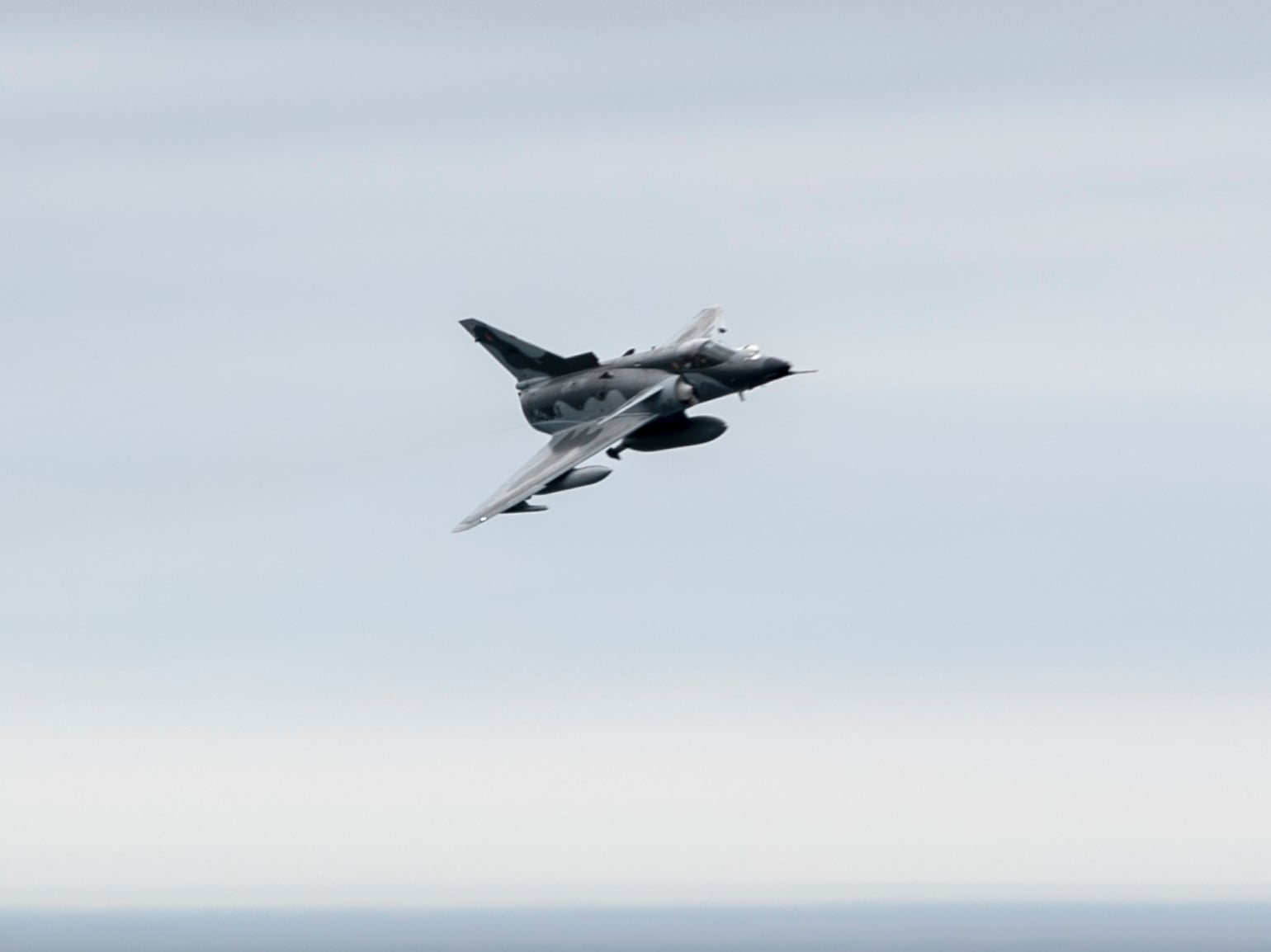
IAI Kfir
“Lion Cub”
The Israeli delta fighter born from a French embargo — a Mirage 5 airframe rebuilt around an American engine, fitted with canards and Israeli avionics, and still flying combat and adversary sorties half a century on.
Born from an embargo
In the 1960s Israel flew French fighters, and the Dassault Mirage III was the star of its victory in the 1967 Six-Day War. But that same war triggered a French arms embargo: President de Gaulle cut Israel off and, in 1969, impounded some 50 Mirage 5 fighters Israel had already ordered and paid for. Overnight, the country’s air force lost its supplier.
Israel Aircraft Industries answered by building the Mirage itself. First came the Nesher, an Israeli-built Mirage 5 that fought in the 1973 Yom Kippur War. Then came the decisive leap: swap the French Atar turbojet for the American General Electric J79 — the engine of the F-4 Phantom, already in Israeli service and license-built at home by IAI’s Bedek division. The J79 was shorter, fatter and far hotter, forcing a redesigned rear fuselage, enlarged air intakes and a distinctive cooling scoop at the base of the fin.
The result first flew in 1973 and entered service in 1975 as the Kfir — Hebrew for “Lion Cub.” With added canard foreplanes for agility and Israeli avionics, it became a genuinely different aircraft from the Mirage it was derived from. Exported to Ecuador, Colombia and Sri Lanka, leased to the U.S. Navy and Marines as an adversary jet, and flown privately in America to this day, the Kfir turned an embargo into one of the most enduring fighters of its generation.
01The Kfir’s origin: the embargo, the Nesher and the Swiss blueprint affair
When France embargoed Israel after 1967, Israel had already invested heavily in the Mirage. One of the strangest chapters in the story is the Frauenknecht affair: Alfred Frauenknecht, a Swiss engineer at Sulzer — which license-built the Mirage’s Atar engine — passed roughly 200,000 technical documents to Israeli agents, reportedly smuggled out in dozens of crates. He was tried in 1971 and imprisoned. How decisive that intelligence really was is debated; some accounts argue it covered mainly the engine rather than the full airframe.
What is certain is that IAI first mastered the Mirage as the Atar-powered Nesher, then re-engined it with the American J79 to create the Kfir. The choice of a U.S. engine over the Rolls-Royce Spey mattered enormously: it tied the new fighter to hardware Israel already operated and could build itself, insulating it from any future embargo.
What makes the Kfir special
An American engine in a French airframe
The heart of the Kfir is the General Electric J79, license-built in Israel by IAI’s Bedek division. Because the J79 is shorter, fatter and much hotter than the French Atar it replaced, engineers had to shorten and widen the rear fuselage, enlarge the air intakes for greater mass flow, add a titanium heat shield around the engine bay, and fit the Kfir’s signature dorsal scoop at the base of the vertical fin to feed cooling air. In afterburner it delivers roughly 18,750 lbf (~83 kN).
Canards that tamed the delta
The definitive Kfir C2 (1976) added fixed swept canard foreplanes on the intake shoulders, plus dog-toothed outer wings and small nose strakes. A pure tailless delta trades away low-speed lift and turn rate; the canards generate a controlled vortex over the wing that raises instantaneous turn rate, adds lift, and markedly shortens the takeoff and landing run. This became the production standard and was retrofitted to earlier airframes.
From point-defence to F-16-class
The Kfir kept evolving. The C7 (1983) added an uprated engine, HOTAS controls, a pulse-Doppler radar, extra hardpoints and in-flight refuelling. The modern export C10 / C60 (“Block 60”) fits the Elta EL/M-2032 multimode radar in an enlarged radome, a glass cockpit, a helmet-mounted display and advanced missiles — avionics IAI has likened to an F-16 Block 52. Colombia and Sri Lanka fly these upgraded Kfirs today.
02The Kfir’s dorsal scoop: why the J79 reshaped the whole airframe
Re-engining a fighter is never a simple swap. The J79 ran hotter and needed more air than the Atar, so IAI reprofiled the intakes and, most visibly, added a large inlet at the base of the leading edge of the vertical tail. That scoop — the quickest way to tell a Kfir from a Mirage at a glance — feeds cooling and afterburner air to the rear fuselage. Combined with a shorter, fatter tail section and internal heat shielding, it let the airframe live with an engine it was never originally designed around.
03The Kfir’s avionics evolution: C1 to C10/C60
The first Kfirs (C1) were essentially J79-powered Neshers with Israeli systems and no large canards — only 27 were built, and many were later leased to the United States. The canard-equipped C2 became the mainstay; the C7 turned a point-defence fighter into a multirole strike aircraft. The latest C10 / Kfir 2000 / C60 standard, developed for export, brings a modern multimode radar, digital cockpit, helmet sight, datalink and beyond-visual-range missiles — keeping a 1970s delta credible into the 2030s.
Full specifications
Baseline note: the figures below describe the Kfir C.2, the canard-equipped single-seat aircraft that made up the bulk of Israeli Air Force service from 1976, powered by the IAI Bedek-built General Electric J79-J1E turbojet. Deltas for the earlier C.1, for the C.7 of the early 1980s, for the two-seat TC.2 and TC.7, and for the export C.10 and the Block 60 offer are in grey. Five warnings belong in front of the tables. First, the widely copied payload figure is arithmetically impossible. The specification set reproduced across the internet gives the C.7 a maximum take-off weight of 16,500 kg and an empty weight of 7,414 kg, which leaves 9,086 kg for fuel, crew, ammunition and stores combined — and then claims 9,390 kg of ordnance on nine hardpoints. The aircraft cannot carry more than it weighs. A realistic external load is about 6,000 kg, which is what Israeli-language sources give, and even that is a paper maximum that no operational sortie approached. Second, the "gross weight" of 10,114 kg in the same table is empty weight plus the internal fuel volume in litres treated as kilograms. Two thousand seven hundred litres of jet fuel weighs about 2,160 kg, not 2,700 kg, so a genuinely clean aircraft with full internal tanks sits nearer 9,570 kg. Wing loading and thrust-to-weight ratios computed from the published gross weight are therefore about six per cent pessimistic; both figures are given below on the corrected basis and the published one. Third, the engine ratings disagree with themselves. The narrative sections of the standard references rate the J79 at 49 kN dry and 83.4 kN in afterburner; the specification tables on the same pages say 52.9 kN and 79.62 kN. The lower afterburning number is the J79-GE-17 figure and the higher one is the uprated Israeli combat rating introduced with the C.7. Both are in circulation as though they described the same engine on the same day, and they do not. Fourth, the production total. Twenty-seven C.1 and 185 C.2 and TC.2 is the commonest breakdown and gives about 212, which is where the ubiquitous "220 plus" comes from once prototypes and trials airframes are added. One widely mirrored page claims 71 C.1, which no other source supports and which cannot be reconciled with the C.1 having been superseded on the line inside a year. Fifth, the service-entry date. Israeli sources and the aircraft’s own service history put first deliveries to 101 Squadron in 1975, with the public unveiling on Independence Day in May of that year; the infobox date of 1976 refers to the C.2. Both dates are defensible; they are not describing the same aeroplane.
Dimensions & weights
- Crew
- 1 — the TC.2 and TC.7 seated two in tandem under a lengthened, drooped nose that improved the instructor’s view over the nose on approach, at the cost of forward-fuselage volume.
- Length
- 15.65 m (51 ft 4 in) — almost exactly the Mirage 5 and Nesher figure, because the rear fuselage was shortened by roughly the amount the nose and intakes grew. The C.10 and Ecuadorian Kfir CE carry a longer nose for the EL/M-2032 antenna and a fixed refuelling probe.
- Wingspan
- 8.22 m (27 ft 0 in) — unchanged from the Mirage III of 1956.
- Height
- 4.55 m (14 ft 11 in) — 4.25 m (13 ft 11 in) is also published and is the Nesher figure; the taller number is the Kfir with its fin-root scoop fairing.
- Wing area
- 34.80 m² (375 sq ft), canards excluded
- Wing
- Tailless delta, leading edge swept 60° 34′, thickness ratio about 3.5 per cent at the root — from the C.2 the outer leading edge carries a "dogtooth" extension that sheds a vortex over the outer wing and delays tip stall.
- Canard foreplanes
- Fixed, sweptback, mounted high on the intake trunks — the C.1 had none in its original form; the C.1P retrofit added small triangular intake fences and horizontal nose strakes; the C.2 enlarged these into proper foreplanes. IAI never published a canard area, and no independent figure exists.
- Empty weight
- 7,285 kg (16,060 lb) — 7,414 kg (16,345 lb) for the C.7 with its extra pylons and avionics. Both are about 700 kg above the Nesher, which is the price of the J79, its titanium heatshield and the reworked rear fuselage.
- Clean gross weight
- ~9,570 kg (~21,100 lb) with full internal fuel, computed properly. The published figure of 10,114 kg (22,298 lb) treats litres of fuel as kilogrammes and should be discarded.
- Typical loaded weight
- 11,603 kg (25,580 lb) — full internal fuel, full ammunition and two air-to-air missiles, which is roughly how the type was flown on interception alert.
- Maximum take-off weight
- 16,200 kg (35,715 lb) for the C.2; 16,500 kg (36,376 lb) for the C.7. The C.7 increase is usually quoted as 3,395 lb over the earlier mark, which does not reconcile with either figure and is best treated as a garbled restatement.
- Internal fuel
- ~2,700 litres (~713 US gal; ~2,160 kg / 4,760 lb) — the internal tanks were rearranged for the Ra’am B prototype, gaining a little over the Nesher.
- Maximum external stores
- ~6,000 kg (~13,230 lb) — and see the warning above about the 9,390 kg figure. In practice fuel came first and a heavily loaded Kfir was a short-legged one.
- Hardpoints
- 7 on the C.2 — one centreline and six underwing. The C.7 added two small stations under the air intakes for a total of nine, suitable for light stores and pods rather than bombs.
Performance
- Maximum speed, high
- 2,440 km/h (1,516 mph; 1,317 kn), Mach 2.3 above 11,000 m (36,000 ft) — a clean, unarmed figure. The Technolog trials aircraft, a two-seat Mirage re-engined with the J79, is credited with Mach 2.5 in the hands of test pilot Menachem Shmul, the fastest speed ever recorded on a Mirage 5 airframe.
- Rate of climb
- 233 m/s (45,900 ft/min) at sea level — roughly a third better than the Atar-engined Nesher, and the single most obvious gain from the engine change.
- Service ceiling
- 17,680 m (58,010 ft)
- Combat radius, ground attack
- ~768 km (~415 nm) on a high-low-high profile with seven 227 kg (500 lb) bombs and two air-to-air missiles
- Combat radius, interception
- ~670 km (~360 nm) — a figure of 1,000 km appears for the attack case in the same tables, which suggests different fuel and store assumptions rather than a different aeroplane.
- Ferry range
- ~1,300 km (~700 nm) is the higher of the two range figures Israeli sources publish; no properly specified ferry range with drop tanks has ever been released.
- g limit
- 7.5 g — the Mirage III airframe limit, retained. The Kfir was never stressed to the 9 g of its F-16 contemporaries and its pilots knew it.
- Wing loading
- 275 kg/m² (56 lb/sq ft) clean with full internal fuel; 333 kg/m² (68 lb/sq ft) at typical loaded weight; 466 kg/m² (95 lb/sq ft) at maximum take-off weight
- Thrust-to-weight
- 0.85 clean with full internal fuel; 0.70 at typical loaded weight; 0.50 at maximum take-off weight. The Nesher managed about 0.60 clean, which is the whole argument for the conversion.
- Turn performance
- Materially improved by the canards — the foreplane trims out some of the elevon download in manoeuvre, so less lift is thrown away holding the nose up, and the vortex it sheds keeps the inner wing flying at higher angles of attack. Neither IAI nor the Israeli Air Force ever published sustained or instantaneous turn-rate figures, and any specific percentage you read is somebody’s estimate.
- Take-off and landing
- Shortened by the canards relative to the plain delta — the foreplanes let the aircraft rotate to a higher attitude without the elevon-down penalty, which is the classic weakness of a tailless delta. No take-off run in metres has been released for any mark. A brake parachute was standard, and the type retained the delta’s high approach speed and long landing roll.
- Low-speed handling
- Transformed by the nose strakes and intake fences — this is the change the US Navy and Marine Corps aggressor squadrons cared about most, because it made the F-21A safe to fly in the slow, ugly corners of a dissimilar-combat engagement.
Propulsion & systems
- Engine
- 1 × General Electric J79-J1E turbojet, built under licence in Israel by IAI Bedek — the same engine family as the F-4E Phantoms Israel began receiving in 1969, which is precisely why it was chosen over the Rolls-Royce Spey that was also trialled.
- Thrust
- 52.9 kN dry (11,890 lbf); 79.62 kN (17,900 lbf) with afterburner. The C.7 is credited with a further 1,000 lbf at full afterburner, giving about 83.4 kN (18,750 lbf) as a combat rating. See the warning above: the two figure sets are routinely printed side by side as if they were one engine.
- Engine installation
- The defining change of the whole programme — the J79 is shorter and fatter than the SNECMA Atar 9C it replaced and runs far hotter, so the rear fuselage was shortened and widened, the intakes enlarged, and the engine wrapped in a titanium heatshield.
- Afterburner cooling scoop
- Large fixed ram-air inlet at the base of the fin leading edge — the single unmistakable external identifier of a Kfir against a Mirage or a Nesher. It exists solely to force cooling air around the afterburner can, and it is the visible admission that an American engine was pushed into a French airframe that was never sized for it.
- Fuel system
- Internal tanks of about 2,700 litres, plus drop tanks on the centreline and inboard wing stations — the C.10 and Ecuadorian CE added an in-flight refuelling probe, which no Israeli Kfir carried in service.
- Radar
- Elta EL/M-2001B ranging radar on the C.2 and C.7 — a ranging set, not an intercept radar: it measured distance for the weapon-aiming computer and could not support a radar-guided missile. Some references give EL/M-2021B for the C.7. The C.10 introduced the true multi-mode EL/M-2032, and the Block 60 offer the EL/M-2052 AESA.
- Navigation and weapon delivery
- Israeli-built central computer, head-up display and air-data system, in the Elbit weapon-delivery and navigation family — the C.7 added a multi-function display and HOTAS controls, and the C.10 two 127 × 177 mm displays with helmet-mounted sight compatibility.
- Self-protection
- Radar warning receiver and chaff and flare dispensers — the dispensers arrived with the C.1P retrofit and were standard thereafter. No internal jammer; electronic countermeasures were carried in pods.
- Escape system
- Martin-Baker zero-zero ejection seat — retained from the Nesher, and a genuine improvement on the French seats of the original Mirage IIICJ fleet.
- Reconnaissance fit
- RC.2 Tzniut, a dedicated camera nose — two of these airframes survive at the Israeli Air Force Museum at Hatzerim. Podded reconnaissance was also carried on standard airframes.
- Engine life and refurbishment
- Overhauled to zero flight hours for the Block 60 offer, with about 1,600 hours to the next replacement — IAI offered a 40-year airframe guarantee when it put refurbished Kfirs back on the market in 2013.
- Cost
- ~US$4.5 million per aircraft in period Israeli figures — against ~US$20 million a copy for a refurbished Block 60 in 2013. Colombia’s upgrade and supply contract from late 2007 was worth over US$150 million; Sri Lanka paid about US$50 million in 2021 to return five aircraft to service, which is US$10 million an airframe for a 50-year-old design.
- Production
- ~220 built — commonly broken down as 27 C.1 and 185 C.2 and TC.2, plus prototypes and trials airframes. All but two C.1 were brought up to later standards.
04The Kfir’s cost: why there is no clean price tag
The Kfir was a domestic Israeli programme, not a fighter sold on an open dollar market, so a firm flyaway unit price simply is not in the public record. Export deals to Ecuador, Colombia and Sri Lanka were bundled packages of aircraft, spares, training and support rather than per-unit list prices. Modern upgrade contracts give a clearer signal: Sri Lanka’s 2024–26 modernisation of five Kfirs was reported at roughly $50 million. Any precise flyaway figure you see for a 1970s-era Kfir should be treated as an estimate, not a sourced price.
Armament & payload
The Kfir kept the Mirage’s two cannon and spent twenty years learning to drop bombs, and only the export marks ever got a radar that could fire a missile beyond visual range
For an aircraft built around an engine change, the Kfir’s weapons were remarkably conservative. Two 30 mm DEFA revolver cannon in the belly, the Israeli Shafrir and later Python infra-red missiles, and iron bombs: that is the whole of the C.2’s armament, and it is the Nesher’s armament with a better gunsight behind it. The Elta EL/M-2001B in the nose was a ranging radar, not an intercept set. It fed distance to the weapon-aiming computer and it could not guide anything, which meant that for the first fifteen years of its life the Kfir was a daylight visual fighter that happened to accelerate like a Phantom.
The C.7 of the early 1980s is where the aeroplane found its real job. Two extra stations under the intakes, a multi-function display, HOTAS controls and, decisively, the ability to carry and guide laser-guided bombs turned a redundant air-superiority fighter into a competent strike aircraft at precisely the moment the F-15 and F-16 had taken air superiority away from it. In Israeli service the C.7 went to a single squadron, 144 at Ovda, and did unescorted interdiction work over Lebanon that the newer types were too valuable to risk. That is the Kfir’s honest career: a stopgap air-superiority fighter for about four years, and a bomb truck for fifteen.
The export marks went further than Israel ever took the type. The C.10, sold to Ecuador as the Kfir CE and to Colombia as the COA, put an Elta EL/M-2032 multi-mode radar in a lengthened nose, and Colombia’s 2017 refit added the EL/M-2052 active array with the I-Derby ER active radar-guided missile and Python 5. A Colombian Kfir of 2020 could shoot at something it could not see, which no Israeli Kfir could ever do. Weapon fits varied enormously by mark and operator: an Israeli C.2 of 1979 was a gun-and-Shafrir day fighter, a Sri Lankan C.2 of 2007 was a dumb-bomb attack aircraft with no precision capability at all, and a Colombian C.10 of 2020 was a genuine beyond-visual-range interceptor. Treat any single armament list as describing one of these and not the others.
Gun — two 30 mm DEFA 553 revolver cannon, and the guns came out for the American lease
- Two DEFA 553 30 mm revolver cannon in the lower forward fuselage, about 1,300 rounds a minute each, built in Israel.
- Ammunition is normally given as 140 rounds per gun. Hebrew-language sources say 200 per gun; the Mirage III standard was 125. The 200-round claim is not corroborated in any Western reference and may confuse total rounds with rounds per gun.
- Roughly six seconds of firing across both guns at the quoted rate. The 30 mm shell is heavy and comparatively slow, which rewards a single well-judged pass.
- The gunsight and the weapon-aiming computer, not the guns, were what the Kfir added over the Nesher. The hardware was French; the aiming solution was Israeli.
- The 25 F-21A aircraft leased to the United States had their internal guns removed and were flown unarmed. An aggressor does not need bullets.
Air-to-air — Shafrir, then Python, and beyond-visual-range capability only for export customers
- Rafael Shafrir 2: rear-aspect infra-red seeker, effective to about 5 km, the standard Israeli Kfir missile of the late 1970s and the weapon that scored the Ecuadorian kill in 1995.
- Rafael Python 3 and Python 4 on later marks, the Python 4 being an all-aspect missile cued by a helmet-mounted sight on the C.10; Python 5 on Colombian aircraft from 2017.
- AIM-9 Sidewinder in D, G and later variants was carried, and remains the standard alternative listed for export aircraft.
- Rafael Derby and the extended-range I-Derby ER, both active radar-guided, are carried only by C.10 and later aircraft with the EL/M-2032 or EL/M-2052 radar. Colombia declared the I-Derby ER in October 2017.
- No Israeli-service Kfir ever carried a radar-guided air-to-air missile. The Matra R.530 that armed French Mirage IIIs was never part of the fit, because the ranging radar could not support it.
Air-to-surface guided — nothing on the C.2, laser-guided bombs from the C.7 onwards
- The C.2 carried no guided air-to-surface weapon of any kind. This is the clearest single measure of how far short of a modern strike aircraft it fell in 1976.
- The C.7’s headline capability was carrying and delivering laser-guided bombs of the Paveway family, together with the Israeli Griffin and Elbit-developed guidance kits. Designation came from a buddy aircraft or a ground party rather than an onboard pod.
- AGM-45 Shrike anti-radiation missiles and AGM-65 Maverick electro-optical missiles appear in Israeli listings for the type, consistent with the Israeli Air Force’s wider inventory of the period.
- BLU-107 Durandal runway-cratering munitions are listed among the stores, a weapon designed for exactly the sort of airfield strike the Kfir was built to fly.
- Colombian Kfirs carried out precision strikes against guerrilla camps for two decades; the standoff and precision weapons involved came with the C.10 refit, not with the original 1989 aircraft.
Bombs — the Mark 80 series, and seven of them was the standard heavy load
- Mark 80 series general-purpose bombs: Mk 82 of 227 kg (500 lb), Mk 83 of 454 kg (1,000 lb) and Mk 84 of 907 kg (2,000 lb), in slick and retarded forms.
- Seven 227 kg bombs plus two air-to-air missiles is the load against which the published high-low-high combat radius of about 768 km is quoted, and it is a fair picture of a Lebanon interdiction sortie.
- CBU-100 Rockeye anti-armour cluster munitions and Israeli TAL-series cluster weapons.
- Israeli-developed guidance kits turned the same Mk 82 and Mk 84 bodies into laser-guided weapons on the C.7 without changing the carriage.
- Sri Lanka’s Kfirs fought a fifteen-year campaign against the LTTE with unguided bombs almost exclusively, with the collateral consequences that implies.
Rockets — inherited from the Mirage and never seriously updated
- 2.75-inch FFAR in LAU-series pods, the standard American light rocket of the period.
- 5-inch Zuni rockets, heavier and used against harder point targets.
- SNEB 68 mm rockets in 19-round French pods, carried over directly from the Mirage 5 and Nesher fit.
- Matra JL-100 combined rocket-and-fuel pods, an odd French device holding both 68 mm rockets and 250 litres of fuel, listed in the Israeli inventory for the type.
- Rockets mattered less to the Kfir than to most of its contemporaries: against a defended target the aircraft’s survival argument was speed, and rocket attack demands a slow, predictable pass.
Pods & other stores — fuel, cameras, jammers, and the targeting pod that never came
- Drop tanks on the centreline and the inboard wing stations, in the Mirage-family sizes of roughly 600, 1,300 and 1,700 litres. Fuel took priority over ordnance on almost every real sortie.
- Podded electronic countermeasures. The Kfir had no internal jammer and depended on external pods and on its chaff and flare dispensers.
- Reconnaissance pods on standard airframes, alongside the dedicated RC.2 Tzniut conversion with a camera nose in place of the ranging radar.
- The C.7’s two additional stations under the air intakes were sized for pods and light stores rather than bombs, and are the practical difference between seven and nine hardpoints.
- No self-designating targeting pod was ever integrated on an Israeli Kfir. The type could drop a laser-guided bomb but could not, on its own, tell it where to go — a limitation the F-16 had already made obsolete before the C.7 entered service.
Three typical loadouts
- Interception alert, Israel, 1979
- Two Shafrir 2 on the inboard wing stations, full cannon ammunition, one centreline drop tank. Clean, light and fast; this is the configuration in which the type’s only Israeli air-to-air victory was scored on 27 June 1979.
- Unescorted interdiction, Lebanon, 1982
- Seven Mk 82 227 kg bombs, two Shafrir or Sidewinder rounds for self-defence, guns loaded, drop tanks as the range demanded. High-low-high, one pass, and no fighter escort because the F-15s and F-16s were needed elsewhere.
- Air defence, Colombia, 2020
- Two I-Derby ER active radar-guided missiles and two Python 5 on a C.10 with the EL/M-2052 active array, helmet-mounted sight, two drop tanks. A 1970s airframe flying a genuinely modern engagement, and the furthest the design was ever taken.
Sourcing caveat. There is no public Israeli Air Force weapons manual for the Kfir, and the armament lists in general references are compilations from export brochures, air-show placards and national-language encyclopedias rather than from a stores clearance document. The bomb, rocket and missile types above are all attested for the type, but no source establishes which were cleared on which station of which mark in which year. The frequently republished payload figure of 9,390 kg is arithmetically impossible against the aircraft’s own maximum take-off and empty weights and should not be repeated.
Variants
Every Kfir is a Nesher with an American engine, and every Atlas Cheetah is a Mirage rebuilt to look like a Kfir — three aircraft that are constantly confused and are not the same
The family tree needs stating plainly, because the three Israeli-derived deltas are blurred together more often than not. The IAI Nesher is an unlicensed Israeli copy of the Dassault Mirage 5, built around the French SNECMA Atar 9C, produced from 1969 and later sold to Argentina as the Dagger; it has its own page. The Kfir is that airframe re-engineered around the licence-built General Electric J79 and, from the C.2, given canard foreplanes. The Atlas Cheetah is a South African rebuild of Mirage III airframes, with Kfir-style canards and nose strakes, carried out from 1986 with heavy Israeli involvement and with technology from the cancelled Lavi programme; it too has its own page, and it is not a Kfir. The proposed Kfir C.9 for Argentina, which would have used the Atar 9K-50 to sidestep American engine export controls, is the point where the Kfir and Cheetah stories touch: the C.9 was cancelled, and the same idea reappeared in South Africa.
Within the Kfir line the sequence is straightforward. The J79 was flown first in a two-seat Mirage testbed, then in a re-engined Nesher, then in a properly developed prototype. The C.1 was fielded without canards and almost immediately retrofitted with them. The C.2 was the definitive Israeli fighter; the C.7 was the definitive Israeli bomber; and everything after that is an export upgrade sold by IAI to keep 1970s airframes commercially alive into the 2030s.
- Technolog (trials aircraft, first flight October 1970)
- A two-seat Mirage converted to take the J79-J1E and its systems, flown from Lod. It later carried the canard and strake configurations that became the C.2, and is credited with Mach 2.5, the highest speed ever flown on a Mirage 5 airframe.
- Re-engined Nesher and Ra’am B (September 1971 and June 1973)
- A J79-powered Nesher flew in September 1971; the definitive prototype, Ra’am B, flew in June 1973 with an extensively revised cockpit, strengthened landing gear, rearranged internal tanks and Israeli avionics. Ra’am A was the Nesher; the naming makes the descent explicit.
- Kfir C.1 (production from April 1975; 27 built)
- The initial production aircraft, without canards, displayed publicly on Independence Day in May 1975 and shown abroad at Farnborough in September 1976. Served chiefly with 101 Squadron in the brown, tan and green "ginger" camouflage.
- Kfir C.1P, the "Kfir Gderot" or fence Kfir (retrofit)
- C.1 airframes brought toward C.2 standard with triangular fences on the intake sides, horizontal strakes on the nose and chaff and flare dispensers. The fences transformed low-speed handling and were later grown into full foreplanes.
- F-21A Kfir (25 aircraft leased to the United States, 1985–1989)
- C.1P airframes leased unarmed, with the internal guns removed, as dissimilar air combat training adversaries under the tri-service designation F-21A. Twelve went to the US Navy’s VF-43 at NAS Oceana in a three-tone blue-grey "ghost" scheme and were returned in 1988 for F-16Ns; thirteen went to the Marine Corps Reserve squadron VMFT-401 at MCAS Yuma, some in Israeli and desert schemes meant to evoke the MiG-23, and were returned in 1989 for F-5Es. The Kfir was chosen because nothing else available accelerated like a Flogger.
- Kfir C.2 and TC.2 (from 1976; 185 C.2 and TC.2 built — the baseline for this page)
- Large fixed canards on the intakes, nose strakes and a dogtoothed outer wing leading edge. Flown by 101, 109, 113, 144, 149 and 254 Squadrons. The TC.2 is the two-seater, with a longer, drooped nose; the RC.2 Tzniut is the camera-nosed reconnaissance conversion.
- Kfir C.7 and TC.7 (Israeli service from the early 1980s; most C.2 converted)
- Uprated J79 combat rating, two extra stations under the intakes for nine hardpoints, higher maximum take-off weight, multi-function display, HOTAS and — the point of the exercise — laser-guided bomb capability. In Israeli service it equipped 144 Squadron at Ovda and wore the grey scheme of the F-16 fleet.
- Kfir C.9 (proposal for Argentina; cancelled)
- A Kfir with the SNECMA Atar 9K-50 in place of the J79, conceived to escape the American veto on J79 exports to South America. Never built. The concept re-emerged as the South African Atlas Cheetah, a separate aircraft with its own history.
- Kfir C.10 and TC.10 (export upgrade; Kfir CE for Ecuador, Kfir COA for Colombia, from 1999)
- Originally marketed as the Kfir 2000. Elta EL/M-2032 multi-mode radar in a lengthened nose, two 127 × 177 mm multi-function displays, helmet-mounted sight compatibility, a new canopy and an in-flight refuelling probe. The mark that finally gave the airframe a radar worth the name; Israel never bought it.
- Kfir C.12 (Colombia, and Sri Lanka from 2024)
- A C.10 without the Elta multi-mode radar — the cockpit, mission computer and avionics upgrade at a lower price. This is the standard to which Sri Lanka’s five surviving aircraft were rebuilt under the US$50 million contract of 2021.
- Kfir Block 60 and Kfir NG (offered from 2013; no confirmed sale as such)
- The C.10 taken further, with the Elta EL/M-2052 active electronically scanned array, open-architecture avionics, a zero-houred engine and a 40-year airframe guarantee, offered at about US$20 million a copy. Pitched at Argentina, Bulgaria, the Philippines and Colombia without success. Block 60 and C.10 are not synonyms: Block 60 is the later AESA-equipped development of the C.10, and Sri Lanka’s C.12 aircraft are described in some reports as "near Block 60 standard", which is a marketing phrase rather than a designation.
- IAI Nammer (demonstrator flown April 1991; no sales)
- An export derivative offered with the Atar 9K-50 or the General Electric F404, carrying technology from the cancelled Lavi, and intended to sidestep the American engine export veto altogether. It found no customer, and the refurbished-Kfir business took its place.
Disposition, September 2026. The Israeli Air Force retired the Kfir over the second half of the 1990s, 1996 being the date usually recorded; the type’s last documented Israeli operational activity is Operation Accountability in Lebanon in 1993, and its place was taken by the F-16 and F-15. Ecuador, which bought twelve C.2 and TC.2 in 1982 and four more in 1996 and later upgraded some to CE standard, has withdrawn the type; five had already been lost in accidents by 2005. Colombia is phasing its aircraft out in favour of seventeen Saab Gripens ordered on 14 November 2025, the first Colombian Kfir having gone up as a gate guardian at Captain Germán Olano Moreno Air Base in May 2025. Sri Lanka, which took fifteen airframes in all from 1996 and lost two on the ground in the LTTE raid on Katunayake on 24 July 2001 and two more in a mid-air collision in 2011, has brought five back to life: the first upgraded C.12 flew and was inducted on 11 June 2026, more than fifty years after the C.1 entered production. Six ex-Israeli F-21 Kfirs are on the United States civil register to the contractor ATAC, a Textron subsidiary flying adversary sorties for the American services; one was lost with its pilot at NAS Fallon on 6 March 2012. Preserved originals are numerous and all are genuine airframes — no reproduction Kfir exists or could plausibly be built. The largest collection is at the Israeli Air Force Museum at Hatzerim, which holds C.1, C.2, C.7, TC.2, two RC.2 Tzniut and at least one returned F-21A; others stand at Ovda, Ramat David, Hatzor, Beersheba, Hadera and Madatech in Haifa, at the Sri Lanka Air Force Museum, and, uniquely outside Israel and its customers, an F-21A at the Intrepid Sea, Air & Space Museum in New York.
Operators today
Two air forces still fly the Kfir, one of them on its way out and one of them only just back in business
Fifty-one years after the first production aircraft left the line, the Kfir is down to two military operators and both numbers are moving. Colombia is the larger fleet and the shrinking one: the Colombian Aerospace Force selected the Saab Gripen to replace it in April 2025 and signed for seventeen aircraft on 14 November 2025, and the first retired Kfir was already on a plinth by May 2025. Sri Lanka is the opposite case — a fleet that was effectively dead, with a single serviceable airframe out of seven by 2017, and which has been partly resurrected by a US$50 million contract with Israel Aerospace Industries covering five aircraft to C.12 standard, the first of them inducted on 11 June 2026. Neither figure is large and neither is stable. A third operator exists but is not an air force: the American contractor ATAC, a Textron subsidiary, holds six ex-Israeli F-21 Kfirs on the civil register for adversary work, and is omitted from the chart below because its current flying status cannot be corroborated from open sources.
These are estimates, current to September 2026. Many airframes counted on paper are stored, in deep overhaul, or not operational. The Colombian figure of 16 is the FlightGlobal World Air Forces count and is being run down against the Gripen order; the Colombian Aerospace Force’s own summary text still says 21, and a figure of 23 was current as recently as 2019, so the true flying number today is probably lower than 16 rather than higher. The Sri Lankan figure of 5 counts only the aircraft covered by the IAI upgrade contract and now returning to service; a further seven airframes remain on charge but have been grounded for years and are not counted here. Sources: IISS The Military Balance and FlightGlobal World Air Forces, cross-checked against national air force reporting; entries that could not be corroborated, including ATAC’s civil-registered aircraft, are omitted.
From embargo to enduring export fighter
France pulls the plug
After the Six-Day War, France embargoes Israel and impounds some 50 paid-for Mirage 5 fighters, cutting off Israel’s supplier.
The Frauenknecht trial
Swiss engineer Alfred Frauenknecht is tried for passing Mirage-engine documents to Israel — a strange footnote to the Kfir’s birth.
First flight
The definitive J79-powered prototype flies. Israel now has a Mirage-derived fighter built around an American engine it makes itself.
Enters service
The Kfir is publicly unveiled and joins the Israeli Air Force.
Canards arrive
The Kfir C2 introduces the signature canard foreplanes, transforming the delta’s agility and field performance.
The Lion goes west
The first F-21A Kfirs arrive in the United States as U.S. Navy and Marine Corps adversary jets.
The Cenepa War
Ecuadorian Kfirs fly combat against Peru; one is credited with downing a Peruvian A-37 — a contested but best-attested Kfir air-to-air kill.
Still fighting at fifty
Colombia completes an F-16-class C10/C60 upgrade; Sri Lanka modernises its survivors, flying the first upgraded jet in 2026.
Twelve Kfir stories
The embargo that built a fighter
France cut Israel off after 1967 and kept the Mirages it had already sold.
Read the full story
The Swiss blueprint affair
A Sulzer engineer smuggled some 200,000 Mirage-engine documents to Israel.
Read the full story
From Nesher to Kfir
Israel first cloned the Mirage as the Nesher, then re-engined it.
Read the full story
An American heart
Choosing the F-4’s J79 over the Rolls-Royce Spey tied the Kfir to hardware Israel already made.
Read the full story
The scoop at the tail
That inlet at the base of the fin is the fastest way to spot a Kfir.
Read the full story
Canards on the shoulders
The 1976 C2 added foreplanes that fixed the delta’s weaknesses.
Read the full story
The one kill
Israel’s Kfirs flew mostly strike missions; a single air-to-air victory is claimed.
Read the full story
The Lion comes west
~25 Kfirs served as F-21A adversaries at Oceana and Yuma.
Read the full story
Private MiGs for hire
Decades later, ex-Israeli Kfirs still fly “red air” in America.
Read the full story
A Kfir over the Cenepa
Ecuador’s Kfirs fought Peru in a jungle border war.
Read the full story
Katunayake’s Kfirs
Sri Lanka flew Kfirs in a long ground war against the Tamil Tigers.
Read the full story
Still fighting at fifty
Colombia and Sri Lanka keep upgrading a 1970s delta.
Read the full story
The Kfir in pictures
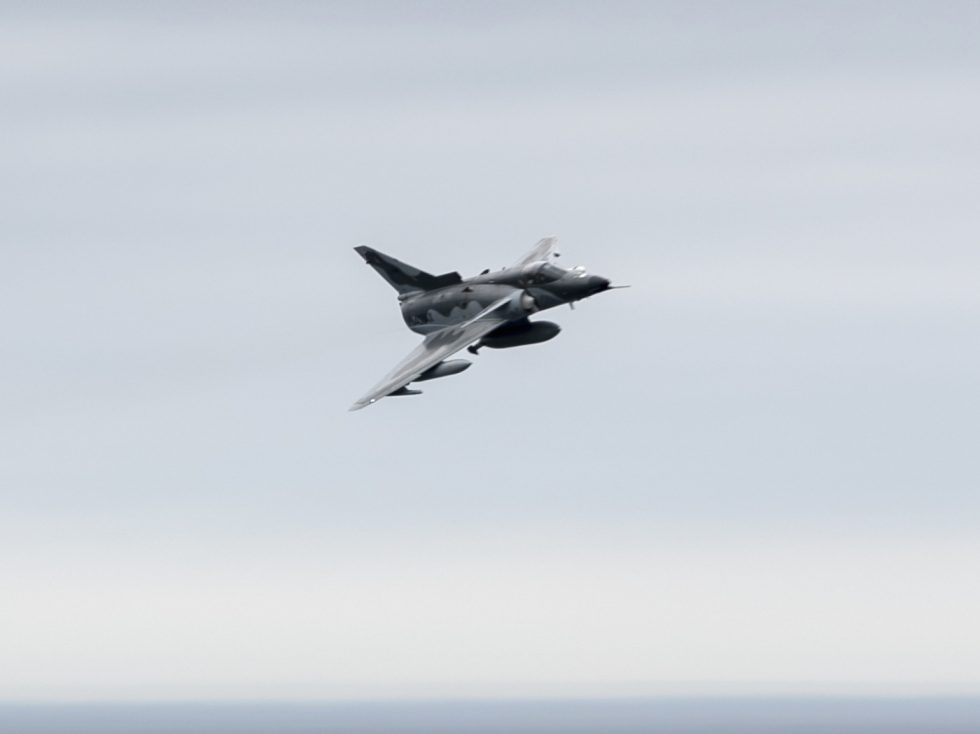
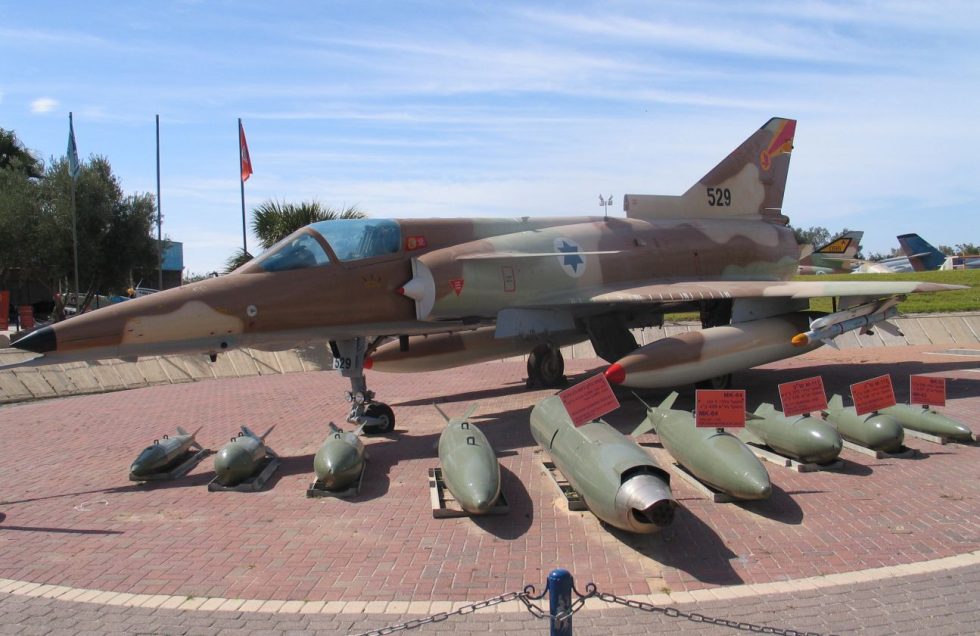
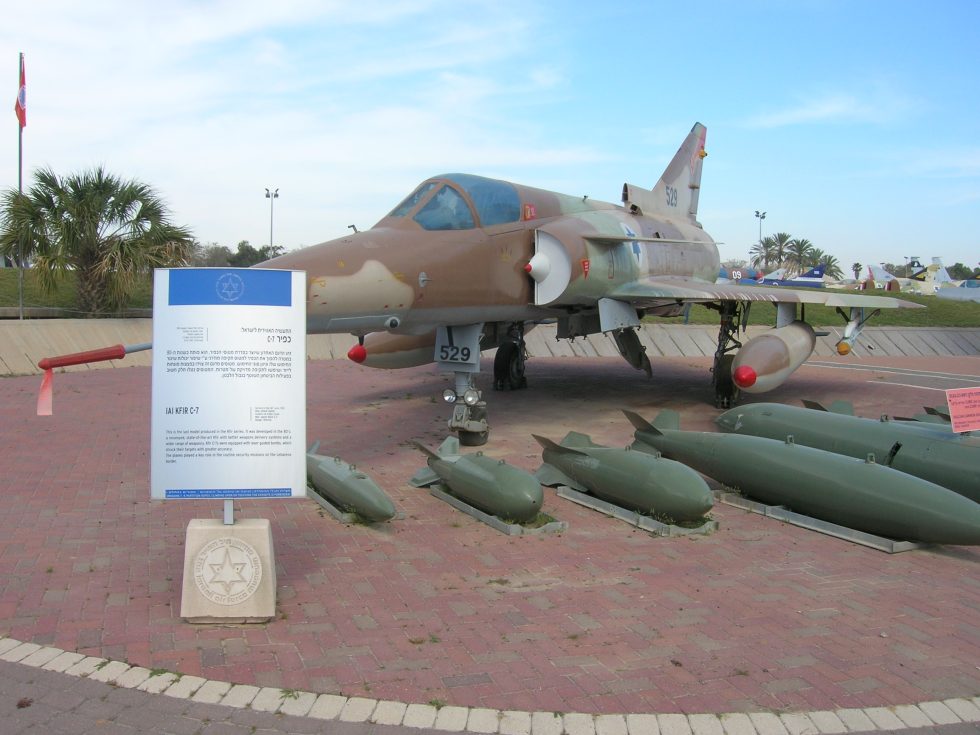
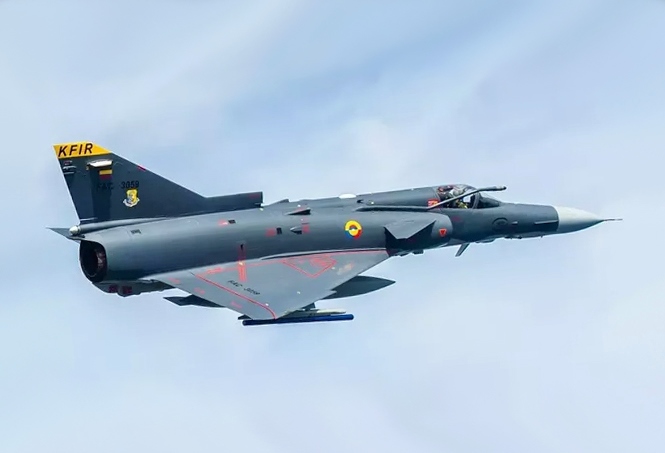
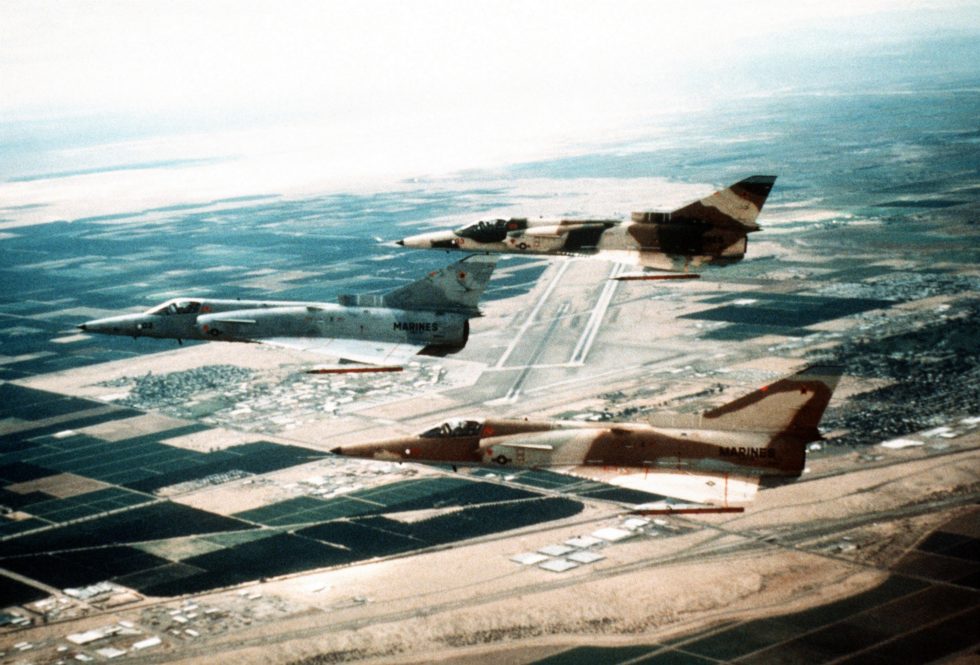
The Kfir in motion
A dedicated Kfir video feature is coming soon. In the meantime, explore the gallery above and the twelve stories for the full picture of Israel’s embargo-born delta fighter.
The IAI Kfir in motion
Iron Voke — one of the most-watched IAI Kfir films on YouTube.
Where the Kfir flies
The score that defines it
The Kfir arrived just as the F-15 and F-16 took over Israel’s air-superiority role, so it earned its record mostly as a strike aircraft — over Lebanon for Israel, against the LTTE for Sri Lanka, and in a jungle border war for Ecuador. Its clearest air-to-air moment came not with the Israeli Air Force but over the Cenepa in 1995. Air-combat claims for the type are genuinely contested, so we present them with care.
Compare the combat record of every military aircraft. Figures as of July 2026.
Everything people ask about the IAI Kfir
Can I fly in a Kfir?
Is the Kfir just a copy of the Mirage?
How fast is the Kfir?
What engine does the Kfir use?
Did the Kfir ever score an air-to-air kill?
What was the F-21?
Who still flies the Kfir?
You can’t fly the Kfir.
These, you can.
Some legends only live in museums — others are fuelled and waiting. MiGFlug has put civilians in real military jet cockpits since 2004.
 Fly the L-39 AlbatrosThe world’s most-flown jet trainer — aerobatics included
 Fly the F-104 Starfighter“The missile with a man in it”
 Fly the MiG-21The Cold War’s most-produced jet
 Fly the T-33 Shooting StarAmerica’s first jet trainer
 Fly the DH VampireA piece of early jet history
 Fly the S.211Agile Italian jet trainer
 Fly the MB-326The classic Aermacchi jet
 Fly the MiG-15The Soviet legend of the Korean War
Continue the tour
Every fact, checked
- 19FortyFiveThe French embargo, the impounded Mirage 5s and the J79 re-engine that created the Kfir.
- The Aviation Geek ClubThe Nesher provenance debate and the Sri Lanka Kfir modernisation.
- GlobalSecurity.orgDevelopment history, variants and first-flight milestones.
- Military FactorySpecifications, engine data and variant breakdown.
- flugzeuginfo.netDimensions, weights and performance figures (hedged where sources differ).
- HistoryNetThe 1995 Cenepa War and the Ecuadorian Kfir A-37 claim.
- HistoryNet — “The Lion Comes West”The F-21A lease to the U.S. Navy and Marine Corps.
- ATACReference for the privately operated ex-Israeli Kfir adversary fleet.
- Fuerza Aérea EcuatorianaEcuadorian Kfir squadron history and service record.