
Fiat G.91
“Gina”
The little Italian jet that won NATO’s only common-fighter contest — a cheap, tough, rough-field strike fighter that flew for Italy and Germany, wrote smoke for the Frecce Tricolori, and saw its only real war in Portugal’s African colonies.
NATO’s common fighter that almost was
In the early 1950s NATO tried something it never really managed again: to make its air forces fly the same aircraft. Out of the 1952 Lisbon conference came NATO Basic Military Requirement 1 (NBMR-1) — a call for a cheap, lightweight strike fighter that could scramble from rough, semi-prepared forward strips and survive the loss of proper runways in the opening hours of a war. Twelve designs were entered; three were funded. Fiat’s answer, drawn by chief designer Giuseppe Gabrielli (the “G” in every Fiat “G.” type), looked like a scaled-down F-86 Sabre and was called the G.91.
It first flew on 9 August 1956 and was declared the competition winner in 1957, beating the French Breguet Taon and Dassault Étendard VI. Italy was so confident it had ordered the jet before the verdict was even announced. Nicknamed “Gina,” it entered Italian service in 1958 and was soon being licence-built in West Germany — the first jet combat aircraft produced in Germany after the Second World War.
The grand dream of one NATO fighter collapsed — only Italy, West Germany and Portugal ever flew the Gina in numbers. But the aircraft itself was a quiet success: a rugged, easy-to-maintain workhorse that grew into the twin-engine G.91Y, thrilled crowds for nearly two decades with the Frecce Tricolori, and fought its only war in the skies over Portuguese Africa.
01The Fiat G.91 and NBMR-1: NATO’s only common-fighter competition
NBMR-1 was issued in 1953–54 and asked for a near-Mach-0.9 strike fighter light enough to disperse to grass and damaged airfields, cheap enough to buy in quantity, and able to loiter over a battlefield up to roughly 175 miles away. Twelve companies submitted designs; three finalists were funded under a NATO cost-share (the United States paying half): the Fiat G.91, the Breguet Br.1001 Taon and the Dassault Étendard VI. The Folland Gnat was rated brilliant but too experimental.
Fly-offs at Brétigny-sur-Orge in 1957–58 went to the G.91. Yet the political dream fell apart: France backed its own designs, Britain its own, and most members bought nationally. The “standard NATO fighter” ended up flying with just Italy, West Germany and Portugal — a reminder of how hard true alliance standardisation really is.
What makes the Fiat G.91 special
Built to fly from a field, not a runway
NBMR-1 assumed NATO’s airfields would be cratered in the first hours of a war, so Gabrielli built the G.91 to operate from grass, dispersed strips and bomb-damaged surfaces. It got a rugged tricycle undercarriage with low-pressure tyres, simple and robust systems, and cockpit and fuel-tank armour for the ground-attack role. It was deliberately a cheap, tough, many-of-them aircraft — a philosophy the Harrier would later push to its extreme.
The Orpheus — Britain built it, America paid for it
Power came from a single British Bristol Orpheus 803 axial-flow turbojet of about 22 kN (5,000 lbf) thrust — a light, simple, single-spool engine whose development was funded by the United States as part of the NATO programme. Italian G.91s used Fiat-built Orpheus engines under licence. Its reliability and low weight were the whole basis of the rough-field, low-maintenance concept; the same engine family powered the Folland Gnat.
Camera and cannon — then twin engines
The R-series carried a three-camera reconnaissance nose alongside its guns and ordnance — one airframe that could photograph and strike in the same sortie. The later G.91Y pushed the idea further, swapping the lone Orpheus for two afterburning General Electric J85 turbojets: roughly 60% more take-off thrust, more fuel, longer range and the safety of a second engine.
02The Fiat G.91 restarted Germany’s jet industry
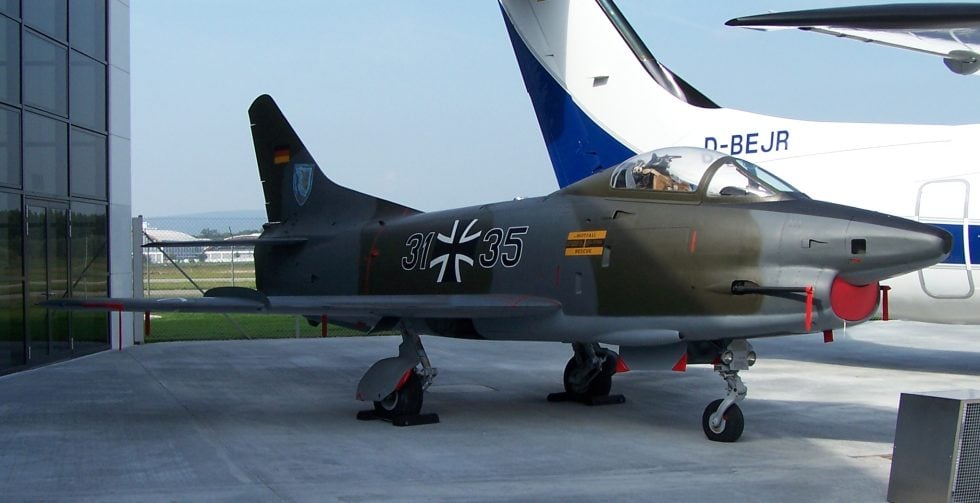
Barred from military aviation after 1945, West Germany re-entered combat-aircraft production by licence-building the G.91. Assembly was handled by the Flugzeug-Union Süd consortium of Dornier, Messerschmitt and Heinkel, and together with Fiat-supplied airframes the Luftwaffe fielded around 344 aircraft — mostly the cannon-armed R/3 and the T/3 trainer. These were the first jet warplanes built in Germany since the war, making the little Gina as much an industrial rebirth as a piece of procurement.
03The twin-engine G.91Y: they cut the engine in half and doubled it
By the mid-1960s the single-engine Gina was running out of growth, so Fiat replaced the lone Orpheus with two afterburning GE J85-GE-13A turbojets, each about 18 kN in reheat. First flown on 27 December 1966, the G.91Y was longer, heavier and carried about a third more internal fuel — giving markedly better range, a much higher climb rate and the survivability of a second engine. Only Italy bought it, operating roughly 65–75 into the 1990s. It was almost a new aircraft built on the old layout.
Full Fiat G.91 specifications
Baseline note: the figures below describe the G.91R/3, the single-seat ground-attack and tactical-reconnaissance version built for the Luftwaffe around the Bristol Siddeley Orpheus 803 and two 30 mm DEFA cannon. It is the right baseline for three reasons: it is the mark that was actually mass-produced, at 344 aircraft out of roughly 756 G.91s of all types; it is the mark Germany licence-built, which is where most of the type’s industrial history sits; and, handed on second-hand from Luftwaffe stocks, it is the mark that did most of Portugal’s flying. Deltas for the Italian G.91R/1, the export G.91R/4, the two-seat G.91T and the twin-engined G.91Y are in grey. Three cautions before the numbers. First, the G.91Y is not really a variant and should not be read as one. It shares the trainer’s fuselage lines and the family name and almost nothing else: two afterburning General Electric J85s in place of one Orpheus, a new wing with automatic leading-edge slats, more fuel, better avionics and half again the all-up weight. Where its figures appear below they are given as a separate aeroplane, not as a delta. Second, the G.91 did not meet the requirement it won. NBMR-1 asked for a strike fighter of no more than 2,200 kg (4,850 lb) empty and 4,700 kg (10,360 lb) gross; the production G.91R came in at 3,100 kg (6,834 lb) empty and 5,500 kg (12,125 lb) gross, 41 per cent and 17 per cent over. Fiat won by being the least compromised of the entrants, not by hitting the numbers, and every published G.91 weight should be read against that. Third, the service ceiling is genuinely disputed: Western sources commonly print 13,100 m (43,000 ft), Russian and some Italian references 12,190 m (40,000 ft), and no reconciliation is available. Both are given.
Dimensions & weights
- Crew
- 1 — and no radar operator, navigator or second pair of eyes was ever contemplated. The G.91T and G.91T/3 seat two in tandem under a stepped canopy, which is what makes the trainer 1.38 m longer than the fighter rather than any change of role
- Length
- 10.29 m (33 ft 9 in). R/1 and R/4: 10.30 m (33 ft 10 in), the difference being measurement convention rather than structure. T and T/3: 11.67 m (38 ft 3 in). Y: 11.67 m (38 ft 3 in), the trainer fuselage kept and reused
- Wingspan
- 8.56 m (28 ft 1 in), unchanged across the whole single-seat R series. T, T/3 and Y: 9.01 m (29 ft 7 in). For scale, a North American F-86F spans 11.30 m; the G.91 is a Sabre reduced by roughly a quarter in every direction, which is exactly what Giuseppe Gabrielli set out to draw
- Height
- 4.00 m (13 ft 1 in). T: 4.45 m (14 ft 7 in). Y: 4.43 m (14 ft 6 in). The low stance was deliberate: the cockpit sill, the gun bays and the engine bay could all be reached from the ground, which matters when the dispersed-field doctrine assumes there are no maintenance stands
- Wing area
- 16.42 m² (176.7 sq ft). T, T/3 and Y: 18.13 m² (195.1 sq ft). The R-series wing is small even by 1950s light-fighter standards, and it is the reason the aeroplane accelerates and rolls well and the reason it runs out of lift when a heavy stores load is hung under it
- Aspect ratio
- 4.5 — computed from the published span and area, and high for a swept combat wing of the period. It buys the field performance NBMR-1 demanded at the cost of the transonic manoeuvring the aeroplane was never asked to do
- Wing sweep and section
- 37° at quarter chord, 10 per cent thickness-to-chord — the same sweep angle as the F-86, and the resemblance is not accidental: Fiat had built and supported Sabres in Italy and the G.91 borrows the nose intake, the sweep and much of the aerodynamic thinking outright. Two-spar all-metal structure, centre section integral with the fuselage, detachable outer panels
- Empty weight
- 3,100 kg (6,834 lb). Portuguese figures for their own R/4s run higher, at 3,360 kg (7,407 lb), which is the same airframe with different equipment and a different weighing convention. T: 3,865 kg (8,521 lb). Y: 3,900 kg (8,598 lb) for an aeroplane with two engines and a bigger wing, which is the clearest measure of how much weight the twin saved elsewhere
- Normal loaded weight
- 5,390 kg (11,883 lb) — guns, ammunition, full internal fuel and a light external load. This is the configuration the performance figures below describe. Y: 7,800 kg (17,196 lb)
- Maximum take-off weight
- 5,500 kg (12,125 lb); Portuguese sources give 5,670 kg (12,500 lb) for their aircraft. Y: 8,700 kg (19,180 lb) at maximum overload. The R-series margin between normal and maximum is only 110 kg, which tells you how little the aeroplane had left once it was fuelled and armed
- Maximum external load
- 680 kg (1,500 lb) on four underwing pylons for the R/3 and R/4. R/1: 454 kg (1,000 lb) on the same four stations, the difference being pylon and structural clearance rather than lift. Y: ~1,814 kg (4,000 lb), well over twice the single-engined aeroplane and the whole justification for building it
- Fuel
- Seven armoured cells in the fuselage, plus two underwing drop tanks — and the honest position is that no manufacturer’s internal capacity figure for the G.91R is in general circulation; the published specification tables simply omit it. What can be stated is the shape of the problem: 2,290 kg (5,049 lb) separates empty weight from normal loaded weight, and that gap has to contain the pilot, the oil, up to 240 rounds of 30 mm ammunition and all of the fuel. There is no in-flight refuelling provision on any mark
Performance
- Maximum speed, low level
- 1,086 km/h (675 mph, 586 kn) at 1,500 m (4,900 ft), about Mach 0.87. Some sources round this to 1,075 km/h (668 mph) for the R/1. Y: 1,110 km/h (690 mph, 599 kn) at sea level. The G.91 is a fast aeroplane low down and an ordinary one anywhere else, which is precisely the flight regime NBMR-1 described
- Maximum Mach number
- Mach 0.95 in level flight — the NBMR-1 ceiling, and the R series sits a little under it. The Y reaches Mach 0.95 at 10,000 m (32,800 ft). The first prototype exceeded Mach 1 in a dive, which was reported at the time as evidence of a supersonic aeroplane; it was not one, and no G.91 was ever supersonic in level flight
- Cruising speed
- 650 km/h (404 mph, 351 kn). Y: 800 km/h (497 mph, 432 kn), a reflection of the twin’s better thrust margin rather than of any aerodynamic advance
- Rate of climb
- 30 m/s (5,900 ft/min) at sea level. Y: 86 m/s (16,900 ft/min) with both afterburners lit — nearly three times the single-engined aeroplane, and the number that most starkly separates the two
- Service ceiling
- 13,100 m (43,000 ft) in Western references; 12,190 m (40,000 ft) in Russian and several Italian ones, with no published reconciliation. Y: 12,500 m (41,000 ft). It is a moot number for a type that spent its whole career below 300 m
- Combat radius
- ~320 km (~200 miles) with ten minutes over the target, against the ~280 km (~170 miles) NBMR-1 asked for. This is the single most important performance figure for the type and the one most often left out of comparisons: the G.91 is a battlefield aeroplane that cannot reach an enemy’s rear areas, and everything about its cost and its field performance was traded for that
- Range
- 1,150 km (715 miles) on internal fuel; up to 1,850 km (1,150 miles) ferrying with tanks. Y: 3,400 km (2,110 miles) ferry range with drop tanks, which is what made the twin useful for reinforcing Italian bases the R could not reach in one hop
- Take-off run
- 1,180 m (3,870 ft) to clear a 15 m (50 ft) obstacle at maximum weight, against the 1,100 m (3,600 ft) NBMR-1 specified. On a firm grass strip, lightly loaded, the figure falls well below that, and it was the demonstrated grass and pierced-steel-planking performance rather than the paved-runway number that won the competition
- Landing and deceleration
- Drogue parachute stowed at the base of the rudder — standard on the R series and the practical enabler of the short-field claim, because the aeroplane could get into strips it would have struggled to get out of. A number of Luftwaffe production aircraft were additionally fitted with an arrester hook for cable engagement at dispersed sites
- Wing loading
- 331 kg/m² (68 lb/sq ft) at normal loaded weight. Y: 480 kg/m² (98 lb/sq ft), heavy enough that the automatic leading-edge slats fitted to the twin were not a refinement but a necessity
- Thrust-to-weight ratio
- 0.42 at normal loaded weight, dry, there being no reheat on any Orpheus fitted to a G.91. Y: 0.43 with both afterburners, which looks like parity and is not — the twin carries far more, and 0.43 of 7,800 kg is a great deal more thrust than 0.42 of 5,390 kg
Propulsion & systems
- Engine
- 1 × Bristol Siddeley Orpheus 803 turbojet, built under licence in Italy by Fiat. The Orpheus is the hidden common ancestor of the whole NBMR-1 competition: all three finalists chose it, and the United States paid a substantial part of its development cost through the Mutual Weapons Development Program, so the NATO lightweight fighter was in practice an American-funded British engine in an Italian, French or Franco-Italian airframe
- Rated thrust
- 22.24 kN (5,000 lbf), dry. No G.91 of any mark had an afterburner on its Orpheus. Early prototypes and pre-production aircraft flew behind the Orpheus 801 of 20.11 kN (4,520 lbf), and the difference is large enough that pre-1959 performance reports should not be read across to production aircraft
- Engine architecture
- Seven-stage axial compressor, can-annular combustor with seven flame tubes, single-stage turbine — deliberately the simplest useful turbojet Bristol could draw. Its virtue was that it was cheap, light and easy to handle, not that it was efficient; specific fuel consumption of about 1.08 lb/(lbf·h) is undistinguished even for 1958 and is part of why the combat radius is what it is
- Engine dry weight
- 379 kg (835 lb), for a thrust-to-weight ratio near 6:1. An Orpheus could be changed at a dispersed site with a small team and a hoist, which was a specified requirement rather than a happy accident
- G.91Y powerplant
- 2 × General Electric J85-GE-13A afterburning turbojets, 12.12 kN (2,725 lbf) dry and 18.15 kN (4,080 lbf) with reheat each — 36.30 kN (8,160 lbf) in total against the Orpheus’s 22.24 kN, an increase of about 60 per cent. Twin engines also gave the Y something the R never had over hostile ground: a second chance
- Air intake
- Single nose intake, ducts bifurcated around the cockpit — the Sabre arrangement, simple and reliable, and the reason there is no room in the nose for radar. The nose volume that a Western fighter of the 1960s would have filled with a radar scanner holds cameras instead
- Sensors
- Three Vinten cameras in the nose — typically one forward-facing and two oblique, giving genuine low-level tactical reconnaissance from a standard strike airframe. This is why so many G.91 units were nominally reconnaissance wings, and it is the capability Portugal used most in Africa, where finding the enemy was harder than hitting him
- Radar and navigation
- None — no radar of any kind was fitted to any G.91 of any mark, in any air force, at any point in nineteen years of production. Weapon aiming was by fixed or gyro gunsight, navigation by map, stopwatch, compass and radio aids. The G.91 was a clear-weather, daylight, visual aeroplane, and in Central European weather that was a serious limitation the Alpha Jet was bought partly to address
- Protection
- Steel armour plate on three sides of the cockpit, armoured windscreen, protected fuel cells — a NBMR-1 requirement rather than a Fiat initiative, and an unusually complete fit for a 5,500 kg aeroplane. It earned its weight over Guinea and Mozambique, where small-arms fire from below was the standing threat until 1973
- Ejection seat
- Martin-Baker Mk.4 — a well-proven seat but not a zero-zero one, with a minimum safe ejection envelope that a battlefield-support aeroplane operating at 100 m over hostile ground routinely sat below. Several of the Portuguese losses in Guinea were unsurvivable for that reason
- Undercarriage and field capability
- Tricycle gear designed from the outset for unprepared surfaces — low-pressure tyres, generous track, and clearances chosen for grass, packed earth and pierced steel planking rather than concrete. Italy trialled the type from austere strips at Frosinone from 1959, and the Luftwaffe took G.91s to Béchar in Algeria in 1962–63 for desert and dust trials. Detailed tyre pressures and gear loads are not well published
04The Fiat G.91’s cost: why no clean price exists
The G.91 was built under NATO cost-sharing and national defence budgets in the late 1950s and 1960s, never sold on an open dollar market, so a firm flyaway unit price simply is not part of the public record. Its whole design brief was to be cheap — a mass-produced, austere-field strike fighter deliberately kept simple to buy and maintain in quantity. No credible cost-per-flight-hour figure exists for the type in open sources either. Any precise dollar figure you see attached to a G.91 should be read as an estimate, not a sourced number.
Armament & payload
The G.91 carried two cannon, four pylons and no radar, and the interesting question is not what it could lift but how little NATO ever asked it to
The G.91R/3’s armament is two 30 mm DEFA 552 revolver cannon with about 120 rounds a gun in the lower forward fuselage, four underwing pylons carrying up to 680 kg (1,500 lb), and a nose full of cameras where a radar would otherwise be. That is the whole of it. The Italian G.91R/1 and the export R/4 substituted four 12.7 mm Colt-Browning M3 machine guns with 300 rounds each — a lighter, longer-firing, considerably less destructive fit that reflected a 1953 requirement written before 30 mm revolver cannon were universal, and the R/1’s external load was capped lower still at 454 kg (1,000 lb). The stores themselves were conventional for the period: iron bombs up to 250 kg, napalm tanks, Matra and Hispano rocket pods, and provision for Nord AS-20 command-guided missiles and AIM-9B Sidewinders that almost nobody used. The twin-engined G.91Y kept the two DEFA and roughly trebled the external load to about 1,814 kg (4,000 lb), which finally made the airframe a credible attack aeroplane rather than a credible battlefield one. Gun fits, ammunition loads and pylon clearances differ by mark and by operator, and Portuguese aircraft in Africa were re-equipped from three separate German batches over sixteen years, so no single armament description covers the fleet.
What the armament reveals is the doctrine. NBMR-1 asked for a machine that could disperse to a field, be turned round by a small team, strike a target within about 280 km and come back, and it explicitly asked for tactical nuclear capability. The G.91 delivered the first three and never carried the fourth: no G.91 of any air force was ever armed with a nuclear weapon, and the nuclear clause quietly lapsed as the strike role went to aircraft that could actually reach targets in depth. What was left was a close-support and armed-reconnaissance aeroplane with the reach of an artillery duel. Germany bought it in that role and built its whole light attack force around it; Italy bought it in that role and kept it for thirty-four years; and everyone else, offered the winner of a NATO competition, bought something made at home instead.
The only sustained combat use of the type was Portuguese, in colonial wars Portugal lost, and it should be described plainly rather than admiringly. Esquadra 121 Tigres took eight G.91R/4s into Bissalanca in Portuguese Guinea in 1966 and flew them until the 1974 withdrawal, accumulating over 14,000 hours of operational flying; Esquadra 502 Jaguares and later Esquadra 702 Escorpiões operated eight aircraft each in Mozambique from late 1968 and September 1970 respectively, working out of Beira, Tete and Nacala with forward strips at Nampula, Mueda and Vila Cabral. The weapons were rockets, fragmentation bombs and napalm, delivered against guerrilla camps, supply routes and villages, and the cameras were used as much as the guns. Angola saw a token deployment of Esquadra 93 Magníficos to Luanda in late 1974 that flew roughly one combat sortie before the whole colonial structure collapsed. The Portuguese Air Force lost seven G.91s in Guinea and one in Mozambique. Losses to insurgent action were rare until PAIGC and FRELIMO received Soviet 9K32 Strela-2 shoulder-launched missiles — the SA-7 Grail — in 1973, after which the type became acutely vulnerable: 5413 on 25 March 1973, 5419 on 28 March 1973 and 5437 on 31 January 1974 were all brought down by missiles, and Portuguese pilots were forced into higher, less accurate delivery profiles for the rest of the war. That is the honest summary of the G.91 in combat: effective against an enemy with rifles, largely neutralised by an enemy with a man-portable heat-seeker.
Gun
- 2 × 30 mm DEFA 552 revolver cannon, ~120 rounds per gun, in the lower forward fuselage — the R/3, and the standard Luftwaffe and later Portuguese fit
- 4 × 12.7 mm Colt-Browning M3 machine guns, 300 rounds per gun — the Italian R/1 and the export R/4, including every Portuguese aircraft in Guinea and Mozambique until the ex-Luftwaffe R/3s arrived from 1976
- 2 × 30 mm DEFA 552 on the G.91Y, ~125 rounds per gun
- The G.91T trainers retained a reduced fixed gun fit and the underwing stations for weapons instruction; the G.91PAN display aircraft had guns, ammunition boxes and cameras removed entirely
- No cannon or gun pod was ever carried on the centreline — there is no centreline station on any G.91
Air-to-air
- AIM-9B Sidewinder, cleared on the outboard pylons; specification tables commonly list up to four, which is a paper figure rather than an operational load
- Effectively unused. With no radar, no radar warning receiver and no missile better than an early rear-aspect Sidewinder, the G.91 had no air-combat role in any air force that flew it, and none of its operators tasked it for one
- The cannon were the real air-to-air armament, and only in the sense that any gun-armed aeroplane can defend itself if cornered at low level
- The G.91YS, developed in 1970 for a Swiss requirement that never materialised, added a fifth pylon and improved Sidewinder provision — the closest the family came to an air-to-air fit, and it was never bought
Air-to-surface guided
- Nord AS-20, up to four — a radio command-guided missile flown onto the target by the pilot with a small thumb controller while holding the aeroplane straight
- Nord AS-30 on the G.91Y, the larger and more capable member of the same family
- Both demanded a long, straight, predictable run-in, which is exactly what a battlefield-support aeroplane over a defended target cannot afford. Operational use was minimal and Portugal never employed guided weapons in Africa at all
- No laser designation, no television guidance, no anti-radiation capability was ever fitted to any mark
Bombs
- Conventional iron bombs to 250 kg (550 lb) on the inboard pylons; 500 lb-class American and 50–120 kg fragmentation weapons were used interchangeably depending on operator stocks
- Napalm tanks — the Portuguese weapon of choice against camps and bush cover in Guinea and Mozambique, and the one that most defines the type’s combat record
- Practice bomb carriers, used heavily by the Luftwaffe on the ranges at Decimomannu and in Germany
- Maximum external load 680 kg (1,500 lb) for the R/3 and R/4, 454 kg (1,000 lb) for the R/1, ~1,814 kg (4,000 lb) for the G.91Y
- Nuclear weapons: never. NBMR-1 required the capability; no G.91 was ever equipped or certified for one
Rockets
- 2 × Matra Type 116 pods, 19 × SNEB 68 mm rockets each — the standard European fit and the most-used G.91 weapon in Luftwaffe service
- Hispano SURA R80 80 mm rockets, typically 18 carried on rails or in pods
- American 5-inch HVAR and 2.75-inch FFAR were carried by some operators where stocks dictated
- Unguided rockets fired in a shallow dive were the G.91’s most effective weapon against dispersed targets in Africa, and the delivery profile that the Strela made lethal from 1973
Pods & other stores
- Two underwing drop tanks on the inboard stations — and because the same pylons carried the heaviest ordnance, the aeroplane was permanently choosing between reach and weight of fire
- Nose camera installation: three Vinten cameras, one forward and two oblique, fitted as standard to the R/1 and R/3 and to Portuguese reconnaissance-tasked aircraft
- Gun pods on the G.91Y’s four stations where the internal DEFA fit was judged insufficient
- Smoke generation system and coloured-dye tanks on the sixteen G.91PAN conversions for the Frecce Tricolori — the only G.91 store ever designed purely to be looked at
- No targeting pod, no electronic countermeasures pod, no chaff or flare dispenser was ever a standard fit, which is precisely why 1973 went as it did
Three typical loadouts
- Luftwaffe battlefield interdiction, Leichtes Kampfgeschwader, North German Plain, mid-1960s
- Two 30 mm DEFA with full ammunition, two Matra 116 pods of 19 × SNEB 68 mm on the outboard stations, two drop tanks inboard. Flown at 150–300 m against armoured columns on the assumption that Soviet forces would be met within 200 km of the base, from a dispersed strip, with a turnaround measured in tens of minutes. It is the sortie the aeroplane was designed for and the one it never had to fly.
- Esquadra 121 close support, Bissalanca, Portuguese Guinea, 1968–1972
- Four 12.7 mm Colt-Browning with 300 rounds a gun, two napalm tanks or two fragmentation bombs inboard, rockets outboard, no drop tanks. Radius rarely more than 150 km on a front that was everywhere and nowhere. Deliveries were made low and visually, which worked against an enemy with rifles and heavy machine guns and stopped working in 1973.
- Italian tactical reconnaissance sortie, 2º Stormo, 1970s
- Full gun ammunition, three nose cameras, no external stores or a single pair of tanks. Low-level photographic runs over pre-briefed routes, flown fast and once. This was the G.91’s quietly best role: small, cheap, hard to see and carrying the one sensor fit it genuinely did well.
Sourcing caveat: gun and ammunition figures are taken from Fiat and Luftwaffe data for the R/3 and from Portuguese Air Force accounts for the R/4; stores clearances are compiled from published specification tables that frequently list capability rather than practice, and the four-Sidewinder figure in particular should be read as a clearance, not a load. Portuguese loss dates, serials and causes follow Portuguese Air Force records as published; the aircraft-by-aircraft attribution of losses between Strela missiles, ground fire and mechanical failure is disputed in some cases and no independent audit of the Guinea campaign exists.
Variants
Fiat won a NATO competition to standardise Western Europe on one strike fighter, and Western Europe responded by buying its own aircraft instead
NBMR-1 was issued in December 1953 and it was, on paper, one of the most sensible documents NATO ever produced. It asked for a lightweight tactical strike fighter that could operate from grass, roads and pierced steel planking with minimal ground support, reach Mach 0.95, strike a target about 280 km away with ten minutes on station, carry four 12.7 mm or two 20–30 mm guns, protect its pilot and its fuel with armour, and be built in quantity by a common European production programme. The logic was that dispersal was the only answer to a Warsaw Pact first strike on NATO’s airfields, and that standardisation was the only answer to European industrial fragmentation. Eight designs were submitted. The finalists were the Breguet Br.1001 Taon, the Fiat G.91 and the Dassault Mystère XXVI, later the Étendard VI — and all three chose the same Bristol Orpheus engine, its development part-funded by the United States.
The competition history is messier than the outcome suggests, and it is routinely told wrong. The initial technical assessment announced on 30 June 1955 placed the Taon first, the G.91 second and the Dassault third; it was on that basis that France expected to win. But it was Fiat that received the development contract for three prototypes and twenty-seven pre-production aircraft, and Italy that ordered the aeroplane before the competition had concluded. The first prototype flew at Turin on 9 August 1956 with Riccardo Bignamini at the controls and was destroyed on 20 February 1957 by a horizontal-tail control failure — a loss France cited when it decided to press on with the Étendard VI regardless of the competition. The comparative flying trials took place at Brétigny-sur-Orge in September 1957, the G.91 was declared the winner in January 1958, and NATO defence ministers endorsed it in April. Then the programme did what NATO procurement programmes do. Britain ignored the whole exercise and went on building Hunters. France built the Étendard IV for its navy, from which the Super Étendard eventually descended, and served with it until 2016 — a better afterlife than the winner had. Greece and Turkey evaluated the G.91R/4 and chose American aircraft. Norway, Austria and Switzerland looked and declined. The United States Army evaluated four aircraft in 1961 for forward air control and the Air Force ten more in 1961–62, and inter-service politics over who was allowed to own fixed-wing close support killed any prospect of an American order.
What saved the programme was West Germany, and the reason was industrial rather than tactical. The Luftwaffe ordered the largest G.91 fleet of anyone — 50 Fiat-built R/3s followed by 294 built in Germany, plus 66 two-seaters — and the German aircraft were assembled by a consortium in which Dornier took the centre fuselage, final assembly and flight testing at Oberpfaffenhofen, Messerschmitt the forward fuselage and tail, and Heinkel the wing. The first German-built aircraft flew on 20 July 1961 and production ran to 1966 for the R/3 and into the early 1970s for the trainers. For an aircraft industry rebuilding itself after fifteen years of prohibition, the G.91 was less a weapon than a training programme: it is the aeroplane on which Dornier, Messerschmitt and Heinkel relearned modern series production, and the direct institutional ancestor of the Dornier half of the Alpha Jet that replaced it.
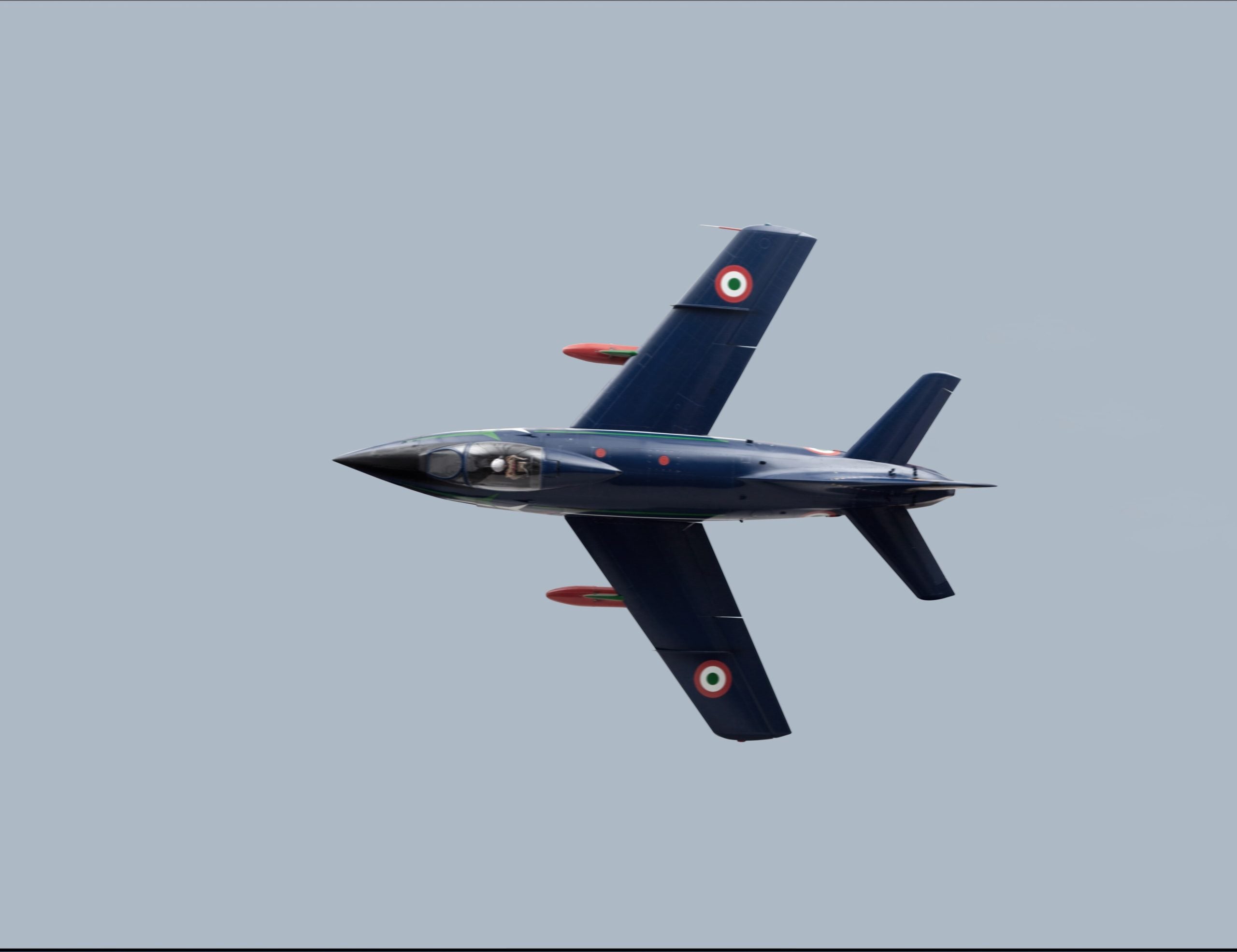
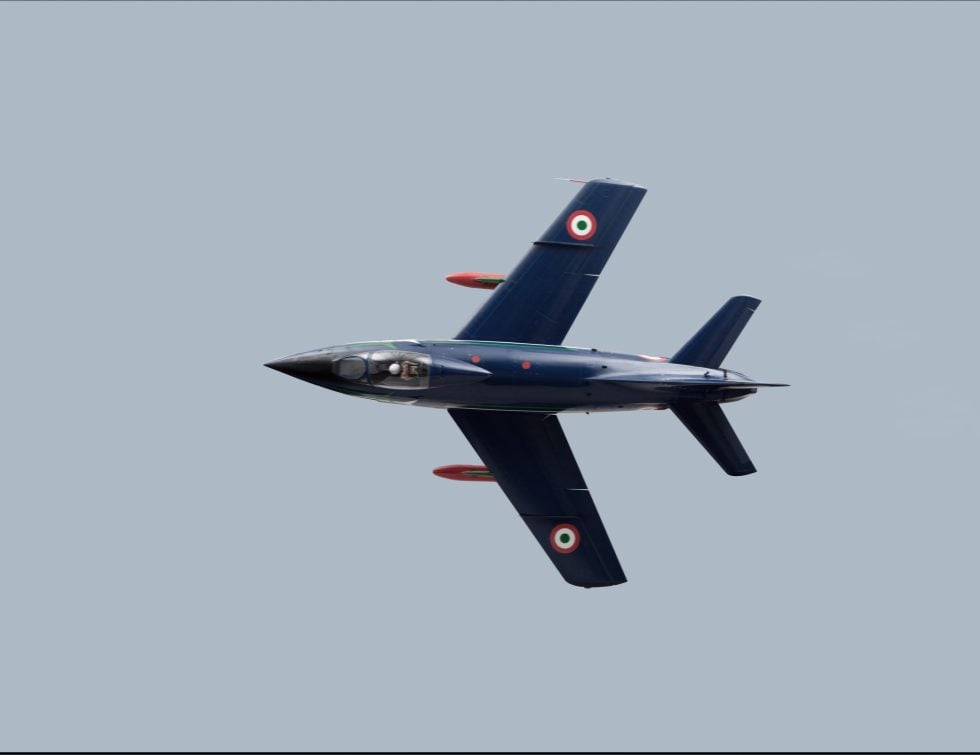
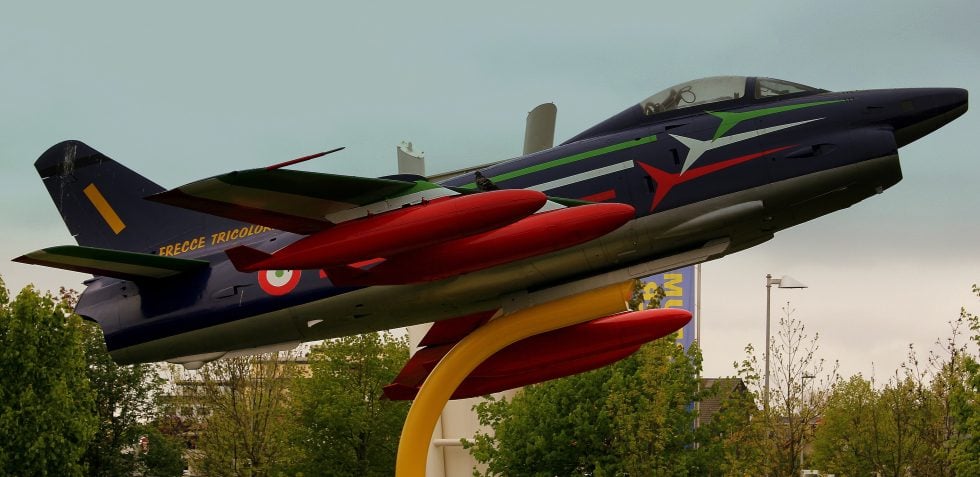
Italy’s G.91 had a second career nobody planned. In 1963–64 sixteen pre-production airframes were stripped of guns, ammunition boxes and cameras, fitted with smoke generators and handed to the Pattuglia Acrobatica Nazionale, which had formed at Rivolto on 1 March 1961 flying F-86Es. The G.91PAN gave the Frecce Tricolori the aeroplane the team is still identified with: nine aircraft plus a soloist, roughly 1,500 flying hours a year, and serviceability in excess of 90 per cent from an airframe designed to be maintained in a field. The team flew it until 1982, when the MB-339A took over. More people have seen a G.91 in a Frecce Tricolori display than have ever seen one carry a weapon, and the 1988 Ramstein disaster — frequently misattributed to the type — happened six years after the team had given up its G.91s.
- G.91 prototypes and pre-production (1956–1959, 3 prototypes and 27 pre-production)
- First flight 9 August 1956 at Turin. Orpheus 801 of 20.11 kN (4,520 lbf); the first aircraft lost on 20 February 1957 to a horizontal-tail control failure. The pre-production batch first flew on 20 February 1958 and provided the airframes later converted for the Frecce Tricolori.
- G.91R/1, R/1A and R/1B (1958–1964, ~100 for Italy)
- The Italian production standard: four 12.7 mm Colt-Browning M3, three nose cameras, 454 kg (1,000 lb) external load, Orpheus 803. The R/1A brought revised navigation instrumentation to a partly American standard, the R/1B a strengthened airframe and undercarriage after early fatigue findings. Entered operational service 1961.
- G.91R/3 (1959–1966, 344: 50 Fiat-built plus 294 built in Germany)
- The definitive mark and the baseline here. Two 30 mm DEFA 552 in place of the machine guns, 680 kg (1,500 lb) external load, uprated electrics, revised navigation fit and, on some aircraft, an arrester hook. First German-built example flew from Oberpfaffenhofen on 20 July 1961.
- G.91R/4 (1961–1962, 50 built)
- Built against a Mutual Aid order for Greece and Turkey, who both then chose American aircraft. Four 12.7 mm guns as on the R/1 but the R/3’s 680 kg (1,500 lb) load and structure. Ten went to the Luftwaffe, forty to Portugal in 1965–66 — and it is this orphaned batch, built for two air forces that did not want it, that became the only G.91 to fight.
- G.91T/1 and G.91T/3 (1960–1973, ~76 and 66)
- The two-seat operational trainer: 1.38 m longer, a taller fin, a larger wing of 18.13 m² and a stepped tandem canopy, with a reduced gun fit and the full pylon set retained for weapons training. T/1 for Italy from 1964, T/3 for the Luftwaffe with 44 built by Fiat and 22 in Germany from 1971 to 1973. It is the T airframe, not the R, that the G.91Y was built from.
- G.91PAN (1963–1964, 16 conversions)
- Pre-production airframes stripped of armament, ammunition boxes and camera fit, fitted with a smoke generation system and coloured-dye tanks for the Frecce Tricolori. Flown by the team from 1964 until the MB-339A replaced it in 1982, with availability above 90 per cent and about 1,500 hours a year on the fleet.
- G.91Y (1966–1976, 67: 2 prototypes, 20 pre-series, 45 series)
- Close to a different aeroplane. The trainer fuselage retained, the single Orpheus replaced by two afterburning General Electric J85-GE-13As for about 60 per cent more thrust, automatic leading-edge slats, more fuel, a lightened structure and a genuinely modern nav-attack fit. First flight 27 May 1966 (widely also given as 12 December 1966 for the second aircraft); in service from July 1968 with 101º Gruppo at Cervia and from 1974 with 13º Gruppo at Brindisi.
- G.91YS (1970, prototype only)
- Developed against a Swiss requirement, first flown 16 October 1970: a fifth pylon, improved AIM-9 Sidewinder provision and upgraded avionics. Switzerland bought nothing, and neither did anyone else.
- Unbuilt projects: G.91R/5, R/6, T/4, G.91YT (1959–1970s, none built)
- A long-range R/5 for Norway, an improved R/6 for Italy, a T/4 with F-104G instrumentation to serve as a Starfighter lead-in trainer, and a two-seat conversion trainer version of the twin. Every one of them died for want of an order, which is the story of the type in miniature.
- Ex-Luftwaffe transfers to Portugal (1976–1982, 94 aircraft)
- Not a variant but the most consequential re-designation in the type’s history. As Germany retired its fleet, Portugal took 94 surplus R/3s and T/3s at nominal cost; only around 44 were made operationally useful and the rest were cannibalised or used for ground instruction. These aircraft equipped Esquadra 301 Jaguares at Montijo and Esquadra 303 Tigres, flew in NATO Tiger Meets in 1980 and 1985, and kept the type in front-line European service for another decade after its combat career had ended.
Closing note on survivors and disposition. Around 756 G.91s of all marks were built between 1956 and 1977, and the surviving population is unusually large for a type of its age because three air forces retired substantial fleets in the same decade rather than losing them piecemeal. Portugal preserves the most: approximately 46 airframes in museums, on air base gate plinths, in public parks and in storage, including examples at Sintra air base, at the Museu do Ar and at Jardim Gil Eanes in Portimão — all of them originals, most of them ex-Luftwaffe R/3s and T/3s that reached Portugal after 1976, and several of them Guinea and Mozambique veterans. Germany holds a large number, notably at the Luftwaffenmuseum der Bundeswehr at Berlin-Gatow, at the Flugwerft Schleissheim of the Deutsches Museum, and on plinths at former Luftwaffe stations; the Bundesluftwaffe wrote off 70 aircraft in twenty-two years of operation, a loss rate that was regarded at the time as good. Italy preserves G.91Rs, G.91Ts, G.91Ys and, most visibly, Frecce Tricolori G.91PANs at the Museo Storico dell’Aeronautica Militare at Vigna di Valle, the Museo Nazionale della Scienza e della Tecnologia in Milan and on gate guardian duty at air force stations across the country. Single aircraft are held further afield, including one at the Malta Aviation Museum at Ta’ Qali. Every survivor is an original airframe: no G.91 replica or reproduction has ever been built, there being neither a market nor a reason. Critically, none of them flies. No G.91 of any mark is known to be maintained in airworthy condition anywhere in the world, and none has been civil-registered and returned to flight in the way that Gnats, Hunters and L-39s routinely are — a consequence of a bespoke Italian-built Orpheus with no civil support chain and an ejection seat and armour fit that make the type awkward to certify. The last flights were, in order: the last Luftwaffe G.91 in 1982; the last Italian G.91R at Treviso on 9 April 1992; the last Portuguese aircraft on 15 June 1993, after twenty-seven years and more than 75,000 flying hours; the last Italian G.91Y in 1994 as the AMX replaced it; and the last Italian G.91T in 1995, closing thirty-four years of Italian service and the operational history of the type.
From NATO contest to Cold-War workhorse
NBMR-1 issued
NATO calls for a lightweight, rough-field strike fighter — its first attempt at a common combat aircraft.
First flight
Gabrielli’s Fiat G.91 prototype flies for the first time on 9 August, piloted by Riccardo Bignamini.
Wins the contest
The G.91 beats the Breguet Taon and Dassault Étendard VI in the NATO fly-offs and enters Italian service.
Two-seat trainer
The transonic G.91T trainer first flies on 31 May, checking out pilots for the single-seat strike versions.
Frecce Tricolori
Italy’s national aerobatic team adopts a special unarmed G.91 PAN; German licence production ramps up.
Twin-engine Gina
The G.91Y first flies on 27 December; Portugal begins combat use of the G.91R/4 in Portuguese Guinea.
Passing the baton
West Germany retires the G.91; the Frecce Tricolori replace it with the Aermacchi MB-339.
Into history
Italy retires the last G.91 and G.91Y; Portugal withdraws its fleet in 1993 after some 75,000 hours.
From the flight line: twelve Fiat G.91 stories
The first common fighter
NBMR-1 was NATO’s attempt to make every air force fly the same cheap strike jet.
Read the full story
Confidence before the verdict
Italy ordered the G.91 into production before it had even won the contest.
Read the full story
The engine England built and America paid for
A British turbojet, funded by the US, licence-built in Turin.
Read the full story
Fighting from a field
The G.91 was engineered to survive the day the runways die.
Read the full story
The first German jets after the war
Licence-building the Gina restarted Germany’s combat-aircraft industry.
Read the full story
Gina writes smoke over Europe
For nearly two decades the Gina was the face of Italian aerobatics.
Read the full story
Portugal’s African war
The only G.91 to fire in anger did so over Portugal’s colonies.
Read the full story
Downed by a soldier’s shoulder
Over Guinea, guerrillas with Soviet Strela missiles shot down several Ginas.
Read the full story
The twin-engine Gina
They swapped the single engine for two — and nearly built a new aircraft.
Read the full story
The one that got away from the US Army
America nearly flew the Gina — until the Air Force said no.
Read the full story
The orders that never flew
Greece and Turkey’s Ginas vanished into other air forces.
Read the full story
Gina flies again
In 2023 a restored Frecce Tricolori Gina returned to the sky.
Read the full story
The Fiat G.91 in pictures
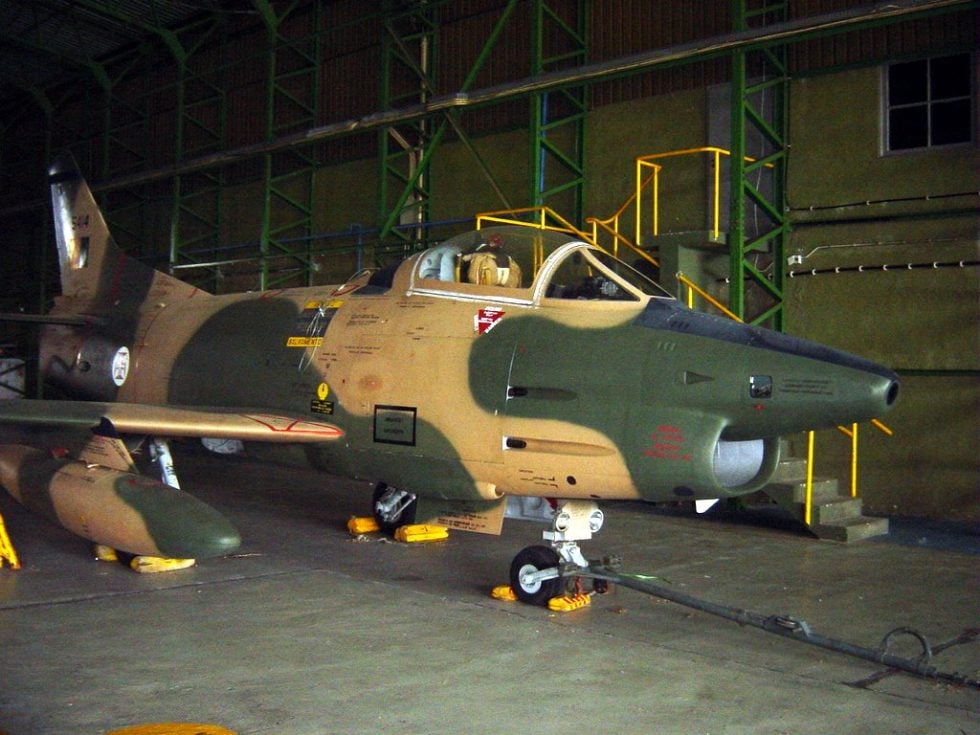
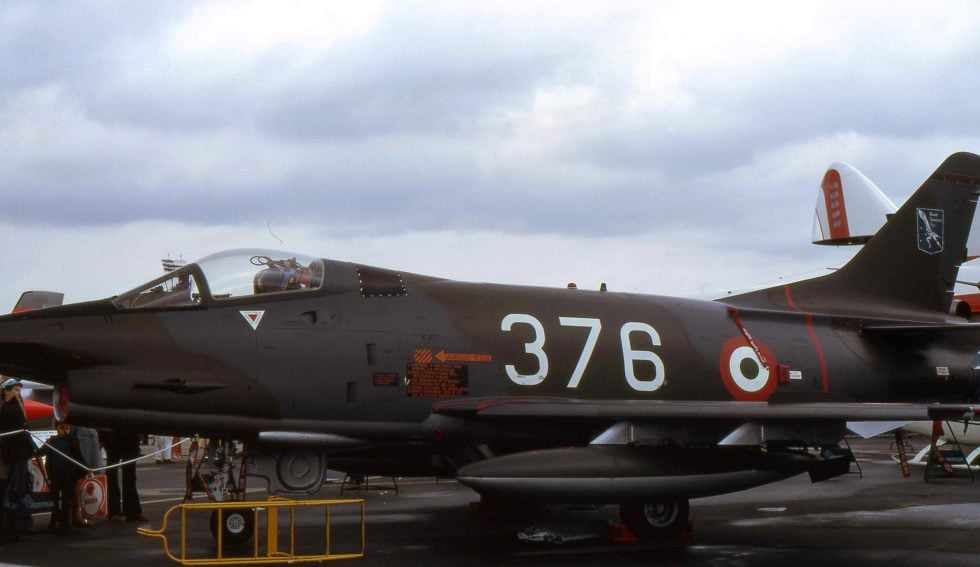
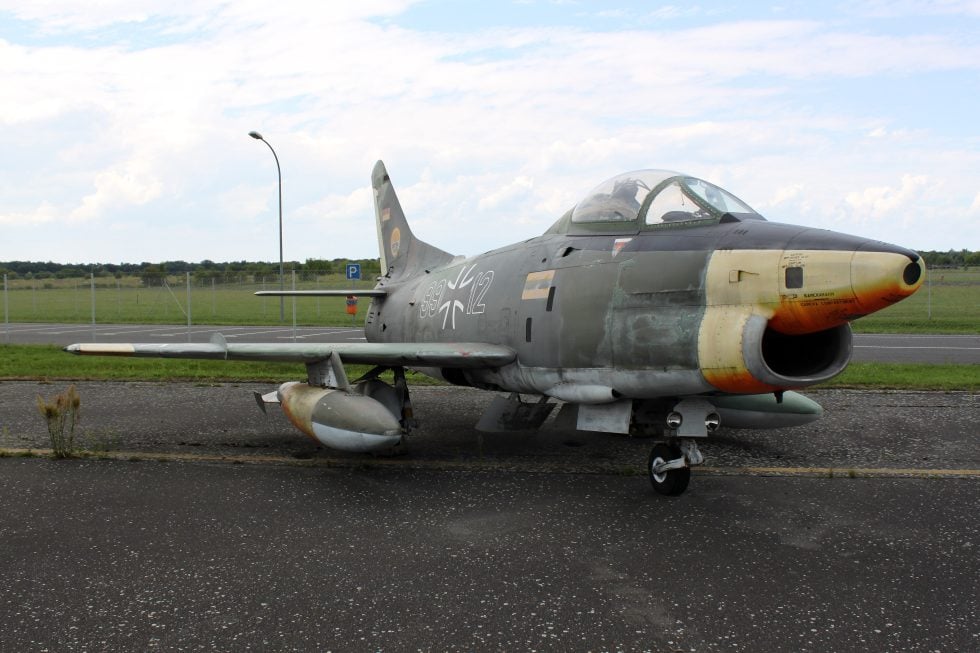
The Fiat G.91 in motion
A featured Fiat G.91 video is coming soon. In the meantime, explore the gallery above and the twelve stories for the full picture of NATO’s little strike fighter.
The G.91 in motion
Military Aviation History — one of the most-watched G.91 films on YouTube.
Where the Fiat G.91 flew
The war the Gina actually fought
Italy and West Germany kept the G.91 poised for a NATO war in Europe that never came — neither ever fired it in anger. The type’s only sustained combat was Portuguese: from 1966 the Portuguese Air Force flew the Gina in close-air-support and strike missions during the colonial wars in Guinea, Mozambique and Angola. It is a difficult chapter, recorded here as history — the little jet met heavy ground fire and, in Guinea, some of the first shoulder-launched anti-aircraft missiles ever used in combat.
Compare the combat record of every military aircraft. Figures as of July 2026.
Everything people ask about the Fiat G.91
Can I fly in a Fiat G.91?
What do the “G” and the name “Gina” mean?
Why was the G.91 built?
Who used the Fiat G.91 in combat?
What engine did it have?
How fast was the Fiat G.91?
Did the Frecce Tricolori fly the G.91?
Is any Fiat G.91 still flying?
You can’t fly the Fiat G.91.
These, you can.
Some legends only live in museums — others are fuelled and waiting. MiGFlug has put civilians in real military jet cockpits since 2004.
 Fly the L-39 AlbatrosThe world’s most-flown jet trainer — aerobatics included
 Fly the F-104 Starfighter“The missile with a man in it”
 Fly the MiG-21The Cold War’s most-produced jet
 Fly the T-33 Shooting StarAmerica’s first jet trainer
 Fly the DH VampireA piece of early jet history
 Fly the S.211Agile Italian jet trainer
 Fly the MB-326The classic Aermacchi jet
 Fly the MiG-15The Soviet legend of the Korean War
Continue the tour
Every fact, checked
- GlobalSecurity.org — Fiat G.91NATO competition, engine, variants, production and operator breakdown.
- The Aviation Geek ClubPortuguese G.91 service in Angola — squadrons, serials and the 1974–75 withdrawal.
- Aces Flying High — Portuguese TigerPortuguese variants, combat losses, SA-7 shoot-downs and the 75,000-hour tally.
- Malta Aviation MuseumNBMR-1 background, competition finalists, variants and Frecce Tricolori history.
- flugzeuginfo.net — G.91 dataDimensioned specifications for the single-engine G.91R.
- MilitaryFactory — Fiat G.91Variant-by-variant armament and specifications (12.7 mm guns vs 30 mm cannon).
- AirVectors (Greg Goebel)Narrative development history and the G.91/AMX variant lineage.
- Vintage Aviation NewsThe sole airworthy G.91 (MM6305), restored 2022–23, and total-production figures.