
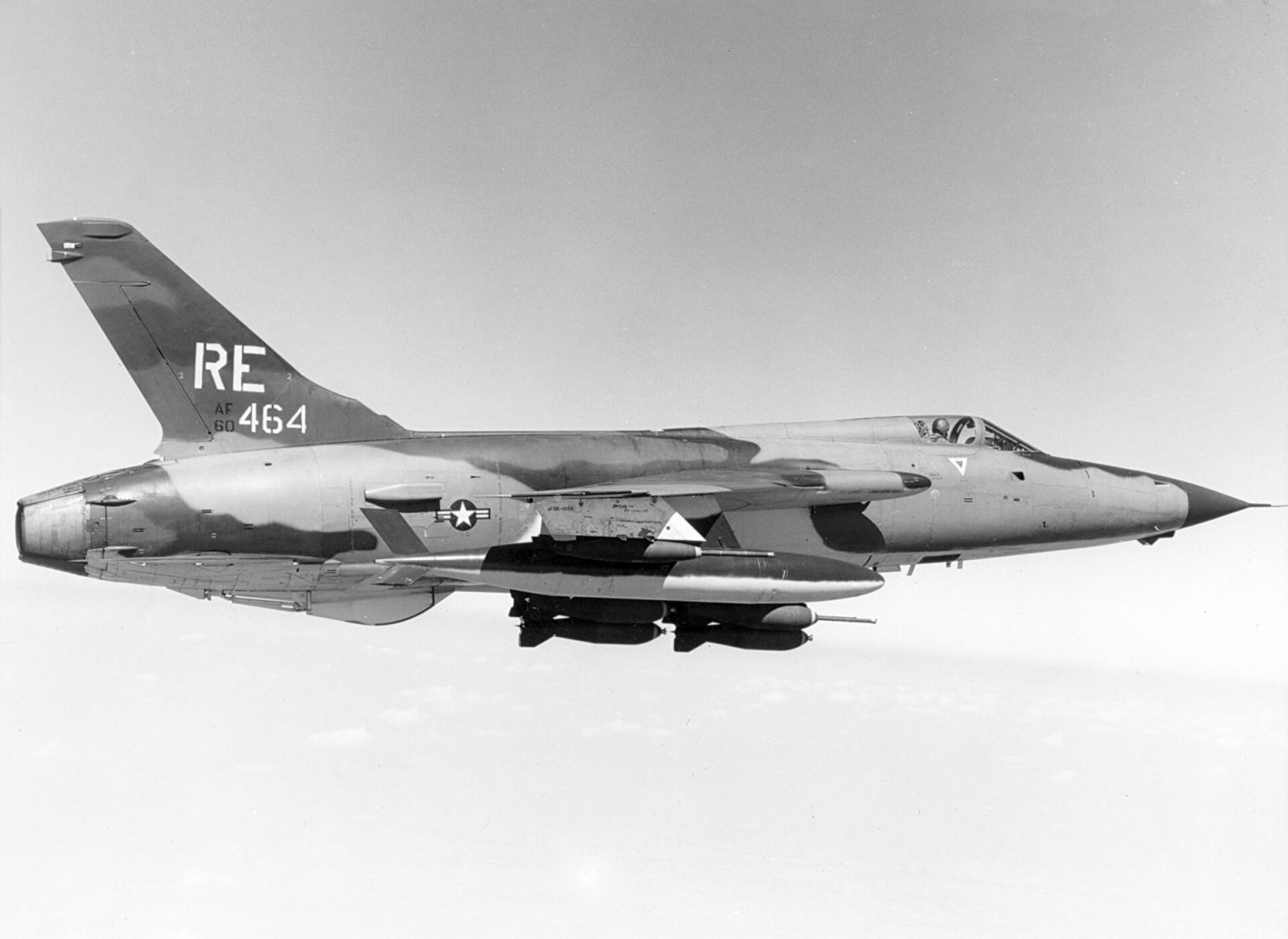
Republic F-105 Thunderchief
“Thud”
The largest single-seat, single-engine combat aircraft ever built — a Mach-2 nuclear strike bomber that became the workhorse of Rolling Thunder, and paid for it with nearly half its fleet over North Vietnam.
The nuclear bomber that fought a conventional war
The F-105 was never meant to do what history remembers it for. Republic Aviation’s chief designer Alexander Kartveli conceived it around 1951 as a private venture: a single-seat, single-engine machine that could dash across enemy territory at supersonic speed, low and fast, and drop a nuclear bomb carried in an internal bomb bay. Everything about it was built for that one mission — a huge airframe wrapped around a huge engine, with distinctive forward-swept air intakes feeding the intake air it needed at Mach 2.
The result, first flown as the YF-105A on 22 October 1955 and in squadron service from 1958, was the biggest single-seat, single-engine combat aircraft ever built. At over 23 tonnes fully loaded it was heavier than some World War II medium bombers, and it could carry a bigger bomb load than a B-17. Crews called it the “Thud” — part affection, part gallows humour about the sound they imagined it made hitting the ground.
Then came Vietnam. The nuclear bomb bay was plumbed for a fuel tank, the racks were hung with conventional iron bombs, and the Thud was sent north. From 1965 it flew the bulk of the Rolling Thunder strike campaign against the most heavily defended airspace on earth — and it was slaughtered there. It also, improbably, shot down MiGs with its gun and pioneered the most dangerous mission in the air force: hunting surface-to-air missiles as a Wild Weasel.
01Why the F-105 Thunderchief was so big: a fighter designed around a nuclear bomb bay
Most fighters grow around a cockpit and a pair of wings. The F-105 grew around a bomb bay. Kartveli’s team started from the volume needed to carry a Mark 28-class nuclear weapon internally — so that the aircraft stayed clean and fast on the low-level dash to the target — and then wrapped a Mach-2 airframe and the most powerful available engine around it. That is why the Thud ended up the largest single-seat, single-engine combat aircraft ever fielded, with an empty weight heavier than a fully loaded World War II fighter.
The irony is that the internal bay was almost never used for its intended purpose. Over Vietnam it usually carried a 1,500-litre fuel tank to extend the aircraft’s short legs, while the bombs hung outside on wing and centreline pylons. The Thud spent its whole combat career doing the opposite of what its shape was optimised for.
What makes the F-105 special
One giant engine, one giant airframe
The Thunderchief is built around a single Pratt & Whitney J75 turbojet delivering about 109 kN (24,500 lbf) in afterburner — then one of the most powerful engines in the world. Feeding it are the F-105’s signature forward-swept wing-root intakes, which used variable geometry to manage airflow past Mach 2. No other single-engine fighter of its generation was anywhere near its size.
The fastest ride down on the deck
Loaded with bombs, the Thud was clumsy in a turning dogfight — but at low level, wide open, it was breathtaking. Its wing loading and raw thrust made it rock-steady and blisteringly fast on the deck, faster than almost anything that tried to catch it near the ground. That low-altitude speed was the whole point of a nuclear striker, and it kept many Thud crews alive when they ran for the coast after a strike.
Wild Weasel: the SEAD pioneer
The two-seat F-105F and F-105G turned the Thud into the world’s first dedicated SAM-hunter. Carrying radar-warning receivers and the AGM-45 Shrike anti-radiation missile — later the larger AGM-78 Standard ARM — the “Wild Weasels” deliberately baited SA-2 missile radars into switching on, then killed them. It invented the suppression-of-enemy-air-defences mission that every air force still flies today.
02The F-105 Thunderchief’s Wild Weasel mission: ‘first in, last out’
When North Vietnam fielded Soviet SA-2 surface-to-air missiles in 1965, the USAF had no answer. The response was the Wild Weasel: two-seat Thuds crewed by a pilot and an electronic-warfare officer whose job was to fly into the missile envelope, provoke a radar lock, and destroy the site. The crews’ grim motto was “First In, Last Out” — they arrived ahead of the strike package to clear the SAMs and stayed until the bombers had left. When the concept was first briefed, one EWO’s reaction — “You gotta be sh***ing me”, abbreviated YGBSM — became the community’s badge of honour. It was statistically the most dangerous flying job of the war.
03The F-105’s MiG kills: a bomber that fought back with its gun
The Thud was a strike aircraft, not a fighter — yet it is credited with 27.5 confirmed MiG kills over Vietnam, and all but a couple were scored with its internal 20 mm M61 Vulcan cannon rather than with missiles. Heavy and fast, a clean F-105 that had already dropped its bombs could accelerate away from a MiG-17 and, in the right setup, turn the tables with a gun pass. It was never going to win a low-speed turning fight, but on its own terms the bomber occasionally became the hunter.
Full F-105D specifications
Baseline note: the figures below describe the single-seat F-105D in the form it flew over North Vietnam — one Pratt & Whitney J75-P-19W turbojet with water injection, the AN/ASG-19 Thunderstick fire-control system built around a NASARR R-14A radar, an M61A1 rotary cannon in the port side of the nose and, on very nearly every combat sortie, a fuel tank rather than a bomb inside the bomb bay. That is the right baseline because the D was the Thunderchief: 610 of the 833 airframes completed were F-105Ds, and they flew the majority of United States Air Force strike sorties against North Vietnam in the first years of the war. Deltas for the earlier F-105B and for the two-seat F-105F and F-105G Wild Weasel are in grey. Eight warnings before any number below is read. First, and most important, the loss figures, because they are quoted more loosely than those of any other American aircraft. Two tallies circulate in reputable works and both appear in the same reference sources: 382 aircraft lost of 833 built, of which 62 were operational rather than combat losses; and 395 F-105s lost in South-East Asia, of which 334 fell to enemy action — 296 F-105Ds and 38 two-seaters — and 61 to operational accidents. The two are not reconcilable by arithmetic and the difference lies in whether aircraft written off after recovery, destroyed on the ground, or lost outside the South-East Asia theatre are counted. What both agree on is the thing that matters: 296 F-105Ds destroyed by the enemy against 610 built is 48.5 per cent of the single-seat fleet, and over the whole life of the type roughly 612 of the 833 airframes ever built were destroyed in accidents or in combat. Second, production. The 833 total is a fleet figure and only adds up if you count everything: 2 YF-105A, 4 YF-105B, 71 F-105B, 610 F-105D, 143 F-105F and 3 JF-105B. Anyone quoting the F-105B as more than 71 aircraft is folding the prototypes into the production run. Third, maximum speed. Mach 2.1 at 35,000 ft is the specification figure for a clean aeroplane on a test card. A Thunderchief carrying six 750 lb bombs, two 450 US gallon tanks and a jamming pod was a transonic aircraft, and the speed that actually kept crews alive was the low-level dash, where the F-105 was the fastest thing in the theatre and the canopy could go milky from kinetic heating. Fourth, range. The 676 nautical mile combat range is a range and not a radius. Missions from Takhli and Korat to Route Package Six required two or three tanker contacts, and the F-105 campaign was as much a tanker campaign as a bombing one. Fifth, ordnance. 14,000 lb is the quoted total capacity across bay and pylons; the bomb bay alone was rated at about 8,000 lb; and a representative Rolling Thunder load was six M117s, some 4,500 lb, because fuel and jamming pods took the rest. Sixth, the bomb-bay tank. Its capacity is given as 390 US gallons in the standard specification tables and as 350 US gallons in other accounts of the same installation; both circulate and neither is obviously wrong. Seventh, gun ammunition: 1,028 rounds is the usual figure, 1,029 appears almost as often, and at close to 6,000 rounds per minute the difference is a tenth of a second. Eighth, a correction that keeps propagating: the engine is a Pratt & Whitney J75. The Smithsonian’s own online object record for its F-105D calls it a General Electric J75-P-19W, which is wrong, and the error has been copied widely.
Dimensions & weights
- Crew
- 1 — and this is the whole point of the aeroplane. The F-105D is the largest single-seat, single-engine combat aircraft ever built, heavier at maximum weight than a loaded Second World War medium bomber, flown by one man who navigated, found the target, worked the radar, dropped the bombs and fought the MiGs. The F-105F and F-105G carry two: pilot in front, and behind him an electronic warfare officer whom the Weasel crews called the Bear
- Length
- 19.63 m (64 ft 4¾ in) for the F-105D. The two-seat F-105F and F-105G are about 21.21 m (69 ft 7 in), roughly five feet longer, the stretch absorbed into the forward fuselage to make room for the second cockpit
- Wingspan
- 10.65 m (34 ft 11¼ in) — identical on every mark. A very short span for an aircraft of this weight, chosen deliberately so the wing would ride smoothly through low-level turbulence at high speed rather than climb well
- Height
- 5.99 m (19 ft 8 in). The two-seaters are taller at about 6.15 m (20 ft 2 in) because the fin had to grow in area to restore directional stability lost to the longer nose
- Wing area
- 35.77 m² (385 sq ft) — small, and the reason the Thunderchief turned badly, climbed indifferently and cruised beautifully at 500 ft
- Aspect ratio
- 3.18 — a stubby, highly loaded wing. Compare the F-4 Phantom II at 2.77 or the A-4 Skyhawk at 2.91: the F-105 belongs firmly in the low-level dash family, not the manoeuvring one
- Wing sweep
- 45° at quarter chord — more sweep than most of its contemporaries, bought at a real cost in low-speed handling and approach speed. Thunderchiefs landed fast and used a drag chute as a matter of routine
- Aerofoil
- NACA 65A005.5 at the root, NACA 65A003.7 at the tip — five and a half and under four per cent thickness/chord. That is exceptionally thin, thin enough that there is no room in the wing for fuel, which is why every drop of the F-105’s internal fuel sits in the fuselage on top of a very hot engine. It is the single design decision that did most to make the aircraft burn when hit
- Empty weight
- 12,181 kg (26,855 lb). The F-105F and F-105G are close to 900 kg (2,000 lb) heavier empty, which cost them a little acceleration and almost nothing in top speed
- Gross weight
- 16,165 kg (35,637 lb) — the clean combat weight against which the performance figures in the middle column are quoted
- Maximum take-off weight
- 23,967 kg (52,838 lb). A fully loaded F-105D on a hot Thai afternoon weighed more than a Second World War B-25 Mitchell and needed most of a 10,000 ft runway to get airborne
- Internal fuel
- 2,900 L (770 US gal) in the fuselage tanks, plus ~1,480 L (390 US gal) in the bomb-bay tank that occupied the weapons bay on almost every combat sortie. Maximum fuel with a 650 US gallon centreline tank and two 450 US gallon wing tanks is about 10,600 L (2,810 US gal). Some accounts give the bomb-bay tank as 350 US gal
- Bomb bay
- 4.83 × 0.81 × 0.81 m (15 ft 10 in × 32 in × 32 in) — sized precisely around one nuclear store and rated at about 8,000 lb. It is the defining feature of the design and, in eight years of war, it almost never held a weapon
Performance
- Maximum speed
- Mach 2.1 at 10,700 m (1,210 kt, 2,241 km/h, 1,393 mph at 35,000 ft), clean. The F-105B reached Mach 2.15 on test. This is a specification number and no combat-loaded Thunderchief ever went near it
- Speed at low level
- 1,958 km/h (1,216.48 mph, 1,057 kt) — the world speed record over a 100 km closed circuit, set on 11 December 1959 by an F-105B flown by Brigadier General Joseph Moore. That record, flown low and clean, is the most honest single statement of what the aeroplane was built to do
- Rate of climb
- 196 m/s (38,500 ft/min) at sea level, clean and in reheat with water injection
- Time to 10,700 m
- 1 min 42 s (to 35,000 ft) — respectable rather than remarkable for a Century Series aircraft, and irrelevant to the way the type was actually used
- Service ceiling
- 14,800 m (48,500 ft). Lower than every interceptor of its generation, because altitude was never what this aircraft was for
- Combat range
- 1,252 km (676 nmi, 778 miles) — a range, not a radius, and quoted for a clean aircraft. Read the next row instead
- Typical combat radius
- ~370–480 km (~200–260 nmi) unrefuelled with a useful bomb load. The Hanoi target areas lay some 640 km (400 miles) from the Thai bases, so a Route Package Six mission meant a pre-strike tanker contact on the way in and another on the way out. Without KC-135s there was no Rolling Thunder
- Ferry range
- 3,550 km (1,917 nmi, 2,207 miles) with maximum external fuel and no ordnance
- Wing loading
- 450 kg/m² (93 lb/sq ft) at gross weight — among the highest of any fighter of the period, and the arithmetic behind both the smooth low-level ride and the inability to turn with a MiG-17
- Thrust-to-weight
- 0.74 at gross weight in full reheat with water injection. At combat take-off weight it is well under 0.5, which is why fully loaded departures from Takhli in the hot season were a matter of professional interest
- Maximum lift-to-drag
- 10.4 — a clean, efficient airframe by the standards of 1959, and the reason a damaged Thud with a running engine could often be coaxed a long way towards the Gulf of Tonkin before its crew had to leave it
Propulsion & systems
- Engine
- 1 × Pratt & Whitney J75-P-19W afterburning turbojet — the same engine family as the F-106 Delta Dart and the U-2, and one of the largest turbojets ever fitted to a single-engine fighter. The F-105B flew initially on the J75-P-5 at 23,500 lbf and late production blocks received the J75-P-19
- Thrust, dry
- 64.0 kN (14,300 lbf) military power
- Thrust, reheat
- 117.9 kN (26,500 lbf) with afterburner and water injection. The W in the designation is the water: a demineralised water injection system that raised mass flow for take-off and gave a hot, heavy Thunderchief roughly a thousand extra pounds of thrust for the two minutes that mattered most
- Air intakes
- Forward-swept variable-geometry side inlets — the aircraft’s signature feature and the work of Antonio Ferri, carried across from the abandoned Republic XF-103 programme. The forward sweep and the movable internal plug matched airflow to the engine from subsonic to Mach 2 and gave the F-105 a recognisable silhouette that nothing else has ever shared
- Fuselage
- Area-ruled — the pronounced wasp waist was added after the first prototypes proved draggy through the transonic region. The YF-105A was not area-ruled and, though it went supersonic on its first flight on 22 October 1955, it was a markedly slower aeroplane than the YF-105B that followed on 26 May 1956
- Speed brakes
- Four petals arranged around the exhaust nozzle — opening in a cloverleaf around the jet pipe. Distinctive, effective, and a reliable way of identifying an F-105 in a photograph
- Fire control
- AN/ASG-19 Thunderstick with NASARR R-14A monopulse radar — an all-purpose radar with air-to-air ranging, ground mapping and terrain-avoidance modes, working with a toss-bombing computer, an air data computer and an autopilot. The F-105B had the far simpler MA-8 with an E-34 ranging gunsight and an E-30 toss computer; it was a fair-weather aircraft and the D was not
- Navigation
- AN/APN-131 Doppler navigator with air data computer and autopilot. Thirty F-105Ds were later given AN/ARN-92 LORAN under the Thunderstick II programme, recognisable by a long dorsal spine running from the canopy to the fin, and credited with about 50 ft bombing accuracy from 15,000 ft — blind-bombing accuracy that arrived too late to matter over the North
- Flight controls
- Fully powered, dual hydraulic systems, all-moving stabilator — and the type’s worst flaw. The hydraulic lines ran close together through the lower fuselage, a single fragment could drain both systems, and with pressure lost the stabilator ran to full nose-down. At 500 ft that was fatal, and it killed a great many Thunderchief pilots before armour, line separation and a manual stabilator-locking device were retrofitted to give a crew a few more seconds to get out
- Survivability fit
- Added armour, improved ejection seat, fin-mounted radar homing and warning antennas — all retrofitted during the war rather than designed in, along with ram-air scoops to cure afterburner-bay fires caused by inadequate cooling. The fuel sat in the fuselage above the engine because the wing was too thin to hold any, so a hit that opened a tank very often produced a fire
- Wild Weasel electronics
- AN/APR-25 and AN/APR-26 vector and launch-warning receivers, ER-142 panoramic receiver on the F-105F Wild Weasel III. The F-105G added AN/APR-35, AN/APR-36 and AN/APR-37 homing and warning sets and the AN/ALR-31 wingtip installation, plus a pair of Westinghouse AN/ALQ-105 jamming transmitters carried in two long cylindrical blisters faired onto the fuselage sides — internal jamming that freed the underwing pylons for weapons
- Refuelling
- Flying-boom receptacle in the upper nose with provision for a bolt-on probe on the port side for probe-and-drogue tankers, a legacy of the KB-50 era and of trans-Pacific deployments. In practice the war was fought behind KC-135s and the boom
04The F-105 Thunderchief’s cost: cheap to buy, brutally expensive to lose
The F-105D’s flyaway price is usually quoted at around $2.1 million in early-1960s dollars — roughly $20 million in today’s money and modest for a Mach-2 aircraft. But the meaningful cost of the Thud was measured in attrition, not procurement. With production having ended in 1964, every airframe shot down over North Vietnam was irreplaceable: the assembly lines were closed, and the fleet simply shrank with each mission. No reliable public cost-per-flight-hour figure exists for the type, and any precise dollar figure attached to it should be read as an estimate.
Armament & payload
The Thunderchief was designed around a bomb bay it hardly ever used and saved by a gun nobody thought it would need
Everything about the F-105’s armament follows from a single sentence in the requirement: one thermonuclear bomb, carried internally, delivered at very low level and very high speed after a one-way dash into the Warsaw Pact. That is what the 15 ft 10 in bay in the belly is for, that is why the wing is too thin to hold fuel or pylons of any size, and that is why the aeroplane has the acceleration of a missile and the turning circle of a lorry. It never dropped a nuclear weapon. What it dropped instead, for eight years, was iron: M117 750-pounders in sixes and eights, hung on external racks the airframe had never been designed around, while the bomb bay held a ferry tank because the fuel had to come from somewhere.
Two weapons rescued the type’s reputation. The first was the M61A1 Vulcan, fitted almost as a courtesy to the fighter lobby and mounted low on the port side of the nose. Twenty-four and a half of the Thunderchief’s 27½ air-to-air victories were scored with it, all of them against MiG-17s, and in 1966 and 1967 F-105 pilots shot down more MiG-17s than the F-4 Phantom II crews escorting them. That is a genuinely strange statistic: a bomb-laden fighter-bomber out-killing its own escort, with a gun, because the escort’s missiles did not work and the Thud had one thing the MiG-17 could not match, which was the ability to accelerate away from anything at low level once the bombs were gone.
The second was the anti-radiation missile, and it changed air warfare permanently. When the SA-2 Guideline appeared over North Vietnam in 1965 there was no established way to fight a radar-guided surface-to-air missile system, so the Air Force invented one, and the two-seat F-105F was the aircraft it invented it in. The AGM-45 Shrike and later the much larger AGM-78 Standard ARM homed on the Fan Song fire-control radar itself. The tactics that grew around them — hunting the site, provoking it into transmitting, killing it before the strike package arrived, and staying over the target area until the last bomber had left — are the origin of every suppression-of-enemy-air-defences doctrine flown since. Fits varied sharply by mark, year and mission: the F-105B carried far less conventional ordnance until Project Look-Alike quadrupled the fit, no single-seat F-105D ever carried a Standard ARM, Sidewinder rails were often left off to save drag, and from 1966 an outboard pylon that might have held a bomb usually held a jamming pod instead.
Gun
- 1 × 20 mm General Electric M61A1 Vulcan, six barrels, in the lower port side of the nose with a linkless feed drum of 1,028 rounds (1,029 appears in some sources). Rate of fire around 6,000 rounds per minute, giving roughly ten seconds of firing in total.
- The Thunderchief was only the second fighter in the world to carry the M61, after the F-104 Starfighter, and the first to take it into a serious air-to-air fight. On the F-105B the weapon carried its development designation, T-171E3.
- 24½ of the type’s 27½ confirmed kills were gun kills, every one against a MiG-17 Fresco. The half is a victory shared with an F-4. Three more were scored with AIM-9 Sidewinders.
- The first, on 29 June 1966, is the story that defines the aircraft: Major Fred Tracy of the 421st TFS, his F-105D hit by nine cannon shells that killed his gunsight and most of his instruments, watched the MiG overshoot his decelerating aircraft, aimed along the pitot boom and fired about 200 rounds by eye. The MiG’s left wing folded.
- Against ground targets the gun was used constantly and hard — on flak sites, trucks, barges and in strafing passes that the manual did not encourage — and the M61’s reliability in that role did as much for its reputation as any air-to-air score.
Air-to-air
- AIM-9B and later AIM-9E Sidewinder, infrared homing, usually two rounds on the outboard underwing pylons and occasionally four. This was the whole of the Thunderchief’s guided air-to-air capability.
- Three kills with the Sidewinder against 24½ with the gun. The AIM-9B was a rear-aspect weapon with a narrow seeker field, a minimum range that a turning fight quickly violated, and a reputation among F-105 pilots for coming off the rail and going somewhere else.
- No radar-guided missile capability of any kind. The NASARR R-14A gave air-to-air ranging for the gunsight, nothing more. The F-105 could not carry an AIM-7 Sparrow and was never intended to.
- Sidewinder rails cost drag and a pylon, so on many strike missions they were simply not fitted — the pylon went to a bomb, a tank or a jamming pod. A Thunderchief pilot expecting a MiG fight brought the gun.
- Set against 27½ victories, 17 F-105s were shot down by enemy fighters. That is a positive exchange ratio for an aircraft that was never meant to fight other aircraft at all, achieved while carrying bombs, and it is the least-known statistic of the Vietnam air war.
Air-to-surface guided
- AGM-45 Shrike — the standard anti-radiation round from 1966, about 177 kg (390 lb), built on a Sparrow airframe with a passive seeker in the nose. Its limitations were severe: a narrow-band seeker that had to be tuned on the ground for the specific radar expected, a launch window of only a few degrees off the nose, an effective reach shorter than the SA-2 that was shooting back, and no memory — if the site switched off, the missile went stupid. Crews put its success rate at around a quarter.
- AGM-78 Standard ARM from 1968 — a naval RIM-66 airframe adapted to the role, about 620 kg (1,370 lb), 4.57 m long, with a 97 kg blast-fragmentation warhead and a reach of roughly 90 km (56 miles). The AGM-78B added a broadband seeker and, crucially, a memory circuit that carried it to the site after the radar shut down. It could be fired from outside the SA-2’s envelope. It was also enormous, heavy, and very expensive, so a Weasel typically carried one, with Shrikes for everything else.
- AGM-12 Bullpup, in the AGM-12B (250 lb warhead) and AGM-12C (1,000 lb warhead) forms — radio command guided, meaning the pilot had to fly the missile onto the target with a small thumb controller while continuing to fly towards the target himself, watching a flare in the tail. Against the Thanh Hoa bridge in 1965 it accomplished essentially nothing, and it was quietly abandoned.
- Only the two-seaters carried the AGM-78. Fourteen F-105Gs were first modified for the AGM-78A, with a further sixteen given AGM-78B capability between November 1968 and June 1969.
- Laser-guided bombs, which transformed the war for the F-4 from 1968, never became an F-105 weapon: by the time Paveway was in wide use the Thunderchief had been withdrawn from the strike role.
Bombs
- M117 750 lb general-purpose bombs — the definitive F-105 weapon. Six on a centreline multiple ejector rack was the standard Rolling Thunder load; eight or more were possible at the cost of fuel. Sixteen 750-pounders is the theoretical maximum sometimes quoted and was not a combat load.
- Mk 80 series — Mk 82 500 lb, Mk 83 1,000 lb and Mk 84 2,000 lb low-drag bombs, increasingly with Snakeye retarding fins for low-level delivery, which the F-105 needed because it released very low and very fast.
- Nuclear stores in the internal bay: Mk/B28, B43, B57 and later B61, delivered by low-altitude bombing system toss manoeuvre — a pull-up, a release over the shoulder and an escape turn, on a profile from which survival was hoped for rather than expected. This was the aircraft’s entire reason for existing and no F-105 ever flew it in anger.
- Cluster and area weapons — CBU-24 and CBU-29 bomblet dispensers used heavily against anti-aircraft artillery sites and SAM crews, and BLU-1 and BLU-27 napalm canisters. Cluster munitions in front of a strike package, to keep gunners’ heads down, was standard Iron Hand practice.
- Maximum ordnance is quoted as 14,000 lb (6,400 kg) across the bay and five hardpoints, with the bay alone rated at about 8,000 lb. The often-repeated line that an F-105 could carry a heavier bomb load than a B-17 is true and slightly misleading: it could not carry that load anywhere useful without tankers.
Rockets
- LAU-3/A pods of 19 × 2.75 in (70 mm) folding-fin aircraft rockets, the standard American fit of the period, carried on the underwing pylons for flak suppression and against soft targets in Laos and southern North Vietnam.
- Smaller LAU-32 seven-round pods were also used, generally when pylons were at a premium and a light suppression load was wanted alongside bombs.
- Rockets were a minor part of the Thunderchief’s repertoire and became rarer as the war moved north. Firing 2.75 in rockets requires a shallow dive and a steady tracking pass, which over Hanoi was a way of being killed.
- The AIR-2 Genie and the other unguided nuclear rockets of the era were interceptor weapons and were never an F-105 fit; the aircraft had no air-defence role.
- There is a persistent claim that F-105s fired 5 in Zuni rockets. Zuni was overwhelmingly a Navy and Marine Corps weapon; if any Air Force Thunderchief carried it, it was not a service-standard fit.
Pods & other stores
- QRC-160-1, later standardised as the AN/ALQ-71 noise jamming pod — arguably the most important store the F-105 ever carried. From late 1966, four-aircraft flights flew a precisely spaced "pod formation" so their overlapping jamming denied the Fan Song radar a usable range solution. SA-2 effectiveness fell sharply. The price was that the formation could not manoeuvre freely, which made it a better target for MiGs and for guns.
- AN/ALQ-87 and successor jamming pods replaced the QRC-160 as North Vietnamese operators learned to work through it — a measure-countermeasure cycle that ran for the whole war.
- Fuel: a 650 or 750 US gallon centreline tank, two 450 US gallon underwing tanks, and the 390 US gallon bomb-bay tank that made the internal bay a fuel compartment on virtually every combat sortie of the war.
- Racks: multiple and triple ejector racks on the centreline and inboard pylons, fitted fleet-wide during Project Look-Alike from 1962 to 1964, which roughly quadrupled the conventional weapons capability of an aircraft designed to carry one bomb inside itself.
- F-105G internal jammers: two Westinghouse AN/ALQ-105 transmitters in long cylindrical fairings along the lower fuselage sides. Putting the jammer inside the aeroplane rather than on a pylon is what made the definitive Wild Weasel a genuinely better aircraft rather than a more heavily loaded one.
Three typical loadouts
- Victor Alert, Western Europe, 1962
- One B43 or B57 nuclear store in the internal bay, two 450 US gallon underwing tanks, gun loaded, aircraft cocked on the pad with a target folder and a low-level route across the inner German border. Delivery by low-altitude bombing system toss. The bomb-bay fuel tank removed, because for once the bay held what it was built to hold. This is the configuration the entire aeroplane was designed for and it was flown thousands of times on alert and never once in anger.
- Rolling Thunder strike, Route Package Six, 1967
- Six M117 750 lb bombs on a centreline multiple ejector rack, two 450 US gallon tanks on the inboard pylons, one QRC-160 jamming pod outboard, a 390 US gallon tank filling the bomb bay, 1,028 rounds for the M61. Two tanker contacts, an approach up Thud Ridge north-west of Hanoi, a 45-degree dive-bomb delivery through what was by 1967 the heaviest air defence system ever assembled, and out low and fast. Bomb load: about 4,500 lb, on an aircraft rated for 14,000.
- Iron Hand Wild Weasel, F-105G, 1972
- One AGM-78B Standard ARM on an inboard pylon, two AGM-45 Shrikes outboard, two 450 US gallon tanks, AN/ALQ-105 jammers internal, full APR-35/36/37 warning and homing fit, gun loaded. First into the target area to hunt the SA-2 sites, last out to cover the withdrawal of the strike aircraft. The mission that gave the Weasel community its motto and its casualty list.
Sourcing caveat. Weapon fits are drawn from USAF technical orders, unit histories and the standard published accounts, and they varied from wing to wing, month to month, and with the pilot’s own judgement about drag. The 27½ aerial victory total is the official USAF credit and individual claims have been revised more than once; North Vietnamese records of their own MiG-17 losses do not match the American credits, as is true across the whole war. The 14,000 lb ordnance figure is a structural capacity, not a load anyone flew. Shrike hit rates around 25 per cent come from crew recollection rather than from instrumented assessment, and no reliable independent count exists of how many SA-2 sites were actually destroyed by anti-radiation missiles as opposed to being merely silenced.
Variants
The Thunderchief has three production marks, no export customers at all, and one conversion that invented a whole branch of air warfare
The F-105 has a short variant list for an aircraft built in such numbers, and an unusually honest one: almost every proposed mark was cancelled, nothing was ever licence-built, and not a single Thunderchief was ever sold abroad. It served with one air force, the United States Air Force, and with nobody else. That is rare for a Century Series type — the F-100, the F-104 and the F-5 all went overseas in quantity — and it is a consequence of what the aeroplane was: a specialised nuclear penetrator, expensive, thirsty, demanding of runway and of maintenance, and useless to any air force that did not have American nuclear weapons to deliver and tankers to reach the target.
The origin is Republic’s own money. Alexander Kartveli’s team began the AP-63 study in 1950 and worked through something like 108 configurations before settling on the layout, submitting it to the Air Force in April 1952. A letter contract for 199 aircraft followed that September and was then cut, restored and cut again through the post-Korea budget years until a February 1955 contract for two YF-105As, ten F-105Bs and three RF-105As finally produced hardware. Plans that once ran past 1,500 aircraft were curtailed once the F-4 Phantom II showed that a Navy fighter could do more of the Air Force’s work than the Air Force had expected. Production ended in 1964 at 833 airframes.
The aircraft then spent its career doing the opposite of what it was designed for, and paid for it. Conventional bombing of defended fixed targets in daylight, repeatedly, along predictable routes dictated by Washington target lists, is close to the worst possible employment of a single-engine aircraft with its fuel in the fuselage and both hydraulic runs in the same tunnel. The F-105 is the only American aircraft ever withdrawn from a combat theatre because it was being destroyed faster than it could be replaced — production had ended in 1964 and there was no way to make more. The last F-105D unit, the 355th Tactical Fighter Wing, left South-East Asia in October 1970. The Weasels stayed until the end.
Two men were awarded the Medal of Honor flying F-105Fs, five weeks apart, both on defence-suppression missions, and both stories are worth stating exactly. On 10 March 1967, over the Thai Nguyen steel works, Captain Merlyn H. Dethlefsen and his electronic warfare officer Captain Mike Gilroy had their aircraft damaged by flak and were then attacked by MiGs. Rather than leave, they stayed in the target area, evaded the MiGs, and went back through the defences repeatedly until the SAM site was destroyed. On 19 April 1967, Major Leo K. Thorsness of the 355th TFW at Takhli, flying F-105F 63-8301 as Kingfish 01 with Captain Harold E. Johnson behind him, destroyed one SA-2 site with a Shrike and a second with cluster bombs, shot down a MiG-17 with the cannon when his wingman’s crew was shot down and their parachutes came under attack, damaged a second MiG, refuelled, and then went back alone, out of ammunition and short of fuel, to fly cover for the rescue attempt — and finally passed his own tanker to another aircraft in worse shape than his, landing at Udorn with the gauges reading empty. Eleven days later, on 30 April 1967, Thorsness and Johnson were shot down by a MiG-21 and both were captured. Thorsness spent almost six years as a prisoner of war and was released on 4 March 1973; his Medal of Honor had been approved while he was in captivity and was not announced until he came home, for fear of what his captors would do with it.
- YF-105A (1955–1956, 2 built)
- Prototypes flown with the interim Pratt & Whitney J57-P-25 because the J75 was not ready, and without area ruling. First flight 22 October 1955, and supersonic on that first flight, which flattered a design that was in fact well short of its promised performance. Both were used for development and neither resembled the production aircraft in the two features that matter most, the waisted fuselage and the forward-swept intakes.
- YF-105B (1956–1957, 4 built)
- The aeroplane as it was meant to be: J75 power, an area-ruled fuselage and the Ferri forward-swept variable-geometry inlets. First flight 26 May 1956. The transformation between the A and the B is one of the clearest demonstrations anywhere of what the area rule was worth.
- F-105B (1958–1959, 71 built)
- The first production mark, with the MA-8 fire control, an E-34 ranging gunsight and an E-30 toss-bombing computer — a clear-weather nuclear striker. Entered service with the 335th TFS of the 4th TFW in May 1958 and was declared operational in January 1959. Nine were flown by the Thunderbirds in 1964 for six shows before a fatal structural failure returned the team to the F-100D. The B never went to Vietnam; it served out its life with the Air National Guard into 1981.
- RF-105B and JF-105B (1956–1959, 3 completed)
- A dedicated tactical reconnaissance Thunderchief with a camera nose was ordered and cancelled; three airframes were completed instead as JF-105B test aircraft with modified noses but no cameras, and used for stores separation and development trials. The Air Force bought RF-101 Voodoos and later RF-4Cs for the job.
- F-105C, F-105E and F-105H (proposed 1957, 1959 and later; none built)
- Two proposed two-seat trainers, cancelled in 1957 and 1959 respectively when the money went to combat aircraft, and a much later proposed upgrade that never left paper. The trainer role was eventually filled by the F-105F, which is why the F designation follows the D with two gaps in between — a source of endless confusion in variant lists.
- F-105D (1959–1964, 610 built)
- The definitive aircraft and the baseline for this page. J75-P-19W with water injection, AN/ASG-19 Thunderstick fire control with NASARR R-14A radar, Doppler navigation and genuine all-weather capability. First flight 9 June 1959. Grounded repeatedly between 1961 and 1967 for fuselage frame fatigue, wiring chafe, fuel system faults and engine problems, with about $51 million spent on fixes, and brought to a common standard by Project Look-Alike from 1962 to 1964. Flyaway cost about $2.14 million per aircraft. This is the mark that flew the war and this is the mark that was destroyed in it.
- F-105D Thunderstick II (1969–1971, 30 modified)
- Thirty aircraft given AN/ARN-92 LORAN and an improved bombing computer, unmistakable for the long dorsal spine running the length of the fuselage from canopy to fin. Credited with about 50 ft accuracy in blind bombing from 15,000 ft. By the time it was ready the bombing of the North had stopped and the aircraft were in reserve units.
- F-105F (1963–1964, 143 built)
- The two-seat, dual-control, fully combat-capable version. None was ordered as an F: all 143 were F-105Ds on contract that were completed as two-seaters. About five feet longer, a taller and larger fin, some 2,000 lb heavier, and within a couple of per cent of the single-seater’s performance. Its Commando Nail aircraft, flown by the hand-picked crews known as Ryan’s Raiders, had modified radar and release systems for all-weather low-level night attack on the North, the first mission on 26 April 1967.
- EF-105F Wild Weasel III (1966–1967, about 86 airframes designated for modification)
- The aircraft that made suppression of enemy air defences a permanent discipline, following the F-100F Wild Weasel I and the failed F-4C Wild Weasel II. Fitted with AN/APR-25 and APR-26 warning and launch receivers, the ER-142 panoramic receiver and Shrike capability, and flown from the summer of 1966. The casualties were appalling from the start: five of the first eleven aircraft were lost by the end of August 1966. Published counts of aircraft actually converted range from 54 to 86 depending on whether one counts airframes designated, modified or delivered, and the discrepancy has never been reconciled.
- F-105G (1967–1970, 61 converted from F-105F)
- The definitive Wild Weasel: AN/APR-35, APR-36 and APR-37 homing and warning sets, the AN/ALR-31 wingtip installation, AGM-78 Standard ARM capability on 30 aircraft, and two AN/ALQ-105 jamming transmitters in fuselage blisters so that the pylons could carry weapons instead of pods. It flew with the 357th TFS, 12th TFS, 17th Wild Weasel Squadron and 6010th WWS in the theatre, then with the 561st and 562nd TFS of the 35th TFW until the F-4G replaced it in 1980, and finally with the 128th TFS of the Georgia Air National Guard.
Closing note on retirement and survivors. The last F-105G was retired by the 128th Tactical Fighter Squadron of the Georgia Air National Guard on 25 May 1983, and the last F-105 flight of any kind was made on 25 February 1984 by the 466th Tactical Fighter Squadron, Air Force Reserve, at Hill AFB, Utah. No Thunderchief has flown since. None is airworthy, none is civil-registered, and given the J75, the airframe hours and the fatigue history there will not be one; the type is a museum aeroplane and will stay one. Roughly 105 complete airframes survive in museums, on gate guard duty and in storage, a figure compiled to May 2021 and subject to slow attrition as outdoor aircraft in poor condition are scrapped. The reason so few remain is arithmetic rather than neglect: about 612 of the 833 built — something close to three quarters — were destroyed in combat or in accidents over the type’s service life. Every survivor is an original Republic airframe; there are no reproductions of an F-105 and there never will be, since nobody is going to build a replica of a 24-tonne supersonic fighter-bomber. Notable examples include F-105D 60-0445 at the Smithsonian’s Steven F. Udvar-Hazy Center in Virginia, restored to the 421st TFS markings it wore at Korat in 1967; F-105D 60-0504 and F-105G 63-8320 at the National Museum of the United States Air Force at Wright-Patterson AFB; F-105G 63-8300 at the Musée de l’Air et de l’Espace at Le Bourget, one of the very few Thunderchiefs outside the United States; F-105G 62-4416 at the Joe Davies Heritage Airpark at Palmdale; and F-105D 62-4299 at the Veterans Memorial Museum, Chehalis, Washington. Leo Thorsness’s Medal of Honor aircraft, F-105F 63-8301, is not among them.
From nuclear striker to Vietnam workhorse
A private design begins
Republic’s Alexander Kartveli starts work on a supersonic nuclear strike bomber built around an internal bomb bay — the project that becomes the F-105.
First flight
The YF-105A prototype flies on 22 October and goes supersonic on its maiden flight, despite an interim engine.
Enters service
The F-105B joins Tactical Air Command as a nuclear-strike fighter-bomber.
The definitive F-105D
The all-weather F-105D, with its NASARR radar and R-14A fire-control system, becomes the main production version.
Rolling Thunder
The Thud becomes the primary USAF strike aircraft over North Vietnam and flies its first Wild Weasel SAM-hunting missions.
Two Medals of Honor
Wild Weasel pilots Merlyn Dethlefsen (10 March) and Leo Thorsness (19 April) earn the Medal of Honor in F-105Fs.
Handing over the strike role
With losses mounting and production long ended, the F-105D is progressively replaced in the strike role by the F-4 Phantom II; the F-105G Wild Weasel soldiers on.
Retirement
The last F-105s leave Air National Guard and Air Force Reserve service, closing the Thud’s 26-year career.
From the cockpit: twelve Thunderchief stories
The bomber that grew around a bomb
The F-105 was designed from the bomb bay outward, which is why it ended up so enormous.
Read the full story
Why it’s called the ‘Thud’
The nickname was affectionate, mocking and grimly prophetic all at once.
Read the full story
Forward-swept intakes
The Thud’s odd wing-root intakes were one of the first of their kind on a production fighter.
Read the full story
Carrying the war north
From 1965 the F-105 flew roughly three-quarters of the USAF strikes against North Vietnam.
Read the full story
Nearly half the fleet
The Thud’s loss rate over the North was so high the USAF risked running out of them.
Read the full story
First in, last out
The two-seat Thuds baited SAM radars into firing so they could destroy them.
Read the full story
The four-letter creed
The Weasel mission was so alarming its first briefing produced a permanent motto.
Read the full story
A bomber that shot down MiGs
The Thud scored 27.5 MiG kills — nearly all with its gun.
Read the full story
Thorsness over Hanoi
On 19 April 1967 Leo Thorsness earned the Medal of Honor on a single Wild Weasel mission.
Read the full story
Dethlefsen’s furnace
Six weeks earlier, another Thud pilot won the Medal of Honor pressing an attack through flak and MiGs.
Read the full story
Passing the torch to the Phantom
By the late 1960s the surviving Thuds were handing the strike role to the F-4.
Read the full story
The mission that outlived the jet
The Thud is gone, but every SEAD mission flown today descends from it.
Read the full story
The Thunderchief in pictures
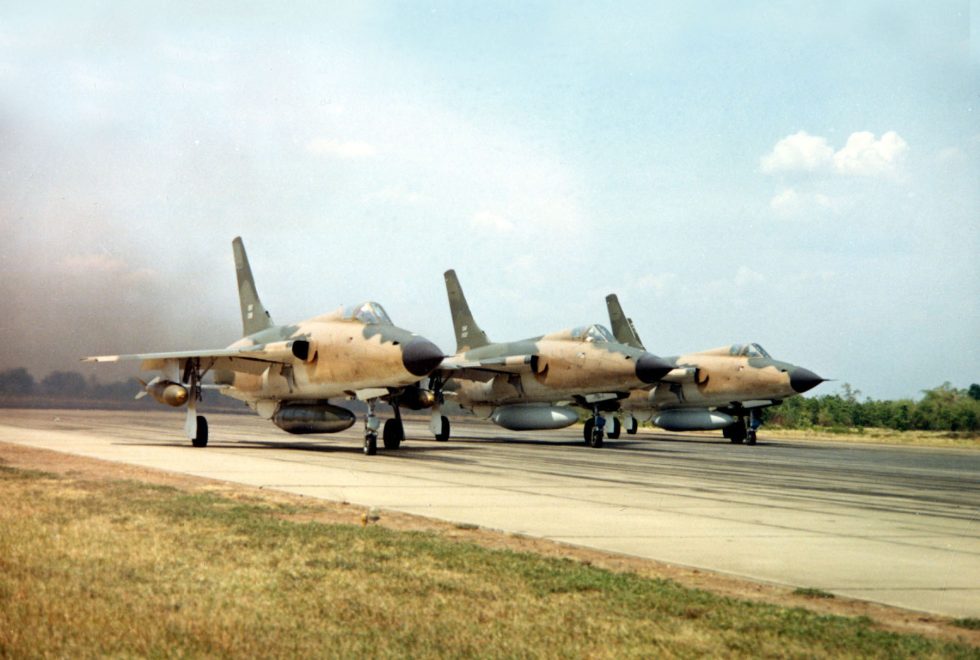
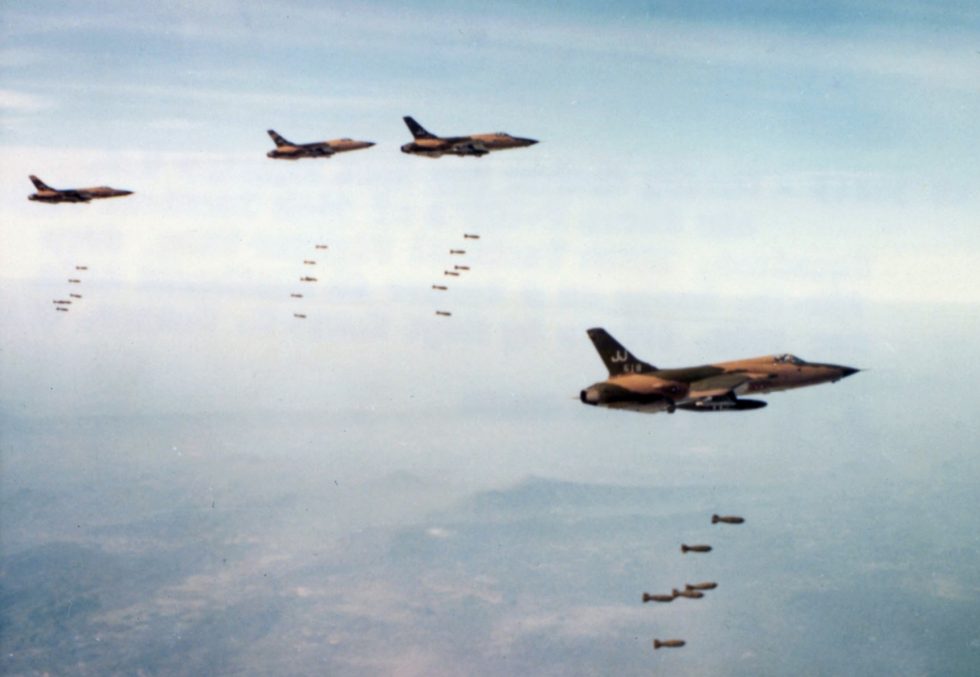
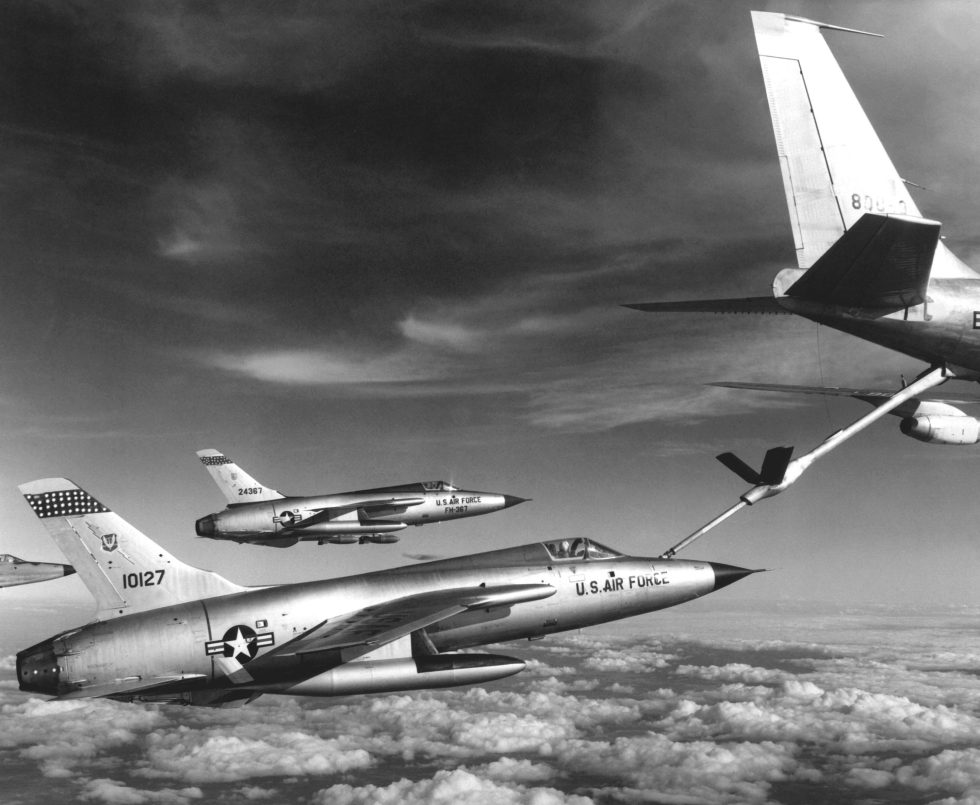
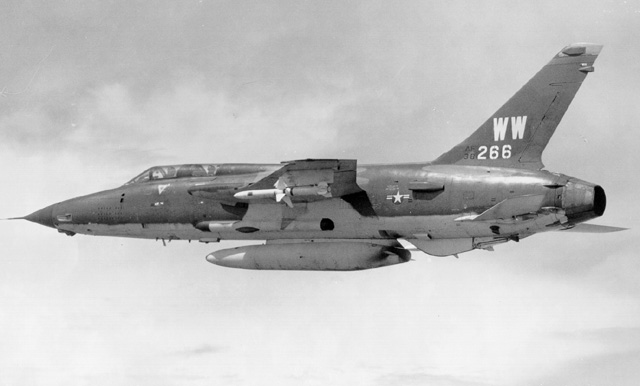
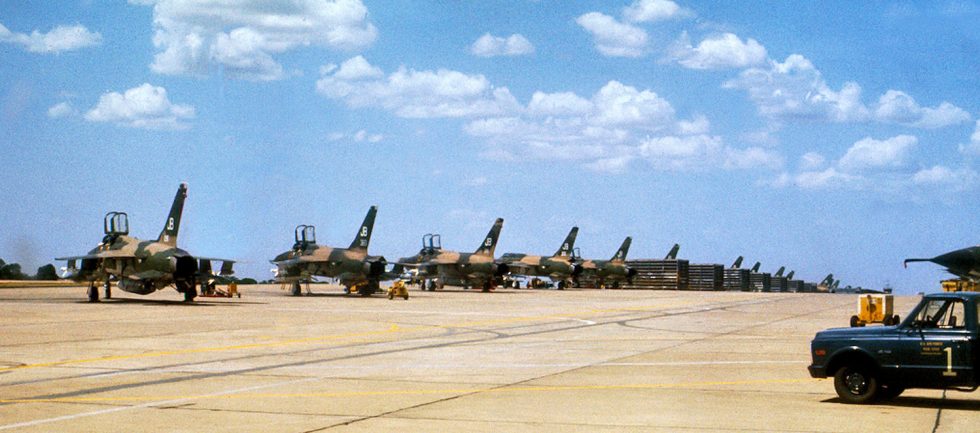
The F-105 Thunderchief in motion
Wings Over the Rockies Air & Space Museum — one of the most-watched F-105 Thunderchief films on YouTube.
Where the Thunderchief served
The score that defines it
The F-105’s record is a study in contradiction: a strategic nuclear bomber that fought a conventional war, took the heaviest losses of any American aircraft in Vietnam, and still shot down MiGs with its gun. Its combat figures — especially the loss numbers — vary between sources and should be read as widely-cited estimates rather than exact accounts.
Two of the Thud’s Wild Weasel pilots — Merlyn Dethlefsen and Leo Thorsness — received the Medal of Honor. Compare the combat record of every military aircraft. Figures as of July 2026.
Everything people ask about the F-105 Thunderchief
Can I fly in an F-105?
Why is the F-105 called the “Thud”?
How fast was the F-105?
Did the F-105 ever shoot down MiGs?
What was the F-105 Wild Weasel?
How many F-105s were lost in Vietnam?
Why was the F-105 retired so early?
You can’t fly the F-105.
These, you can.
Some legends only live in museums — others are fuelled and waiting. MiGFlug has put civilians in real military jet cockpits since 2004.
 Fly the L-39 AlbatrosThe world’s most-flown jet trainer — aerobatics included
 Fly the F-104 Starfighter“The missile with a man in it”
 Fly the MiG-21The Cold War’s most-produced jet
 Fly the T-33 Shooting StarAmerica’s first jet trainer
 Fly the DH VampireA piece of early jet history
 Fly the S.211Agile Italian jet trainer
 Fly the MB-326The classic Aermacchi jet
 Fly the MiG-15The Soviet legend of the Korean War
Continue the tour
Every fact, checked
- National Museum of the U.S. Air ForceOfficial F-105 fact sheets: development, variants, service history and specifications.
- AirVectors — Greg GoebelDetailed technical and operational history of the Thunderchief and its variants.
- The Aviation Geek ClubThe F-105 loss rate during Rolling Thunder and the eight-month attrition warning.
- We Are The MightyThe Wild Weasel mission, YGBSM, and how the Weasels cleared the skies over Vietnam.
- 19FortyFiveThe Thud’s reputation, MiG-kill tally and loss statistics in Vietnam.
- Military FactoryDimensions, weights, engine and armament specifications for the F-105D.
- Vietnam Air Losses (Chris Hobson)Reference record of USAF aircraft losses over Southeast Asia, including the F-105.
- Smithsonian National Air and Space MuseumReference for preserved F-105 airframes and the Medal of Honor Wild Weasel actions.