
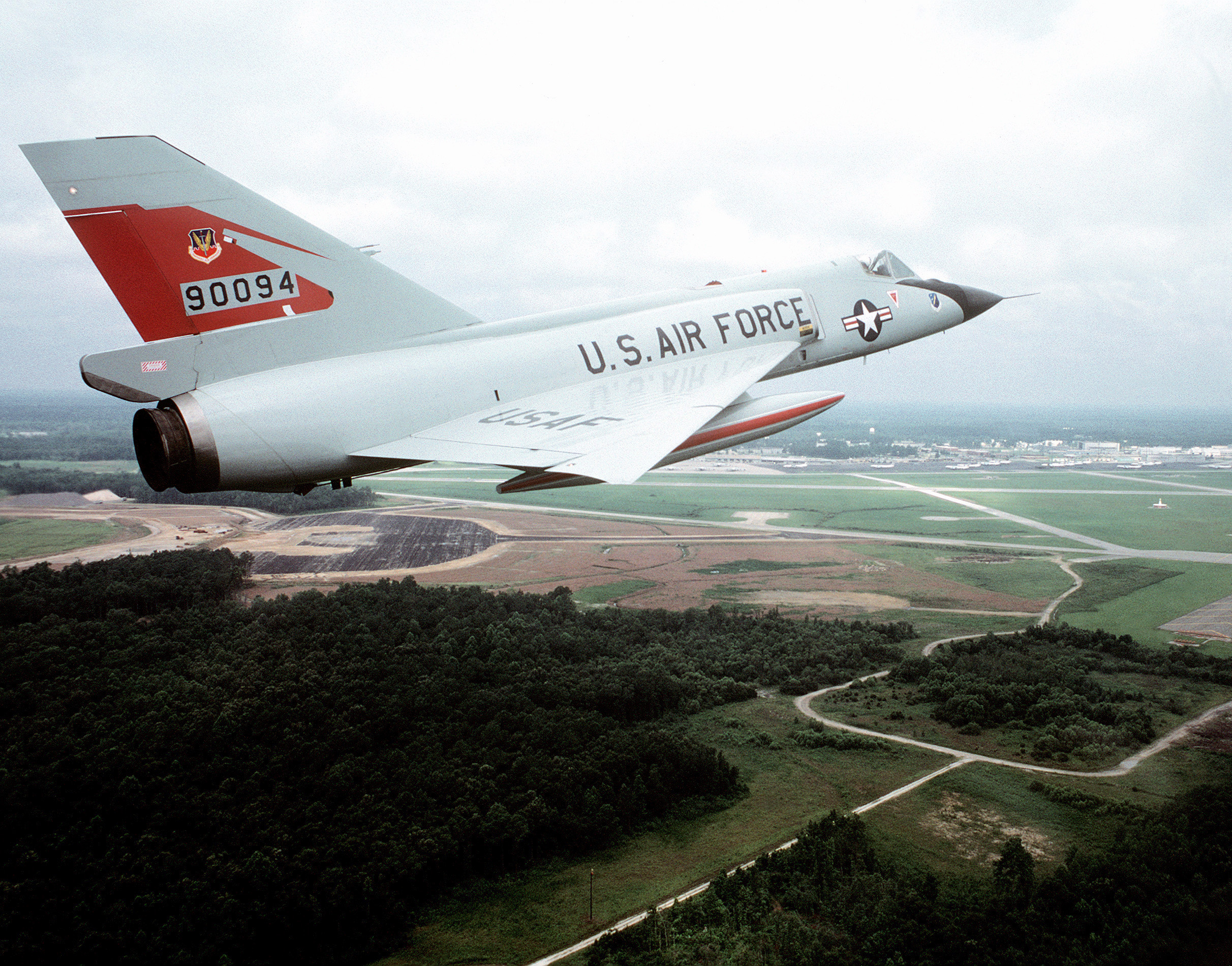
Convair F-106 Delta Dart
“The Ultimate Interceptor”
America’s last dedicated interceptor — a tailless delta built to catch Soviet bombers over the Arctic, flying nuclear-tipped rockets under the automated eye of the SAGE air-defence network, and the fastest single-engine jet the world has ever timed.
The USAF’s “Ultimate Interceptor”
In the 1950s the United States expected the next war to arrive over the North Pole — waves of Soviet bombers carrying nuclear weapons toward American cities. The answer was a continental shield of radar, computers and interceptors, and its sharpest point was meant to be the Convair F-106 Delta Dart. Developed from the earlier F-102 Delta Dagger — it began life as the F-102B before its changes proved so extensive that it was redesignated a new type in 1956 — the F-106 was, in the language of the day, the “Ultimate Interceptor.”
The recipe was single-minded: a tailless delta wing, one enormous Pratt & Whitney J75 turbojet, and a mission that was pure air defence. First flown on 26 December 1956 and operational from 1959, the Delta Dart was not built to dogfight or drop bombs. It was built to be vectored by ground computers onto a bomber at 40,000 feet, at twice the speed of sound, and to destroy it — if necessary with a nuclear rocket. Crews and fans alike simply called it “the Six.”
What made the Six remarkable was less the airframe than the system around it. It was a node in SAGE — the Semi-Automatic Ground Environment — a continent-spanning network of radars and computers that could fly the interception for the pilot, steering the aircraft by datalink through its Hughes MA-1 fire-control system. In an age before microchips, the MA-1 filled the jet with hundreds of black boxes. The F-106 never fired a shot in anger; instead it stood alert for nearly three decades, and its story is told in records, longevity and one of the strangest incidents in aviation history — the day a pilotless Delta Dart landed itself in a Montana field.
01The F-106 Delta Dart and the F-102: from Delta Dagger to Ultimate Interceptor
The F-106 grew directly out of the F-102 Delta Dagger, America’s first delta-wing interceptor. The F-102 had been troubled — it could not go supersonic in level flight until its fuselage was reshaped to the “area rule” — and the Air Force wanted far more performance. The improved aircraft, originally the F-102B, gained a much more powerful J75 engine, a redesigned intake and fuselage, and the advanced MA-1 fire-control system. The changes were so sweeping that in 1956 it was redesignated the F-106A, a new type in all but ancestry. The result roughly doubled the Dagger’s capability and gave Air Defense Command the interceptor it had wanted all along — even if it arrived years later and in far smaller numbers than first planned.
What makes it special
A tailless delta and the J75 — Mach 2 at the edge of the stratosphere
The F-106 pairs a clean tailless delta wing with a single Pratt & Whitney J75 turbojet of about 24,500 lbf (109 kN) in afterburner. The delta gives huge internal volume for fuel and a docile high-altitude ride; the J75 gives the thrust to reach roughly Mach 2.3 and to zoom-climb well above its ~57,000 ft service ceiling. It is optimised for one profile above all: a fast, high climb to meet a bomber head-on.
SAGE and the MA-1 — an interceptor flown by computer
The Six was designed to be steered by the ground. Plugged into the SAGE air-defence network, its Hughes MA-1 fire-control system received an interception by datalink and could fly the aircraft to the firing point almost hands-off, then trigger its weapons. The MA-1 was so complex — commonly cited at well over 2,000 pounds of electronics in some 200 “black boxes” — that it was reportedly never fully debugged, and was upgraded for years after the jet entered service.
The AIR-2 Genie — a nuclear air-to-air rocket
The F-106’s signature weapon was the unguided Douglas AIR-2 Genie, a rocket tipped with a roughly 1.5-kiloton nuclear warhead. The idea was brutal but logical: a single nuclear burst in the middle of a bomber stream would destroy anything nearby, no precision guidance required. The Genie sat in the internal weapons bay alongside guided AIM-4 Falcon missiles — the Six carried no gun at all when it entered service.
02The F-106 Delta Dart’s SAGE and MA-1 system: automated interception in the vacuum-tube age
SAGE was one of the largest computer projects of the early Cold War: a chain of blockhouses full of room-sized vacuum-tube computers that fused radar tracks into a single air picture and could hand an interception straight to a fighter. Aboard the F-106, the MA-1 fire-control system flew that interception. Ground controllers could uplink steering commands, and the aircraft could be guided to the firing solution automatically, the pilot largely monitoring rather than flying. It was a genuinely futuristic idea for the late 1950s — and a fragile one. The MA-1 was famously troublesome, receiving a long series of modifications over its service life. Read the automation claims of the era with some caution: the system worked, but never quite as seamlessly as the brochures suggested.
03The F-106 Delta Dart’s armament: the Genie nuclear rocket and the gun that came late
When it entered service the F-106 carried no gun — interceptor doctrine of the day held that missiles and a nuclear rocket had made cannon obsolete. Its internal bay held up to four AIM-4 Falcon guided missiles and a single AIR-2 Genie nuclear rocket. Combat over Vietnam soon exposed the limits of missile-only fighters, and from around 1972 many F-106s were retrofitted with an internal 20 mm M61 Vulcan cannon in a programme nicknamed the “Six Shooter,” which also added a clearer canopy. The Genie was only ever fired with a live warhead once, in the 1957 “John” test — and never in combat.
Full specifications
Baseline note: the figures below describe the single-seat F-106A in its mature Air Defense Command form — one Pratt & Whitney J75-P-17, variable-geometry side intakes, the Hughes MA-1 automatic weapon control system, four Super Falcons and one nuclear Genie rocket carried inside a ventral bay, and no gun. That is the right baseline because 277 of the 340 aircraft built were F-106As and every operational squadron flew them. Deltas for the tandem two-seat F-106B and for the QF-106A drone conversions are in grey. Six warnings before any number below is read. First, and most important: this is not the F-102 Delta Dagger, and the two are confused more often than any other pair of American aircraft. The F-106 was ordered as the F-102B and redesignated on 17 June 1956 because the changes had stopped being a variant, and the differences are total: a J75 in place of the J57, variable intake ramps in place of fixed ones, the MA-1 in place of the interim MG-10, a taller and differently shaped fin, and Mach 2.3 in place of Mach 1.25. Any figure that gives a Delta Dart Mach 1.2, or a Delta Dagger Mach 2, has been copied from the wrong aeroplane. Second, production. The best-attested split is 277 F-106A and 63 F-106B for a total of 340; USAF acceptance tables give 275 F-106As, and a figure of 342 appears where the two prototypes are counted separately from the production run. The Air Force originally intended to buy about 1,000 and cut the order to roughly 350 after cost growth and disappointing early flight test. Third, the wing. 61.52 m² (661.5 sq ft) is the standard quotation; 695 sq ft appears where a source has copied the F-102A wing across, and 632 sq ft appears in at least one European data table. Fourth, the record speed. The FAI figure is 2,455.736 km/h, which converts to 1,525.92 mph; the round number in general use is 1,525.95 mph and 1,525.96 mph is equally common. A figure of 1,525.695 mph circulates widely and is a transposition of digits. Mach 2.31 is arithmetically correct for that speed at 40,000 ft; the Mach 2.39 and Mach 2.41 quoted on enthusiast pages are not. Fifth, thrust. Military (dry) rating for the J75-P-17 is given as 16,100 lbf in most American sources and 17,200 lbf in several European ones; the afterburning figure of 24,500 lbf is not disputed. Sixth, range. "Combat range 1,335 nmi" appears in tabular sources and is a one-way still-air figure on internal fuel; the operational combat radius was closer to 500 nmi, and confusing the two flatters the aircraft badly.
Dimensions & weights
- Crew
- 1 — and unlike the F-102 the workload was survivable, because the MA-1 flew most of the intercept itself. The F-106B seated two in tandem under a longer canopy, instructor behind pupil, and was fully combat-capable rather than a stripped trainer. QF-106A drones flew both with and without a pilot aboard
- Length
- 21.55 m (70 ft 8.8 in); 70 ft 9 in is the rounding used by the National Museum of the USAF. The F-106B was the same length, its second cockpit absorbed into the existing fuselage rather than added to it
- Wingspan
- 11.67 m (38 ft 3.5 in) — a fraction wider than the F-102A, and identical between the A and B models
- Height
- 6.18 m (20 ft 3.3 in) — the fin was redesigned from the F-102’s: shorter in chord, squarer in outline, and the quickest way to tell the two types apart from the side
- Wing area
- 61.52 m² (661.5 sq ft) — the conically cambered wing developed for the late F-102 was standard on the F-106 from the outset. See the fourth warning above on the competing figures
- Aspect ratio
- 2.1 — very low, as a tailless delta must be. It bought high-Mach efficiency and a huge fuel volume, and it cost energy retention in a sustained turn
- Aerofoil
- NACA 0004-65 (modified) — four per cent thickness/chord, with conical camber worked into the leading edge. The same section the F-102A ended up with, on a larger and cleaner airframe
- Wing sweep
- 60° at the leading edge — pure tailless delta with elevons, no tailplane and no flaps. Approach was flown nose-high and fast, and every landing used the braking parachute
- Empty weight
- 11,077 kg (24,420 lb) — about 2,300 kg heavier than an F-102A, which is the price of the bigger engine, the bigger fuel load and the MA-1
- Combat weight
- 15,670 kg (34,510 lb) — clean, full internal fuel, four Falcons and a Genie aboard
- Maximum take-off weight
- 17,350 kg (38,250 lb) with two external tanks; 18,975 kg (41,833 lb) appears in one widely mirrored European data table and is not supported by the American flight manual figures
- Internal fuel
- 1,514 US gal (5,731 litres, 1,261 imp gal) usable, in five groups of tanks. The F-106B held 1,450 US gal. This is a very large internal load for a fighter of the period and it is why the Six could stand a long combat air patrol without tanks
- External fuel
- 2 × 360 US gal (2 × 1,363 litres) from 1967 — and these were supersonic tanks, cleared to Mach 2.0. The original 230 US gal (871 litre) tanks limited the aircraft to Mach 1.25, exactly the trap the F-102 never escaped. Getting a tanked interceptor back to Mach 2 was one of the most useful modifications the type ever received
- Wing loading
- 254 kg/m² (52 lb/sq ft) at combat weight — low by fighter standards, which is why F-106 pilots kept beating F-4 crews in turning engagements at height even though the Phantom out-accelerated them
Performance
- Maximum speed
- 2,455 km/h (1,525 mph, 1,325 kt) at 12,190 m (40,000 ft), Mach 2.31 — the clean figure, and one the aircraft genuinely achieved rather than one extrapolated on paper
- Record speed
- 2,455.736 km/h (1,525.92 mph) — the FAI-homologated absolute world air speed record of 15 December 1959. It remains the fastest speed ever recorded by a single-engined jet aircraft
- Cruising speed
- 1,046 km/h (650 mph, 565 kt) — the transit figure quoted by the National Museum of the USAF for a cruise to the intercept point
- Rate of climb
- 147 m/s (29,000 ft/min) at sea level — more than double the F-102A’s, and the single clearest measure of what the J75 bought
- Time to 15,850 m
- 6 min 54 s to 52,000 ft — against the 1954 Interceptor requirement of four minutes that the F-102 had missed. The Six did not meet it either, but it came far closer and it did so while carrying a nuclear weapon
- Service ceiling
- 17,375 m (57,000 ft) — the figure the F-102 programme had promised in 1954 and never delivered
- Combat ceiling
- About 16,150 m (about 53,000 ft) — the National Museum of the USAF quotes 53,000 ft as the operational ceiling, which is the honest number for an armed aircraft on a real intercept rather than a light one being flown for a chart
- Combat radius
- About 925 km (about 500 nmi, 575 miles) on internal fuel — roughly 490 miles is the figure most often quoted. This is the number that matters and it is routinely displaced in tables by the one-way range
- Range on internal fuel
- 2,470 km (1,335 nmi, 1,536 miles) still-air, one way — not a radius, and not achievable on a sortie that includes a supersonic dash
- Ferry range
- 4,345 km (2,346 nmi, 2,700 miles) with two external tanks; considerably further after the in-flight refuelling receptacle was fitted from 1967, which is how the 318th FIS flew the type across the Pacific to Korea in 1968
- Thrust-to-weight
- 0.71 at combat weight in full reheat — almost identical to the F-102A’s on paper, at a very much higher weight and with vastly better intake pressure recovery at speed. The intake, not the ratio, is the story
- Load factor limits
- +7 g / −3 g — generous for an interceptor, and part of why the type acquired an undeserved reputation as a dogfighter it was never asked to be
Propulsion & systems
- Engine
- 1 × Pratt & Whitney J75-P-17 — two-spool afterburning turbojet, essentially a scaled-up J57 and the same family that powered the F-105 and the U-2A’s successors. Early aircraft flew with the J75-P-9 and were re-engined. The original 1953 intention was the Wright J67, a licensed Bristol Olympus; its development collapsed and the Air Force approved the J75 in early 1955, which forced the intake redesign that in turn forced the new designation
- Military (dry) thrust
- 71.6 kN (16,100 lbf); 76.5 kN (17,200 lbf) is given in several European tables. The discrepancy is unresolved in open sources
- Afterburning thrust
- 109.0 kN (24,500 lbf) — a 42 per cent increase over the F-102A’s J57-P-25, and the reason the F-106 does everything the Deuce could not
- Air intakes
- Variable-geometry side intakes with movable ramps — the decisive change. The F-102’s fixed intakes choked above about Mach 1.25; the F-106’s ramps schedule the shock system with speed and keep pressure recovery high to Mach 2.3. Early flight test was disappointing and the programme came close to cancellation; inlet modification, more than anything else, saved it
- Fire control
- Hughes MA-1 automatic weapon control system — search and track radar, infrared sensor, the Hughes Digitair digital computer, autopilot coupling, navigation and missile-launch computation in one integrated set. It was described at the time as the most complex and completely integrated weapon control system ever fitted to an interceptor, and it was also the least reliable thing on the aircraft: it was modified more than sixty times in service before it worked as advertised
- Data link
- Time Division Data Link to SAGE — the aircraft received encoded steering commands directly into its automatic flight control system. In Close Control the ground sent Mach, altitude and heading and the pilot set the throttle; in Modified Close Control the ground sent target data and the MA-1 computed the tactic itself. The F-104 was too small to carry the equipment and the F-101B never had the full fit; only the F-106 and the Bomarc missile were flown this way
- Infrared search and track
- Retractable infrared sensor ahead of the windscreen — a passive detector added in service, giving the MA-1 a second, jam-proof way to acquire a target. It retracted flush when not in use, which the F-102’s fixed ball did not
- Weapons bay
- Internal ventral bay, no weapon pylons — four Falcons on extending trapeze rails in the outer bays and the Genie rocket in the centre. Bay doors were driven open by 3,000 psi air in about 1.5 seconds, rails extended in about one second, and the whole open-fire-close cycle took roughly six seconds. The F-106 is one of very few fighters that never carried a weapon on a wing pylon
- Flight controls
- Elevons, single fin and rudder, no tailplane, no flaps — irreversible hydraulic controls with artificial feel and an automatic flight control system that could fly the aeroplane hands-off. Deep flat spins were the type’s characteristic killer, and are the reason the Cornfield Bomber exists
- Ejection seat
- Convair/Stanley supersonic rotational "B" seat, 1959–1964 — a two-stage device with more than thirty pyrotechnic charges that rotated the pilot through 90° and flew him down on the seat to 15,000 ft. It passed its sled and flight tests and then killed people in the low, slow ejections that actually happened. The Air Force ordered its replacement in 1964; the Weber rocket-catapult zero-zero seat arrived in 1965 and served to the end
- In-flight refuelling
- Boom receptacle aft of the cockpit, fitted from August 1967 — not an original feature. Until then the Six was a strictly local-defence aeroplane; afterwards it could be deployed across oceans, which is what made the Korean and Icelandic rotations possible
- Cockpit
- Vertical tape instruments, centre control column — the column carried two grips, the right hand flying the aeroplane and the left working the radar. Project Six Shooter replaced the braced canopy with a clear-topped one from 1972, which transformed rearward visibility and is the easiest way to date a photograph
04The F-106 Delta Dart’s operating costs: what the numbers really tell us
Firm cost figures for the F-106 are scarce and inconsistent, as is usual for a 1950s–60s military aircraft. Contemporary sources place the flyaway unit cost very roughly in the region of $4–5 million in early-1970s dollars, but this should be read as an order-of-magnitude estimate rather than a precise, audited price. No reliable public cost-per-flight-hour figure exists for the type. What is better documented is the aircraft’s reputation for reliability: the F-106 is often cited as having one of the lowest accident rates of any Century-series fighter, which helped keep it economical enough to serve for almost thirty years. Treat any exact dollar figure attached to the Six with healthy scepticism.
Armament & payload
The F-106 carried a nuclear rocket in its belly for twenty-nine years and got a gun only in its fourteenth
The Delta Dart was armed for exactly one job: killing Soviet bombers over North America, at height, in weather, in numbers, once. Everything it carried lived inside a ventral bay — four Hughes Super Falcon missiles on extending trapeze rails in the outer compartments, and in the centre a Douglas AIR-2A Genie, an unguided rocket with a 1.5 kiloton W25 nuclear warhead. The logic was blunt and it was correct on its own terms. Guided missiles of the late 1950s missed; a fission warhead detonating somewhere in the vicinity of a bomber stream did not need to hit anything.
The Falcons were the F-106’s conventional answer and they were never good. Two AIM-4F semi-active radar rounds sat on the forward rails and two AIM-4G infrared rounds on the rear, and both were small, short-legged weapons with contact fusing that demanded a near-perfect firing solution. They stayed on the aircraft for its entire career, long after Sparrow and Sidewinder had left them behind, for the least glamorous reason in aviation: the bay was the size it was, and a Sparrow would not fit. The bay doors were driven open by 3,000 psi air, the rails swung the missile clear of the fuselage, and the whole open-fire-close cycle took about six seconds — elegant engineering wrapped around a mediocre weapon.
A gun arrived only in 1972, under Project Six Shooter, when the Vietnam air war had comprehensively demolished the all-missile doctrine that had produced the aircraft. A single M61A1 Vulcan with 650 rounds went into the rear half of the weapons bay in place of the Genie, under a small ventral fairing, with an optical sight and a new frameless canopy. It was the right fix fifteen years late, and the F-106 never fired it, or anything else, in anger. Fits varied by year and by airframe far more than tables admit: the supersonic 360 US gal tanks only arrived in 1967, in-flight refuelling in the same year, and although the Six Shooter canopy and sight went fleet-wide only about 75 guns were built and installed, on aircraft that already had vertical tape instruments.
Gun
- None at all until 1972. The F-106 was designed under the same doctrine as the F-102 and the F-4: that an interceptor kills bombers with guided weapons from miles away and that a gun is dead weight. For the mission actually assigned — large, slow, non-manoeuvring targets over the Arctic — the reasoning held up better here than anywhere else.
- 1 × General Electric M61A1 Vulcan, 20 mm, 650 rounds from Project Six Shooter, initiated in 1972 under Convair project lead Bob Archibald, with installation trials dating back to 10 February 1969. At the gun’s maximum rate that is roughly six and a half seconds of firing.
- The gun occupied the rear half of the weapons bay, displacing the AIR-2A Genie, with a bulged fairing under the fuselage to clear the rotating barrels. The four Super Falcons were unaffected. Trading a nuclear rocket for a cannon is a fair summary of how the threat picture had changed.
- Six Shooter also brought an optical gunsight, prototyped at Tyndall AFB, and a clear-topped canopy that deleted the metal strip over the pilot’s head. The canopy was the more valuable half of the programme and it went to the whole F-106A fleet; the gun did not.
- Only about 75 guns were built under the General Electric contract, and they went to squadrons that already had vertical tape instrumentation — the 49th FIS took early kits, followed by the 318th and 87th. Sources that say every F-106A carried a Vulcan are conflating the airframe modification with the weapon.
Air-to-air
- 4 × Hughes Super Falcon in the outer bays on extending trapeze rails: two AIM-4F semi-active radar homing on the front rails and two AIM-4G infrared on the rear. Standard from entry to service in 1959 until the last aircraft went to storage in 1988 — a twenty-nine year run on an unchanged weapon.
- AIM-4F — about 2.18 m (7 ft 2 in) long, about 68 kg (150 lb), roughly 13 kg (28.7 lb) warhead, effective to something like 11 km (7 miles). The Super Falcon had a longer-burning motor than the early GAR-1 but kept the same fundamental problem: no proximity fuse, so it had to strike the target.
- AIM-4G — the infrared round, about 2.07 m (6 ft 10 in) and about 66 kg (145 lb), rear-aspect only. Against a bomber it worked. Against anything that manoeuvred or knew it was being shot at, both Falcons were close to useless, which is exactly what the F-4 community discovered over North Vietnam.
- They were kept because they fitted. The bay was designed around a Falcon-sized store and could not be made to take an AIM-7 Sparrow or, later, an AIM-9L, so the last dedicated interceptor in USAF service went to retirement with 1950s missiles aboard.
- The nuclear AIM-26A Falcon is listed as an F-106 store in some references. The best-attested operational fit is four Super Falcons plus one Genie; the AIM-26 belongs firmly to the F-102 and its appearance in F-106 tables should be treated with suspicion.
Air-to-surface guided
- None. Not one, ever. No air-to-ground guided weapon was carried, cleared, trialled or proposed for any F-106 in USAF service.
- This is a real distinction rather than an accident of the record. The F-102 at least improvised ground attack in Vietnam with infrared Falcons fired at lorry engines; the F-106 was never deployed to a shooting war and never had to invent anything.
- There were no wing pylons capable of carrying a weapon. The two underwing stations were plumbed for fuel and plumbed for nothing else, for the entire life of the type.
- The F-106X and F-106E/F studies of 1968 proposed better radars, look-down/shoot-down capability and links to airborne early warning aircraft. All of it was still air-to-air. Nobody in the programme’s history seriously proposed turning the Six into a strike aircraft.
- The card is kept rather than deleted because the absence is informative: the F-106 is the purest single-role aeroplane the USAF ever fielded in quantity, and that purity is why it was retired rather than adapted.
Bombs
- None. No F-106 of any mark was cleared to carry a bomb of any kind, conventional or nuclear. There was no rack, no pylon and no bay geometry that would accept one.
- The type nonetheless carried a nuclear weapon on alert for most of its career. It was the AIR-2A Genie, an air-to-air rocket fired at aircraft, and conflating it with a bomb is the commonest error made about F-106 armament.
- The alert commitment was real and continuous: armed F-106s sat on five-minute readiness at bases from Alaska and Iceland to Florida, with a live nuclear round in the belly, for roughly three decades.
- Two underwing stations existed and carried fuel tanks only — 230 US gal subsonic tanks originally, 360 US gal supersonic tanks from 1967.
- The contrast with the rest of the Century Series is stark. The F-100, F-101 and F-105 all became nuclear strike aircraft. The F-106 was an interceptor on the day it was ordered and an interceptor on the day it was withdrawn.
Rockets
- 1 × Douglas AIR-2A Genie in the centre bay — an unguided, nuclear-armed rocket with a W25 warhead of 1.5 kilotons. Known as the MB-1 until the 1962 tri-service redesignation, which is why the same weapon appears under two names in documents a few years apart.
- Propulsion was a Thiokol SR49-TC-1 solid motor of about 162 kN (36,000 lbf) burning for roughly two seconds, accelerating the round to about Mach 3.3 and carrying it some 10 km (about 6 miles) in a total flight time of around twelve seconds. The MA-1 computed the launch point and the burst; the pilot pressed and turned away.
- Only one Genie was ever detonated in flight, during Operation Plumbbob shot John on 19 July 1957, fired from an F-89J over Yucca Flat at around 18,500 to 20,000 ft — with five volunteer officers standing unshielded beneath the burst to demonstrate that it was safe. That was before the F-106 existed; no F-106 ever fired one live.
- Roughly 3,150 Genies were built to 1962. The F-89, F-101B and F-106 all carried them; the F-106 was the last, and the weapon left United States service with the aircraft in 1988. Canada retired hers in 1984.
- No unguided conventional rockets were carried. The F-102’s celebrated 2.75 in Mighty Mouse tubes built into the weapons-bay doors were not reproduced on the F-106, whose doors were plain. Any F-106 table listing FFAR has borrowed it from the Deuce.
Pods & other stores
- 2 × 360 US gal (1,363 litre) supersonic drop tanks from 1967 — the only external stores worth the name, and unusual in being cleared to Mach 2.0. Almost every contemporary interceptor became subsonic the moment it hung tanks; the F-106 did not.
- 2 × 230 US gal (871 litre) subsonic tanks before that, limiting the aircraft to Mach 1.25 — that is, to F-102 performance. Replacing them is one of the least discussed and most consequential upgrades in the type’s history.
- No gun pod, no reconnaissance pod, no electronic-warfare pod, no targeting pod, no buddy store. The Six carried tanks or it carried nothing, and there is no photograph showing otherwise.
- Retractable infrared sensor ahead of the windscreen and a braking parachute in the tail cone. Neither is a store, and both are integral to how the aircraft actually worked: one found the target, the other stopped the aeroplane.
- Pacer Six drone kit from 1986 — radio command guidance, telemetry, scoring and flight-termination equipment installed by Flight Systems Inc. at Mojave. QF-106As flew both manned, for ferry and proving flights, and unmanned, to be shot at.
Three typical loadouts
- Continental alert, 1962
- Two AIM-4F and two AIM-4G Super Falcons in the outer bays, one AIR-2A Genie in the centre bay, full internal fuel, no external tanks. Five-minute readiness in an alert hangar under a SAGE sector, with the data link ready to fly the aircraft to a computed intercept from a few seconds after the wheels came up. This is the configuration the aeroplane existed for and the one it spent most of thirty years sitting in.
- Long-range combat air patrol, Korea 1968
- Four Super Falcons, one Genie, two 360 US gal supersonic drop tanks, air-to-air refuelling planned. The 318th FIS deployed to Osan from 18 February 1968 under Operation Red Fox after the seizure of USS Pueblo, making the first Pacific crossing by the type; four more squadrons rotated through until May 1970, escorting reconnaissance flights after the shooting down of an EC-121 in April 1969. The nearest the F-106 ever came to combat.
- Post-Six Shooter air defence, 1975
- Two AIM-4F and two AIM-4G in the outer bays, one M61A1 with 650 rounds in the rear centre bay in place of the Genie, clear-topped canopy and optical sight, two supersonic tanks. A missile interceptor rearmed for the possibility of a visual identification pass and a close-range shot — the doctrine of 1954 finally corrected by the experience of 1967.
Sourcing caveat: Falcon and Genie designations changed in the 1962 tri-service reform, so the same weapons appear as GAR-3A, GAR-4A and MB-1 in early documents and as AIM-4F, AIM-4G and AIR-2A afterwards; sources that mix the two systems in one sentence are common. Gun installation numbers are the least secure figures on this page — the frequently repeated claim that all F-106As received the M61 conflates the fleet-wide Six Shooter canopy and sight modification with a gun fit that ran to roughly 75 aircraft. The W25 yield of 1.5 kt is the standard open-literature figure and is not independently verifiable. No F-106 ever fired a weapon in combat, so none of these figures has ever been tested against an enemy.
Variants
The Delta Dart has two production marks, four paper aeroplanes and two hundred drones
For an aircraft that served twenty-nine years, the F-106 has an unusually thin variant list. There is the interceptor, the two-seater, a handful of proposals that were never built, and the long unhappy afterlife in which two thirds of the fleet was shot down over American ranges by American missiles.
Its origin is the single fact most often got wrong. The F-106 was ordered as the F-102B, the "ultimate interceptor" half of the 1954 Interceptor programme, with the F-102A as an interim stopgap. When the Wright J67 collapsed and the Pratt & Whitney J75 was substituted in early 1955, the intakes, the fuselage and the fin all had to change, and the Hughes MX-1179 fire control that the requirement had always wanted — the MA-1 — was at last ready. On 17 June 1956 the aircraft was redesignated F-106A. The first machine, 56-0451, flew at Edwards on 26 December 1956 with Richard L. Johnson at the controls, the same test pilot who had flown the first YF-102 three years earlier.
It very nearly did not survive its own flight test. Acceleration and top speed came in below Convair’s estimates, the MA-1 was chronically unreliable, a canopy departed an aircraft in flight and grounded the fleet in December 1959, and the planned buy of about 1,000 aircraft was cut to roughly 350. Air Defense Command fought for the programme and inlet modifications delivered the promised performance. Then, in a fortnight of December 1959, the same aeroplane broke the absolute world air speed record and was grounded by a loose canopy — which is the F-106 in miniature.
What followed was the longest and least eventful career of any Century Series fighter. The F-106 flew from bases across the contiguous United States, Alaska and Iceland, deployed to Korea from 1968 to 1970 and to Germany, sat nuclear alert for three decades, beat F-4s in exercises at altitude and lost to them in acceleration, and never fired a shot at an enemy. Air Defense Command was the parent for most of that time; as it was dismantled the aircraft passed to Tactical Air Command and then, from 1972, in growing numbers to the Air National Guard. The F-15 began displacing it in the early 1980s. The last regular Air Force interceptor squadron, the 5th FIS at Minot AFB, gave up its Darts in April 1985 after taking its first Eagle on 4 December 1984, though some unit listings carry active-duty F-106 operations to 1987. The 119th FIS of the New Jersey Air National Guard at Atlantic City flew the last of them and sent its final aircraft to storage on 8 August 1988. It remains the last dedicated interceptor the United States Air Force has ever operated.
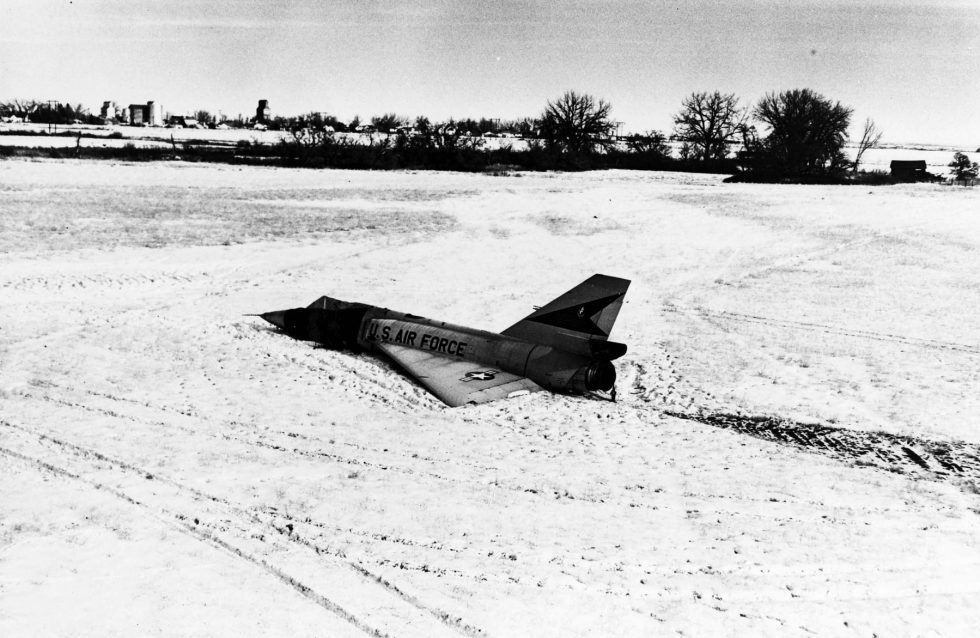
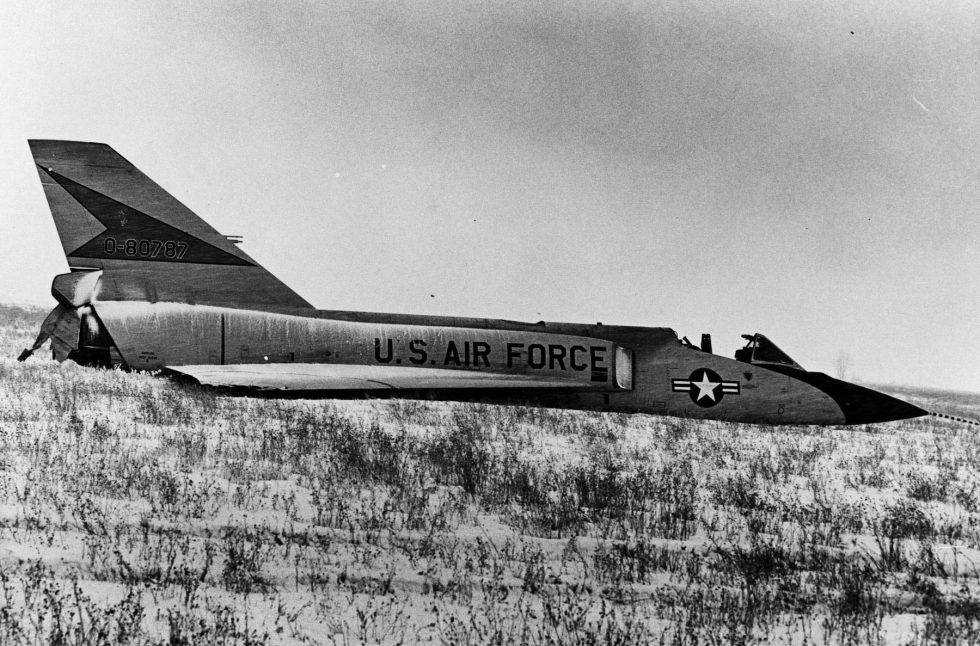
The best-known F-106 story is also the most embellished, so it is worth stating exactly. On 2 February 1970, 1st Lt Gary Foust of the 71st FIS was flying air combat training out of Malmstrom AFB, Montana, in F-106A 58-0787. Following Captain Tom Curtis through a high-g rudder reversal at around 38,000 ft, he departed controlled flight into a post-stall gyration and then into the deep flat spin that was the type’s characteristic killer. He rode it down roughly four miles, tried the drag chute, and ejected at about 15,000 ft. As he hung in the parachute, Major James Lowe — who had been reading him the recovery procedure — watched the aeroplane pitch its nose down, recover and fly away, and radioed the line every account quotes: Gary, you’d better get back in it. Trimmed for take-off with the throttle at idle, and relieved of both the pilot’s weight and the seat, the aircraft settled into a shallow descent and slid to a stop on its belly in a snow-covered field near Big Sandy, Montana. Foust was picked up unhurt by snowmobilers.
Four details are usually got wrong. It was not a cornfield: that is Montana grain country and the aircraft came down in snow, so the nickname is a misnomer that has outlived every correction. It did not land itself in any deliberate sense — it recovered from a spin and arrived, engine still running, in a controlled crash that happened to be gentle. It did not stay put: the exhaust melted the snow beneath it and the machine began to slide across the field, which is why the local sheriff who first reached it retreated and let it run, and it travelled several hundred feet before the fuel ran out roughly an hour and three quarters later. And the damage was slight rather than nil; one recovery officer said he could have flown it out. The aircraft was dismantled, moved by rail, repaired, and returned to service with the 49th FIS, and Foust himself flew it again in 1979. It went to the National Museum of the United States Air Force in August 1986 and is displayed there in 49th FIS markings, to the enduring irritation of some 71st FIS veterans. Foust’s rank is given as both first lieutenant and captain in reputable sources; first lieutenant is the better-attested at the time of the incident.
- F-102B (1955–1956, ordered but never built as such)
- The designation under which the aircraft was ordered on 18 April 1956, seventeen aircraft on the initial contract. Redesignated F-106A on 17 June 1956 once the J75 substitution had changed the intakes, the fuselage and the tail beyond any reasonable claim to being an F-102 variant. This shared paperwork is the root of the endless confusion between the two types.
- F-106A (1956–1961, 277 built)
- The production interceptor and the baseline for this page. First flight 26 December 1956; first deliveries to the Air Force from 30 September 1957; first operational squadron the 539th FIS at McGuire AFB in May 1959; initial operational capability with the 498th FIS at Geiger AFB in October 1959. J75-P-17, MA-1, variable intake ramps, four Super Falcons and a Genie. USAF acceptance tables give 275; 277 is the figure in general use.
- F-106B (1958–1960, 63 built)
- The tandem two-seater, authorised in August 1956 as a trainer and built as a fully combat-capable interceptor. The second cockpit was absorbed into the existing fuselage rather than bolted on, so length and span were unchanged and the area-rule distribution was arguably improved — a two-seater no slower than the single-seater, which is rare. No squadron flew the B exclusively; every ADC and ANG unit held a few for checks and for operational intercepts.
- F-106C / F-106D (proposed 1958, cancelled 23 September 1958)
- A far more capable aircraft on paper: the huge Hughes AN/ASG-18 radar developed for the North American XF-108 Rapier in a longer, fatter nose, with one GAR-9/AIM-47 long-range missile on a centre trapeze and an AIM-26A in each side bay. Cancelled with the Rapier. Canada looked at it briefly after the Avro Arrow was killed in 1959 and bought CF-101 Voodoos instead.
- F-106X (proposed 1968, not built)
- A rebuilt aeroplane with canard foreplanes, a Pratt & Whitney JT4B-22 and a 40 in radar dish with look-down/shoot-down capability. Offered as a cheaper alternative to the F-12 interceptor programme, and refused.
- F-106E / F-106F (proposed September 1968, not built)
- A lengthened nose, improved radar and a two-way UHF data link that would have let the aircraft work with airborne warning aircraft and over-the-horizon radar rather than only with fixed SAGE sectors. The last serious attempt to extend the design, and the point at which the Air Force decided the F-15 would do the job instead.
- NF-106B (1966–1991, 2 aircraft)
- Two-seaters assigned to NASA. The most productive was the Langley storm-hazards aircraft flown from 1980 to 1986, which was deliberately flown into thunderstorms and struck by lightning 714 times without structural damage, including 72 strikes on a single flight at 38,000 ft in 1984. The data underpins the lightning protection standards used on airliners today, and it is arguably the F-106’s most useful contribution to anything.
- Project Six Shooter (1972 onwards, modification not a mark)
- Clear-topped canopy, optical gunsight and provision for an M61A1 with 650 rounds in the rear weapons bay in place of the Genie. Applied fleet-wide as an airframe change; the gun itself went to roughly 75 aircraft. Frequently but wrongly described as a variant designation.
- QF-106A (1986–1998, about 194 converted)
- The Pacer Six full-scale aerial target programme, run by the 82nd Tactical Aerial Targets Squadron at Tyndall AFB and by the 475th Weapons Evaluation Group, with operations also from Holloman AFB and White Sands. The drones could be flown manned or unmanned and were built to survive repeated missile engagements. Conversion figures of 194 and 199 both circulate; the discrepancy is between airframes converted and airframes actually delivered to the target squadrons.
- Eclipse QF-106 (December 1997 – February 1998, 1 aircraft, 6 flights)
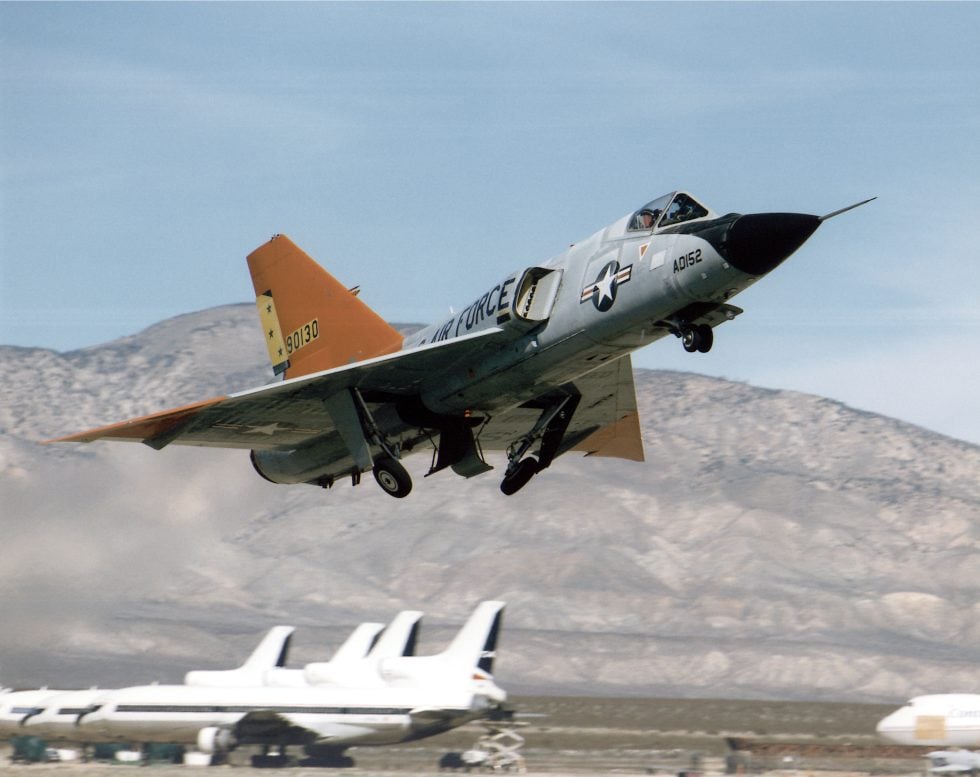
- A drone airframe borrowed back for NASA Dryden, towed aloft behind a C-141A Starlifter to test whether a high-wing-loading delta could be tow-launched as a reusable space launcher. NASA pilot Mark Stucky flew it manned. The last flight, on 6 February 1998, was the last time an F-106 flew.
Closing note on survivors. No F-106 has flown since 6 February 1998 and none is airworthy; there is no civil-registered example and, given the MA-1 and the airframe hours, there will not be one. Survivor counts run from about 26 to something over 40, and the spread is genuine rather than careless: the low figure counts accessible museum aircraft, the higher one adds gate guardians at Air National Guard bases, technical-training hulks and airframes in poor condition on ranges. Every survivor is an original Convair airframe — there are no reproductions of this type and no replicas, and the drone programme is precisely why so few remain, since roughly two thirds of all F-106s ever built were expended as targets. Notable examples include 58-0787, the Cornfield Bomber, at the National Museum of the United States Air Force at Wright-Patterson in 49th FIS markings; 56-0451, the first aircraft flown, at the Selfridge Military Air Museum in Michigan; 59-0003 at Pima Air and Space Museum, Tucson; 59-0137 at the Evergreen Aviation and Space Museum, Oregon; and F-106B 57-2509 at the Palm Springs Air Museum, California. The last drone shot down is variously given as 57-2524 at Holloman on 20 February 1997 and as an aircraft expended over the Gulf of Mexico in January 1998; both dates appear in the same reference works and neither has been reconciled.
Three decades on continental alert
Redesignated & first flight
The heavily revised F-102B is redesignated the F-106A; the first aircraft flies on 26 December 1956 at Edwards AFB.
Enters service & sets a record
The Six joins Air Defense Command; on 15 December Major Joe Rogers sets a world speed record of 1,525.695 mph — still unbeaten for single-engine jets.
The SAGE shield
F-106 squadrons stand nuclear-armed alert across the US and Iceland, plugged into the SAGE network against the Soviet bomber threat.
The Cornfield Bomber
On 2 February a pilotless F-106 recovers from a flat spin after its pilot ejects and belly-lands itself, engine running, in a Montana field.
The gun comes back
The “Six Shooter” upgrade adds an internal 20 mm M61 Vulcan cannon and a clearer canopy — missiles alone were no longer enough.
The Guard’s last interceptor
As newer fighters take over air defence, the F-106 soldiers on with the Air National Guard, the last of the pure interceptors.
Retirement
The last operational F-106s leave service with the 119th Fighter-Interceptor Squadron of the New Jersey Air National Guard.
A second life as a drone
Under the Pacer Six programme, roughly 190 retired airframes are converted to QF-106 target drones, flying on into the late 1990s.
Twelve stories of the Six
From Delta Dagger to Delta Dart
The F-106 began as an improved F-102 before becoming a new type entirely.
Read the full story
Why crews called it “the Six”
Officially the Ultimate Interceptor, informally just the Six.
Read the full story
The interceptor flown by computer
Ground computers could steer the F-106 to its target by datalink.
Read the full story
A nuclear rocket for air combat
The AIR-2 Genie carried a nuclear warhead meant to destroy a whole bomber formation.
Read the full story
Two hundred black boxes
The F-106’s fire-control system was one of the most complex of its era.
Read the full story
The fastest single-engine jet ever timed
Major Joe Rogers set a world speed record that still stands for its class.
Read the full story
The Cornfield Bomber
A pilotless F-106 recovered from a spin and landed itself in a field.
Read the full story
The Six Shooter
Combat over Vietnam brought the cannon back to the missile-only interceptor.
Read the full story
Never fired in anger
For all its firepower, the F-106 never shot at an enemy.
Read the full story
The interceptor that outlasted its replacement plans
Repeated attempts to replace the F-106 kept falling through.
Read the full story
From interceptor to target
Retired F-106s were reborn as full-scale drones.
Read the full story
The last of its kind
No dedicated interceptor has followed the F-106 in US service.
Read the full story
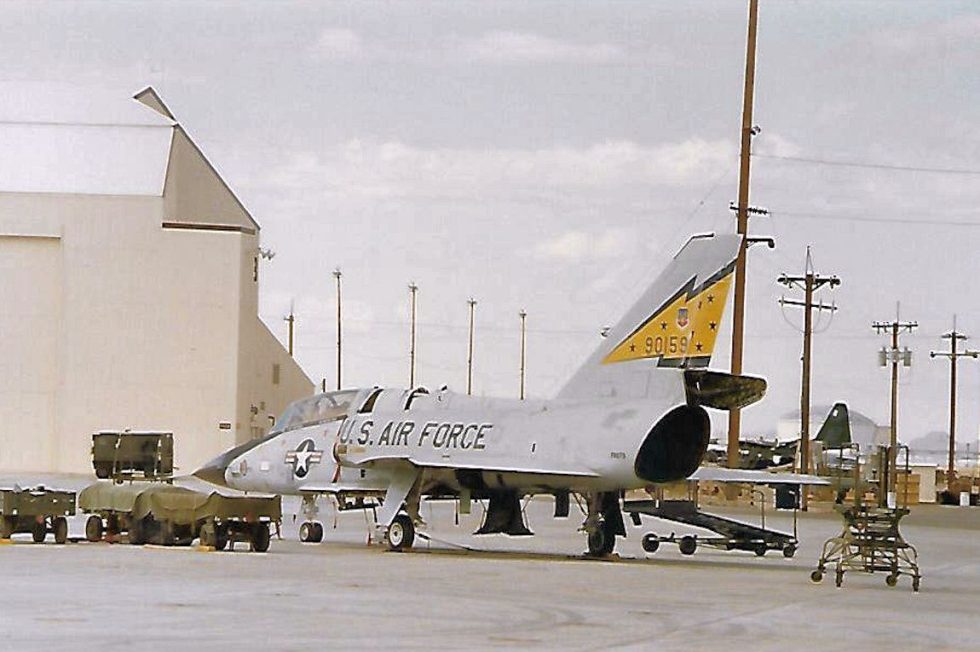
The Delta Dart in pictures
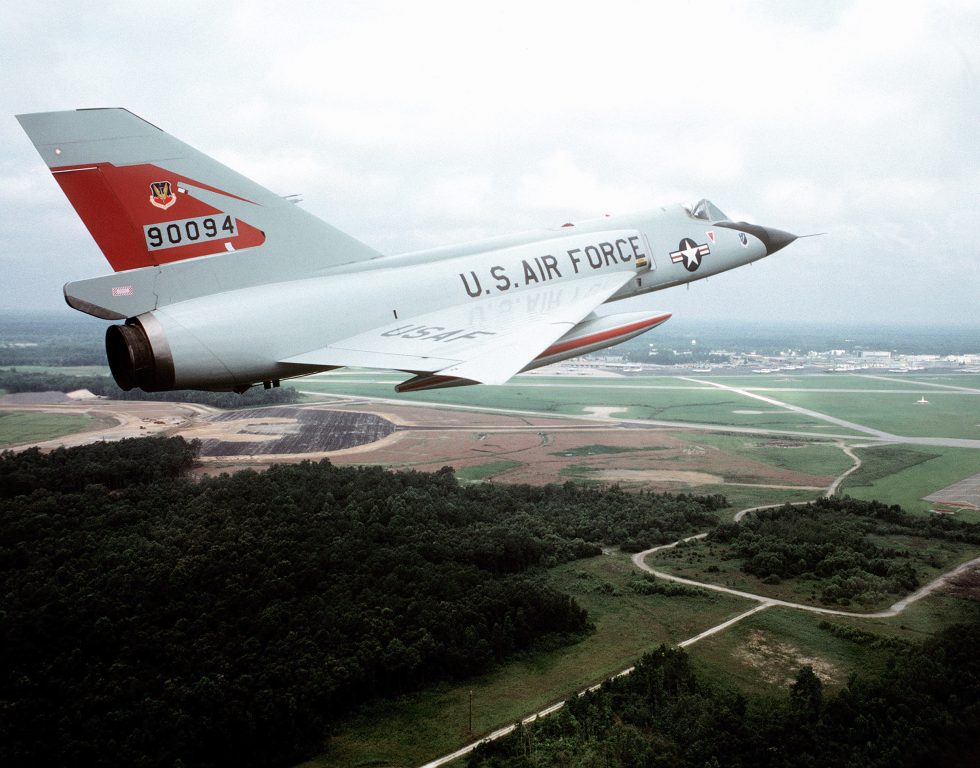
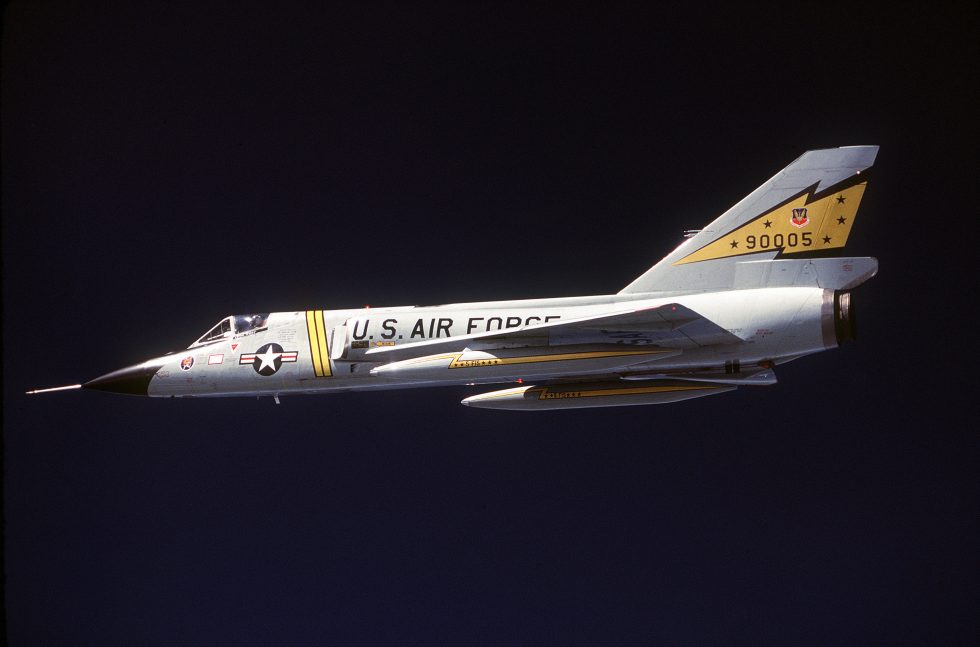
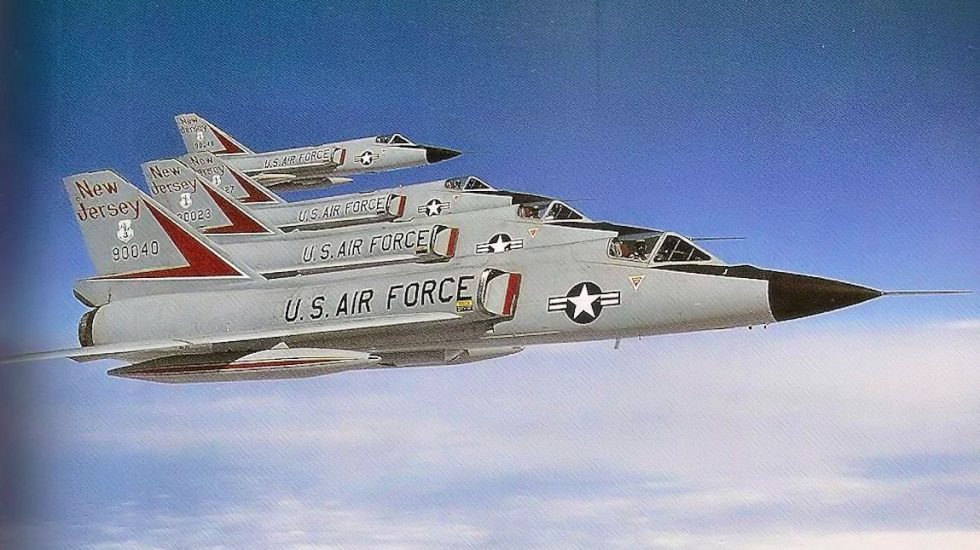
The Delta Dart in motion
A verified, high-authority video feature for the F-106 is still being selected — video coming soon. In the meantime, the photo gallery above and the stories carousel cover the aircraft in depth.
Where the Delta Dart flew
The record that defines it
The F-106 never fired a shot in anger. Its entire three-decade career was spent on continental air defence — scrambling to meet Soviet aircraft, standing nuclear-armed alert, and deterring an attack that never came. Its story is written not in kills but in speed records, reliability and sheer longevity as the last of the pure interceptors.
Compare the combat record of every military aircraft. Figures as of July 2026.
Everything people ask about the F-106
Can I fly in an F-106?
How fast was the F-106?
Why is the F-106 called the “Ultimate Interceptor”?
What was the “Cornfield Bomber”?
Did the F-106 ever shoot down an enemy aircraft?
Was the F-106 really armed with a nuclear weapon?
Did the F-106 have a gun?
When did the F-106 retire?
You can’t fly the F-106.
These, you can.
Some legends only live in museums — others are fuelled and waiting. MiGFlug has put civilians in real military jet cockpits since 2004.
 Fly the L-39 AlbatrosThe world’s most-flown jet trainer — aerobatics included
 Fly the F-104 Starfighter“The missile with a man in it”
 Fly the MiG-21The Cold War’s most-produced jet
 Fly the T-33 Shooting StarAmerica’s first jet trainer
 Fly the DH VampireA piece of early jet history
 Fly the S.211Agile Italian jet trainer
 Fly the MB-326The classic Aermacchi jet
 Fly the MiG-15The Soviet legend of the Korean War
Continue the tour
Every fact, checked
- National Museum of the U.S. Air Force — F-106A Delta DartOfficial specifications, development history and production figures.
- HistoryNet — Convair F-106: The Ultimate InterceptorDevelopment, the MA-1/SAGE system, armament and the 1959 speed record.
- F-106 Delta Dart (f-106deltadart.com)Dedicated enthusiast archive: service history, the MA-1 system and QF-106 conversions.
- The Cornfield Bomber 58-0787Detailed account of the 1970 pilotless landing and the aircraft’s recovery.
- Museum of Aviation — F-106 Delta DartCross-checked dimensions, engine and performance data.
- Avgeekery — The SixBackground on the interceptor mission, the Genie and the “Six Shooter” gun.
- The National InterestThe F-106 as America’s last dedicated bomber interceptor.
- FAI records databaseReference for the 1959 world absolute speed record.