
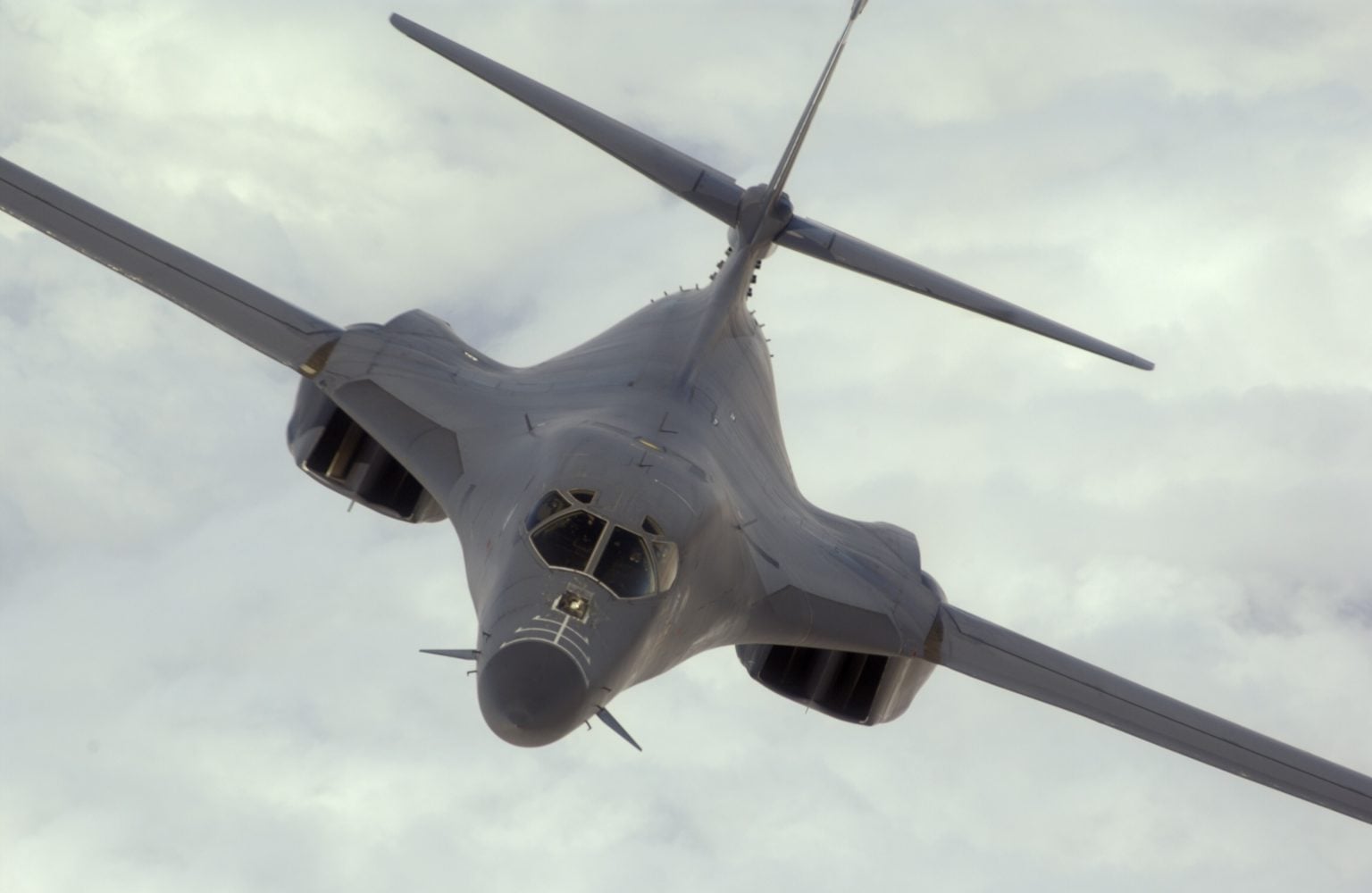
Rockwell B-1 Lancer
“The Bone”
A variable-sweep, four-engine supersonic heavy bomber — cancelled by one president, revived by another, and turned from a nuclear penetrator into the conventional-strike workhorse of America’s wars.
Cancelled, revived, and sent to war
The B-1 was born to solve a Cold-War problem: how to get a manned bomber through increasingly dense Soviet air defences after the high-flying B-52 had become vulnerable to surface-to-air missiles. Rockwell’s answer was the B-1A — a sleek, variable-sweep-wing bomber able to dash at high altitude and, crucially, sprint fast and low under radar. It first flew on 23 December 1974. But it was expensive, and in June 1977 President Jimmy Carter cancelled the B-1A, betting instead on cruise missiles and the emerging technology of stealth.
The programme did not die. President Ronald Reagan revived it in 1981 as the B-1B — a redesigned aircraft optimised not for high-altitude speed but for low-level penetration, with a strengthened airframe, a far greater payload and a dramatically reduced radar signature. The first B-1B flew on 18 October 1984 and the type entered service in 1986. One hundred were built, nicknamed the “Bone” — a play on “B-One.”
Ironically, the nuclear penetrator never dropped a bomb in anger during the Cold War. Through the 1990s and 2000s the B-1 was reoriented away from the nuclear mission entirely and rebuilt as a conventional bomber — and in that role it found its true career. Carrying the largest internal payload of any bomber in the US inventory, it became the workhorse of American air power over Iraq, Kosovo, Afghanistan and against ISIS, dropping vast tonnages of precision JDAMs. Now, as the stealthy B-21 Raider enters service, the ageing Bone is finally being retired.
01The Rockwell B-1 Lancer’s cancellation and revival: how one bomber survived two presidents
When Jimmy Carter cancelled the B-1A on 30 June 1977, he did so believing that air-launched cruise missiles carried by B-52s, together with the still-secret stealth bomber programme that would become the B-2, made a costly new penetrating bomber unnecessary. The decision was hugely controversial and became a political flashpoint.
Ronald Reagan campaigned partly on restoring it, and in 1981 his administration approved 100 B-1B aircraft. The revived jet was not the old B-1A: it traded the A-model’s Mach-2-plus high-altitude dash for a stronger structure, higher weights, fixed engine inlets and radar-absorbent shaping that cut its radar cross-section to roughly a hundredth of the B-52’s. It was, in effect, a different aircraft built for a different way of getting to the target — fast and low, rather than high and fast.
What makes it special
Variable-sweep wing and a blended body
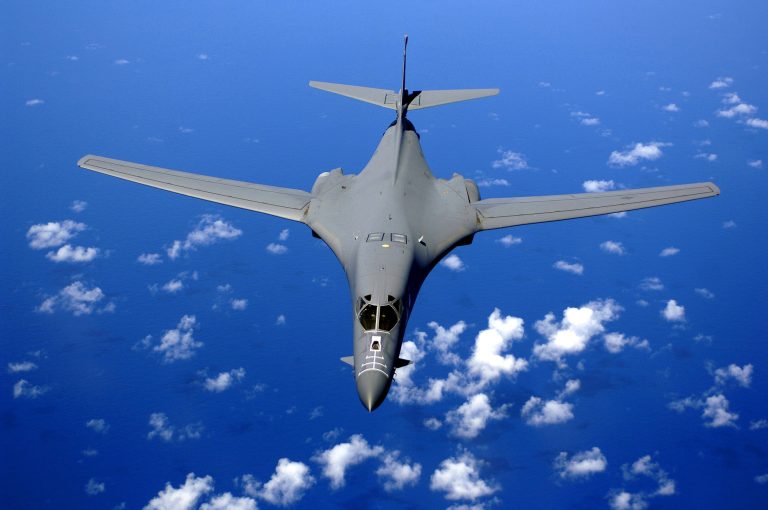
The Bone’s wings pivot from 15° spread for takeoff and efficient cruise to 67.5° fully swept for high-speed, low-level dashes. Married to a blended wing-body that smooths airflow and helps carry fuel and payload, the design lets a 200-tonne bomber fly fast and low, hugging the terrain to slip beneath enemy radar — the core idea of the B-1B.
The largest internal payload in the fleet
Three cavernous internal weapons bays give the B-1B the largest internal payload of any bomber in US service — up to about 34,000 kg (75,000 lb) of ordnance. It can carry 84 Mk 82 bombs, 24 GBU-31 JDAMs or 24 JASSM cruise missiles internally, with no drag or radar penalty from external pylons. That deep magazine is what makes it a conventional-strike heavyweight.
Four F101 turbofans and a smaller signature
Power comes from four General Electric F101-GE-102 augmented turbofans, each around 137 kN (30,780 lbf) in afterburner — the engine core that later spawned the F110 and F118. Combined with serpentine intakes and radar-absorbent design, the B-1B has a radar cross-section far smaller than the B-52’s — not stealthy like the B-2, but far harder to see than the jet it was meant to replace.
02The B-1B Lancer’s variable-sweep wing: why a heavy bomber needed swing wings
A bomber built to penetrate at low level faces a contradiction. To take off heavy, loiter efficiently and land safely it wants a long, straight wing; to punch through the dense low-altitude air at high speed without being torn apart by turbulence it wants a short, sharply swept one. The variable-sweep wing solves both: spread to 15° for takeoff and cruise, and swept back to 67.5° for the high-speed dash. The penalty is weight and mechanical complexity in the wing pivot, but for the B-1B’s fast-and-low mission it was judged worth it — the same reasoning that gave swing wings to the F-111, F-14 and Soviet Tu-160.
03The B-1 Lancer’s conversion from nuclear to conventional: the bomber that changed jobs
The B-1B entered service as a nuclear penetrator, but it never carried nuclear weapons in combat. After the Cold War the type was progressively removed from the nuclear mission — its nuclear wiring and hardware stripped out through the 1990s and formally accounted for under later arms-control treaties — and rebuilt as a purely conventional bomber. Upgrades gave it precision JDAMs, a targeting pod, a moving-target radar and a data link, turning a jet designed to deliver free-fall nuclear bombs into the most prolific precision-strike platform of the post-9/11 wars. It is one of the clearest examples of a strategic aircraft finding an entirely new career.
Full specifications
Figures are for the production B-1B. Contested or variable values (ceiling, exact payload) are hedged; performance depends heavily on load and configuration.
Baseline note: the figures below describe the B-1B, the only version ever built in numbers and the aircraft the USAF still flies. Deltas for the cancelled Mach 2.2 B-1A are in grey, and they are the point of this page: the B-1B is a slower, heavier, less exotic aeroplane than the one it replaced, and almost every difference in this table is a deliberate trade of speed for payload, range and radar signature. Where a number is an inference rather than a published figure — radar cross-section above all — that is said so.
Dimensions & weights
- Crew
- 4 — aircraft commander, pilot, offensive systems officer and defensive systems officer, on ACES II ejection seats (three of the four B-1As instead had a jettisonable crew escape capsule — the whole forward cabin left the aircraft as one piece, an idea inherited from the F-111 and abandoned as heavy and unreliable)
- Length
- 44.5 m (146 ft 0 in)
- Wingspan, wings forward
- 41.8 m (137 ft 0 in) at 15° sweep — used for take-off, landing and long-range cruise
- Wingspan, wings swept
- 24.1 m (79 ft 0 in) at 67.5° sweep
- Sweep range
- 15° to 67.5°, continuously variable
- Height
- 10.4 m (34 ft 0 in)
- Wing area
- 181.2 m² (1,950 sq ft) wings forward; aerofoil NACA 69-190-2
- Empty weight
- 87,100 kg (192,000 lb)
- Gross weight
- 147,900 kg (326,000 lb)
- Maximum take-off weight
- 216,400 kg (477,000 lb); the B-1A was limited to 179,200 kg (395,000 lb). The extra 37 tonnes is fuel and weapons, bought with the speed that was given up
- Internal payload
- ~34,000 kg (~75,000 lb) across three bays — the largest internal weapons load of any aircraft in the United States inventory
- External payload
- ~22,700 kg (~50,000 lb) on six fuselage hardpoints — designed in, then sealed for three decades because using them would have raised arms-control questions, and only now being reopened for conventional weapons
- Wing loading
- 816 kg/m² (167 lb/sq ft) at gross weight, wings forward
Performance
- Maximum speed, altitude
- 1,335 km/h (830 mph; 721 kn), Mach 1.25 at 15,200 m (50,000 ft). The B-1A reached Mach 2.22 — the second prototype did it — and the B-1B gave that up entirely when the variable intake ramps were deleted
- Maximum speed, low level
- 1,126 km/h (700 mph; 608 kn) at 60–150 m (200–500 ft), about Mach 0.92 — faster down low than the B-1A, which is the trade nobody mentions
- Service ceiling
- 18,300 m (60,000 ft)
- Range
- 9,445 km (5,870 mi; 5,100 nmi); 7,600 km (4,720 mi) carrying 16,800 kg (37,000 lb) of weapons
- Combat radius
- ~5,540 km (~3,444 mi; ~2,993 nmi)
- Rate of climb
- 28.8 m/s (5,678 ft/min)
- Thrust-to-weight
- 0.38 at gross weight
- Radar cross-section
- About 2.4 m² (26 sq ft) — roughly one-fiftieth of the B-52’s, comparable to a small fighter, and achieved with serpentine intake ducts, radar-absorbent material and blended surfaces rather than faceting. This is a widely repeated estimate, not a released measurement, and it is emphatically not stealth: the B-2 is orders of magnitude smaller
- Records held
- 61 FAI world records for speed, payload, distance and time-to-climb in its weight classes
- Mission capable rate
- 52.8 per cent in FY2017, and worse afterwards: in 2019 a House Armed Services subcommittee was told the number of fully mission-capable B-1s was in single digits out of a fleet of 62. Two decades of continuous overhead-watch tasking over Afghanistan and Iraq wore the airframes out faster than the sustainment budget assumed
- Fleet groundings
- Three fleet-wide stand-downs in four years: June 2018 and March 2019 over ejection seat and drogue chute defects, and 20 April 2021 over the augmenter fuel pump filter housing after a ground emergency at Ellsworth
- Longest sustained deployment effort
- 770 sorties and 9,500 flying hours by nine aircraft of the 9th Expeditionary Bomb Squadron in six months over Afghanistan to August 2012 — a quarter of all combat sorties over the country, with one bomber airborne at all times
Propulsion & systems
- Engines
- 4 × General Electric F101-GE-102 afterburning turbofans, paired in two nacelles under the wing gloves (the B-1A flew the F101-GE-100; the -102 traded a little performance for durability and fuel efficiency. The F101 core went on to become the F110 fighter engine and the CFM56, which is why this bomber is the ancestor of most of the world’s narrow-body airliners)
- Thrust, each
- 77.4 kN (17,390 lbf) dry, 136.9 kN (30,780 lbf) with reheat
- Intakes
- Fixed, with serpentine ducts and radar baffles hiding the compressor faces. The B-1A’s variable ramps and nozzles — the things that made Mach 2.2 possible — were deleted to cut cost, weight and, above all, radar return. This single change is the difference between the two aircraft
- Structural Mode Control System
- Two small vanes low on the nose, driven by accelerometers mounted with them and working with the lower rudder segment, actively damping the fuselage’s bending modes in low-level turbulence. It keeps the crew able to work and the airframe from fatiguing at 60 m and 600 kn; the alternative was about four tonnes of extra structure
- Attack radar
- Westinghouse AN/APQ-164 passive electronically scanned array, the antenna fixed and tilted off-axis so it does not reflect straight back at an illuminating radar — a stealth measure on an aircraft that is not stealthy. Terrain-following down to 60 m, hands off, in cloud
- Defensive systems
- Eaton AN/ALQ-161A radar warning and jamming suite, later supplemented by the AN/ASQ-184 defensive management system. The ALQ-161A is the programme’s enduring embarrassment: it never worked as specified, was notorious for jamming the aircraft’s own tail-warning function, and the Block F upgrade meant to fix it was cancelled outright in December 2002 after cost overruns
- Targeting
- AN/AAQ-33 Sniper Advanced Targeting Pod on a chin hardpoint, integrated across the fleet from 2007 — the single change that turned a nuclear penetrator into the close air support aircraft it spent the 2000s being
- Cockpit
- Integrated Battle Station, begun 2012 and completed across the fleet in 2020 at a cost of about US$1.1 billion: Fully Integrated Data Link, vertical situation display units and a central integrated test system, replacing analogue instruments with a genuine glass cockpit
- First flight
- B-1A on 23 December 1974; the first production B-1B on 18 October 1984 (a converted B-1A had flown in B-1B configuration on 23 March 1983)
- Service entry
- First delivery to Dyess AFB in June 1985; initial operational capability 1 October 1986, on nuclear alert; the hundredth and last aircraft delivered on 2 May 1988
- Number built
- 104 — 4 B-1A prototypes (1974–1977, flown on test until April 1981: 70 flights, 378 hours) and 100 B-1Bs (1983–1988). 244 B-1As had been planned before Carter cancelled the programme
- Unit cost
- ~US$283 million in 1998 constant dollars, against the roughly US$100 million per aircraft lifetime figure that helped persuade Carter to cancel the B-1A in 1977
04The B-1 Lancer’s operating costs: why the Bone is expensive to keep flying
The B-1 is a big, complex, ageing four-engine aircraft, and it costs accordingly. Program flyaway costs in the late 1990s were commonly cited around US$280–320 million per aircraft, and the cost per flight hour is frequently quoted in the US$60,000–70,000 range — among the higher figures in the bomber fleet. Low-altitude, high-speed flying is hard on airframes, and years of heavy use over Afghanistan and Iraq wore the fleet down. Rising maintenance costs and airframe fatigue are among the reasons the US Air Force is retiring the type as the B-21 Raider comes online. Treat any single dollar figure as an order-of-magnitude estimate rather than an audited number.
Armament & payload
The B-1B carries more bombs internally than any other American aircraft and is forbidden by treaty from carrying the only weapon it was built for
Three weapons bays, 34,000 kg of internal load, a rotary launcher in each bay, no gun and no air-to-air missile: on paper the B-1B is the most capable conventional bomb truck the United States has ever fielded, and in practice that is exactly what it has been since 1998. It has never dropped a nuclear weapon and it never will. The nuclear tasking was given up in the mid-1990s under START I, and between then and 2011 the aircraft were physically converted — nuclear wiring bundles cut out of the weapons bays, the external hardpoints modified so a nuclear pylon can never be attached, and the pylons themselves destroyed. Russian inspectors visit Dyess and Ellsworth on alternating years to confirm the conversion has not been reversed.
What replaced the nuclear mission was a career nobody planned. Sniper targeting pods from 2007, a Fully Integrated Data Link, and thirty-hour-a-week overhead watch turned a supersonic penetrator into a loitering close air support platform for infantry in Afghanistan — work it did superbly and which wore the fleet out. The current chapter is maritime and stand-off: the B-1 was the first and for years the only carrier of the LRASM anti-ship missile, and the six external hardpoints sealed since the START conversion are finally being reopened, this time for conventional and hypersonic weapons. Weapon clearances have shifted repeatedly across the Conventional Mission Upgrade Programme blocks, and some loads listed in the technical orders have never been carried operationally; the counts below are the published maxima, not what a given aircraft flies with.
Gun
- None carried. The B-1 has never had a gun of any kind, in either the A or the B.
- It was designed without one at a time when the B-52 still had a radar-directed 20 mm tail turret — the tail gun came off the B-52 only in 1991, five years after the B-1B entered service.
- The reasoning was that a bomber crossing Soviet airspace at 200 ft and Mach 0.92 would never be in a gun engagement, and a turret is weight, drag and radar return for nothing.
- No gun pod exists for the type and none has ever been proposed. Strafing is not, and has never been, a B-1 mission.
Air-to-air
- None carried. The type has no air-to-air capability and no air-to-air missile has ever been integrated on it.
- Self-defence is the AN/ALQ-161A jamming suite, chaff and flares, terrain masking and speed — and, since the 1990s, simply not going anywhere without fighters.
- The one serious proposal to change that was the B-1R of 2004: an AESA radar, uprated engines and air-to-air missiles on modified external hardpoints, turning the bomber into a long-range missile carrier. It was never funded and never built.
- The nearest thing to an air-to-air weapon on the aircraft today is the AGM-158C LRASM, and its targets are ships.
Air-to-surface guided
- AGM-158A JASSM and AGM-158B JASSM-ER stealthy cruise missiles, up to 24 internally on the three rotary launchers — 19 were fired by B-1s against Syrian chemical weapons targets on 14 April 2018
- AGM-158C LRASM anti-ship missile: the B-1B was the first platform to carry it and reached early operational capability with it in December 2018, giving the USAF a long-range maritime strike weapon it had lacked since the 1990s
- AGM-154 JSOW glide dispenser, cleared under the Block E upgrade completed in September 2006
- Hypersonic carriage. The AGM-183A ARRW was to be integrated using the external hardpoints; the programme’s future has been repeatedly in doubt, but the carriage work continues — the Hypersonic Integration Programme has demonstrated captive carry of a 5,000 lb-class store and release of a weapon shape from the new Load Adaptable Modular pylon
- No nuclear weapons of any kind, guided or otherwise. The AGM-86B ALCM was never a B-1 weapon and the AGM-181 LRSO will not be
Bombs
- Unguided. Up to 84 × Mk 82 500 lb bombs, low-drag or air-inflatable-retarder, and up to 24 × Mk 84 2,000 lb — a single aircraft carrying what a squadron of fighters would need several sorties to deliver
- JDAM. 24 × GBU-31 2,000 lb (Mk 84 or BLU-109 penetrator warhead), or GBU-38 500 lb JDAM on multiple ejector racks mounted to the rotary launchers, plus GBU-54 Laser JDAM for moving targets — the everyday weapon of the Afghanistan and Syria years. The GBU-39 Small Diameter Bomb is cleared on paper and has never been fielded on the type
- Cluster and dispenser weapons. CBU-87, CBU-89 Gator and CBU-97 Sensor Fuzed Weapon, and the wind-corrected CBU-103/104/105 — Block C modified 50 bomb racks specifically to let one aircraft deliver 30 dispensers in a sortie
- Mines. Mk 62 Quickstrike shallow-water mines and Mk 65 naval mines — a quiet but genuinely important capability, since very few aircraft can lay a minefield across a strait in one pass
- Nuclear: none, and none possible. B61 and B83 bombs were carried until the mid-1990s. The wiring that armed them was cut out and removed, and the fleet has been treaty-verified non-nuclear since 2011
Rockets
- None carried. No unguided rocket pod has ever been cleared, trialled or proposed for the B-1.
- There is nowhere sensible to put one: the three internal bays take rotary launchers, and the external hardpoints were sealed from the START conversion until the current pylon work.
- The tactics rockets serve — a shallow dive, a visual attack, a second pass over the same target — are the opposite of what a 216-tonne aircraft with a terrain-following radar is for.
- Where a B-1 needs area effect it uses cluster dispensers; where it needs precision against a moving vehicle it uses a Laser JDAM and a Sniper pod. Neither requires the crew to see the target with their own eyes.
Pods & other stores
- Sniper Advanced Targeting Pod on a chin hardpoint by the forward bay, fleet-wide from 2007 — laser designation, long-range video and the ability to talk a ground controller onto a target, which is what kept the aircraft relevant
- Six external hardpoints, designed in and then unusable for thirty years. The August 2019 reconfiguration used a moveable forward bulkhead to stretch the intermediate bay from 4.57 m to 6.83 m (180 in to 269 in) for the Common Strategic Rotary Launcher, and reopened the external stations for conventional carriage
- Load Adaptable Modular pylon, developed by Boeing on company money and demonstrated in 2024: two 2,000 lb weapons or one 5,000 lb weapon per pylon. The USAF put US$50.26 million into the External Heavy-Stores Pylon programme in FY2026; combined internal and external carriage would take the missile count from 24 to about 36
- A fuel tank can be carried in a weapons bay in place of a launcher, trading payload for range
- No electronic warfare pod. Everything defensive is internal, which is both elegant and the reason the ALQ-161A’s failures could never be fixed by hanging something new underneath
Three typical loadouts
- Overhead watch (Afghanistan and Iraq, 2001–2021)
- Sniper pod on the chin, a mixed bay of GBU-38 500 lb JDAM, GBU-31 2,000 lb JDAM and GBU-54 Laser JDAM, and a fuel tank in one bay. Eight to twelve hours on station, weapons released a few at a time on request from ground controllers — the mission the aircraft was never designed for and did better than anything else available.
- Stand-off strike (Syria, 14 April 2018)
- Up to 24 × AGM-158 JASSM or JASSM-ER on the three rotary launchers, released hundreds of kilometres from the target. Two B-1Bs fired 19 JASSMs at the Barzah and Him Shinshar chemical weapons sites without entering Syrian air defence coverage.
- Maritime strike (the current Pacific role)
- Up to 24 × AGM-158C LRASM internally, or Mk 62 Quickstrike mines for choke-point denial. One aircraft, launching from continental United States bases with tanker support, puts more anti-ship missiles into the air than a surface action group.
Sourcing caveat: weapon counts come from the USAF fact sheet, the B-1B weapons loading checklists cited in the standard references, and USAF and Air Force Global Strike Command statements on specific operations. Several loads that appear in technical orders — the Small Diameter Bomb among them — have never been fielded, and are marked as such rather than counted. The external and hypersonic carriage figures are from budget documents and test reporting and describe demonstrated or funded capability, not fielded capability.
Variants
Carter cancelled the aeroplane that could do Mach 2.2, Reagan revived a slower one, and the slower one turned out to be the useful aircraft
The B-1’s two lives are the whole story. The B-1A was a Mach 2.2 high-altitude penetrator with variable intake ramps, a crew escape capsule and a bill that had reached over US$100 million an aircraft in lifetime cost by 1977. On 30 June 1977 Jimmy Carter cancelled it, having been briefed on the classified stealth work that would become the F-117 and the B-2, and having been persuaded that a fleet of B-52s carrying AGM-86 cruise missiles could saturate Soviet defences for at least 20 per cent less money. Four prototypes flew on quietly until April 1981; the second reached Mach 2.22.
Ronald Reagan campaigned on the cancellation and reversed it on 2 October 1981, ordering 100 aircraft — but not the same aircraft. The revived B-1B deleted the variable intake ramps, capping speed at Mach 1.25 at altitude, and in exchange raised low-level speed from about Mach 0.85 to 0.92, cut radar cross-section to roughly a fiftieth of a B-52’s, and raised maximum take-off weight by 37 tonnes. It was explicitly an interim aircraft, meant to bridge the years between the B-52 becoming too vulnerable and the stealth bomber arriving. The B-2 arrived, in numbers so small it changed nothing, and the interim aircraft is still flying forty years later.
The honest verdict on the trade is uncomfortable. As a nuclear penetrator the B-1B was compromised on delivery: too slow to outrun what Carter’s critics said it would outrun, not remotely stealthy enough to do what the B-2 does, and saddled with an electronic warfare suite that never worked. As a conventional bomber — a role added at a cost of US$3 billion after the Soviet Union collapsed — it has been one of the most productive aircraft the USAF has ever operated. It was cancelled for the wrong reasons, revived for the wrong reasons, and became valuable for reasons nobody argued about at the time.
- B-1A (first flight 23 December 1974; 4 prototypes, 244 planned)
- Mach 2.2 at altitude with variable intake ramps and nozzles, anti-flash white undersides, and on three of the four a jettisonable crew escape capsule. Cancelled 30 June 1977; flight testing continued to April 1981 across 70 flights and 378 hours. The first prototype ended up dismantled for radar signature testing at Griffiss.
- B-1B (first production flight 18 October 1984; 100 built to May 1988)
- Fixed intakes with serpentine ducts and radar baffles, ACES II seats instead of the capsule, strengthened structure to 477,000 lb, an upgraded electronic warfare suite to counter the look-down MiG-31, and a top speed of Mach 1.25. Entered service on nuclear alert on 1 October 1986.
- B-1B Block A (as delivered, 1985–1988)
- Nuclear bombs and unguided gravity weapons only. No precision conventional capability of any kind — which is why the entire fleet sat out the 1991 Gulf War while B-52s did the work.
- B-1B Blocks B, C and D (Conventional Mission Upgrade Programme, 1995–2001)
- Block B improved the synthetic aperture radar and countermeasures in 1995; Block C modified 50 bomb racks for 30 cluster dispensers per sortie; Block D added near-precision weapons, secure communications and the MIL-STD-1760 smart weapons interface. The conversion cost about US$3 billion, ordered by President George H. W. Bush once the nuclear role became doubtful.
- B-1B Block E (completed September 2006)
- New avionics computers and clearance for WCMD, JSOW and JASSM — the upgrade that made the B-1 a stand-off weapon carrier rather than a bomb dropper.
- B-1B Block F (cancelled December 2002)
- The Defensive Systems Upgrade Programme, intended to finally fix the AN/ALQ-161A. Killed on cost and schedule, leaving the fleet with the jammer it had always had.
- Integrated Battle Station (2012–2020; ~US$1.1 billion)
- Three concurrent modifications — Fully Integrated Data Link, vertical situation display units and a central integrated test system — delivering the aircraft’s first genuine glass cockpit and its most comprehensive upgrade to date.
- External carriage reconfiguration (demonstrated from August 2019)
- A moveable forward bulkhead stretching the intermediate bay for the Common Strategic Rotary Launcher, plus reopening six external hardpoints and the Boeing Load Adaptable Modular pylon — raising the missile load from 24 to about 36 and enabling 5,000 lb-class hypersonic stores.
- B-1R (2004 proposal, not built)
- A regional bomber concept: AESA radar, uprated engines, external hardpoints modified for air-to-air missiles. It would have made the B-1 a fighter-escorting missile carrier. Never funded.
- Export variants (none, ever)
- The B-1 was never exported, never offered for export and never studied for a foreign customer. As a nuclear-capable heavy bomber it was outside the bounds of any release policy, and by the time it was conventional-only there was nothing to sell and no one buying.
Closing caveat, and the fleet arithmetic, since there is no operator chart on this page: the United States Air Force is and has always been the only operator. One hundred B-1Bs were built; eleven B-1s have been lost in accidents since 1984 with twelve crew killed — the first a B-1A prototype in August 1984, the most recent a B-1B at Ellsworth on 4 January 2024 in freezing weather and poor visibility, all four crew ejecting safely. In February 2021 the USAF divested 17 aircraft to concentrate maintenance money on the remainder, four of them stored at Davis-Monthan in a condition that would allow recall, leaving a published inventory of 45 — a figure USAF documents still quote despite the 2024 loss, so treat 44 to 45 as the honest range. They serve with the 7th Bomb Wing at Dyess AFB, Texas and the 28th Bomb Wing at Ellsworth AFB, South Dakota, with test aircraft at Edwards and Nellis. Combat use has continued without pause: Desert Fox in 1998, Kosovo, Afghanistan, Iraq, Syria, 85 targets in Iraq and Syria in February 2024, the Venezuela strikes of January 2026 and Operation Epic Fury against Iranian ballistic missile facilities in March 2026. The replacement is the B-21 Raider, which stands up first at Ellsworth alongside the B-1s it will replace; current USAF planning keeps the Lancer flying to about 2036–2037, with modernisation funded into 2031. Whether the airframes last that long is a separate question from whether the budget says they will.
From AMSA to the B-21 handover
B-1A first flight
Rockwell’s variable-sweep B-1A prototype makes its maiden flight on 23 December 1974, aimed at high-altitude supersonic penetration.
Carter cancels the B-1A
President Carter halts production in June 1977, betting on cruise missiles and the secret stealth-bomber programme instead.
Reagan revives it as the B-1B
The Reagan administration approves 100 redesigned B-1B bombers, optimised for low-level penetration rather than high-altitude dash.
B-1B first flight
The first production-standard B-1B flies on 18 October 1984, with a stronger structure and a far smaller radar signature.
Enters service
The B-1B reaches initial operational capability at Dyess AFB in October 1986 as a nuclear penetrator for Strategic Air Command.
Combat debut — Desert Fox
On 17–18 December 1998 the B-1B drops its first bombs in anger over Iraq, twelve years after entering service.
The conventional workhorse
Kosovo, Afghanistan and Iraq turn the denuclearised Bone into America’s go-to precision bomber, dropping huge JDAM loads.
The anti-ISIS campaign
B-1s fly long strike sorties over Syria and Iraq against ISIS, at times delivering a large share of the coalition’s bomb tonnage.
Retirement for the B-21
The Air Force begins drawing down the fleet in 2021, with full retirement planned as the stealthy B-21 Raider enters service.
Twelve B-1 Lancer stories
The bomber Carter killed
In 1977 President Carter cancelled the B-1A, calling it unnecessary in the age of cruise missiles.
Read the full story
Reagan brings it back
Ronald Reagan revived the programme in 1981, ordering 100 redesigned B-1B bombers.
Read the full story
Why they call it the Bone
Crews nicknamed the B-1 the “Bone” — a play on writing out B-One.
Read the full story
Wings that swing
The B-1’s wings pivot from 15 degrees to 67.5 degrees to fly both slow and supersonic.
Read the full story
The deepest magazine in the fleet
No US bomber carries more ordnance internally than the B-1B.
Read the full story
A twelve-year wait for war
The B-1B did not drop a bomb in anger until 1998, over a decade after entering service.
Read the full story
Loitering gunship of the sky
Over Afghanistan the B-1 became an on-call bomb truck for troops below.
Read the full story
Bomb tonnage over Syria
During the campaign against ISIS, B-1s delivered a huge share of the coalition’s ordnance.
Read the full story
Sixty-plus world records
The B-1 has set dozens of FAI-recognised records for speed, payload and distance.
Read the full story
A nuclear jet with no nukes
Through the 1990s the B-1 was stripped of its nuclear role entirely.
Read the full story
Four crew, one Bone
The B-1 flies with a crew of four on ejection seats — not the lone pilot of a fighter.
Read the full story
Making way for the Raider
As the stealthy B-21 arrives, the Bone is finally heading for retirement.
Read the full story
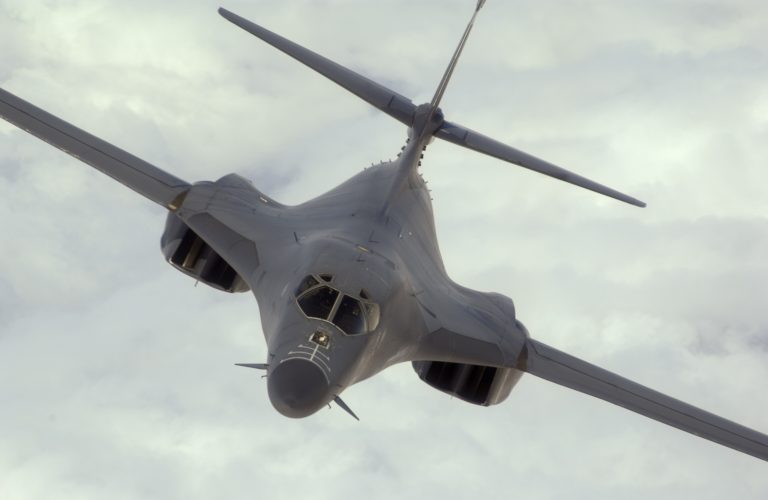
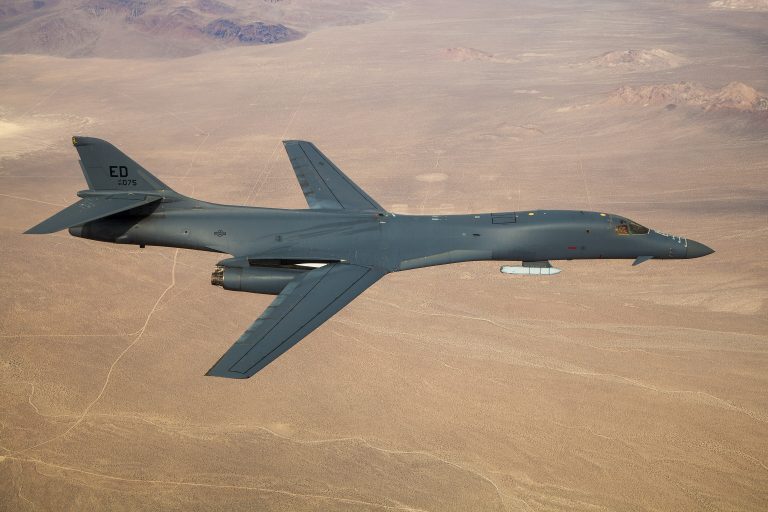
The Bone in pictures

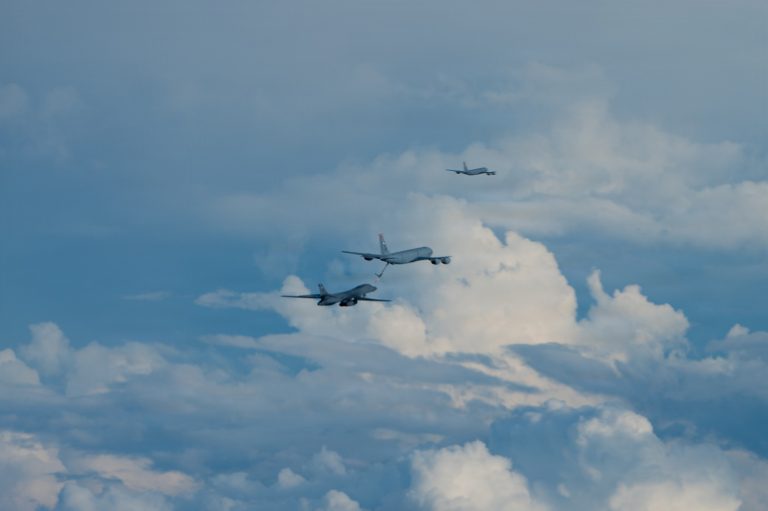
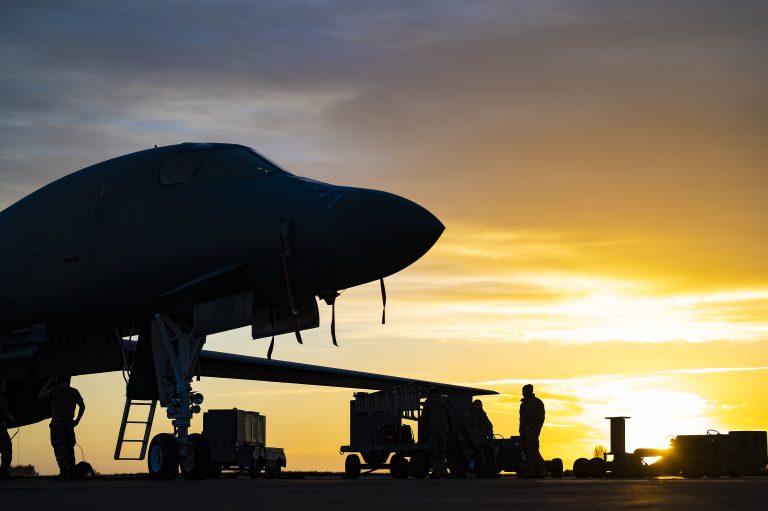
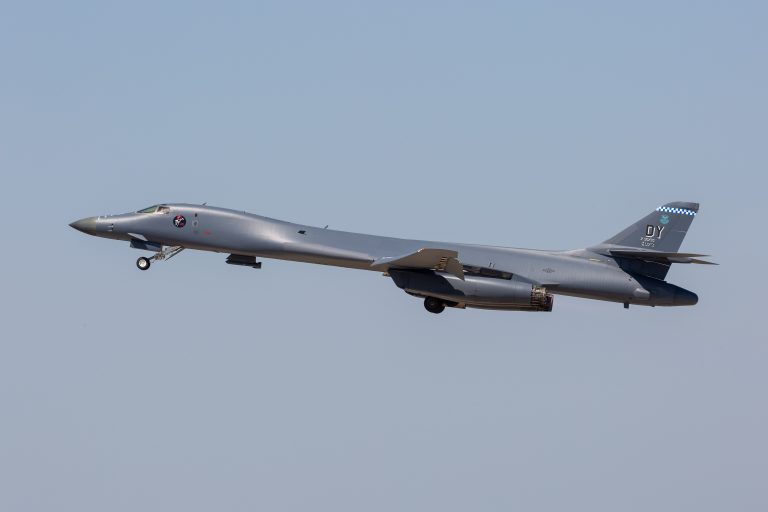
The B-1 Lancer in motion
A curated video feature for the B-1 Lancer is coming soon. In the meantime, explore the photo gallery above and the operations map below.
Where the B-1 flies
The record that defines it
The B-1 is not an air-to-air fighter and holds no aerial kills — its record is written in bomb tonnage. Built as a nuclear penetrator it never fought the Cold War, but after being reborn as a conventional bomber it became one of the hardest-working strike aircraft in the US inventory. Its combat debut came in Operation Desert Fox over Iraq in December 1998; it went on to serve over Kosovo, Afghanistan and Iraq, and during the campaign against ISIS it repeatedly delivered a large share of the coalition’s bombs. Along the way B-1 crews have set dozens of world records for speed, payload and distance.
Compare the combat record of every military aircraft. Figures as of July 2026.
Everything people ask about the B-1 Lancer
Can I fly in a B-1?
Why was the B-1 cancelled and then revived?
Why is the B-1 nicknamed the “Bone”?
Does the B-1 carry nuclear weapons?
How much can a B-1 carry?
How fast is the B-1?
Is the B-1 being retired?
You can’t fly the B-1.
These, you can.
Some legends only live in museums — others are fuelled and waiting. MiGFlug has put civilians in real military jet cockpits since 2004.
 Fly the L-39 AlbatrosThe world’s most-flown jet trainer — aerobatics included
 Fly the F-104 Starfighter“The missile with a man in it”
 Fly the MiG-21The Cold War’s most-produced jet
 Fly the T-33 Shooting StarAmerica’s first jet trainer
 Fly the DH VampireA piece of early jet history
 Fly the S.211Agile Italian jet trainer
 Fly the MB-326The classic Aermacchi jet
 Fly the MiG-15The Soviet legend of the Korean War
Continue the tour
Every fact, checked
- U.S. Air Force — B-1B Lancer fact sheetOfficial specifications, payload, crew and service history.
- U.S. Strategic Command — 25 years since the B-1’s combat debutThe 1998 Operation Desert Fox combat debut and later operations.
- Air & Space Forces Magazine — B-1 weapons profileDimensions, engines, production numbers and first-flight dates.
- Smithsonian — “The Bone Is Back”On the aircraft’s reinvention as a conventional bomber and its nickname.
- The National Interest — the B-1 from the Cold War to SyriaCancellation, revival and the anti-ISIS bombing campaign.
- The Aviationist — Rockwell B-1 LancerDesign, variable-sweep wing and denuclearisation background.
- Airman Magazine — B-1B LancerCrew perspective, mission role and the “Bone” nickname.
- National Museum of the U.S. Air Force — B-1B LancerProgramme history and preserved-airframe reference.