
Convair B-58 Hustler
The first Mach 2 bomber
A needle-nosed delta that flew at twice the speed of sound with a nuclear weapon slung under its belly — dazzling, record-breaking, brutally expensive and dangerous, and gone from service after barely a decade.
The bomber that flew too fast for its own good
In the early 1950s the US Air Force wanted a bomber that could outrun everything in the sky. The answer, from Convair in Fort Worth, Texas, was one of the most radical aircraft of the age: the B-58 Hustler, the first operational bomber able to sustain Mach 2 — twice the speed of sound. It first flew on 11 November 1956 and entered service with Strategic Air Command in 1960. Nothing that came before it looked or flew remotely like it.
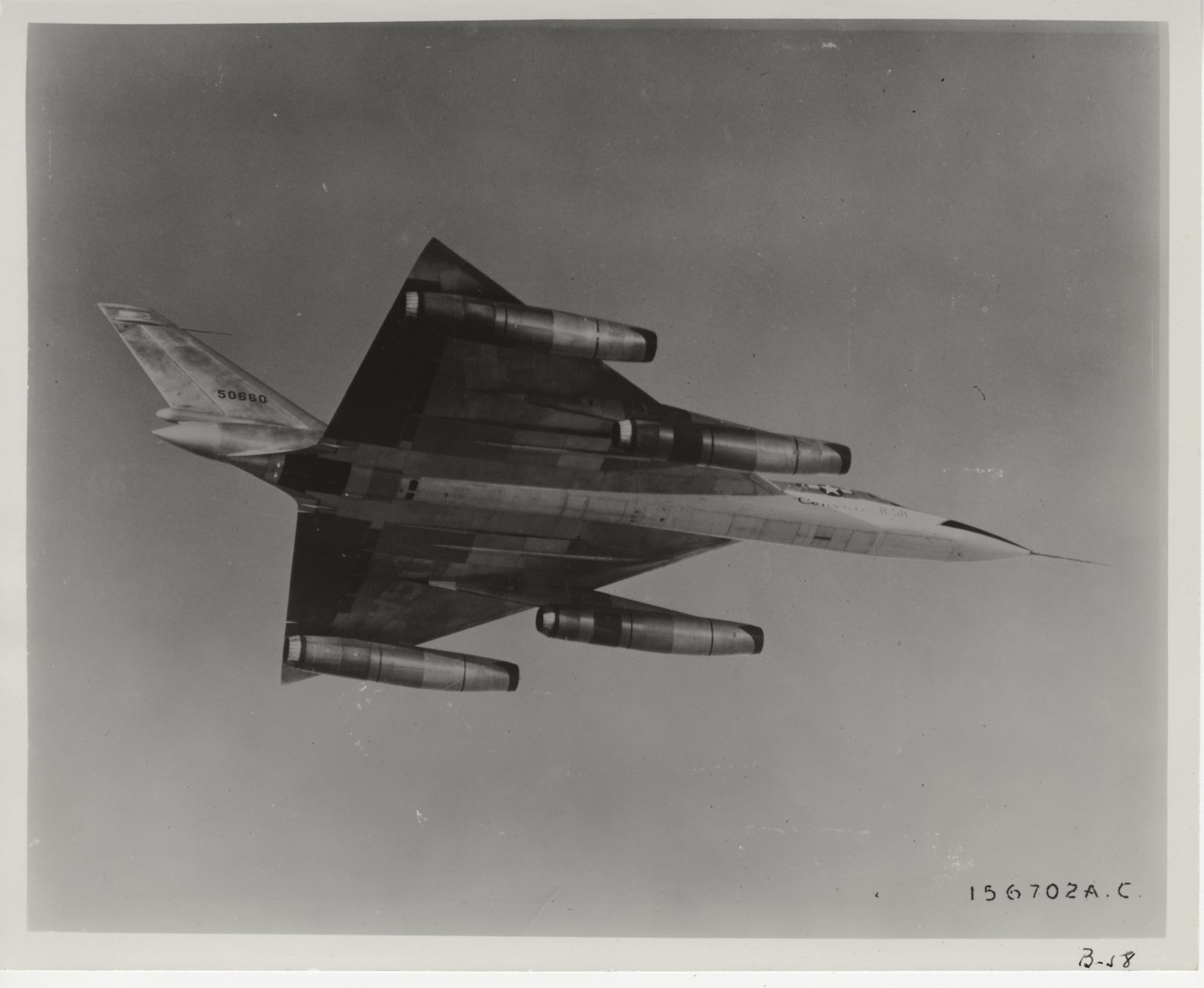
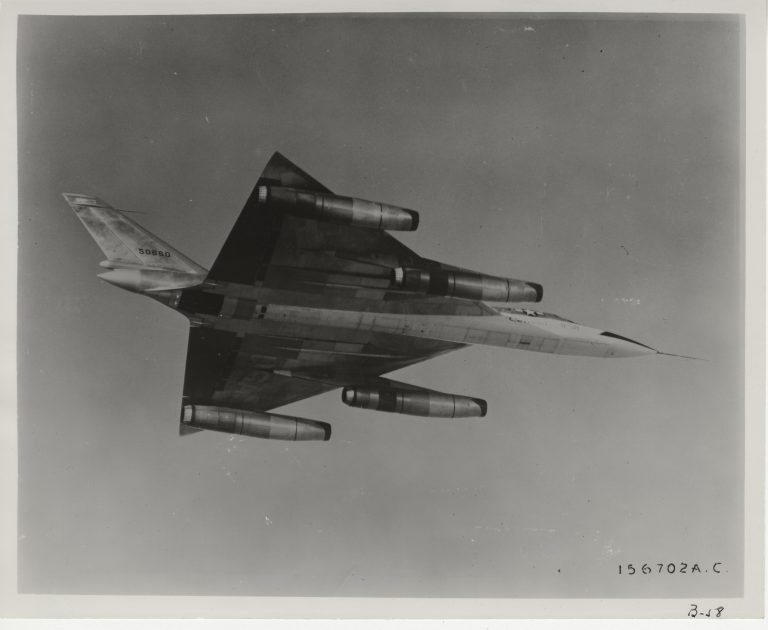
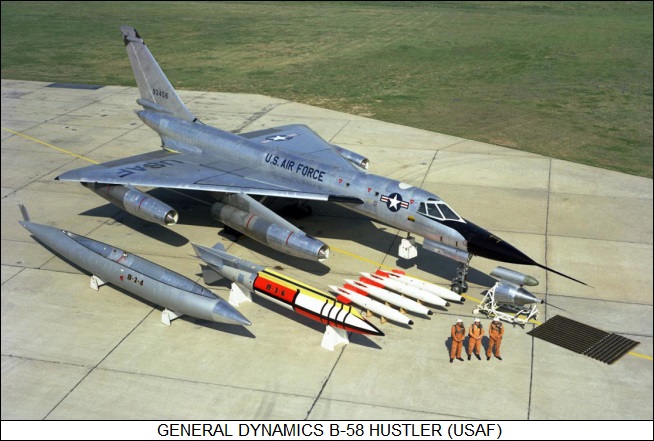
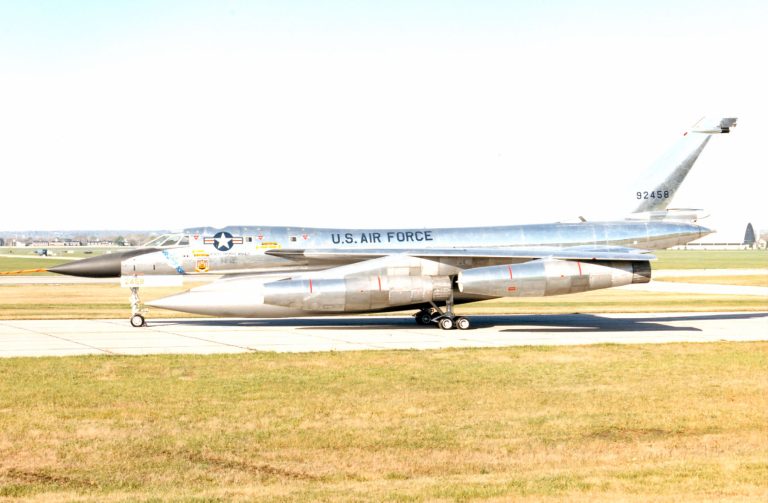
To reach Mach 2, Convair threw out the rulebook. The Hustler used a sharp delta wing, an area-ruled “wasp-waist” fuselage and four General Electric J79 afterburning turbojets slung under the wing. There was almost no room inside for fuel or a bomb bay, so Convair hung an enormous jettisonable pod beneath the fuselage that carried the extra fuel and the nuclear weapon in one droppable package. A crew of three — pilot, navigator-bombardier and defensive systems operator — sat in tandem in a jet packed with the most advanced systems money could buy.
And it was money — enormous amounts of it. The B-58 was extravagantly expensive to buy and to fly, roughly three times the operating cost of the subsonic B-52 it was meant to complement. It was also dangerous: demanding to fly, unforgiving of mistakes, and prone to fatal accidents. Of 116 built, 26 were lost in crashes. Worse, by the time it was operational the mission it was built for was disappearing: Soviet surface-to-air missiles made high-altitude supersonic penetration a death sentence, and intercontinental ballistic missiles were taking over the nuclear-strike role. Defense Secretary Robert McNamara ordered the type retired, and by January 1970 — barely a decade after entering service — every Hustler was gone.
01The Convair B-58 Hustler’s origins: how America built its first Mach 2 bomber
The Hustler grew out of early-1950s Air Force studies for a supersonic strategic bomber, which Convair won in 1952. Convair — already the delta-wing specialist behind the F-102 and F-106 interceptors — proposed a bomber shaped like a scaled-up delta fighter. To beat the transonic drag rise it applied Richard Whitcomb’s newly discovered area rule, pinching the fuselage where the wing joined it. To save weight and internal volume, the fuel and the weapon were moved outside the aircraft entirely, into a droppable belly pod.
The result was a technological tour de force that pushed 1950s engineering to its limits: stainless-steel honeycomb skins, an early inertial navigation and bombing system, and a needle nose that could touch Mach 2. It also pushed cost and complexity to their limits, and that tension — astonishing performance against ruinous expense and a shrinking mission — defined the Hustler’s whole short life.
What makes it special
A delta wing built for the Mach 2 dash
The Hustler’s sharply swept delta wing — thin, broad and low-drag — let it cruise at Mach 2, twice the speed of sound and far faster than any bomber before it. The same planform that made Convair’s F-102 and F-106 interceptors supersonic was scaled up to bomber size, trading the docile handling of a straight wing for raw high-altitude speed.
Four General Electric J79 turbojets
Power came from four GE J79 afterburning turbojets in individual underwing pods — the same engine family that powered the F-104 Starfighter and F-4 Phantom. Each produced roughly 69 kN (15,600 lbf) in afterburner. Podding the engines separately kept them clear of the slim, area-ruled fuselage and made a Mach 2 four-engine bomber possible.
The droppable fuel-and-weapon pod
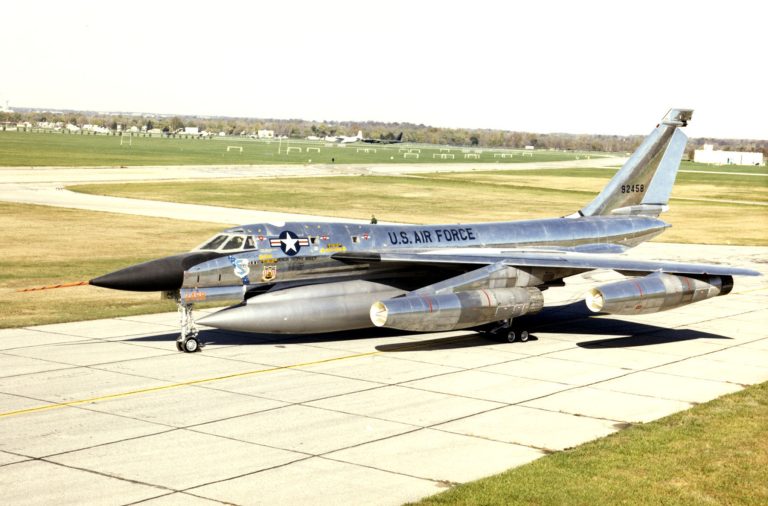
The Hustler’s slender body left no room for a conventional bomb bay, so it carried a huge jettisonable centreline pod holding both extra fuel and the nuclear weapon. Burn the fuel, drop the pod on the target, and the jet flew home lighter and faster. Married to the area-ruled fuselage, it was one of the boldest packaging ideas in bomber design.
02The B-58 Hustler’s delta wing and area rule: shaping an airframe for Mach 2
Flying at Mach 2 meant defeating the violent drag rise that builds around the speed of sound. Convair used two tools. The first was the delta wing: thin in section, deeply swept, and structurally efficient, it gave low supersonic drag and enough internal volume in the wing roots for structure and systems. The second was Richard Whitcomb’s area rule, which says the aircraft’s total cross-sectional area should change smoothly from nose to tail. That is why the Hustler’s fuselage is pinched into a “wasp waist” where the wing meets it — the narrowing offsets the wing’s bulk so the combined area grows gently. The airframe itself was exotic: much of the skin was stainless-steel and aluminium honeycomb sandwich, light and stiff enough to survive the heat and loads of sustained supersonic flight.
03The B-58 Hustler’s droppable pod: fuel and a nuclear weapon in one jettisonable package
Because the area-ruled fuselage had almost no internal volume, Convair put the mission load outside the aircraft. The original MB-1 pod was a single large streamlined body carried on the centreline that held both fuel and a nuclear weapon; the crew burned the pod’s fuel on the way to the target, then released the whole pod. Later the two-component TCP (two-component pod) split fuel and weapon so the empty lower fuel tank could be dropped separately, improving range and flexibility. It was an elegant idea with real drawbacks — the pod was heavy, drag-producing and complex, and a jet that had dropped it had also dropped much of its fuel. But it was the only way to give a Mach 2 delta the range and payload of a strategic bomber.
Full specifications
Figures are for the production B-58A. Contested or variable values (ceiling, range, cost) are hedged; performance depended heavily on pod configuration, fuel and refuelling.
Baseline note: the figures below describe the B-58A in its definitive Strategic Air Command configuration — four General Electric J79-GE-5B turbojets, the encapsulated escape system fitted from 1962, and a tail barbette mounting one 20 mm T171E-3 rotary cannon. Deltas for the two XB-58 prototypes, the eleven YB-58A trials aircraft, the seventeen RB-58A pre-production machines and the eight TB-58A trainers are given in grey. Four cautions apply before any number here is quoted. First, the B-58 has no meaningful weight without saying what is hanging under it: the aeroplane, the MB-1C pod and the two-component pod are three different aircraft as far as the flight manual is concerned, and a single row cannot express that. Second, the engine designation is genuinely unsettled — the Wikipedia specification block prints J79-GE-5A at 10,400 lbf dry and 15,000 lbf in afterburner, while Air Force Magazine and Joe Baugher both print J79-GE-5B at 10,300 lbf military and 15,600 lbf maximum; production aircraft in fact ran J79-GE-5A, -5B and -5C in service, and the fleet was never uniform. Third, the range rows in circulation are a mess: 4,100 nautical miles, 1,740 nautical miles and "1,550 miles unrefuelled" are all printed as though they were the same quantity, and they are not. Fourth, the height row disagrees by nearly half a metre between sources, which for an aeroplane measured this often is a transcription problem rather than a real one.
Dimensions & weights
- Crew
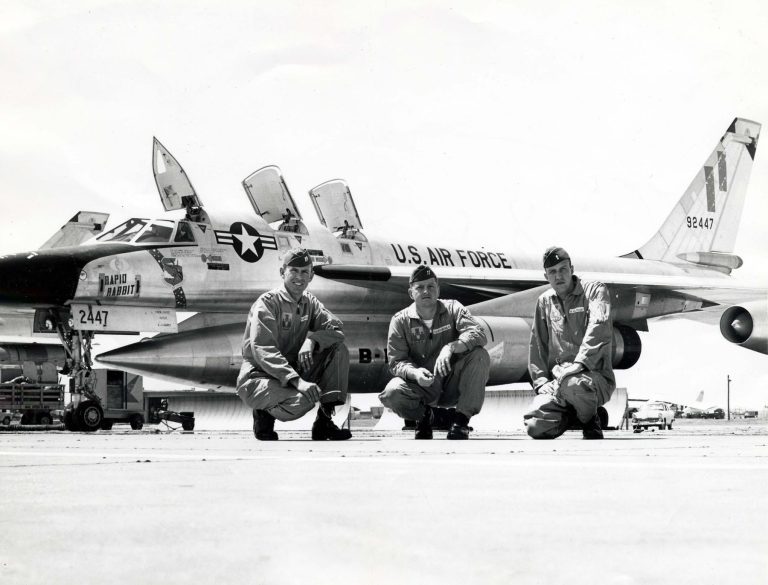
- 3 — pilot, navigator-bombardier and defensive systems operator, seated in three separate tandem cockpits with no way to see, reach or physically help one another. The navigator had a small side window; the DSO, sealed in the third station behind him, had none at all and flew the aeroplane’s entire career looking at instruments and a radar scope. Crews were hand-picked, all-officer and unusually experienced by SAC standards, and they were kept together as a fixed crew for years because there was no cheap way to train a replacement. The TB-58A moved the instructor into the second station with a duplicate set of controls and a seat canted ten degrees to starboard so he could see past the student’s head
- Length
- 29.51 m (96 ft 10 in) — slimmer through the waist than the raw number suggests, because the fuselage was reprofiled to Richard Whitcomb’s area rule after the configuration had already been frozen once. Baugher prints 96 ft 9.4 in, which is the same aeroplane measured more fussily
- Wingspan
- 17.32 m (56 ft 10 in) — less than half the span of the B-47 it replaced and barely a third that of the B-52 that outlived it. The B-58 is a strategic bomber with the wing of a fighter, and almost every operational complaint about it follows from that one fact
- Height
- 9.58 m (31 ft 5 in) over the fin. Wikipedia’s specification block gives 29 ft 11 in (9.12 m); the 31 ft 5 in figure is the one printed by the type’s own literature and by the FAS entry, and the gap is almost certainly a measurement taken with and without the pod fitted
- Wing area
- 143.3 m² (1,542 sq ft) — a cropped delta with 60° of leading-edge sweep, conical camber worked into the outer panels, and a thickness-to-chord ratio running from about 3.46 per cent at the root to 4.08 per cent at the tip. There is no horizontal tail: pitch and roll are both done by elevons, and trim is done by moving fuel
- Aspect ratio
- 2.09 — extraordinarily low, which is what buys Mach 2 and what makes the aeroplane land at a fighter’s speed while weighing as much as a loaded airliner
- Centreline pod
- 17.4 m × 1.5 m (57 ft × 5 ft) for the MB-1C — a store nearly three-fifths as long as the aircraft carrying it, holding a thermonuclear weapon amidships and fuel in tanks fore and aft to keep the whole assembly in trim as it burned. The two-component pod that replaced it stacked a 10.7 m (35 ft) weapon-and-fuel upper section on an expendable lower fuel section
- Empty weight
- 25,202 kg (55,560 lb) — clean, without pod. Baugher prints 55,650 lb. The structure accounted for only 13.8 per cent of gross weight, a figure no contemporary bomber came close to and the direct payoff of bonded aluminium honeycomb
- Typical combat weight
- 68,000 kg (150,000 lb) — the weight the handling data is written around, and the one at which the rotation and approach figures below apply
- Maximum take-off weight
- 80,236 kg (176,890 lb) with a full pod. Wikipedia lists a "gross weight" of 67,871 lb between the empty and maximum rows; at 12,300 lb above empty that cannot be a gross weight in any normal sense and is best ignored
- Internal fuel
- ~53,000 L (~14,000 US gal) in integral wing tanks of about 34,100 L and fuselage tanks of about 19,000 L, the rearmost of which existed chiefly as a trim ballast tank. The MB-1C added roughly another 15,000 L. A fully fuelled B-58 could not take off, so the standard mission began with a partial load and a tanker
- Wing loading
- 210 kg/m² (44 lb/sq ft) at gross weight — modest on paper, and completely misleading, because a 60° delta generates its lift by angle of attack rather than by area and the aeroplane approached at attitudes that alarmed anyone watching from the ground
Performance
- Maximum speed
- 2,122 km/h (1,147 kn, 1,319 mph) at 12,200 m — Mach 2.0. Baugher gives Mach 2.2 and some references print 1,385 mph; the operational limit was set not by thrust but by skin temperature, because the airframe is aluminium and the honeycomb bonding adhesives could not be asked to hold much above roughly 115 °C. The B-58 is the fastest aeroplane that could be built out of aluminium, and it sits exactly on that ceiling
- Sustained record speed
- 2,095.42 km/h (1,302.07 mph) held for 30 minutes 45 seconds over a closed circuit on 10 May 1961 — the Blériot Trophy flight. This is not a dash figure; it is half an hour of continuous Mach 2, which no other aircraft in the world could do in 1961
- Cruise speed
- 980 km/h (530 kn, 610 mph) subsonic — the speed at which the B-58 actually spent most of its flying life, because supersonic cruise emptied the tanks at a rate that made the tanker force the limiting factor on the whole force
- Service ceiling
- 19,300 m (63,400 ft) — comfortably above the interceptors of 1957 and comfortably inside the engagement envelope of the S-75 Dvina that entered Soviet service the same year. That sentence is the entire strategic history of the aeroplane
- Rate of climb
- 88 m/s (17,400 ft/min) at gross weight; a lightly loaded B-58 was credited with nearly 234 m/s (46,000 ft/min), which is fighter figures from a machine with a three-man crew and a thermonuclear weapon under it
- Combat range
- ~3,220 km (1,740 nmi) on internal and pod fuel. The Federation of American Scientists prints "1,550 miles unrefuelled", which must be a radius rather than a range; Wikipedia’s 4,100 nmi is a ferry figure. No SAC war plan ever assumed the B-58 would reach a Soviet target without tankers, and on the Tokyo–London record run it took five
- Ferry range
- 7,600 km (4,100 nmi) — maximum, subsonic, clean of a weapon, and of no operational meaning whatever except as a delivery-flight number
- Rotation speed
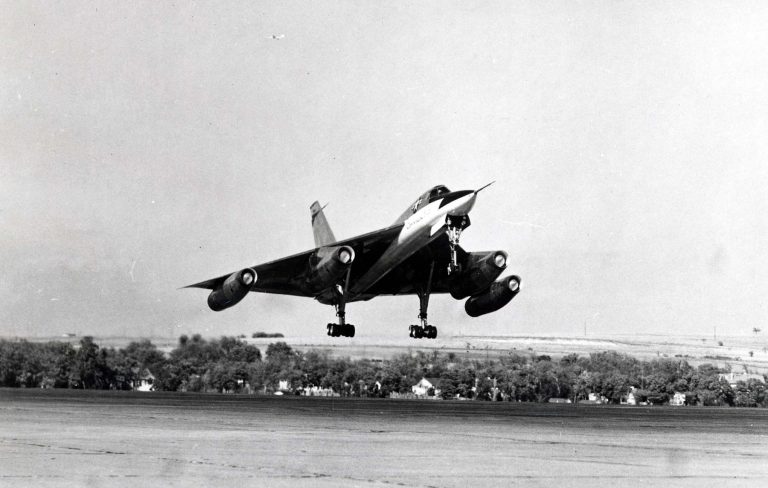
- 377 km/h (203.5 kn) at 150,000 lb, reached at about 14° angle of attack. The delta had to be flown onto and off the runway at attitudes that left the crew looking at sky, and the landing gear — eight small high-pressure wheels per main unit — was built for inflation pressures and rotational speeds beyond anything previously fitted to an aeroplane
- Braking
- Drag chute mandatory — there was no configuration in which a B-58 stopped on a normal runway without it. The type shared this with the B-47 and B-52, but the B-58 approached faster than either
- Handling limits
- 17° angle of attack — beyond it the aeroplane could pitch up and depart into a spin. Recovery was not assured: applying elevon, a mis-set centre of gravity, or an entry below 4,600 m (15,000 ft) could each make it unrecoverable. In the stall the nose stayed up and the machine simply sank, and the rate of sink built fast unless a great deal of thrust went in immediately
- Low-level penetration
- ~1,100 km/h below 150 m — demonstrated over 1,930 km. This is the number that killed the programme. Subsonic, in dense air, burning fuel at high rates, a B-58 doing the job SAC needed after 1960 was an expensive way to do what a B-52 or an F-111 could do further and cheaper
- Altitude with payload
- 26,018 m (85,360 ft) carrying 5,000 kg, set on 18 September 1962 — the flight that took the Harmon Trophy. Two payload-to-altitude records fell on the same sortie
Propulsion & systems
- Engines
- 4 × General Electric J79-GE-5B afterburning turbojets. Production aircraft also flew the -5A and later the -5C; the XB-58 and early trials machines used the J79-GE-1. The J79 is the defining American engine of the period — a 17-stage compressor with variable stator vanes, three turbine stages and a variable exhaust nozzle — and the B-58 and the F-104 got it into the air at almost the same moment
- Rated thrust
- 46 kN (10,300 lbf) military and 69.4 kN (15,600 lbf) with afterburner, per engine, on the -5B. The Wikipedia block gives 10,400 lbf and 15,000 lbf for the -5A. Total afterburning thrust of about 278 kN against a 30,800 kg reference weight gives the frequently quoted thrust-to-weight ratio of 0.919, a number that only applies to an aeroplane carrying almost nothing
- Installation
- Four individual underwing pylons — not paired nacelles. The arrangement was chosen late, after the earlier configuration was reworked for area rule, and it is why the B-58 looks like a fighter that has grown four extra engines rather than a bomber that has been given them
- Air intakes
- Translating conical spikes — fully aft on the ground and at low speed to pass maximum air, driven forward as speed built to hold the shock system in place. Inlet and engine management was largely automatic, which mattered, because an unstart at Mach 2 in a tailless delta is not a condition a crew talks its way out of
- Fuel system and trim
- Transfer for centre-of-gravity control — the aft fuselage tank was primarily ballast, moved to keep the aeroplane in trim as Mach number changed the centre of pressure. The system had a vice of its own: "fuel stacking", in which fuel surged in the tanks during acceleration or deceleration and shifted the centre of gravity abruptly enough to pitch or bank the aircraft without warning
- Air refuelling
- Boom receptacle — and the B-58 was more dependent on it than any other bomber SAC ever fielded. A KC-135 could not stay with a Hustler at its own cruise, so the profile was a descent, a slow subsonic top-up and a climb back, repeated. The Tokyo–London record took five refuellings in eight and a half hours
- Navigation and bombing
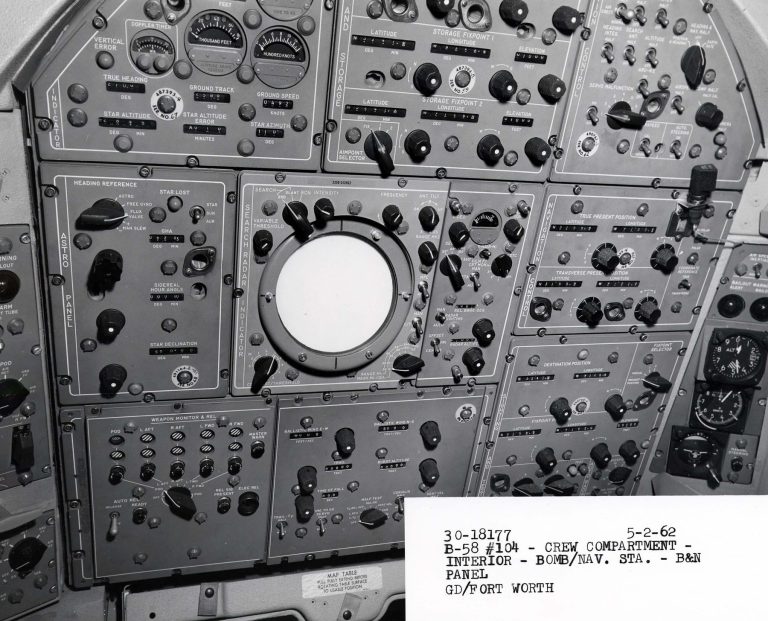
- Sperry AN/ASQ-42 — an integrated system of six subsystems combining search radar, Doppler ground-speed and drift measurement, a KS-39 star tracker for astro-inertial position fixing, a navigation computer and its own malfunction-detection channel. It was among the most ambitious airborne systems of its generation, and its reliability was one of the standing complaints against the aeroplane
- Defensive fire control
- Emerson MD-7 — a Ku-band tail radar with a computing sight, laying the barbette automatically and fired remotely by the defensive systems operator from his scope. There was no visual sighting station and no second gun position anywhere on the aircraft
- Escape system
- Stanley Aviation encapsulated seats — qualified in 1963 after fatal high-speed ejections showed that an open seat at Mach 2 killed the occupant. A three-piece telescoping clamshell closed round each crewman, sealed, pressurised and supplied him with oxygen; the pilot’s capsule enclosed his control column so he could keep flying "turtled up". After landing the shell opened out into a raft, with a radio, a survival rifle and clothing aboard. Aircraft delivered before the retrofit had conventional ejection seats, so the encapsulated system is a mid-life feature of the type, not an original one
- Structure
- Bonded aluminium honeycomb — outer and inner aluminium skins bonded to an aluminium or glass-fibre honeycomb core, one of the first extensive uses of the technique on a production aircraft. It is what made a 13.8 per cent structural fraction possible, and it also made the aeroplane expensive to build, awkward to repair in the field and intolerant of the heat that a faster machine would have generated
04The Convair B-58 Hustler’s cost: why the Hustler was too expensive to keep
The B-58 is one of the classic examples of an aircraft priced out of its own mission. It was extraordinarily complex — exotic materials, an early inertial nav-and-bombing system, four engines and a droppable pod — and it cost accordingly. When the huge research-and-development bill is spread across the small fleet, the effective per-aircraft cost is frequently cited at around US$33 million in early-1960s money, and the type reportedly cost roughly three times as much to operate as the B-52. For a jet with short range, a small payload and a mission that Soviet missiles were rapidly closing off, that price was impossible to justify. Treat any single dollar figure as an order-of-magnitude estimate rather than an audited number — but the direction is not in doubt: the Hustler was gorgeous, brilliant and unaffordable.
Armament & payload
The B-58 carried its bomb outside, in a pod longer than a Spitfire, and fired its only gun backwards
The B-58 has no bomb bay. That single omission shapes everything else about its armament. Convair traded internal volume for area-ruled slimness and hung the weapon underneath in a jettisonable pod that also held a substantial share of the fuel, so that the aeroplane arrived over the target, released the whole assembly, and came home some fifteen tonnes lighter and appreciably faster. It was an elegant answer to a Mach 2 requirement and a poor answer to almost anything else, because a pod is not a bomb bay: it can be loaded with one weapon, it cannot be reloaded with a different sort of weapon in an afternoon, and it cannot hold conventional ordnance in any quantity worth flying.
The original MB-1C pod put a W39 thermonuclear warhead in the middle with fuel fore and aft to keep it in trim as it burned. It leaked. Fuel found its way into the weapon compartment, and the fix was the two-component pod, in which an expendable lower section carried fuel only and was dropped when empty, leaving a shorter upper section holding the weapon and its own fuel. From 1961 four small tandem pylons were added under the wing roots, so a B-58 could carry up to five weapons — the pod plus four B43s or B61s — for a maximum of 19,450 lb. That was the aeroplane at its most heavily armed, and it was still a smaller load than a B-47 had carried thirteen years earlier.
Defensively there was one gun, in the tail, on a remotely controlled barbette. Nothing else. The B-58 mounted no air-to-air missile, no rocket, no chin turret and no waist position, and it never fired the tail gun in anger, because it never went to war. When Vietnam raised the question of a supersonic conventional bomber, the absence of a bomb bay answered it. Weapon clearances shifted repeatedly across the type’s ten operational years, and much of the nuclear loading record remains thinly declassified; the stores named below are those consistently attested for the B-58 rather than a contemporaneous authorised loading list.
Gun
- 1 × 20 mm General Electric T171E-3 six-barrel rotary cannon in a tail barbette — the weapon standardised shortly afterwards as the M61 Vulcan. One gun, and the only one on the aeroplane.
- 1,200 rounds, at a cyclic rate of up to 4,000 rounds per minute. That is about eighteen seconds of continuous fire, and no crew would ever have used it that way.
- Emerson MD-7 Ku-band radar fire control laid the barbette and computed the lead. The defensive systems operator fired it remotely from the third cockpit, watching a scope; he could not see the target and had no optical backup.
- It was never fired in combat. The B-58 flew no operational sortie against an enemy in its entire service life, and the barbette’s real value was as a deterrent to a stern conversion by an interceptor that had already failed to catch the aeroplane in the first place.
- The doctrine was speed, not gunnery. A machine that cruised at Mach 2 above 18,000 m was not expected to be shot at from behind; when surface-to-air missiles made that assumption false, no amount of tail armament could have helped.
Air-to-air
- None carried, ever. No air-to-air missile was fitted, cleared or planned for the operational B-58. The tail barbette was the whole of its air-to-air capability.
- The B-58D proposal would have turned the type into a long-range interceptor, and got no further than paper. The idea recurs in most fast-bomber programmes and almost never survives contact with a costing exercise.
- One airframe did carry the hardware. B-58A 55-0665, universally called "Snoopy", was given a lengthened nose housing the Hughes AN/ASG-18 radar and flew from 1962 to 1964 as the trials aircraft for the GAR-9 / AIM-47 missile system — the fire-control fit intended for the F-108 Rapier and later the YF-12A.
- It was a testbed, not a fighter. Snoopy carried the radar and the mission electronics; the missiles it supported were launched from other aircraft. The B-58 never fired an air-to-air weapon.
Air-to-surface guided
- No guided air-to-surface weapon entered service on the B-58. For its whole career the aiming solution was a radar bombsight, an astro-inertial fix and gravity.
- Lockheed High Virgo — an air-launched ballistic missile derived from the X-17 research rocket — was flown from a B-58 in a series of four launches in 1958 and 1959, carried on the centreline in place of the pod.
- One High Virgo shot was an anti-satellite attempt, fired in September 1959 against the Explorer 6 satellite. Telemetry was lost and the result was never confirmed; it remains one of the earliest air-launched ASAT trials by any nation.
- The proposed B-58E was to have carried air-launched ballistic missiles as a standing armament, and the B-58B was studied as a mothership for the Mach 4 ramjet-powered FISH parasite. Neither was built.
- Nothing conventional and guided — no television, radar or laser-guided weapon was ever integrated, and by the time such weapons mattered the type had been retired.
Bombs
- Maximum weapons load 19,450 lb (8,822 kg) in the five-weapon configuration introduced from 1961: one pod weapon plus four on the wing-root pylons.
- MB-1C pod — a single W39Y1-1 variable-yield thermonuclear warhead carried amidships in a 17.4 m store weighing about 16,300 kg fully fuelled. This was the alert weapon for the type’s first years.
- Two-component pod — the BLU-2/B-1 upper section carrying a B53-class weapon and fuel at about 11,970 lb gross, riding on the BLU-2/B-2 expendable lower fuel section of about 26,000 lb when full. The lower half went first, the weapon stayed.
- Wing pylon weapons: Mk 39, B43, B53 and B61 free-fall nuclear bombs are the types repeatedly attested, in combinations of one large weapon or four smaller ones.
- Effectively no conventional capability. With no bomb bay and pylons sized for special weapons, the B-58 could not usefully carry iron bombs. It is the principal reason the type was never sent to Southeast Asia while B-52s and B-57s were.
Rockets
- No rocket armament of any kind. The B-58 carried no unguided air-to-ground rockets and no air-to-air rockets, which puts it in a small minority of 1950s American combat aircraft.
- No rocket-assisted take-off either. Unlike the B-47, which needed JATO bottles to leave a hot runway at weight, the Hustler had 278 kN of afterburning thrust against a far smaller airframe and never required assistance.
- The only large rockets a B-58 ever carried were the four High Virgo ballistic test missiles, mounted where the weapons pod normally hung. They were a payload, not armament.
- The drag chute did the work rockets did elsewhere — the aeroplane’s take-off and landing problem was one of stopping, not of starting, and the chute was carried on every sortie as a consumable store.
Pods & other stores
- MB-1C combination pod — weapon and fuel in one 57 ft store, with tanks at each end so that burning fuel did not run the centre of gravity away. Its fuel leaked into the weapon compartment, which is why it was replaced.
- Two-component pod (TCP) — the answer to the leak and to a tactical problem as well: the crew could drop a spent fuel section over friendly territory and keep the weapon, instead of being committed to jettisoning both together.
- LA-331 reconnaissance pod — an MB-1C shell rebuilt around a Fairchild KA-56 panoramic camera and associated scanners, carried by the RB-58A aircraft for high-speed low-level photography.
- Four wing-root stub pylons, fitted across the fleet between 1961 and 1963, the only hardpoints on the aircraft and the only way it ever carried more than one weapon.
- Chaff and jamming equipment in the aft fuselage, managed by the defensive systems operator alongside the tail radar. The countermeasures fit changed repeatedly and is poorly documented; what is clear is that the DSO’s electronic work, not his gunnery, was the real defence.
Three typical loadouts
- Ground alert, 1961
- One MB-1C pod with a W39 thermonuclear weapon and its integral fuel, internal tanks part-filled to permit take-off, tanker rendezvous planned within the first hour of the sortie. Tail barbette loaded with 1,200 rounds. This was the aeroplane as SAC actually kept it, sitting on pad alert at Carswell, Little Rock or Bunker Hill.
- Five-weapon maximum, 1963
- Two-component pod on the centreline plus four B43 or B61 bombs on the wing-root stub pylons — 19,450 lb of ordnance, the heaviest load the type could take. Range and top speed both suffered badly, and the configuration was a demonstration of what the airframe could be made to do rather than the way it was normally flown.
- Low-level penetration, post-1963
- Single weapon in the two-component pod, run in below 150 m at about 1,100 km/h subsonic, with the astro-inertial system carrying the navigation where radar returns were useless. It was the profile SAC needed after the S-75 arrived, it was the profile the aeroplane was worst at, and flying it wore out an airframe designed for smooth air at altitude.
Sourcing caveat: pod designations, warhead marks and pylon clearances for the B-58 come largely from post-Cold-War declassification and from secondary compilations that copy one another. Where the MB-1C, the BLU-2/B-1 and BLU-2/B-2 weights are quoted here they follow Joe Baugher and the Greg Goebel history; the 19,450 lb maximum load and the Mk 39 / B43 / B53 / B61 list follow the current Wikipedia article. Figures for the tail gun and the MD-7 are consistent across all of them.
Variants
Convair built 116 Hustlers, cancelled every improvement to them, and exported none
The B-58 has one of the shortest variant lists of any major Cold War aircraft, and the reason is not that the design resisted development. It is that every proposed development was cancelled. Convair drew a stretched B-58B with uprated engines and canards, a Mach 3 B-58C on J58 engines, an interceptor, a missile carrier and a 52-seat supersonic airliner; the Air Force bought none of them. What was actually built was thirty trials and pre-production aircraft and eighty-six operational bombers, and eight of the trials machines were then converted into trainers because there was no other way to teach anyone to fly the thing.
Nor was there an export or licence story. The B-58 carried thermonuclear weapons as its only meaningful armament, cost roughly $12.44 million apiece in 1960 dollars — the frequently repeated claim that the aeroplane cost more than its weight in gold is arithmetically close to true — and demanded a tanker fleet and a maintenance establishment that no other air force possessed. No foreign operator ever flew one, and no foreign order was ever seriously entertained.
The programme total through fiscal year 1961 was about $3 billion. Against that, the type was in front-line service for nine years and five months, was declared operational on 1 August 1960 and was gone by 31 January 1970, having never dropped a weapon in anger. Robert McNamara ordered its retirement in late 1965, five years before it happened, on the straightforward ground that a bomber costing 40 per cent more per flying hour than a B-52 while carrying less, going less far and doing the low-level job worse was not a weapon system worth keeping.
- XB-58 (1956–57 / 2)
- Prototypes, first flight 11 November 1956 on J79-GE-1 engines. Rolled out 31 August 1956; the aircraft went supersonic early and comfortably, which was never the programme’s problem.
- YB-58A (1957–59 / 11)
- Trials and development aircraft covering weapons, pods, the escape system and the navigation fit. Eight were later rebuilt as TB-58A trainers and one as the NB-58A engine testbed.
- RB-58A (1958–60 / 17)
- Pre-production airframes completed with provision for the LA-331 reconnaissance pod and its KA-56 panoramic camera. Most were subsequently brought to bomber standard and served as B-58As; the dedicated reconnaissance role never materialised.
- B-58A (1959–62 / 86)
- The production bomber and the only operational variant. Final delivery October 1962. Fitted in service with the encapsulated escape system from 1962 and with the four wing-root stub pylons between 1961 and 1963.
- TB-58A (1960–62 / 8 conversions)
- Trainers converted from YB-58A airframes, with dual controls in a reworked second station offset ten degrees to starboard and all tactical systems — autopilot, bombing, navigation, countermeasures — stripped out. First conversion flew February 1960.
- NB-58A (1960s / 1 conversion)
- Engine testbed carrying a General Electric YJ93 slung under the fuselage for the XB-70 Valkyrie programme — a Mach 2 bomber flight-testing the engine of the Mach 3 bomber that was meant to replace it, and which was itself cancelled.
- B-58A "Snoopy" (1962–64 / 1 conversion)
- Airframe 55-0665 rebuilt with a long drooping nose radome housing the Hughes AN/ASG-18 pulse-Doppler radar for the GAR-9 / AIM-47 programme. The nose gave the aircraft its name and its unmistakable profile.
- B-58B (cancelled 1959 / 0)
- Proposed production successor with uprated J79-GE-9 engines, a stretched fuselage, canard surfaces and a genuine conventional weapons capability. Cancelled before any airframe was laid down; the conventional capability it would have brought is precisely what the B-58 lacked in Vietnam.
- B-58C (cancelled early 1961 / 0)
- A far larger aircraft on Pratt & Whitney J58 engines — the powerplant that went on to the SR-71 — with an estimated Mach 3 dash and about 5,200 nautical miles of range. Studied in two- and four-engine forms and killed as ballistic missiles took over the deterrent mission.
- B-58D, B-58E and Model 58-9 (proposals / 0)
- Respectively a long-range interceptor, a multi-role carrier of air-launched ballistic missiles, and a 52- to 58-seat Mach 2.4 supersonic airliner offered to the airlines. None left the drawing board. No licence-built version and no export variant of any kind was ever produced.
Closing note on survivors: eight B-58s survive, all of them original airframes — no reproduction, replica or composite B-58 exists, and none could plausibly be built. Seven are complete and on display: 55-0663, the fourth machine built and the oldest survivor, converted to TB-58A and held by the Grissom Air Museum at Peru, Indiana; 55-0666 at the Castle Air Museum, Atwater, California, under long-running restoration with its outboard nacelles refitted in 2024; TB-58A 55-0668 in the Heritage Park at Little Rock AFB, Arkansas, dedicated on 3 May 2013; 59-2437 "Firefly II" outdoors at Port San Antonio on the former Kelly Field, Texas; 59-2458 "Cowtown Hustler", the Bendix and Mackay Trophy aircraft, indoors and by some margin the best-preserved of the eight, at the National Museum of the United States Air Force, Wright-Patterson AFB, Ohio; 61-2059 "Greased Lightning", which holds the Tokyo–London record to this day, at the Strategic Air Command and Aerospace Museum at Ashland, Nebraska; and 61-2080, the last Hustler delivered, at the Pima Air and Space Museum, Tucson, Arizona. The eighth, 55-0665 "Snoopy", is not a display aircraft at all: it survives as a stripped derelict fuselage on the photographic target range at Edwards AFB, California, without engines or instruments. That is eight from 116 built — and 26 of those 116 were destroyed in accidents, a loss rate of 22.4 per cent, though the Wikipedia article gives 24 in one place and 26 in another and more than half the losses fell in the flight-test programme rather than in squadron service.
From delta dream to early retirement
Convair wins the contract
The US Air Force selects Convair’s delta-wing proposal for a supersonic strategic bomber, drawing on the company’s F-102/F-106 delta experience.
First flight
The prototype XB-58 makes its maiden flight on 11 November 1956 at Fort Worth, Texas — the start of the Mach 2 bomber era.
Enters SAC service
The B-58A reaches operational service with Strategic Air Command, the first bomber in the world able to sustain Mach 2.
New York–Paris record — and tragedy
“The Firefly” sets the first supersonic Atlantic crossing on 26 May, winning the Mackay and Harmon Trophies — then crashes at the Paris Air Show days later, killing its crew.
Bendix Trophy dash
On 5 March a Hustler flies Los Angeles–New York–Los Angeles, setting three speed records in one flight and winning the Bendix and Mackay Trophies.
Tokyo to London
A B-58 flies Tokyo–London in 8 hours 35 minutes at an average of about 938 mph, taking the Harmon Trophy — a record that still stands.
McNamara orders retirement
Judging the Hustler too costly and its mission overtaken by missiles, Defense Secretary Robert McNamara directs that the fleet be withdrawn.
Retired after a decade
By January 1970 the last B-58s are withdrawn from service — one of the shortest front-line careers of any Cold-War bomber.
Twelve B-58 Hustler stories
The delta that became a bomber
Convair scaled up its delta-fighter know-how into a Mach 2 bomber.
Read the full story
First to sustain Mach 2
No bomber before it could cruise at twice the speed of sound.
Read the full story
The wasp waist
Its pinched fuselage is the area rule made visible.
Read the full story
A weapon you dropped with the fuel
The Hustler carried its bomb and much of its fuel outside the jet.
Read the full story
Nineteen world records
The Hustler rewrote the record books for speed and distance.
Read the full story
The Firefly’s triumph and tragedy
A record-setting jet crashed at the Paris Air Show, killing its crew.
Read the full story
Coast to coast and back
One 1962 flight set three speed records at once.
Read the full story
A record that still stands
The Tokyo-to-London run has never been beaten.
Read the full story
A jet that bit back
The Hustler was fast, unforgiving and often fatal.
Read the full story
Three men, three cockpits
Pilot, bombardier and defence operator sat in a row.
Read the full story
Overtaken by the missile
Soviet SAMs and ICBMs erased the mission it was built for.
Read the full story
Gone in a decade
Retired by 1970, the Hustler had one of the shortest bomber careers.
Read the full story
The Hustler in pictures
The B-58 Hustler in motion
A curated video feature for the B-58 Hustler is coming soon. In the meantime, explore the photo gallery above and the operations map below.
Where the B-58 flew
The record that defines it
The B-58 Hustler never fired a shot in anger. Built as a nuclear penetrator for a war that never came, it served through the 1960s on Strategic Air Command alert but was never used in combat — and its high-altitude Mach 2 mission was rendered obsolete by Soviet missiles before it could ever be flown for real. Its true record is written in the record books: the Hustler set roughly nineteen world records for speed and distance, winning the Bleriot, Thompson, Mackay, Bendix and Harmon Trophies. That glory came at a steep price — a punishing accident rate that destroyed 26 of the 116 aircraft built, several during record attempts.
Compare the combat record of every military aircraft. Figures as of July 2026.
Everything people ask about the B-58 Hustler
Can I fly in a B-58?
Why was the B-58 the first Mach 2 bomber?
What was the droppable pod under the B-58?
Was the B-58 ever used in combat?
Why did the B-58 have such a short career?
What records did the B-58 set?
How many B-58 Hustlers are left?
You can’t fly the B-58.
These, you can.
Some legends only live in museums — others are fuelled and waiting. MiGFlug has put civilians in real military jet cockpits since 2004.
 Fly the L-39 AlbatrosThe world’s most-flown jet trainer — aerobatics included
 Fly the F-104 Starfighter“The missile with a man in it”
 Fly the MiG-21The Cold War’s most-produced jet
 Fly the T-33 Shooting StarAmerica’s first jet trainer
 Fly the DH VampireA piece of early jet history
 Fly the S.211Agile Italian jet trainer
 Fly the MB-326The classic Aermacchi jet
 Fly the MiG-15The Soviet legend of the Korean War
Continue the tour
Every fact, checked
- National Museum of the U.S. Air Force — Convair B-58A HustlerOfficial specifications, crew, service history and the droppable pod.
- B-58 Hustler Association — Trophies & RecordsThe full list of world records and trophies, with dates and crews.
- The Aviation Geek Club — “The Firefly” and the Le Bourget crashThe 1961 New York–Paris record and the fatal Paris Air Show accident.
- The Aviation Geek Club — the 1962 Bendix Trophy flightThe Los Angeles–New York–Los Angeles round-trip record of March 1962.
- War History Online — The Convair B-58 HustlerDevelopment, the first operational Mach 2 bomber, and why it was retired.
- Vintage Aviation News — Surviving B-58 HustlersThe preserved airframes and where to see a Hustler today.
- National Security Journal — 26 of 116 lost in ten yearsThe accident rate, dangerous handling and short service life.
- 19FortyFive — Mach 2, but retired while the B-52 flies onCost, obsolescence and the contrast with the enduring B-52.