
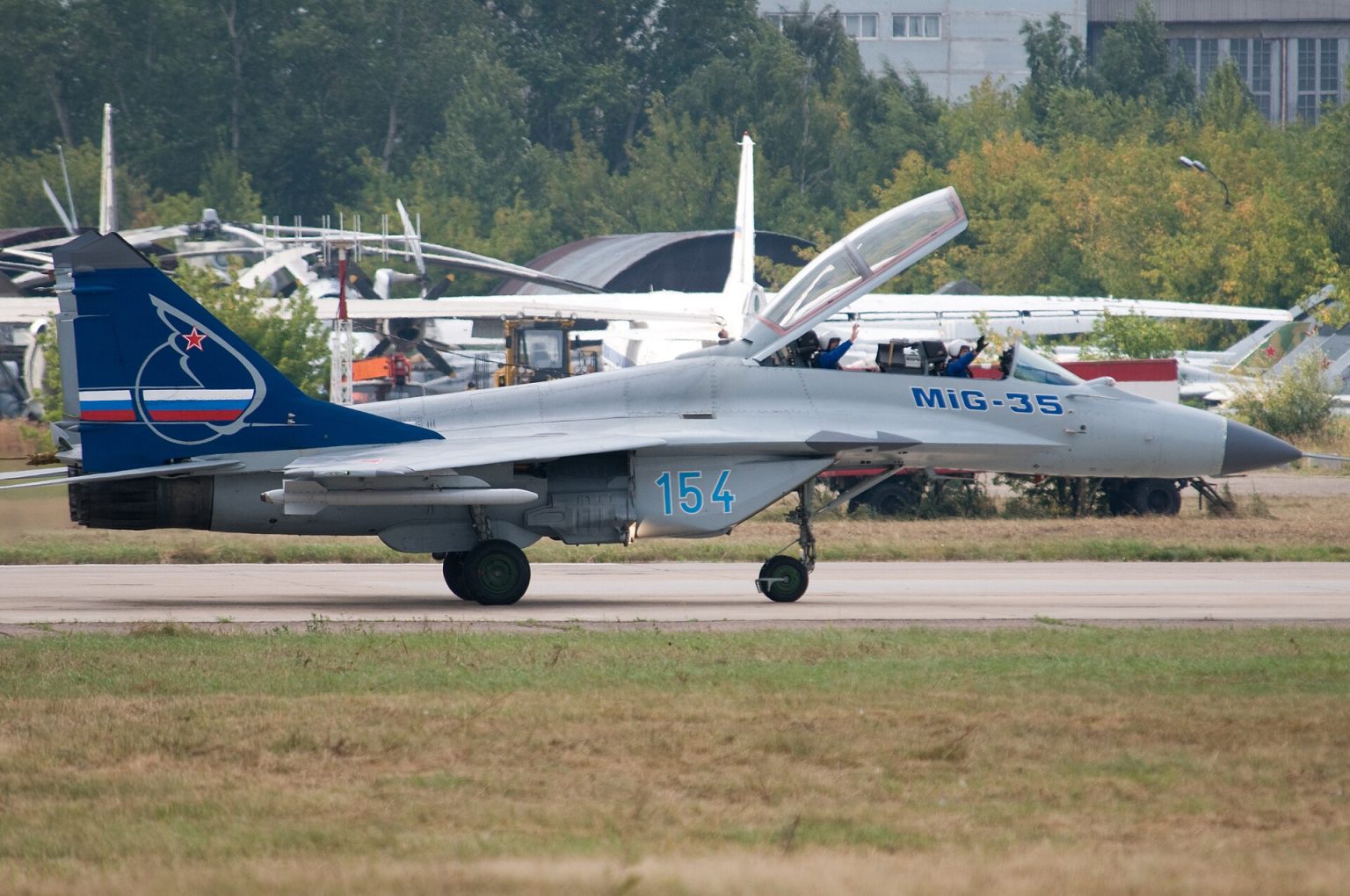
Mikoyan MiG-35
“Fulcrum-F”
The latest branch of the MiG-29 family — a heavily upgraded 4++ generation multirole fighter marketed hard for export, yet built so far in only a handful of examples and overshadowed at home by the heavier Sukhoi Flankers.
The last of the Fulcrums — and the orders that never came
The MiG-35 is the newest and most heavily developed member of the long MiG-29 “Fulcrum” family. Where the original 1980s MiG-29 was a short-legged, point-defence dogfighter, the MiG-35 is pitched as a 4++ generation multirole fighter: built on the modernised MiG-29M/M2 and carrier-capable MiG-29K airframe, it adds new avionics with an open-architecture design, an optional active electronically scanned array (AESA) radar, more internal fuel, extra hardpoints and heavier weapons load. On paper it is by far the most capable Fulcrum ever offered.
Mikoyan first attached the “MiG-35” name to a demonstrator shown at the Aero India show in Bangalore in 2007, aimed squarely at India’s huge MMRCA fighter competition. That bid failed — India selected the Dassault Rafale, with the MiG-35 reportedly marked down on engine and radar maturity. A largely redesigned MiG-35 re-emerged years later: developed from around 2014 with Russian defence-ministry funding, the revised aircraft made its first flights in late 2016 and was formally unveiled at the Lukhovitsy factory in January 2017. Mikoyan again marketed it aggressively for export, framing it as a low-cost multirole alternative to Western types.
The reality has fallen well short of the sales pitch. The Russian defence ministry ordered only about six aircraft in 2018 — a token batch — and despite years of promotion the type has secured no confirmed export orders. Bids or evaluations tied to India, Egypt, Malaysia, Bangladesh, Algeria and others came to nothing. At home the MiG-35 has been comprehensively overshadowed by the heavier Su-30SM and Su-35S Flankers, which Russia bought in far larger numbers, and by the fifth-generation Su-57. Production and export figures for the MiG-35 should be treated with caution: only a very small number are known to have been built, and the gap between the aircraft’s marketing and its actual service career is the defining fact of the programme.
01The Mikoyan MiG-35’s development: from a 2007 demonstrator to a revised 2016–2017 fighter
The MiG-35 story runs in two distinct phases, and they are easy to confuse. The first was a demonstrator unveiled at Aero India 2007, essentially an evolution of the MiG-29M/M2 fitted with new systems and shown for India’s Medium Multi-Role Combat Aircraft (MMRCA) contest. A pair of aircraft flew for that competition around 2009–2011, but India chose the Rafale, and this first MiG-35 push effectively stalled.
The second phase is the aircraft usually meant today. Developed from around 2014 with Russian ministry-of-defence backing, this revised MiG-35 made its maiden flights towards the end of 2016 and was formally presented in January 2017. It is this version — MiG-35S single-seat and MiG-35UB/D two-seat — that entered limited Russian service. Because the same designation covers both a 2007 demonstrator and a 2016–2017 production-standard jet, published “first flight” dates and figures vary between sources; treat single quoted numbers with care.
What makes it special
An optional AESA radar — more often advertised than fitted
The MiG-35 is offered with an active electronically scanned array (AESA) radar from the Zhuk family (marketed as Zhuk-A / Zhuk-AE). AESA is a genuine generational step over the mechanical radars of earlier Fulcrums. In practice, reporting suggests many airframes have flown with the mechanically-scanned Zhuk-ME instead, and the AESA has featured more prominently in sales literature than in confirmed operational fits. Treat AESA as an option, not a guaranteed standard.
Uprated RD-33MK engines — smokeless, but still RD-33
Power comes from two Klimov RD-33MK afterburning turbofans, each rated around 88 kN in reheat — an uprated, smokeless, FADEC-controlled development of the MiG-29’s original RD-33. A thrust-vectoring variant (RD-33OVT) was demonstrated on related MiG-29 test aircraft. Critics note that the family remains an evolution of a 1980s engine rather than a clean-sheet design, with only incremental gains in thrust, economy and life.
More fuel, more payload, new avionics
Over the baseline MiG-29 the MiG-35 adds more internal fuel, additional hardpoints, an open-architecture avionics suite, an optical locator system (OLS) for passive search-and-track, and an integrated defensive-aids package. The result is a longer-ranged, harder-hitting multirole Fulcrum — even if it stops short of the stealth and sensor fusion of true fifth-generation fighters.
02The MiG-35’s AESA radar: why the headline feature is best described as an option
Much of the MiG-35’s marketing has leaned on its AESA radar, and the technology is real — an electronically scanned array offers faster scanning, better multi-target tracking and stronger jamming resistance than the mechanically-steered radars of older Fulcrums. The complication is maturity and fit. Across the type’s long, stop-start development the AESA (Zhuk-A / Zhuk-AE) has repeatedly appeared in brochures and show aircraft, while several reports indicate that airframes actually delivered have carried the mechanically-scanned Zhuk-ME. Independent confirmation of a fielded, operational AESA in Russian MiG-35 service is thin. The honest summary is that the AESA is an available option whose real-world deployment is hard to verify — a recurring theme in the gap between what the MiG-35 is advertised to be and what has actually been built.
03The MiG-35 versus the Sukhoi Flankers: why Russia bought Su-30s and Su-35s instead
The single biggest obstacle to the MiG-35 has been competition inside Russia’s own air force. Through the 2010s the Russian Aerospace Forces poured procurement into the heavier Su-30SM and Su-35S — twin-engine Flankers with longer range, larger radar and heavier payload — and into the fifth-generation Su-57. With the lightweight MiG offering only a modest cost advantage and the Sukhoi line already in mass production, there was little institutional appetite for a parallel light-fighter fleet. The result is that the MiG-35 was ordered in only token numbers at home, which in turn undercut its export case: buyers are wary of a fighter its own maker’s air force barely operates.
Full specifications
Figures are approximate and drawn from manufacturer and open-source data for the single-seat MiG-35S; a two-seat MiG-35UB/D is also built. Sources differ — contested values are hedged.
Baseline note: the figures below describe the single-seat MiG-35S as delivered to the Russian Aerospace Forces, powered by two Klimov RD-33MK turbofans, using the best-attested open figures as they stood in September 2026. Two warnings before the tables. First, almost nothing here is an independently measured number: RAC MiG has never published a certified specification for the type, and the widely circulated tables descend from air-show handouts and export brochures issued between 2007 and 2019 for an aircraft that was still being defined. Second, the designation itself is muddled, and the brief this page was written from had it wrong. The Russian serial single-seater is the MiG-35S, izdeliye 9-41S (9.41SR in some listings); izdeliye 9-61 is the export single-seat MiG-35, and 9-67 the export two-seat MiG-35D. The two are not the same aircraft on paper and possibly not in fact. Deltas for the two-seat MiG-35UB (izdeliye 9-47S), for the export 9-61/9-67 pair, and for the MiG-29M/M2 and MiG-29OVT ancestors are in grey. Three published disagreements are worth settling first. Maximum take-off weight: 24,500 kg appears in the standard reference tables, GlobalSecurity quotes the manufacturer at 23,500 kg, and the closely related MiG-29M is listed at 26,500 kg — three numbers for what is nominally one airframe. Service ceiling: 16,000 m in the reference tables against 17,500 m in the brochure material. Gun ammunition: 100 rounds for the MiG-35, 150 for the MiG-29M, same gun, same wing root. Where a row is a manufacturer claim it says so.
Dimensions & weights
- Crew
- 1 — two in tandem for the MiG-35UB (izdeliye 9-47S) and the export MiG-35D (9-67). The family was designed around a convertible cockpit: the single-seater is the two-seater with the rear station replaced by a fuel tank, which is why the two marks share a length and a canopy line
- Length
- 17.3 m (56 ft 9 in) — the MiG-29M is listed at 17.37 m (57 ft 0 in), and the difference is almost certainly rounding rather than a real change. For scale, an F-16C is 15.06 m (49 ft 5 in) and a Rafale C 15.27 m (50 ft 1 in)
- Wingspan
- 12.0 m (39 ft 4 in) — unchanged in span from the original MiG-29 (9-12), though the wing itself is not the same: the MiG-29M wing has a straight trailing edge, no overwing louvres, and integral fuel tanks the 1977 aircraft did not have
- Height
- 4.7 m (15 ft 5 in) — the MiG-29M is quoted at 4.4 m (14 ft 5 in); the taller figure for the MiG-35 is usually attributed to the revised fin fillets and antenna fit
- Wing area
- 41 m² (441 sq ft) — 42 m² (450 sq ft) in the MiG-29M listing. Either way the type retains the MiG-29 planform, and with it a wing that is generous in area and modest in fuel volume
- Empty weight
- 11,000 kg (24,251 lb) — against 11,600 kg (25,574 lb) for the MiG-29M and roughly 10,900 kg for the baseline MiG-29 (9-12). Nobody has published a weighed figure; these are manufacturer statements
- Normal take-off weight
- 17,500 kg (38,581 lb) — the two-seat MiG-29M2 is listed at 19,000 kg (41,888 lb), and the MiG-35UB will be in that region
- Maximum take-off weight
- 24,500 kg (54,013 lb) — but see the note above: 23,500 kg (51,809 lb) is quoted by the manufacturer, 26,500 kg (58,422 lb) for the MiG-29M. The move from about 18.5 tonnes on the original MiG-29 to the mid-twenties is the single biggest change in the family and is what lets the aircraft be called medium rather than light
- Maximum landing weight
- 16,800 kg (37,037 lb) — a low figure relative to MTOW, which means a heavily loaded aircraft cannot bring its stores home without jettisoning
- Internal fuel
- ~4,800 kg (~10,580 lb) — this row is the weakest in the table. The manufacturer claims roughly 50 per cent more internal fuel than the original MiG-29 (9-12), which held 3,500 kg (7,716 lb); that arithmetic gives about 5,250 kg, other listings give 4,560 kg as on the MiG-29K, and RAC MiG has never published a single authoritative number. Treat any precise figure you see elsewhere with suspicion
- External fuel
- up to three 1,150-litre tanks (304 US gal each; about 2,750 kg / 6,060 lb of fuel in all) — one on the centreline and two underwing, at the cost of three of the nine hardpoints. A retractable in-flight refuelling probe is fitted as standard, which the original MiG-29 lacked
- Maximum external load
- ~6,500 kg (~14,330 lb) on nine hardpoints, eight underwing and one ventral. The manufacturer has also claimed 7,000 kg (15,432 lb) on ten pylons; the MiG-29M is listed at 5,500 kg (12,125 lb). No MiG-35 has been photographed carrying anything approaching the maximum
- Wing loading
- 427 kg/m² (87.5 lb/sq ft) at normal take-off weight, rising to about 598 kg/m² (122 lb/sq ft) at maximum. The lightly loaded figure is the one the marketing uses; the heavy one is what a strike sortie actually flies at
Performance
- Maximum speed, altitude
- 2,100 km/h (1,134 kn; 1,304 mph) — Mach 2.25 at height, the same figure quoted for the MiG-29M and, for that matter, for the MiG-29 of 1983. GlobalSecurity carries a brochure claim of 2,700 km/h, which is not credible for this airframe and inlet and should be discarded
- Maximum speed, sea level
- 1,400 km/h (756 kn; 870 mph) — Mach 1.14, limited by dynamic pressure rather than thrust
- Cruise speed
- 805 km/h (435 kn; 500 mph) — the figure in the standard listing. There is no supercruise claim; the RD-33MK is a low-bypass afterburning engine of 1980s architecture and the type needs reheat to go supersonic
- Rate of climb
- 330 m/s (65,000 ft/min) — an initial, clean, light-fuel figure. It is identical to the number published for the MiG-29M and is best read as a family characteristic rather than a MiG-35 measurement
- Service ceiling
- 16,000 m (52,493 ft) — against 17,500 m (57,415 ft) in the brochure material. The lower figure is the one used in the reference tables and is consistent with the rest of the MiG-29 family
- Thrust-to-weight
- 1.03 at normal take-off weight on two engines of 88.26 kN, falling to about 0.73 at maximum take-off weight. The published 1.02 for the MiG-29M is the same calculation
- g limit
- +9 / −3 — the MiG-29M is listed at +8 to +9. A g-force protection system was among the upgrades Russia offered India in March 2020, which implies it was not there before
- Combat radius
- ~1,000 km (~540 nmi; 620 mi) — a mission-profile figure with no profile attached, and therefore close to meaningless. The honest way to read it is comparatively: it is roughly half again what a MiG-29 (9-12) could manage, and still short of a Su-30 or a Rafale
- Ferry range, internal fuel
- 2,000 km (1,080 nmi; 1,243 mi) — the MiG-29M figure; 1,700 km (918 nmi) for the two-seat M2, and the MiG-35UB will be similar
- Ferry range, three tanks
- 3,000 km (1,620 nmi; 1,864 mi) — 2,700 km (1,458 nmi) for the two-seater
- Ferry range, one refuelling
- 6,000 km (3,240 nmi; 3,728 mi) — with three tanks and a single air-to-air top-up. A deployment number, not a combat one
- Take-off and landing run
- not published — no figure traceable to the manufacturer has been released for the MiG-35, which is unusual for a type marketed this hard. What is known is telling in itself: the MiG-35 replaces the MiG-29K/KUB’s arrestor hook with a braking parachute in the same tail fairing, so it lands like a land-based fighter and needs the chute to do it
Propulsion & systems
- Engines
- 2 × Klimov RD-33MK — the "Morskaya Osa" (Sea Wasp), a FADEC-controlled development of the RD-33 first fielded on the MiG-29K/KUB. Modern materials in the hot section give about 7 per cent more thrust than the 1981 engine, and the combustor is smokeless, which removes the MiG-29’s single most notorious visual signature
- Thrust, dry
- 52.0 kN each (11,690 lbf; 5,300 kgf)
- Thrust, afterburning
- 88.26 kN each (19,841 lbf; 9,000 kgf) — 176.5 kN (39,680 lbf) total, against 81.3 kN per engine on the original RD-33
- Engine life
- 4,000 hours declared — a large claimed improvement on the early RD-33, whose short overhaul intervals were a standing complaint among MiG-29 operators and one of the reasons India cited when it dropped the type. Whether the declared figure is being achieved in service is not publicly verifiable
- Thrust vectoring
- optional RD-33OVT, not fitted to any aircraft in service — the all-aspect vectoring nozzle demonstrated on the MiG-29OVT (izdeliye 9-15D, aircraft "156") from 2003, which deflects in any plane rather than in pitch only as on the Su-30MKI. Russian sources state the MiG-35 vectoring variant was cancelled on weight and cost grounds, with the nozzle retained as a customer option. Nobody has ordered it. The supermanoeuvrability that sold the aeroplane at Le Bourget in 2007 is not in the aircraft the Russian air force flies
- Radar, serial aircraft
- mechanically scanned Zhuk-family set — this is the central honest point about the MiG-35. Russian VKS aircraft are equipped with a mechanically scanned Zhuk, in the Zhuk-M/ME class: a 624 mm slotted planar array, about 120 km against a 5 m² target, ten tracked and four engaged, 220 kg. Reporting in March 2025 stated plainly that the VKS version omits the AESA to hold cost down
- Radar, AESA (offered)
- Phazotron Zhuk-A/AE, later Zhuk-AM/AME — promised since 2007 and still of unclear fielded status. The Zhuk-AE (FGA-29) has 680 transmit/receive modules in a 575 mm aperture — an independent teardown analysis counts 652 channels in 163 quad modules — about 130 km initially with 250 km later claimed, 30 tracked and 6 engaged. The Zhuk-AM/AME (FGA-50) shown in 2016 claims 1,000 modules, 260 km and about 100 kg. A 2024 Rosoboronexport commercial reaffirms AESA for the export aircraft. No serial VKS MiG-35 has been confirmed with one
- Infrared search and track
- OLS-UEM (13SM-1) — the offset nose sensor, combining infrared search and track with a television channel and a laser rangefinder. Claimed detection of airborne targets to 55 km (30 nmi) in the tail-on aspect, coverage ±90° in azimuth and +60° to −15° in elevation, laser ranging to 20 km (12 mi)
- Targeting pod
- OLS-K / OLS-KE — a podded electro-optical set carried on a fuselage station for the air-to-surface role, claimed to find ground targets at 20 km (12 mi) and ships at 40 km (25 mi), with laser designation for the KAB-500L and Kh-29L. It occupies a hardpoint that would otherwise carry a weapon or a tank
- Flight controls
- quadruplex digital fly-by-wire — the KSU-941 system inherited from the MiG-29K/M, replacing the mechanical and analogue arrangement of the original MiG-29. This is the change that makes the airframe a different aeroplane to fly, and it dates from the MiG-29M programme of the late 1980s, not from the MiG-35
- Cockpit
- three colour multifunction displays and a wide-angle head-up display — with a helmet-mounted sight, hands-on throttle and stick, and a MIL-STD-1553B databus, the last being a deliberate export concession. The export aircraft is offered with a further revised cockpit
- Self-protection
- integrated defensive suite, details unverified — radar warning, missile approach warning and chaff and flare dispensers are standard for the family, and a podded jammer is offered. Russian publicity has additionally claimed a laser-based directed infrared countermeasures installation; no such fit has been photographed on a serial aircraft and the claim should be treated as marketing until it is
- Structure
- about 15 per cent composite by structural weight — a manufacturer figure, with a claimed airframe life of 6,000 flying hours or 40 calendar years. The corrosion protection and sealing developed for the naval MiG-29K carry over, which is the one genuine engineering benefit the land aircraft inherited from the carrier programme
04The MiG-35’s production and operating costs: why the real numbers are so hard to pin down
Reliable figures for the MiG-35 are genuinely scarce, and that scarcity is itself part of the story. Russia is reported to have ordered only about six aircraft in 2018, and no export contracts have been confirmed, so there is no large production run against which a stable flyaway price could settle. Published unit-cost figures — commonly quoted in the region of US$30–50 million — are best read as estimates or export-brochure numbers rather than audited prices, and no credible cost-per-flight-hour figure exists in open sources. Even the total number built is uncertain: counts vary between sources depending on whether demonstrators and prototypes are included. Any precise dollar or fleet figure attached to the MiG-35 should be treated as an approximation.
Armament & payload
The MiG-35 carries the MiG-29K’s weapons on the MiG-29K’s pylons, and hardly any of it has been photographed on a Russian MiG-35
The weapons list below is an inventory of what the airframe is cleared or advertised to carry, not a record of what has been fired from one. Nine hardpoints, a claimed 6,500 kg of external stores and a 30 mm gun in the port wing root is a conventional and perfectly respectable fit for a medium fighter, and every item on it already existed for the MiG-29K/KUB and MiG-29M/M2 before the MiG-35 name was coined. That is the point: the armament is not an argument for the aeroplane, because the aeroplane brought no new weapon with it. What the MiG-35 was supposed to add was the sensor and the datalink to use those weapons at range — an AESA radar feeding active-seeker missiles, an electro-optical pod for guided bombs. The radar is the part that has not arrived. Fitted with a mechanically scanned Zhuk, the aircraft shoots the R-77 at whatever range a 1990s slotted array supports, which is a very different weapon system from the one in the brochure. Practically none of this is confirmed for the Russian MiG-35S specifically: the fits listed are those advertised for the export MiG-35 (izdeliye 9-61) and cleared on the MiG-29M/K, and Russian and export aircraft carry different radars, different mission software and, in the export case, different missile designations.
Gun
- One 30 mm Gryazev-Shipunov GSh-30-1 (9A-4071K), single-barrel, gas-operated, in the port wing leading-edge root extension — the same installation and the same gun as every MiG-29 since 1983.
- Ammunition is listed as 100 rounds for the MiG-35 and 150 for the MiG-29M. The gun, the bay and the wing root are identical, so at least one of those numbers is wrong; 150 is the long-standing family figure.
- Rate of fire 1,500–1,800 rounds per minute, muzzle velocity about 860 m/s, 30 × 165 mm ammunition including high-explosive incendiary and armour-piercing.
- The gun is aimed through the head-up display and the helmet sight and is the one weapon on the aircraft whose behaviour is beyond dispute, because it has been in service for four decades.
Air-to-air
- R-73 and RVV-MD (AA-11 Archer), short-range infrared with high off-boresight seekers and helmet cueing — still the most respected part of the Russian air-to-air inventory, and the reason a MiG in a turning fight is not to be taken lightly.
- R-77-1 and RVV-SD (AA-12 Adder), medium-range active radar homing, the export RVV-SD rated at about 110 km. This is the weapon an AESA was meant to serve; on a mechanically scanned Zhuk its useful envelope is a good deal smaller.
- R-27R/ER semi-active and R-27T/ET infrared (AA-10 Alamo), the older medium-range family, retained for commonality with existing MiG-29 stocks rather than for capability.
- Up to eight air-to-air missiles in a clean interception fit, typically six R-77 and two R-73. Brochure claims of very-long-range weapons on this type do not survive contact with the radar it actually carries.
Air-to-surface guided
- Kh-29T television-guided and Kh-29L laser-guided (AS-14 Kedge), the heavy short-range strike weapon of the family, about 660 kg apiece.
- Kh-31A anti-ship and Kh-31P anti-radiation (AS-17 Krypton), ramjet-powered and supersonic — the pairing that gives the type a genuine maritime strike and defence-suppression claim.
- Kh-35 and Kh-35UE (AS-20 Kayak), sea-skimming anti-ship, specifically listed in the export offers made to Argentina in 2021.
- Kh-38ME family, the modular short-range weapon with laser, television, infrared or satellite guidance, offered on export aircraft.
- Kh-36 Grom-1 was listed as planned rather than fielded; it has not been seen on the aircraft.
Bombs
- KAB-500KR, 500 kg television-guided with a correlator seeker — fire and forget, but it needs to see the target through cloud-free air.
- KAB-500L, 500 kg laser-guided, requiring the OLS-K pod on a fuselage station to designate.
- KAB-500S-E, 500 kg satellite-guided by GLONASS, the all-weather option and the one with the loosest accuracy.
- Unguided FAB-250 and FAB-500 general-purpose bombs, RBK cluster dispensers and ZB-500 incendiary tanks, carried in multiples on the underwing stations.
- Nothing heavier than 500 kg class is credibly listed; this is not a bomb truck, and the low maximum landing weight discourages bringing stores home.
Rockets
- S-8 80 mm (3.15 in) in B-8M1 twenty-round pods, the standard Russian light rocket, in high-explosive, shaped-charge and flechette forms.
- S-13 122 mm (4.8 in) in B-13L five-round pods, the heavier bunker and runway weapon.
- S-24B 240 mm (9.4 in) single rounds on rail launchers, a Cold War holdover still listed for the family.
- Rockets are the least interesting part of this aircraft’s repertoire and the most likely to be used, because they are what the Russian air force can actually afford to expend.
Pods & other stores
- OLS-K / OLS-KE electro-optical targeting pod on a ventral or fuselage station — the designator without which the laser-guided stores are inert.
- Up to three 1,150-litre drop tanks, one centreline and two underwing, each consuming a weapons station.
- UPAZ-1A buddy refuelling store, giving one aircraft the ability to tank another — a capability inherited from the MiG-29K programme and genuinely useful for a small air arm.
- Podded electronic countermeasures of the MSP-418K class are offered; the internal suite is not publicly specified.
- Reconnaissance pods are advertised in export material with no detail attached and should be regarded as a sales line rather than a system.
Three typical loadouts
- Air defence patrol
- Six R-77-1 on the inner and middle underwing stations, two R-73 outboard, one 1,150-litre centreline tank, gun loaded. This is the fit implied by the May 2025 deployment of MiG-35s to guard Moscow against Ukrainian drones — the one operational task the type is known to have been given, and one for which a short-legged, agile fighter with a good infrared missile is genuinely well suited.
- Maritime strike
- Four Kh-31A or Kh-35UE on the inner stations, two R-73 for self-defence, two 1,150-litre underwing tanks. The export pitch to Argentina and to south-east Asian buyers rested on this loadout; no customer bought it.
- Precision attack with designation
- Two KAB-500L or Kh-29L, two Kh-31P for defence suppression, OLS-K pod on the fuselage station, two R-73, one centreline tank. Note what this costs: the pod and the tank between them take two of nine hardpoints before a single weapon is hung.
Sourcing caveat: no MiG-35 has been publicly photographed releasing a guided weapon, and the Russian Ministry of Defence has released no weapons-employment footage from the type. Every entry above is drawn from export literature, air-show placards and clearances established on the MiG-29K/KUB and MiG-29M/M2, and export designations (RVV-MD, RVV-SD, Kh-35UE, Kh-38ME) denote downgraded rounds that are not identical to the Russian-service weapons of the same family.
Variants
Every MiG-35 designation is a renaming of something that already flew, which is both the programme’s method and its problem
There is no MiG-35 airframe in the sense that there is an F-35 airframe. The lineage runs in a straight line from the MiG-29M of the late 1980s — a comprehensively redesigned Fulcrum with fly-by-wire, integral wing tanks, a real air-to-ground capability and a heavier maximum weight — through the naval MiG-29K/KUB that Russia and India actually paid for, to a marketing designation applied in 2007 to sell that same aeroplane into the Indian competition. Mikoyan said as much: the MiG-35 is described in Russian sources as essentially an upgraded MiG-29KR.
The sequence matters because it explains the outcome. The thrust-vectoring demonstrator that made the name famous was a MiG-29 (izdeliye 9-15D) flying from 2003. The aircraft shown at Aero India in February 2007 under the MiG-35 name was a MiG-29M with a new label. The dedicated demonstrators 961 and 967 flew in autumn 2009. The aircraft the Russian air force finally accepted in 2019 was a further iteration of that, without the vectoring nozzles and, on present evidence, without the AESA radar. Twelve years of development produced a MiG-29M with better displays.
The commercial record is the honest measure. Presented from 2007 as a 4++ generation multirole fighter, the type has not won a single export order in nineteen years of marketing, while the aircraft it is derived from — the plain MiG-29M/M2 — sold 46 to Egypt in April 2015 for about two billion dollars and a further batch to Algeria from 2019. Customers offered the choice between the MiG-35 and its own ancestor bought the ancestor.
- MiG-29M / MiG-29M2, izdeliye 9-15 then 9-41 / 9-47 (first flight 25 April 1986; series from 2015)
- The real parent aircraft: fly-by-wire, integral wing and spine tanks, ten hardpoints, air-to-ground weapons, no overwing louvres. Everything called MiG-35 descends from this, and this is what Egypt and Algeria actually bought.
- MiG-29K / MiG-29KUB, izdeliye 9-41 / 9-47 (first flight of the new-build aircraft 20 January 2007; 45 for India, 24 for Russia)
- The naval version, and the commercial success of the family. It funded the RD-33MK, the KSU-941 flight controls and the Zhuk-ME radar that the MiG-35 then inherited. The visible difference on the land aircraft is a braking parachute where the hook used to be.
- MiG-29OVT / MiG-29M OVT, izdeliye 9-15D, aircraft "156" (flying 2003; shown MAKS 2005, Le Bourget 2007; one aircraft)
- The thrust-vectoring demonstrator with RD-33OVT engines whose nozzles deflect in any plane rather than pitch only. Around fifty flights with vectoring engaged by 2005. It was billed at Le Bourget as the MiG-35 and did more than anything else to create the type’s reputation — for a capability no production MiG-35 has.
- MiG-35 demonstrators "961" and "967" (first flights autumn 2009; two aircraft)
- The single-seat and two-seat aircraft built to compete in the Indian MMRCA, carrying the Zhuk-AE AESA and the OLS-UEM. These are the aircraft on which the 2007–2011 sales campaign rested, and they were prototypes throughout.
- MiG-35, izdeliye 9-61 (export single-seat; no orders)
- The export single-seater, offered with the Zhuk-A/AM AESA, a revised cockpit and export-designation weapons. A 2024 Rosoboronexport commercial still promises the AESA. Nobody has bought one.
- MiG-35D, izdeliye 9-67 (export two-seat; no orders)
- The two-seat export variant, the configuration demonstrated to India. Retains full combat capability with an instructor or weapons officer in the rear seat.
- MiG-35S, izdeliye 9-41S (Russian serial single-seat; state trials from May 2018, first two delivered 17 June 2019)
- The aircraft that actually exists. The rear cockpit of the two-seater is replaced by a fuel tank; the radar is a mechanically scanned Zhuk rather than an AESA; there are no vectoring nozzles. A preliminary certificate for limited series production followed in May 2021.
- MiG-35UB, izdeliye 9-47S (Russian serial two-seat; small numbers)
- The tandem two-seater for conversion training and as a combat-capable second-crew aircraft. Roughly 1,500 kg heavier at normal take-off weight and correspondingly shorter-legged; otherwise systems-identical to the MiG-35S.
- Naval MiG-35 (proposed; never built)
- A carrier variant with the BINS-SP-2 landing system was studied. Since the MiG-29K already does that job and the type descends from it, the proposal was circular from the start and went nowhere.
- MMRCA 2.0 offer (from 2018; 114 aircraft sought; undecided)
- The MiG-35 was re-entered for India’s renewed 114-aircraft requirement, with Russia offering automatic landing and g-protection systems in March 2020. The competition has not been decided, and India has since committed to further Rafales.
Closing note on the order book, current to September 2026. There is no operator of the MiG-35 outside Russia, and no export contract has ever been signed, which is why this page carries no operators chart: a single bar of fewer than ten aircraft would flatter the type rather than inform. The documented Russian record is this. Reports in May 2013 spoke of an intention to order 37; in July 2017 the Ministry of Defence agreed to 24 aircraft for delivery by the end of 2027; in August 2018 an actual contract was signed for six. Those six took five years to build, the first two arriving on 17 June 2019 and the batch declared complete in 2023; a mooted follow-on for 14 aircraft in 2020 did not materialise. Six airframes were allocated to the Swifts display team, which tells you what the air force thought it had. Estimates published in 2025 and February 2026 put fewer than ten in service, against the 24 ordered. In March 2025 the then head of United Aircraft Corporation announced that large-scale production would at last begin, on aircraft explicitly without the AESA radar; a former Mikoyan engineer quoted at the time doubted the plants could do it, assembly having moved from the closed Moscow works to the smaller Lukhovitsy plant. The only known operational employment came in May 2025, when the Ministry of Defence said MiG-35s were flying air defence over Moscow against Ukrainian drones. India eliminated the type from the 126-aircraft MMRCA competition on or before 27 April 2011, on the grounds that the radar did not make its advertised range and the engines did not make their advertised thrust — note that it was knocked out at the technical stage, not beaten by the Rafale, which won the two-horse final against the Typhoon on 31 January 2012; the whole 126-aircraft tender was then withdrawn on 30 July 2015. Egypt looked at 24 in 2014 and bought 46 MiG-29M/M2 instead in April 2015. Bangladesh’s 2017 tender for eight was cancelled for lack of funds. Malaysia, Argentina, Peru, Myanmar and Vietnam have been named as prospects and none has ordered. No unit price has ever been published; the nearest anchor is Egypt’s roughly two billion dollars for 46 MiG-29M/M2 with support, about 43 million dollars an airframe.
From Aero India demonstrator to a token fleet
The name appears
Mikoyan unveils a MiG-35 demonstrator at Aero India in Bangalore, based on the MiG-29M/M2 and aimed at India’s MMRCA contest.
The MMRCA bid
MiG-35 aircraft take part in India’s 126-jet competition; the type is reportedly downgraded on engine and radar maturity.
India picks the Rafale
India selects Dassault’s Rafale, ending the first MiG-35 export push and leaving the programme without a launch order.
A fresh start
A largely redesigned MiG-35 is funded by the Russian defence ministry, reworking the aircraft around new avionics and systems.
Revised jet flies
The updated MiG-35 makes its first flights towards the end of the year at the Lukhovitsy factory.
Formal unveiling
The MiG-35 is presented publicly in January 2017 and promoted hard for export as a 4++ generation multirole fighter.
A token order
The Russian defence ministry orders only about six aircraft; first deliveries to the Aerospace Forces follow, with state trials running late.
Overshadowed
With no confirmed export sales and the VKS favouring Su-30SM, Su-35S and Su-57, the MiG-35 remains a very small, marginal fleet.
Twelve MiG-35 stories
The last of the Fulcrums
The MiG-35 is the most developed member of the MiG-29 line.
Read the full story
A demonstrator for India
The MiG-35 name first appeared at Aero India 2007.
Read the full story
Beaten by the Rafale
India marked the MiG-35 down on engines and radar.
Read the full story
Rebuilt from 2014
A second, redesigned MiG-35 emerged years later.
Read the full story
First flight, second time
The revised MiG-35 flew in late 2016.
Read the full story
Just six for Russia
Russia ordered only a token batch of MiG-35s.
Read the full story
The orders that never came
A long list of prospects produced no confirmed sales.
Read the full story
A Fulcrum sale — but not this one
Egypt bought MiG-29M/M2, not the MiG-35.
Read the full story
Losing at home
Russia preferred the heavier Flankers.
Read the full story
The AESA question
The headline radar is more brochure than fixture.
Read the full story
A star of the display circuit
The MiG-35 is best known from air-show demonstrations.
Read the full story
Marketing versus the record
The MiG-35’s story is the gap between the two.
Read the full story
The MiG-35 in pictures
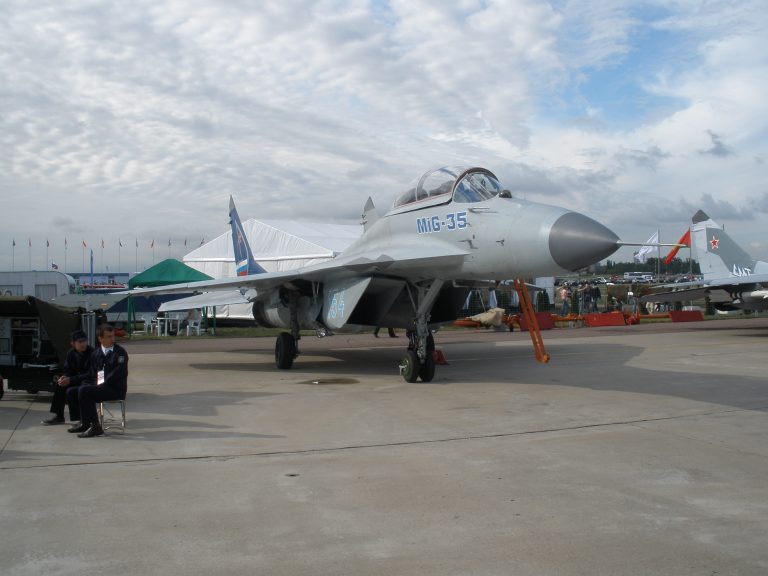
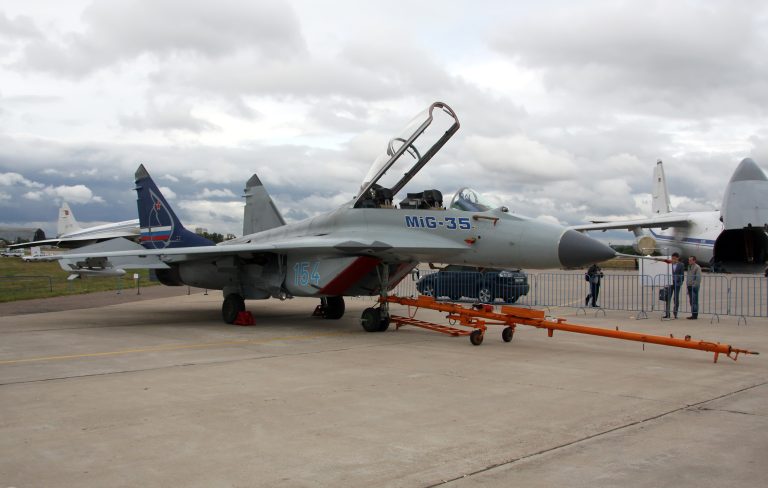
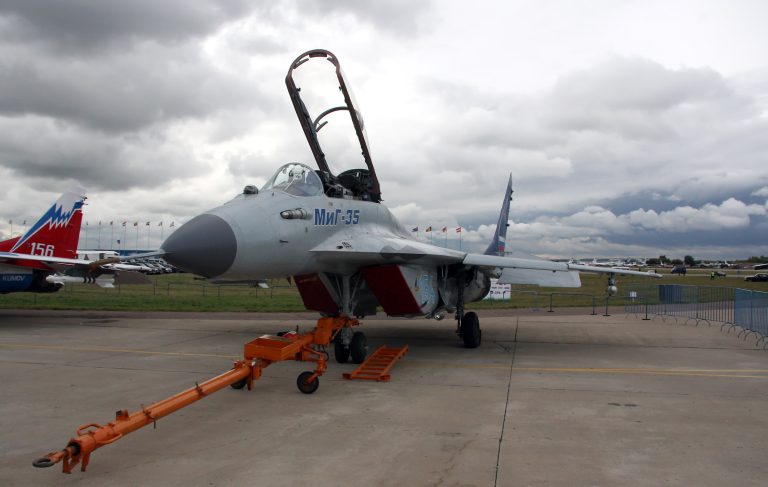
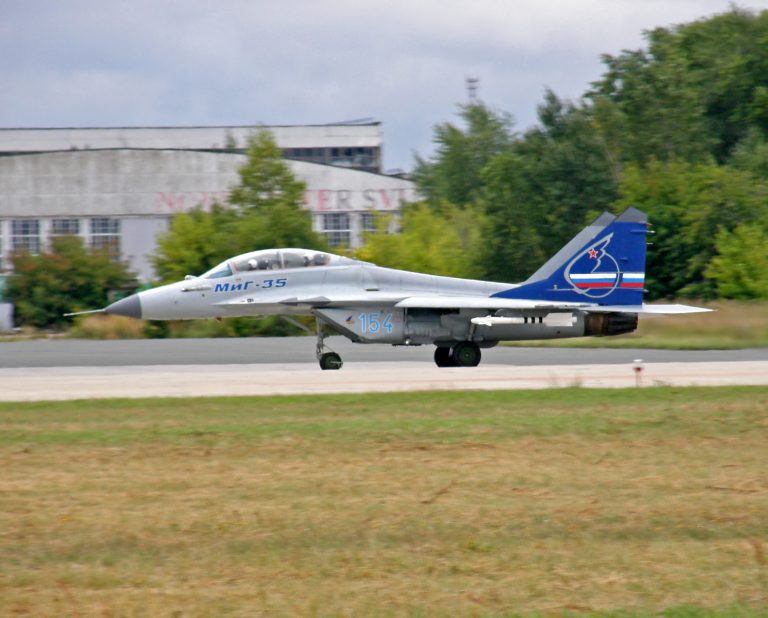
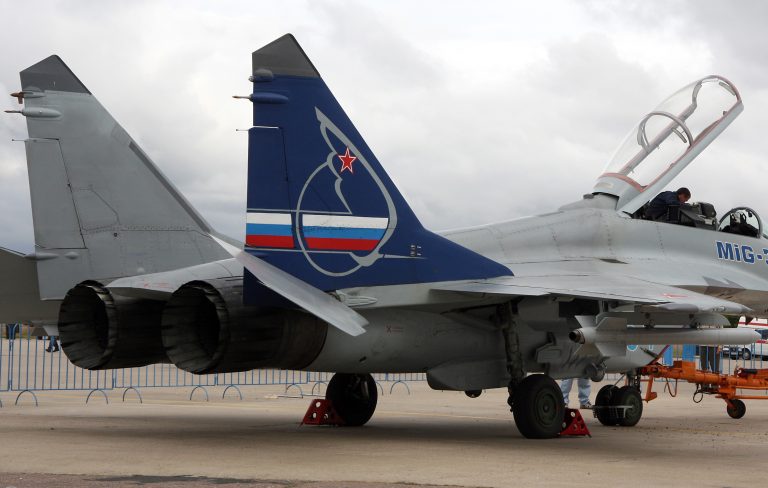
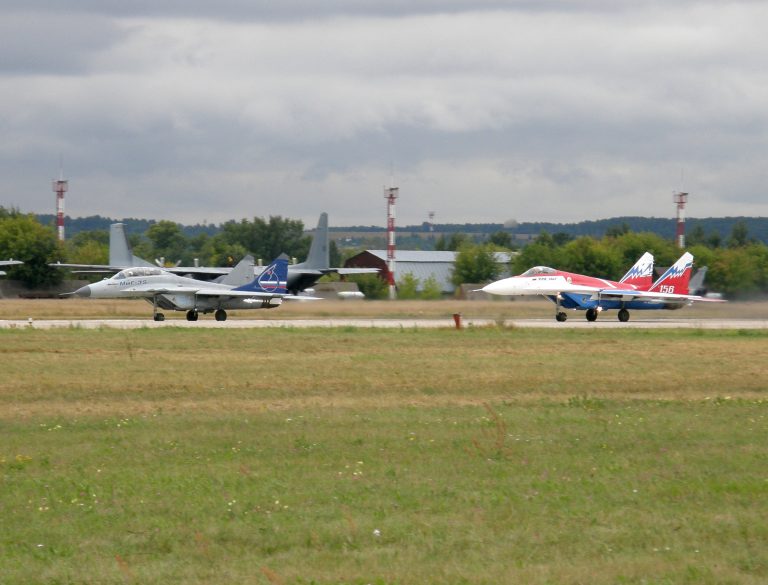
The MiG-35 in motion
A curated video feature for the Mikoyan MiG-35 is coming soon. In the meantime, explore the photo gallery above and the operator map below.
Where the MiG-35 flies
The record that defines it
The MiG-35’s record is defined less by combat than by how little of it there has been. Only a token batch of around six aircraft has been ordered, all by Russia; there are no confirmed export operators, and the type has no established front-line combat history under the MiG-35 designation. Its most visible role has been on the air-show circuit, where its handful of airframes demonstrate the high-agility flying the Fulcrum family is known for. Read neutrally, the MiG-35 is a capable design whose service story is dominated by the mismatch between its marketing and its numbers.
Compare the combat record of every military aircraft. Figures as of July 2026.
Everything people ask about the MiG-35
Can I fly in a MiG-35?
Is the MiG-35 just an upgraded MiG-29?
How many MiG-35s have been built?
Has any country bought the MiG-35 for export?
Does the MiG-35 really have an AESA radar?
Why did Russia buy so few MiG-35s?
How does the MiG-35 compare to the F-35?
You can’t fly the MiG-35.
These, you can.
Some legends only live in museums — others are fuelled and waiting. MiGFlug has put civilians in real military jet cockpits since 2004.
 Fly the L-39 AlbatrosThe world’s most-flown jet trainer — aerobatics included
 Fly the F-104 Starfighter“The missile with a man in it”
 Fly the MiG-21The Cold War’s most-produced jet
 Fly the T-33 Shooting StarAmerica’s first jet trainer
 Fly the DH VampireA piece of early jet history
 Fly the S.211Agile Italian jet trainer
 Fly the MB-326The classic Aermacchi jet
 Fly the MiG-15The Soviet legend of the Korean War
Continue the tour
Every fact, checked
- Airforce Technology — MiG-35 Fulcrum-FSpecifications, radar and systems overview for the multirole variant.
- Military Factory — Mikoyan MiG-35Dimensions, engines, armament and generation baseline.
- The War Zone — why the MiG-35 looks like a dead duckThe 2018 order for six aircraft, delayed trials and the Sukhoi competition.
- FlightGlobal — engines and radar blamed for MMRCA failureWhy the MiG-35 lost India’s medium-fighter competition.
- 19FortyFive — Russia’s MiG-35 fighter fiascoProduction numbers, export rejections and market positioning.
- National Security Journal — Russia built just sixThe token domestic order and the air-show role.
- The EurasianTimes — why India keeps rejecting the MiG-35India’s repeated decisions against the type.
- The National Interest — the MiG-35’s ride-or-die momentProgramme context and the gap between ambition and orders.