
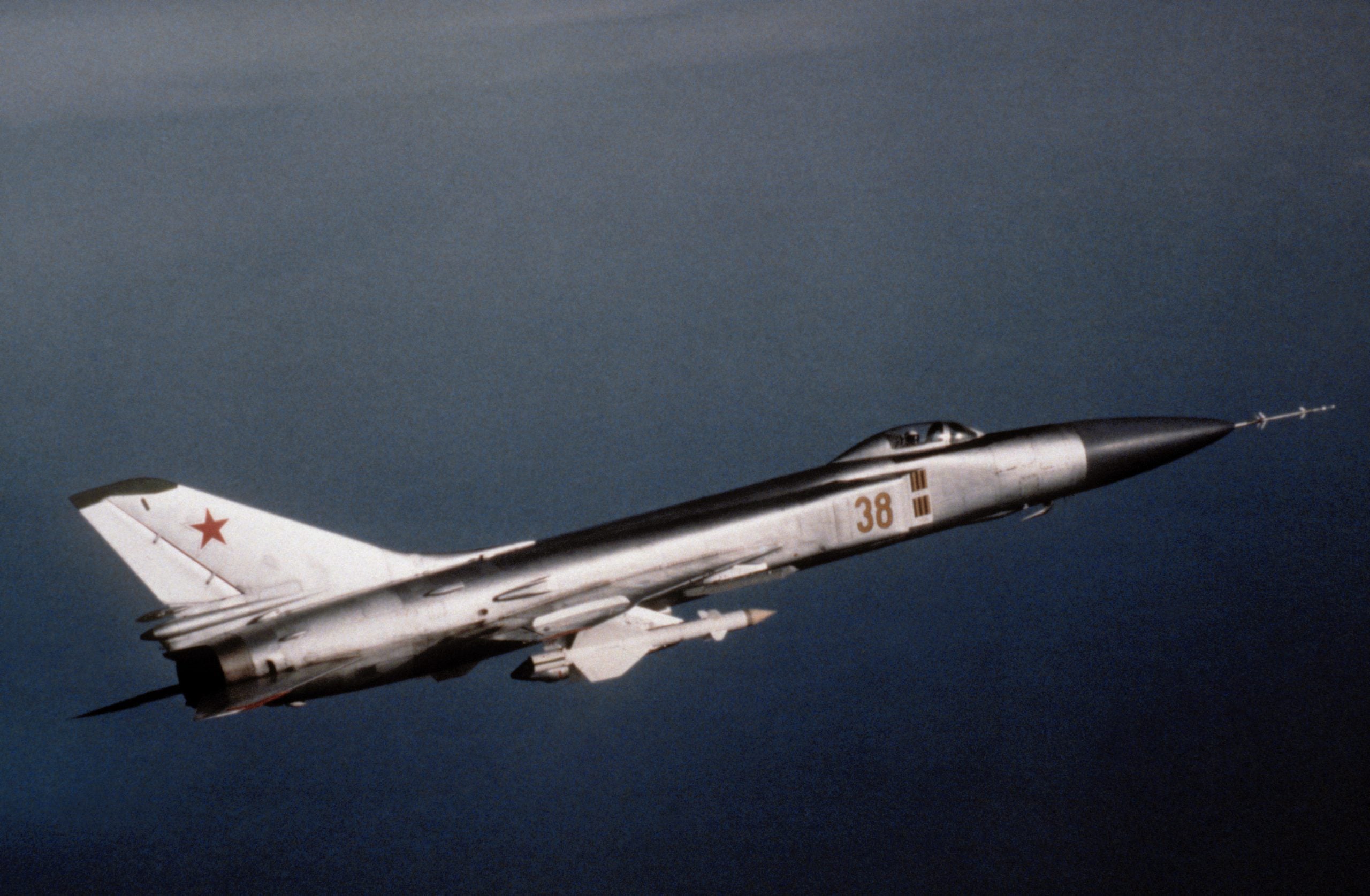
Sukhoi Su-15
“Flagon”
A Mach-2 twin-engine delta interceptor built to guard the vast Soviet frontier — and the aircraft whose name is bound, above all, to two civil airliners it should never have met.
The Sukhoi Su-15: guardian of Soviet skies
By the end of the 1950s the Soviet Air Defence Forces — the PVO — had a problem of geography. The country was enormous, its borders long, and the threats it feared came fast and high: American reconnaissance aircraft and, potentially, supersonic bombers. Sukhoi’s existing single-engine interceptors, the delta-winged Su-9 and Su-11, were quick but short-legged, lightly armed and reliant on a single engine over some of the emptiest terrain on Earth. The design bureau set out to build something better.
The answer was the Su-15. Where the Su-11 had one engine, the new aircraft had two — mounted side by side in the rear fuselage and fed by plain lateral intakes, a layout chosen for reliability and thrust rather than elegance. It kept the tailed-delta wing family of its predecessors but grew larger, heavier and considerably more capable. The prototype, designated T-58, first flew on 30 May 1962 in the hands of test pilot Vladimir Ilyushin, and the type entered PVO service in 1965. NATO gave it the reporting name “Flagon.”
The Su-15 was never a dogfighter and was never meant to be. It was a ground-controlled interceptor: scrambled and vectored onto its target by radar operators on the ground, it would close at high speed, acquire the intruder on its own Taifun radar, and destroy it with a pair of large air-to-air missiles — typically one radar-guided and one heat-seeking. The definitive version, the Su-15TM “Flagon-F,” introduced a compound “ogival” wing and an improved radar in the early 1970s, and became the backbone of Soviet point defence for two decades.
Uniquely among major Soviet fighters of its era, the Su-15 was never exported. It was considered too sensitive — too closely tied to the secrets of the Soviet air-defence network — to sell even to Warsaw Pact allies. Around 1,290 were built, and every one served the USSR and, briefly after 1991, its successor states.
For all that, the Su-15 is remembered by the wider world for something other than its engineering. Twice, Soviet Su-15 pilots were vectored against civilian airliners that had strayed into prohibited airspace. In April 1978 a Su-15 forced down Korean Air Lines Flight 902 over the far north-west of the USSR; two passengers were killed. And on the night of 1 September 1983 a Su-15TM shot down Korean Air Lines Flight 007 near Sakhalin, killing all 269 people aboard — one of the defining tragedies of the late Cold War. These events, examined soberly further down this page, are the reason most people have heard the aircraft’s name at all.
The Flagon was retired through the 1990s as the MiG-31 and Su-27 took over the air-defence mission. It had done the job it was designed for — watch, wait, and intercept — for thirty years.
01The Su-15’s origins: from the Su-9 and Su-11 to a twin-engine interceptor
The Su-15 did not appear from nowhere. Sukhoi had spent the late 1950s building a family of tailed-delta interceptors around a single afterburning engine: the Su-9 (“Fishpot”) and the improved Su-11. Both were fast climbers designed to catch high-flying intruders, but both were limited — modest range, a single engine, and a nose intake whose central shock cone left little room for a powerful radar.
The Su-15 kept the wing philosophy but solved those limits. Moving to two engines in the rear fuselage freed the nose for a large radar dish and added the redundancy prized for long patrols over empty territory. Side intakes replaced the nose inlet. The result was a heavier but far more effective area-defence interceptor — and the most numerous of Sukhoi’s Cold-War interceptors.
What makes the Su-15 special
Two engines instead of one
The defining choice was twin Tumansky turbojets — the R-11 on early aircraft, the more powerful R-13-300 (~65 kN each in afterburner) on the Su-15TM. Two engines gave the thrust to reach Mach 2 and the redundancy to fly long air-defence patrols over Siberia and the Arctic, where a single engine failure could mean the loss of both jet and pilot.
From pure delta to the ‘ogival’ wing
Early Flagons flew a simple triangular delta. The definitive Su-15TM adopted a compound cranked-delta wing with a kinked, less-swept outer leading edge. It improved handling and lift at the low speeds of takeoff and landing — a real weakness of pure deltas — at a modest cost in top speed, which settled at about Mach 2.1.
Radar and a mixed missile pair
The interceptor carried the Taifun-M radar (developed from the earlier Oryol) in its long dielectric nose. Its standard load was two large R-98 (AA-3 “Anab”) missiles — one radar-guided, one infrared — fired as a pair to maximise the chance of a kill. Later aircraft added short-range R-60 missiles or gun pods.
02The Su-15’s ground-controlled interception: fighting by radar and radio
The Su-15 was one arm of a system, not a free-roaming hunter. Soviet air defence was built around dense networks of ground radars and controllers who tracked intruders and vectored interceptors onto them by radio — a doctrine called ground-controlled interception (GCI). The pilot often did not search for his target so much as arrive where the controllers sent him, switch on his own radar for the final approach, and fire.
The design reflected this. The Su-15 had a powerful radar and long-reach missiles but limited endurance and no need for the agility of a dogfighter. It was optimised to be guided quickly to a single high-value target and to kill it on the first pass. That doctrine explains both its strengths and the tragedies: the same system that made it a formidable border guard also placed the final decision in a chain of ground commanders under intense time pressure.
03The Su-15 family: from Flagon-A to the definitive Flagon-F
The Flagon evolved steadily. Early Su-15 (“Flagon-A”) aircraft had the pure delta wing and the Oryol radar. Interim versions tested the compound wing. The definitive Su-15TM “Flagon-F” combined the cranked wing, the improved Taifun-M radar and updated missiles. A two-seat operational trainer, the Su-15UM, kept the interceptor’s handling while adding a second cockpit. All told, roughly 1,290 aircraft were built at Novosibirsk between the mid-1960s and the late 1970s.
Full Su-15TM specifications
Baseline note: the figures below describe the Sukhoi Su-15TM (OKB designation T-58TM, NATO Flagon-F), the definitive production interceptor built at Novosibirsk plant No. 153 from late 1971 — compound-delta wing, ogival radome, Taifun-M radar and two Tumansky R-13-300 turbojets. It is the right baseline because it is the mark that mattered: the TM was the version that equipped the bulk of the PVO’s interceptor regiments through the 1970s and 1980s, the version that flew both Korean Air Lines interceptions, and the version most surviving airframes represent. Deltas for the early Su-15 (Flagon-A, pure delta wing, Oryol-D58 radar), the extended-span double-delta Flagon-D, the ten-off Su-15T (Flagon-E) and the Su-15UT and Su-15UM trainers are in grey. Five cautions before any number here is used. First, published lengths for the same aeroplane range from 19.56 m to 22.03 m, a spread of nearly two and a half metres, because Russian tables give the overall length including the long nose air-data boom while several Western compilations give the fuselage alone or an intermediate figure; both are quoted below, and they must never be mixed. Second, the wing loading of 555 kg/m² that circulates in English-language tables cannot be reconciled with any published weight: 17,200 kg over 36.6 m² is 470 kg/m², and even the maximum take-off weight yields only 489 kg/m². Third, the engine is the R-13-300 and its afterburning rating is 6,600 kgf; tables that print "R-13F-300, 70 kN" are quoting a rating no source for the Su-15 supports, and airwar.ru’s 65.7 kN sits between the two. Fourth, production totals: 1,290 airframes of all types is the figure given by every serious modern account, and the "some 1,500" found in older Western references is an overstatement. Fifth, service ceiling is given as 18,100 m for the TM and 18,500 m for the earlier pure-delta aircraft; the TM was heavier and had more wing, and the small loss is real rather than a printing error.
Dimensions & weights
- Crew
- 1 — one pilot flying the aeroplane, working the radar and running the missile channel, under close ground control from a Vozdukh-1 command post. The Su-15UT and Su-15UM added a second cockpit ahead of the first with full dual controls; the UT had no radar and no weapons, the UM had a working weapon channel but no search radar of its own
- Length overall
- 22.03 m (72 ft 3 in) including the nose air-data boom, the figure used in Russian documentation. The fuselage alone is quoted at 19.56 m (64 ft 2 in) and airvectors gives an intermediate 20.54 m (67 ft 5 in); the early Su-15 measured 22.07 m (72 ft 5 in) on the same overall convention
- Wingspan
- 9.34 m (30 ft 8 in) on the compound-delta wing. Several tables print 9.43 m (30 ft 11 in); the difference is within the noise of Soviet publication practice and is not a different wing. The original pure-delta Flagon-A spanned only 8.616 m (28 ft 3 in), and the extra span is the single most consequential change made to the type
- Height
- 4.84 m (15 ft 11 in) on the TM; 5.00 m (16 ft 5 in) on the early Su-15, the reduction coming from a revised fin and undercarriage stance rather than a shorter airframe
- Wing area
- 36.6 m² (394 sq ft) on the compound delta; 34.56 m² (372 sq ft) on the pure delta of the Flagon-A. Two square metres bought a usable reduction in approach speed and a wider low-speed envelope, which is why the change was made in mid-production rather than saved for a new type
- Wing planform
- Compound "double" delta — roughly 60° leading-edge sweep inboard, reducing to about 45° on the extended outer panels, with a small fence at the kink. Introduced on the Flagon-D from 1969 and standard on everything after it; the Flagon-A was a plain 60° delta of constant sweep
- Empty weight
- 10,760 kg (23,722 lb); airvectors gives 10,874 kg (23,970 lb) for the same mark. The early Su-15 came out at 10,220 kg (22,530 lb), so the TM’s radar, wing and systems cost roughly half a tonne
- Normal take-off weight
- 17,200 kg (37,920 lb) with full internal fuel and two R-98M rounds; 16,520 kg (36,420 lb) on the early Su-15
- Maximum take-off weight
- 17,900 kg (39,463 lb); 17,094 kg (37,685 lb) on the Flagon-A. The margin between normal and maximum is only 700 kg, which tells you how little the airframe had left over once its fuel and its two big missiles were aboard
- Internal fuel
- 6,860 litres (1,812 US gal) in three fuselage and two wing tanks. Generous in volume, modest in endurance: two afterburning turbojets on a supersonic climb profile empty it quickly, and the type was designed around short, radar-directed dashes from an alert pad rather than patrol
- External fuel
- 2 × 600 litres (2 × 159 US gal) in PTB-600 tanks on the two fuselage pylons. These are the same two stations that carry the gun pods, so an Su-15TM could have cannon or ferry range but never both
- Maximum external load
- ~1,500 kg (3,307 lb) across six pylons: two inboard wing stations for the large missiles, two outboard for short-range rounds, two under the fuselage for tanks or gun pods. The early Flagon-A had four pylons only
Performance
- Maximum speed, altitude
- 2,230 km/h at 12,000 m (1,385 mph / 1,204 kn at 39,400 ft) carrying two missiles. The same figure is quoted for the Flagon-A and the TM, which is plausible: the TM gained thrust and lost it again to weight and frontal area
- Maximum Mach number
- Mach 2.1 — a structural and kinetic-heating limit on an aluminium airframe, not a thrust limit. Soviet regiment practice held everyday intercepts well below it; Mach 2 was a test-flight and record number, not a nightly one
- Maximum speed, sea level
- 1,400 km/h (870 mph). Respectable for the period, and the number that mattered on the low-level border scrambles the type actually flew
- Service ceiling
- 18,100 m (59,400 ft) for the Su-15TM; 18,500 m (60,700 ft) for the earlier and lighter Su-15. Both are ordinary sustained-flight ceilings; zoom-climb figures are higher and are not comparable
- Rate of climb
- 228 m/s (44,900 ft/min) initial, at low weight in full afterburner. This is the type’s best quality and the reason the PVO kept it: from brakes-off it could be at bomber altitude very quickly indeed
- Combat range
- 725 km (450 mi / 391 nmi) on internal fuel in an intercept profile. Short, and the governing operational fact about the Su-15: it defended the airfield it sat on and the corridor immediately beyond it
- Ferry range
- 1,700 km (1,056 mi / 918 nmi) with two PTB-600 tanks; the earlier Su-15 is credited with 1,550 km (963 mi). Neither figure represents a combat radius, and no Su-15 was a long-range interceptor in the sense the Tu-128 was
- Wing loading
- 470 kg/m² (96 lb/sq ft) at normal take-off weight; 489 kg/m² (100 lb/sq ft) at maximum. The widely reprinted 555 kg/m² corresponds to no published weight for this aeroplane and should be discarded
- Thrust-to-weight ratio
- 0.77 at normal take-off weight (129.4 kN of afterburning thrust against 168.7 kN of weight). The published 0.84 implies an aircraft of about 15,700 kg, that is, one well down on fuel; both numbers are honest if you say which weight you mean
- Load factor limit
- +6.5 g — adequate for a straight-line interceptor and never the point of the design. The Su-15 was not a dogfighter and its pilots were not trained as such
- Minimum engagement altitude
- 500 m (1,640 ft) for the Su-15TM with Taifun-M against a target over land, against roughly 2,000 m for the earlier Oryol-D58 aircraft. Modest look-down capability was the whole point of the TM, and it is still far short of a genuine pulse-Doppler set
Propulsion & systems
- Engines
- 2 × Tumansky (Gavrilov) R-13-300 afterburning turbojets — the same core family as the MiG-21bis engine. The early Su-15 and the Flagon-D flew on 2 × R-11F2S-300. Some English references name the TM’s engine the R-13F-300; the airframe is the same either way, but the thrust figure that travels with that name is not supported
- Thrust, military
- 40.2 kN each (4,100 kgf / 9,040 lbf); 38.3 kN (3,900 kgf) each for the R-11F2S-300
- Thrust, afterburning
- 64.7 kN each (6,600 kgf / 14,550 lbf); airwar.ru prints 65.7 kN and some English-language online tables 70 kN, the latter unsupported by any Soviet source. The R-11F2S-300 of the early aircraft gave 60.8 kN (6,200 kgf) each
- Air intakes
- Rectangular side intakes with variable ramps, splitter plates and boundary-layer bleed — the decisive break from the Su-9 and Su-11, whose nose intake and translating shock cone left almost no room for a radar dish. Moving the intakes to the flanks freed the entire nose for an antenna, and that single change is what the Su-15 is
- Radar
- RP-26 Taifun-M (NATO Twin Scan): detection of a high-flying target at about 70 km (43 mi), lock-on at about 45 km (28 mi), with improved resistance to jamming and a limited look-down mode. The early Su-15 carried the Oryol-D58 of the Su-11 lineage, the service index for which is RP-15; English tables that print "RP-22 Oryol-D" have borrowed the designation of the MiG-21S’s Sapfir-21, a different set entirely. The intermediate Su-15T’s plain Taifun, derived from the MiG-25’s Smerch, was so unreliable that production stopped after about ten aircraft
- Ground-control link
- Lazur-M command-guidance datalink — the aircraft was a node in the Vozdukh-1 automated interception system, flown onto its target by a ground controller with steering commands displayed to the pilot. The Su-15 was never conceived as an independent hunter, and its short radar range and single crewman only make sense inside that system
- Identification
- SRZO-2M Khrom-Nikel IFF interrogator and transponder — military IFF only. It could interrogate Soviet military aircraft; it could tell a pilot nothing whatever about a civil airliner, which is directly relevant to both Korean Air Lines interceptions
- High-lift system
- Blown flaps with engine-bleed boundary-layer control (SPS) — introduced with the compound-delta wing to attack the type’s worst vice. Deltas land fast, and the early Su-15 landed very fast indeed; the combination of more span and blown flaps brought approach speeds down to something an average conscript-era PVO airfield could live with
- Deceleration
- Twin brake parachutes in a fairing at the base of the fin, plus wheel brakes — standard Soviet practice and genuinely necessary on this airframe, whose landing run without the chutes was long enough to be a routine hazard on icy northern runways
- Ejection seat
- KS-4 — rated for escape from zero to 20,000 m (65,600 ft) at speeds of not less than 140 km/h (87 mph). It is not a zero-zero seat: on the runway, below that speed, the pilot had nothing
- Fuel system
- Three fuselage tanks and two wing tanks, 6,860 litres total — plus two 600-litre PTB-600 drop tanks when carried. There was no in-flight refuelling capability of any kind on any mark, which is the other half of the range problem
- Unit cost
- Not published — Soviet internal accounting prices for PVO interceptors were not released, and no meaningful figure exists in the open literature. Any dollar cost quoted for an Su-15 is an invention, and the type was never sold to anybody, so no export price exists either
04The Su-15’s operating costs: why no reliable price exists
The Su-15 was a Soviet state product, built for the PVO and never sold on any open market — not even to Warsaw Pact allies. As a result there is no meaningful flyaway unit price and no credible cost-per-flight-hour figure for the type in the public record; the Soviet planned economy did not price military aircraft the way Western procurement did. Any precise dollar figure attached to a Su-15 online is, in practice, an invention. What can be said is that as a twin-engine, radar-equipped interceptor it was more expensive to buy and operate than the single-engine Su-9 and Su-11 it replaced.
Armament & payload
The Su-15TM carried two big missiles, two small ones, and a gun only if it gave up its fuel
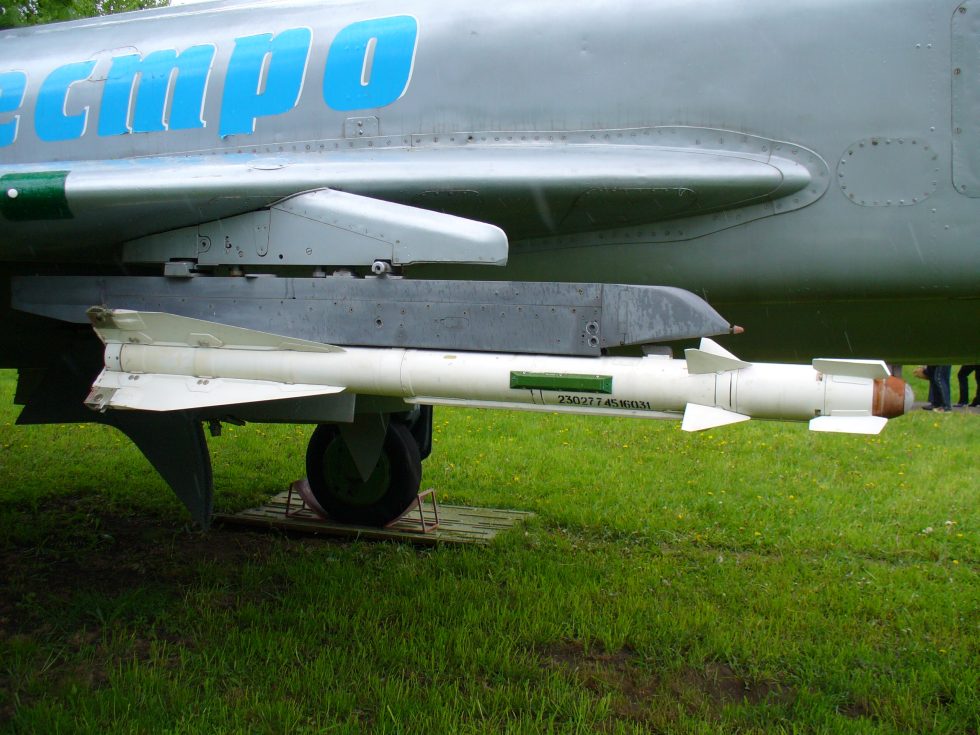
The Su-15 was armed to do one thing: put a large radar-guided missile into a large aeroplane flying straight and level at high altitude. Two R-98M rounds on the inboard wing pylons were the whole of the original armament, fired in pairs — one semi-active radar-homing, one infra-red — so that chaff, a flare or a cloud deck could not defeat both seekers at once. That pairing is the type’s single genuinely clever tactical idea, and it was inherited from the Su-11.
Everything else was added later and grudgingly. The Su-15TM gained two outboard pylons for R-60 short-range infra-red rounds, an acknowledgement that the missile-only orthodoxy of the late 1950s had failed. It gained the ability to hang a pair of UPK-23-250 gun pods under the fuselage, each containing a twin-barrel GSh-23L and 250 rounds — but on the same two stations as the drop tanks, so a gun-armed Su-15TM was a short-legged one. There was never an internal cannon on any mark. This is not a fighter that could be talked into being something else.
The armament matters because of how it was used. On 20 April 1978 Captain Aleksandr Bosov fired two R-60s at Korean Air Lines Flight 902, a Boeing 707 that had strayed deep over the Kola Peninsula after a compass failure near the magnetic pole; one missile tore roughly four metres off the port wing and holed the cabin, killing two passengers, and the aircraft made a forced landing on the frozen Korpijärvi lake in Karelia, some 140 km from the Finnish border. On 1 September 1983 Major Gennadiy Osipovich, flying an Su-15TM of the 777th Fighter Regiment from Sokol on Sakhalin, fired two R-98M rounds into Korean Air Lines Flight 007 near Moneron Island at about 18:26 UTC; all 269 people aboard were killed. Before firing he loosed four bursts, more than two hundred rounds, from his gun pods, and later said of them: "For all the good it did. It’s doubtful whether anyone could see them" — they were armour-piercing, not tracer. Weapon fits varied by regiment and by year, and the early Flagon-A had four pylons rather than six; treat any single list as one period’s snapshot rather than the type standard.
Gun
- No internal cannon on any production Su-15, of any mark. The card is kept because the absence is the type’s defining armament fact for its first decade.
- From the Su-15TM, two UPK-23-250 pods could be carried on the fuselage pylons. Each holds one twin-barrel GSh-23L 23 mm cannon with 250 rounds, firing at roughly 3,200 rounds per minute.
- The pods occupy the drop-tank stations. Carrying guns meant flying on internal fuel alone, on an aircraft whose combat range was already only 725 km — a straight trade of reach for the ability to make a warning pass.
- Osipovich’s 1983 bursts were fired from these pods. The ammunition loaded was armour-piercing rather than tracer, so the rounds were effectively invisible at night; the ICAO investigation treated the attempted warning as one that could not reasonably have been seen.
- The Su-15UM trainer could also carry the pods, which is why it is described as combat-capable while the earlier Su-15UT was not.
Air-to-air
- 2 × R-98M (AA-3 Anab) on the inboard wing pylons, about 290 kg apiece with a warhead of roughly 40 kg; engagement ranges are quoted between about 18 and 24 km depending on source and profile.
- Always a mixed pair: R-98MR semi-active radar-homing and R-98MT infra-red, launched together at one target so that a single countermeasure could not spoil both shots.
- The early Su-15 carried the parent R-8M and then the R-98; the missiles improved across the type’s life far more than the airframe did.
- 2–4 × R-60 (AA-8 Aphid) on the outboard pylons of the Su-15TM — 43.5 kg, a 3 kg warhead, and a reach of some 8 km. Added because two long-range rounds and no gun had proved an unacceptably thin hand.
- Two R-98Ms is the entire primary magazine. Miss with both and the Su-15 had nothing left but its pods, if it was carrying them.
Air-to-surface guided
- None, on any mark, ever. No guided air-to-ground weapon was carried, cleared or trained for.
- The Su-15 belonged exclusively to the PVO, the separate air-defence service, and not to Frontal Aviation. Ground attack was another service’s job and never entered the syllabus.
- The Su-15Sh project of the early 1970s proposed a ground-attack version with a revised nose and a strike fit; it was studied and rejected, and no airframe was built.
- Because the type was never exported, no foreign operator improvised a strike role for it either — unusual for a Soviet fighter of this generation.
Bombs
- No bombs in PVO service. There were no bomb racks, no bomb bay, no sight and no bombing computer on any operational Su-15.
- Compilations that credit the type with FAB-250 or FAB-500 loads are describing the theoretical capacity of six pylons rated to about 1,500 kg, not anything a squadron ever loaded.
- The fuselage stations were plumbed for fuel and wired for gun pods. They were not stressed or cleared for ordnance.
- The unbuilt Su-15Sh is the only place a bomb load appears in the programme’s paperwork.
Rockets
- No unguided rockets in operational service on any mark.
- Early T-58 configuration studies were drawn with rocket packs in the manner of the MiG-19; all of it was deleted before production as the missile-only doctrine hardened.
- UB-16-57 pods with S-5 rockets appear only in the paper Su-15Sh strike proposal, and no PVO regiment was ever certified for them.
- The one exception in spirit rather than fact: the Su-15 was credited with destroying five drifting reconnaissance balloons in 1975, a task done with missiles and cannon rather than rockets.
Pods & other stores
- 2 × PTB-600 drop tanks, 600 litres each, on the fuselage pylons — the only stores most Su-15s carried besides missiles, and the ones that made ferry flights across the Soviet Union possible at all.
- 2 × UPK-23-250 gun pods on the same two stations, mutually exclusive with the tanks.
- No reconnaissance pod, no targeting pod, no electronic-warfare pod, no buddy refuelling store. The Su-15 had no in-flight refuelling capability of any kind.
- Internal rather than podded, but decisive: the Lazur-M datalink that flew the aircraft onto its target from a Vozdukh-1 ground station. Without it the Su-15’s 70 km radar and single pilot would have been close to useless.
Three typical loadouts
- Standard high-altitude intercept
- 2 × R-98M (one R-98MR radar, one R-98MT infra-red) on the inboard wing pylons, 2 × PTB-600 tanks under the fuselage. The alert fit at most PVO airfields: maximum reach, maximum probability of a kill against a bomber, no gun aboard.
- Point defence
- 2 × R-98M inboard, 2 or 4 × R-60 outboard, clean fuselage, internal fuel only. Flown when the threat was expected close in and manoeuvring; the R-60s exist to cover the case the big rounds were never designed for.
- Border patrol and identification
- 2 × R-98M inboard, 2 × UPK-23-250 gun pods under the fuselage, no tanks. The fit Osipovich’s aircraft carried over Sakhalin on 1 September 1983 — the configuration in which a Soviet interceptor could shoot at an intruder without killing it, at the cost of half its endurance.
Sourcing caveat: Su-15 weapon fits are reconstructed from Russian technical literature and post-1991 memoir material, and the boundary between what was cleared and what was routinely loaded is often blurred. Missile performance figures for the R-98 family in particular vary widely between sources, and no Soviet-era firing-envelope data has been published in full. Where this page gives a range it gives the span found across authorities rather than a single confident number.
Variants
The Su-15 grew a bigger wing and a better radar, and nothing else ever changed
The Su-15 line runs from the T-58D prototype of 1962 to the last Su-15UM of 1979, and across seventeen years of production it received exactly two substantial improvements: a compound-delta wing to make it land at a survivable speed, and the Taifun-M radar to give it a limited look-down capability. The fuselage, the cockpit, the single crewman and the two-missile magazine are the same at the end as at the beginning.
That conservatism was deliberate. The PVO wanted quantity and availability from a design bureau also building the Su-17 and the Su-24, and it got them: about 1,290 airframes from Novosibirsk, more than any other dedicated Soviet interceptor of the period, distributed across roughly thirty regiments from the Baltic to Kamchatka. The Su-15 was the workhorse that made the Soviet air-defence map look solid on paper.
It was also never exported, to the Warsaw Pact or to anyone else — the only major Soviet fighter of its generation kept entirely at home, on grounds of radar and datalink secrecy and because PVO assets served a national air-defence system rather than an alliance. A claim occasionally repeated that Su-15s deployed to Egypt in 1972 with Soviet crews is thinly sourced and does not survive comparison with what is known of that detachment, which flew MiG-25RB and MiG-21 aircraft.
- T-58D-1, -2, -3 (1962–1964, three prototypes)
- The aeroplane that established the layout: side intakes with variable ramps, twin R-11F2S-300 engines, solid nose for a radar. First flight 30 May 1962 with Vladimir Ilyushin at the controls.
- Su-15 Flagon-A (1966–1969, plain 60° delta)
- First production mark, with the Oryol-D58 radar and two R-8M or R-98 missiles on four pylons. Officially commissioned 3 April 1965, in PVO service from 1967. Fast and quick-climbing; it landed like a brick.
- T-58VD Flagon-B (1966, one aircraft)
- Short-take-off testbed with three Kolesov RD-36-35 lift jets in the fuselage, first flown 6 June 1966 and shown at Domodedovo in 1967. The lift engines ate the fuel tankage; the idea went no further.
- Su-15 Flagon-D (from 1969)
- The important change: a compound "double delta" wing of greater span and area with a fence at the kink, plus blown flaps. Approach speed and take-off run both improved substantially, and every later mark uses this wing.
- Su-15UT Flagon-C (1970–1972)
- Two-seat conversion trainer with a 45 cm fuselage stretch, tandem cockpits and a periscope for the instructor. No radar, no weapons; a pure handling trainer for a type that badly needed one.
- Su-15T Flagon-E (1970–1971, about ten built)
- First attempt at the Taifun radar, derived from the MiG-25’s Smerch. The set proved so unreliable that production was cut off after roughly ten aircraft — the shortest production run of any Su-15 mark, and an honest admission of failure.
- Su-15TM Flagon-F (1971–1975, the definitive mark)
- Taifun-M radar with better jamming resistance and engagement down to 500 m, R-13-300 engines, six pylons for R-98M and R-60 rounds and UPK-23-250 gun pods, and later an ogival radome replacing the earlier conical one. This is the Su-15 that flew the interceptions the world remembers.
- Su-15UM Flagon-G (1976–1979, final production)
- Two-seat trainer on the TM airframe without the UT’s fuselage stretch, retaining a weapon channel for R-60s and gun pods but no search radar. The last new-build Su-15s of any kind.
- Su-15bis (1972, one converted prototype)
- Re-engined with Gavrilov R-25-300 turbojets, first flown 3 July 1972 and approved for production. Engine supply was committed to the MiG-21bis instead and none was built — the type’s best missed opportunity.
- Su-15Sh, Su-15-30 and Su-19 (paper projects, none built)
- A ground-attack conversion, a version for the new K-30 missile, and a proposed two-seat successor. All were studied and all were dropped; the Su-15’s replacement duties passed to the MiG-31 and Su-27.
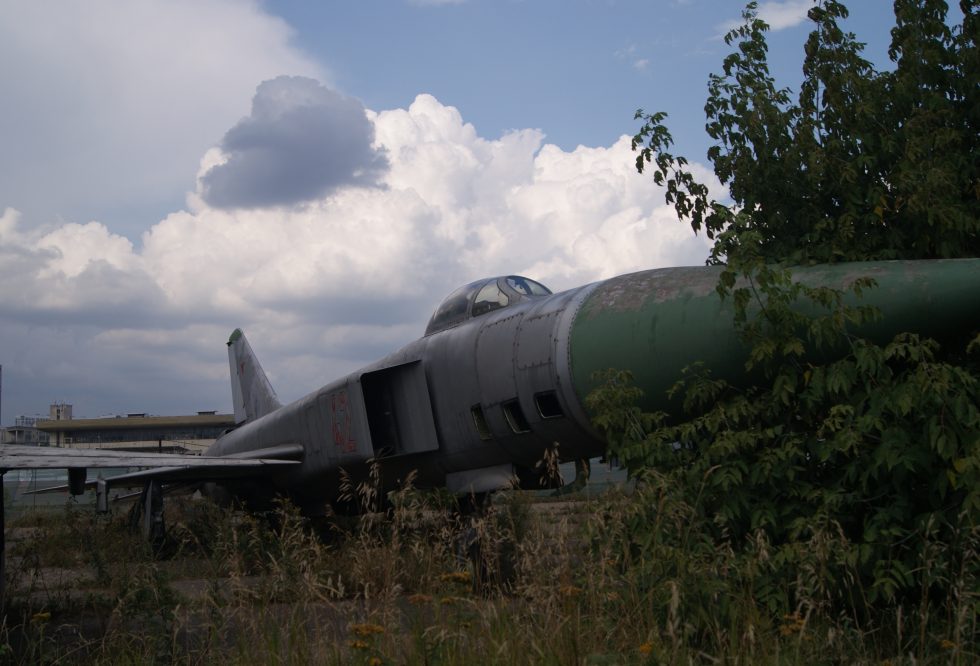
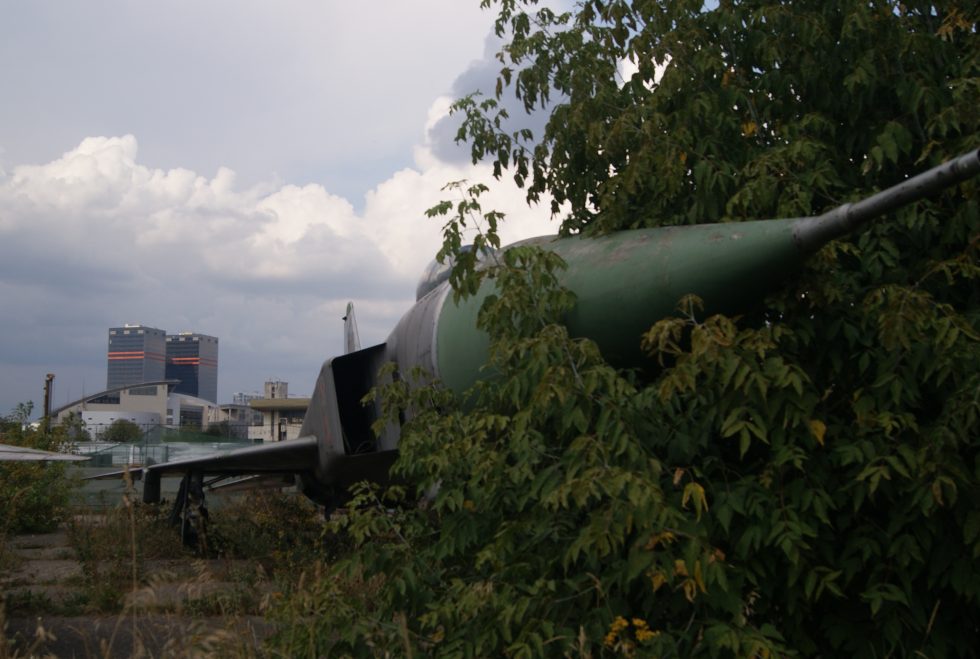
The Su-15 has no fleet section because none survives in service anywhere. The Russian Air Force withdrew its last aircraft in 1994, many being cut up to meet Conventional Armed Forces in Europe treaty ceilings, and Ukraine retired its remaining machines by 1996; sources differ over whether the first Russian units stood down in 1993 or 1994. Since the type was never exported and never civil-registered, there is no residual operator anywhere in the world and there never can be. Survivors are original airframes rather than reproductions — nobody has ever built a replica Su-15 — and something on the order of thirty to forty are preserved, as museum exhibits and airfield gate guards in Russia, Ukraine, Belarus, Kazakhstan and Latvia. The Central Air Force Museum at Monino holds examples of more than one mark. None is airworthy, none is likely ever to fly again, and no complete Su-15TM exists in a Western collection.
From drawing board to Cold-War sentinel
Programme begins
Sukhoi starts work on the T-58, a twin-engine successor to the single-engine Su-9 and Su-11 interceptors.
First flight
The T-58 prototype flies on 30 May with test pilot Vladimir Ilyushin at the controls.
Enters PVO service
The Su-15 joins the Soviet Air Defence Forces as a dedicated area-defence interceptor; NATO names it “Flagon.”
The definitive Flagon-F
The Su-15TM enters service with a compound cranked wing and the improved Taifun-M radar — the version built in the greatest numbers.
Korean Air Lines Flight 902
On 20 April a Su-15 fires on a Boeing 707 that strayed over Soviet territory, forcing it down on a frozen lake; two passengers are killed.
The Kulyapin ramming
On 18 July, out of missiles, Captain Valentin Kulyapin rams an Argentine-registered CL-44 transport intruding from Iran; he ejects safely, the transport is lost.
Korean Air Lines Flight 007
On the night of 1 September a Su-15TM shoots down a Boeing 747 near Sakhalin after it strayed into Soviet airspace; all 269 aboard are killed.
Retirement
Russia withdraws the Su-15 in the mid-1990s as the MiG-31 and Su-27 take over; Ukraine, which briefly inherited a fleet, retires its aircraft by 1996.
Twelve Flagon stories
The interceptor Sukhoi built twice over
The Su-15 grew out of the single-engine Su-9 and Su-11 — same delta family, twice the engines.
Read the full story
A fighter flown from the ground
The Su-15 was one piece of a vast radar-and-radio air-defence machine, not a lone hunter.
Read the full story
Two Tumansky turbojets
The move to twin engines gave the Flagon its Mach-2 speed and its long-range reliability.
Read the full story
The wing that got a kink
The Su-15TM traded a little top speed for a wing that behaved better where it mattered.
Read the full story
One radar shot, one heat-seeker
The Flagon typically fired its missiles in pairs — guided two different ways for insurance.
Read the full story
Korean Air Lines Flight 902
On 20 April 1978 a Su-15 forced a stray Boeing 707 down onto a frozen lake; two people died.
Read the full story
The Kulyapin ramming
Out of missiles, a Su-15 pilot deliberately rammed an intruding transport — and survived.
Read the full story
Korean Air Lines Flight 007
On 1 September 1983 a Su-15TM shot down a Boeing 747 near Sakhalin; all 269 aboard were killed.
Read the full story
The night that changed navigation
The loss of Flight 007 pushed the United States to open GPS to the whole world.
Read the full story
The fighter that was never sold
Alone among major Soviet fighters of its day, the Su-15 was kept strictly at home.
Read the full story
Flagon-A to Flagon-F
The Su-15 evolved through a decade of refinement into the definitive TM.
Read the full story
Handing over the watch
As the Flagon aged, the MiG-31 and Su-27 inherited the job of guarding Soviet skies.
Read the full story
The Flagon in pictures
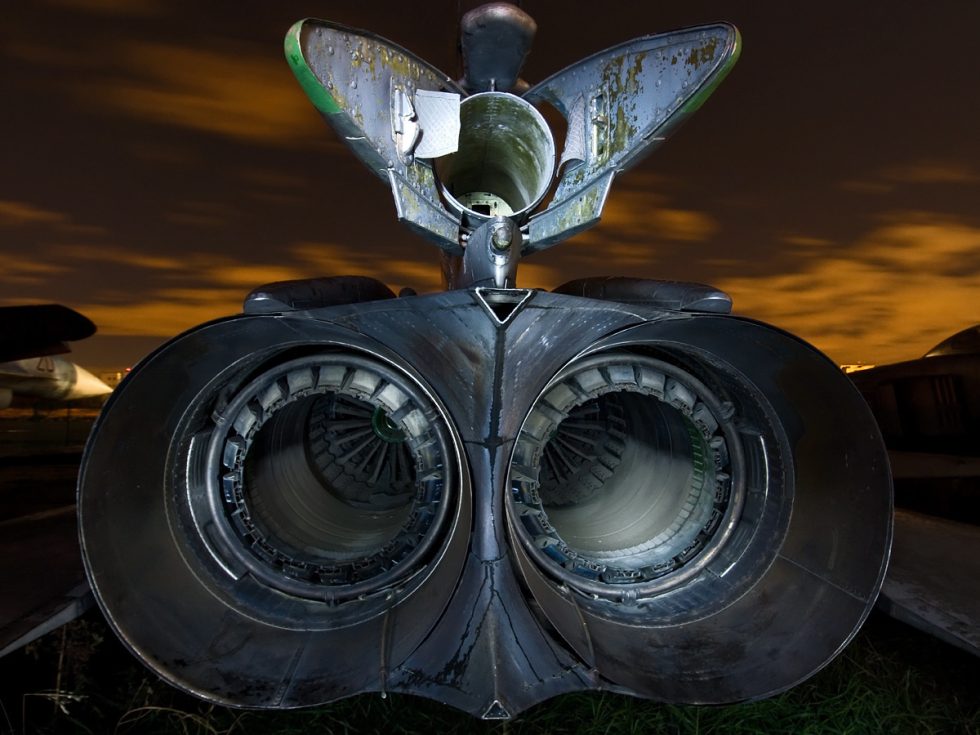
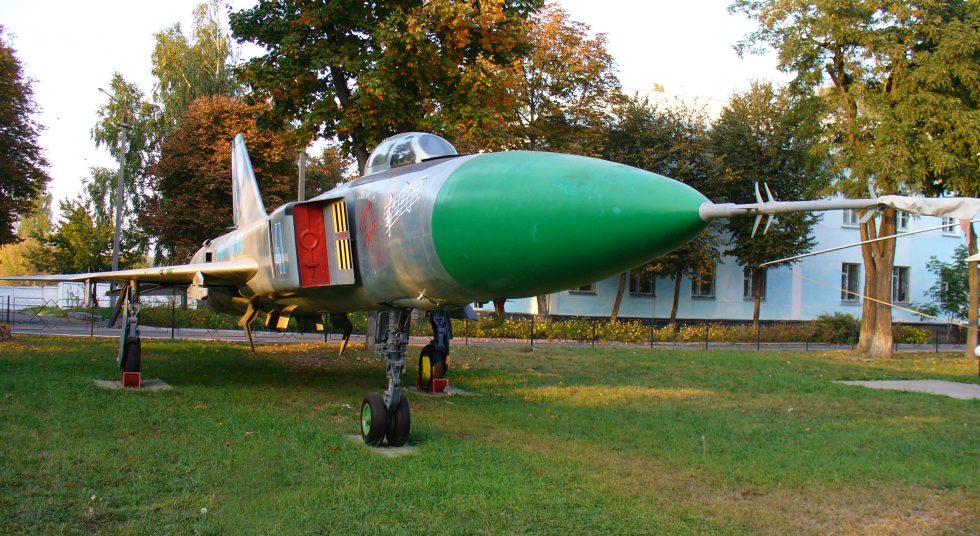
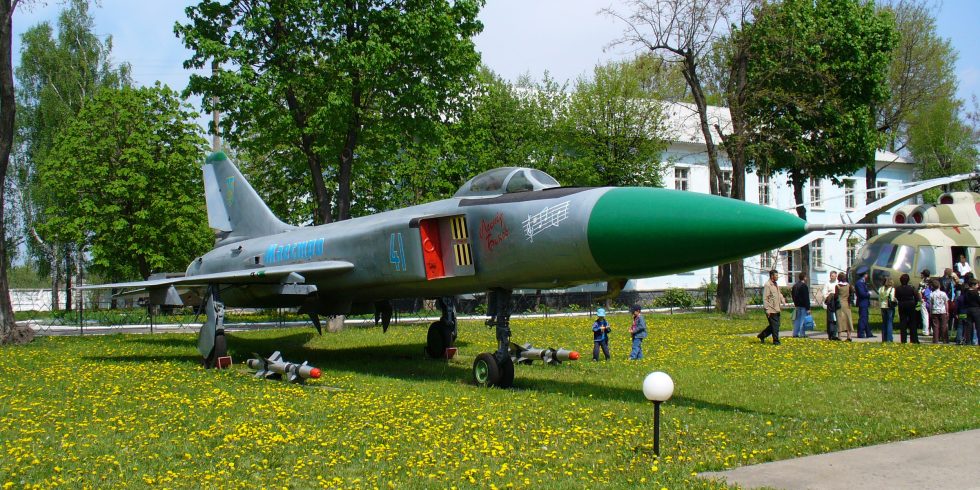
Where the Flagon flew
An interceptor that rarely fired in anger
The Su-15 never fought an enemy fighter and scored no air-to-air victories in war. For thirty years its record was one of vigilance — scrambles, interceptions and shadowing of aircraft near Soviet borders that ended without a shot. The exceptions were not victories in any ordinary sense: on three occasions Flagon pilots fired on, rammed or destroyed civil and transport aircraft that had entered prohibited airspace, twice with the loss of civilian lives. Those incidents, not any dogfight, are how the world came to know the type.
See the wider combat record of every military aircraft. The two airliner incidents are described factually in the stories and Q&A above and below.
Everything people ask about the Su-15
Can I fly in a Su-15?
How fast was the Su-15?
Was the Su-15 ever exported?
Did a Su-15 shoot down Korean Air Lines Flight 007?
What happened to Korean Air Lines Flight 902?
What weapons did the Su-15 carry?
Is the Su-15 still in service?
You can’t fly the Su-15.
These, you can.
Some legends only live in museums — others are fuelled and waiting. MiGFlug has put civilians in real military jet cockpits since 2004.
 Fly the L-39 AlbatrosThe world’s most-flown jet trainer — aerobatics included
 Fly the F-104 Starfighter“The missile with a man in it”
 Fly the MiG-21The Cold War’s most-produced jet
 Fly the T-33 Shooting StarAmerica’s first jet trainer
 Fly the DH VampireA piece of early jet history
 Fly the S.211Agile Italian jet trainer
 Fly the MB-326The classic Aermacchi jet
 Fly the MiG-15The Soviet legend of the Korean War
Continue the tour
Every fact, checked
- GlobalSecurity.org — Su-15 FlagonDevelopment history, service dates, production totals and the shootdown record.
- Encyclopaedia Britannica — Korean Air Lines flight 007Reference account of the 1 September 1983 shootdown and its aftermath.
- The Aviation Geek Club — KAL 007The interception, Major Osipovich and the sequence over Sakhalin.
- Assoc. for Diplomatic Studies & TrainingDiplomatic fallout of the Flight 007 tragedy and the Cold-War context.
- Sierra Hotel Aeronautics — KAL 902The 1978 interception, the missile strike and the landing on the ice.
- Air Mobility Command Museum — KAL 007Museum retrospective on the flight and the navigation legacy.
- The National Interest — Su-15 FlagonOverview of the type, its role and its association with the KAL incidents.
- MiGFlug Afterburner — The night Flight 007 never came homeMiGFlug’s own long-form account of the 1983 shootdown.