
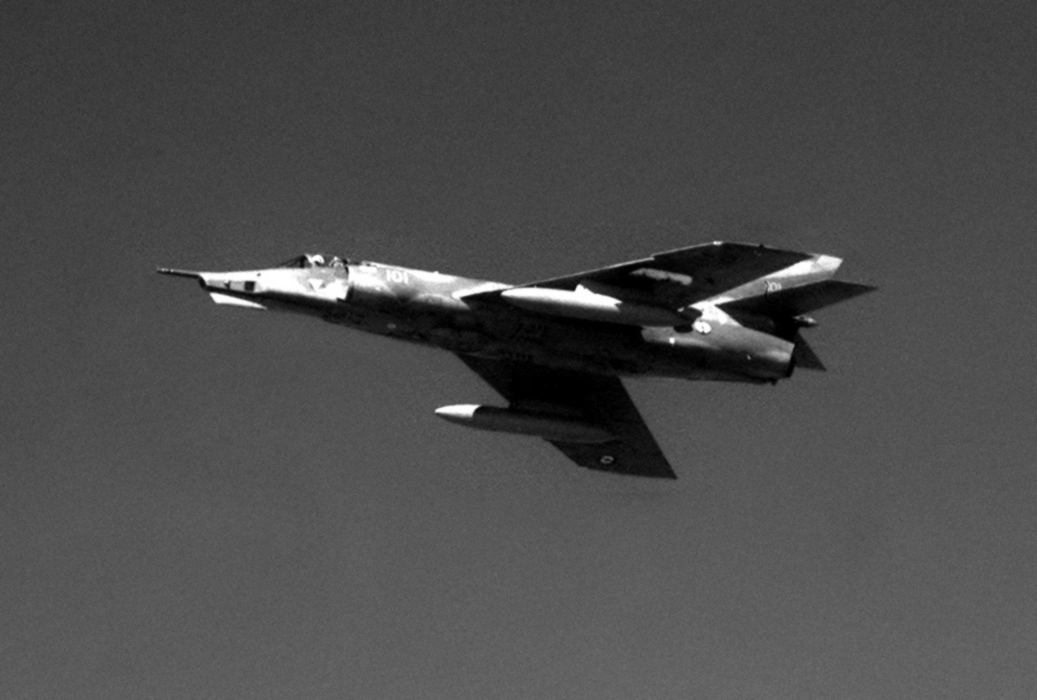
Dassault Étendard IV
France’s first carrier-borne jet strike fighter — a subsonic Aéronavale workhorse that flew from the decks of Clemenceau and Foch for nearly four decades, and drew the blueprint for the more famous Super Étendard that followed.
France’s first jet to fly from the sea
The Étendard IV began life as a loser. In the early 1950s NATO issued the NBMR-1 requirement for a cheap, rugged light strike fighter, and Dassault entered a family of small jets — the twin-engined Étendard II and the single-engined Étendard VI. Both were beaten in the competition by the Italian Fiat G.91. But Dassault believed in the airframe, and pressed on with a larger, more powerful private-venture derivative it funded itself: the Étendard IV, which first flew on 24 July 1956.
What saved the design was the sea. The French Navy (Aéronavale) was building two new aircraft carriers, Clemenceau and Foch, and needed a home-grown jet to fly from them. Dassault navalised the Étendard IV into the Étendard IVM (“M” for Marine) — adding an arrester hook, catapult attachment points, folding wingtips and long-stroke landing gear. This navalised prototype first flew on 21 May 1958 in the hands of test pilot Jean-Marie Saget. It became the first jet fighter designed from the outset for French carrier operations.
The Étendard IV was never meant to be a world-beater on paper. A single non-afterburning SNECMA Atar 08B turbojet of about 43 kN gave it a top speed of only around Mach 1 — subsonic in level flight, and just supersonic in a shallow dive. What it offered instead was exactly what a small navy needed: a simple, tough, reliable strike aircraft that two carriers could operate day and night. Between December 1961 and May 1965 the Aéronavale took delivery of 69 strike-configured IVM and 21 reconnaissance IVP aircraft, entering squadron service from 1962.
Its career was long and, mercifully, largely uneventful in combat — the type never fought a major air war, but it gave France two decades of carrier strike capability and, crucially, taught the Aéronavale how to run a modern jet air group at sea. The Étendard IVP reconnaissance version, fitted with cameras and an in-flight refuelling probe, proved so useful that it outlived the strike aircraft by almost a decade, flying on until 27 July 2000. And the whole programme became the foundation for its far more famous successor — the Super Étendard, the jet that would sink ships in the Falklands and carry France’s naval nuclear deterrent for a generation.
01The Étendard IV’s origins: how a losing NATO contender became France’s first carrier jet
NATO’s 1953 NBMR-1 competition sought a lightweight tactical strike fighter that could operate from rough forward strips. Dassault developed two contenders in the Étendard family — the twin-engine Étendard II and the single-engine Étendard VI — but both were rejected in favour of the Fiat G.91. Rather than abandon the work, Dassault scaled the design up around a more powerful engine and funded a private-venture prototype, the Étendard IV-01, which flew in July 1956.
The French Navy, then commissioning the carriers Clemenceau and Foch, saw in it the indigenous carrier jet it wanted. A December 1956 order funded a semi-navalised prototype, and a 1957 order followed for pre-production Étendard IVM machines — “M” for Marine. What had failed as a NATO land-based fighter succeeded, in navalised form, as the first jet designed specifically to fly from French carriers.
What makes it special
A private venture, navalised for the fleet
Turning a rejected land fighter into a carrier aircraft meant serious surgery: a yoke-style arrester hook, catapult cable-attachment hooks under the wing leading edges, folding wingtips to fit the deck lifts, an extensible nosewheel and long-stroke landing gear to soak up hard deck landings. The result was the first jet designed from the start for French carrier operations — the aircraft that taught the Aéronavale to run a jet air group at sea.
One Atar, and the Mach-1 ceiling
The Étendard IV flew on a single non-afterburning SNECMA Atar 08B turbojet of about 43 kN (4,400 kgf). That made it subsonic in level flight and only just supersonic in a dive — roughly Mach 1. It was never the fastest jet of its era, but a single simple engine made it cheap to run, easy to maintain and dependable on a pitching flight deck, which mattered far more to a two-carrier navy.
The IVP: cameras, a probe and a 38-year career
The reconnaissance Étendard IVP swapped the nose radar and cannon bay for three film cameras, added a fixed in-flight refuelling probe and could carry a buddy-buddy tanker pod to top up other aircraft. That versatility made it indispensable: the IVP flew on until 2000, nearly a decade after the strike IVM had retired.
02The Étendard IV’s blown flaps: the boundary-layer control experiment
Landing a jet on a carrier means flying as slowly as possible on the approach, and Dassault experimented with clever aerodynamics to help. One pre-production airframe was configured for boundary-layer control — “flap blowing” — in which high-pressure air bled from the engine was blown over the top surface of the flaps to keep the airflow attached and the flaps effective at very low approach speeds. This experimental variant (sometimes designated IVB) used a Rolls-Royce Avon engine to supply the extra bleed air. The blown-flap system was not adopted for the production Étendard IV, but the same low-speed thinking underpinned the design that did enter service.
03The Étendard IV and the Super Étendard: the “90% common” that wasn’t
By the late 1960s the Étendard IVM was looking dated, and Dassault proposed an updated version to keep costs down — pitching it as roughly 90% common with the existing aircraft. In reality the new jet needed a more powerful Atar 8K-50 engine, a modern nav-attack system with the Agave radar, and a substantially reworked structure; engineers later quipped it was closer to “90% different.” The result, the Super Étendard, first flew in 1974 and entered service in 1978, going on to fame in the Falklands and as France’s carrier-borne nuclear-strike aircraft. The Étendard IV was its direct ancestor — a separate exhibit in this museum.
Full specifications
Baseline note: the figures below describe the Dassault Étendard IVM as delivered to the French Navy between December 1961 and May 1965 — a single-seat carrier strike fighter built around one non-afterburning SNECMA Atar 08B, of which 69 were completed. It is the right baseline because it is the mark that equipped Flottilles 15F, 11F and 17F and Escadrille 59S, that flew almost all of the type’s catapult launches and deck landings, and that every published "Étendard IV" specification table is in fact describing. Deltas for the 21 Étendard IVP reconnaissance aircraft, for the four IVM airframes rebuilt to IVP standard at Cuers in 1977–79, and for the eight IVPM modernisations of 1989–94 are in grey. Four warnings before the numbers. First, and the one that matters most: this aircraft is not the Super Étendard. The Super Étendard is a different, later aeroplane — first flown 28 October 1974, powered by the Atar 8K-50 of 49 kN, fitted with Thomson-CSF Agave radar and an inertial navigation and attack system, and built to carry the AM39 Exocet anti-ship missile. It was the Super Étendard that sank HMS Sheffield in the Falklands in 1982 and that served with Argentina and Iraq. The Étendard IV described here never carried Exocet, never had Agave, never flew in the South Atlantic and was never exported to anybody. The two types share a family resemblance and roughly 90 per cent of nothing else; Dassault itself has admitted the Super was a far more thorough redesign than the marketing of the day suggested. Do not read a Super Étendard figure into this table. Second, the speed. Published maxima for the Étendard IVM range from 1,099 km/h to 1,380 km/h because the two figures measure different things: 1,099 km/h is the level maximum at sea level, while 1,380 km/h corresponds to the Mach 1.3 limit Dassault quotes and which the aeroplane reached only in a dive. The Étendard IVM was a subsonic aircraft with a supersonic dive capability, not a supersonic fighter, and it is honest to say so. Third, small dimensional and weight discrepancies. Height appears as 3.85 m in Dassault’s own literature and in French museum data, as 3.90 m in the English-language references, and as 3.79 m elsewhere; maximum take-off weight appears as both 10,200 kg and 10,800 kg. Internal fuel is one of the worst-documented figures for any post-war French naval aircraft and the two commonly cited values differ by more than 400 litres. Where authorities disagree, both numbers are given below. Fourth, the fleet totals. Around 180,000 flying hours and 25,300 deck landings are quoted for the Étendard fleet as a whole; a separate claim of "more than 200,000 hours" for the reconnaissance variant circulates widely and cannot be right, because 21 aeroplanes flying for 36 years would each have had to average more than 9,500 hours. The 200,000 figure almost certainly restates the whole-fleet total and has been mis-attributed to the IVP.
Dimensions & weights
- Crew
- 1 — every Étendard IV of every mark was a single-seater, and no two-seat conversion trainer was ever built. Aéronavale pilots came to the type from the Fouga CM.175 Zéphyr, a carrier-capable trainer with a hook, and did their first deck landing on the Étendard itself. That is the reason Escadrille 59S at Hyères existed and the reason it kept flying IVMs long after the front-line flotillas had given them up
- Length
- 14.35 m (47 ft 1 in) — identical on the IVM and the IVP, because the IVP’s camera nose replaced the gun bay and radar rather than adding to the airframe
- Wingspan
- 9.60 m (31 ft 6 in) — a very short span for a strike aircraft, and one of the reasons the wing loading is as high as it is
- Wingspan, wingtips folded
- 7.80 m (25 ft 7 in) — only the outer panels fold. Dassault navalised the land-based Étendard IV by hinging the wingtips rather than redesigning the whole wing, which saved weight and complexity and cost the aircraft nothing in deck-park density that mattered on the Clemenceau class
- Height
- 3.85 m (12 ft 8 in) — the manufacturer’s figure and the one used by French museums holding surviving airframes. English-language references generally give 3.90 m (12 ft 10 in) and some sources 3.79 m; the differences are almost certainly about whether the aircraft is measured on oleos compressed or extended
- Wing area
- 28.40 m² (305.7 sq ft) — the naval conversion enlarged the land-based Étendard IV wing by about 15.5 per cent, precisely because approach speed on to a 265 m angled deck is a function of wing area and nothing else will save you
- Wing sweep
- 45° on the leading edge — the same basic planform Dassault carried forward, unaltered in its essentials, into the Super Étendard fifteen years later
- Empty weight
- 5,897 kg (13,001 lb) — Dassault’s own literature rounds this to 5,800 kg and French museum plates to 5,900 kg
- Gross weight
- 8,170 kg (18,012 lb) — a clean fighter configuration with full internal fuel and gun ammunition, no external stores
- Maximum take-off weight
- 10,200 kg (22,487 lb) — but 10,800 kg (23,810 lb) is given by the Morbihan Aéro Musée for its own airframe and appears in French sources; the higher figure is likely a land-based limit, the lower a catapult limit
- Maximum external stores
- ~1,360 kg (3,000 lb) across four pylons — the usually quoted figure. Some references allow up to about 1,610 kg (3,550 lb). Either way this is a modest bomb load, roughly a third of what a Skyhawk of the same generation could lift, and it is the single hardest limitation of the aircraft
- Internal fuel
- ~2,620 kg (5,780 lb), about 3,270 litres — but roughly 2,850 litres also appears in print, and the two cannot both be right. The IVP is credited with about 10 per cent more internal capacity, bought with the volume freed by deleting the cannon and their ammunition
- Wing loading
- 282 kg/m² (57.8 lb/sq ft) at gross weight — high for a carrier aeroplane of 1958, and the reason the Étendard needed every square metre of that enlarged wing, full-span double-slotted flaps and leading-edge devices to get its approach speed down to something a hook and a wire could absorb
Performance
- Maximum speed
- 1,099 km/h (683 mph, 593 kt) at sea level, about Mach 0.90 — the honest level-flight figure and the one that describes what the aircraft actually did on a low-level strike run
- Maximum Mach number
- Mach 1.3 in a dive, which Dassault expresses as 1,380 km/h (857 mph, 745 kt). The Étendard IVM could go supersonic, but only downhill and only briefly; on the Atar 08B’s 4,400 kgp with no afterburner it could not sustain it in level flight
- Rate of climb
- 100 m/s (20,000 ft/min) at sea level, clean — respectable, and a reminder that the airframe was aerodynamically clean even if it was short of thrust and short of fuel
- Service ceiling
- 15,500 m (50,850 ft) — Dassault quotes a more conservative 45,000 ft (13,716 m), which is closer to what an operational aircraft with stores would ever have seen
- Ferry range
- 3,300 km (2,050 miles, 1,780 nmi) with external tanks — the maximum-fuel transit figure, not a combat figure, and it is quoted almost universally without that qualification
- Combat radius
- ~550 km (340 miles, 300 nmi) on a high-low-high profile with about 500 kg of ordnance — short. This is the number that explains why the Aéronavale wanted the Jaguar M, then the Super Étendard, and why in-flight refuelling from a buddy-equipped stablemate was a routine part of Étendard operations rather than an occasional luxury
- Maximum arrested-landing speed
- 256 km/h (159 mph, 138 kt) — the normal limit for recovery aboard Clemenceau and Foch. The figure is quoted here because it matters: on 15 April 1994 an Étendard IVPM came aboard Clemenceau at roughly 300 km/h with a shredded elevator and no flaps, well beyond that limit, and the wire held
- Catapult launch
- Two 50 m BS-5 steam catapults on Clemenceau and Foch. The Étendard IVM was designed for them from the start, with catapult spools on an extendible nose leg — a French naval detail rather than a bridle arrangement, and one carried straight through to the Super Étendard and the Rafale M
- Thrust-to-weight ratio
- 0.54 at gross weight, 0.43 at maximum take-off weight, 0.75 empty — the arithmetic of a dry turbojet in a naval airframe. Marginal on a hot day at maximum weight, and the reason Dassault built the Avon-engined Étendard IVB with blown flaps to see whether the problem could be engineered away
- Wing loading, maximum
- 359 kg/m² (73.5 lb/sq ft) at 10,200 kg — at full external load the aeroplane was heavy on the wing, which flattened the turn and made a second pass over a defended target an unattractive proposition
- Fleet service record
- About 180,000 flying hours and 25,300 deck landings across the whole Étendard IV fleet from 1962 to 2000 — roughly 2,000 hours per airframe over 38 years, with the IVP fleet of 21 aircraft carrying the last seven of those years on its own
Propulsion & systems
- Engine
- One SNECMA Atar 08B single-shaft turbojet — no afterburner, no reheat, nothing but dry thrust. The Atar 08 family was the same French axial-flow line that powered the Mystère IV and, in afterburning 09 form, the Mirage III; the naval installation was chosen for simplicity and fuel economy over outright performance
- Rated thrust
- 43.2 kN (9,700 lbf, 4,400 kgp). Dassault’s own reference pages describe the production engine as an Atar 8C of 4,500 kgp; the 08B designation at 4,400 kgp is what appears on the prototype and in the great majority of published tables, and is used here
- Air intakes
- Fixed side intakes with boundary-layer splitter plates — no variable geometry, which is entirely consistent with an aircraft never intended to hold Mach 1 in level flight
- In-flight refuelling
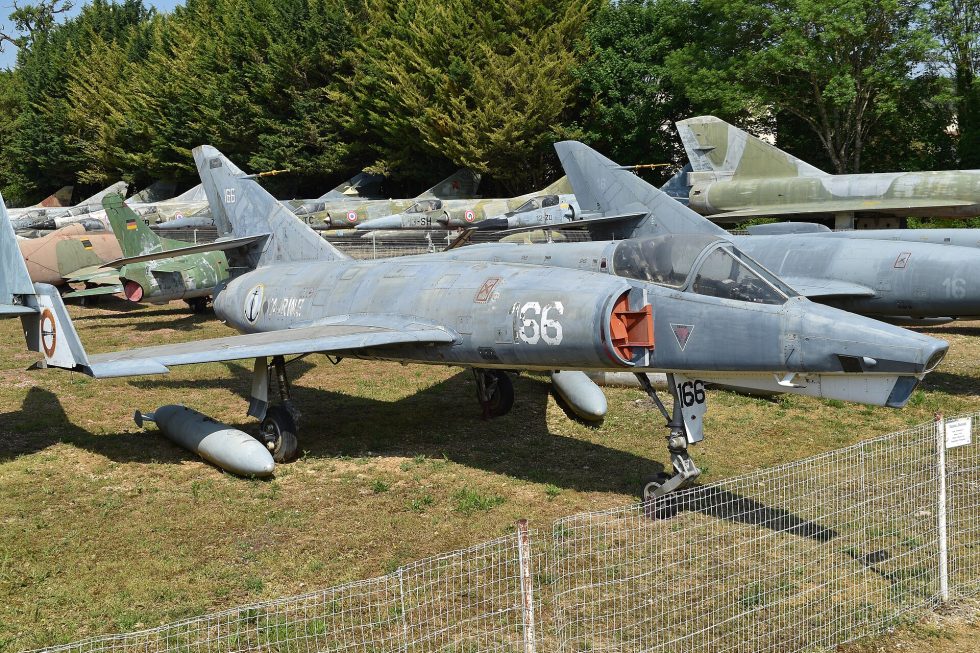
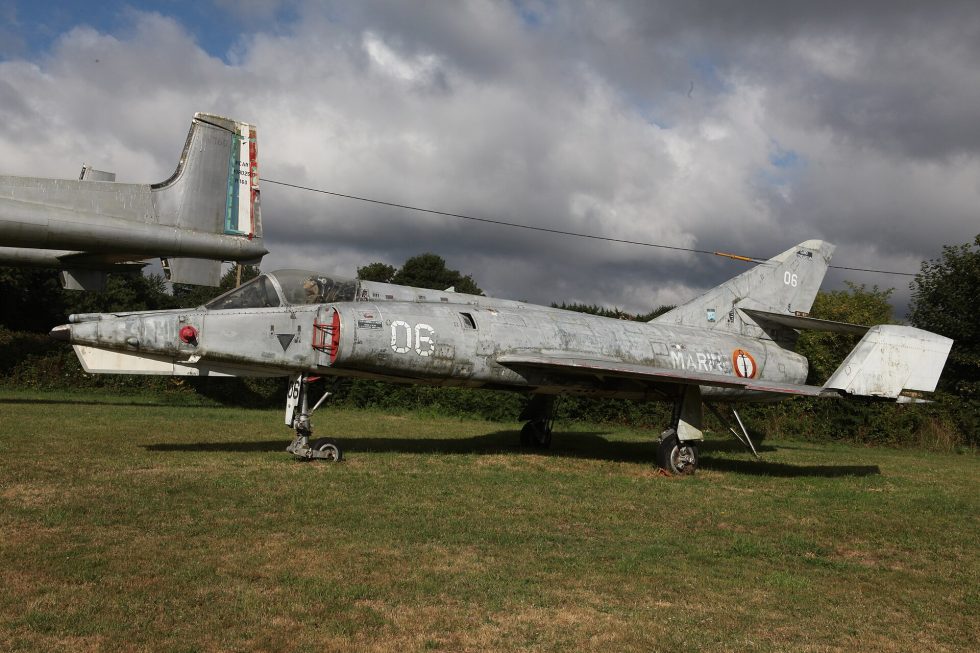
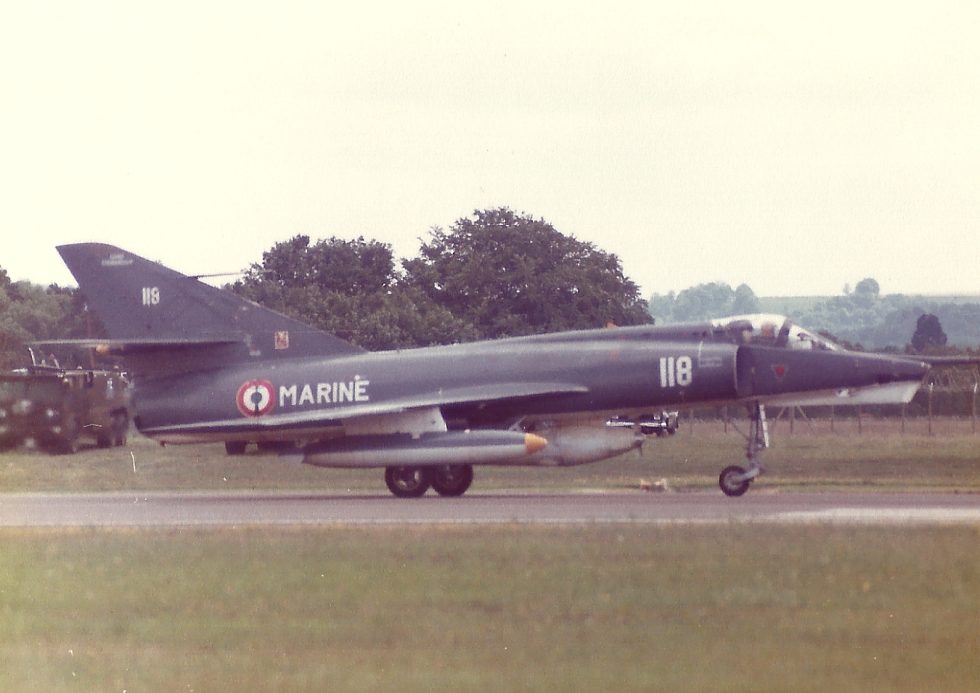
- Retractable nose probe on the Étendard IVM — and a permanently fixed, non-retractable probe on the IVP, because the camera installation took the volume the retraction mechanism needed. The fixed probe is the quickest way to tell an IVP from an IVM in a photograph
- Buddy refuelling
- Removable Douglas-pattern buddy pack — carried by the IVP and, contrary to a common belief, also by Étendard IVM airframes from roughly number 51 onwards and by two of the prototypes. Buddy tanking was not an IVP monopoly; it was how a short-legged air group extended itself, one Étendard giving fuel to another
- Radar
- Dassault Aida ranging radar in the nose of the IVM — a small ranging and terrain-clearance set with an infrared sensing element, not a search radar and emphatically not a maritime attack radar. The IVP had no radar at all: its nose was full of cameras. When people say the Étendard had "radar", this is what they mean, and it is a very long way short of the Agave fitted to the Super Étendard
- Weapon aiming
- Saab BT-9 analogue toss-bombing computer with a gyro gunsight — a Swedish system in a French naval aircraft, bought because it worked and because Saab had solved low-level toss delivery earlier than anyone in France had. It gave the Étendard a genuine loft-bombing capability at a time when most of its contemporaries were still dive-bombing by eye
- Navigation
- TACAN receiver, radio compass and carrier homing — and no inertial platform. The eight IVPM conversions of 1989–94 finally received an inertial navigation unit along with new communications and a self-protection suite, which is what allowed a 1960s reconnaissance aircraft to work usefully in NATO airspace over Bosnia in the 1990s
- Reconnaissance fit, IVP
- A CER 10 PR camera chassis carrying three cameras in the reshaped nose — OMERA equipment derived from the Mirage IIIR installation — plus an optional demountable ventral pod holding three more, including long-focus cameras for stand-off work. Some accounts describe the total nose fit as five cameras; the three-plus-three arrangement is what Flottille 16F’s own history records
- Carrier equipment
- Arrester hook, catapult spools on an extendible nose leg, folding wingtips, strengthened structure and undercarriage — the full navalisation package, added to a land-based design that had been drawn for rough forward airstrips. That the conversion worked as well as it did is the strongest argument for the aircraft
- High lift and flight controls
- Full-span double-slotted flaps, leading-edge droop, spoilers, powered ailerons and a brake parachute — everything needed to drag the approach speed of a 45°-swept, short-span wing down to something survivable. The brake parachute was for shore bases; on the boat the hook did the work
- Ejection seat
- Martin-Baker Mk 4 — the standard British seat of the period, fitted from the mid-1960s and later brought to zero-zero capability. Not a French seat, and not something Dassault publicity dwelt on
04The Étendard IV’s operating costs: why the numbers are elusive
The Étendard IV was a French state naval programme, built in modest numbers for a single customer and never sold on an open market, so no reliable flyaway unit price or cost-per-flight-hour figure exists in the public record. Its economic appeal was structural rather than headline: a single, simple, non-afterburning engine and a rugged airframe made it comparatively cheap to operate and maintain from a carrier deck — exactly the trait a two-carrier navy valued. Any precise monetary cost attached to the type today should be treated as an estimate.
Armament & payload
The Étendard IVM carried two cannon, two tonnes of nothing very modern, and never a single Exocet
The Étendard IVM’s armament is a straightforward early-1960s French strike fit: two 30 mm DEFA 552 cannon in the lower forward fuselage with 150 rounds each, four underwing pylons cleared for roughly 1,360 kg of iron bombs, SNEB rocket pods, Nord AS.20 and AS.30 radio-command missiles and drop tanks, and AIM-9B Sidewinders when the Navy briefly needed the aircraft to double as a fleet fighter. Nothing about it was adventurous, and the Saab BT-9 toss-bombing computer was the only genuinely advanced item in the whole system. What matters more is what the aircraft never had: no radar-guided air-to-air missile, no laser designator, no anti-ship missile, and no nuclear weapon — the Aéronavale’s carrier-borne nuclear strike role arrived in 1980 with the Super Étendard and the AN 52, not with this aeroplane.
The Étendard IVP is a separate case and deserves to be treated as one. It was disarmed: both cannon were deleted and the ventral bay given over to cameras, and although the four wing pylons remained for tanks and the buddy refuelling pack, no IVP ever flew an armed strike sortie. Every combat photograph the type brought home from Lebanon, Bosnia and Kosovo was taken by an aircraft that could not shoot back. Fits varied by mark, by squadron and by decade: 15F carried Sidewinders on IVMs from 1962 to 1965 as an interim fleet-defence measure until the F-8E(FN) Crusader arrived, the R.550 Magic appears in some later listings, and published maximum external loads for the IVM range from 1,360 kg to about 1,610 kg without any source explaining the difference.
Gun
- Two 30 mm DEFA 552 revolver cannon in the lower forward fuselage, 150 rounds per gun, 300 rounds total — the standard French gun of the era, shared with the Mystère IV, the Mirage III and later the Super Étendard
- A high-velocity 30 mm shell was a serious weapon against soft ground targets and small craft, and the DEFA’s revolver action gave a rate of fire well above the Hispano-class guns it replaced
- Ammunition capacity was the weak point. Three hundred rounds is around four seconds of continuous fire; the Étendard was a one-pass strafer, not a gun platform for a long engagement
- The Étendard IVP carried no gun at all. Both cannon and their ammunition boxes were removed to make room for the ventral camera installation, and the deleted mass and volume are part of why the IVP had more internal fuel
- Guns and gunsight were harmonised for both air-to-air and air-to-ground use, which was normal practice for a type expected to defend the fleet in the morning and attack a beach in the afternoon
Air-to-air
- AIM-9B Sidewinder — the only air-to-air missile the type carried operationally in quantity, and only for a short period. Flottille 15F flew Sidewinder-armed Étendard IVMs from 1962 to 1965 as an interim fleet air-defence force
- That role ended when the Vought F-8E(FN) Crusader entered French service in 1964–65. The Crusader was a proper interceptor with a proper radar; the Étendard was never anything but a stopgap in the air-defence role and everyone involved knew it
- Matra R.550 Magic appears in later armament listings for the type. It is plausible for the last years of IVM service but is not attested in front-line use in the way the Sidewinder is, and it should be treated with caution
- No radar-guided air-to-air missile was ever carried. The Aida ranging radar could not support one, and no Matra R.530 fit existed for this aircraft
- In practice, from 1965 onwards the Étendard IVM’s air-to-air armament was two 30 mm cannon and a gyro sight, which is to say self-defence only
Air-to-surface guided
- Nord AS.20 — a small radio-command guided missile of about 144 kg, steered by the pilot on to the target using a thumb controller while he flew the aeroplane. Effective in a range only if the pilot could hold a steady tracking pass, which over a defended target was a great deal to ask
- Nord AS.30 — the larger and much more useful weapon at about 520 kg, same manual command-to-line-of-sight principle, with a warhead heavy enough to destroy a hardened structure or a bridge pier
- Both were first-generation MCLOS weapons, and both demanded the pilot fly a predictable straight line towards the target through the terminal phase. This is not a criticism of the Étendard; it is a criticism of 1960 guidance technology
- No Exocet, ever. The AM39 Exocet is a Super Étendard weapon, dependent on the Agave radar and the inertial attack system that only the Super Étendard carried. No Étendard IVM or IVP was ever fitted, cleared or tested for it, and the aircraft had no sensor capable of finding a ship at anti-ship-missile range
- No laser-guided weapon and no television-guided weapon was carried. There was no designator pod for this aircraft and no cockpit display to use one with
Bombs
- SAMP Type 25 of 250 kg and SAMP Type 21 of 400 kg — the standard French general-purpose bombs of the period, and the ordnance an Étendard IVM most often carried on a strike sortie
- American 500 lb and 1,000 lb bombs were also cleared, a reflection of NATO stockpile commonality rather than any French preference
- Delivery was by dive attack or by low-level loft, the latter computed by the Saab BT-9. Toss delivery was the aircraft’s real party trick, and it allowed a subsonic aeroplane to release from outside the worst of the light flak envelope
- Maximum practical bomb load was around 1,360 kg over four pylons, though carrying it meant no drop tanks and therefore a radius short enough to make the whole sortie questionable. Fuel and ordnance competed for the same four stations, and fuel usually won
- No nuclear weapon. The AN 52 tactical nuclear bomb was integrated on the Super Étendard from 1980 and on Air Force Jaguars and Mirages; the Étendard IVM was never a nuclear striker, and any source that says otherwise has confused the two Dassault types
Rockets
- Matra rocket pods each holding eighteen 68 mm SNEB rockets — typically two pods, one under each wing, and the most common ground-attack fit after iron bombs
- The 68 mm SNEB was the French equivalent of the American 2.75 in FFAR: cheap, dispersed, devastating against vehicles, aircraft in the open and troops without overhead cover, and useless against anything hardened
- Rocket attack meant a shallow diving pass at close range, which put the aeroplane inside the envelope of every automatic weapon on the target. In an aircraft with no armour worth the name and one engine, this was the most dangerous thing an Étendard pilot could be asked to do
- Rockets and cannon together made the standard close-support load, and it is the load in which Étendard IVMs practised most often during Mediterranean and Indian Ocean deployments
- No large-calibre or guided rocket was carried; the type never received anything comparable to the American Zuni or the later French 100 mm weapons
Pods & other stores
- Drop tanks on the inboard pylons — the single most-carried external store of the type’s career, and effectively compulsory on any sortie of operational length
- Removable Douglas-pattern buddy refuelling pack, giving one Étendard the ability to refuel another. Carried by the IVP and by IVM airframes from roughly number 51 onwards, it turned part of the strike force into its own tanker force, at the cost of the aeroplanes doing the tanking
- CER 10 PR camera chassis and the demountable ventral camera pod of the IVP — three cameras in the nose, three more in the pod including long-focus optics, all OMERA equipment derived from the Mirage IIIR fit
- Practice bomb carriers and towed target gear for the training role, which is what Escadrille 59S at Hyères used its Étendard IVMs for through to 1991
- No electronic warfare or chaff pod in front-line IVM service. Self-protection equipment arrived only with the eight IVPM conversions of 1989–94, which is a very late fix for a type that had by then been flying combat reconnaissance under fire for a decade
Three typical loadouts
- Carrier strike, Étendard IVM
- Two 30 mm DEFA 552 cannon with 300 rounds, two SAMP Type 25 250 kg bombs on the outboard pylons and two drop tanks inboard, delivered by low-level loft with the Saab BT-9 computer. The classic Aéronavale strike fit of the 1960s and 1970s and the reason the pylons were plumbed the way they were: two stations for the war, two for the fuel to get there.
- Interim fleet air defence, Étendard IVM, 1962–65
- Two AIM-9B Sidewinders, two 30 mm cannon and two drop tanks, flown by Flottille 15F from Clemenceau and Foch while the Navy waited for its Crusaders. A subsonic aeroplane with a ranging radar standing fleet-defence alert is an admission of a gap, not a capability, and it lasted only until the F-8E(FN) arrived.
- Tactical reconnaissance, Étendard IVP
- No guns, three OMERA cameras in the nose, the demountable ventral pod with three more including long-focus optics, two drop tanks, and a fixed refuelling probe on the nose. This is the configuration that flew over the Bekaa, over Sarajevo, Rogatica and Goražde, and over Kosovo — unarmed, low, and photographing everything.
Sourcing caveat: armament listings for the Étendard IV are unusually inconsistent. Maximum external load is given as 1,360 kg in the English-language references, about 1,610 kg in others and around 2,000 kg in some popular accounts; the Matra R.550 Magic is listed by several sources but is far less well attested in service than the AIM-9B; and station-by-station clearances have never been published in a form a general reader can check. The one thing that is entirely certain is the negative: no Étendard IV of any mark carried Exocet, a nuclear weapon, or any precision-guided munition beyond the manually steered AS.20 and AS.30.
Variants
Dassault lost the NATO light-strike competition, then sold the losing design’s big brother to the Navy that nobody had asked
The Étendard began as a response to a lesson the Korean War had taught everyone: modern fighters had become too heavy, too complicated and too expensive, and NATO wanted something small enough to work from a bombed-out strip. In December 1953 NATO issued Basic Military Requirement 1 for a light weight tactical strike fighter — take off over a 15 m obstacle in 1,100 m, Mach 0.95, a 280 km radius with ten minutes over the target, empty weight capped at 2,200 kg. Dassault entered the family: the twin-Gabizo Étendard II, which first flew on 23 July 1956 and was hopelessly underpowered, and the Bristol Orpheus-engined Étendard VI, which first flew on 15 March 1957 and was the serious contender. In January 1958 the Fiat G.91 was declared the winner. France and Britain both refused to buy it. Dassault had spent four years and two prototype programmes on a competition it lost.
What saved the design was a decision taken in parallel and largely at Dassault’s own expense. Alongside the NATO entrants the company had drawn a larger, more powerful machine originally designated Mystère XXIV and redesignated Étendard IV, essentially the Étendard II enlarged by fifteen per cent around a single Atar. Nobody had ordered it. It flew as a private venture on 24 July 1956, the day after the Étendard II. The Armée de l’Air, by then committed to the Mirage III, was not interested. The French Navy was — because it had two new carriers building, Clemenceau and Foch, and nothing French to put on them. An order for a semi-navalised prototype followed in December 1956, a contract for five fully navalised pre-production aircraft on 31 May 1957, and the first Étendard IVM flew on 21 May 1958. The aeroplane that lost a land war competition became the first French-built jet to fly from a French carrier deck.
Ninety were ordered and delivered between December 1961 and May 1965: 69 IVM strike fighters and 21 IVP reconnaissance aircraft. There were no exports, no licence production and no foreign operator; the Étendard IV is one of the very few Dassault combat types that served with exactly one air arm and one navy. Its lasting significance is not what it did but what it made possible — the Super Étendard, which is a different and later aeroplane, and beyond it the entire line of French carrier aviation that runs through to the Rafale M today.
- Étendard II (Mystère XXII) (first flight 23 July 1956 / 1 prototype)
- The original light strike fighter for the French Air Force, powered by two small Turboméca Gabizo turbojets of about 1,100 kgp each. Span 8.74 m, length 12.89 m, Mach 0.99 on a very good day. It was underpowered, showed none of the promise the Mirage line was already showing, and was abandoned after a single prototype.
- Étendard VI (Mystère XXVI) (first flight 15 March 1957 / 2 prototypes)
- Dassault’s formal entry for NATO Basic Military Requirement 1, essentially the Étendard II reworked around a single Bristol Orpheus. It was beaten by the Fiat G.91, declared winner in January 1958 after comparative trials against eight competing projects from France, Italy and the United States. France never adopted the G.91; Germany became its largest operator with 344 aircraft. The Étendard VI is the aircraft this whole story turns on, because losing with it is what pushed Dassault towards the Navy.
- Étendard IV (Mystère XXIV) (first flight 24 July 1956 / 1 prototype)
- The private-venture enlargement: the Étendard II scaled up about fifteen per cent around a single SNECMA Atar 101E3 of 34.3 kN, span 9.04 m, length 13.40 m. Built without an order and without a customer. This is the airframe the naval version was derived from, and the reason Dassault had something to offer when the Navy came asking.
- Étendard IVB (1957 / 1 prototype)
- The road not taken: a single prototype with a Rolls-Royce Avon of 49.8 kN — some sixteen per cent more thrust than the Atar — and boundary-layer control blowing over the flaps to cut approach speed. It was the better aeroplane on paper and would have fixed both of the Étendard’s real weaknesses at once. It was not adopted, and buying a British engine for a French naval aircraft was not a proposition anybody in Paris was going to enjoy defending.
- Étendard IVM pre-production (1958–60 / 1 semi-navalised prototype + 5 pre-series)
- Ordered in December 1956 and 31 May 1957 respectively. The first flew on 21 May 1958 with the Atar 08B, folding wingtips, arrester hook, catapult spools on an extendible nose leg, strengthened structure, an enlarged fin and a wing 15.5 per cent larger than the land-based aircraft’s. Catapult and arrested-landing trials were flown with the Royal Navy in 1960, then aboard Clemenceau from late 1960 into early 1961.
- Étendard IVM (delivered December 1961–May 1965 / 69)
- The production strike fighter and the baseline for this page. Two 30 mm DEFA 552, Aida ranging radar, Saab BT-9 toss-bombing computer, four pylons. Served with Flottille 15F from June 1962, 11F from April 1963, 17F from January 1964 and Escadrille 59S from October 1965. 11F gave up its IVMs in September 1978 and 17F in June 1980, both for the Super Étendard; 59S flew them on as the carrier landing trainer until 1 July 1991.
- Étendard IVP (1962–65 / 21, serials 101–121)
- The reconnaissance aircraft, and the mark that outlived everything else. Cannon deleted, a CER 10 PR chassis with three OMERA cameras in a reshaped nose, a demountable ventral pod for three more, more internal fuel, a fixed non-retractable refuelling probe and the buddy tanking pack. Flottille 16F was formed on it at Istres on 1 May 1964 and flew nothing else for 36 years. Detachments were three or four aircraft at a time; the squadron never embarked whole.
- Étendard IVP conversions (1977–79 / 4 aircraft)
- Attrition in 16F was made good not by new build but by rebuilding surplus IVM airframes to reconnaissance standard at Cuers, renumbered into the reconnaissance series as 152 or 153, 162, 163 and 166. Sources differ on whether the first of the four was aircraft 52 or 53. It is a small detail that tells you something larger: by the late 1970s there was no production line to go back to.
- Étendard IVPM (1989–94 / 8 conversions)
- The modernisation that let a 1960s aeroplane fight in the 1990s: aircraft 107, 114, 115, 118, 120, 153, 162 and 163 received an inertial navigation unit, new communications and a self-protection suite, at around 6,880 man-hours each. Aircraft 115 is the one that came home from Bosnia with its right elevator torn off.
- Super Étendard (first flight 28 October 1974 / 85 built — a different aircraft)
- Listed here only to keep it separate. After the navalised SEPECAT Jaguar M was cancelled by the French government in 1973 — a decision in which Dassault’s lobbying played a considerable part — the Navy received the Super Étendard instead: Atar 8K-50 of 49 kN, Thomson-CSF Agave radar, inertial attack system, AM39 Exocet and, from 1980, the AN 52 nuclear bomb. Seventy-one for France and fourteen for Argentina. It sank HMS Sheffield in 1982 and it served until 2016. None of that belongs to the Étendard IV, and readers who conflate the two are attributing an entire generation of capability to an aeroplane that never had it.
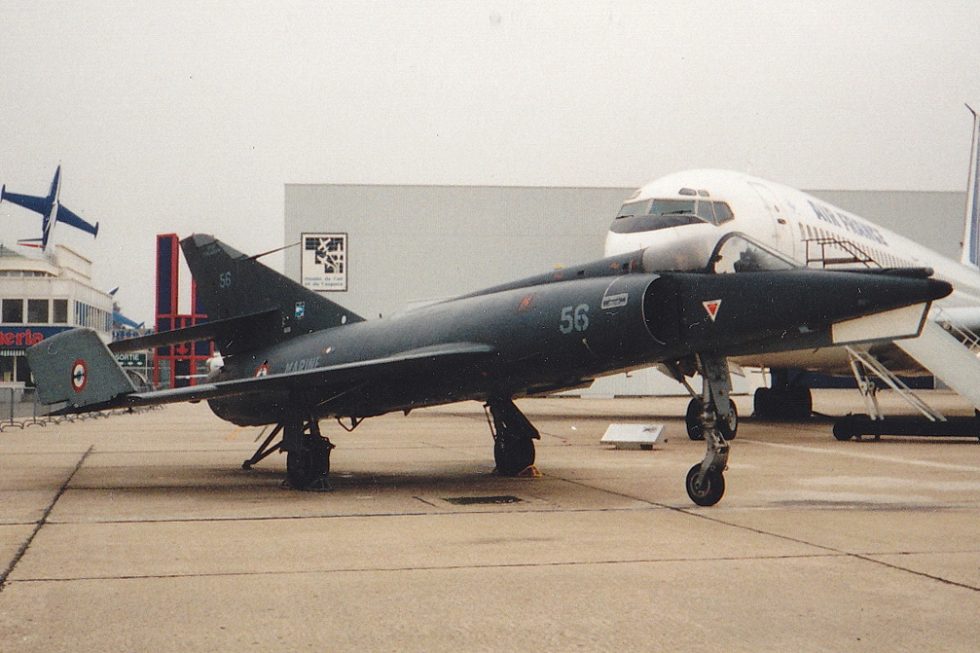
Disposition and survivors. Not one Étendard IV flies today, and none is likely to: the last IVM deck landing was made by aircraft 14 aboard Clemenceau on 20 June 1991, Escadrille 59S retired the mark on 1 July 1991, and the reconnaissance fleet finished with a last catapult launch on 22 June 2000, a last flight on 27 July 2000 and the dissolution of Flottille 16F the following day. Of the 90 airframes built, a substantial minority survive in France as museum exhibits, gate guards and instructional airframes, all of them original machines — there are no reproductions of this type and no reason anyone would build one. Confirmed examples include Étendard IVM number 14, the aircraft that made the last deck landing, at the Morbihan Aéro Musée, restored in 2023; number 30, a Bordeaux-Mérignac airframe of 1962 that served with 11F, 17F and 59S, at the Musée Européen de l’Aviation de Chasse at Montélimar; and further aircraft at the Musée de l’Aéronautique navale at Rochefort, which also displays the shredded tail section cut from IVPM number 115 after 15 April 1994. Three early IVM airframes — numbers 13, 18 and 68 — no longer exist as Étendard IVs at all: they were rebuilt as the three Super Étendard prototypes, of which number 68 survives at Toulouse-Balma and number 18 at Rochefort. Precise national survivor totals have never been published, and any figure quoted to the unit should be treated with suspicion.
Operators
The Étendard IV was flown by exactly one air arm, French Naval Aviation, and it was the first carrier jet of wholly French design and manufacture to serve at sea.
The Étendard began as a loser. Dassault’s light strike design was offered to NATO’s 1957 competition for a standard light close-support fighter as the Étendard VI and was beaten by the Fiat G.91, which is why the family survived only because the French Navy picked up the bigger, Atar-engined version as a private venture and made it the Aéronavale’s standard carrier aircraft. Ninety were built — 69 Étendard IVM strike fighters and 21 Étendard IVP reconnaissance machines, delivered between 9 December 1961 and 26 May 1965 — and the type entered service in 1962 with Flottille 15F, flying from the new carriers Clemenceau and Foch and later from Flottilles 11F, 17F and 16F, with 59S as the deck-landing school. The IVM was displaced by its own descendant, the Super Étendard, from 1978 and withdrawn in July 1991 after some 180,000 flight hours and 25,300 deck landings; the IVP, doubling as the air wing’s buddy tanker with its refuelling pod, outlived it by nine years, shooting reconnaissance over Lebanon, Bosnia and Kosovo before retiring on 27 July 2000. The single row counts the 90 production aircraft on order, not the one prototype and five pre-production aircraft; and four IVM were rebuilt to reconnaissance standard in 1979, so they are counted once here, under the original IVM figure.
In service with
- No current military operator
- —
Formerly operated by
- French Naval AviationFrance · the only operator — 69 Étendard IVM strike fighters and 21 Étendard IVP reconnaissance aircraft, delivered from 9 December 1961 to 26 May 1965, with prototypes and five pre-production aircraft on top; in service from 1962 with Flottille 15F, then 11F and 17F, with 16F flying the IVP and 59S serving as the carrier-landing school; embarked on Clemenceau and Foch; the IVM was progressively replaced by the Super Étendard from 1978 and withdrawn in July 1991, while four IVM converted to reconnaissance configuration in 1979 joined the IVP fleet, which also flew the buddy refuelling pod and served over Lebanon in 1983–84, Bosnia in 1994–95 and Kosovo in 1999 before retiring on 27 July 2000
- 90 · 1962–2000
1 operators, 0 current. Dates are first delivery to last retirement, and the basis of the quantity column is stated above. Air forces with a MiGFlug Order of Battle page are linked (1 so far); the rest follow as the database grows.
From NATO reject to four decades at sea
The NATO competition
NATO’s NBMR-1 light-strike-fighter contest opens; Dassault’s Étendard II and VI contenders will lose out to the Fiat G.91.
A private venture flies
Dassault funds a larger derivative; the Étendard IV-01 prototype first flies on 24 July 1956, and the French Navy takes an interest.
Navalised prototype
The carrier-configured Étendard IVM first flies on 21 May 1958, piloted by Jean-Marie Saget — France’s first purpose-designed carrier jet.
Eyes for the fleet
The reconnaissance Étendard IVP, with a camera nose and a refuelling probe, makes its first flight on 19 November 1960.
Into service
The Aéronavale embarks the Étendard IVM aboard the new carrier Clemenceau — the first jet designed from the start for French carrier operations.
The fleet delivered
Between December 1961 and May 1965 the Navy receives 69 strike IVM and 21 reconnaissance IVP aircraft, flying from both Clemenceau and Foch.
The Super Étendard arrives
The developed Super Étendard enters service, taking over the strike role and carrying France’s naval strike mission for decades to come.
The strike jets retire
The last Étendard IVM bow out, ending with the carrier-qualification school Escadrille 59S at Hyères.
The last Étendard
The reconnaissance IVP flies on until 27 July 2000 — nearly 38 years after the type first went to sea.
From the programme: twelve Étendard IV stories
A NATO reject finds a future
The Étendard family lost the NBMR-1 light-fighter contest — but Dassault kept going on its own money.
Read the full story
Dassault backs itself
With no government contract, Dassault paid to build and fly the Étendard IV-01 prototype in 1956.
Read the full story
Teaching a jet to land at sea
Arrester hook, catapult hooks, folding wingtips and long-stroke gear turned a land fighter into a carrier aircraft.
Read the full story
Saget takes the IVM up
Test pilot Jean-Marie Saget flew the navalised prototype on its maiden flight at Melun-Villaroche.
Read the full story
One Atar, and Mach 1
A single non-afterburning SNECMA Atar 08B kept the Étendard IV honest at just about the speed of sound.
Read the full story
The blown-flap experiment
One airframe used engine bleed air over the flaps to fly slower on the approach.
Read the full story
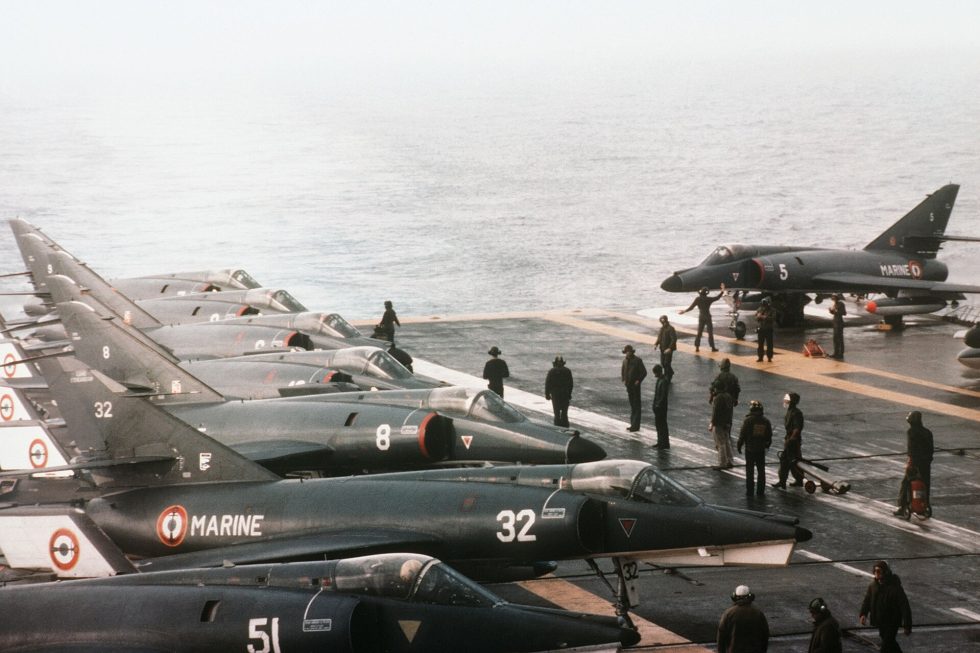
Life aboard Clemenceau and Foch
The Étendard IV gave France two decades of carrier strike from its two flagships.
Read the full story
The eyes of the fleet
The IVP traded guns and radar for cameras, becoming the carrier group’s reconnaissance workhorse.
Read the full story
Étendards feeding Étendards
A fixed probe and a tanker pod let the IVP refuel other aircraft in the air.
Read the full story
The “90% common” successor
Dassault sold the Super Étendard as a cheap update — it turned out to be almost a new aircraft.
Read the full story
The carrier school at Hyères
In its final years the Étendard IVM taught new pilots the art of the arrested landing.
Read the full story
Thirty-eight years at sea
The reconnaissance IVP outlived the strike jet by nearly a decade, retiring in 2000.
Read the full story
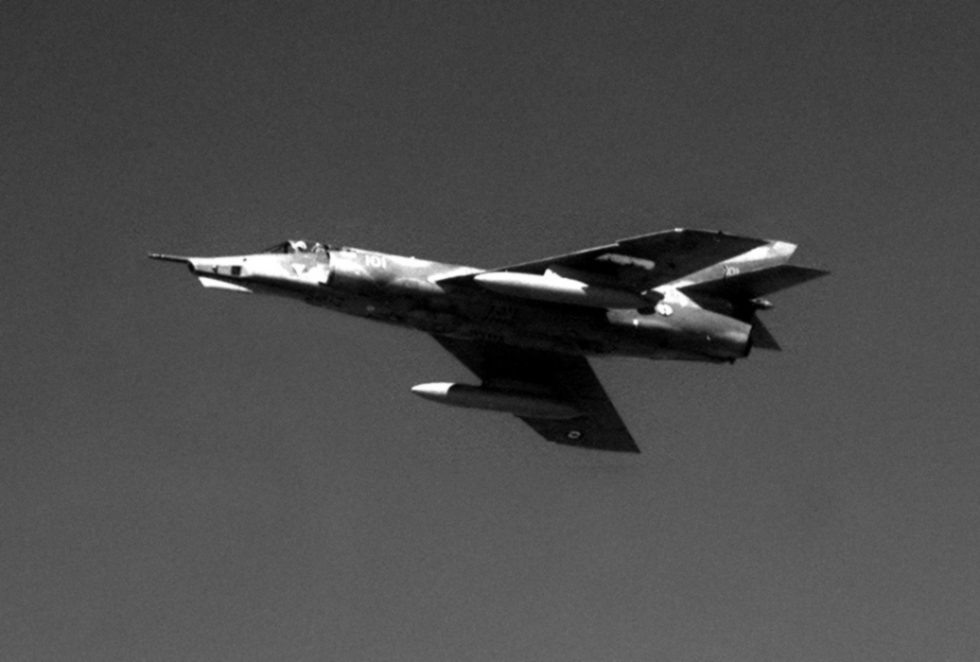
The Étendard IV in pictures
Where the Étendard IV served
The record that defines it
The Étendard IV was never blooded in a major air war — its value was measured in endurance, not kills. For nearly four decades it gave the French Navy an organic carrier strike and reconnaissance capability, and it taught the Aéronavale how to operate jets at sea. Its record is one of quiet, sustained service from the decks of two carriers.
Compare the combat record of every military aircraft. Figures as of July 2026.
Everything people ask about the Étendard IV
Can I fly in an Étendard IV?
What was the Dassault Étendard IV?
What is the difference between the Étendard IV and the Super Étendard?
How fast was the Étendard IV?
Which aircraft carriers did it fly from?
Why did the reconnaissance IVP serve so long?
Who else operated the Étendard IV?
You can’t fly the Étendard IV.
These, you can.
Some legends only live in museums — others are fuelled and waiting. MiGFlug has put civilians in real military jet cockpits since 2004.
 Fly the L-39 AlbatrosThe world’s most-flown jet trainer — aerobatics included
 Fly the F-104 Starfighter“The missile with a man in it”
 Fly the MiG-21The Cold War’s most-produced jet
 Fly the T-33 Shooting StarAmerica’s first jet trainer
 Fly the DH VampireA piece of early jet history
 Fly the S.211Agile Italian jet trainer
 Fly the MB-326The classic Aermacchi jet
 Fly the MiG-15The Soviet legend of the Korean War
Continue the tour
Every fact, checked
- Dassault Aviation — EtendardManufacturer history: first-flight dates, deliveries (69 IVM + 21 IVP), and the IVP’s retirement in July 2000.
- AirVectors (Greg Goebel) — Dassault Étendard & Super ÉtendardOrigins as a private venture, navalisation details, boundary-layer control and the “90% common” Super Étendard.
- Military Factory — Dassault Etendard IVDimensions, weights, engine and thrust, armament (2 × 30 mm DEFA) and production figures.
- Ailes Anciennes Toulouse — Dassault Étendard IVMPreservation notes and service history of the strike variant in French service.
- Naval Encyclopedia — Clemenceau-class carriersThe carriers Clemenceau and Foch and the air groups the Étendard IV flew within.
- Pima Air & Space Museum — Dassault Etendard IVMMuseum reference for a preserved Étendard IVM airframe and its background.
- Master194 — Étendard IVM history & walkaroundDetailed airframe walkaround, variant breakdown and service background.