
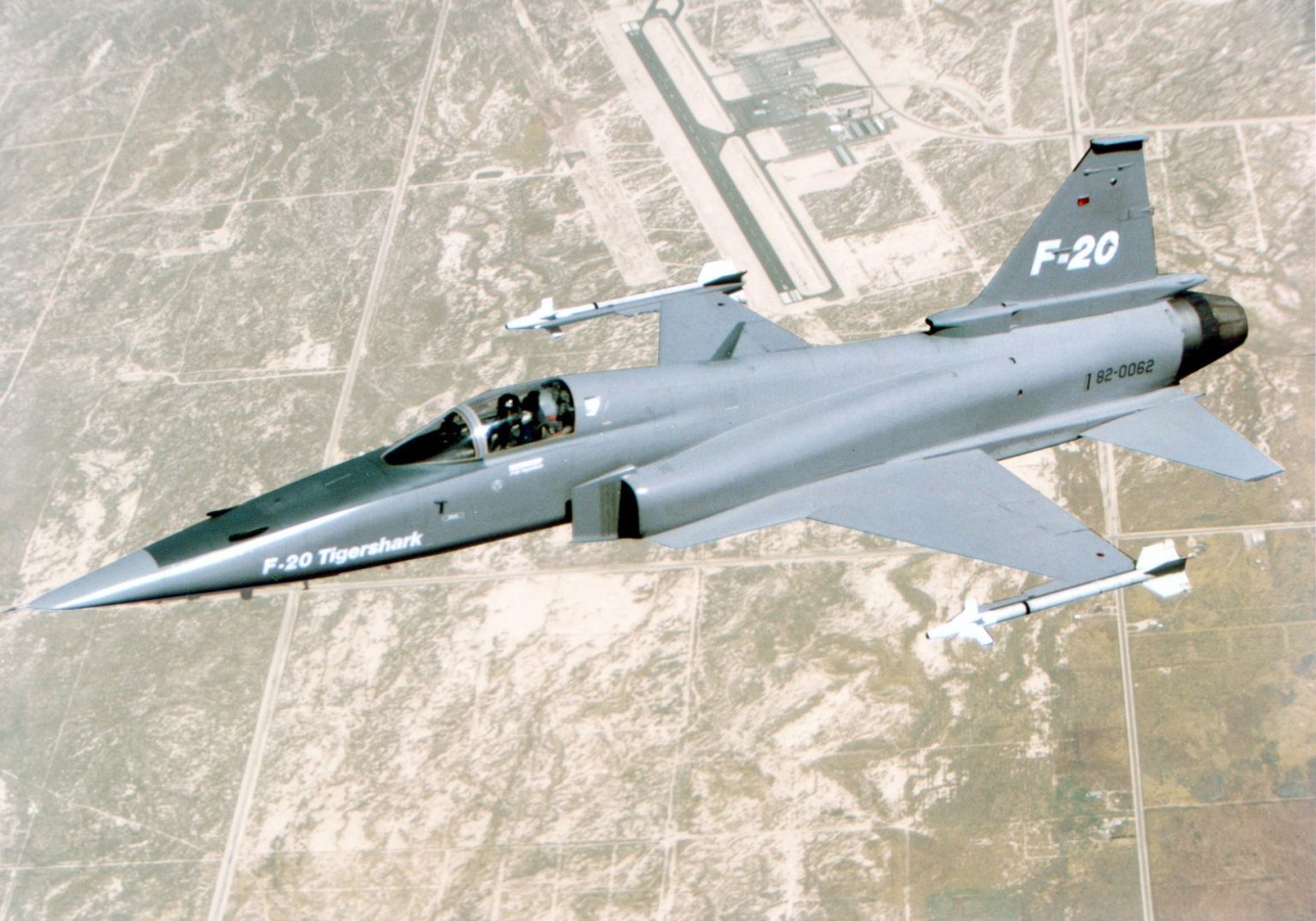
Northrop F-20 Tigershark
“The great fighter nobody bought”
A privately funded, much-improved single-engine development of the F-5 — a new GE F404 engine and modern radar giving roughly 80% of an F-16’s capability at a fraction of the cost. It flew superbly. It never won a single order.
The Northrop F-20 Tigershark: a superb fighter the world was not allowed to buy
By the late 1970s Northrop had sold thousands of its cheap, rugged F-5 family to America’s allies. The company reasoned that the same customers would want a modern successor — something with far more thrust, a real radar and true beyond-visual-range punch, but still a fraction of the price and complexity of a frontline US fighter. So Northrop did something almost unheard-of in modern aerospace: it decided to build that aircraft as a private venture, funding development itself rather than waiting for a government contract.
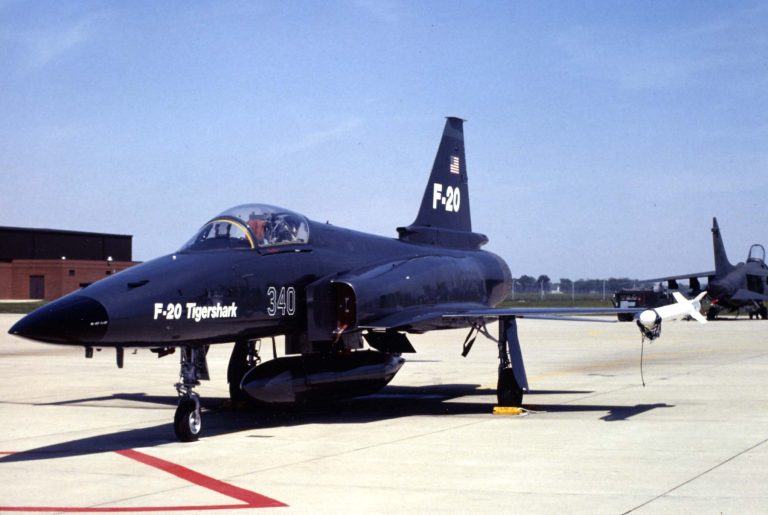
The result, first designated F-5G and later redesignated F-20 Tigershark, was a dramatic re-engineering of the F-5. Out went the two small J85 turbojets; in went a single General Electric F404 turbofan — the same engine class as the F/A-18 — giving roughly a 60% thrust increase. Northrop added a modern APG-67 multi-mode radar, an updated cockpit and the ability to carry radar-guided missiles. The company’s brief to its engineers was blunt: build an aircraft with about 80% of an F-16’s capability at half the cost.
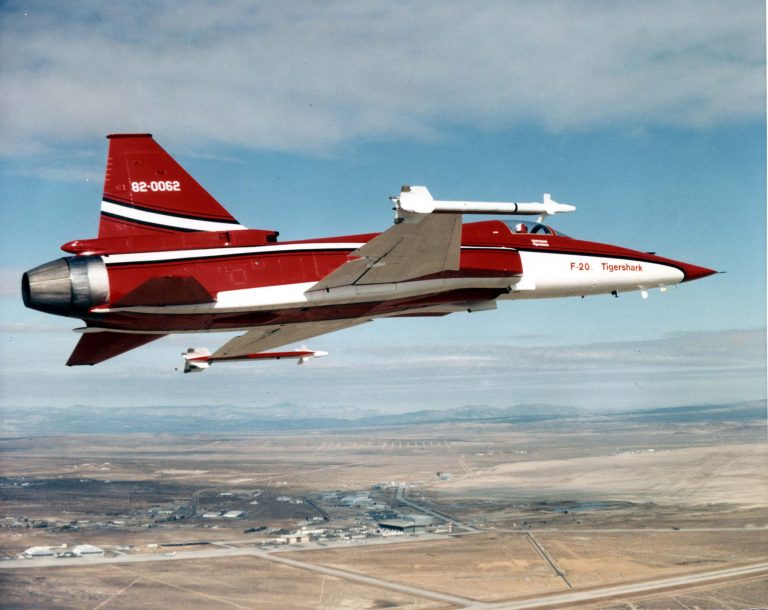
On paper and in the air, it worked. The first Tigershark flew on 30 August 1982, and it was genuinely outstanding: it could scramble from a cold cockpit and be at altitude in well under three minutes, needed a fraction of the maintenance hours of an F-16, and handled beautifully. Northrop recruited high-profile advocates — among them the legendary test pilot Chuck Yeager — and toured the aircraft around the globe on sales demonstrations.
And then it ran headlong into politics. The Tigershark had been conceived for an export niche created under President Carter, whose policy steered US allies toward a deliberately downgraded “FX” export fighter rather than frontline American types. But under the Reagan administration that logic collapsed: allies were increasingly allowed to buy the F-16 Fighting Falcon itself. Faced with a choice between a brand-new Northrop aircraft with no other users, and the same F-16 the US Air Force flew — often on attractive terms — foreign governments chose the Falcon. The Tigershark had no home air force to anchor it and no allies willing to be the first buyer.
Two of the three prototypes were then lost in fatal crashes during overseas sales demonstrations — at Suwon, South Korea in October 1984, and at Goose Bay, Canada in May 1985. In both cases investigators concluded the aircraft had not failed; the pilots had lost consciousness under sustained high-G manoeuvring. The accidents were not the cause of the programme’s failure, but they darkened an already fading sales campaign. In 1986, after roughly $1.2 billion of its own money and not one order, Northrop cancelled the F-20. It remains the classic story of a great aircraft that arrived at exactly the wrong moment.
01The Northrop F-20 Tigershark’s origins: how the F-5G export upgrade became a private-venture gamble
The F-20 began as a modest idea: re-engine the successful F-5E Tiger II to keep Northrop’s export line competitive into the 1980s. Northrop studied new powerplants from the mid-1970s and settled on a single General Electric F404, the design that would define the aircraft. Under President Carter’s 1977 arms-transfer policy, the United States wanted to sell allies a purpose-built, deliberately limited “FX” export fighter instead of frontline types — and the re-engined Northrop, initially called the F-5G, was the leading candidate for that role.
Crucially, Washington would not pay for it. So Northrop financed the aircraft itself, betting that export demand would repay the investment. When the US military assigned it the out-of-sequence designation F-20 in 1982 — a deliberate signal that it was a genuinely new aircraft, not just a modified F-5 — the company had already committed to one of the boldest private gambles in Cold War aviation. The bet depended entirely on the export door staying the shape Carter had cut. It did not.
What makes it special
One F404 in place of two J85s
The single most important change from the F-5 was the powerplant. The twin J85 turbojets were replaced by one General Electric F404-GE-100 turbofan of roughly 17,000 lbf (~76 kN) in reheat — about a 60% thrust increase and the same engine family as the F/A-18 Hornet. The Tigershark gained a genuinely high thrust-to-weight ratio, blistering acceleration and a famous ability to go from a cold cockpit to 40,000 ft in well under three minutes.
A real radar and true BVR capability
Where the F-5 was essentially a clear-weather dogfighter, the F-20 carried the General Electric AN/APG-67 multi-mode radar — a modern set giving look-up and look-down search, tracking and the ability to guide radar-guided AIM-7 Sparrow missiles as well as heat-seeking Sidewinders. Combined with an updated cockpit and HUD, it turned a lightweight day-fighter airframe into a credible all-weather multirole aircraft.
Built to be cheap to own, not just to buy
Northrop engineered the Tigershark around low operating cost and high readiness. In testing it reportedly needed around 15 maintenance man-hours per flight hour against roughly 34 for the F-16 of the day, flew more hours between failures, and could be turned around fast. The pitch was not merely a low sticker price but a fighter a smaller air force could actually afford to keep flying — the “80% of an F-16 at half the cost” promise made concrete.
02The Northrop F-20 Tigershark versus the F-16: why “80% at half the cost” still lost
On its own numbers the Tigershark was a bargain. Northrop offered it at roughly $15 million a copy, with dramatically lower running costs than an F-16 and performance close enough that many pilots who flew it came away impressed. For a small air force that only needed air defence and light strike, it was arguably the more sensible buy.
But defence procurement is rarely decided on the airframe alone. The F-16 had the decisive advantages of scale and politics: it was already in mass production, flown by the US Air Force and a growing club of allies, backed by an enormous spares and upgrade ecosystem, and — once Washington allowed it — available for export on competitive terms. Buying the F-16 meant joining a huge, well-supported user base with a clear upgrade path; buying the F-20 meant being the lone customer for an orphan aircraft. Against that, 80% of the capability at half the cost was not enough.
03The Northrop F-20 Tigershark’s two fatal crashes: what really happened at Suwon and Goose Bay
Two of the three Tigersharks were lost during overseas sales tours. On 10 October 1984, the first prototype crashed at Suwon Air Base, South Korea, killing Northrop test pilot Darrell Cornell. On 14 May 1985, a second aircraft crashed at Goose Bay, Canada, killing pilot David Barnes. Both were demonstration flights involving sustained high-G aerobatic sequences.
The investigations reached the same sober conclusion in each case: there was no evidence of any aircraft or system failure. Instead, both pilots were assessed to have suffered G-induced loss of consciousness (G-LOC) during demanding manoeuvres flown to impress prospective customers. The findings cleared the airframe, but the loss of two of three demonstrators — and two respected pilots — was a heavy blow to a campaign that was already struggling to convert admiration into orders.
Full specifications
Figures are for the F-20A as flown by the three prototypes. As the aircraft never entered production, some values are manufacturer or demonstration figures and are given as commonly cited numbers.
Baseline note: the figures below describe the F-20A as flown on the second and third aircraft, 82-0063 (GI1001) and 82-0064 (GI1002), which carried the complete AN/APG-67 avionics fit. The first aeroplane, 82-0062 (GG1001, registered N4416T), was an engine-change demonstrator flying F-5E-standard avionics behind a new nose, and several published F-20 numbers actually describe it. Only three aircraft were completed and a fourth was partly built, so no production standard was ever frozen: every performance figure here is a Northrop or flight-test number, not a service one. Deltas for the F-5E Tiger II the design grew out of, and for the General Dynamics F-16/79 it was measured against, are in grey. Six published disagreements need settling before the tables begin. First, and most importantly, the thrust claim: it is widely written that the single F404 doubled the F-5E’s thrust, and it did not. Two J85-GE-21 turbojets give 5,000 lbf each in afterburner, 10,000 lbf together; the F404-GE-100 gives 17,000 lbf. That is 70 per cent more on the test-stand numbers, and Northrop’s own literature and every careful secondary source say 60 per cent more, which is the installed figure once intake and nozzle losses are counted. Sixty to seventy per cent, not one hundred. It was still the single most transformative change ever made to an F-5. Second, wingspan: 26 ft 8 in is the clean figure and 27 ft 11.9 in is measured over the wingtip missile rails, and sources quote both without saying which. Third, length: 47 ft 4 in is the standard figure and is essentially identical to the F-5E’s, though 46 ft 6 in appears in some tables. Fourth, the "combat ceiling 15,000 ft" that circulates on copied spec sheets is a corrupted transcription: 15,000 ft is the altitude at which the 13.2° per second sustained turn rate was measured, not a ceiling of any kind. Fifth, thrust-to-weight: the quoted 1.13 does not follow from the quoted weights, because 17,000 lbf against a 16,015 lb combat weight is 1.06; the higher figure implies either a lighter fuel state or an uninstalled thrust rating, and both are given below. Sixth, the money: 1.2 billion dollars is the programme total to cancellation and more than 750 million of it was direct contractor-funded development, but both are Northrop’s own accounting and neither was ever independently audited.
Dimensions & weights
- Crew
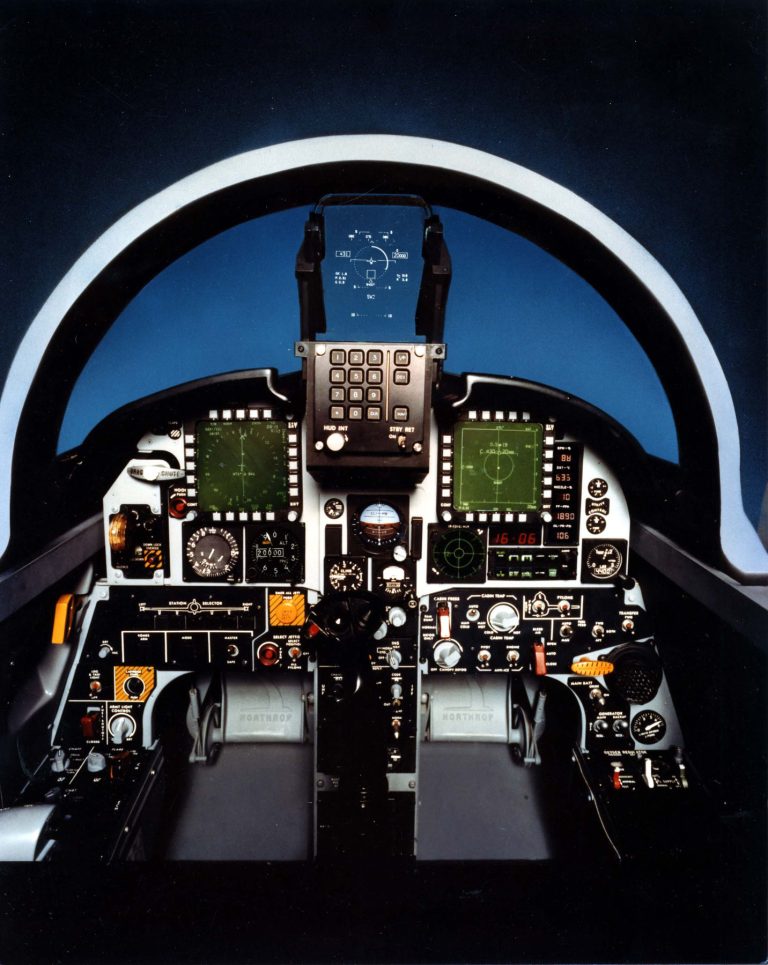
- 1 — under a single-piece canopy on a raised seat, a cockpit reworked from the F-5E’s around a wide-angle head-up display and two multi-function displays. Northrop advertised the type as an aeroplane a competent F-5 squadron could convert onto without a new pilot-training pipeline, which for the air forces it was aimed at was a genuine selling point
- Length
- 14.43 m (47 ft 4 in), nose probe excluded. Within centimetres of the F-5E, which is the point: the F-20 was sold as a rebuilt Tiger, not a new aeroplane, and the sales pitch depended on it looking and being handled like one. Some tables give 46 ft 6 in
- Wingspan, clean
- 8.13 m (26 ft 8 in), identical to the F-5E
- Wingspan over missile rails
- 8.53 m (27 ft 11.9 in) with AIM-9 launchers fitted at the tips. This is the figure most often reproduced without a qualifier, which is why F-20 span is quoted two different ways
- Height
- 4.22 m (13 ft 10 in) to the fin tip
- Wing area
- 17.28 m2 (186 sq ft), the F-5E reference area. The enlarged leading-edge extensions added only 1.6 per cent of area, so the reference figure is normally carried across unchanged
- Leading-edge extensions
- Enlarged and reshaped over the F-5E’s — the cleverest single piece of aerodynamics on the aeroplane. For 1.6 per cent more wing area they raised the maximum lift coefficient by about 12 per cent, which is a return no amount of extra span would have bought, and they carried the usable angle of attack out to 35° against the F-16’s 30°
- Tailplane
- All-moving, 30 per cent larger in area than the F-5E’s — needed to rotate a heavier aeroplane at the higher angles of attack the new wing could reach, and the reason the instantaneous turn rate improved by 7 to 20 per cent depending on the point in the envelope
- Empty weight
- 5,357 kg (11,810 lb). The F-5E is usually quoted at 4,349 kg (9,588 lb), so the F-20 was about a quarter heavier before a drop of fuel went aboard — engine, radar, fly-by-wire and structure all paid in
- Combat weight
- 7,264 kg (16,015 lb) at 50 per cent internal fuel with two AIM-9 Sidewinders, the condition in which the turn and acceleration figures were set
- Maximum take-off weight
- 12,474 kg (27,500 lb) against the F-5E’s 11,187 kg (24,664 lb). The gain is modest because the constraint was never engine power; it was the low-set wing and the F-5 landing-gear geometry, which capped each wing station at 454 kg (1,000 lb) no matter what the aeroplane could lift
- Internal fuel
- ~2,291 kg (5,050 lb). This is the number that limited the aeroplane. The F404 is thirstier in absolute terms than two J85s even while being far more efficient per pound of thrust, and the F-5 fuselage had nowhere obvious to put more. Against an F-16 of similar external size the F-20’s payload-radius performance was plainly inferior, and Northrop never found a good answer to it
- External fuel
- Up to three 330 US gal drop tanks (1,249 litres each), centreline and inboard wing. Almost every published F-20 range figure assumes at least some of them
- Wing loading
- 420 kg/m2 (86 lb/sq ft) at combat weight — high by the standards of the new-generation fighters it was competing with, and the reason the F-20’s manoeuvre performance rested on thrust and on the leading-edge extensions rather than on a big wing
Performance
- Maximum speed
- 2,124 km/h (1,320 mph; 1,147 kt) at altitude, Mach 2.0. The F-5E was limited to about Mach 1.6, so this was a genuine step into a different class rather than a marketing number
- Service ceiling
- 17,300 m (56,800 ft) against the F-5E’s 15,800 m (51,800 ft)
- Initial rate of climb
- 16,100 m/min (52,800 ft/min). The F-5E is normally quoted at about 10,500 m/min (34,400 ft/min). This is the single most vivid illustration of what one F404 did to a Tiger
- Time to 12,200 m
- 2.3 minutes to 40,000 ft from brake release. Combined with the start-up time below, this is what made the interceptor case: an F-20 sitting cold on an alert pad could be at height in well under four minutes
- Acceleration, Mach 0.9 to 1.2
- 29 seconds — through the transonic drag rise, the number that decides who arrives first in an intercept and the one an F-5E could not approach
- Sustained turn rate
- 13.2° per second at Mach 0.8 and 4,570 m (15,000 ft). Supersonic turn rates were about 47 per cent better than the F-5E’s
- Instantaneous turn rate
- 20° per second — between 7 and 20 per cent better than the F-5E depending on where in the envelope the comparison is drawn, and mostly the work of the bigger tailplane and the new leading-edge extensions
- Maximum usable angle of attack
- 35° against about 30° for the F-16A. One of the few hard measures on which the F-20 beat the aeroplane that killed it
- Design load factor
- +9 g — and the two fatal accidents both occurred inside this limit, with the airframe intact and the pilot unconscious. The aeroplane could pull more than a display routine could safely ask of a man
- Thrust-to-weight ratio
- 1.06 at combat weight (17,000 lbf against 16,015 lb), against the 1.13 usually published, which implies either a lighter fuel state or an uninstalled rating. Either way it was comfortably above unity, which the F-5E at roughly 0.7 never was
- Take-off and landing run
- 434 m (1,425 ft) at normal weight, 1,082 m (3,550 ft) at maximum take-off weight; landing run 655 m (2,150 ft). Short-field performance was a deliberate design target for customers with modest runways and dispersal requirements
- Combat radius
- ~590 km air superiority (320 nm, two AIM-9, five minutes of combat); ~560 km (300 nm) combat air patrol with three tanks and 138 minutes on station; ~1,020 km (550 nm) hi-lo-hi interdiction; ~280 km (150 nm) close air support with seven Mk 82s. Respectable for the size, and still short of what an F-16 offered on the same mission
- Ferry range
- ~3,732 km (2,015 nm; 2,318 miles) with full internal fuel and three drop tanks
- Scramble time
- About 22 seconds from power-on to take-off roll — the shortest of any contemporary fighter, achieved with a self-contained start and an avionics suite that came up ready rather than needing an alignment. For an air force whose warning time is measured in single-digit minutes this was worth more than a Mach number, and it is the one F-20 claim nobody has ever disputed
Propulsion & systems
- Powerplant
- One General Electric F404-GE-100 afterburning turbofan — a single-engine derivative of the F404-GE-400 developed for the F/A-18, itself descended from the YJ101 that flew in Northrop’s own YF-17. The F-20 therefore closes a circle: the engine Northrop’s losing lightweight fighter fathered came back to power its next one
- Rated thrust
- 76 kN (17,000 lbf) with afterburner, 49 kN (11,000 lbf) dry. The F-5E’s pair of J85-GE-21 turbojets gave 10,000 lbf between them in afterburner and 7,200 lbf dry — so 60 to 70 per cent more thrust, in one engine instead of two, with fewer parts to maintain
- Fuel efficiency
- Projected 53 per cent less fuel burned than contemporary fighters on comparable missions — a turbofan against turbojets, and one of the strongest arguments in the whole sales case, because the air forces the FX policy targeted paid for fuel out of budgets that did not stretch
- Intakes and installation
- Fixed-geometry lateral intakes, enlarged over the F-5E’s to feed a single engine of far greater mass flow, with the twin engine bays merged into one — the change that drove the rear-fuselage redesign and most of the empty-weight growth
- Radar
- General Electric AN/APG-67 — an all-digital X-band coherent pulse-Doppler set weighing under 73 kg (160 lb) in under 0.054 m3 (1.9 cu ft), drawing 396 W average, with a planar array antenna. This was the F-20’s real leap: the F-5E’s AN/APQ-153 and later APQ-159 were ranging sets with roughly 20 nm reach and no missile-guidance role at all
- Radar performance and modes
- Up to 40 nm in track modes and 80 nm in velocity search against a fighter-sized target, with track-while-scan on ten targets — plus air-to-ground, sea-search and mapping modes, moving-target detection, and optional synthetic-aperture imaging. It is this set that gave the aeroplane genuine beyond-visual-range capability through the AIM-7 Sparrow, which the F-16A could not carry until the Block 15 ADF conversion arrived in February 1989
- Cockpit and displays
- Wide-angle head-up display, two monochrome multi-function displays, full hands-on-throttle-and-stick controls — a 1980s cockpit grafted onto a 1960s airframe, and by a wide margin the most modern thing about the aeroplane apart from the engine
- Navigation
- Ring-laser-gyro inertial navigation system replacing the electro-mechanical platform of the period. No spin-up, no long alignment, no gimbals to wear out — and the direct enabler of the 22-second scramble that everything else about the aeroplane was sold around
- Flight control
- Dual-channel fly-by-wire — not a relaxed-stability system in the F-16 sense; the F-20 remained conventionally stable. The electronics were there to tame a considerably more powerful aeroplane on an airframe drawn for half the thrust
- Structure
- Semi-monocoque aluminium with substantially increased composite and glass-fibre content over the F-5E — incremental rather than revolutionary. The F-20 was an aerodynamic and systems aeroplane, not a materials one
- Maintenance and reliability
- Northrop claimed 63 per cent lower operating and maintenance costs than contemporaries, 52 per cent less maintenance manpower, and four times the reliability of the average front-line design — with life-cycle costs 40 to 50 per cent below the F-16’s. The three aircraft flew about 1,500 sorties with excellent availability, and the honest caveat is that they flew them from Edwards in ideal conditions with a factory team, which is not the same test as a conscript air force in monsoon season
- Unit cost
- ~10.7 million US dollars fly-away in 1983 on a 150-aircraft buy — against 11 million for the F-16/79 and 12.4 million for a full-standard F-16A. The F-20 was cheaper, and it was never cheap enough to overcome the fact that after 1981 a customer could simply buy the F-16A instead
04The Northrop F-20 Tigershark’s cost: a ~$1.2 billion private bet that returned nothing
The Tigershark’s economics were its entire selling point — and, ultimately, its tragedy. Northrop marketed the aircraft at roughly $15 million per airframe, undercutting the F-16 while promising far lower operating costs: fewer maintenance man-hours per flight hour, higher availability and quicker turnaround. For a small nation it was pitched as a fighter you could not only buy but genuinely afford to run.
Because the F-20 never entered service, there is no reliable published cost-per-flight-hour figure for it — any number quoted is a manufacturer projection rather than fleet experience. The one hard financial fact is the one that sank the company’s ambitions: Northrop is reported to have spent on the order of $1.2 billion of its own money developing and marketing the Tigershark, and recovered essentially none of it, having sold zero aircraft. It was among the largest private-venture losses in the industry’s history.
Armament & payload
The F-20 kept the Tiger’s two nose cannon and added the one missile the export F-16 could not yet fire
The F-20’s weapons fit is the F-5E’s with a radar bolted behind it, and that single change is worth more than the whole rest of the list. Two M39 revolver cannon, seven stations, 3,600 kg (8,000 lb) of stores on paper and a Sidewinder on each wingtip is a 1972 aeroplane’s armament; the AN/APG-67 turned it into something that could shoot at a target it could not see, which no F-5 had ever done and which the F-16A as offered for export could not do either until the Block 15 Air Defense Fighter conversion in February 1989. An AIM-7 Sparrow was fired from the third aircraft in February 1985 and AIM-120 AMRAAM integration was designed in from the start.
What the aeroplane could not do was carry much. The F-5 wing sits low and the landing gear was never moved, so each wing station was limited to 454 kg (1,000 lb) regardless of what the airframe could lift, and only the fuselage station would take a 907 kg (2,000 lb) Mk 84. Against an F-16 of broadly similar external size the payload-and-radius shortfall was obvious to every evaluation team that looked at both, and Northrop never had a convincing answer beyond price. Nothing below was ever cleared by a service armament authority, because no service ever operated the type: every clearance in the published lists is a Northrop capability statement backed by flight test at Edwards, and mark-to-mark variation is a question that does not arise for an aeroplane with one build standard and three examples.
Gun
- Two Pontiac M39A3 20 mm single-barrel revolver cannon in the upper nose, one either side, inherited unchanged from the F-5E.
- 280 rounds per gun, 560 in total — roughly eleven seconds of fire per gun at about 1,500 rounds per minute. Modest, and identical to what a Tiger II pilot already had.
- Now aimed by an APG-67 feeding a lead-computing head-up display rather than by the F-5E’s ranging-only set, which is a larger practical difference than the unchanged hardware suggests.
- The nose bays were retained despite the wholly new radome ahead of them, one of several places where the F-20 stayed deliberately faithful to the F-5 to protect its conversion and logistics argument.
- A GPU-5/A pod carrying the four-barrel 30 mm GAU-13/A was offered as a bolt-on for ground attack, at the cost of a station and a great deal of drag.
Air-to-air
- AIM-9 Sidewinder on both wingtip rails as standard, with up to four more on underwing stations — the same short-range fit any late F-5 carried.
- Two AIM-7 Sparrow underwing, and this is the entry that mattered: semi-active radar homing, beyond visual range, guided by the APG-67. One was fired in test in February 1985.
- Four AIM-120 AMRAAM designed in for the production standard. The missile did not enter service until 1991 and no F-20 ever carried one, so this remains a design provision and should be read as such.
- Track-while-scan on ten targets gave the pilot a tactical picture no F-5 pilot had ever had, and it is the capability the aeroplane was really selling.
- For a small air force facing MiG-21s and MiG-23s, an aeroplane with Sparrow and a 40 nm track range for eleven million dollars was a serious proposition. That it was also available with an F-16 badge from 1981 is the whole tragedy.
Air-to-surface guided
- Up to four AGM-65 Maverick, television- or imaging-infrared-guided, the standard American light-fighter stand-off weapon of the decade.
- Nothing else. No anti-radiation missile, no anti-ship missile and no cruise weapon appears in any published F-20 clearance list.
- No integrated targeting or laser-designator pod was developed for the type, so laser-guided bombs would have required a designator from another aircraft or from the ground.
- The APG-67’s ground-mapping, sea-search and moving-target modes gave the airframe the sensor basis for a much wider guided-weapon fit than it ever received.
- This card is short for an honest reason: guided air-to-surface work needs integration money, and Northrop was spending its own money and spent it on the air-to-air case first.
Bombs
- Mark 80 series low-drag general-purpose bombs: five Mk 82 of 227 kg (500 lb) on the fuselage station, or a single Mk 84 of 907 kg (2,000 lb) there.
- Wing stations limited to 454 kg (1,000 lb) each by ground clearance and the unmodified F-5 undercarriage — the hard structural ceiling on the whole air-to-ground case.
- CBU-24, CBU-49, CBU-52 and CBU-58 cluster munitions across the wing stations.
- M129 leaflet bombs, a reminder of the counter-insurgency and internal-security roles that many of the intended customers actually flew.
- Maximum external stores ~3,600 kg (8,000 lb) across seven stations, a figure that only closes if the fuselage station is loaded heavy and the wings light.
Rockets
- LAU-10 pods, four 5-inch Zuni rockets each, normally two pods.
- Matra pods of eighteen 68 mm SNEB rockets each, reflecting the European weapon stocks many prospective customers already held.
- 2.75-inch folding-fin aerial rockets in LAU-3 and LAU-68 type pods, the American equivalent and the most commonly quoted fit.
- CRV7 pods, the higher-velocity Canadian 2.75-inch rocket, also listed.
- Unguided rockets were the bread and butter of the air forces the FX policy was written for, and the F-20’s clearance list was drawn up with exactly that customer in mind.
Pods & other stores
- Up to three 330 US gal (1,249 litre) drop tanks on the centreline and inboard wing stations — assumed in nearly every published F-20 range figure.
- GPU-5/A 30 mm gun pod with the GAU-13/A, the heaviest strafing option offered.
- Electronic countermeasures pods on the outboard stations; no internal self-protection jammer was fitted to any of the three aircraft.
- No reconnaissance variant was developed. The F-5E had produced the RF-5E Tigereye with a camera nose; the F-20’s nose was full of radar, and the equivalent was never built.
- Seven stations in total: centreline, four wing pylons and two wingtip missile rails. Compact, conventional and deliberately identical in handling to what F-5 groundcrews already knew.
Three typical loadouts
- Air superiority
- Two wingtip AIM-9 Sidewinders, two underwing AIM-7 Sparrows, 560 rounds for the cannon and a centreline tank. This is the configuration that justified the aeroplane: about 590 km (320 nm) of radius with five minutes of combat, and a radar-guided shot available before the merge. No export F-16A of 1983 could match it.
- Combat air patrol
- Two AIM-9 on the tips and three 330 US gal drop tanks, giving roughly 560 km (300 nm) to station and 138 minutes there. Combined with the 22-second scramble, this is the point-defence mission the type was really built for and the one on which small air forces evaluated it hardest.
- Close air support
- Seven Mk 82 bombs, two AIM-9 for self-defence and a drop tank, for about 280 km (150 nm) of radius. The honest note here is the wing-station weight cap: it is the loading limit, not the aeroplane’s lifting ability, that sets this number.
Sourcing caveat: no service armament manual exists for the F-20, because no service ever took delivery. The lists above are consolidated from Northrop sales documentation and the Edwards flight-test programme, and a proportion of them — AMRAAM most obviously — describe designed-in provision rather than anything that was ever loaded on an aeroplane. Where a store is known to have been carried or fired, it has been said so explicitly.
Variants
Three aeroplanes, one build standard, and a policy that was cancelled underneath them
The F-20 exists because of a memorandum. In May 1977 the Carter administration issued Presidential Directive 13, a conventional arms transfer policy that barred the export of front-line American fighters to most of the world: NATO, Australia, Japan and a short list of exceptions could buy F-15s and F-16s, and everyone else could not. Carter personally blocked the sale of F-5Gs to Taiwan. To fill the gap the administration created the FX programme in January 1980 — an intermediate export fighter, better than an F-5E and deliberately less capable than an F-16, to be developed entirely at the manufacturer’s own risk and expense, with the American government controlling every aspect of who it could be shown to. Two companies bid. General Dynamics offered the F-16/79, an F-16A with the F-16’s F100 replaced by a J79 turbojet and its avionics cut down, and spent about 60 million dollars on it. Northrop offered the F-5G, the Tiger II rebuilt around a single F404, and spent more than 750 million.
Technically, Northrop won that argument outright. The F-5G, redesignated F-20 in late 1982 and named Tigershark in March 1983 — Northrop asked to skip F-19 so as to have an even number, unlike Soviet practice — flew on 30 August 1982 with Russ Scott at the controls, reached Mach 1.04 and 40,000 ft on a forty-minute first flight, and turned out to be exactly what had been advertised. It climbed at 52,800 ft per minute, went to Mach 2, held 35° of angle of attack, carried a proper multi-mode radar and a Sparrow, and could be started, aligned and rolling in twenty-two seconds. It was cheaper than either F-16 on offer, it needed roughly half the maintenance manpower, and its availability in test was superb. Steve Pace’s judgement — one of the best fighters that never went into production — is not sentimentality. It was a good aeroplane.
It was also, by 1981, an aeroplane with no reason to exist. The Reagan administration took office in January 1981 and began dismantling the export restrictions that had created the FX requirement in the first place. Pakistan, Venezuela, Turkey and Greece were cleared to buy F-16s; South Korea already had them. Every prospective F-20 customer now faced a simple question — a cut-price intermediate fighter, or the actual front-line American fighter for a million or two more? — and every one of them answered it the same way. Taiwan, the customer Northrop had counted on hardest, was closed off from the other direction when the 17 August 1982 communiqué with Beijing capped American arms sales; Taipei went away and built the Ching-kuo instead, around a GD-53 radar derived directly from the F-20’s APG-67. India looked and chose to develop the LCA. Israel took American subsidy for the Lavi, a competitor Northrop protested about in vain. Bahrain, the one signed customer, cancelled. Morocco’s twenty-aircraft negotiation died with the programme.
Then the aeroplanes started killing their pilots. On 10 October 1984 the first prototype, 82-0062, crashed at Suwon Air Base in South Korea during a demonstration; Northrop test pilot Darrell Cornell was killed. On 14 May 1985 the second, 82-0063, crashed at CFB Goose Bay in Labrador while Dave Barnes practised the routine he was to fly at the Paris Air Show; he too was killed. Both investigations cleared the aeroplane completely. Neither accident involved a mechanical or design fault: both pilots lost consciousness under sustained g in a display sequence, inside an airframe stressed for 9 g and behaving exactly as designed. G-LOC was very imperfectly understood in 1984, and the F-20 was one of the aircraft that taught the industry to understand it. The distinction was correct, it was documented, and to a foreign air ministry watching the news it was completely irrelevant. Half the demonstration fleet was gone, in front of exactly the customers it had been sent to impress.
The last hope was an American order, because several foreign governments had made their purchase conditional on one. Congress directed the Air Force and Navy to study aggressor and dissimilar-air-combat aircraft in November 1984; the Navy chose a version of the F-16 in January 1985, at a price widely believed to have been set below cost to exclude the F-20. On 31 October 1986 the Air Force selected the F-16C for its Air National Guard air-defence requirement, the F-16 having by then acquired the Sparrow capability that had been the F-20’s trump card. Eighteen days later, on 18 November 1986, Northrop cancelled the programme. It had spent roughly 1.2 billion dollars of shareholders’ money over eleven years and sold nothing. The South Korean sales campaign left a bribery scandal behind it that cost several Northrop managers their jobs and earned chairman Thomas V. Jones a reprimand; he retired in 1989.
- F-5G (1975–1982, design phase)
- The original designation and the original idea: an F-5E Tiger II re-engined with one F404 in place of two J85s, with enlarged intakes, a merged engine bay, a bigger tailplane and a new nose. Studied from 1975, offered under the FX policy from January 1980, funded throughout by Northrop alone.
- F-20A Tigershark (1982–1986, 3 built, 1 unfinished)
- The production designation, applied from late 1982 with the name approved in March 1983. No production aircraft was ever built, so F-20A describes an intended standard rather than a delivered one. Northrop deliberately built its prototypes to production quality rather than as test hacks, which is why their reliability figures were so good and why so few were needed.
- 82-0062, GG1001 (first flight 30 August 1982; lost 10 October 1984)
- The first aeroplane, registered N4416T, effectively an engine-change demonstrator: new powerplant, new intakes, new nose contour, but F-5E-standard avionics behind the radome. It had flown 240 sorties by April 1983 and demonstrated to representatives of ten nations. Destroyed at Suwon Air Base, South Korea, killing Darrell Cornell.
- 82-0063, GI1001 (first flight 26 August 1983; lost 14 May 1985)
- The second aeroplane, registered N3986B, and the first to fly the complete production avionics suite including the AN/APG-67, the ring-laser-gyro inertial platform and the two-display cockpit. Destroyed at CFB Goose Bay, Labrador, killing Dave Barnes during Paris Air Show display practice.
- 82-0064, GI1002 (1984–1986; the sole survivor)
- The third and last completed aeroplane, full avionics standard, and the one that fired an AIM-7 Sparrow in February 1985 to demonstrate beyond-visual-range capability. After the two losses it carried the entire demonstration programme alone until cancellation.
- Fourth airframe (begun 1985–1986, never completed)
- Partly built, and intended to incorporate the extensive modifications proposed for South Korean licence production — the most serious production prospect the programme ever had. Work stopped with the cancellation and it never flew.
- Air Defense Fighter proposal (1984–1986, not built)
- The F-20 as offered for the American aggressor and Air National Guard air-defence requirements, on which several export customers had explicitly made their own orders conditional. The Navy chose an F-16 derivative in January 1985 and the Air Force chose the F-16C on 31 October 1986; both decisions killed export prospects as surely as they killed the domestic ones.
- F-16/79 (1980–1983, 1 converted; the rival)
- Not an F-20 variant but the aeroplane it was built to beat: an F-16A with the F100 turbofan replaced by a J79 turbojet and downgraded avionics, developed by General Dynamics for about 60 million dollars against Northrop’s 750 million. It sold nothing either. The FX policy produced two carefully degraded fighters and zero sales, which is the clearest verdict available on the policy itself.
- AN/APG-67 descendants (1989 onwards, in production)
- The one part of the aeroplane that lived. The radar became the GD-53 Golden Dragon of Taiwan’s AIDC F-CK-1 Ching-kuo, first flown 28 May 1989 and built in 137 examples, and later the APG-67(V)4 of South Korea’s KAI FA-50. General Electric sold its radar division; the line ended up with Lockheed Martin. Both of the customers Northrop most wanted for the F-20 ended up flying its radar in someone else’s aeroplane.
Survivors: exactly one original airframe exists. 82-0064, construction number GI.1002, the third and last F-20 completed, is preserved at the California Science Center in Exposition Park, Los Angeles, displayed in the air and space gallery. The first and second aircraft were destroyed in the 1984 and 1985 accidents and neither was rebuilt. The fourth airframe was never finished and its disposal is not recorded in any source consulted here. No reproduction, replica or full-scale mock-up F-20 is known to be on public display anywhere, so the Los Angeles aeroplane is not merely the best surviving example — it is the entire surviving fleet, and roughly 1.2 billion dollars of Northrop’s own money now hangs from a museum ceiling.
From F-5 upgrade to cancelled dream
Engine studies
Northrop studies re-engining the F-5, selecting a single General Electric F404 turbofan to replace the twin J85s — the change that defines the aircraft.
The FX export niche
President Carter’s arms-transfer policy calls for a purpose-built, downgraded “FX” export fighter for allies. The re-engined Northrop, as the F-5G, becomes the leading candidate.
Redesignated F-20 & first flight
The aircraft is redesignated F-20 to mark it as genuinely new. The first prototype flies on 30 August 1982 with test pilot Russell Scott.
“Tigershark” and the world tour
The name Tigershark is adopted and Northrop tours the aircraft worldwide, enlisting advocates including Chuck Yeager for its global sales campaign.
Suwon crash
The first prototype is lost at Suwon, South Korea on 10 October, killing test pilot Darrell Cornell; investigators find no aircraft fault, citing G-induced loss of consciousness.
Goose Bay crash
A second Tigershark crashes at Goose Bay, Canada on 14 May, killing pilot David Barnes — again attributed to G-LOC, not a design flaw.
No orders — cancelled
With allies permitted to buy the F-16 instead and not one Tigershark sold, Northrop ends the programme after some $1.2 billion of its own investment.
The survivor
The sole remaining airframe, the third prototype, is preserved and displayed at the California Science Center in Los Angeles.
Twelve Northrop F-20 Tigershark stories
Betting the company’s own money
Northrop funded the F-20 itself — a rare and risky move in modern aerospace.
Read the full story
Two turbojets become one turbofan
Swapping twin J85s for a single F404 transformed the F-5 into something new.
Read the full story
Why it became the F-20
A jump from F-5 to F-20 was a deliberate marketing signal.
Read the full story
80% of an F-16 at half the cost
Northrop’s founding brief for the F-20 was a single, blunt sentence.
Read the full story
A legend on the sales team
The first man to break the sound barrier became a Tigershark salesman.
Read the full story
The F-16 that ate its lunch
The Tigershark’s doom was a jet the US had decided to export.
Read the full story
Cold cockpit to combat in minutes
The F-20 was engineered to be ready faster and cheaper than its rivals.
Read the full story
The first demonstrator lost
A sales flight in South Korea ended in tragedy.
Read the full story
A second identical loss
Seven months later, the pattern repeated in Canada.
Read the full story
A superb performer on paper
Every serious pilot report on the F-20 was glowing.
Read the full story
Beaten by policy, not by physics
The Tigershark lost a contest that had almost nothing to do with flying.
Read the full story
Where to meet a Tigershark today
One of three ever built still exists — and you can go see it.
Read the full story
The Tigershark in pictures
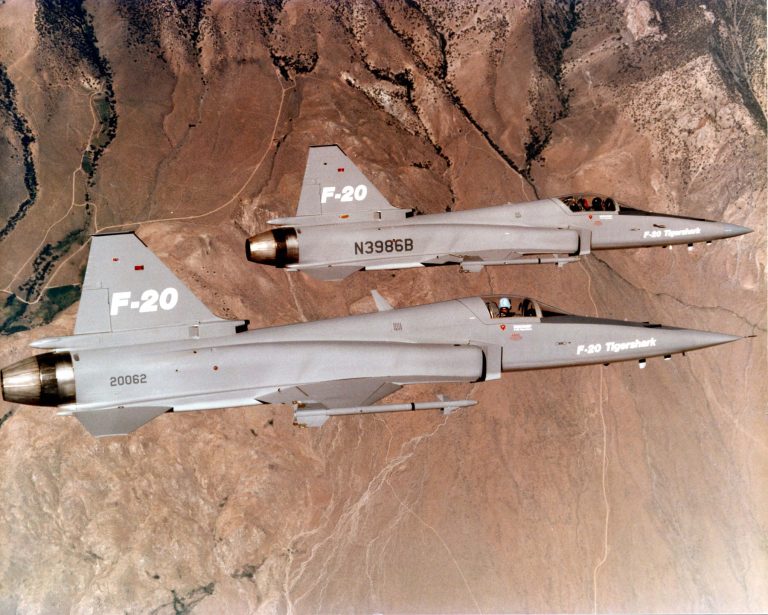
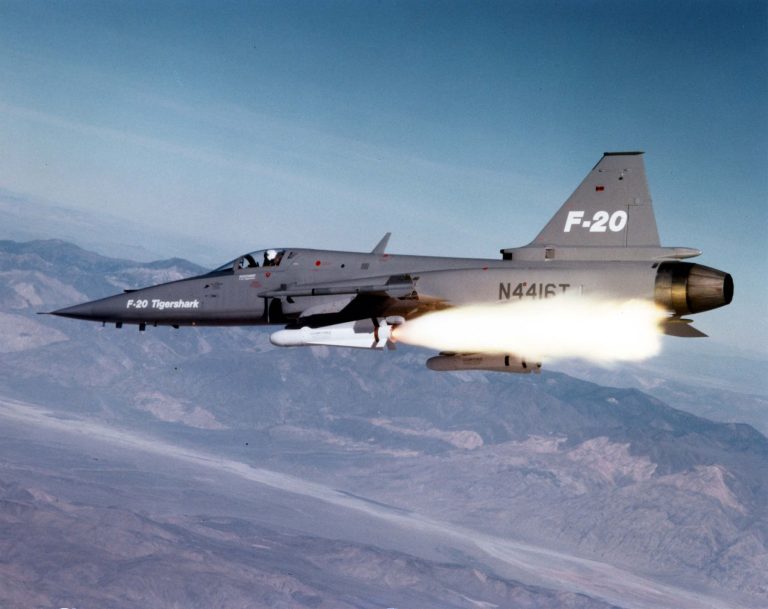
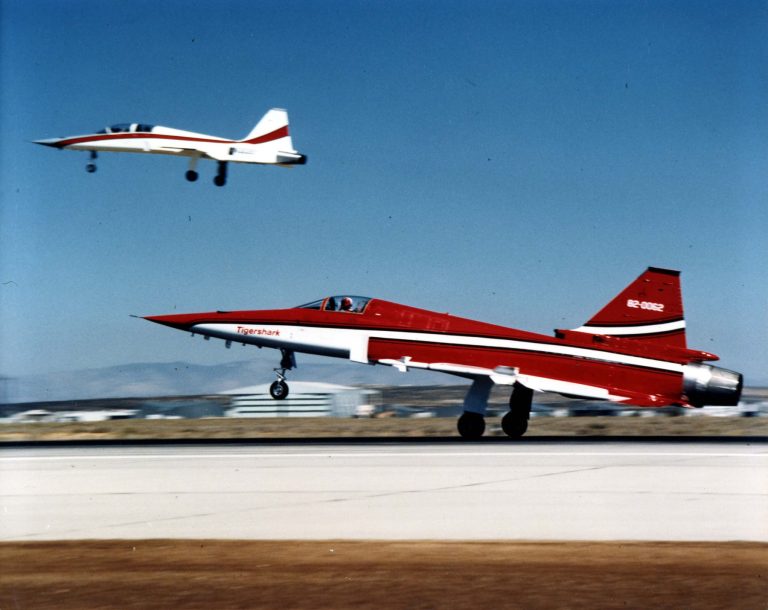
The Tigershark in motion
A curated video feature for the Northrop F-20 Tigershark is coming soon. In the meantime, explore the photo gallery above and the operator map below.
Where the Tigershark flew
Where the record stands
The F-20 Tigershark has no combat record, because it never entered service with any air force. Its story is measured not in kills but in a paradox: an aircraft that performed superbly in the air yet failed completely in the marketplace. Three prototypes flew roughly 1,500 sorties in testing and on demonstration tours; two were lost in fatal accidents attributed to G-induced loss of consciousness, not to any fault of the design. Not one order was ever placed, and the programme was cancelled in 1986. Its true significance is as the definitive example of a “great aircraft nobody bought.”
Compare the combat record of every military aircraft. Figures as of July 2026.
Everything people ask about the F-20 Tigershark
Can I fly in an F-20 Tigershark?
Why did the F-20 Tigershark fail to sell?
How was the F-20 different from the F-5?
What happened in the two F-20 crashes?
How good was the F-20 Tigershark?
Does any F-20 Tigershark still exist?
You can’t fly the F-20.
These, you can.
Some legends only live in museums — others are fuelled and waiting. MiGFlug has put civilians in real military jet cockpits since 2004.
 Fly the L-39 AlbatrosThe world’s most-flown jet trainer — aerobatics included
 Fly the F-104 Starfighter“The missile with a man in it”
 Fly the MiG-21The Cold War’s most-produced jet
 Fly the T-33 Shooting StarAmerica’s first jet trainer
 Fly the DH VampireA piece of early jet history
 Fly the S.211Agile Italian jet trainer
 Fly the MB-326The classic Aermacchi jet
 Fly the MiG-15The Soviet legend of the Korean War
Continue the tour
Every fact, checked
- Vintage Aviation News — Grounded Dreams: F-20 TigersharkDevelopment, the F404 re-engining, cost and readiness figures, and the F-16 competition.
- PlaneHistoria — The Extinct Tigershark’s Untold TaleF-5G origins, APG-67 radar, performance figures and the export-policy story.
- This Day in Aviation — Northrop F-20AFirst-flight date and pilot, the two fatal crashes, dates, pilots and the surviving airframe.
- The Armory Life — Right Plane, Wrong TimeThe private-venture gamble, the “80% at half the cost” brief and why it failed.
- Defense Media Network — What Might Have BeenThe FX export-fighter policy, the Reagan-era shift and the F-16 decision.
- Hush-Kit — I Flew the F-20 TigersharkFirst-hand pilot impressions of the aircraft’s handling and performance.
- The National Interest — The Greatest Fighter That Never FlewAnalysis of the programme’s commercial failure and legacy.
- California Science Center — Air & SpaceThe museum preserving the sole surviving F-20 prototype.