
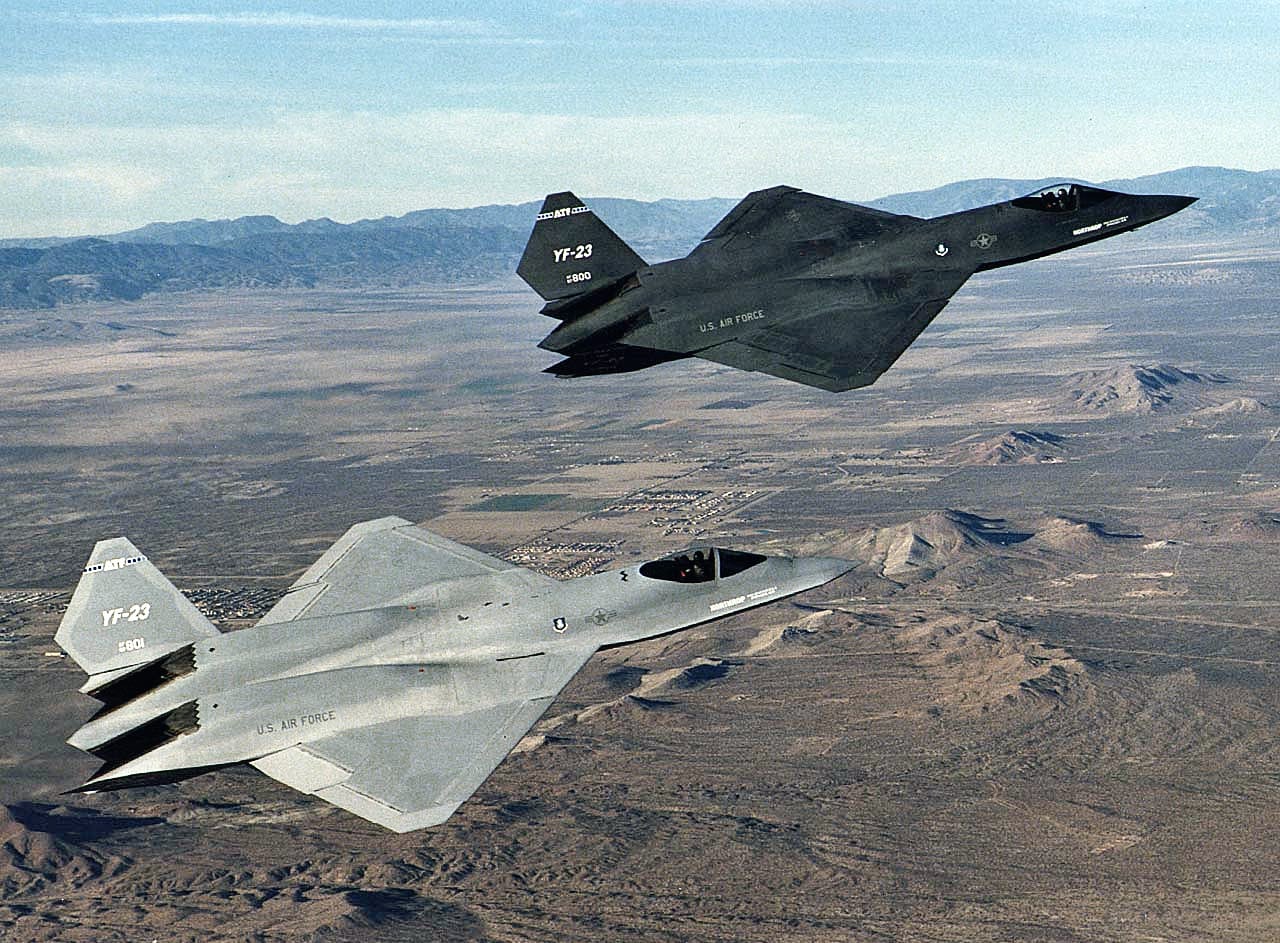
Northrop YF-23
“Black Widow II”
The stealthier, faster Advanced Tactical Fighter prototype that lost the contest of the century to the YF-22 — a diamond-winged, V-tailed “what-if” legend that many engineers still believe should have become the F-22.
The Northrop YF-23: the stealth fighter that should have won — and didn’t
In the early 1980s the US Air Force set out to replace the F-15 Eagle with a radically new kind of fighter: fast, stealthy, and able to cruise supersonically without afterburner. The programme was called the Advanced Tactical Fighter (ATF), and in October 1986 the Air Force narrowed a crowded field to two teams to build flying prototypes. Lockheed (with Boeing and General Dynamics) would build the YF-22. Northrop, partnered with McDonnell Douglas, would build the YF-23.
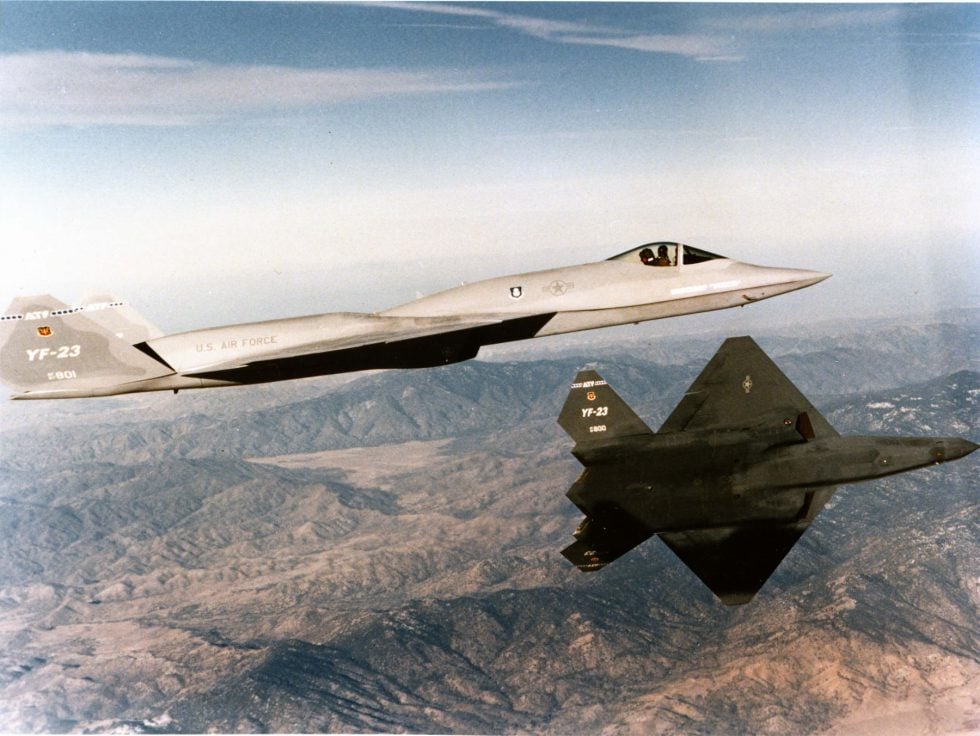
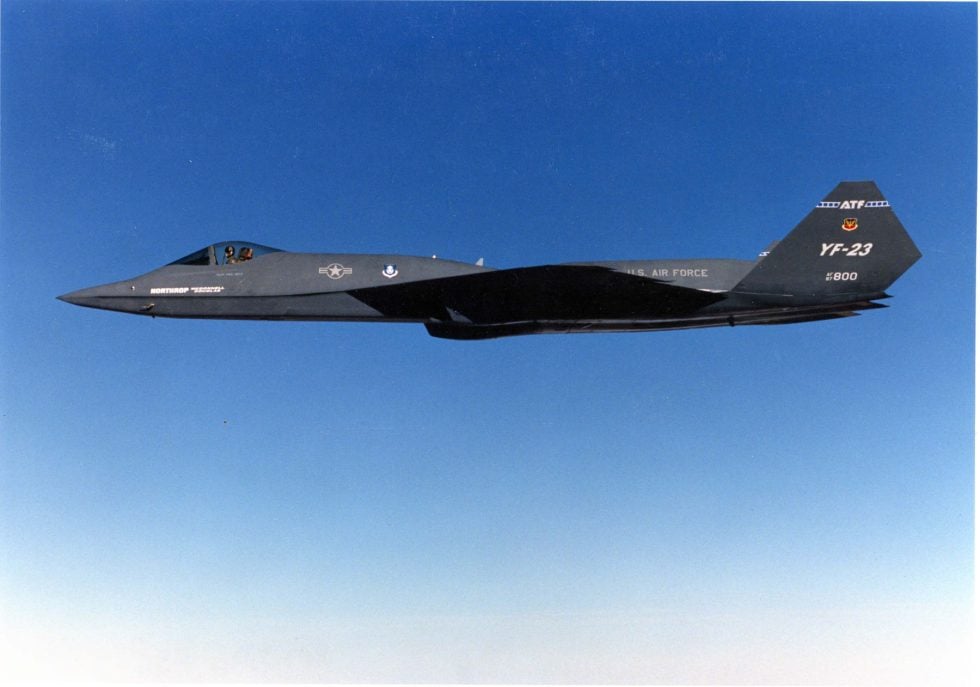
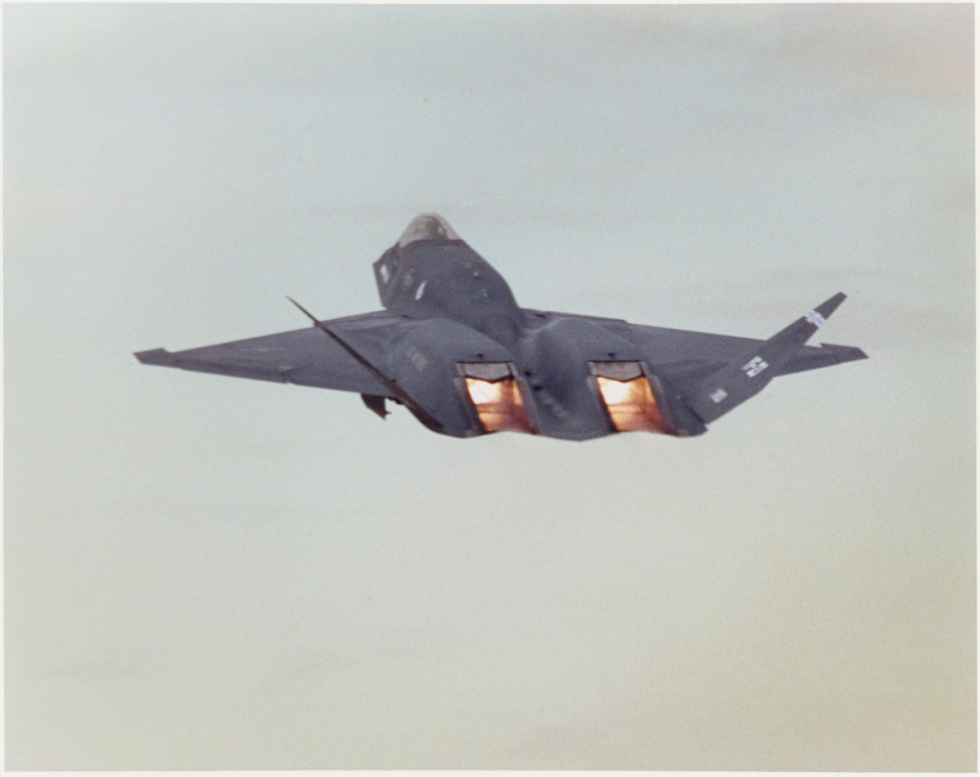
What Northrop produced looked like nothing before it. The YF-23 married a diamond-shaped wing, a deeply blended fuselage and a pair of enormous, all-moving V-tail surfaces canted steeply outward — a shape optimised above all for stealth and sustained speed. Its two engines were buried deep in the fuselage, fed by S-shaped ducts that hid the fan faces from radar, and exhausted over long troughs lined with heat-resistant tiles to shield and cool the plume from below. Two prototypes were built: PAV-1, a charcoal-grey machine unofficially nicknamed “Black Widow II,” powered by Pratt & Whitney YF119 engines; and PAV-2, a lighter-grey aircraft dubbed the “Gray Ghost” (and, in testing, “Spider”), fitted with General Electric YF120s.
PAV-1 first flew from Edwards Air Force Base on 27 August 1990, with PAV-2 following that October. In the flight-test programme the YF-23 proved faster and, by most accounts, stealthier than the rival YF-22. It reached a demonstrated speed around Mach 1.8 and supercruised at roughly Mach 1.6 — the best sustained supersonic figure of the contest. On paper it was the higher-performance, lower-observable aeroplane.
And yet, on 23 April 1991, Air Force Secretary Donald Rice announced that the Lockheed YF-22 had won. Both designs met the ATF requirements; the Air Force simply had more confidence in Lockheed and Pratt & Whitney to deliver the aircraft on time and on budget. The YF-22’s thrust-vectoring agility and its team’s perceived lower risk carried the day. The stealthier, faster jet had lost — not on the numbers, but on judgement about risk, cost and manoeuvrability.
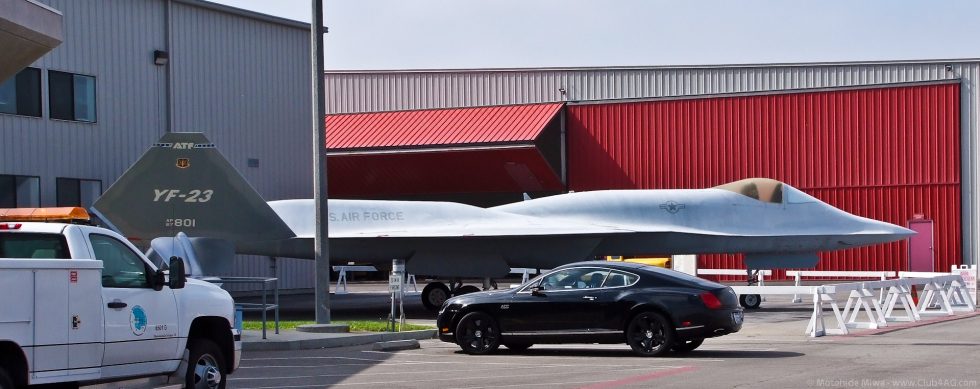
Only two YF-23s were ever built, and both survive. PAV-1 is displayed indoors at the National Museum of the United States Air Force near Dayton, Ohio, alongside the XB-70 and SR-71; PAV-2 sits at the Western Museum of Flight in Torrance, California, on long-term loan from NASA — outdoors, its engines removed. Neither ever fired a shot or entered service. That is exactly why the YF-23 endures as one of aviation’s great “what-ifs”: a beautiful, radical machine that many engineers and enthusiasts still argue was the better fighter.
01The YF-23 versus the YF-22: why Northrop’s stealth fighter lost the ATF contract
The decision has been argued over for more than thirty years. The public rationale from the Air Force was narrow and consistent: both aircraft met the requirements, but the service had greater confidence in the Lockheed / Pratt & Whitney team to manage the enormous production programme on schedule and on cost. The YF-22 also demonstrated thrust-vectoring agility and high-alpha manoeuvres that the deliberately simpler, faster YF-23 did not attempt — and in the early-1990s mindset, close-in dogfighting agility still carried real weight.
Several factors are commonly cited alongside the official line: Lockheed’s more aggressive flight-demonstration programme; Northrop’s reputation being clouded at the time by cost problems on the B-2 and the A-12; and a judgement that the YF-23’s edge in speed and all-aspect stealth mattered less than confidence in delivery. None of this means the YF-23 was inferior — most analyses agree it was the stealthier and faster design. It means the ATF was decided as much on programme risk and trust as on raw performance. That is the heart of the “what-if.”
What makes the YF-23 special
All-aspect stealth, radar and infrared
The YF-23 was shaped to hide from more than radar. Its diamond wing aligned every edge into just a few angles to scatter radar returns, while the engines were buried deep and fed by S-ducts that hid the spinning fan faces. Aft, the exhaust vented over long troughs lined with heat-resistant tiles that shielded and cooled the plume from below — cutting the aircraft’s infrared signature as well as its radar cross-section.
The V-tail: two surfaces doing four jobs
Instead of separate vertical fins and horizontal stabilisers, the YF-23 used two large, all-moving V-tail surfaces canted steeply outward. Together they handled pitch and yaw while presenting far less flat area to a radar and shielding the hot exhaust. Northrop deliberately skipped thrust vectoring — betting that stealth and speed mattered more than the extreme agility its rival was demonstrating.
Supercruise: fast without afterburner
A core ATF demand was supercruise — sustained supersonic flight without fuel-guzzling afterburner. The YF-23 excelled at it, buried twin engines and a clean, low-drag airframe letting it cruise at roughly Mach 1.6 and dash near Mach 1.8. That combination of speed and low observability was meant to let it strike and survive before an enemy ever saw it.
02The YF-23’s two prototypes: Black Widow II, Gray Ghost and their rival engines
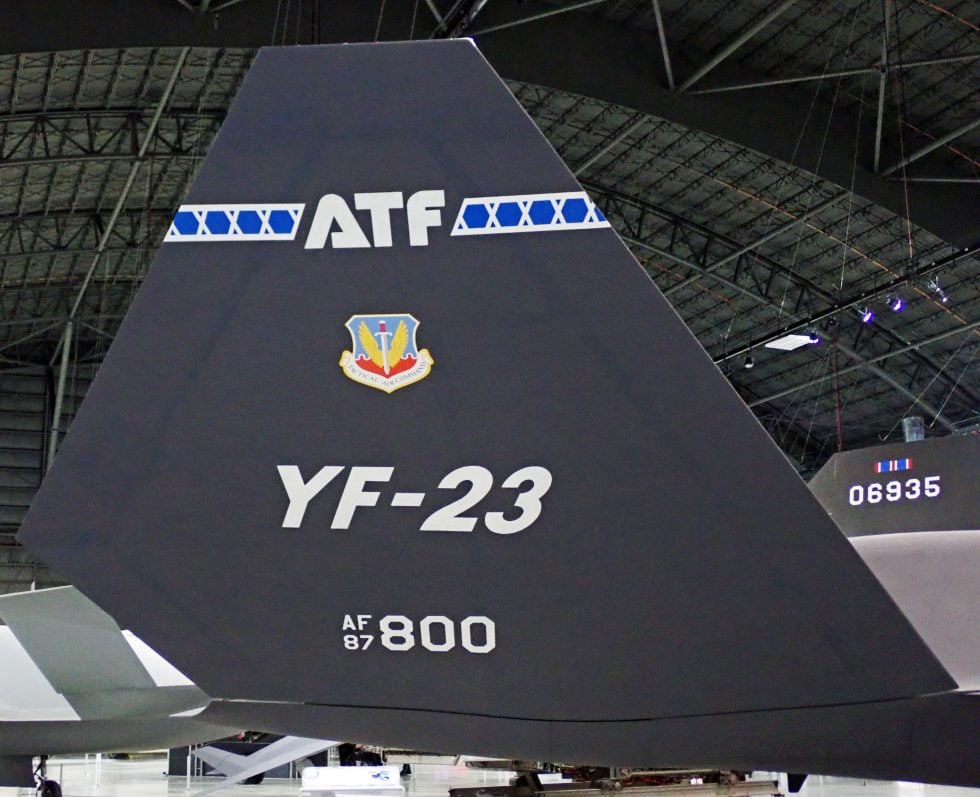
The two YF-23s were externally near-identical but carried different powerplants, because the ATF also ran a parallel engine competition. PAV-1 (serial 87-800), the charcoal-grey aircraft unofficially named “Black Widow II” after Northrop’s WWII P-61 night-fighter, flew with Pratt & Whitney YF119 engines. PAV-2 (serial 87-801), painted a lighter grey and nicknamed the “Gray Ghost” (and “Spider” in testing), used General Electric YF120 engines.
Northrop was reportedly never comfortable with the “Black Widow II” name and largely dropped it. When the ATF was decided, Pratt & Whitney’s F119 won the engine contest too and went on to power the F-22 — so the YF120 that gave PAV-2 its higher supercruise figure never entered production either. Sources sometimes disagree on which nickname belonged to which airframe; the pairing above follows the two museums that hold the aircraft today.
03After the loss: the YF-23’s afterlife as a NASA testbed proposal and “what-if” bomber
Losing the ATF did not quite end the story. Both prototypes were handed to NASA in late 1993 for a planned structural-testing programme that was never funded, so the aircraft mostly sat. Northrop also studied YF-23-derived concepts over the following years — including a proposed naval ATF variant during the programme and, later, a regional-bomber / interim-strike concept based on the airframe pitched in the mid-2000s. None were built.
What kept the design alive was its reputation. Because it was demonstrably fast and stealthy yet never entered service, the YF-23 became the aviation world’s favourite counterfactual — the “road not taken” against which the very successful F-22 is endlessly compared. Both surviving airframes are now museum pieces, but the argument over which jet was really better has never fully died.
Full Northrop YF-23 specifications
Baseline note: the figures below describe the YF-23A as flown in 1990 — specifically PAV-1, Air Force serial 87-0800, the Pratt & Whitney YF119-engined prototype rolled out at Hawthorne on 22 June 1990 and first flown from Edwards on 27 August 1990 by Northrop chief test pilot Alfred "Paul" Metz. Deltas for PAV-2 (87-0801, General Electric YF120 engines), for the never-built production F-23 (DP231 and DP232), for the naval NATF-23 (DP527) and for the 2004 FB-23 bomber study are in grey. Four things must be said before any number is read. First, this was a prototype programme that ran for four months and stopped; a great many quantities that would be routine for a service fighter — internal fuel, rate of climb, radius on a stated profile, radar cross section — were never published, and the standard specification block openly flags that some of its entries are estimates. Second, the empty weight of 29,000 lb is a contractor figure quoted without engines, which is not what "empty weight" means anywhere else; every ratio derived from it should be treated as soft. Third, the maximum speed remains classified, and the widely repeated "Mach 2.2" is a design number, not a flown one — the fastest the aircraft is documented to have gone is Mach 1.8, on afterburner, during flutter clearance. Fourth, and most abused of all, the supercruise figures: the Air Force Materiel Command history office states plainly that PAV-2’s maximum supercruise speed has never been publicly released. What follows separates what was measured from what was predicted, and says which is which.
Dimensions & weights
- Crew
- 1 — a single pilot on a centre stick with side-mounted throttles, in a cockpit whose forward instrument panel and much of its furniture came straight off the McDonnell Douglas F-15E production line to hold prototype costs down. A two-seat F-23 was drawn for the production proposal and for the naval variant; neither was built
- Length
- 20.55 m (67 ft 5 in). The production F-23 grew to 21.46 m (70 ft 5 in) for the F119 installation and 21.59 m (70 ft 10 in) for the physically larger F120. The naval NATF-23 went the other way, shortened to 19.11 m (62 ft 8.5 in) — exactly the length of the F-14 it would have replaced, because that was the deck-spot the Navy had
- Wingspan
- 13.28 m (43 ft 7 in), unchanged on the production F-23. The NATF-23 stretched to 14.63 m (48 ft 0 in) with folding outer panels giving 7.11 m (23 ft 4 in) folded
- Height
- 4.24 m (13 ft 11 in) to the tips of the ruddervators. The production F-23 stood 4.47 m (14 ft 8 in); the NATF-23, with its steeper tail cant and carrier gear, 5.31 m (17 ft 5 in)
- Wing area
- 88.3 m² (950 sq ft), identical on the production F-23 and enlarged to 97.5 m² (1,050 sq ft) on the naval design for approach speed. This is a large wing for a 29-tonne aeroplane, and it is the single most important number on this page
- Aspect ratio
- 2.0 — extraordinarily low, closer to a supersonic bomber or an SR-71 than to a fighter. A short, deep, heavily swept planform is what buys low wave drag and volume for fuel; what it costs is induced drag in a hard turn, and that trade is the whole argument between the YF-23 and the YF-22 reduced to one figure
- Wing planform
- Diamond, edges swept 40° front and back — leading and trailing edges swept the same amount so that every major edge on the aeroplane could be aligned to one of just a few directions. That alignment discipline is what produced the eight-lobe radar cross section plot whose spidery shape gave the type its unofficial name
- Tail configuration
- All-moving V-tail, canted 50° from the vertical — two surfaces doing the work of the four on a conventional fighter, and among the largest all-moving tail surfaces ever fitted to a fighter. They provide pitch when rotated in opposition and yaw when rotated together, and they are canted far enough that neither presents a vertical face to a radar. There is no rudder and no separate tailplane
- Empty weight
- 13,150 kg (29,000 lb) — but this is a contractor weight quoted without engines installed, an unusual convention that makes the number look far better than it is. Adding two YF119s puts roughly 3,200 kg (7,000 lb) back on. Comparisons with the 19,700 kg (43,400 lb) empty weight of the production F-22 are therefore meaningless
- Combat weight
- 23,280 kg (51,320 lb) — the weight at which the flattering thrust-to-weight and wing-loading figures below are quoted
- Take-off gross weight
- 29,030 kg (64,000 lb). The original 1984 Statement of Operational Need asked for a 22,700 kg (50,000 lb) fighter; neither team could get near it, and by 1988 the requirement had been relaxed to 27,200 kg (60,000 lb) with engine thrust raised from the 30,000 lbf class to the 35,000 lbf class to compensate. Both prototypes still overshot it
- Wing loading
- 329 kg/m² (67.4 lb/sq ft) at take-off gross; 264 kg/m² (54 lb/sq ft) at combat weight. Low for the class, and a direct consequence of that very large diamond wing — it is why the aeroplane cruised so efficiently and why it did not need afterburner to stay supersonic
- Internal fuel
- Never publicly released — the figure remains unpublished for both prototypes. What is known is directional: the production F-23 had its fuselage volume deliberately expanded for more fuel and for the avionics the prototypes never carried, and the trough between the engine nacelles was filled in, which added both volume and area-rule refinement
- Weapons bay
- One bay, ventral, forward of the main undercarriage — sized around six AIM-120A AMRAAM, cut down from an original requirement for eight. The production F-23 split this into two tandem bays in a lengthened forward fuselage, the forward one for AIM-9 Sidewinders and the aft for AMRAAM and bombs
Performance
- Maximum speed
- Classified — sources state in excess of Mach 2 at altitude on full afterburner, and the design figure of Mach 2.2 (about 2,335 km/h, 1,450 mph, 1,260 kt at height) is what the specification tables carry. The fastest speed actually documented in flight is Mach 1.8, reached on afterburner during flutter clearance. Every "Mach 2.2" you will read is a prediction, not a measurement
- Supercruise, PAV-1 (YF119)
- Mach 1.43 on 18 September 1990 — roughly 1,520 km/h (945 mph, 820 kt) at altitude, held without afterburner. This is the only YF-23 supercruise figure attached to the engine the Air Force actually chose for production
- Supercruise, PAV-2 (YF120)
- Over Mach 1.6 on 29 November 1990, with Mach 1.72 (about 1,825 km/h, 1,135 mph, 985 kt) the figure that circulates and General Electric engineers privately suggesting as much as Mach 1.8. The official position is "over Mach 1.6" and nothing more; the Air Force Materiel Command history office states the maximum was never publicly released. Treat 1.72 as a floor-plus-rumour, not a record
- How this is normally misreported
- By comparing unlike with unlike — the popular claim is "YF-23 Mach 1.6 versus YF-22 Mach 1.58", which sets the Northrop aircraft’s General Electric-engined best against the Lockheed aircraft’s General Electric-engined best and calls it an airframe result. Match the engines properly and the picture changes: on the YF120 the YF-23 managed over Mach 1.6 against the YF-22’s Mach 1.58, a real but narrow win; on the YF119 both aircraft supercruised at exactly Mach 1.43. The YF-23 was the faster aeroplane, but by a margin far smaller than the folklore, and its best number belongs to an engine that lost
- Service ceiling
- 19,800 m (65,000 ft), estimated rather than demonstrated
- Combat radius
- ~1,300–1,480 km (700–800 nmi) on the subsonic profile the 1984 requirement specified; about 930 km (500 nmi) on the mixed subsonic and supersonic profile. These are requirement figures the design was sized to meet, not measured results — no YF-23 ever flew a combat-representative mission profile
- Ferry range
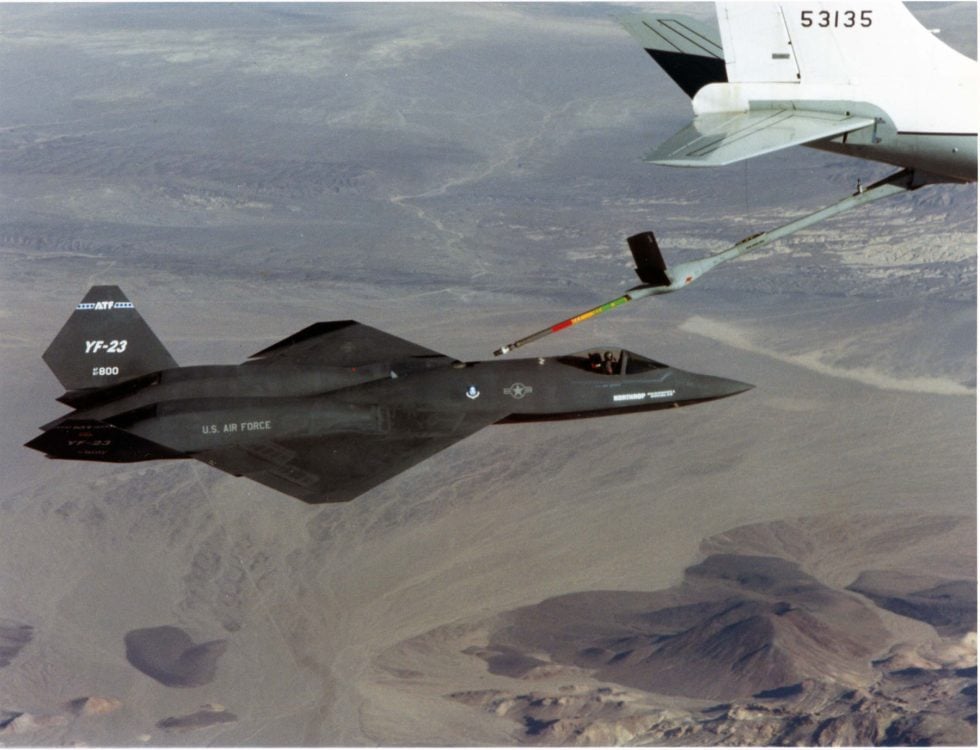
- ~4,500 km (2,430 nmi, 2,800 miles), an estimate. There is a boom receptacle on the spine of the forward fuselage, and it was used in test
- Load factor demonstrated
- +7.1 g — the highest flown in the programme, not a design limit. The ATF requirement, and the F-22 that came from it, called for 9 g. Nobody took a YF-23 there, and the aircraft’s structural envelope was never opened up
- Angle of attack demonstrated
- 25° — against the YF-22’s trimmed alpha of over 60°. Paul Metz has stated that the YF-23 was capable of trimmed flight to 60° and that its high-alpha behaviour was better than any legacy fighter’s, but capability asserted is not capability demonstrated, and in a contest partly judged on risk that distinction cost Northrop dearly
- Thrust-to-weight ratio
- 1.09 at take-off gross weight, 1.36 at combat weight, on 35,000 lbf-class engines. Both figures rest on the engineless empty weight noted above and should be read as indicative
- Landing requirement
- 915 m (3,000 ft). The original figure was 610 m (2,000 ft), which forced thrust reversers on both competitors; relaxing it in 1987 let Northrop delete the reversers and shrink the engine nacelles — a change that reached the production F-23 but never the prototypes, whose flat-topped nacelles were nicknamed "bread loafs" and were larger and draggier than the final design intended
- Flight-test totals
- 50 flights, 65.2 hours across both aircraft between 27 August and late December 1990 — PAV-1 tested over 93 days, PAV-2 over 82. The YF-22 flew 74 flights and 91.6 hours in the same window. That gap of 24 sorties and 26 hours is not a footnote: it is one of the stated reasons the Air Force judged Lockheed the lower-risk bid
- Sortie-generation demonstration
- 6 flights in about 10 hours by PAV-1 on 30 November 1990 — a deliberate surge to show that a stealth aircraft with a curved composite skin could be turned round like a fighter rather than nursed like an F-117. It is the most underrated result of the whole programme and almost nobody quotes it
Propulsion & systems
- Engines, PAV-1
- 2 × Pratt & Whitney YF119-PW-100N afterburning turbofans — a conventional low-bypass design of modest ambition, chosen in April 1991 as the production engine and developed into the F119 that powers the F-22 Raptor
- Engines, PAV-2
- 2 × General Electric YF120-GE-100N afterburning turbofans — a variable-cycle engine that could behave as a turbofan for cruise economy and shift towards turbojet behaviour for high-speed thrust. It was the more advanced machine and it gave the YF-23 its best numbers. The Air Force judged it the higher risk and did not buy it, which means the aeroplane’s celebrated supercruise performance was never going to be available in the fighter that would have entered service
- Dry thrust
- 104.5 kN (23,500 lbf) each, quoted for the YF120
- Afterburning thrust
- 133–156 kN (30,000–35,000 lbf) each — the range in the published tables reflects the mid-programme uprating from the 30,000 lbf class to the 35,000 lbf class, and exact installed figures for both engines remain classified
- Air intakes
- Fixed-geometry, trapezoidal in frontal profile, widely spaced — no variable ramps at all, on an aeroplane meant for sustained Mach 1.6-plus. Boundary-layer air was swallowed by porous suction panels ahead of each inlet and ducted away to vents over the fuselage and wings. Fixed inlets are lighter, cheaper, more reliable and far stealthier than variable ones; the price is that they are optimised for one speed and compromised everywhere else
- Inlet ducts
- S-ducts, long and serpentine — curved sufficiently that no radar looking into the intake can see a compressor face. Engine faces are among the brightest features on any aircraft; hiding them is one of the two or three things that separates a stealth aeroplane from a low-signature one, and Northrop paid for it in duct length, internal volume and pressure recovery
- Exhaust system
- Single-expansion ramp nozzles into troughs in the upper aft deck — the exhaust is turned over the top of the airframe and run aft along channels lined with heat-abating tiles, exactly as on the B-2, so that an infrared seeker looking up from below sees structure rather than a plume. It works, and it is the single most distinctive feature of the design
- Exhaust liner, and its consequences
- "Lamilloy" transpiration-cooled tiles by Detroit Diesel Allison — a porous laminate bled with engine air to carry heat away. Aft-deck heating was flagged by the Air Force as a specific risk area of the Northrop design, and the cost and performance of the liners ended in litigation between Northrop and Allison. A clever solution that had not been proved, on a bid being judged largely on risk, is a bad place to be
- Thrust vectoring
- None — the deliberate central divergence from the YF-22, which carried two-dimensional vectoring nozzles. Northrop’s position was that vectoring bought agility at a cost in weight, complexity, cooling and infrared signature that a fighter designed to shoot first from beyond visual range should not pay. The Air Force of 1991, still shaped by Vietnam-era arguments about the dogfight, did not agree. The naval NATF-23 design did adopt two-dimensional vectoring nozzles, which is a quiet admission that the argument was not settled even inside Northrop
- Flight controls
- Ruddervators, flaperons and split-surface airbraking — pitch from the V-tails moving in opposition, yaw from them moving together, roll from raising flaps and ailerons on one side while lowering them on the other, and aerodynamic braking from deflecting flaps down and ailerons up on both sides at once. Elegant, and with far fewer moving surfaces and hinge lines than a conventional tail, which is itself a stealth benefit
- Flight control system
- Fly-by-wire with a central management computer — the aeroplane is statically unstable and cannot be flown without it. Control laws were developed on a large-scale simulator and then flown on a modified Convair C-131 Samaritan, the Total In Flight Simulator, before anyone strapped into the real thing. Metz reported the handling as precise from the first flight
- Structure
- Composite skins over metal substructure, built outside-in — the continuously curved Gaussian surfaces that give the aeroplane its look are difficult enough to form that the large composite skin panels were fabricated first and the internal members built to fit them, reversing normal practice. Some deliberately mundane parts kept costs down: an F-15 nose wheel, F/A-18 main undercarriage components, F-15E cockpit hardware
- Mission avionics
- None fitted — the YF-23 was a demonstrator for airframe and propulsion only. The radar, sensor fusion and displays intended for the F-23 were flown on a modified BAC One-Eleven laboratory and exercised in McDonnell Douglas’s Avionics Ground Prototype. Both ATF teams had independently selected the same Westinghouse and Texas Instruments phased-array radar, which became the AN/APG-77; the winner of the competition therefore had no bearing on which radar the Air Force ended up with
- Radar cross section
- Never released; characterised by an eight-lobe plot — the edge-alignment scheme concentrated returns into eight narrow spikes, and the resulting plot shape, spidery on paper, is the reason the aircraft was unofficially christened Black Widow II after Northrop’s P-61 of 1942. The YF-23 was assessed as the stealthier of the two competitors, but no number for either has ever been published and anyone quoting one is guessing
- Programme cost
- $691 million to each team for demonstration and validation in FY1985 dollars, over 50 months, with Northrop and McDonnell Douglas investing a further $650 million of their own money and General Electric and Pratt & Whitney $100 million each. The Air Force intended to buy 750 ATFs at a unit flyaway cost of $35 million in FY1985 dollars. It eventually bought 187 F-22s at several times that figure, which is the strongest evidence that the requirement, not the losing design, was the unaffordable part
04The YF-23’s costs: why there is no unit price or cost-per-hour figure
The YF-23 never reached production, so a flyaway unit cost simply does not exist in any meaningful sense — only two prototypes were ever built, funded as part of the Advanced Tactical Fighter demonstration/validation phase rather than sold as a finished product. The overall ATF Dem/Val effort ran into the billions across both competing teams, but that figure covers design, tooling, two airframes and an entire flight-test campaign, not a per-aircraft price.
There is likewise no credible cost-per-flight-hour figure for the type: the two aircraft together flew only about 50 sorties over roughly a year before the programme ended. Any precise dollar cost attached to a “YF-23” online should be read as an estimate or a projection of what a production F-23 might have cost — not a real operating number.
Armament & payload
The YF-23 never fired a shot, never carried a missile, and lost partly because of it
Two YF-23s flew for four months and neither was ever armed. There was no gun, no missile, no bomb and no rocket; the weapons bay was fitted, wired and configured for launch, its doors were cycled in flight and its acoustic environment measured at speed, and that is the whole of the story. The six headings below have therefore been repurposed, because six cards reading "none carried" would be padding rather than information. What matters is what the aeroplane was designed to carry, what the production F-23 would have carried, and what its rival did in front of the customer that it did not.
That last point deserves stating flatly, because it is the most common error in the popular account of this competition. It is often said that neither prototype fired a weapon. That is wrong. Lockheed fired both AIM-9 Sidewinder and AIM-120 AMRAAM rounds from the YF-22’s internal bays, and it did so although no such demonstration was required by the contract. Lockheed also flew the YF-22 in trimmed flight beyond 60° angle of attack. Northrop did neither. The Dem/Val prototypes were explicitly "best-effort" machines, evaluated against each team’s own sealed-envelope predictions rather than head-to-head against one another, so on the letter of the rules Northrop gave up nothing. On the psychology of a source selection that turned on perceived risk, it gave up a great deal.
The underlying design intent was consistent and defensible. Northrop built an aeroplane meant to enter contested airspace unseen, shoot from beyond visual range with AMRAAM, and leave at a speed no interceptor could match without burning its fuel reserve. On that theory of air combat — which is, incidentally, how the F-22 has actually been employed and how every fifth-generation fighter since has been marketed — a gun and a knife-fight capability are insurance premiums, not core requirements. Every store listed below is a provision, a plan or a proposal. Not one of them was ever carried aloft by a YF-23, and the production F-23 configuration was frozen only as a paper submission in December 1990.
Gun — drawn, never installed
- Neither prototype carried a gun or a gun bay. The nose and forward fuselage of PAV-1 and PAV-2 contained test instrumentation where the armament would have gone.
- The production F-23 was to mount a single 20 mm M61 Vulcan rotary cannon in the left side of the lengthened forward fuselage, with a stealth-compatible door over the muzzle in the manner later used on the F-22.
- The naval NATF-23 moved the M61 into a fairing in the right wing instead, to free centreline volume for a keel bulkhead that the catapult and arrestor loads demanded.
- Ammunition capacity was never published for either configuration. The F-22 that emerged from the winning bid carries 480 rounds; the F-23 would plausibly have been similar, but that is inference, not evidence.
- Northrop’s design philosophy treated the gun as a legal and last-resort requirement rather than a combat expectation. In more than three decades of F-22 operations, that view has been vindicated: no F-22 has used its cannon in air-to-air combat.
Air-to-air missiles — six planned, none carried
- The bay was sized around six AIM-120A AMRAAM. The original ATF requirement was eight internal missiles; it was cut to six during the requirements reviews of 1987 and 1988 as both teams fought a losing battle with take-off weight.
- Published provision figures for the YF-23 give four AIM-120 AMRAAM or AIM-7 Sparrow medium-range rounds plus two AIM-9 Sidewinders — a mixed load reflecting the transitional armoury of 1990, when Sparrow was still in service and AMRAAM had only just been fielded.
- The production F-23’s forward bay was dedicated to AIM-9 Sidewinders, with the aft bay carrying AMRAAM. Sidewinders on trapeze launchers in a separate forward bay is precisely the arrangement the F-22 uses.
- The NATF-23 would have carried the US Navy’s planned AIM-152 Advanced Air-to-Air Missile, a very long-range fleet-defence weapon intended to replace the AIM-54 Phoenix, with AIM-9s carried on the bay doors themselves. AIM-152 was cancelled in 1992 and never entered service.
- No missile of any type was carried aloft, mated, or launched from a YF-23. The bay was used for acoustic and door-cycling measurement only.
The weapons bay — one cell, tested empty
- A single large bay on the underside of the fuselage, between the nose gear and the main gear, closed by doors that were opened and closed in flight throughout the test programme.
- Its acoustic environment was measured with the doors open at speed. This matters more than it sounds: cavity resonance in an open weapons bay at transonic speed can destroy a missile’s seeker or shake its airframe apart before it is ejected, and it was one of the genuine unknowns of internal carriage.
- The bay was, in the Air Force’s own description, configured for weapons launch. What was never demonstrated was the launch itself.
- The production F-23 replaced this with two tandem bays in a longer forward fuselage, a change driven partly by separation aerodynamics and partly by the need to keep the aeroplane area-ruled with the bays open.
- The NATF-23 split its bay along the centreline with a structural bulkhead, sacrificing weapon flexibility to stiffen the keel for carrier landings — an honest illustration of how much naval requirements cost.
Air-to-surface stores — provisioned, never defined
- The ATF was conceived in 1981 with both air-to-air and air-to-ground missions in view, but air superiority was made the primary role in 1983 and the strike requirement was never given weight in the competition.
- The production F-23’s aft bay was specified to take bombs as well as AMRAAM. No specific weapon fit was ever published, and no bombing system was ever defined for the aircraft.
- The NATF-23 study named the AGM-88 HARM anti-radiation missile and the AGM-84 Harpoon anti-ship missile as potential carriage — the only named air-to-surface weapons anywhere in the F-23 lineage.
- The 2004 FB-23 bomber proposal took the concept furthest: an internal payload of about 4,540 kg (10,000 lb) over a combat radius exceeding 2,960 km (1,600 nmi), in an airframe stretched to roughly 30.5 m (100 ft).
- None of this was ever hardware. The YF-23 has no air-to-ground record of any kind, and claims that it was a better strike platform than the F-22 rest entirely on the larger internal volume implied by its planform.
Sensors — flown, but not in this aeroplane
- Neither prototype carried any mission avionics. There was no radar, no infrared search and track, no electronic warfare suite and no sensor fusion — the aircraft was a demonstrator for airframe and propulsion, and nothing else.
- The intended radar was a Westinghouse and Texas Instruments active phased array. So was Lockheed’s. Both teams picked the same one, and it became the AN/APG-77 that flies in the F-22 today.
- Northrop tested the sensor suite aboard a modified BAC One-Eleven flying laboratory; McDonnell Douglas built a full Avionics Ground Prototype to shake down the software and hardware.
- A Martin Marietta infrared search and track was evaluated and was demoted in 1989 from a baseline requirement to a provision for later fitting — the same fate it suffered on the F-22, which has never carried one.
- The consequence for the competition was subtle and damaging: with no mission systems aboard, the YF-23 could demonstrate only that it flew well. It could not demonstrate that it fought well.
What was demonstrated, and what was not
- Demonstrated: supercruise on both engine types, Mach 1.8 on afterburner, 7.1 g, 25° angle of attack, aerial refuelling, weapons-bay door operation at speed, and a six-sortie surge in ten hours on 30 November 1990.
- Not demonstrated: any weapon release; any high-alpha flight beyond 25°; the 9 g the requirement called for; the classified maximum speed; and any mission-systems capability whatever.
- The YF-22, by contrast, fired AIM-9 and AIM-120 rounds from its bays and flew trimmed beyond 60° alpha, neither of which the contract obliged it to do.
- The two YF-23s flew 50 sorties and 65.2 hours; the two YF-22s flew 74 sorties and 91.6 hours. The Air Force cited the difference explicitly when it rated Lockheed the lower-risk bid.
- Northrop was not being lazy. It was being literal: the prototypes were contractually best-effort machines judged against sealed-envelope predictions, not a flyoff. Reading the rules correctly and the customer incorrectly is a recognisable way to lose a competition.
Three loadouts — two from the drawings, one as actually flown
- YF-23A as flown, 1990
- Empty bay, no gun, no pylons, no external stores of any kind, and several hundred kilograms of flight-test instrumentation, telemetry and ballast where the armament and mission systems would have lived. Both aircraft flew every one of their 50 sorties in this configuration.
- Production F-23A, air superiority as proposed
- Forward bay: 2 × AIM-9 Sidewinder on trapeze launchers. Aft bay: 4 × AIM-120 AMRAAM. Fuselage: 1 × 20 mm M61 Vulcan behind a stealth door on the left side. Nothing external, nothing on the wings, and a combat radius of 700 to 800 nmi with a substantial supersonic segment flown on dry thrust.
- NATF-23, fleet air defence as proposed
- Split centreline bay: AIM-152 AAAM long-range missiles for the outer air battle, with provision for AGM-88 HARM and AGM-84 Harpoon. Bay doors: 2 × AIM-9. Right wing fairing: 1 × M61. Folding wings, canards, a tailhook and two-dimensional thrust-vectoring nozzles — a heavier, more complex aeroplane that the Navy walked away from before anyone had to build it.
Sourcing caveat: no armament was ever fitted to a YF-23, so every entry above derives from the Dem/Val and EMD proposal documentation as summarised by Paul Metz, Tony Chong and Jay Miller, from the Aronstein, Hirschberg and Piccirillo programme history, and from the NATF-23 DP527 schematics that surfaced publicly only in the 2010s. Ammunition loads, exact missile counts for the naval variant and any radar cross section figure remain unpublished or classified. Where a source gives a specific number for a weapon the aeroplane never carried, that number is a specification, not a measurement.
Variants
Northrop drew the F-23 for twenty-one years and built exactly two of them
The YF-23 is the visible tip of a design lineage that began in a small stealth-fighter cell inside Northrop’s B-2 division in October 1981 and did not finally stop until the 2006 Quadrennial Defense Review killed the last bomber derivative. Almost all of it exists only as drawings, models and wind-tunnel data. Understanding the family matters, because the two aeroplanes that flew were frozen in January 1988 and were already out of date as representations of what Northrop was actually offering by the time they took off.
Three concepts were studied in the early 1980s and the choice between them defined everything that followed. The Agile Maneuverable Fighter had the best aerodynamics and minimal stealth. The Ultra Stealth Fighter, nicknamed "Christmas Tree" for its planform, achieved only four radar cross section lobes through ruthless edge alignment and was, in configurator Darold Cummings’s account, uncontrollable beyond roughly 10° angle of attack. The High Stealth Fighter split the difference with diamond wings, all-moving V-tails, exhaust troughs and eight-lobe alignment. HSF won internally by 1985 and every subsequent F-23 is a refinement of it. That early convergence was Northrop’s great advantage in 1986 — the company had a mature, wind-tunnel-tested, radar-pole-tested concept while Lockheed, still recovering from losing the B-2 competition with faceted shapes, had an immature one. Northrop was ranked first on the Dem/Val proposals. It then lost the competition that mattered.
Why it lost is worth stating without romance, because the internet version of this story is largely wrong. The Air Force did not judge the YF-23 a worse aeroplane. Secretary of the Air Force Donald Rice announced on 23 April 1991 that both designs met the requirements, and the Lockheed and Pratt & Whitney bids were rated higher on technical aspects, assessed as lower risk, and considered to have more effective programme management. In the Air Force Materiel Command’s own summary, the service simply had more confidence in Lockheed and Pratt & Whitney to deliver the weapon system on time and on cost. Four things fed that judgement: the YF-23 flew 24 fewer sorties and 26 fewer hours; it demonstrated neither weapon firing nor high-alpha flight; its aft-deck heating and the unproven Lamilloy exhaust liners were an identified technical risk that later ended in litigation between Northrop and Allison; and Northrop’s recent record on the B-2 and the AGM-137 TSSAM, both badly over cost and behind schedule, was fresh in everyone’s memory. There is also persistent speculation in the aviation press that the Lockheed design was seen as the more adaptable basis for the Navy’s NATF, though the Navy abandoned NATF entirely by FY1992, which makes that a reason that evaporated within a year of being acted upon.
The honest verdict is uncomfortable for both camps. The YF-23 was probably the stealthier and certainly the faster aeroplane, and its design philosophy — see first, shoot first, leave fast, never turn — has been comprehensively vindicated by how fifth-generation fighters are actually flown. But it was a demonstrator that demonstrated less, offered by a company the customer had learned to distrust on schedule and cost, with one genuinely novel and unproven thermal solution buried in the part of the airframe nobody could inspect. Northrop lost on management credibility and risk perception rather than on aerodynamics. That is not a conspiracy; it is procurement.
- N-360 (1983, design study)
- Northrop’s first serious ATF response after the requirement settled on air superiority: a Mach 2-plus delta with a single vertical tail, thrust vectoring and thrust reversers. Conventional, and abandoned as soon as the Air Force’s stealth requirements hardened in late 1985.
- AMF, USF and HSF (1983–1985, concept studies)
- The three-way internal competition described above — Agile Maneuverable Fighter, Ultra Stealth Fighter and High Stealth Fighter. Flat-plate models of all three survive. HSF was selected by 1985 and its shaping, including the chined "platypus" nose and the Gaussian-curved canopy developed by chief scientist Yu Ping Liu, is recognisably the YF-23.
- DP86E and DP110 (1986, Dem/Val proposal)
- The refined HSF, validated by computational fluid dynamics, wind tunnel and radar-pole testing, submitted in July 1986. Northrop and Lockheed were selected as finalists on 31 October 1986, Northrop placed first, and each team received $691 million and 50 months.
- DP117K (frozen January 1988)
- The prototype configuration as actually built, with a sharper and more voluminous nose than the earlier platypus shape for better radar performance and a strengthened, lower-drag aft deck. Because it froze in 1988, it retained the oversized flat-topped "bread loaf" nacelles sized for thrust reversers that the Air Force had already stopped requiring.
- YF-23A PAV-1 (1990, 1 built, serial 87-0800)
- Pratt & Whitney YF119 engines, civil registration N231YF, rolled out 22 June 1990 and first flown 27 August 1990 by Paul Metz on a 50-minute sortie. Painted charcoal grey and nicknamed "Gray Ghost". It briefly wore a red hourglass on its ram air scoop as a ground-crew warning, a black widow spider marking that Northrop management ordered removed as soon as they saw it. Supercruised at Mach 1.43 on 18 September 1990 and flew six sorties in ten hours on 30 November 1990.
- YF-23A PAV-2 (1990, 1 built, serial 87-0801)
- General Electric YF120 variable-cycle engines, registration N232YF, first flown 26 October 1990 by Jim Sandberg. Painted in two shades of grey and nicknamed "Spider". Supercruised at over Mach 1.6 on 29 November 1990. The two nicknames are frequently swapped in print and online; the Western Museum of Flight, which holds PAV-2, is the authority for the pairing given here.
- F-23A EMD, DP231 and DP232 (December 1990, proposal only)
- The production submission and the real competitor to the F-22 that was actually built. Lengthened to 21.46 m (70 ft 5 in) for the F119 or 21.59 m (70 ft 10 in) for the larger F120, with two tandem weapons bays, an M61 cannon, an enlarged radome for the AESA radar, more internal fuel, smaller rounded nacelles with the trough between them filled in for area ruling, exhaust trough edges aligned to the planform sweep, and serrated semicircular inlets with conical compression bumps in place of the prototypes’ trapezoidal ones. Single-seat and two-seat versions were offered.
- NATF-23 DP533 and DP527 (1989–1990, proposals only)
- The naval Advanced Tactical Fighter submission to replace the F-14 Tomcat, for a planned 546 aircraft. DP533 had four tails; DP527, with two more steeply canted and serrated ruddervators plus dihedral canards, was judged the better answer and was submitted with the F-23 EMD proposal in December 1990. Wings moved far aft and folding, reinforced gear, a tailhook, two-dimensional thrust-vectoring nozzles, a quarter-circle serrated inlet with a conical compression surface, and a keel-stiffening bulkhead through the weapons bay. The Navy was already withdrawing by late 1990 and abandoned NATF outright by FY1992 on cost.
- FB-23 "Rapid Theater Attack" (2004, proposal only)
- Northrop Grumman’s bid for a USAF interim regional bomber, against the Lockheed Martin FB-22 and the Boeing B-1R. Two seats, the F-23 planform scaled to roughly 30.5 m (100 ft) in length, over 2,960 km (1,600 nmi) combat radius, 4,540 kg (10,000 lb) internal payload, the EMD inlet retained, and round axisymmetric nozzles above the aft deck instead of the wedge-flap arrangement. Killed by the 2006 Quadrennial Defense Review, which wanted a genuinely long-range bomber; that requirement became the B-21 Raider — which Northrop Grumman won.
- Two-seat F-23 (never designated, never built)
- Both the Air Force EMD design and the naval variant were offered in single-seat and two-seat form. No two-seat F-23 progressed beyond drawings, and no trainer version of the F-22 was ever built either — the first fifth-generation fighter to be flown solo from the first sortie set a precedent the F-23 would have shared.
Survivors, stated precisely: both airframes exist, and they are the only two that ever did. There are no reproductions, no static test articles on display and no third aircraft. YF-23A PAV-1, serial 87-0800, registration N231YF, the charcoal-grey "Gray Ghost", is displayed in the Research and Development gallery of the National Museum of the United States Air Force at Wright-Patterson AFB near Dayton, Ohio; the museum’s own fact sheet dates its arrival to 2000, while some published accounts give a later transfer date. YF-23A PAV-2, serial 87-0801, registration N232YF, the light-grey "Spider", is displayed at the Western Museum of Flight at Zamperini Field in Torrance, California; it was reclaimed by Northrop Grumman in 2004, rebuilt cosmetically as a display model for the FB-23 bomber proposal, and returned to the museum in 2010. Both aircraft have been engineless since 1991, when they were handed to NASA’s Dryden Flight Research Center at Edwards for a loads-calibration study that was never carried out; they sat in storage until mid-1996. Neither has flown since December 1990. The only other physical artefact of consequence is the DP527 naval wind-tunnel model, tested for 14,000 hours and donated with its canards removed by Boeing St Louis in 2001 to the Klein Park Veterans Memorial at Bellefontaine Neighbors, Missouri, where it stands in the open as a monument that almost nobody recognises.
From ATF contender to museum legend
ATF programme begins
The US Air Force launches the Advanced Tactical Fighter effort to replace the F-15 with a stealthy, supercruising air-superiority fighter.
Down to two teams
On 31 October the Air Force selects Lockheed and Northrop to build flying prototypes. Northrop teams with McDonnell Douglas to build the YF-23.
Rollout
PAV-1, the “Black Widow II,” is unveiled at Edwards Air Force Base on 22 June, revealing the diamond wing and V-tail for the first time.
First flight
PAV-1 makes its maiden flight on 27 August with Northrop test pilot Paul Metz at the controls; PAV-2 follows in October.
Flight test
The two prototypes demonstrate supercruise near Mach 1.6, air refuelling and supersonic handling across roughly 50 flights.
The YF-23 loses
On 23 April the Air Force selects the Lockheed YF-22 and Pratt & Whitney F119. The stealthier, faster YF-23 is beaten on perceived risk and cost.
Handed to NASA
Both airframes pass to NASA in December for a planned structural-test programme that is never funded — the aircraft mostly sit.
Into museums
PAV-1 goes to the National Museum of the US Air Force in Ohio; PAV-2 to the Western Museum of Flight in Torrance, California. Both survive today.
Twelve YF-23 stories
The fighter to beat the F-15
The ATF set out to build the most advanced air-superiority fighter in the world.
Read the full story
Northrop and McDonnell Douglas
Two aerospace giants joined forces to challenge Lockheed for the contract of the century.
Read the full story
A shape unlike any fighter before it
The diamond wing and steeply canted V-tail made the YF-23 look like something from the future.
Read the full story
Hiding from heat as well as radar
The buried engines and tiled exhaust troughs cut the aircraft’s infrared signature.
Read the full story
Faster than the jet that beat it
The YF-23 supercruised at around Mach 1.6 — the best of the contest.
Read the full story
Two surfaces, four jobs
The all-moving V-tail replaced four conventional surfaces with two.
Read the full story
27 August 1990
PAV-1 lifted off from Edwards with test pilot Paul Metz.
Read the full story
23 April 1991
The Air Force chose the YF-22 — and the YF-23 was finished.
Read the full story
Did the better jet lose?
Enthusiasts and engineers still argue the YF-23 was the superior design.
Read the full story
Both aircraft still exist
Unusually for losing prototypes, both YF-23s were preserved.
Read the full story
The DNA that lived on
Northrop’s stealth expertise did not go to waste.
Read the full story
The fan-favourite that never was
The YF-23’s looks made it a star of films, games and models.
Read the full story
The YF-23 in pictures
Where the YF-23 flew
A combat record that never happened
The YF-23 never entered service, never carried live weapons and never fired a shot — its entire career was a flight-test programme run from Edwards Air Force Base in 1990–91. Its “record” is therefore one of demonstrated capability rather than combat: it proved supercruise, all-aspect stealth and high-speed handling, and by most accounts did so better than the aircraft that beat it. What it never got was the chance to prove any of that in action.
See how service fighters compare in the combat record of every military aircraft. The YF-23 has no combat history to report — its story is one of what might have been.
Everything people ask about the YF-23
Can I fly in a YF-23?
Why did the YF-23 lose to the F-22?
Was the YF-23 better than the F-22?
How many YF-23s were built, and where are they now?
How fast was the YF-23, and could it supercruise?
Why is it called the “Black Widow II” and “Gray Ghost”?
You can’t fly the YF-23.
These, you can.
Some legends only live in museums — others are fuelled and waiting. MiGFlug has put civilians in real military jet cockpits since 2004.
 Fly the L-39 AlbatrosThe world’s most-flown jet trainer — aerobatics included
 Fly the F-104 Starfighter“The missile with a man in it”
 Fly the MiG-21The Cold War’s most-produced jet
 Fly the T-33 Shooting StarAmerica’s first jet trainer
 Fly the DH VampireA piece of early jet history
 Fly the S.211Agile Italian jet trainer
 Fly the MB-326The classic Aermacchi jet
 Fly the MiG-15The Soviet legend of the Korean War
Continue the tour
Every fact, checked
- National Museum of the US Air Force — YF-23A fact sheetThe museum that holds PAV-1: engines, Mach ~2 speed, single crew, and the 1991 loss to the YF-22A.
- Western Museum of Flight — YF-23A (PAV-2)The museum that holds PAV-2: serial 87-801, GE YF120 engines, supercruise and the October 1990 first flight.
- Vintage Aviation News — Grounded Dreams: Northrop YF-23Programme history, dimensions, flight-test summary and the official rationale for the ATF decision.
- 19FortyFive — Only two YF-23s were ever builtThe two prototypes, their serials and engines, current museum locations and condition, and why the type lost.
- The Aviation Geek ClubYF-23 design, stealth features and supercruise performance versus the YF-22.
- The National InterestAnalysis of the ATF competition and the long-running “YF-23 should have won” debate.
- NASA Armstrong (Dryden) historyThe YF-23 airframes’ transfer to NASA in 1993 and the un-funded structural-test plan.
- Smithsonian National Air and Space MuseumBackground on the Advanced Tactical Fighter programme and 1990s US stealth development.