
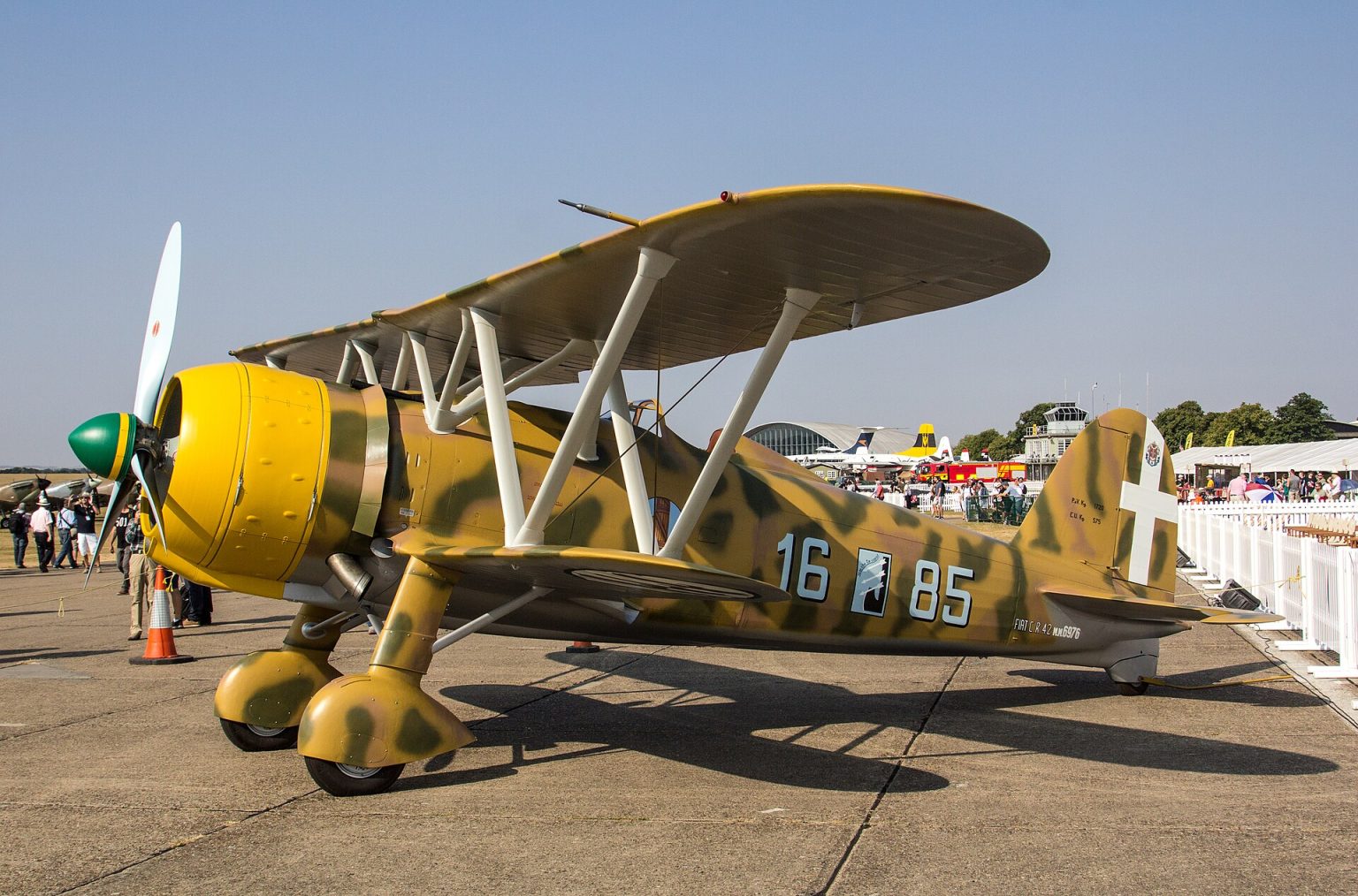
CR.42 Falco
A biplane in the monoplane age
Italy’s last great biplane fighter — beautiful, astonishingly agile, and obsolete the day it entered service, yet it fought on every Italian front from the Battle of Britain to the East African highlands.
The Falco: the last of the fighting biplanes
By the end of the 1930s the world’s air forces were racing to replace their biplanes with sleek monoplane fighters. Italy went the other way. In 1938 Fiat flew a brand-new biplane, the CR.42 Falco, and the Regia Aeronautica ordered it in quantity — a deliberate bet on agility and the dogfight at the very moment those things were being overtaken by speed and firepower.
The man behind it, Celestino Rosatelli, had designed the earlier CR.32, a biplane that had done well in the Spanish Civil War. Italian pilots loved the tight-turning, responsive feel of a good biplane, and the Falco delivered it in full: a clean sesquiplane, with a smaller lower wing, a powerful Fiat radial and handling that pilots — friend and foe — found delightful.
It was also, by 1940, hopelessly outdated. Slow and armed with just two machine guns, the Falco could not live with a Spitfire or Hurricane in a straight fight. And yet Italy built roughly 1,819 of them — the most-produced Italian aircraft of the war — and threw them onto every front it fought on.
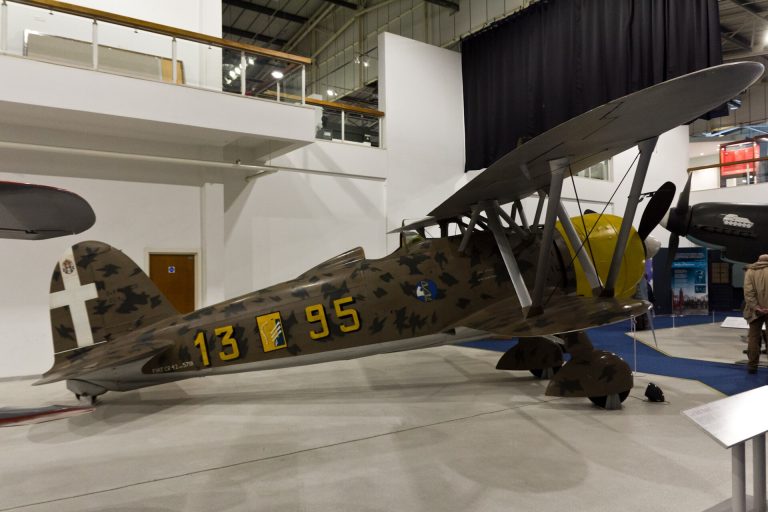
One of the strangest episodes came over the English Channel. In late 1940 Italian CR.42s of the Corpo Aereo Italiano flew from bases in Belgium against England — open-cockpit biplanes pitched into the radar-and-Spitfire world of the Battle of Britain. One Falco force-landed in Suffolk and survives in the RAF Museum to this day.
The Falco’s real war was fought in the heat and dust of North and East Africa, where skilled Italian pilots used its agility against Gladiators, Hurricanes and P-40s. In the mountains of East Africa, Mario Visintini ran up 16 victories to become the highest-scoring biplane fighter ace in history.
As the monoplanes took over, the Falco found second-line work as a night-fighter, ground-attack aircraft and trainer, serving to the end of the war — Germany even pressed over 150 into night-harassment duty. Several survive in museums today. The CR.42 was the last of a breed: the front-line fighter biplane, gone from the sky forever.
01Why Italy built a new biplane in 1939
The Falco can look like a mistake — a biplane ordered into mass production just as biplanes became obsolete. But it made a certain sense at the time. Italy’s aero-engine industry could not yet supply enough powerful inline engines for a first-rate monoplane, and Italian fighter doctrine still prized the tight-turning dogfight, where a nimble biplane could hold its own.
The result was an aircraft that was genuinely excellent at what it did — and outmatched by everything that mattered by 1941. The Falco is a case study in how quickly the technology of air warfare moved, and how an air force’s doctrine and industry can leave it fighting the last war with the wrong tool, however beautifully made.
How Fiat perfected a design the world was leaving behind
The peak of the biplane
The Falco was a sesquiplane — its lower wing much smaller than its upper — refined from Rosatelli’s successful CR.32. Everything about it was tuned for the tight-turning dogfight: light, responsive controls and a famously quick half-roll that repeatedly surprised its monoplane opponents.
The Fiat radial
Power came from a Fiat A.74 air-cooled radial of around 840 hp — reliable and simple, but modest by the standards of the Merlins and DB 601s its enemies flew. It gave the Falco respectable agility and climb, but never the speed to dictate a fight.
Light armament
The Falco went to war with just two machine guns, typically two 12.7 mm Breda-SAFATs in the nose, sometimes with light underwing bombs added. It was enough against other biplanes and unarmoured targets, but far too little to trouble modern, armoured monoplanes.
02A quick half-roll and a hard truth
RAF pilots who fought the Falco came away impressed by its manoeuvrability — British intelligence specifically noted the surprise caused by its ability to snap into an extremely tight half-roll. In a slow, turning fight the CR.42 could out-manoeuvre a Hurricane or even a Spitfire.
The hard truth was that modern air combat had moved on from the turning fight. Fast monoplanes could dictate the terms of an engagement, diving in, firing and climbing away before the nimble biplane could bring its guns to bear. The Falco could win the manoeuvre and still never get the chance to shoot — the central dilemma of every biplane fighter caught in the monoplane age.
Fiat CR.42 Falco — by the numbers
Baseline: the standard single-seat Fiat CR.42 of the 1940 production blocks — Fiat A.74 R.C.38 radial, two 12.7 mm Breda-SAFAT above the cowling, no radio, no armour, no bomb racks. That is the aeroplane roughly 300 of which were on charge when Italy declared war on 10 June 1940, and the one the RAF met over Malta, Libya and Eritrea. Deltas for the tropicalised CR.42AS, the CR.42CN night fighter, the two-seat CR.42B, the German CR.42LW and the one-off CR.42DB are in grey. Two warnings before the figures. First, the top speed is not agreed: English-language references almost always give 441 km/h at 6,100 m, while Italian sources including several Fiat-derived tables give 430—440 km/h, and service aircraft with mud, patched fabric and no propeller polish were slower than either. Second, weights differ by about 60 kg between the Italian and English tables; both are given. All performance is for a clean airframe, which the CR.42 rarely was after 1941.
Dimensions & weights
- Crew
- 1 CR.42B trainer: 2 in tandem
- Upper wingspan
- 9.70 m (31 ft 10 in)
- Lower wingspan
- 6.50 m (21 ft 4 in) a true sesquiplane — the lower wing is barely two thirds of the upper, which is where much of the CR.42's unusual cleanness came from
- Length
- 8.25 m (27 ft 1 in) CR.42B: 8.94 m (29 ft 4 in), the fuselage stretched for the second cockpit
- Height
- 3.59 m (11 ft 9 in)
- Wing area
- 22.40 m² (241.1 sq ft), both planes combined
- Empty weight
- 1,782 kg (3,929 lb) Italian tables give 1,720 kg (3,792 lb); the difference is equipment fit, not airframe
- Loaded weight
- 2,295 kg (5,060 lb) CR.42B: 2,300 kg (5,071 lb). CR.42AS with two 100 kg bombs and sand filter was heavier again and lost roughly 20 km/h
- Wing loading
- 102 kg/m² (21.0 lb/sq ft) at loaded weight — high for a biplane and low for anything else, which is the whole story of how it fought
- Power loading
- 2.73 kg/cv (6.0 lb/hp) at the 840 cv altitude rating
- Structure
- welded steel-tube fuselage with light-alloy panels forward and fabric aft; wings of light-alloy spars and ribs, fabric covered. Rosatelli's trademark Warren-truss interplane bracing carried the loads in rigid W struts with no flying or landing wires at all the single most important reason a 1938 biplane could reach 440 km/h
- Undercarriage
- fixed cantilever legs with oleo shock absorbers and streamlined spats; tailwheel. Spats were routinely removed on desert and grass strips Swedish J 11s were flown on skis through the northern winters
Performance
- Maximum speed
- 441 km/h (274 mph) at 6,100 m (20,000 ft) — Italian sources give 430—440 km/h; either way the fastest biplane fighter ever to see squadron service
- Maximum speed, sea level
- 345 km/h (214 mph) the radial and the two wings both cost most at low level, where most of the type's later war was fought
- Cruising speed
- 399 km/h (248 mph)
- Landing speed
- 128 km/h (80 mph)
- Rate of climb
- 11.8 m/s (2,320 ft/min) at sea level
- Time to altitude
- 9 min 0 s to 6,000 m (19,685 ft)
- Service ceiling
- 10,210 m (33,500 ft)
- Range
- 780 km (485 miles) CR.42 Egeo with the 100-litre auxiliary tank: about 1,100 km (685 miles), which is what made the Iraq deployment possible at all
- Endurance
- 2 h 30 min at economical cruise
- Take-off run
- 210 m (690 ft)
- Landing run
- 340 m (1,120 ft)
- Fastest of the family
- 518 km/h (322 mph) the one-off CR.42DB on a Daimler-Benz DB 601A, March 1941 — the fastest biplane ever flown, and a demonstration that the airframe was never the problem
Propulsion & systems
- Engine
- one Fiat A.74 R.C.38, 14-cylinder two-row air-cooled radial
- Capacity
- 31.25 litres (1,907 cu in), bore and stroke 140 × 145 mm (5.51 × 5.71 in)
- Power
- 840 cv (829 hp, 618 kW) at 3,800 m (12,470 ft); 870 cv (858 hp) for take-off at 2,520 rpm. Fiat had nothing more powerful in production, and this single fact shaped every Italian fighter of 1940
- Supercharger
- single-stage single-speed geared centrifugal, rated altitude 3,800 m; single Stromberg carburettor, 87-octane fuel Italian 87-octane was poorer than the British 100-octane of 1940 and the engine was rated accordingly
- Reduction gear
- geared drive; engine dry weight 590 kg (1,301 lb)
- Propeller
- Fiat 3D.41-1 three-blade metal constant-speed unit, 2.90 m (9 ft 6 in) diameter
- Fuel
- 350 litres main tank between engine and cockpit plus 110 litres in a reserve tank under the seat, 460 litres (101 imp gal) total. Unprotected: no self-sealing covering was ever fitted CR.42 Egeo added a 100-litre auxiliary tank
- Protection
- none. No armour plate, no armoured windscreen, no self-sealing tanks the Swedish J 11 was the exception: 20 mm of plate behind the pilot, fitted locally because the Flygvapnet thought the aircraft indefensible as delivered
- Radio
- none as standard on Italian aircraft. Squadron leaders used hand signals and wing-rocking; radio sets were fitted piecemeal from 1941 and were standard on the Egeo, the CR.42CN and all Swedish machines this, more than the second wing, is what beat the Regia Aeronautica's fighter arm in 1940
- Cockpit and sights
- open cockpit with a small windscreen; San Giorgio optical reflector sight with ring-and-bead backup. Italian pilots had actively lobbied against enclosed canopies, and got their way Eric Brown, who flew MM5701 in 1941, called it "brilliantly manoeuvrable, an acrobatic gem, but under-gunned and very vulnerable"
- Night and special equipment
- CR.42CN: flame-damped extended exhausts and two searchlights on the lower wing, no radar of any kind. CR.42LW: flame dampers and underwing bomb racks. CR.42EC: smoke-laying gear. CR.42RF: camera installation, about six aircraft
03A family of Falcos
The basic Falco spawned a string of sub-types: the up-armed CR.42bis, the CR.42CN night-fighter (which intercepted RAF raiders without radar), the CR.42AS fighter-bomber for ground attack in the desert, and the Swedish-operated J 11. Figures varied a little between versions and production batches; those above are representative of the standard fighter.
Armament & payload
The CR.42 went to war with two machine guns, and two machine guns had stopped being an armament
The Falco's battery was two 12.7 mm Breda-SAFAT machine guns in the upper forward fuselage, synchronised to fire through the propeller disc, with about 400 rounds each. In 1935 that was a heavy fighter armament; in 1940, when the Hurricane carried eight guns and the Bf 109E carried two cannon and two guns, it was not an armament at all. The 12.7 mm round itself was good — heavier than the British .303 and effective against fabric and light structure — but two guns firing through a propeller at an effective 575 rounds a minute each put roughly a quarter of the metal into the air that a Hurricane did, and the Breda-SAFAT was notorious for jamming. Italian pilots compensated by closing to 40 or 50 metres, which is exactly what an aeroplane this manoeuvrable allowed them to do and exactly what killed them when the target shot back. The very earliest production aircraft carried one 12.7 mm and one 7.7 mm gun, not two 12.7 mm; ammunition quantities are quoted between 350 and 400 rounds per gun depending on source and installation, and the underwing gun and bomb fits varied from squadron to squadron rather than by any tidy mark number.
Gun
- Two 12.7 mm Breda-SAFAT machine guns, fixed and forward-firing in the upper fuselage decking, synchronised through the propeller disc
- About 400 rounds per gun, roughly 800 in all; ball, armour-piercing, incendiary and a high-explosive round that was more of a nuisance than a weapon
- Cyclic rate around 700 rounds/min, cut to roughly 575 by the synchronising gear; the gun was a licence descendant of the Browning and shared its virtues without matching its reliability
- Earliest aircraft: one 12.7 mm and one 7.7 mm Breda-SAFAT, a mixed fit that made sighting and load planning worse for no saving
- CR.42ter added two more 12.7 mm guns in underwing fairings, four in all. The drag cost was real and the fit stayed uncommon.
Air-to-air
- None. No guided air-to-air weapon existed anywhere in the world during the CR.42's entire operational life
- Air fighting meant the two cowling guns, a San Giorgio reflector sight and a turn radius nothing else in 1940 could follow
- RAF Fighter Command's own intelligence summary of late October 1940 noted that the CR.42's "capacity to execute an extremely tight half roll has caused considerable surprise to other pilots and undoubtedly saved many Italian fighters from destruction"
- The tactical trap was that surviving is not winning: a Falco could evade a Hurricane almost indefinitely and still had no way to shoot it down before it climbed away and came back
Air-to-surface guided
- None, and nothing of the kind was available to any Italian unit while the type was in front-line use
- The first guided air-to-ground weapons used in anger were the German Fritz X and Henschel Hs 293 of 1943, carried by four-engined bombers, not by fighters
- By 1943 the CR.42's ground work was bombs, guns and the pilot's eye, at night, from very low down
- Aiming was by dive angle and judgement; there was no bombsight worth the name in a single-seat CR.42
Bombs
- Two underwing racks, 200 kg (440 lb) maximum — normally two 100 kg bombs or two 50 kg
- CR.42AS: the standard fit for North Africa from 1941, sand-filtered engine plus racks, flown as a fighter-bomber against columns and airfields once the Macchi C.200 and Bf 109 took over the fighter role
- Spezzoni containers of small anti-personnel and incendiary bomblets, widely used in the Balkans and against partisans
- CR.42LW: four 50 kg bombs, the German night-harassment fit, dropped from a few hundred metres onto vehicle parks and bivouacs
- Hungarian aircraft were retrofitted with racks in spring 1944 for a night ground-attack squadron, the same idea arrived at independently
Rockets
- None. No air-to-ground rocket ever entered Italian squadron service on the CR.42
- Italy had no equivalent of the British RP-3 or the German Panzerblitz in operational use, and the CR.42's ground-attack war was fought entirely with bombs and 12.7 mm guns
- This mattered: from 1942 the type was doing exactly the work rockets were invented for, without them
- Nothing rocket-related was fitted by the Luftwaffe to the CR.42LW either, which was a bomb and gun aircraft to the end
Pods & other stores
- 100-litre underfuselage auxiliary tank on the CR.42 Egeo, raising range from about 780 km to about 1,100 km for Aegean and Iraq operations
- Two underwing searchlights on some CR.42CN night fighters, an honest attempt at a problem that actually needed radar
- Underwing 12.7 mm gun fairings on the CR.42ter; smoke-generating apparatus on the CR.42EC; vertical camera on about six CR.42RF reconnaissance conversions
- Glider-towing hook on the CR.42R; ski undercarriage on Swedish J 11s; twin floats on the single ICR.42 seaplane prototype
- Two 20 mm cannon were never fitted. The airframe could not take the recoil in the wings and the A.74 was a radial, so there was no propeller hub to fire through
Three typical loadouts
- Day interception, 412ª Squadriglia, Italian East Africa, 1940—41
- Two 12.7 mm guns, full tanks, no radio, no armour, no bombs. This is the CR.42 at its best and it was very good indeed. Against Gladiators, Wellesleys, Blenheims and elderly Hardys over Eritrea and the Sudan, 412ª Squadriglia produced the top-scoring pilots of the whole East African campaign: Mario Visintini with 16 confirmed victories, the highest total ever credited to a biplane pilot in any war; Luigi Baron with 12; Aroldo Soffritti with 8. On 6 November 1940 the squadriglia claimed seven Gladiators for no loss. The campaign was lost anyway, because the Royal Navy cut the supply route and no amount of flying skill replaces spare parts. Visintini flew into Mount Bizen near Nefasit on 11 February 1941 in bad weather, looking for Baron.
- Fighter-bomber, CR.42AS, 13° Gruppo, Libya, 1941—42
- Two 12.7 mm guns, two 100 kg bombs, sand filter, spats removed. From April 1941, once the C.200 and the Bf 109 arrived in theatre, the Falco stopped being a fighter and became a strafer. It was surprisingly well suited to it — small, strong, agile at low level, able to use rough forward strips — and this, not air fighting, is where the type did its steadiest work. The cost was heavy: no armour, no self-sealing tanks and no radio, over ground defended by Bofors guns.
- Night harassment, CR.42LW, 2./Nachtschlachtgruppe 9, Italy, 1944
- Two 12.7 mm guns, four 50 kg bombs, flame-damped exhausts, no radio aids. Operating from Caselle and later Centocelle against the Anzio beachhead and the Cassino front, and from Udine and Zagreb against Yugoslav partisans. The logic was the same as the Soviet Po-2's: an aircraft too slow to intercept at night, cheap enough to lose, quiet enough to arrive unannounced, keeping an enemy awake. On 31 May 1944 NSGr 9 had 18 Falchi on strength and 15 flyable, and it converted to Ju 87Ds shortly after.
Sourcing caveat: ammunition capacity, gun mark and the exact bomb loads carried by CR.42AS and CR.42LW aircraft differ between references, and the underwing fits were often local modifications rather than factory standards, so a "variant" here frequently means a field conversion. Victory claims on all sides in East Africa, Greece and North Africa were substantially inflated; where claims and confirmed losses are both known they are given separately, and where only claims survive that is said.
Variants
Fiat kept building biplane fighters until 1944, and for two or three years there was an argument for it
The uncomfortable question about the CR.42 is not why it fought badly in 1940 but why Italy ordered it at all in 1939, when the Spitfire and the Bf 109E were already in squadron service. The honest answer has four parts, and only one of them is stupidity. First, Fiat had no engine. The A.74 R.C.38 gave 840 cv and nothing better was in production; the German DB 601 was not available and the Italian inline programmes were years from delivering. With that much power, the aerodynamic penalty of the second wing was worth perhaps 30 to 40 km/h against a monoplane of the same weight — and Italy's own monoplanes proved it, because the Fiat G.50 managed 470 km/h and the Macchi C.200 about 500 km/h on the same engine. Second, Celestino Rosatelli's Warren-truss bracing produced a biplane with no rigging wires at all, which closed much of the remaining gap. Third, the Spanish Civil War had been read as a vindication: the CR.32 had done very well there, and both Ethiopia and Spain were fought against disorganised opposition, which gave a flattering impression of what Italian fighters could do. Fourth, and least defensible, Italian fighter pilots lobbied hard for open cockpits and dogfighting agility and the Regia Aeronautica listened to them.
The result was an aeroplane that was genuinely excellent at what it was designed for and immediately irrelevant to what the war turned out to be. The first flight was on 23 May 1938 at Turin-Aeritalia with Valentino Cus at the controls; the type entered service in 1939 and was still coming off the line in 1944. Every published production total should be treated with care: the figures most often quoted are 1,781 or 1,784 aircraft, while counts that include the German-supervised CR.42LWs and all export airframes reach roughly 1,819. What is not in dispute is that this makes the CR.42 the most-produced Italian aircraft of the Second World War — more Falchi were built than Macchi C.200s, C.202s or SM.79s.
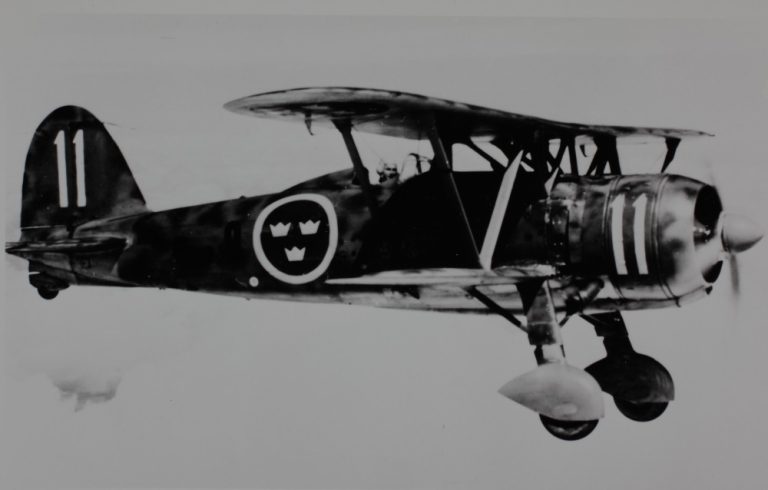
Three foreign air forces bought it and all three learned something. Belgium ordered 40 in 1939 for 40 million francs and had received somewhere between 24 and 34 when the Germans came on 10 May 1940 — sources disagree, with Italian references giving 39 or 40 delivered and English ones far fewer. The IIème Groupe de Chasse flew about 35 sorties in four days and Charles Goffin was credited with a Do 17, a Ju 52 and two Bf 109Es, which is a remarkable return; then fourteen Falcos were destroyed on the ground at Brustem by Stukas, and five survivors were captured. Hungary took between 68 and 72 from mid-1938 onwards, flew them over Yugoslavia in April 1941 and then into the Soviet Union, where the 1. Vadász Ezred claimed 25 destroyed for two lost to fighters — a good record against I-16s and I-153s, and one that ended the moment the Soviets fielded anything modern. Sweden bought 72, designated them J 11 and used them for neutrality patrols; Swedish pilots hated them. Thirty and more were lost to accidents and mechanical failure, the type had a bad reputation for spinning, and the Flygvapnet bolted 20 mm of armour behind the pilot before it would send them up. The last J 11s were decommissioned on 14 March 1945 and nineteen were sold off as target tugs.
Two operational episodes deserve to be named plainly. The Corpo Aereo Italiano sent to Belgium in the autumn of 1940 — 50 CR.42s of 18° Gruppo at Ursel, 45 G.50s at Maldegem, BR.20 bombers at Melsbroek — was a political gesture that cost lives for nothing. It was the wrong aircraft, the wrong weather and the wrong month: the Luftwaffe had already lost the daylight battle, the Falchi had no radio and no cockpit heating for a North Sea winter, and German formations could not fly slowly enough to stay with them. On 11 November 1940 ten BR.20s of 43° Stormo and forty CR.42s of 18° Gruppo were sent against Harwich; the G.50 escort never arrived because of the weather. Some thirty Hurricanes of Nos. 46 and 257 Squadrons and Spitfires of No. 41 Squadron met them over the Thames Estuary. Three BR.20s and two CR.42s were shot down, a third CR.42 force-landed with an overheating engine, and the RAF lost nothing at all: two fighters were slightly damaged. A second sweep on 23 November put 29 CR.42s over the Kent coast between Folkestone and Dungeness; the Italians claimed five Spitfires and got none, and lost two more Falchi. The CR.42s went home in early January 1941. Against that, the East African campaign is the type's real record — 412ª, 413ª and 414ª Squadriglie in Eritrea produced better results with the CR.42 than anyone anywhere else, because in that theatre it was fighting Gladiators and Wellesleys rather than Spitfires.
The airframe sequence follows. Quantities are given where a specific source supports them, and left out where they do not.
- Fiat CR.41 (1936, 1 prototype)
- Rosatelli's radial-engined development of the CR.32, on a Gnome-Rhône 14K. It did not go into production but it established the layout — radial engine, sesquiplane wings, Warren bracing — that the CR.42 refined.
- CR.42 (first flight 23 May 1938; production 1939—1944)
- The production single-seater. Two 12.7 mm guns, open cockpit, no radio, no armour. Roughly 300 were on charge on 10 June 1940 and about 60 were still flyable at the armistice of 8 September 1943. Detail changes across production blocks were minor; the CR.42bis and CR.42ter designations refer chiefly to gun fit rather than to distinct production runs.
- CR.42AS (Africa Settentrionale, from 1940)
- Tropicalised fighter-bomber: sand filter for the A.74, two underwing racks for 100 kg bombs, desert equipment. The most numerous operational sub-type after the plain fighter, and the version in which the CR.42 did most of its useful work from 1941 onwards.
- CR.42CN (Caccia Notturna, from 1940)
- Night fighter with flame-damped extended exhausts and, on some aircraft, two searchlights under the lower wing. No radar. It nevertheless had some success against RAF night raids on northern Italy in 1942. Capitano Giorgio Graffer intercepted a Whitley over Turin on the night of 13—14 August 1940, found his guns jammed, and rammed it.
- CR.42B / Biposto (about 40, built by Agusta and Caproni Trento)
- Two-seat trainer with the fuselage lengthened to 8.94 m for a second cockpit. Maximum speed fell to about 430 km/h. Used for fighter conversion training and, later, for liaison.
- CR.42 Egeo (1941)
- Long-range version with a 100-litre auxiliary tank and a radio, built for the Aegean. Eleven aircraft of the 155ª Squadriglia flew 900 km from Rhodes via Aleppo to Mosul in May 1941 to support the Iraqi revolt, wore Iraqi markings, were operational for four days, lost one aircraft in combat on 28 May and abandoned three more. The whole episode lasted under a fortnight.
- ICR.42 (1940, 1 prototype)
- Twin-float seaplane conversion tested in 1941: 423 km/h, 950 km range, 9,000 m ceiling. Not proceeded with.
- CR.42DB (March 1941, 1 prototype)
- A CR.42 re-engined with a 1,010 hp Daimler-Benz DB 601 inline. It reached 518 km/h and remains the fastest biplane ever flown. The Regia Aeronautica did not pursue it, correctly: every DB 601 Italy could obtain was needed for the Macchi C.202, which did 600 km/h on the same engine.
- CR.42LW (1943—44; 200 ordered, about 150 built, 112 accepted)
- German night ground-attack version ordered from Fiat after the September 1943 armistice: flame dampers, two 12.7 mm guns, four 50 kg bombs. Allied bombing of the Turin works kept the delivered total well below the order. Flown by Nachtschlachtgruppe 9 in Italy and Nachtschlachtgruppe 7 in Croatia and Austria until the last weeks of the war. That a 1938 Italian biplane was in German front-line production in 1944 says a good deal about both air forces by that date.
- Export designations (1939—41)
- Belgium: 40 ordered, between 24 and 34 delivered from March 1940, no separate designation. Hungary: 68 to 72 aircraft in three lots from 1938, flown as CR.42 without a Hungarian designation. Sweden: 72 as the J 11, delivered February 1940 to September 1941, the largest single export order. Spain: two CR.42bis in 1939. Finland ordered twelve, rejected them, and they went to Sweden.
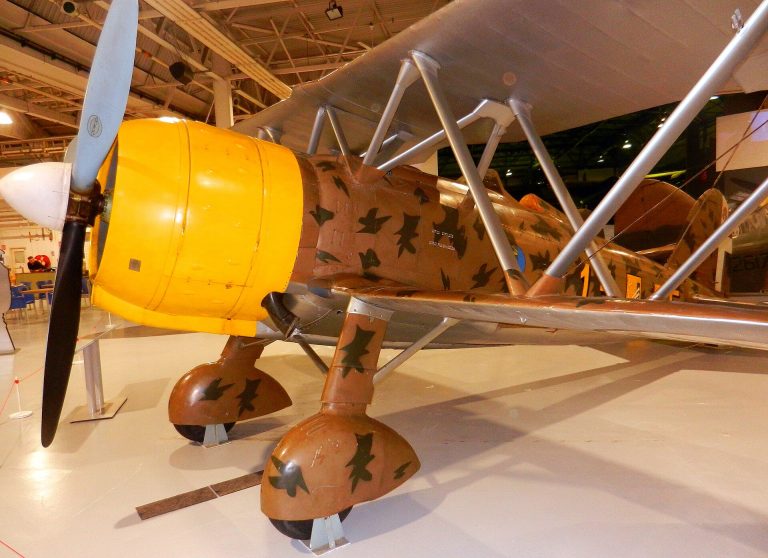
Survivors, precisely. Four original CR.42 airframes exist and none is airworthy. MM5701, a 95ª Squadriglia aircraft flown by Sergente Pietro Salvadori, force-landed with an overheating engine on the beach at Orford Ness, Suffolk, on 11 November 1940 during the Harwich raid; it was captured intact, test-flown in mock combat by the Air Fighting Development Unit in 1941, kept after 1943, restored in the 1970s and is on static display at the Royal Air Force Museum London under museum serial BT474 — the only CR.42 anywhere in original wartime Italian markings on an airframe that flew operationally. Swedish J 11 no. 2543, marked "9", is displayed at the Flygvapenmuseum in Linköping. Swedish J 11 no. 2542 crashed into terrain in Kiruna municipality on 13 April 1942, killing Bertil Klintman, and was recovered in 1983; its subsequent history is genuinely disputed, with English sources placing it with The Fighter Collection at Duxford under long-term restoration to fly and Italian ones recording it as transferred to the Italian Air Force on 25 May 1994 — the two accounts cannot both be right and neither could be confirmed here. The aircraft displayed as MM4653 at the Museo storico dell'Aeronautica Militare at Vigna di Valle is a composite reconstruction, roughly 60 per cent original material drawn from wrecks in Sweden, Italy and France, and not a single surviving airframe. There are no flying reproductions. Two further claims about this aeroplane need qualifying. It is routinely called the last biplane fighter to enter production anywhere; the Soviet Polikarpov I-153 was contemporary and far more numerous, so the defensible version of the claim is that the CR.42 was the last new-design biplane fighter put into large-scale production by a major air force and that it stayed in production later, into 1944, than any other. And on the last biplane air-to-air victory in Europe: on 8 February 1945 ten CR.42LWs of Stab and 2./Nachtschlachtgruppe 7 flew from Agram-Gorica against partisans near Sisak in Croatia and were attacked by P-38 Lightnings of the 14th Fighter Group; three Falchi were shot down and an unidentified German pilot claimed a Lightning. If allowed, that is the last biplane victory of the war. It is not well corroborated: USAAF records are reported to show no matching loss on that date. The competing claim is better documented and earlier — on 2 September 1944 Master Sergeant František Cyprich of the Slovak insurgent Combined Squadron shot down a Hungarian-marked Ju 52/3m in Avia B-534.217 during the Slovak National Uprising, though no Hungarian loss record confirming it has been traced either. The fair statement is that the Avia holds the last biplane victory anyone has been able to document, and the CR.42 holds the last one anyone claimed.
From the last biplane to the war’s end
From CR.32 to CR.42
Fiat’s Celestino Rosatelli refines his line of biplane fighters. The CR.42 Falco makes its first flight on 23 May 1938.
Into service, already outdated
The Falco enters Regia Aeronautica service in 1939, and is a front-line fighter when Italy declares war in June 1940 — by which point the biplane is already obsolescent.
Biplanes over Britain
Italian CR.42s of the Corpo Aereo Italiano fly from Belgium against England — one of the strangest sights of the Battle of Britain.
The African wars
In North and East Africa the Falco comes into its own. In East Africa, Mario Visintini scores 16 victories to become the top biplane ace in history.
Second-line survivor
As monoplanes take over front-line fighting, the Falco moves to night-fighting, ground attack and training, remaining useful long after it should have been retired.
German service and the end
After 1943 Germany operates over 150 Falcos for night-harassment raids. The last of the fighting biplanes serves on until the very end of the war in Europe.
Eight chapters in the Falco’s war
A throwback built by the thousand
While the world switched to monoplanes, Italy ordered a brand-new biplane fighter — and built it in enormous numbers.
The full story
Agility that surprised the RAF
British pilots who tangled with the Falco came away startled by just how sharply it could manoeuvre.
The full story
The Corpo Aereo Italiano
In one of the strangest episodes of the air war, Italian biplanes flew against England during the Battle of Britain.
The full story
Mario Visintini’s 16 kills
In the mountains of East Africa, one Italian pilot made the CR.42 the mount of the highest-scoring biplane ace in history.
The full story
The last biplane duels
Over the deserts and highlands of Africa, the CR.42 fought the very last biplane-against-biplane battles in history.
The full story
The CR.42CN without radar
Denied the speed to fight by day, the Falco found a second life hunting in the dark.
The full story
Luftwaffe night harassment
After Italy’s surrender, the Falco went to war again — this time in German markings.
The full story
Where to see a Falco today
For an aircraft built by the thousand and largely scrapped, a surprising number of Falcos survive.
The full story
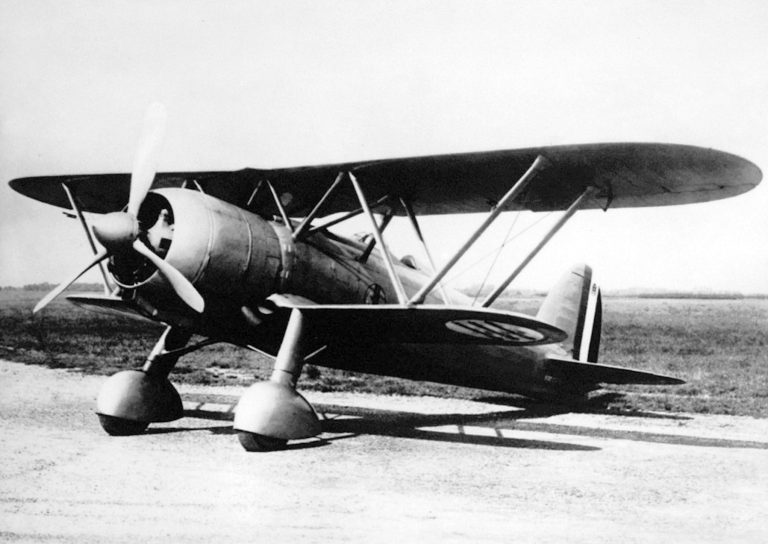
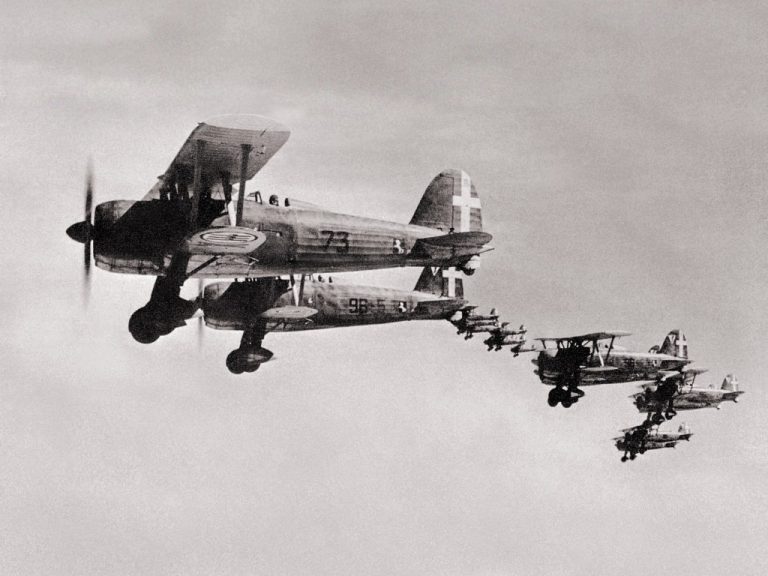
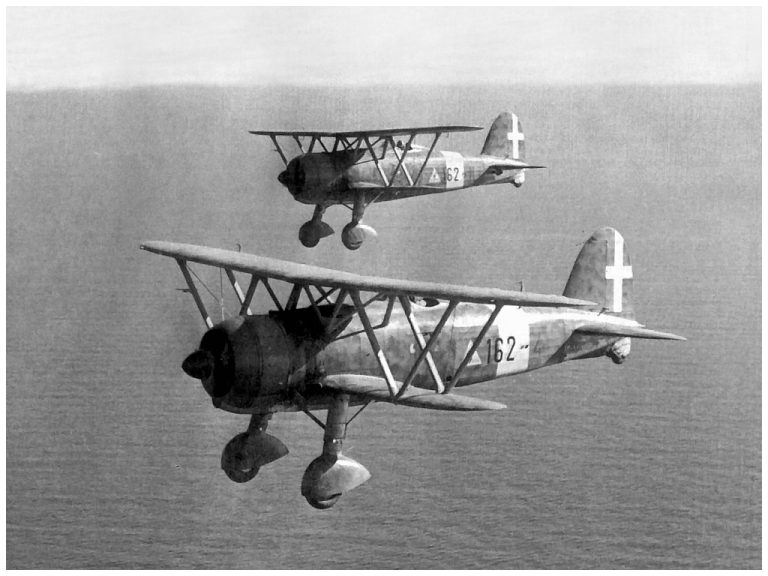
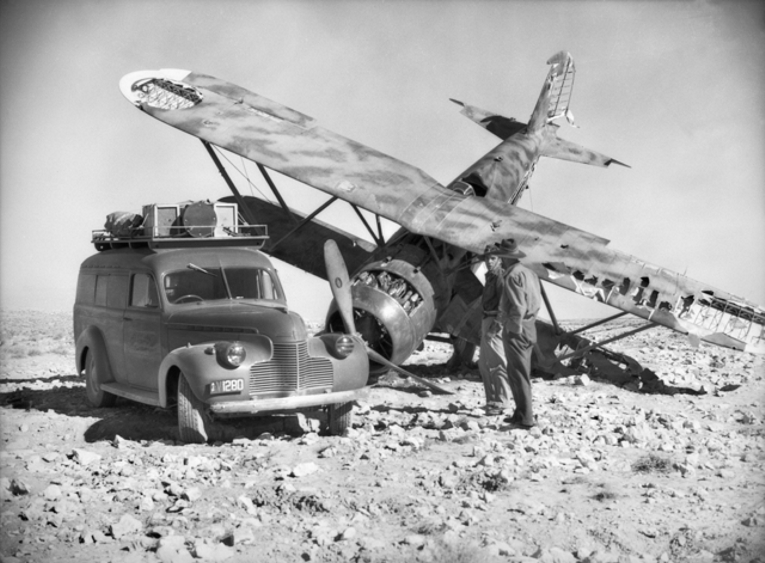
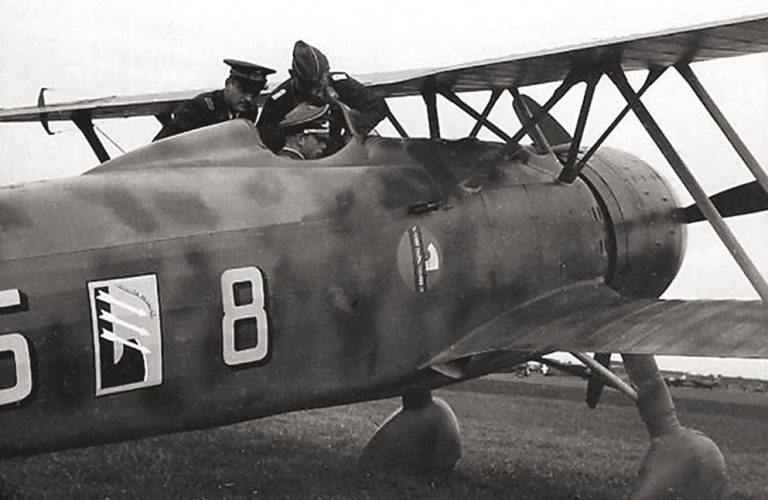
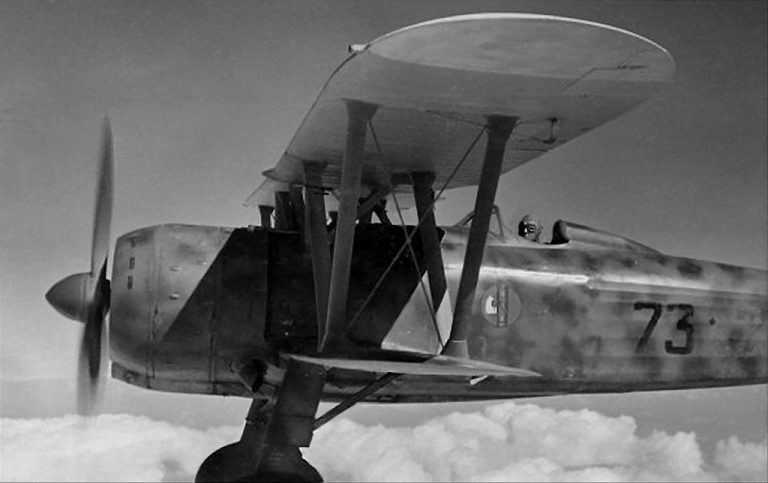
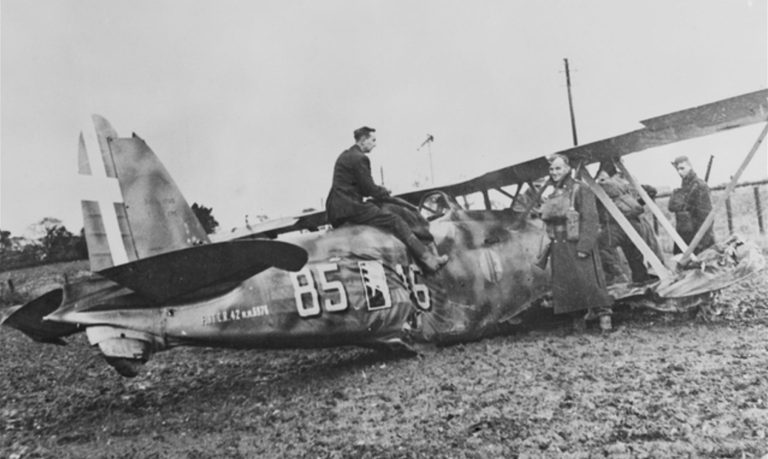
The Falco in pictures
See the Falco in context
Was the Falco the best biplane fighter of the war — or a beautiful anachronism? This short history follows the CR.42 from Fiat’s drawing board through the Battle of Britain and the African wars to its place as the last front-line fighter biplane.
Video: “Fiat CR.42 — The Best Biplane Fighter of WW2?” by AllthingsWW2 (~88,000 views). Embedded via YouTube.
Where the Falco fought
The Falco, by the numbers
The CR.42 fought a war it was never really equipped to win, and its record is a mix of genuine successes and inevitable losses. Superb in a turning fight and available in huge numbers, it did real damage where it could dictate the terms — and was picked apart where it could not. It was, above all, the last front-line fighter biplane, closing a chapter of air warfare that began in 1914.
Claims and losses in the Mediterranean and African air wars are hard to reconcile between Italian, British and other records; the figures above reflect the type’s scale and its most famous exploits rather than a precise tally.
Fiat CR.42 Falco — questions & answers
Can you fly a Fiat CR.42 Falco today?
No airworthy CR.42 currently flies for the public, though one is under long-term restoration at Duxford. Several complete examples survive as static museum exhibits. If you want to fly a real fighter yourself, MiGFlug offers cockpit experiences in genuine jet fighters you can actually strap into.
Why did Italy use biplanes in the Second World War?
Italian fighter doctrine still prized the tight-turning dogfight, where an agile biplane excelled, and Italy’s engine industry could not yet supply enough powerful inline engines for a first-rate monoplane. The CR.42 was the result — superb at manoeuvre, but overtaken by the speed and firepower of monoplane fighters.
Did Italian biplanes really fight in the Battle of Britain?
Yes. In late 1940 the Corpo Aereo Italiano flew Fiat CR.42s from bases in occupied Belgium against southern England — one of the more surprising sights of the Battle of Britain. One of those Falcos survives, having force-landed in Suffolk.
Was the CR.42 a good fighter?
For its type, yes — it was beautifully agile and could out-turn a Hurricane or even a Spitfire. But it was slow and armed with only two machine guns, so against modern monoplanes it was badly outclassed and increasingly relegated to second-line roles.
How many CR.42s survive?
Several. Complete Falcos are preserved at the RAF Museum in the UK, the Swedish Air Force Museum and the Italian Air Force Museum, with another under restoration at Duxford.
You can’t fly a Falco — but you can fly a fighter jet
The Falco’s war belongs to history, but the thrill of flying a real fighter doesn’t. With MiGFlug you can strap into a genuine jet — from the L-39 Albatros to a MiG-29 at the edge of space — with an experienced fighter pilot beside you.
 Fly the L-39 AlbatrosThe world’s most-flown jet trainer — aerobatics included
 Fly the F-104 Starfighter“The missile with a man in it”
 Fly the MiG-21The Cold War’s most-produced jet
 Fly the T-33 Shooting StarAmerica’s first jet trainer
 Fly the DH VampireA piece of early jet history
 Fly the S.211Agile Italian jet trainer
 Fly the MB-326The classic Aermacchi jet
 Fly the MiG-15The Soviet legend of the Korean War
Related aircraft
Where these facts come from
- RAF Museum — Fiat CR.42 FalcoThe Battle of Britain survivor MM5701
- Vintage Aviation News — surviving FalcosThe world’s surviving CR.42s
- Key.Aero — Italy’s forgotten fighterHistory & combat record
- San Diego Air & Space MuseumArchive photography of the type
Figures are drawn from museum and reference sources and cross-checked; where sources differ, the most commonly cited value is given. Armament and performance varied between the Falco’s several sub-types.