
Heinkel He 219 Uhu
Germany's first purpose-built night fighter — radar-equipped, packed with firsts including ejection seats and tricycle gear, and rated a superb bomber-destroyer. Yet procurement politics strangled it: barely 268–300 were ever built, and just one survives today.
The Heinkel He 219 Uhu: the night fighter that was too good for its own air force
The Heinkel He 219 Uhu (“Eagle Owl”) is one of the great might-have-beens of the Second World War. It was the first German aircraft designed from the outset as a radar-equipped night fighter, and by the standards of 1943 it was startlingly modern — fast, heavily armed, and stuffed with features years ahead of its rivals. In combat it proved deadly. And yet fewer than three hundred were ever built, because the men who ran German aircraft procurement did not want it. The Uhu’s story is the story of a brilliant machine defeated less by the enemy than by the politics of its own side.
By 1942 the RAF’s Bomber Command was pounding German cities night after night, and the Luftwaffe was defending the darkness with improvised night fighters — adapted Messerschmitt Bf 110s, Junkers Ju 88s and Dornier Do 217s. These were serviceable but slow, and they struggled against the fast British bombers, above all the wooden de Havilland Mosquito. Ernst Heinkel’s design team, led by Robert Lusser, offered a solution: a clean twin-engine aircraft designed specifically for the night-fighting role, with the speed to catch anything the RAF could send.
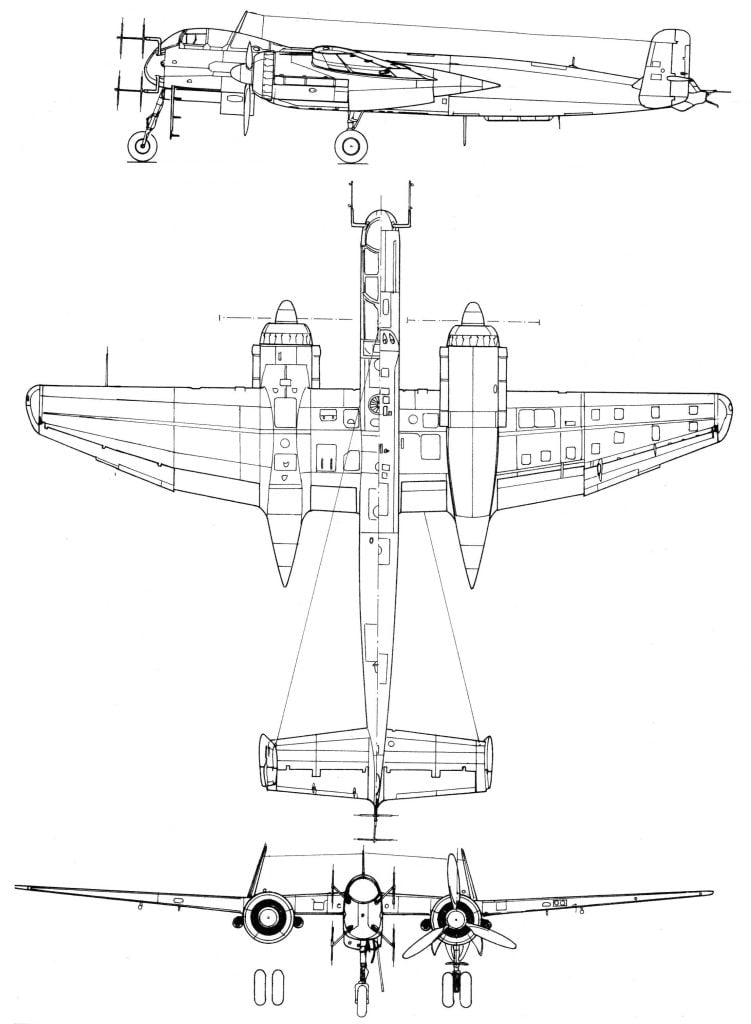
What emerged was remarkable. The He 219 had a tricycle undercarriage — a nosewheel layout still unusual on German combat aircraft — which made it far easier to handle on the ground at night. Its two crew sat in a pressurised-feeling, well-glazed cockpit fitted with what were, in effect, the world’s first ejection seats to be installed in an operational aircraft, blasted clear by compressed air. In the nose it carried airborne interception radar, the FuG 220 Lichtenstein SN-2, its aerials sprouting from the nose in the antlered array the British nicknamed the “stag’s antlers.” And it bristled with cannon — a heavy forward battery, and on many aircraft a pair of upward-firing weapons, the famous Schräge Musik, that let a pilot slide unseen beneath a bomber and rake it from below.
“Had the Heinkel 219 been produced in quantity, it might have driven the RAF’s night bombers from the skies over Germany. It was that good — and it was that comprehensively wasted.”— A common assessment among post-war aviation historians (paraphrased)
The aircraft’s combat debut became legend. On the night of 11–12 June 1943, flying from Venlo in the occupied Netherlands, the night-fighting ace Major Werner Streib took a pre-production He 219 up against a Bomber Command raid and, in a single sortie, shot down five bombers — then wrecked the aircraft in a landing accident when its flaps failed. The tally is the one most often quoted, though as with all such claims the exact figure is debated. Over the following nights the small Venlo detachment ran up further victories, including several of the previously near-untouchable Mosquitoes. To the crews who flew it, the verdict was plain: give us this aircraft in numbers, and we can win the night battle.
They never got it. The head of Luftwaffe procurement, Field Marshal Erhard Milch, distrusted the He 219. He regarded it as expensive, complex and a distraction, and he preferred to press on with adaptations of aircraft already in mass production — the Ju 88 night-fighter family above all. Milch repeatedly tried to cut back or cancel the programme, and the Uhu was buffeted by a running bureaucratic feud that consumed the very months when it might have been built in quantity. Production trickled rather than flowed; figures vary between sources, but only somewhere around 268 to 300 aircraft were completed in total, and they were spread thinly among a handful of units, principally Nachtjagdgeschwader 1.
So the He 219 fought the whole rest of the war as a small, elite force rather than the war-winning weapon its supporters imagined. As 1944 wore on, the same crises that crippled the rest of the Luftwaffe pressed down on the Uhu units too: aviation fuel grew desperately short, experienced aircrew were used up faster than they could be replaced, and the sheer weight of Allied air power made every sortie more dangerous. The He 219 kept scoring where it flew, but it flew ever less often, and the handful of aircraft could be in only one place at a time. Its crews respected it; the RAF feared it where they met it; and historians have argued ever since about how much difference a few thousand of them might have made. What is certain is that the aircraft itself was not the problem. The Uhu was a genuinely advanced design that did everything asked of it in combat — and it was throttled at birth by the indecision and rivalry of the organisation that ordered it. That is why it fascinates: not a failure of engineering, but a failure of judgement wrapped around a superb aeroplane.
01Why Germany needed the He 219 Uhu: the night battle over the Reich+
By 1942–43 the night sky over Germany had become a battlefield in its own right. RAF Bomber Command had switched to area bombing by night to avoid the murderous daylight flak and fighters, sending streams of hundreds of Lancasters, Halifaxes and Wellingtons deep into the Reich. To stop them the Luftwaffe built the Kammhuber Line — a belt of radar-directed “boxes” in which ground controllers vectored night fighters onto individual bombers picked out on radar.
The trouble was the fighters themselves. The Bf 110, Ju 88 and Do 217 pressed into night work were converted day- or medium-bombers: adequate, but often no faster than the bombers they hunted, and hopelessly outpaced by the fast, high-flying Mosquito. What the Nachtjagd needed was an aircraft conceived from a clean sheet for the job — fast enough to run down anything, stable enough to be a steady gun platform, and able to carry heavy radar and armament without becoming a barge. That aircraft was the He 219. It arrived to answer exactly the right question, at exactly the moment German procurement politics were least willing to fund the answer.
The design itself grew out of an earlier Heinkel private-venture study, the P.1060, a fast multi-role twin that Robert Lusser’s team reworked into a dedicated night fighter once the scale of the RAF’s night offensive became clear. General Josef Kammhuber, the commander who built and ran the German night-fighter arm, became one of the aircraft’s strongest advocates — and his championing of the He 219 against Milch’s scepticism would eventually contribute to his own removal from command. From the very start, in other words, the Uhu was as much a political project as a technical one.
02The He 219 Uhu's list of firsts: ejection seats, tricycle gear and radar in one airframe+
The Uhu packed an unusual number of genuine firsts and advanced features into a single design. It is widely credited as the first operational military aircraft to be fitted with ejection seats — compressed-air seats for both crew members, a real innovation at a time when bailing out of a fast, complex aircraft at night was often fatal. It was also the first operational German aircraft to use a tricycle (nosewheel) undercarriage, which transformed ground handling and take-off in darkness compared with the tail-draggers it replaced.
To these it added airborne interception radar as standard — the FuG 220 Lichtenstein SN-2, whose nose aerials gave the aircraft its distinctive antlered silhouette — and a heavy, flexible cannon armament that on many aircraft included the upward-firing Schräge Musik installation. No other night fighter of its era brought so many modern ideas together in one airframe. The tragedy is that so few were built that most of these innovations reached the front only in tiny numbers.
It is worth pausing on the ejection seats in particular, because they capture the spirit of the whole design. Early ejection systems were experimental and dangerous in their own right, and fitting them to a production combat aircraft in 1942–43 was a genuine leap of faith. Heinkel had been a pioneer of the technology — the firm’s He 280 jet prototype had already made the first emergency escape by ejection seat in 1942 — and the He 219 carried that experience into an operational type. The message to the men who would fly it was unmistakable: this was an aircraft designed by people who had actually thought about how its crews might survive the worst night of their lives. That attention to the human being in the cockpit was, in 1943, almost as advanced as the radar in the nose.
03Werner Streib and the He 219's deadly combat debut, 11–12 June 1943+
The aircraft’s reputation was made on a single night. On 11–12 June 1943, Major Werner Streib — already one of the Luftwaffe’s leading night-fighter aces — flew a pre-production He 219 V9 from Venlo against an RAF raid on the Ruhr. In the course of one sortie he was credited with shooting down five bombers, before the aircraft’s flaps malfunctioned on his return and it was wrecked in the ensuing crash landing; Streib and his radar operator walked away.
Five kills in a single sortie was an extraordinary result, and though the precise number is debated (as wartime claims always are), the wider point is not: over the following nights the handful of He 219s at Venlo continued to score, including against RAF Mosquitoes that other German night fighters could rarely catch. The debut convinced the front-line night-fighter community that the Uhu was the aircraft they had been waiting for. It did not convince the procurement authorities in Berlin — and it was Berlin, not Bomber Command, that ultimately decided the Uhu’s fate.
Streib was no ordinary pilot, which is worth remembering when weighing the debut: he was already a highly experienced ace and a commander of night fighters, so the result reflected both a superb aircraft and an exceptional airman. That nuance matters, because it cuts against a simple “wonder-weapon” reading — the He 219 gave a great pilot the tools to do great things, rather than turning any pilot into an ace. Even so, the reports flowing back from Venlo in June 1943 were emphatic, and they turned the aircraft into a cause. Kammhuber and the night-fighter leadership seized on the results to press for mass production; the fact that they still lost the argument tells you everything about how the decision was really being made.
How the He 219 Uhu was built — a night fighter designed for the job
Radar in the nose
The FuG 220 Lichtenstein SN-2 airborne interception radar let the crew find bombers in darkness, its antenna array giving the Uhu its unmistakable “stag’s antlers” nose. It was standard equipment, not an afterthought.
Cannon & Schräge Musik
A heavy forward battery of 20 mm and 30 mm cannon, and on many aircraft a pair of upward-firing 30 mm MK 108s — Schräge Musik — that let the pilot attack a bomber from directly below its blind spot.
Ejection seats & tricycle gear
Compressed-air ejection seats for both crew — the first on any operational aircraft — and a nosewheel undercarriage that made the fast, heavy night fighter far easier and safer to handle in the dark.
04The He 219's DB 603 engines and performance: fast enough to catch a Mosquito+
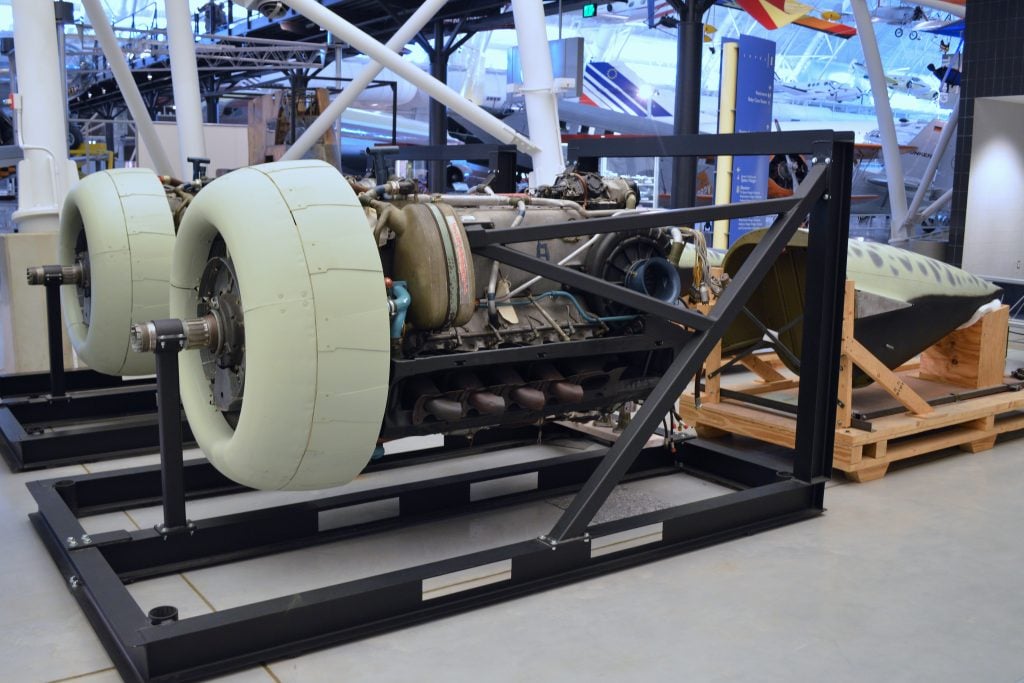
The Uhu was powered by two Daimler-Benz DB 603 inverted-V12 engines — large, powerful units that gave it the speed its role demanded. Output and top speed varied by variant: early A-series aircraft with the DB 603A were good for roughly 580–615 km/h, while the later A-7, with more powerful DB 603E engines, is commonly cited at around 670 km/h at altitude. Exact figures differ between sources and depend on weight, radar drag and armament fit, so they are best treated as approximate.
Crucially, that performance was enough to run down the fast British bombers, including the Mosquito, which had been running rings around the Luftwaffe’s converted night fighters. Combined with heavy firepower and radar, the He 219’s speed is what made it such an effective bomber-destroyer — and what made its front-line crews so desperate to have it in numbers.
The DB 603 was one of the largest inverted-V12 engines Germany fielded, and it gave the Uhu genuine reserves of power — important for an aircraft that had to lift heavy radar aerials, a big cannon battery and full fuel, and still accelerate to catch a fleeing bomber. It was not trouble-free; like most high-output wartime engines it demanded careful handling and good maintenance, both of which grew harder to guarantee as Germany’s situation deteriorated. But when it was running well, the DB 603 gave the He 219 exactly the margin of speed that the converted Bf 110s and Ju 88s so conspicuously lacked.
05Schräge Musik explained: how the He 219 killed bombers from below+
Schräge Musik — German slang loosely meaning “jazz” or literally “slanted music” — was one of the deadliest night-fighting innovations of the war, and the He 219 was among the aircraft that carried it. The idea was simple and lethal: mount a pair of cannon (typically 30 mm MK 108s) in the fuselage firing upward and slightly forward, so the night fighter could formate unseen beneath an RAF bomber and fire up into its wings and fuel tanks.
The tactic exploited a fatal weakness of the British heavies: they had no ventral gun turret and their crews rarely watched directly below. A well-flown night fighter could slide into the bomber’s blind spot, take careful aim at the fuel-laden wing between the engines, and destroy it before the crew even knew they were under attack. On the He 219, with its radar to find the target and its speed to close in, Schräge Musik made a formidable weapon system — when the aircraft was available to use it.
The 30 mm MK 108 cannon typically used for the installation was a short-barrelled, low-velocity weapon that fired large, heavy explosive shells — ideal for the close-range, deflection-free shots that Schräge Musik made possible. A short burst into a wing tank could be catastrophic, and because the attack came from an unexpected quarter and often used non-tracer ammunition, RAF crews frequently had no idea what had hit them; losses that were in fact caused by upward-firing cannon were sometimes attributed to flak or mid-air collision. It took the RAF a considerable time even to work out that the tactic existed. The He 219 was one of the aircraft that made this deadly technique so effective, and it is a large part of why a well-handled Uhu was such a nightmare for a bomber crew.
06Variants of the He 219: from the A-0 pre-production to the high-altitude chasers+
He 219 production centred on the A-series. Early A-0 pre-production and A-2 aircraft established the type in service with the DB 603A/AA engines; the definitive high-performance variant was the A-7, with more powerful DB 603E (and, in sub-variants, other DB 603 versions), a strengthened structure and provision for a heavy, mixed cannon armament. Various R (Rüstsatz) field-conversion sets tailored the armament fit, and the sole surviving aircraft is an A-2/R4.
Heinkel also proposed and prototyped more ambitious developments — higher-altitude versions intended to catch the Mosquito and high-flying reconnaissance aircraft, and studies with different engines and armament. But because the whole programme was starved of priority and repeatedly threatened with cancellation, these advanced variants never reached meaningful production. The Uhu that actually fought the war was the modestly-built A-series, deployed in numbers far below what its crews wanted.
Because production was so small and so frequently interrupted, individual He 219s often differed considerably from one another in radar fit, armament and equipment, with field-conversion R-kits mixing and matching weapons to suit the units and the targets. This makes the type unusually hard to pin down to a single “standard” specification — a reminder that the Uhu was, in effect, hand-built in penny packets rather than mass-produced to a fixed pattern. The armament figures quoted for the He 219 should therefore always be read as representative rather than definitive.
Heinkel He 219 A specifications and cost
Figures below are broadly representative of the He 219 A (with notes where variants differ) and are drawn from established reference works and the Smithsonian. Wartime German figures vary between sources, so contested values are flagged as estimates.
Baseline: the Heinkel He 219 A-7 of late 1944 and 1945 — two Daimler-Benz DB 603E, the full FuG 220 SN-2 radar fit and the six-cannon battery with Schräge Musik — because it was the definitive production mark and because the specification table reproduced in almost all English-language sources describes it. Deltas for the A-0, the A-2, the stripped A-6, the Jumo-engined D-1 and the unbuilt B, C and E high-altitude projects are in grey. Four warnings before the figures. First, the headline maximum speed is a clean-airframe number and the He 219 never flew clean: the eight-dipole Hirschgeweih aerial array, the exhaust flame dampers and the ventral gun tray together cost the aircraft roughly 45 km/h, which German sources record explicitly for the A-2 and which nobody records for the A-7. Second, the weights are the worst-attested numbers on this aeroplane: English-language tables give an empty weight of 11,200 kg for the A-7 while German-language tables give 8,120 kg for the A-2, and the two cannot both describe the same airframe with 3,000 kg of engines, guns and radar between them. Both are shown below and neither is endorsed. Third, production is genuinely unknown at the margins because Heinkel’s Vienna-Schwechat records for the last months were destroyed; totals in the literature run from 268 to about 294 and the brief for this page said 290 to 300, which is at the very top of the defensible range. Fourth, the He 219 has attracted more folklore than almost any other Luftwaffe type, and two of the best-loved stories — that three pre-production aircraft shot down twenty RAF machines including six Mosquitos in ten days, and that it was the first operational German aircraft with a nosewheel — do not survive checking. Both are corrected in place below.
Dimensions & weights
- Crew
- 2 — pilot and radar operator, seated back-to-back with the operator facing aft A deliberately small crew for a deliberately specialised aeroplane. The operator worked the FuG 220 scopes facing rearward under the same long canopy, which gave him a stable dark-adapted working position and gave the pilot an unobstructed forward view. The projected A-5 and the He 219 C would have carried three, the C using a complete Ju 388J cockpit section.
- Length
- 15.55 m (51 ft 0 in) English-language tables give 15.33 m (50 ft 4 in) for the A-7 against the German figure of 15.55 m for the A-2; the difference is small enough to be a nose-cone or datum convention rather than a real change. The unbuilt He 219 C would have been 17.15 m (56 ft 3 in) on an entirely new fuselage.
- Wingspan
- 18.50 m (60 ft 8 in) The A-2 is usually quoted at 18.53 m. Every serious attempt to turn the Uhu into a high-altitude fighter began by stretching this: 22.06 m (72 ft 5 in) for the He 219 B, 24.55 m (80 ft 7 in) for the Hütter Hü 211, and 28.5 m (93 ft 6 in) for the paper He 219 E. None flew.
- Height
- 4.10 m (13 ft 5 in)
- Wing area
- 44.5 m² (479 sq ft) Small for the weight, and the reason the He 219 was a fast cruiser and an indifferent climber. The He 419 development stretched this to 59 m² (635 sq ft) precisely to buy back altitude performance.
- Aspect ratio
- 7.7 Unremarkable, and worth stating plainly because the He 219 is often written up as an aerodynamic tour de force. It was not. It was a conventional, clean, well-detailed shoulder-wing twin whose virtues were installation engineering and systems, not wing design.
- Aerofoil
- Heinkel section, He 2 37 16.8–0.715–36.6 at the root, He 2 37 12–0.715–36.6 at the tip
- Empty weight
- 11,200 kg (24,690 lb), A-7 This is the single most disputed number on the aeroplane. German-language sources give 8,120 kg (17,900 lb) for the A-2, a gap of over three tonnes that no plausible difference between the two marks explains. One of the two figures is almost certainly an equipped-versus-bare distinction that has lost its label somewhere in seventy years of copying. Treat any He 219 weight you see with suspicion.
- Loaded weight
- 15,300 kg (33,730 lb), A-7 The A-2 is given at 12,500 kg (27,560 lb) normal and 13,302 kg (29,325 lb) with the ventral drop tank. The A-7 grew through heavier engines, more fuel and the full six-gun battery.
- Wing loading
- 344 kg/m² (70.4 lb/sq ft) at loaded weight Very high for a 1944 piston fighter of any kind, and the arithmetic behind Eric Brown’s verdict that the aircraft was underpowered. The A-2 at 12,500 kg works out at 281 kg/m² (57.5 lb/sq ft), which is closer to the number the aeroplane deserved.
- Internal fuel
- ~2,500 l (~660 US gal) in the fullest fits, with a ventral drop tank available on the same station as the gun tray Figures are inconsistently reported and rose through the marks; the A-2’s lengthened engine nacelles existed specifically to carry additional tankage. What is firmly attested is the effect: 1,545 km on internal fuel, 2,100 km with the tank.
- Undercarriage
- Retractable tricycle gear, single nosewheel retracting rearward into the fuselage nose, mainwheels into the nacelles Almost every account calls the He 219 the first operational German military aircraft with a nosewheel. It was not. The Arado Ar 232 transport flew in June 1941 on tricycle gear and was flying operational supply sorties to the Stalingrad pocket in January 1943, five months before the Uhu went to war. The accurate claim — still a real one — is that the He 219 was the first German combat aircraft in operational service to have one, and it mattered: a nosewheel makes a heavy twin far safer to land at night by an exhausted crew, which is exactly the case the layout was chosen for.
Performance
- Maximum speed
- 670 km/h (416 mph, 362 kn) at 7,000 m (23,000 ft), A-7 on DB 603E A clean-airframe figure. Some tables round this to 420 mph, which is a conversion error rather than a different measurement. Treat it as what the airframe could do without the war strapped to it.
- Maximum speed, operational fit
- 560 km/h (348 mph) at 6,300 m (20,670 ft) with the Hirschgeweih aerials fitted, against 605 km/h (376 mph) at 6,400 m clean — both A-2 on DB 603A This pair of numbers is the most useful thing in the table. A 45 km/h penalty for eight dipoles and their masts is a heavy price, and it was paid by every night fighter in the Luftwaffe. It is also the reason the anti-Mosquito claims deserve scepticism: a radar-equipped Uhu was not appreciably faster than a Mosquito night fighter, and could be slower.
- Cruising speed
- 540 km/h (336 mph)
- Rate of climb
- 10 m/s (1,970 ft/min) near sea level, falling to 8 m/s (1,575 ft/min) at 6,000 m German sources qualify both figures as approximate. Eric Brown, who flew captured A-2s at Farnborough, called the climb "certainly unimpressive" and the aircraft "decidedly underpowered", and these numbers are why.
- Time to 6,000 m
- About 11 minutes on the published climb rates Derived here from the climb figures above rather than taken from a source table, and offered as an order of magnitude. It is slow enough that the He 219 was a poor scrambling interceptor and had to be positioned early — which is exactly how ground-controlled night interception worked, so the weakness mattered less than it looks.
- Service ceiling
- 8,900 m (29,200 ft), A-2 on DB 603A English-language tables give 12,700 m (41,700 ft) as an absolute ceiling for the A-7. That figure sits very badly with a wing loading of 344 kg/m² and with the whole reason the He 219 B, C and E projects existed, and it should be treated as an outlier. The honest summary is that the Uhu worked well at Bomber Command’s altitudes and was running out of aeroplane above them.
- Range on internal fuel
- 1,545 km (960 mi, 834 nmi)
- Range with drop tank
- 2,100 km (1,305 mi); a ferry range of 2,000 km (1,243 mi) is also quoted The two figures are close enough that they are probably the same measurement described twice.
- Endurance
- ~2 h 50 min at cruising speed Derived from range and cruise rather than sourced. Long enough for a full night’s work over the Netherlands, Denmark or northern Germany, which is what the aircraft was built to do.
- Speed margin over the Mosquito
- Marginal at best, and negative in some fits Mosquito night-fighter marks ran from roughly 610 km/h for the NF Mk XIX to roughly 655 km/h for the NF Mk 30. A radar-equipped He 219 A-2 made 560 km/h. The stripped A-6 was built specifically to close this gap and reportedly reached 650 km/h at 12,000 m, but none entered production. The claim that the He 219 could catch the Mosquito is true of a clean A-7 and false of the aeroplane the Luftwaffe actually flew.
- Take-off and landing
- Docile by the standards of a heavy piston twin, and deliberately so The tricycle gear, the wide track and the good forward view were chosen to make a fifteen-tonne aeroplane landable at three in the morning on a blacked-out field. Streib’s own first sortie ended in a wrecked aircraft on landing, but the cause was iced-over glazing and electrically actuated flaps that retracted themselves, not the undercarriage.
Propulsion & systems
- Engines
- 2 × Daimler-Benz DB 603E inverted V-12, liquid-cooled, 1,800 PS (1,324 kW, 1,776 hp) for take-off, rated altitude 7,000 m (23,000 ft) The A-0 used the DB 603A at 1,750 PS with a rated altitude of only 5,700 m; the A-2 used the DB 603AA, which traded power down to 1,670 PS in exchange for a better supercharger and 7,300 m. Sources credit the A-5 with the 1,900 PS DB 603G, but the DB 603G was cancelled before production, so any A-5 so described was either a trials installation or a misattribution.
- Engine detail
- 44.52 l (2,717 cu in), bore and stroke 162 × 180 mm (6.38 × 7.09 in), dry weight 920 kg (2,030 lb) each The largest-displacement German inverted V-12 to reach volume production, and the engine the He 219 programme was hostage to. Early DB 603s had poor altitude performance, which is a substantial part of why the RLM rejected the design in January 1942.
- Propellers
- Three-blade VDM constant-speed units, one per engine
- Powerplant installation
- Unitised Kraftei power eggs with annular frontal radiators, interchangeable as complete assemblies One of the genuinely excellent things about this aeroplane, and the reason its nacelles look like a radial installation from the front. A whole power unit could be swapped rather than rebuilt in situ — a serviceability advantage the Luftwaffe was in no position to waste.
- Airborne interception radar
- FuG 220 Lichtenstein SN-2, 90 MHz, four-by-two-dipole Hirschgeweih array, maximum range about 4 km (2.5 mi), minimum 900 m (3,000 ft) The early aircraft carried the 490 MHz FuG 212 Lichtenstein C-1 with its 32-dipole Matratze array, which Window and Allied jamming had gutted by mid-1943. SN-2’s low frequency restored capability until a FuG 220-equipped Ju 88G-1 landed by mistake at RAF Woodbridge in July 1944 and handed the set over intact. Late aircraft carried FuG 218 Neptun, six switchable channels between 158 and 187 MHz.
- Passive homing receivers
- FuG 227 Flensburg, homing on RAF Monica tail-warning radar; FuG 350 Naxos Z, homing on H2S ground-mapping transmissions Weapons in their own right. A night fighter that homes on a bomber’s own emissions needs no ground control and cannot be jammed by chaff, and the RAF was slow to realise what its own equipment was doing to it. Flensburg was compromised by the same Woodbridge Ju 88 in July 1944.
- Radio and identification
- FuG 16ZY VHF R/T with homing facility, FuG 25a Erstling IFF, blind-approach equipment The standard late-war Luftwaffe fit; individual aircraft varied and the surviving documentation for He 219 radio installations is thin.
- Ejection seats
- Two compressed-air seats, one per crew station The He 219 was the first operational aircraft of any nation to be built with ejection seats for its crew. German sources credit them with saving roughly 60 airmen. The technology came from the He 280 jet prototype, from which Helmut Schenk made the first emergency ejection in history on 13 January 1942; compressed air rather than the explosive cartridges Heinkel later used on the He 162. Of all the He 219’s "firsts" this is the one that holds up completely, and the one that has had the longest afterlife.
- Flight control systems
- Hydraulic undercarriage, electrically actuated flaps The electric flaps were a weak point. On the type’s first operational sortie they failed to lock down and retracted themselves during Streib’s approach, which wrote off the aircraft; the same failure mode recurred.
- Cockpit
- Long single canopy over both crew, armoured glass forward; pressurisation designed in from the start and never fitted to a production aircraft The 1940 P.1055 proposal specified a pressure cabin, and the abandonment of it is the clearest single sign of how much ambition was stripped out of the design between proposal and service.
- Structure
- All-metal stressed-skin shoulder-wing monoplane, twin fins and rudders, ventral weapons tray on the fuselage centreline Conventional, well made and expensive — conventional metal construction at a moment when the RLM was pressing wooden alternatives such as the Ta 154 on grounds of strategic material supply. That argument was used against the He 219 and it was not an unreasonable one.
07The He 219 Uhu's operating costs: why no cost-per-hour figure exists today+
Unlike post-war jets, wartime German aircraft were not costed in a way that translates into a modern cost-per-flight-hour figure, and no reliable programme accounting for the He 219 survives in any comparable form. Reichsmark unit prices quoted for other Luftwaffe types are of limited use and are not consistently recorded for the Uhu.
More fundamentally, there is no He 219 flying anywhere in the world. Exactly one complete aircraft survives — a static museum exhibit — and there is no airworthy example, no operator, no maintenance programme and no fuel bill to measure. Any “cost per hour” figure would therefore be pure invention, so we record it honestly as not applicable. If you want to know what flying a genuine historic military jet actually costs today, MiGFlug’s live pricing is the place to look.
08How many He 219s were built — and why so few+
Production totals for the He 219 are usually given as somewhere between about 268 and 300 aircraft across all variants, with different sources citing different figures depending on how pre-production and partially-completed airframes are counted. By any measure it is a strikingly small number for an aircraft its front-line crews regarded as the best night fighter available to them.
The reason was not technical difficulty but priority. The programme never received the backing needed for mass production, because senior procurement figures — Erhard Milch above all — preferred to concentrate on adapting aircraft already in quantity production, chiefly the Ju 88 night-fighter series. Repeated attempts to cancel or curtail the He 219 kept it starved of resources, and by the time its value was undeniable, Germany’s collapsing war economy could no longer build it in numbers even if the will had existed. The Uhu remained a small, elite type to the end.
The precise figure is genuinely uncertain, and readers will find different numbers in different reference works — some cite as few as 268 completed aircraft, others closer to 290 or 300 once pre-production machines and partly-finished airframes are included. The ambiguity is itself a symptom of the chaotic, stop-start way the type was built: with production repeatedly threatened, restarted and interrupted, even the bookkeeping is uncertain. What every source agrees on is the order of magnitude. Against the many thousands of Ju 88s and Bf 110s that fought the night war, the He 219 was built in the low hundreds — a rounding error in the Luftwaffe’s total output, for an aircraft many of its own crews rated the best of the lot.
Armament & payload
The He 219 put two 30 mm cannon in the one place a Lancaster could neither see nor shoot
The He 219 is the only aircraft in this encyclopedia whose armament can be described in one sentence and whose armament is nonetheless the most interesting thing about it. Six forward-firing cannon grouped tight around the centreline, and two 30 mm MK 108 buried in the rear fuselage pointing up at 65 degrees. That second installation — Schräge Musik, oblique music — was not a Heinkel invention; Oberleutnant Rudolf Schoenert had been experimenting with upward-firing guns since 1941 and the first installation went into a Do 17Z-10 in late 1942. But the He 219 was the first aircraft designed around the idea rather than modified to accept it, with the guns and their ammunition inside the fuselage and only the muzzles breaking the skin.
What made it lethal was geometry, not firepower. RAF heavy bombers had no ventral turret. A night fighter that could sit 460 m below and slightly behind a Lancaster was in a position from which the bomber literally could not see it and could not shoot at it, and from which the shot required no deflection at all. Crews fired into the wing between the engines, aiming for fuel rather than for the fuselage, because a bomber whose wing tanks are burning goes down and a bomber whose crew compartment is shot up sometimes gets home. By 1944 a third of the German night-fighter force carried some version of the installation, and for months Bomber Command could not work out why aircraft were exploding without any gunner reporting a fighter.
The complaints came from the gun, not the concept. The MK 108 was a short-barrelled 30 mm with a muzzle velocity low enough that its shells arced visibly, which meant closing to a range where a disintegrating bomber could take its killer with it. He 219 units began pulling the MK 108s out and substituting 20 mm MG FF/M. Fits varied by mark, by unit and by month to a degree that makes any single armament table misleading. An A-0 of I./NJG 1 in June 1943, an A-2 with SN-2 and full Schräge Musik in mid-1944, and a late A-7 with FuG 218 and a rebuilt gun tray were three different aeroplanes wearing one type number, and the loss of Heinkel’s Vienna-Schwechat records means the late fits are the least well documented of all.
Gun
- Two 20 mm MG 151/20 in the wing roots, 300 rounds per gun — the constant of every mark from the A-0 to the A-7
- Two or four further cannon in a detachable ventral tray (Waffenwanne) on the fuselage centreline: 20 mm MG 151/20 at 300 rounds per gun in the usual fit, with 30 mm MK 108 and 30 mm MK 103 both used
- Six forward-firing guns on the A-7, all grouped close to the centreline, which gave a short convergence and made deflection almost irrelevant — the correct answer for a weapon aimed at a bomber from directly astern in the dark
- The ventral tray detached as a unit, so armament could be changed between sorties rather than rebuilt; the same station carried the drop tank when guns were traded for endurance
- Aimed through a Revi reflector sight; the radar operator called the intercept and the pilot fired visually at very short range
Air-to-air
- Two 30 mm MK 108 mounted in the rear fuselage firing upward at 65 degrees — Schräge Musik, and the He 219’s decisive weapon
- The tactic: close from about 460 m below the bomber in its blind spot, pull up, fire a no-deflection burst into the wing roots and fuel tanks as the nose crosses the sight, and break away. RAF heavies had no ventral turret and frequently never saw what killed them
- Ammunition was specially loaded with a faint-trail tracer substitute so the burst did not advertise the firing position, mixed armour-piercing, high-explosive and incendiary
- By mid-1944 He 219 crews were complaining about the MK 108: superb destructive power, but low muzzle velocity and short effective range forced them close enough to be damaged by their victim’s debris. Units replaced the MK 108s with lighter 20 mm MG FF/M in the field
- No guided air-to-air missile was ever carried. The Ruhrstahl X-4 was intended for day fighters and never reached the night-fighter force
Air-to-surface guided
- None, on any mark, at any time
- The He 219 was the most single-minded aircraft in the Luftwaffe inventory: one role, one target set, one crew of two. Unlike the Ju 88, which was a bomber pressed into night fighting and could go back to bombing, the Uhu had no second job
- The Hs 293 and Fritz X guided weapons that the Do 217 and He 177 carried needed a third crew member to fly the missile visually — impossible in a two-seat night fighter and pointless in the dark
- This single-role purity is exactly the argument Erhard Milch used against the type: scarce Daimler-Benz engines and scarce factory capacity spent on an aeroplane that could do only one thing
Bombs
- None carried operationally
- The He 219 A-1 was to have been a reconnaissance-bomber version of the airframe; the project was abandoned before any were built and the Uhu never carried an offensive bomb load
- The ancestral P.1055 proposal of 1940 was a multi-role machine with a bomb bay, and the ventral tray on the production aircraft is what that bay became
- A single drop tank on the ventral station was the only external store the type routinely carried
Rockets
- None in service on the He 219
- The 21 cm Werfer-Granate tubes that Bf 110 and Fw 190 crews used against American day formations were of no use at night, where the problem was finding the bomber rather than reaching it
- The R4M salvo rocket, which transformed Me 262 attacks in 1945, arrived far too late to be fitted to a type whose production had officially been cancelled a year earlier
- The projected He 419 B-1 would have carried four 30 mm MK 108 in a ventral housing rather than rockets — German night-fighter thinking stayed with cannon to the end
Pods & other stores
- The detachable ventral Waffenwanne gun tray, carrying two or four cannon and their ammunition as a single removable module
- A ventral drop tank, raising range from 1,545 km to 2,100 km on the same station
- The FuG 220 Hirschgeweih aerial array — not a store, but functionally the heaviest drag penalty the aircraft ever carried, worth about 45 km/h
- Exhaust flame dampers over both engines, mandatory for night work and a further speed cost
- Radar and homing installations were fitted and removed piecemeal by units, and the A-2 as delivered, the A-2 as flown in November 1944 and the A-2 preserved in Virginia are three different configurations of one designation
Three typical loadouts
- Bomber interception, the standard night’s work
- Four 20 mm MG 151/20 (two wing root, two ventral tray) plus two 30 mm MK 108 Schräge Musik, FuG 220 SN-2 radar, FuG 350 Naxos Z homing receiver, flame dampers, no drop tank. Ground-controlled onto a bomber stream over the Netherlands or northern Germany, then radar intercept, then a single upward burst from below. This is the fit that killed most of what the He 219 killed.
- Mosquito chase — the A-6 configuration that never entered production
- Four 20 mm MG 151/20 only, Schräge Musik deleted, armour and equipment stripped, reduced fuel. Reportedly good for 650 km/h at 12,000 m. None were built. The aeroplane that was supposed to answer the Mosquito existed as a specification and a handful of conversions, and the standard radar-equipped Uhu was not fast enough for the job.
- Long-range patrol, Denmark and the northern approaches, 1944–45
- Wing-root guns and a reduced ventral fit, ventral drop tank in place of the full gun tray, full radar and passive homing. Range out to 2,100 km. The configuration in which Nachtjagdgeschwader 1 was operating from Grove in Jutland when the Americans found three of them there in June 1945.
Sourcing: armament details here follow the English and German Wikipedia articles, which in turn descend from the standard monograph literature (Remp, Smith and Creek). Round counts of 300 per gun for the MG 151/20 and 100 per gun for the MK 108 are the figures most often printed and are consistent across sources, but no wartime loading table for a specific He 219 unit is available in the open literature. The 65-degree Schräge Musik angle is well attested; installations on other types used anything between 60 and 75 degrees, which Luftwaffe trials at Tarnewitz found to be the useful band.
Variants
Heinkel built the He 219 after the ministry said no, and the ministry spent the next two years trying to stop him
The He 219 began in 1940 as Robert Lusser’s P.1055, a fast multi-role machine with a pressure cabin, ejection seats, tricycle undercarriage and remotely controlled defensive barbettes. The RLM rejected it in August 1940 as too complex and too risky, rejected the four fighter derivatives Lusser offered next, and rejected the P.1056 night fighter after that; Ernst Heinkel sacked Lusser. What saved the design was Josef Kammhuber, who was building a night-fighter force out of converted bombers and wanted something built for the job. Recast as the P.1060 around two DB 603s, it was rejected again by the RLM in January 1942 in favour of Ju 88 and Me 210 derivatives. Heinkel built the prototype anyway, at his own expense. It flew on 6 November 1942, Kammhuber saw it on 19 November, and he ordered it into production on the spot over Erhard Milch’s objections.
That was the high point. Milch, who ran aircraft production at the RLM, spent the next eighteen months trying to kill the programme, and he had arguments as well as animus: the He 219 was expensive, it was made of scarce metal at a moment when the ministry was pushing wooden airframes, it competed for DB 603 engines with the Do 335, and Junkers could deliver Ju 88G night fighters in volume without disrupting anything. In December 1943 he pressed for cancellation in favour of the Ju 88G. The effort contributed to Kammhuber’s removal from the night-fighter command in the autumn of 1943, and on 25 May 1944 Milch got what he wanted: production of the He 219 was officially ended and resources redirected to the Ju 388 and the Focke-Wulf Ta 154 Moskito. Heinkel kept building them anyway, at low rate, until the end.
The judgement history has passed on this is harsh on Milch, and it should be qualified. The famous story that the He 219 lost a comparative fly-off only because it was flown fully equipped while its rivals were stripped comes principally from Heinkel’s own post-war account, and Heinkel was an interested party. It is also true that the Ta 154 Milch backed was destroyed by the loss of the Wuppertal Tego Film glue plant and the corrosive substitute adhesive that made its wings delaminate in flight, that roughly ten were completed, and that the Ju 388 night fighter never reached the front either. Milch bet against the He 219 and his alternatives all failed. Whether the He 219 in volume would have changed anything by 1944 is a different question, and the honest answer is probably not: 268 to 294 aircraft against a bomber force of a thousand a night is not a rounding error that better politics would have fixed.
- He 219 V1 to V-series prototypes (1942–44, at least a dozen)
- V1 flew on 6 November 1942 with DB 603A engines and a dorsal remotely controlled barbette that was quickly deleted after the mounting proved liable to tear away. Later machines trialled armament, radar and engine combinations; V9 was the aircraft Werner Streib flew on the type’s first operational sortie and wrecked on landing.
- He 219 A-0 (1943–44, 104 built)
- Pre-production, and in practice the first service mark. DB 603A, two 20 mm MG 151/20 in the wing roots and up to four 20 mm or 30 mm cannon in the ventral tray, FuG 212 Lichtenstein C-1 radar on the earliest aircraft. These were the aeroplanes handed to I./NJG 1 at Venlo in June 1943 and the ones the famous claims are made about.
- He 219 A-2 (1944, 85 to 95 built)
- The main service mark and the one that survives. Lengthened engine nacelles carrying additional fuel, DB 603AA engines trading power for altitude, FuG 220 SN-2 radar with the Hirschgeweih array, and Schräge Musik as standard. English and German sources disagree on the total: 85 or 95, both through November 1944.
- He 219 A-5 and A-6 (1944, a handful of conversions, no series production)
- The A-5 was a projected three-seat night fighter, with some airframes converted from A-2 standard. The A-6 was the answer to the Mosquito: everything strippable stripped, four 20 mm MG 151/20 only, reportedly 650 km/h at 12,000 m. It never entered production, which is the whole tragedy of the anti-Mosquito claims in one line.
- He 219 A-7 (1944–45, 210 ordered, about 86 believed completed)
- The definitive mark and the source of most published specifications. DB 603E at 1,800 PS, six forward-firing cannon plus Schräge Musik, ordered from November 1944. Actual deliveries are unknown because the Vienna-Schwechat production records did not survive; the 86 figure comes from German-language sources and the 210 is an order, not a delivery.
- He 219 D-1 (1945, five delivered)
- A-7 airframes re-engined with Junkers Jumo 213E, an attempt to escape the DB 603 supply bottleneck that had constrained the type from the beginning. Delivered too late to mean anything.
- He 219 B, C and E (1943–45, none flown)
- The high-altitude family, all of them waiting on the Junkers Jumo 222 24-cylinder engine that never entered production. The B would have had 2,500 hp engines, a 22.06 m wing and 700 km/h. The C was a far larger redesign on a 17.15 m fuselage with a three-man Ju 388J cockpit and a hydraulically powered HL 131V quadruple-gun tail turret; metal was cut, nothing flew. The E was a paper study with a 28.5 m wing and DB 614 engines. Every one of them died with the Jumo 222.
- He 419 (1944–45, six flown)
- The most nearly real of the high-altitude derivatives. He 319 tail, a very long-span wing of 59 m², two 20 mm MG 151/20 in the wings and four 30 mm MK 108 in a ventral housing, quoted at 679 km/h and 13,600 m. Six B-1/R1 aircraft flew. Nothing came of them.
- Hütter Hü 211 (1944, none completed)
- Wolfgang Hütter’s proposal to graft a 24.55 m high-aspect-ratio wing onto a standard He 219 fuselage and tail to make a high-altitude interceptor, again around the Jumo 222. Two sets of wings were under construction when Allied bombing destroyed them.
- Licence production, exports and post-war use (effectively none)
- No He 219 was exported and none was built under licence abroad during the war; production was split between Heinkel’s Rostock-Marienehe and Vienna-Schwechat plants. The single exception is post-war: Letov in Czechoslovakia is credited with assembling two aircraft designated LB-79 from recovered components in 1950, one of them used as a jet-engine test-bed. Captured examples were flown and evaluated by Britain and the United States and then, with one exception, scrapped.
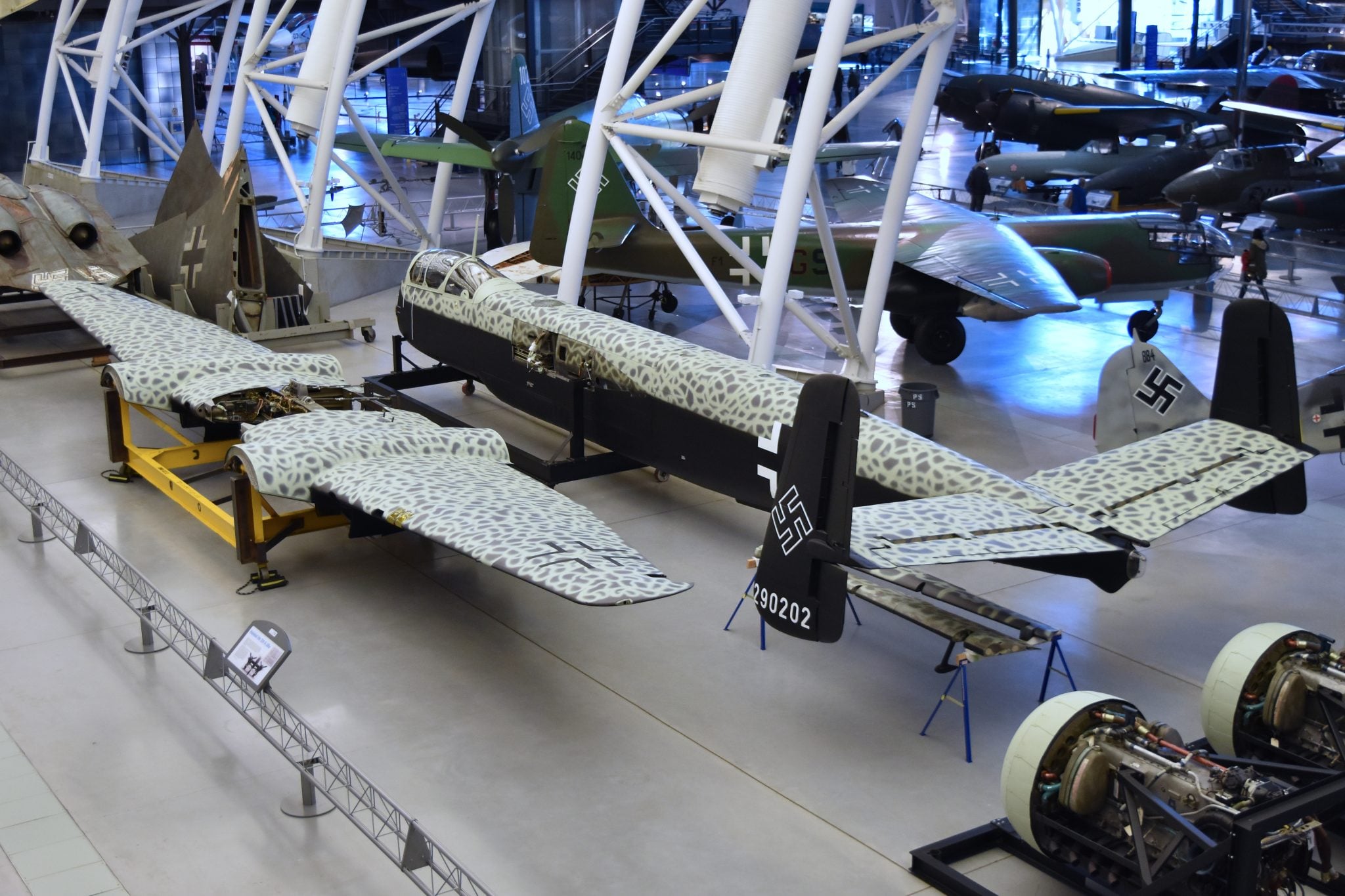
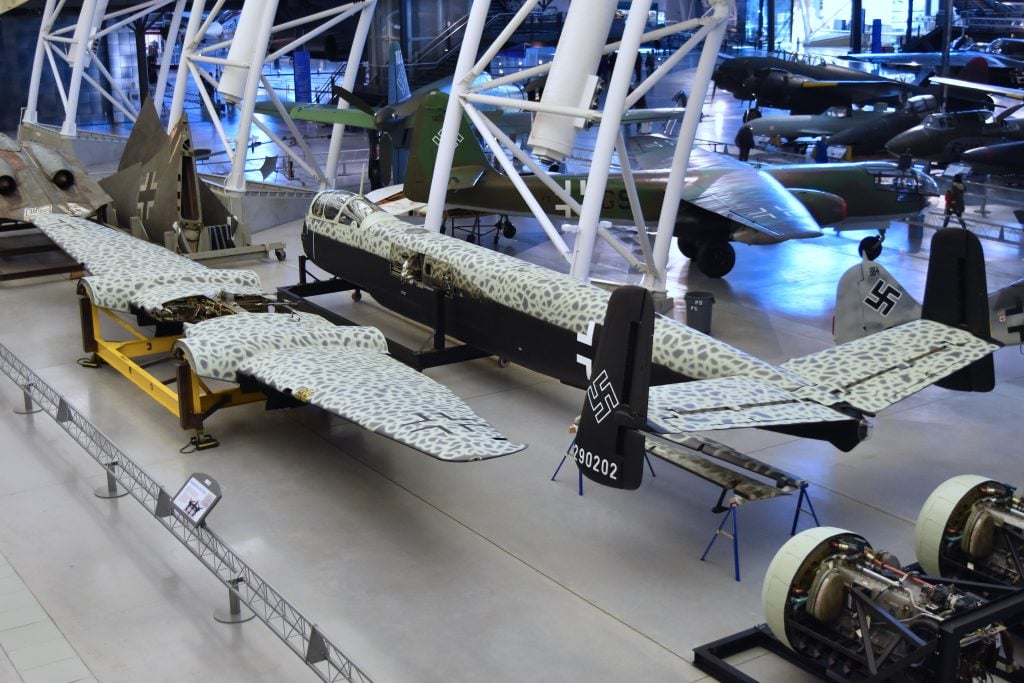
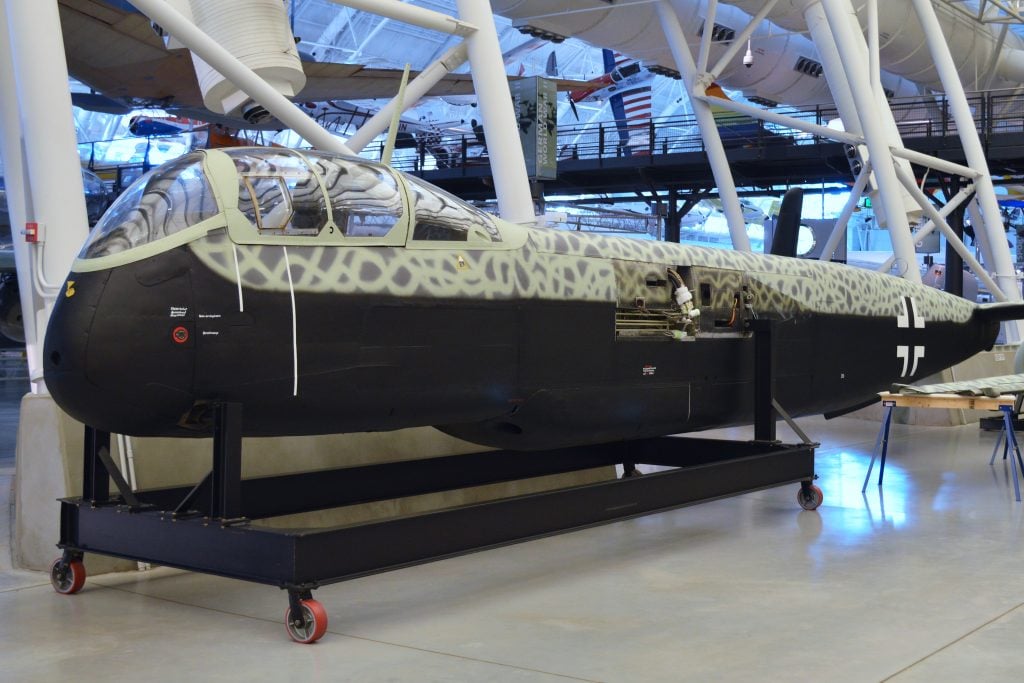
Production and survivors. Totals in the literature run from 268 completed aircraft of all marks (English-language sources) to 276–286 series machines plus four prototypes with 252 accepted by the Luftwaffe (German-language sources); the figure of 290 to 300 sometimes quoted is at the very top of the defensible range and is not the best-attested number. Whatever the true total, it was a fraction of what was needed and the whole argument about the He 219 turns on that. Exactly one substantially complete original airframe survives anywhere in the world: He 219 A-2 Werknummer 290202, one of three found by the USAAF Intelligence Service at Grove in Jutland on 16 June 1945 during Operation Lusty, made airworthy, flown to Cherbourg, shipped to the United States aboard the British escort carrier HMS Reaper and reassembled at Newark Army Air Field. It passed to the Smithsonian, spent decades in storage at Silver Hill in Maryland, and was restored over many years by the National Air and Space Museum; the wing structure was essentially complete by August 2014, the repainted wings were shown at the restoration hangar open house in January 2016, and the assembled aircraft — fuselage, wings, Kraftei nacelles and partially restored DB 603 engines, still without propellers — has been on display at the Steven F. Udvar-Hazy Center in Virginia alongside the museum’s Arado Ar 234 and Dornier Do 335 since about 2021. It is a genuine original airframe, not a reproduction, but it is a restoration rather than a complete or flyable aeroplane, and the Hirschgeweih aerial elements had to be newly fabricated from surviving European patterns. The only other substantial remains are the wreck of an unidentified He 219 raised from the sea bed about 100 m off the beach north of Hirtshals in Denmark in April 2012, which came up in pieces, was displayed at the Forsvars- og Garnisonsmuseum in Aalborg, and was sold to an Austrian enthusiast in August 2015. No reproduction He 219 has ever been built and none is flying.
The He 219 versus the Luftwaffe's other night fighters
The Uhu was the only German night fighter designed from scratch for the role; the others were adaptations of existing bombers and heavy fighters. The comparison shows why front-line crews wanted the He 219 — and why procurement chiefs kept building the others instead. Figures are representative and rounded; wartime sources vary.
| Aircraft | Origin | Crew | Max speed | Notes |
|---|---|---|---|---|
| Heinkel He 219 A | Germany | 2 | ~580–670 km/h | Purpose-built; radar + ejection seats + tricycle gear |
| Messerschmitt Bf 110 G | Germany | 2–3 | ~550 km/h | Adapted heavy fighter; mainstay of the Nachtjagd |
| Junkers Ju 88 G | Germany | 3–4 | ~570 km/h | Adapted bomber; built in far greater numbers |
| Dornier Do 217 N | Germany | 3–4 | ~500 km/h | Adapted bomber; heavy but slow |
On paper and in the air, the He 219 was the class of the field: faster than the adapted types, purpose-designed around its radar and armament, and uniquely equipped with ejection seats and a nosewheel. The Ju 88 G was a fine aircraft too — and, decisively, it was already pouring off the production lines. That, more than any shortcoming of the Uhu, is why the Ju 88 fought the night war in the thousands and the He 219 in the hundreds.
The Heinkel He 219 Uhu: a development and service timeline
A private night-fighter proposal
Heinkel's team under Robert Lusser develops a fast twin-engine design (originally a multi-role P.1060 study) into a dedicated radar night fighter for the Luftwaffe's growing night battle.
First flight
The He 219 V1 prototype makes its maiden flight. Testing reveals a fast, capable aircraft well suited to the night-fighting role.
Legendary combat debut
Flying from Venlo, Major Werner Streib downs five RAF bombers in a single sortie with a pre-production He 219, then crash-lands when the flaps fail. The Venlo detachment scores further victories, including Mosquitoes, over the following nights.
Milch moves against it
Despite front-line enthusiasm, procurement chief Erhard Milch pushes to curtail the programme in favour of Ju 88 night-fighter production. The Uhu is repeatedly threatened with cancellation.
Service with NJG 1
The He 219 equips elements of Nachtjagdgeschwader 1 and other units in the defence of the Reich, flying against RAF Bomber Command over Germany and the Low Countries.
Production officially ended
Official production is ordered to cease, though Heinkel continues limited manufacture. Total output remains tiny — around 268–300 aircraft.
Elite but scarce
The Uhu fights on as a small, respected force to the end of the war, hampered throughout by low numbers, fuel shortages and the collapse of the German war effort.
Captured under Operation LUSTY
A US intelligence team seizes He 219s at Grove, Denmark. Examples are shipped to Britain and the United States for evaluation.
One survivor
He 219 A-2/R4 Werknummer 290202 — the only complete He 219 anywhere in the world — is preserved and displayed at the Smithsonian's Steven F. Udvar-Hazy Center.
The He 219 Uhu in the words of those who flew, feared and studied it
Twelve short stories that capture the Uhu’s brilliance and its tragedy — from a five-kill debut to the single survivor in a museum. Expand each card to read more.
Five bombers in one night
On its first real combat outing, the He 219 downed five RAF bombers in a single sortie — a stunning debut.
Read more
Catching the uncatchable
The fast wooden Mosquito humiliated most German night fighters. The He 219 could actually catch it.
Read more
The first ejection seats
Long before jets made them standard, the He 219 gave its crew compressed-air ejection seats.
Read more
Stag's antlers in the dark
The He 219's radar aerials gave it a bristling, antlered nose the British came to recognise.
Read more
Schräge Musik from below
Upward-firing cannon let the He 219 attack a bomber from its blindest spot.
Read more
The feud that starved a winner
The He 219's worst enemy wore a German uniform: procurement chief Erhard Milch.
Read more
The elite detachment
The Uhu's war was fought by small, expert detachments — never the mass force its crews wanted.
Read more
Easy on the ground, deadly in the air
The tricycle undercarriage made a fast, heavy night fighter far safer to fly in the dark.
Read more
Two crew, one purpose
Everything about the Uhu was arranged around finding and killing bombers at night.
Read more
Shipped west under Operation LUSTY
When the war ended, Allied teams grabbed surviving He 219s to learn their secrets.
Read more
The last Uhu in the world
Exactly one complete He 219 exists — and it took the Smithsonian decades to bring it back.
Read more
A brilliant aircraft, wasted
Historians still argue about how much difference a few thousand Uhus might have made.
Read more
The aircraft Milch preferred instead
The Uhu had to compete not with the RAF but with other German designs for scarce priority.
Read more
A blueprint for the jet-age interceptor
Strip away the propellers and the He 219 looks remarkably like the night fighters that followed it.
Read more
Heinkel He 219 Uhu photographs
Genuine wartime, captured-aircraft and museum images of the Uhu, including the sole surviving airframe at the Smithsonian. Click any photo to enlarge. Credits below each frame.
Watch: restoring the last He 219 Uhu at the Smithsonian
“A Rare Restoration Project” by the Smithsonian Channel (official) — 237,000+ views. The museum’s restoration experts work on the last surviving He 219 in the world. Verified on YouTube.
Where the Heinkel He 219 flew — origin, night-fighter service and the sole survivor
The Uhu was a German aircraft flown almost exclusively by the Luftwaffe’s night-fighter arm. This map shows its country of origin, the theatres of its night-fighter service in the defence of the Reich against RAF Bomber Command, the nations that captured and evaluated it after the war, and the single country where the one surviving airframe is preserved today. Hover (or tap) a country for detail.
The He 219 Uhu by the numbers
The Heinkel He 219 Uhu: six deeper questions
09Erhard Milch versus the He 219: the procurement feud that decided its fate+
No account of the He 219 makes sense without the figure of Field Marshal Erhard Milch, who as State Secretary and head of aircraft procurement wielded enormous power over what the Luftwaffe built. Milch regarded the Uhu as an expensive, complicated distraction. His preference was to rationalise production around a few types already being built in quantity — and for night fighting that meant the Junkers Ju 88 G, a capable adaptation of an aircraft pouring off the lines in the thousands.
Milch repeatedly moved to cut back or cancel the He 219, even as the night-fighter units clamoured for it after its striking combat debut. The result was a running institutional feud that consumed 1943 and 1944 — the exact period in which a determined effort could have put the Uhu into mass production. The programme was never killed outright, but nor was it ever properly resourced, and it withered in the gap between front-line demand and procurement resistance. It is a textbook example of how internal politics, not enemy action, can neutralise a superior weapon.
It would be unfair to cast Milch simply as a villain, however. His job was to squeeze the maximum number of usable aircraft out of a war economy that was already stretching at the seams, and there was a real logic to concentrating on a handful of proven, mass-produced types rather than a complex new one that needed its own tooling, spares and training pipeline. Standardisation genuinely mattered. The tragedy is that in this particular case the “rationalisation” argument was applied to an aircraft that was clearly better at the job than the alternatives — and that the decision was coloured by personal antipathy and by Milch’s wider feud with the night-fighter leadership. Good administrative instincts, applied through bad politics, produced the worst possible outcome: a superb aircraft neither properly built nor cleanly cancelled, but left to wither in between.
10Radar and the Nachtjagd: how the He 219 hunted in the dark+
The He 219 was a node in a whole system. German night defence relied on ground-based radar and control — the Kammhuber Line and its successors — to detect incoming bomber streams and vector fighters into contact. Once close, the night fighter used its own airborne radar to complete the interception. On the Uhu this was the FuG 220 Lichtenstein SN-2, a VHF-band set whose large nose aerials could pick up a bomber at a few kilometres’ range, beyond the reach of the earlier sets the RAF had learned to jam.
The radar operator, seated behind the pilot, read the display and talked the pilot onto the target until it could be seen against the sky or attacked on instruments. Combined with the aircraft’s speed and heavy armament — and, on many aircraft, upward-firing Schräge Musik — the SN-2 made the He 219 a complete, integrated night-fighting weapon in a way the improvised types never quite were. It was precisely this integration that made the aircraft so valued by those who flew it.
The SN-2 itself was a response to a British countermeasure. The earlier Lichtenstein B/C radar (FuG 202/212) had operated on a frequency the RAF was able to swamp with “Window” — strips of foil dropped to blind German radar — and with electronic jamming. The longer-wavelength SN-2 was harder to jam and restored the night fighters’ ability to find their targets, at the cost of the large, draggy aerial arrays that gave the He 219 its antlered nose. This constant measure-and-countermeasure struggle in the electromagnetic spectrum was as much a part of the night war as the guns, and the He 219 was built to carry whatever the latest radar demanded.
11The He 219 against the Mosquito: could the Uhu really catch it?+
The de Havilland Mosquito tormented the Luftwaffe’s night defences. Fast, high-flying and made largely of wood, it was used as a bomber, an intruder and a pathfinder, and most German night fighters simply could not catch it. This was a serious operational problem, because Mosquitoes could roam over Germany almost at will.
The He 219, with its powerful DB 603 engines and clean design, had genuine speed — enough, its crews found, to run down a Mosquito under the right conditions. In the days following the aircraft’s combat debut, Venlo’s He 219s were credited with destroying several Mosquitoes, which caused a considerable stir precisely because the type had been so hard to intercept. It would be an exaggeration to say the Uhu mastered the Mosquito — numbers were always too small, and the Mosquito had its own advantages — but the He 219 was one of the few German night fighters with a realistic chance against it, and that alone was a powerful argument for building more.
The contest also says something about how honest one must be with the numbers. Catching a Mosquito depended heavily on circumstances — altitude, the geometry of the interception, how much warning the British crew had, and the quality of the ground control that set the German fighter up. The He 219 did not simply out-run the Mosquito in a straight line at every height; rather, it closed the gap enough that, with radar and good control, an interception became possible where before it had been hopeless. That is a more modest claim than “the Uhu beat the Mosquito,” and it is the accurate one. But in the context of 1943–44, when the fast British raiders had seemed almost untouchable, even that modest improvement was electrifying to the men who had been trying, and failing, to catch them.
12Operation LUSTY and HMS Reaper: how three He 219s reached the Allies+
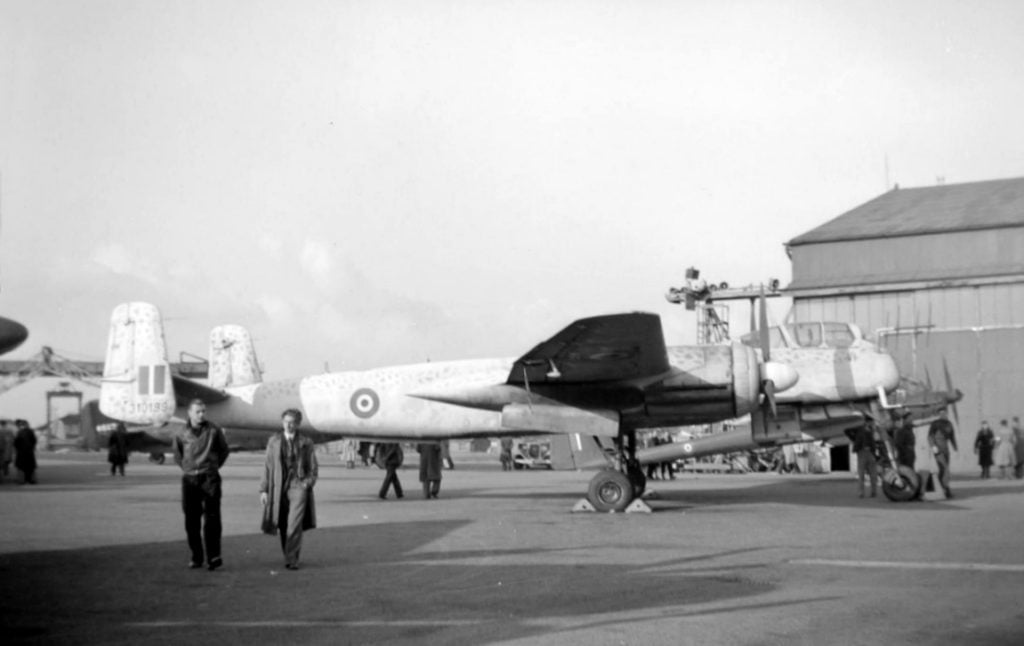
When Germany surrendered, the Allies raced to collect its advanced aircraft for study, an effort the Americans code-named Operation LUSTY (Luftwaffe Secret Technology). On 16 June 1945 a US Army Air Force team under Colonel Harold Watson seized three He 219s at Grove airfield in Denmark. These aircraft were among the many German types loaded aboard the Royal Navy escort carrier HMS Reaper and shipped across the Atlantic for evaluation in the United States.
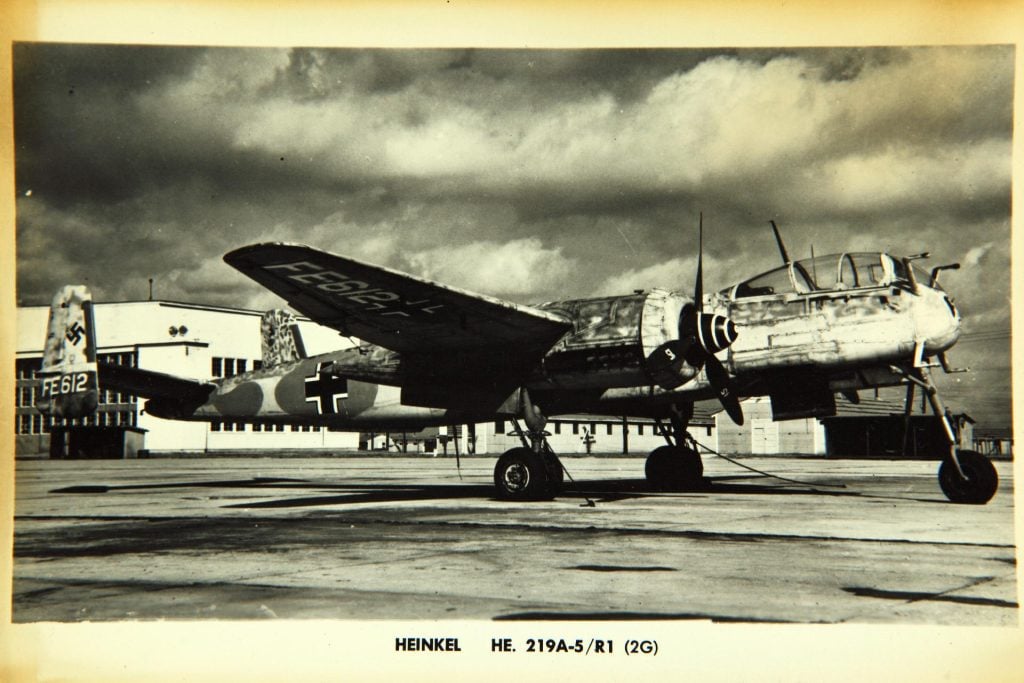
The RAF, for its part, tested a captured He 219 A-5 at Farnborough in 1945, assessing its performance, radar and armament. The Allied interest was serious: the Uhu’s integrated radar-and-cannon night-fighting concept, its ejection seats and its tricycle gear all pointed toward the way post-war interceptors would be built. It is thanks to this capture-and-evaluation effort that any He 219 survives at all: the sole remaining aircraft descends directly from those brought west in 1945.
HMS Reaper’s cargo has since become famous among aviation historians as a kind of floating time capsule of late-war German technology. Alongside the He 219s she carried jets, rocket aircraft, advanced piston fighters and bombers, ferried to the United States for testing and, in a handful of cases, eventual preservation. Most of those aircraft were evaluated and then scrapped once their secrets had been extracted; only a lucky few were set aside for museums. The He 219 was one of the fortunate survivors of that culling — which is why, out of the roughly 268 to 300 built, exactly one complete example still exists today.
13Restoring the last Uhu: the Smithsonian's He 219 A-2/R4, WkNr 290202+
The one He 219 left in the world is an A-2/R4, Werknummer 290202, in the collection of the Smithsonian National Air and Space Museum. Captured in 1945 and brought to the United States, it was given US evaluation numbers (FE-614, later T2-614) and eventually transferred to the Smithsonian in 1949 — after which it spent decades in storage awaiting attention.
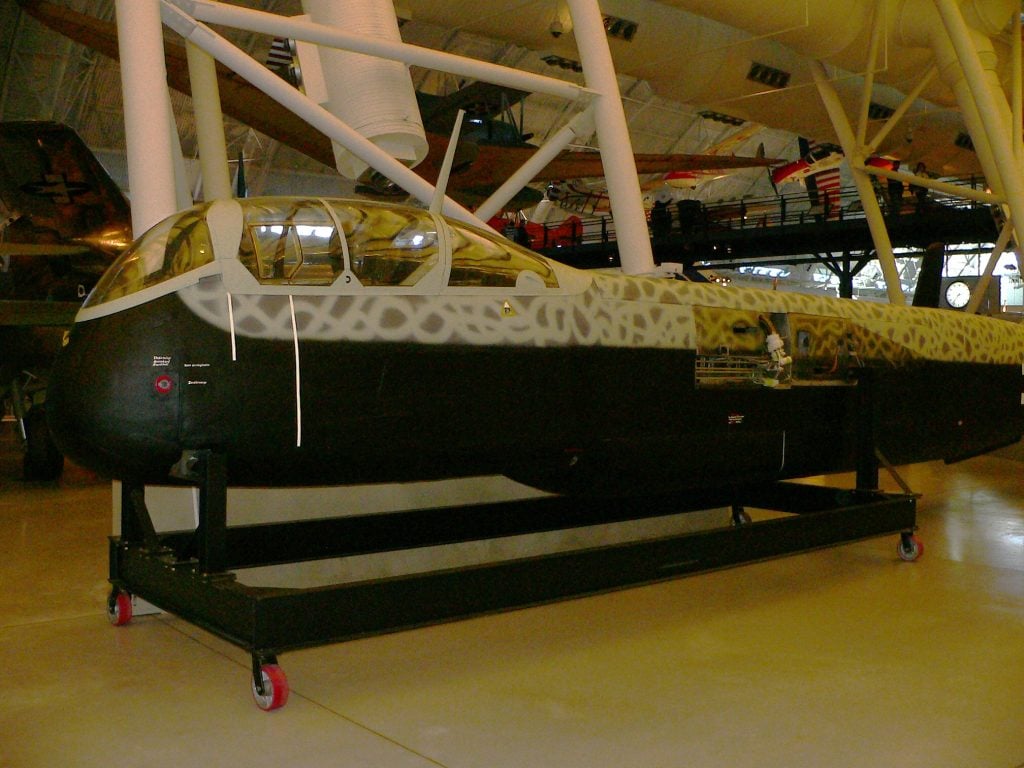
The museum’s long restoration was a considerable undertaking. Missing or damaged components had to be researched and, in some cases, fabricated from original drawings, and the airframe painstakingly conserved to museum standard. Today WkNr 290202 is displayed in the World War II German aviation section of the Steven F. Udvar-Hazy Center in Virginia — a static exhibit, not an airworthy aircraft. It is the single physical survivor of a type that its crews believed could have changed the night war, and it stands as both a technical marvel and a monument to opportunity missed.
Standing beside it, what strikes most visitors is how modern the aircraft looks for something designed in 1942: the clean lines, the businesslike radar nose, the purposeful cannon bay. Restorers and historians have used the airframe to settle points of detail about the type’s construction and equipment that photographs alone could never resolve — a reminder of why preserving even a single example matters so much. For anyone who wants to understand the He 219, this one surviving Uhu is the irreplaceable primary source: the only place on earth where the aircraft can be studied not from drawings or grainy wartime images, but in the metal.
14Was the He 219 really a war-winner? An honest assessment+
It is easy to be swept up in the He 219’s legend — the five-kill debut, the Mosquito victories, the modern design — and conclude that mass production would have swept Bomber Command from the night sky. Reality is more complicated. Even the best night fighter could not have escaped the wider German crises of 1944–45: the catastrophic shortage of aviation fuel, the collapse in aircrew training standards, and the overwhelming Allied material superiority. A larger He 219 force would have inflicted heavier losses on the RAF, perhaps significantly so — but it could not, by itself, have reversed the outcome of the strategic air war.
What the aircraft’s story really illustrates is narrower and sharper: that Germany possessed a night fighter clearly superior to the types it built in bulk, and chose not to build it, for reasons of cost, industrial convenience and personal rivalry. The He 219 was not a wonder-weapon that would have won the war. It was a genuinely excellent aircraft that was needlessly squandered — and that, in the end, is the more damning verdict.
Heinkel He 219 Uhu: your questions answered
Can I fly in a Heinkel He 219?
No. Exactly one complete Heinkel He 219 survives anywhere in the world — an A-2/R4 (Werknummer 290202) preserved as a static exhibit at the Smithsonian’s Steven F. Udvar-Hazy Center — and there is no airworthy He 219 of any kind. MiGFlug does not offer He 219 flights, and no one else can either.
You can, however, fly in several genuine historic military jets today. MiGFlug arranges real flights in aircraft such as the L-39 Albatros, Hawker Hunter, MiG-15 and de Havilland Vampire. See what is currently bookable at migflug.com/flights-prices.
What made the He 219 Uhu so advanced?
The He 219 was Germany’s first purpose-designed night fighter and combined an unusual number of modern features: airborne interception radar (the FuG 220 Lichtenstein SN-2) as standard, a heavy cannon armament often including upward-firing Schräge Musik, two powerful Daimler-Benz DB 603 engines that made it fast enough to catch a Mosquito, compressed-air ejection seats for its two crew (widely regarded as the first on an operational aircraft), and a tricycle undercarriage — the first on an operational German combat aircraft. No other night fighter of its era brought so many advances together in one design.
Did the He 219 really have ejection seats?
Yes. The He 219 is widely credited as the first operational military aircraft fitted with ejection seats — compressed-air seats for both the pilot and the radar operator. Escaping a fast, complex aircraft at night was often fatal, and the ejection seats were a genuinely forward-looking safety feature, decades ahead of their general adoption in the jet age.
What was Schräge Musik on the He 219?
Schräge Musik was an installation of upward-firing cannon — on the He 219 typically two 30 mm MK 108s — angled to fire up and slightly forward. Using radar and ground control, the pilot would slide into the blind spot directly beneath an RAF bomber, then fire up into its fuel-laden wings. British heavy bombers had no belly turret and rarely watched below, which made the tactic devastatingly effective.
How many He 219s were built, and why so few?
Only around 268 to 300 were built in total, depending on the source and how pre-production aircraft are counted — a tiny number for an aircraft its crews rated so highly. The reason was procurement politics: Field Marshal Erhard Milch, who ran Luftwaffe production, distrusted the He 219 and preferred to build adaptations of the already mass-produced Junkers Ju 88. He repeatedly tried to cancel or curtail the programme, so it never reached mass production despite strong front-line demand.
How effective was the He 219 in combat?
Where it was used, it was highly effective. Its combat debut on the night of 11–12 June 1943 saw Major Werner Streib credited with five bombers destroyed in a single sortie (exact tallies are debated), and over the following nights the Venlo detachment scored further victories, including against RAF Mosquitoes that other German night fighters struggled to catch. Crews rated it a superb bomber-destroyer. Its impact on the war was limited only by how few were built.
Are there any surviving He 219s?
Exactly one. The sole surviving He 219 is an A-2/R4, Werknummer 290202, captured in 1945 and now preserved at the Smithsonian’s Steven F. Udvar-Hazy Center in Virginia, where it is displayed after a long restoration. It is a static museum exhibit; there is no airworthy He 219 anywhere in the world.
Who flew the He 219 and where?
The He 219 served principally with Nachtjagdgeschwader 1 (NJG 1) and other night-fighter units in the defence of the Reich. Its most famous operations were flown from Venlo in the occupied Netherlands, from where it intercepted RAF Bomber Command raids routing over the Low Countries and Germany. Because so few were built, it was always operated by small, elite detachments rather than as a mass force.
What does “Uhu” mean?
“Uhu” is the German word for the Eurasian eagle-owl — a large, powerful nocturnal bird of prey. It was an apt name for a fast, radar-equipped night hunter designed to stalk and destroy bombers in the dark. Several other German designs carried animal or bird names in the same tradition.
How does the He 219 compare to the Ju 88 night fighter?
The He 219 was the better night fighter on its merits: purpose-designed, faster, and uniquely equipped with ejection seats and tricycle gear. The Junkers Ju 88 G, by contrast, was a highly capable adaptation of an existing bomber — and, decisively, it was already being built in huge numbers. That is why the Luftwaffe fought most of the night war with the Ju 88 and only a few hundred He 219s. The Uhu was the superior aircraft; the Ju 88 was the one the procurement system chose to mass-produce.
Was the Heinkel He 219 the best night fighter Germany never built?
The He 219 Uhu is one of the most poignant aircraft of the Second World War, precisely because there was so little wrong with it. It was fast, well armed, radar-equipped and thoughtfully designed around the brutal realities of night combat, right down to the ejection seats and the nosewheel. In action it did everything its crews asked of it, destroying bombers — including the elusive Mosquito — from the very first sorties. Judged as an aeroplane, it was a triumph.
Judged as a programme, it was a disaster — and the two verdicts do not contradict each other. The Uhu was defeated not by the RAF but by the Luftwaffe’s own procurement machine, and above all by Erhard Milch’s determination to concentrate on adapting aircraft already in mass production. The months when the He 219 could have been built in quantity were consumed by a bureaucratic feud, and by the time the argument was effectively over, Germany’s fuel and industrial crises had made mass production impossible anyway. Around 268 to 300 aircraft — that is the whole story of a design its supporters believed could have changed the night war.
So the He 219 endures as aviation’s great “what if.” Build it in thousands from 1943, its admirers argue, and Bomber Command’s losses might have become unsustainable. The sceptics reply, fairly, that no single aircraft could have reversed the strategic tide. Both are probably right — and both agree on the essential point. The Uhu was a superb machine, produced in absurdly small numbers, for reasons that had nothing to do with its quality. Today a single survivor stands in a Virginia museum as the quiet, complete embodiment of that waste.
Only one Uhu survives. But you can strap into a real fighter jet.
The He 219 exists today as a single museum exhibit — there is no airworthy example anywhere. If you want the genuine experience of flying in a historic military aircraft, the g-forces, the noise, the view from a fighter cockpit, MiGFlug makes it real. Here are some of the aircraft you can actually book.