
Vickers Wellesley
The RAF’s pioneering long-range monoplane bomber — the first operational aircraft built with Barnes Wallis’s geodetic “basket-weave” structure. It set a world distance record flying non-stop from Egypt to Australia in 1938, and though obsolescent by 1939 it fought on effectively in the vast skies of East Africa.
The Story
The Vickers Wellesley: Barnes Wallis’s geodetic record-breaker
The Vickers Wellesley is one of those aircraft whose importance far outstrips its fame. It was never a great war-winner, and by the time the Second World War began it was already obsolescent as a bomber. Yet it holds a genuinely significant place in aviation history on three counts: it was the first operational Royal Air Force aircraft built with Barnes Wallis’s revolutionary geodetic construction; it set a world distance record with an extraordinary non-stop flight from Egypt to Australia in 1938; and it went on to fight a real and useful war in the vast skies of East Africa. For a single-engined monoplane that most people have never heard of, that is a remarkable record.
The Wellesley grew out of the ferment of British aircraft design in the early 1930s, as the biplane gave way to the monoplane. It began life as a private venture by Vickers, and its most important feature was hidden inside the airframe. Its structure was designed by Barnes Wallis — later world-famous for the “bouncing bomb” of the Dam Busters raid — using a system he called geodetic construction. Instead of a conventional framework of longerons and formers, the geodetic airframe was built as a lattice of light metal members that crossed each other in a basket-weave pattern, following geodesic curves around the fuselage and wings.
The advantages of this lattice were considerable. It was extremely strong for its weight, it distributed loads efficiently, and — crucially, as would be proved in war — it was remarkably tolerant of battle damage: large sections could be shot away and the structure would still hold together. The whole basket-weave frame was then covered in fabric. Geodetic construction was Wallis’s signature contribution to aircraft design, and the Wellesley was its first operational proving ground. The same structure was scaled up for the much more famous twin-engined Vickers Wellington, the mainstay of RAF Bomber Command in the early war years, so in a real sense the Wellesley was the ancestor of the Wellington.
“A basket-weave airframe by Barnes Wallis, a record-breaking range, and a good war in a forgotten theatre — the Wellesley was far more important than it was famous.”— the Vickers Wellesley in a sentence
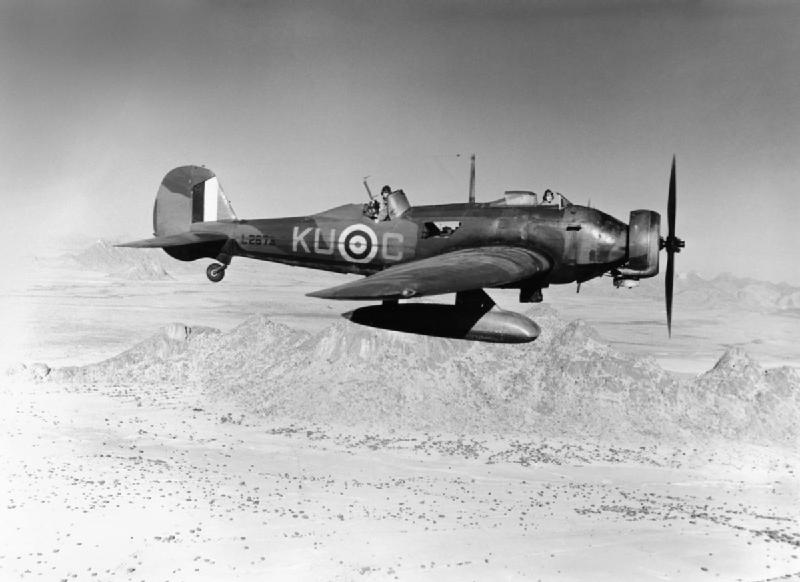
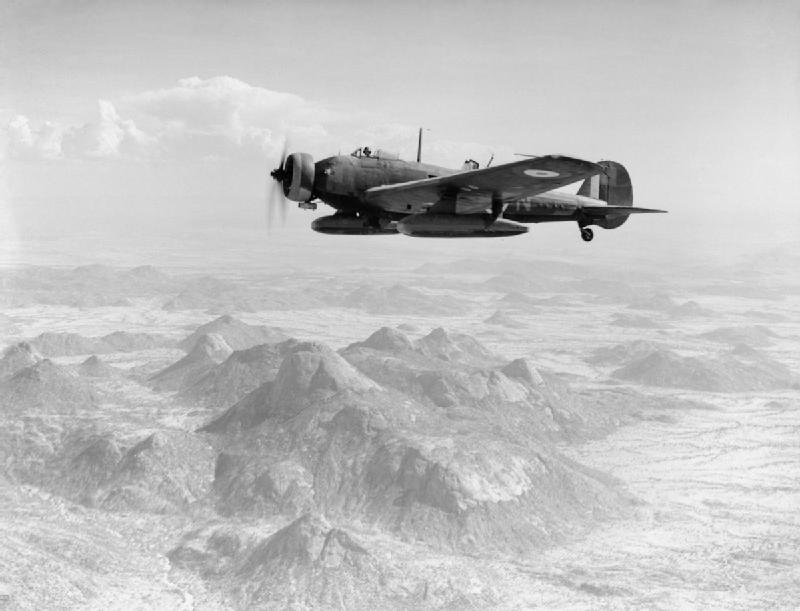
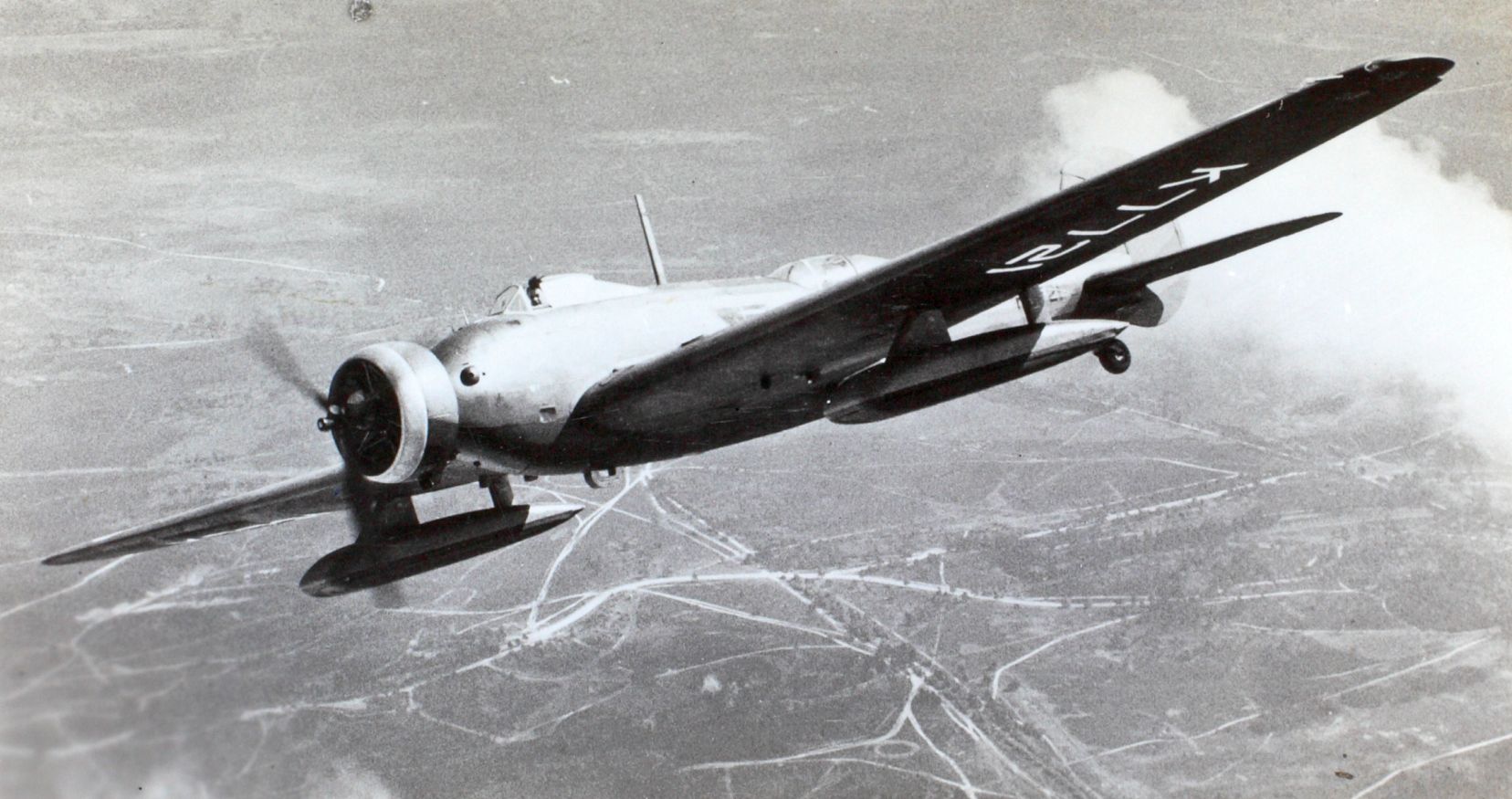
The geodetic structure had one awkward consequence. Because the fuselage was a continuous, load-bearing lattice, there was no convenient way to cut a large internal bomb bay into it. So the Wellesley’s designers did something unusual: they carried the bombs externally, in two streamlined panniers or nacelles slung under the wings, one on each side. It was an ingenious solution to a self-imposed problem, and it gave the aircraft a distinctive look, but it was also a sign of the compromises that the new construction method demanded.
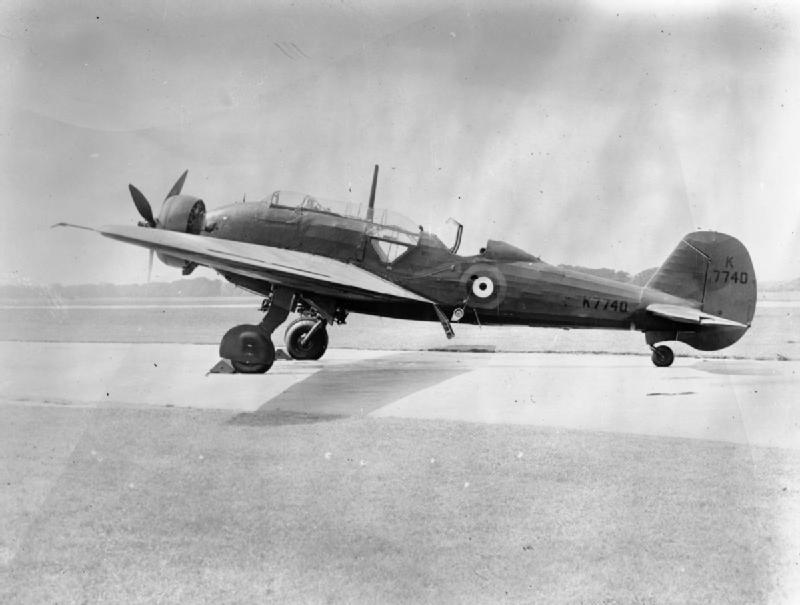
The result was a large, clean, single-engined monoplane with a very long, slender wing — a wing whose high aspect ratio gave the aircraft excellent range and efficiency. Power came from a single Bristol Pegasus radial engine. The Wellesley carried a crew of two, a pilot and an observer/gunner; early aircraft had two separate open cockpits, later replaced by a long glazed “glasshouse” canopy. It entered RAF service in 1937 as a general-purpose bomber, and around 176 were built.
It was that long, efficient wing that made possible the Wellesley’s most famous exploit. Recognising the type’s exceptional range, the RAF formed a special unit, the Long Range Development Flight, and prepared a small number of Wellesleys specially modified for maximum endurance. In November 1938 three of these aircraft set out from Ismailia in Egypt on an attempt at the world non-stop distance record, heading for Australia. Two of the three reached Darwin non-stop, a distance of roughly 7,150 miles (about 11,500 km), while the third landed to refuel. It was a stunning achievement — a new world distance record that would stand for years — and it made the Wellesley briefly famous as a record-breaker rather than a bomber.
That flight was more than a stunt. It was a demonstration of British long-range flying and navigation at the very edge of what was then possible, and it proved the soundness of both the geodetic structure and the efficient Vickers wing over an enormous distance and duration. The Long Range Development Flight’s Egypt-to-Australia record remains one of the great feats of interwar aviation, and it is the achievement for which the Wellesley is best remembered today.
As a front-line bomber, however, the Wellesley was already being overtaken. The late 1930s saw the arrival of fast, twin-engined all-metal monoplane bombers, and by the outbreak of war in September 1939 the single-engined Wellesley was clearly obsolescent. In the main European theatre it had no future. But the RAF found it a role where its greatest virtue — range — still counted for a great deal.
That role was in East Africa. When Italy entered the war in June 1940, its large forces in Italian East Africa — Eritrea, Ethiopia and Italian Somaliland — threatened Sudan, Kenya and the vital Red Sea route. The theatre was enormous, the distances vast, and airfields few and far apart. Here the Wellesley’s long range came into its own. RAF Wellesley squadrons, most famously No. 47 Squadron, flew bombing and reconnaissance missions over Eritrea and Ethiopia, struck at Italian airfields and positions, supported the Allied advance that culminated in the hard-fought Battle of Keren in 1941, and flew long maritime patrols over the Red Sea. It was secondary-theatre warfare, far from the headlines, but it was real combat, and the Wellesley did it well.
By 1941–42, with the East African Campaign won and more modern aircraft arriving, the Wellesley was withdrawn from operations. It had served for only a few years, but they had been eventful ones. As a design it was a fascinating transitional aircraft — a monoplane that still wore fabric over a radically new metal skeleton, a bomber that carried its bombs outside because its own structure left no room within.
The Wellesley’s true legacy is twofold. First, it introduced geodetic construction to RAF service and pointed the way to the Wellington, one of the most important British bombers of the early war. Second, it showed what long range could achieve, both in the record books and in the far-flung campaigns where distance was the enemy as much as the Italians were. A single Vickers Wellesley survives today, preserved in the collection of the Royal Air Force Museum — a rare reminder of an aircraft that was pioneering, record-breaking and quietly useful, and that deserves to be far better known than it is.
01Geodetic construction: Barnes Wallis’s basket-weave structure+
The Wellesley’s defining feature was its geodetic construction, designed by Barnes Wallis. Instead of the usual framework of straight longerons and ring formers, the airframe was built as a lattice of light metal members that crossed one another in a basket-weave pattern, following geodesic curves around the fuselage and wings, and then covered in fabric.
The system was very strong for its weight and distributed loads efficiently, and it proved extraordinarily tolerant of battle damage — large pieces could be shot away without the structure failing. The Wellesley was the first operational RAF aircraft to use it, making it the direct forerunner of the geodetic Vickers Wellington.
02Bombs in underwing panniers: a consequence of the geodetic fuselage+
Geodetic construction created one practical problem. Because the fuselage was a continuous, load-bearing lattice, it could not easily be cut open for a large internal bomb bay. The Wellesley’s designers solved this by carrying the bomb load externally, in two streamlined panniers slung under the wings, one on each side.
It was an unusual and ingenious arrangement, and it gave the aircraft a distinctive appearance. It also illustrates the trade-offs of the new structure: the geodetic airframe brought great strength and damage tolerance, but it dictated where and how the bombs could be carried.
03The long, slender wing and the Bristol Pegasus engine+
The Wellesley was a large, clean single-engined monoplane with a very long, slender, high-aspect-ratio wing. That efficient wing was the key to its exceptional range and was what made the record-breaking Egypt-to-Australia flight possible.
Power came from a single Bristol Pegasus radial engine of roughly 835 to 925 horsepower depending on the mark. The combination of an efficient wing and a reliable, economical radial gave the Wellesley outstanding endurance for a single-engined aircraft of its day.
04From Barnes Wallis to the Dam Busters and the Wellington+
Barnes Wallis, who designed the Wellesley’s structure, is one of the towering figures of British aviation. He is best known to the public for the “bouncing bomb” used in the 1943 Dam Busters raid, and for later work on swing-wing aircraft, but his geodetic construction was an earlier and equally important contribution.
The Wellesley was geodetic construction’s first operational aircraft. Wallis then scaled the same principle up to create the twin-engined Vickers Wellington, which became a mainstay of RAF Bomber Command in the early war years and was famous for bringing its crews home despite appalling battle damage — a direct benefit of the geodetic structure first proved on the Wellesley.
05The 1938 Egypt-to-Australia record flight+
The Wellesley’s most famous exploit was a world distance record. Recognising the type’s exceptional range, the RAF formed the Long Range Development Flight and specially modified a handful of Wellesleys for maximum endurance, stripping weight and adding fuel.
In November 1938 three of these aircraft flew from Ismailia in Egypt towards Australia. Two reached Darwin non-stop — a distance of roughly 7,150 miles, about 11,500 km — while the third landed to refuel. The non-stop world distance record they set stood for years and remains one of the great achievements of interwar long-range flying.
06The Long Range Development Flight: an experiment in endurance+
The Egypt-to-Australia flight was not merely a stunt but a serious experiment in long-range flying and navigation, conducted by a dedicated RAF unit. Flying such distances non-stop, over sea and desert, pushed the limits of contemporary fuel systems, engine reliability and navigation.
The flight proved the soundness of the geodetic structure and the efficient Vickers wing over an enormous distance and duration, and it advanced British understanding of the practicalities of very long-range flight — knowledge that would matter greatly in the war to come. It was the high point of the Wellesley’s career.
07Entering service: the RAF’s new monoplane bomber of 1937+
The Wellesley entered RAF service in 1937 as a general-purpose bomber, one of the new generation of monoplanes replacing the biplanes of the interwar air force. Around 176 were built, and the type equipped a number of home-based bomber squadrons in its early years.
Early Wellesleys had two separate open cockpits for the pilot and the observer/gunner; later aircraft were fitted with a long glazed “glasshouse” canopy joining the two positions. As a modern monoplane with a striking new structure, the Wellesley represented a real step forward for the RAF when it appeared — even if the pace of development would soon leave it behind.
08Obsolescent by 1939: overtaken by the twin-engined bombers+
For all its virtues, the Wellesley was quickly overtaken as a front-line bomber. The late 1930s brought a rapid succession of faster, twin-engined, all-metal monoplane bombers, and against them a single-engined type carrying its bombs in underwing panniers was clearly outdated.
By the outbreak of war in September 1939 the Wellesley had no future in the main European theatre. But rather than retire it, the RAF sent it where its outstanding range still mattered — and there it found a genuinely useful second career.
09The East African Campaign: the Wellesley’s real war+
When Italy entered the war in June 1940, its large forces in Italian East Africa — Eritrea, Ethiopia and Italian Somaliland — threatened Sudan, Kenya and the vital Red Sea shipping route. The theatre was vast, the distances huge and airfields sparse, and here the Wellesley’s long range was a real asset.
RAF Wellesley squadrons, most famously No. 47 Squadron, flew bombing and reconnaissance missions over Eritrea and Ethiopia, attacked Italian airfields and positions, and supported the Allied advance that led to the decisive Battle of Keren in 1941. It was warfare far from the headlines, but it was real combat, and the Wellesley’s endurance suited the theatre well.
10Maritime patrol over the Red Sea+
Besides its bombing and reconnaissance work over the mountains of Eritrea and Ethiopia, the Wellesley was also used for long maritime patrols over the Red Sea. Guarding this vital shipping route against Italian interference was an important task, and one for which the aircraft’s exceptional endurance was well suited.
These patrols are a good example of how the Wellesley’s single great strength — range — kept it useful well beyond the point at which it had ceased to be a viable front-line bomber elsewhere. In a theatre defined by distance, an aircraft that could stay airborne for a very long time was genuinely valuable.
11Wellesley and Wellington: the geodetic family+
The Wellesley and the Vickers Wellington are the two great geodetic aircraft, and the relationship between them is central to the Wellesley’s importance. Both used Barnes Wallis’s basket-weave lattice structure; the Wellesley was the single-engined pioneer, the Wellington the far larger and more numerous twin-engined heavy that followed.
The Wellington became one of the most important British bombers of the early war, famous for absorbing extraordinary battle damage and still bringing its crews home — a direct benefit of the geodetic construction first proved operationally on the Wellesley. In that sense the humble Wellesley was the ancestor of a war-winning aircraft.
12A transitional aircraft: fabric over a metal skeleton+
The Wellesley is a fascinating example of an aircraft caught between two eras. It was a thoroughly modern monoplane with a long, efficient wing and a radically new metal structure — and yet that structure was still covered in fabric, in the manner of the biplanes it was replacing, and its bombs hung outside in panniers.
This blend of the innovative and the old-fashioned is exactly what makes the Wellesley so interesting. It sits at the hinge between the fabric-and-wire world of interwar aviation and the stressed-skin, all-metal world of the Second World War, embodying the transition in a single airframe.
Design & Engineering
How the Vickers Wellesley was built: geodetics, a long wing and panniers
A large single-engined monoplane whose airframe was a fabric-covered geodetic lattice by Barnes Wallis — light, strong and damage-tolerant — with a long, efficient wing for record-setting range and its bombs carried in underwing panniers.
Geodetic structure
Barnes Wallis’s basket-weave metal lattice, fabric-covered — strong for its weight and remarkably tolerant of battle damage.
Underwing panniers
With no room for an internal bomb bay in the geodetic fuselage, the bombs were carried externally in two streamlined underwing panniers.
Long-range wing
A long, slender, high-aspect-ratio wing and an economical Bristol Pegasus radial gave outstanding range for a single-engined type.
Specifications
Vickers Wellesley specifications: dimensions, performance and cost
Baseline note: the figures describe the Wellesley Mk I as built at Brooklands and Weybridge in 1937–38 with the fully supercharged Bristol Pegasus XX. Deltas for the prototypes and for the Long Range Development Unit aircraft that flew to Australia in November 1938 are in grey. Two cautions before reading any Wellesley table. There was never an official Mk II: the label is a modern convenience for the first-batch aircraft that carried one continuous canopy over both cockpits, and it appears in reference works as though it were a mark. And the 33,000 ft ceiling that circulates is not a loaded-aircraft figure — it belongs to a stripped, lightly fuelled test condition, not to a squadron aeroplane with panniers on. The service figures are 25,500 ft (Wikipedia) and 26,100 ft (historyofwar.org).
Dimensions & weights
- Crew
- 2, pilot and observer/gunner (3 with a separate bomb-aimer; both are published as standard)
- Length
- 11.96 m (39 ft 3 in)
- Wingspan
- 22.66 m (74 ft 4 in) — also published as 22.73 m (74 ft 7 in); a measuring convention, not two different wings
- Height
- 4.66 m (15 ft 3½ in) — historyofwar.org gives 12 ft 4 in, a different datum
- Wing area
- 58.5 m² (630 sq ft)
- Aspect ratio
- 8.8 (Vickers quoted 8.83; Fairey Battle 6.6, Bristol Blenheim 6.4)
- Empty weight
- 3,066 kg (6,760 lb) — tare 3,090 kg (6,812 lb) in Vickers figures
- Gross weight
- 5,011 kg (11,048 lb) — 5,047 kg (11,128 lb) elsewhere
- Maximum take-off weight
- 5,670 kg (12,500 lb)
- Wing loading at gross
- 85.7 kg/m² (17.5 lb/sq ft)
- Maximum bomb load
- 907 kg (2,000 lb), every pound of it outside the aeroplane
- Bomb panniers
- two, one under each wing; each takes 2 × 250 lb or 2 × 500 lb
- Undercarriage
- hydraulically retractable mainwheels, fixed tailwheel (spatted on early aircraft)
Performance
- Maximum speed
- 367 km/h at 6,000 m (228 mph at 19,700 ft)
- Maximum speed, service figure
- 357 km/h at 4,570 m (222 mph at 15,000 ft)
- Cruising speed
- 290 km/h at 4,570 m (180 mph at 15,000 ft)
- Range, normal
- 1,960 km (1,220 miles) — 1,770 km (1,100 miles) in Vickers service figures
- Combat radius
- ~700 km (~435 miles) with reserve
- Record distance
- 11,525.9 km (7,158.7 miles), homologated by the FAI
- Record duration
- 48 h 05 min, Ismailia to Darwin, 5–7 November 1938
- Service ceiling
- 7,770 m (25,500 ft) — 7,955 m (26,100 ft) in historyofwar.org
- Time to 4,570 m
- 17.8 min (to 15,000 ft)
- Wing loading at maximum weight
- 96.9 kg/m² (19.8 lb/sq ft)
- Power loading at gross
- 5.4 kg/hp (11.9 lb/hp)
Propulsion & systems
- Engine
- 1 × Bristol Pegasus XX, nine-cylinder air-cooled radial, fully supercharged
- Rated power
- 690 kW (925 hp) — 950 hp in some tables
- Prototype engines
- Pegasus IIM3 on the Type 246; Pegasus X of 731 kW (980 hp) on the rebuilt Type 281
- Record-flight engine
- Pegasus XXII LR on 100-octane fuel, supercharger regeared for economical cruise
- Propeller
- three-blade variable-pitch (constant-speed on the Long Range Development Unit aircraft)
- Cowling
- Townend ring (long-chord NACA-type cowl on the record aircraft)
- Airframe
- Vickers geodetic duralumin lattice to Barnes Wallis's patent, fabric covered
- Bomb stowage
- none internal; two external panniers under the wings
- Fuel, record aircraft
- ~5,865 litres (~1,290 imperial gallons), roughly triple standard tankage
- Automatic flight equipment
- three-axis autopilot with automatic mixture and boost control (record aircraft only)
- Crew accommodation
- separate enclosed cockpits in tandem (one continuous canopy on part of the first batch)
- Navigation
- direction-finding loop on the aircraft with the extended forward canopy
13The Wellesley variants and the Long Range Development Flight aircraft+
The Wellesley was produced chiefly as the Mk I, with detail changes over the production run. Early aircraft had two separate open cockpits for the crew; later machines received a long glazed “glasshouse” canopy connecting the pilot’s and gunner’s positions, which is the form in which the type is most often pictured.
The most specialised versions were the small number of aircraft prepared for the Long Range Development Flight. These were stripped of unnecessary weight and fitted with extra fuel tankage for maximum endurance, and it was these machines that made the record-breaking flight from Egypt to Australia in 1938.
14The Vickers Wellesley’s cost: what the records show+
As with most RAF aircraft of the 1930s, there is no reliable, transparent public figure for the Wellesley’s unit cost, cost per flight hour or total programme cost. It was procured in modest numbers under the defence budgets of the period, and consistent lifetime cost data does not survive in a usable, comparable form.
Rather than repeat an invented number, we list the cost fields here as “not reliably recorded.” As a single-engined aircraft of fabric-covered geodetic construction, the Wellesley would have been relatively economical to build compared with the larger multi-engined types that followed, which is part of why the RAF was able to field it in useful numbers.
15Why the Vickers Wellesley matters+
The Wellesley’s importance rests on three things. It was the first operational RAF aircraft built with Barnes Wallis’s geodetic construction, and so the direct forerunner of the war-winning Wellington. It set a world distance record with the 1938 Egypt-to-Australia flight, one of the great feats of interwar aviation. And it fought a real, useful war in East Africa when its range still counted.
Taken together, these make the Wellesley far more significant than its modest fame suggests. It is a key aircraft in the story of geodetic construction, of long-range flight, and of the RAF’s often-overlooked campaigns in secondary theatres — a genuine pioneer that deserves to be better remembered.
16Survivors: the sole preserved Wellesley+
Only one Vickers Wellesley survives. The type was built in modest numbers, saw hard service, and was retired and largely scrapped during the war, so complete survivors are essentially non-existent apart from this single aircraft.
The sole surviving Wellesley is preserved in the collection of the Royal Air Force Museum. As the only complete example of a pioneering and historically important aircraft — the first operational geodetic RAF machine and an interwar distance record-holder — it is a genuinely precious survivor.
Armament & payload
The Wellesley carried two rifle-calibre guns and hung every bomb outside the aeroplane
Geodetic construction bought the Wellesley its wing and its range, and charged for both in the bomb bay. A lattice of curved duralumin members carrying load in tension and compression along helical paths cannot be interrupted by a large rectangular hole without losing the property that makes it work, so Vickers did not cut one. The bombs went instead into two streamlined panniers slung under the wings — a deliberate engineering trade, not an oversight, and one that bought a 74-foot wing on an aeroplane grossing 11,000 lb. The defensive fit, one fixed rifle-calibre Vickers forward and one drum-fed gun aft, was ordinary 1935 practice and hopeless by 1940. Gun fits varied in service: the rear cockpit carried a Lewis or a Vickers K depending on unit and date, and Middle East aircraft flying maritime patrol from 1941 carried loads that no published armament table lists.
Gun
- One fixed 0.303 in Vickers machine gun in the starboard wing, fired by the pilot
- Sources split on synchronisation: a gun in the wing fires outside the propeller disc and needs no gear, yet historyofwar.org describes it as synchronised. The wing installation is the better-attested one.
- One 0.303 in Vickers K or Lewis gun on a ring mounting in the rear cockpit, drum fed
- No belt feed, no power turret and no ventral position: the underside was undefended
- Two rifle-calibre guns was the entire armament of a front-line 1937 medium bomber
Air-to-air
- None. No guided air-to-air weapon existed anywhere in the world in the 1930s
- The first operational air-to-air missiles entered service in the mid-1950s, more than a decade after the last Wellesley sortie
- Air-to-air defence was one man, one drum-fed gun and a rearward field of fire
- Against Regia Aeronautica Fiat CR.42 biplanes over Eritrea in 1940 that was survivable; against a modern monoplane fighter it was not
Air-to-surface guided
- None. Guided air-to-surface weapons did not exist when the Wellesley was designed, built or withdrawn
- The first used in action were the German Fritz X and Henschel Hs 293 in 1943, after the last Wellesley operations
- Everything the Wellesley dropped was unguided and aimed through an optical bombsight
- The panniers had no electrical or control provision for powered or steered stores
Bombs
- Two under-wing panniers, each carrying 2 × 250 lb or 2 × 500 lb
- Maximum 907 kg (2,000 lb)
- Smaller racks inside each pannier for four 20 lb Cooper bombs, practice bombs, flares or smoke floats
- Loading rules restricted which combinations could be carried at the same time
- Depth charges on Middle East maritime-patrol aircraft from 1941 — the weapon a No. 47 Squadron Wellesley used against U-559 on 30 October 1942
Rockets
- None. Not fitted, not trialled, not proposed
- The RAF's 3-inch rocket projectile did not reach squadrons until 1942
- By then the surviving Wellesleys were flying maritime patrol from Aden and Egypt, not ground attack
- The pannier structure was sized for bomb carriers, not for rails and blast
Pods & other stores
- The panniers themselves are the story: streamlined external containers doing a bomb bay's job because the geodetic wing centre section could not be opened up
- Camera installations for photographic reconnaissance in the Middle East
- Reconnaissance flares and smoke floats for night and maritime work
- Record aircraft: additional tankage to ~1,290 imperial gallons, autopilot and automatic engine controls — fuel carried as payload
Three typical loadouts
- Home training sortie, 1938
- 4 × 250 lb general purpose in the two panniers; forward Vickers and rear Vickers K loaded; no external stores of any other kind.
- East African strike, 1940–41
- 4 × 500 lb in the panniers, or 250 lb bombs plus 20 lb Cooper bombs on the small racks; camera for post-strike assessment.
- Red Sea maritime patrol, 1942
- Depth charges in the panniers, full internal fuel, camera; the fit that put a No. 47 Squadron aircraft over U-559 on 30 October 1942.
Sourcing caveat. Bomb load is consistently given as 2,000 lb, but the split between 250 lb and 500 lb weapons and the permitted mixed loads vary between references, and no single published loading table covers Middle East maritime fits. The forward gun's installation — wing-mounted or synchronised through the disc — is genuinely contested between sources. Crew is given as two in Vickers figures and three in others; both describe real sorties, since a third man was carried when a dedicated bomb-aimer was needed.
Variants
One production mark, no exports, and a handful of conversions that were mostly fuel tank
The Wellesley exists because Vickers hedged. Air Ministry Specification G.4/31 called for a general-purpose aeroplane, and Vickers tendered the Type 253 biplane while building the Type 246 monoplane as a private venture using the same geodetic structure. The monoplane was faster, longer-legged and better in every measurable way, and on 10 September 1935 the Air Ministry cancelled its order for 150 Type 253 biplanes in favour of 96 monoplanes. That decision is the single most consequential thing in the type's history: it put Barnes Wallis's geodetic structure into production, and from there into the Wellington.
The variant list itself is short and unglamorous. There was one production mark, no export customer and no licence production — unusual for a British type of the period. What distinguishes Wellesleys from one another is mostly canopy shape, rudder profile and, in a handful of cases, how much fuel they were built to carry.
The exceptions are the Long Range Development Unit aircraft, and they are the reason anyone remembers the Wellesley at all. Stripped of armament, fitted with roughly triple standard tankage, an economy-rated Pegasus XXII, a constant-speed propeller in a NACA cowl and a three-axis autopilot, they turned a mediocre light bomber into a record breaker. Three left Ismailia on 5 November 1938; two reached Darwin on 7 November after 48 hours and 5 minutes; the third landed at Kupang on Timor to refuel.
- Vickers Type 246 (1935, one)
- Private-venture geodetic monoplane offered against Specification G.4/31; first flight 19 June 1935. Pegasus IIM3, open cockpits, fixed spatted undercarriage.
- Vickers Type 253 (1934–35, one prototype; 150 ordered)
- The biplane Vickers formally tendered, geodetic in the rear fuselage. The production order was cancelled on 10 September 1935 in favour of 96 monoplanes.
- Vickers Type 281 (1936, one)
- The Type 246 rebuilt as K7556: Pegasus X of 980 hp, enclosed cockpits, hydraulically retractable undercarriage and the under-wing bomb panniers. This is the shape that entered production.
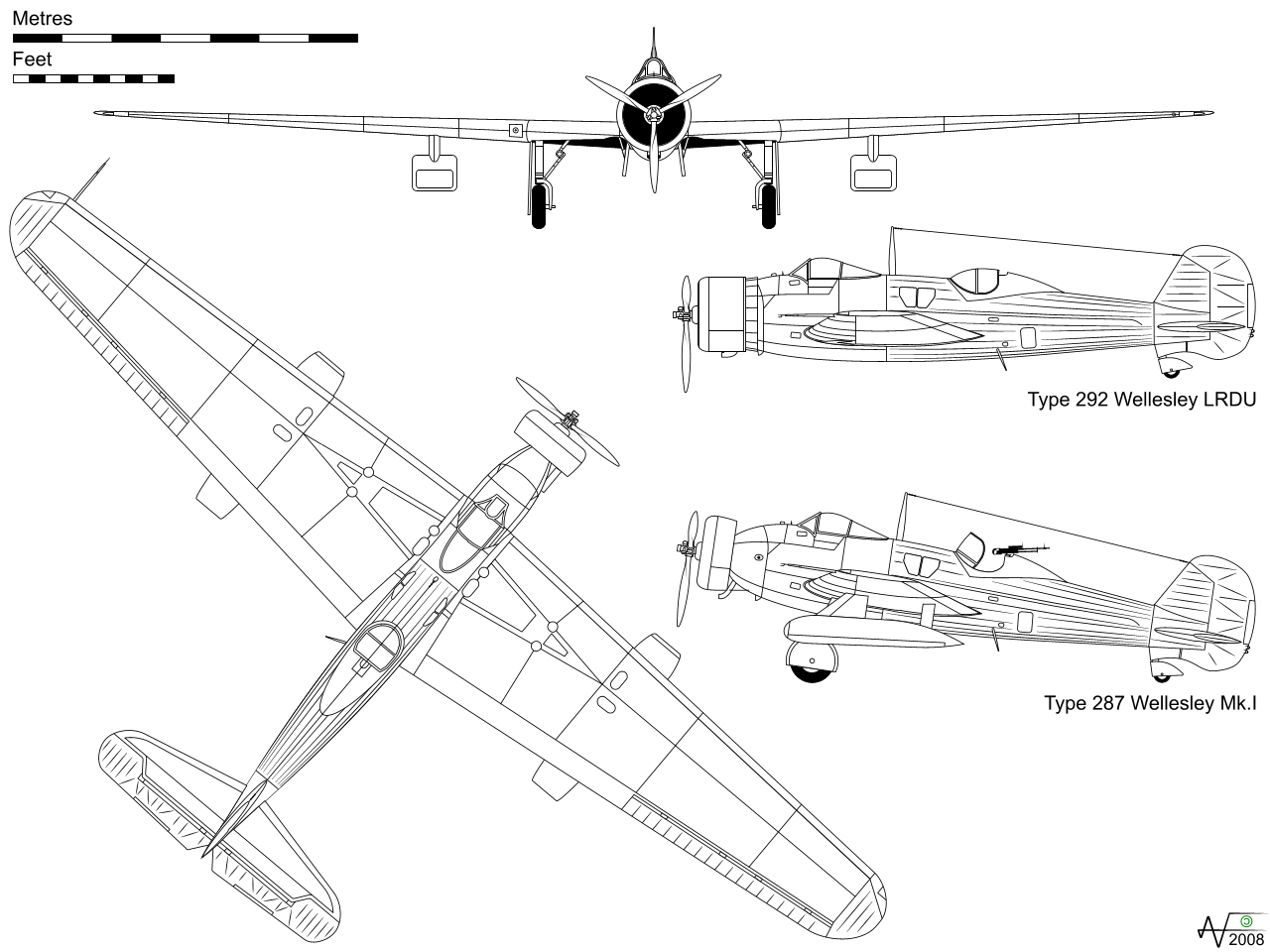
- Wellesley Mk I, Vickers Type 287 (1937–38, 176)
- The only production mark. Pegasus XX; wings strengthened from the ninth airframe. K7713–K7791 and K8520–K8536 against the September 1935 contract for 96; L2637–L2716 against the August 1936 contract for 80.
- Long-canopy aircraft, informally "Mk II" (1937, part of the first batch)
- A single continuous canopy joining both cockpits, with a direction-finding loop. Never an official mark designation, though reference works list it as one.
- Vickers Type 289 (1938, one)
- K7712 converted as a flying testbed for the Bristol Hercules sleeve-valve radial.
- Type 292 long-range trials aircraft (1938, three)
- K7717, K7734 and K7735 with roughly triple standard fuel capacity and strengthened undercarriage, flown for the Long Range Development Unit work-up.
- Long Range Development Unit record aircraft (1938, four)
- L2638, L2639, L2680 and L2681: Pegasus XXII LR, NACA cowl, constant-speed propeller, autopilot, ~1,290 imperial gallons, armament and panniers deleted.
- Middle East maritime-reconnaissance conversions (1941–43)
- Field and depot fits with cameras and depth charges for Red Sea and Indian Ocean patrol, chiefly with No. 47 Squadron.
- Export and licence-built versions (none)
- The Wellesley was never exported and never built under licence. Every airframe was British-built and RAF-operated.
No Wellesley survives. Not one original airframe, not one substantially original major section, and no reproduction has ever been built — the type is known today only from photographs, drawings and the geodetic principle it handed on to the Wellington. Production is usually given as 176 aircraft, occasionally 177 when the prototype is counted. On the record flight, the FAI homologated 11,525.9 km, but at least four imperial conversions circulate — 7,157.7, 7,158.7, 7,162 and 7,175 miles — and they are rounding and great-circle artefacts of one flight, not competing claims. One further correction worth making plainly: several sources, Wikipedia among them, give September 1942 as the type's last operational month. No. 47 Squadron kept Wellesleys in the Middle East into March 1943, and it was a No. 47 Squadron Wellesley that depth-charged U-559 on 30 October 1942 — the boat whose captured cipher documents reopened four-rotor naval Enigma to Bletchley Park. An obsolete light bomber nobody wanted made, at second hand, one of the larger contributions to the Battle of the Atlantic.
Timeline
The Vickers Wellesley through the years
Barnes Wallis develops geodetic construction at Vickers; the Wellesley begins as a private-venture design using the new lattice structure.
The Wellesley prototype flies, the first operational RAF aircraft to use geodetic construction.
The Wellesley enters RAF service as a general-purpose monoplane bomber; around 176 are built.
Specially modified Wellesleys are prepared for a world distance record attempt.
Two Wellesleys fly non-stop from Ismailia, Egypt to Darwin, Australia (~7,150 miles), setting a world distance record.
By the outbreak of war the single-engined Wellesley is outdated as a front-line bomber in Europe.
With Italy’s entry into the war, RAF Wellesleys go into action in the East African Campaign, where their range is a real asset.
Wellesleys support the advance to the Battle of Keren in Eritrea and fly long maritime patrols over the Red Sea.
With the East African Campaign won and modern aircraft arriving, the Wellesley is withdrawn from operations.
The sole surviving Vickers Wellesley is preserved at the Royal Air Force Museum.
Stories & Eyewitnesses
The Vickers Wellesley in stories: the moments that defined it
A geodetic pioneer by Barnes Wallis, a world distance record-holder, and a useful warrior in a forgotten theatre — the Wellesley’s history through the moments that stuck.
Geodetic PioneerBasket-weave first
Wallis’s new structure.
The Wellesley was the first operational RAF aircraft built with Barnes Wallis’s geodetic lattice construction.
It pointed the way straight to the Wellington.
Barnes WallisThe great designer
Before the bouncing bomb.
Its structure was designed by Barnes Wallis, later famous for the Dam Busters’ bouncing bomb.
Geodetics was his earlier, quieter masterpiece.
Basket WeaveStrong and tough
Damage-tolerant lattice.
The geodetic frame was light, strong and famously able to survive heavy battle damage.
A whole section could be shot away and it held.
PanniersBombs outside
No room within.
With a load-bearing lattice fuselage, there was no internal bomb bay, so the bombs hung in underwing panniers.
An ingenious answer to a self-imposed problem.
The Long WingRange machine
Slender and efficient.
A very long, high-aspect-ratio wing gave the Wellesley outstanding range for a single-engined type.
It made the record flight possible.
Egypt to AustraliaThe 1938 record
~7,150 miles non-stop.
In November 1938 two Wellesleys flew non-stop from Egypt to Darwin, setting a world distance record.
It stood for years.
The LRDFEndurance flight
A serious experiment.
The Long Range Development Flight was a genuine test of long-range flying and navigation, not a mere stunt.
It proved the structure and the wing.
Into Service1937
A new monoplane.
The Wellesley entered RAF service in 1937 as a modern monoplane bomber.
Around 176 were built.
OvertakenObsolescent by 1939
The twins arrive.
Fast twin-engined bombers soon left the single-engined Wellesley behind.
It had no future in Europe.
East AfricaA real war
Where range mattered.
In the vast East African theatre from 1940 the Wellesley’s range made it genuinely useful against the Italians.
No. 47 Squadron led the way.
Keren1941
Backing the advance.
Wellesleys supported the hard-fought advance to the Battle of Keren in Eritrea.
Bombing and reconnaissance over the mountains.
Red SeaMaritime patrol
Guarding the route.
Long patrols over the Red Sea guarded a vital shipping route — ideal work for a long-range aircraft.
Endurance kept it useful.
The SurvivorOne left
At the RAF Museum.
A single Vickers Wellesley survives, preserved at the Royal Air Force Museum.
The only complete example of a pioneering type.
Photo Gallery
The Vickers Wellesley in photographs
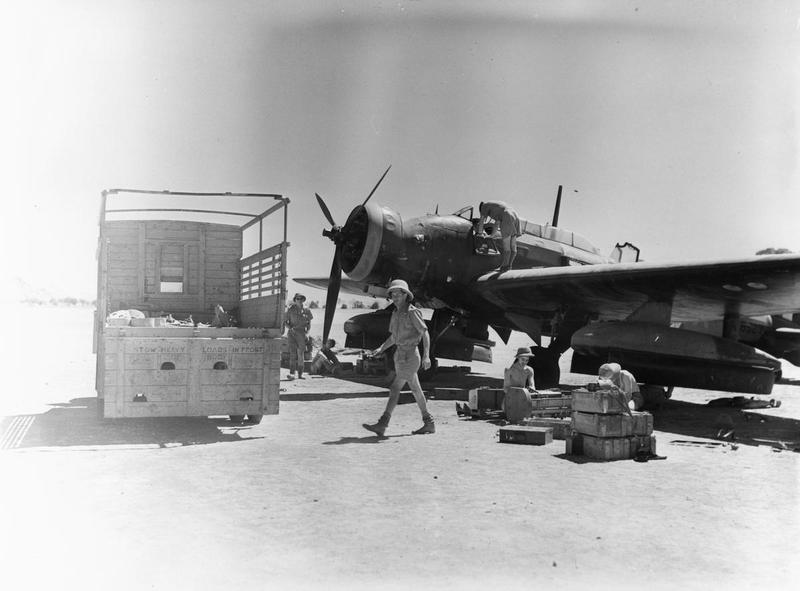
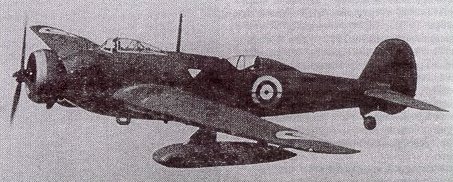
Archival photographs of the Vickers Wellesley, each credited to its source and licence. Click any photo to enlarge.
On Film
The Vickers Wellesley on video: the RAF’s first geodetic bomber
A look at the Vickers Wellesley — Barnes Wallis’s pioneering geodetic monoplane, the record-breaker that flew from Egypt to Australia and went on to fight in East Africa.
A history of the Vickers Wellesley, the RAF’s first geodetic bomber. Source: The Grand Archive (YouTube).
Operations Overview
Where the Vickers Wellesley flew: an operator map
The Vickers Wellesley was flown by one air force only: Britain’s Royal Air Force. It was designed and built in the United Kingdom, served exclusively with the RAF, and was never exported. Its famous 1938 record flight (Egypt to Australia) and its wartime service in East Africa and over the Red Sea were RAF operations from overseas bases, not the work of other national air forces — so this map shows a single operator country, the United Kingdom, as origin, sole operator and the home of the one survivor. Hover or tap the country for detail.
Categories: Design, Manufacture & RAF Service (United Kingdom) · Surviving Aircraft (United Kingdom — the sole survivor at the Royal Air Force Museum). The Wellesley was a Royal Air Force aircraft only, never exported; Egypt and Australia (the record flight) and East Africa (its wartime service) were operating theatres, not separate operators, so just one country is shown.
Service Record
The Vickers Wellesley’s record: pioneer, record-breaker, East African warrior
The Wellesley’s significance lies in its pioneering geodetic structure, its 1938 world distance record, and its real if limited combat in the East African Campaign — a modest aircraft with an outsized place in history.
Questions & Answers
Vickers Wellesley: your questions answered
Can I fly in a Vickers Wellesley?
No — there is no bookable Vickers Wellesley flight experience, and MiGFlug does not offer one. The type retired during the Second World War and only a single example survives, preserved at the Royal Air Force Museum. If what you actually want is the real thing — strapping into a genuine military aircraft and flying it — you very much can do that today in other types. MiGFlug arranges flights in real fighter jets and warbirds around the world. Start here: migflug.com/flights-prices.
Why is the Vickers Wellesley historically important?
On three counts. It was the first operational RAF aircraft built with Barnes Wallis’s geodetic construction, making it the direct forerunner of the war-winning Vickers Wellington. It set a world distance record in 1938 with a non-stop flight from Egypt to Australia. And it fought a real, useful war in the East African Campaign of 1940–41, where its long range was a genuine asset. Few aircraft so obscure have so significant a record.
What is geodetic construction, and why did the Wellesley use it?
Geodetic construction, devised by Barnes Wallis, builds the airframe as a lattice of light metal members crossing each other in a basket-weave pattern along geodesic curves, covered in fabric. It is very strong for its weight and remarkably tolerant of battle damage — large sections can be shot away without the structure failing. The Wellesley was its first operational aircraft, and the same structure was later scaled up for the famous Vickers Wellington.
Why did the Wellesley carry its bombs under the wings?
Because of its geodetic structure. The fuselage was a continuous, load-bearing lattice with no easy way to cut a large internal bomb bay into it, so the designers carried the bomb load externally in two streamlined panniers slung under the wings, one on each side. It was an unusual but ingenious solution dictated by the new construction method.
What was the 1938 Egypt-to-Australia flight?
It was the Wellesley’s most famous exploit. The RAF formed the Long Range Development Flight and specially modified a few Wellesleys for maximum endurance. In November 1938 they flew from Ismailia in Egypt towards Australia; two reached Darwin non-stop, a distance of roughly 7,150 miles (about 11,500 km), setting a world distance record that stood for years. It remains one of the great feats of interwar long-range flying.
Did the Vickers Wellesley see combat?
Yes. Although obsolescent as a front-line bomber by 1939, the Wellesley fought effectively in the East African Campaign of 1940–41 against the Italians in Eritrea, Ethiopia and Sudan, where the vast distances suited its long range. RAF squadrons, most famously No. 47 Squadron, flew bombing and reconnaissance missions, supported the advance to the Battle of Keren, and flew long maritime patrols over the Red Sea.
How many Wellesleys were built, and who operated it?
Around 176 Vickers Wellesleys were built, all for the British Royal Air Force. The type was never exported and had no foreign operators, so the RAF was its only user. It served both from home bases in its early years and, most notably, from bases in Egypt, Sudan and East Africa during the war.
What was the connection between the Wellesley and the Wellington?
Both were designed around Barnes Wallis’s geodetic construction. The single-engined Wellesley was the pioneer that proved the structure in operational service; the far larger, twin-engined Vickers Wellington then applied the same basket-weave lattice on a much bigger scale and became one of the most important RAF bombers of the early war, famous for surviving heavy battle damage. In effect the Wellesley was the ancestor of the Wellington.
Fly For Real
You can’t fly the Vickers Wellesley — but these, you can
No Wellesley is a bookable ride today — only one survives. The urge behind it — to strap into a real aircraft and actually fly — is very much still bookable. MiGFlug puts you in genuine fighters and warbirds around the world.
Fighter Jet Flights
Take the controls of a real ex-military jet with an experienced pilot.
Warbird experiences
Fly in a genuine piston-engined warbird from the golden age of aviation.
All flights are operated by MiGFlug’s vetted partners with professional pilots. Browse every option and current pricing at migflug.com/flights-prices. MiGFlug does not operate Vickers Wellesley flights — no bookable example exists.
Related Aircraft
If the Vickers Wellesley interests you, explore these
Sources & Further Reading
Where this Vickers Wellesley history comes from
Note on figures: dimensions, performance, engine and production numbers for the Vickers Wellesley vary between sources and marks, and are hedged here as approximate; the figures given are broadly representative of a typical version. Production is commonly cited as around 176 aircraft, all for the Royal Air Force. Cost fields are listed as not reliably recorded because trustworthy 1930s procurement cost data is not available in a comparable form. The 1938 record flight (Egypt to Australia) and the East African Campaign were RAF operations from overseas bases, not the work of other national air forces; accordingly the operations map shows the United Kingdom alone as the operator country. One Wellesley survives, at the Royal Air Force Museum.